
March 2023
Season 7 Episode 6 | 26m 8sVideo has Closed Captions
Find sweet products at Hatch’s Honey and Hale Farm and Village, plus visit Lucky Shoes.
As one of the largest honeybee removal services in Stark and Summit counties, Hatch’s Honey is dedicated to saving honeybees and providing quality raw honey. At Hale Farm & Village, it’s time to learn about 19th-century maple production. Then it’s off to Akron to learn more about family-owned Lucky Shoes.
Problems playing video? | Closed Captioning Feedback
Problems playing video? | Closed Captioning Feedback
Around Akron with Blue Green is a local public television program presented by WNEO
March 2023
Season 7 Episode 6 | 26m 8sVideo has Closed Captions
As one of the largest honeybee removal services in Stark and Summit counties, Hatch’s Honey is dedicated to saving honeybees and providing quality raw honey. At Hale Farm & Village, it’s time to learn about 19th-century maple production. Then it’s off to Akron to learn more about family-owned Lucky Shoes.
Problems playing video? | Closed Captioning Feedback
How to Watch Around Akron with Blue Green
Around Akron with Blue Green is available to stream on pbs.org and the free PBS App, available on iPhone, Apple TV, Android TV, Android smartphones, Amazon Fire TV, Amazon Fire Tablet, Roku, Samsung Smart TV, and Vizio.
Providing Support for PBS.org
Learn Moreabout PBS online sponsorship(upbeat music) - Hey, Akronites, welcome once again to a "Around Akron with Blue Green."
And do we have an amazing show ahead of us today.
I'm gonna head down to the Valley, and visit Hale Farm & Village, and learn all about maple syrup.
And then I'm gonna learn about maple sugar.
Then it's off to Lucky Shoes in Fairlawn.
Did you know they've been serving Akron for over a 100 years now?
Now to kick this show off today, I'm gonna meet up with Hatch's Honey & Honey Bee Removal to learn all about the honey bee, and what we can do to help the honey bee out.
Let's go see what Hatch's Honey is all about.
(upbeat music) - Well, about eight years ago, we went to a County Fair, and we walked into a big barn, and there was all these bees in this inspection hive or observation hive.
And just, you know, piqued my curiosity, and so I just started studying on it.
Took some classes through the Summit County Beekeepers Association and after that I bought my first hive, and then, my second hive, and then, my third hive, and then from there, I went to 20 hives, and this year, we're up to 83 hives.
(upbeat music continues) Well, the biggest thing that we're trying to make people aware of is, you know, right now you look outside, and you see the maple trees, they're all in bud, so when you see the red on the trees.
The other thing is dandelions are actually one of the first nectar flows that the honeybee gets.
So we say hold off on killing the dandelions, because they take the poison back to the hive.
Just educating people on what the honeybee does.
One out of three things that you eat is pollinated by a honeybee.
We just ask people to be aware of the honeybee.
Don't be afraid of 'em, because really, they're just out doing what they're supposed to do.
They're pollinating your flowers, the trees, blueberry bushes, your gardens.
(upbeat music) So we really have to, you know, be very vigilant on helping the bees survive, instead of putting out pesticides, and such, 'cause they just take 'em back to the hive, and it really does major damage.
(upbeat music continues) We look at several different locations.
Primarily what I've done in the past is people come to me, I inquire about their property, and we're pretty much going on farms, we're going on hobby farms, we're going on 150-acre farms, we're on a 2000-acre farm, it just helps to promote more pollination, and it's, you know, it's a good win-win situation for everybody.
(upbeat music continues) There's different categories in beekeeping.
You've got the bee haver, I've got a hive, and it just sits over there, and they don't do anything about it.
Then you have the beekeeper, the beekeeper is in there every seven to 10 days, they're working.
Is it helping?
Yes, it's helping.
And on the other hand, it could be hurting at the same time, because people at the, you know, it's a sudden "I'm gonna do bees," well, there's a lot to go into taking care of bees.
There's treating to take care of the bees, manipulating the hives, so you wanna keep the hive strong, you wanna keep that queen really healthy, you wanna make sure she's laying enough, if she's not laying enough, then we gotta look at doing something to the hive.
We have to, maybe we have to, we call it offing the queen, and then we replace her with a new queen.
Yes, having people with bees and all over the place, it's great, but again, it's not just something you want to get, put 'em over in a corner, and say, "I'll see you next, you know, because I just want it for the honey."
Well, really it's a negative at that point, because if you're not treating, and helping those bees to stay healthy, say that you have bees, these sick bees are gonna come over to your bees, you make them sick, then those bees go to the next hive, make them sick.
(upbeat music) So there's a lot of things that people have to think about before they just jump into being a beekeeper, but, you know, that's what the clubs do.
They really help people to understand that.
(upbeat music continues) Well, I think the biggest thing is being a beekeeper, for myself, it's a wonderful therapy because the pheromones, the buzzing in the air, actually picking the bees up within your hands, and they're vibrating and such.
There are some different countries that actually use the hive.
They'll put a, you put a mask on, and it's attached to the top of the hive where you're breathing in that pheromone, and it's wonderful help.
Honeybees themselves and honey is is such a healthy, healthy, you know, especially as if they're raw.
You gotta be careful what you're buying.
You know, look at the label, you know, does it say a product of this country, this country, and this country, it's not real honey.
It may have some real honey in it, but you wanna stay with your local farmer, support the small companies that's what people are helping us do.
You know, we are a small business, but you know, we're growing, and we're just wanting people to enjoy honey, and also we educate people on a regular basis.
You know, honeybee flies 15 miles an hour honeybee lives for six weeks approximately during the summer.
And it's last three weeks, they fly approximately one to two times around the world flight-wise.
So that's 55 to 80,000 miles.
You know when you get stung, well, yes, you swell up.
We actually have where people use the bees for people that have, the sting therapy, who have arthritis, 'cause when you get stung, the bodies, the the proteins that are in that venom make everything run to that particular spot.
You swell, but it brings in fresh blood, and so people use that as a therapy to help them with their arthritis.
If you get burnt, use the honey, and put it on the burn.
All the enzymes, I think, will actually help that burn to heal faster.
Cuts, same thing, people use it for shampoo they use it for facial scrubs, so you know, if you get an opportunity, you know, go online and study about the honeybee, and and all the good things that it does to help you and me, and then we get the byproduct, which is the honey.
(upbeat music ends) - Next up it's down to the Valley to Hale Farm & Village where I'm gonna learn all about maple syrup, and what it goes in to get that delicious nectar you love on your pancake.
Let's go see what Hale Farm & Village Maple Syrup is all about.
(upbeat music) (slow relaxing music) - So this here is our sugar house.
It's a sugar house, it's a sugar home.
It is a step above our sugar camps that we have around the village today.
It is a permanent structure, of course.
However it is a very similar concept.
This building, incidentally, is an original structure to Hale Farm & Village.
Back when we were just Hale Farm it was constructed in 1903 by CO Hale, grandson of Jonathan Hale who moved here in 1810.
We are standing here with a parallel flow evaporator, this is very similar to the type of evaporator CO Hale would've used.
It is obviously a modern construction, it is of stainless steel with our modern fittings here, it is, however, based on an 1865 patent for a parallel flow evaporator.
We have behind us here, on the hillside, a tank in which we store our sap.
Now it is built, this building is built into the hill, so that we can use gravity to let that sap flow downhill, but also so we can get to our tank with ease.
We can pull up our oxcart onto that hill, and drop off any of the sap that we have harvested in the woods next to me here in our sugar bush.
Now, we are going to need a truly substantial amount of sap if we are going to get good quantity of syrup.
We're looking at somewhere between 40 to 60 gallons of sap for each gallon of syrup we are trying to produce.
Keep in mind, in a good year, CO Hale was able to get somewhere between 200 to 300 gallons of syrup at the end of the process.
So this sugar bush has been a very productive and successful sugar bush in the past and will hopefully continue to do so well into the future.
In particular, this is a parallel flow evaporator.
As our sap flows through our lovely, little copper pipe right here (slow relaxing music) into and past our float valve to control the level of sap in the basin, it will flow into here.
For the tallest of you folks in the audience, you might be able to stand on your tippy toes, and see that there is a barrier in here.
That is because we have already hot sap in our evaporator, and colder sap flowing in.
Now, that colder sap is actually going to help push the hot sap back this way across here through a gap, and then forward onto these pipes.
Cold runny liquids, hot viscous liquids do not easily mix.
That's kind of what pushes our flow forward, and it's why we call it a parallel flow, 'cause they are flowing parallel.
So it does flow through this pipe on the side here, and into our second little basin, which is directly above our fire.
So the rest of the evaporation occurs here.
(slow relaxing music continues) As it evaporates, we will check the viscosity with something like this.
This is the skimmer, we can use this to skim any scum that floats to the surface in either basin, but we can also use that to just check to see if it's viscous.
Ours is mostly water today, it is not yet anywhere near a syrup consistency, but we will look to see if it flows off as a sheet, instead of dripping watery.
Once we have determined that our syrup is ready, which will take some time, about six hours from when we first start our fire, we can drain it off.
I said it was six hours from when we first start our fire, and first, you know, get our sap flowing.
After that first gallon of sap, we can expect another gallon roughly every hour on the hour.
This is one of the reasons why this is an efficient process.
As our sap here is evaporating, more sap is flowing into the gizmo.
Now, our last step when we have determined that our sap is now syrup is to drain it.
Sap is made predominantly of three things.
We got water, which is of course taking the roof exit.
We have sugar, which is what we are all after, we want that sweet, sweet syrup and we have trace amounts of minerals.
Now, these are all dissolved in the sap itself, but when we get rid of the water by evaporating it, they clump together, they congeal and they turn into something called sugar sand.
Now that's a pretty whimsical name for something that is a lot closer to bits of glass in our syrup, and I don't know about you, but I don't want my syrup extra crunchy with a side of ouch, so we are going to filter that out.
We have right here our barrel, and it can fit something like this.
This is a similar to a coffee filter, though you could use something like wool, cotton, or cheese cloth, (slow relaxing music) as most folks would've done in the 19th century.
And once, of course, we get this all drained off, we are ready to bottle it, and consume it or sell it, and our process is complete.
We have turned that sap into syrup, and again, it takes anywhere from 40 to 60 gallons of that sap.
We know that this sugar bush has been productive for a very long time.
We know that before CO Hale, Andrew Hale, his father, used this sugar bush, Jonathan Hale used this sugar bush, and we know that when some of the oldest trees in this woods came down, nothing lives forever, in the 1970s, archeological evidence was found of Indigenous Peoples using the sugar bush as well, and tapping it for sap.
So at the very least this has been used productively and sustainably for hundreds of years, possibly thousands.
- That was so good.
Now, we need to learn about maple sugar.
Back to Hale Farm & Village to see what maple sugar is all about.
(upbeat music) (upbeat music) - So we know that the Hale family would have probably had a setup like this or similar to this, although there were a couple of things that were a little bit different.
But in my pot here, we have maple sap.
Sap is mostly watered with a little bit of sugar, and minerals, and basically the process of making maple sugar is to just boil off as much water as we possibly can.
(upbeat music) Now with a sugar camp, we would've had multiple buckets at multiple stages.
So we were making this as efficient as possible, but the way it works is that we would get our water, or our sap boiling, and boiling off as much water as possible and then, we would take our spoon, and we would just check to see how it dripped off of the spoon.
(upbeat music) Once it reached a certain sort of dripping or viscosity, we would take the sap from this pot, move it to the next pot, and then someone else would start stirring, and then I would get fresh sap, and then when that sap would reach a certain viscosity we would keep moving it down.
Now, at this time, in the early part of the 1800s, most people were looking to go for maple sugar instead of maple syrup, (upbeat music) because maple sugar lasted a lot longer.
You could use it to sweeten your food, you could use it in your cooking, you could even use it to trade with your neighbors if there was something, you know, that they needed, or if they wanted to sweeten up their food as well.
The other thing about syrup is that it's much harder to store, and it also also has the potential of spoiling as, like, light exposure hits the syrup.
It can create mold, and things like that.
So most families were looking for maple sugar.
The other thing about the sugar bush is that a sugar camp would be set up with a place for people to take some sleep and some rest, but you would always be working in shifts with your family.
So someone would be going out and collecting the sap, people would be stirring the buckets, someone would get a chance (upbeat music) to take a little nap here and there.
You would be building fires, and keeping your fires nice and hot, and everyone would be doing a little bit of something.
We know that the Hale family, along with their neighbors and relatives, the Hammonds would be producing maple sugar at this time of year, and this is something we continue to this day following those traditions taught to us by the Native People of this area, and continued with people like Jonathan Hale and his family.
(upbeat music continues) - Hatito, my name is Talon Silverhorn.
I'm a citizen of the Eastern Shawnee Tribe from Oklahoma.
And we are talking about how in the late 18th century, Shawnee People are making maple sugar, (Talon speaking Eastern Shawnee) So we are taking maple sap from trees tapped here at Hale Farm & Village, boiling that down into syrup and then removing all of the water from it to produce hot liquid syrup that we pour into molds that we can produce sugar loafs that we can store all year round.
(slow relaxing music) So what we're showing here, in the late 18th century, early 19th century is how this is done in this time period, which includes trade kettles.
So a lot of the things that we see here, the ceramics, the dishware, the cooking pots, all of these things come through European trade.
So these are actually antique pots to the time period.
These are early 19th century brass pots that are still functioning today, and these are exactly what our ancestors were using to produce maple sugar back in the early 19th century.
So what we do is we will hunt for skins and furs, and then we will trade those skins and furs to Europeans who in return will kind of give an estimated value back in things like cookware, and clothing, and yards of ribbon, and tools like scissors, and needles, and oles, and axes, and cooking pots, whatever it is that we might need.
So the fur trade is driving the economy in the late 18th century, early 19th century.
(upbeat music continues) Rather than making maple syrup, like you would have on your pancakes, we want dry sugar because the moisture in maple syrup is what causes it to go bad, and start to ferment even with your best efforts.
After a couple of months, maple syrup will start to ferment on its own, and so we want dry sugar that has no moisture in it, so that way we can store it all year long, and it has the added benefit of being its own storage.
So when we cast sugar into molds as dry sugar, we don't have to find any other separate container to store it in.
Like you might need a mason jar to store granulated sugar today.
(upbeat music continues) So the traditional tree to tap for sugar is the sugar maple.
However, where I'm from on the Shawnee Reservation in Oklahoma today, we don't have a lot of sugar maples.
So we tap things like boxelder, and sycamores, and hickories, and black walnuts, and we produce sugar and syrup from those trees, and they have their own distinct tastes.
Not all of those tastes like maple, maple's kind of its own unique flavor.
So we'll blend black walnut, and hickory, and elm, and all these other syrups to produce kind of their own unique distinct flavors.
(upbeat music ends) - Now to wrap up this show today, it's over to Lucky Shoes in Fairlawn.
Did you know they've been serving the area for over a 100 years now?
Wow, let's go see what Lucky Shoes is all about.
(upbeat music) - My great-grandfather, Joe Luck, came through Ellis Island.
He was an immigrant, Ukraine to England, through Ellis Island to New York City where he was a tenement tailor.
And after the Triangle Shirtwaist Fire, a lot of the safety laws sort of put the tenement tailors out of business.
At that time, Akron, Ohio was the fastest growing city on the planet, because of the rubber industry.
He moved to Firestone Park, and opened a little what they call dry good store where he sold material, he was a tailor, so he made suits, and dresses, and he sold shoes, and the first employees of the company were all family members his sons and daughters.
My grandfather, Milton, his brother, Leonard, their sister, Buella.
So after Joe passed away after the boys came back from World War II, the business wasn't big enough to support two families.
My grandfather split off and came to Fairlawn in 1955, and opened in Fairmont Plaza where we sit today, and the problem with Fairlawn was there was a lot of clothing stores, but there wasn't a good shoe store.
And my grandfather knew shoes, so that's kind of the direction we took.
(upbeat music continues) So the story's a little fuzzy, but we we were one of the original tenants of Fairlawn Plaza.
It was delayed in opening by a season, a few months, it was late, the construction fell behind.
Shoes are a very seasonal business.
I don't care how beautiful your sandals are, in December, nobody wants 'em, they need boots (chuckles).
So my grandfather and my dad, you know, had the shoes stacked up in the garage in cases.
And when we finally did open, it was the support of the community that helped us because nobody needed what we had, but my dad and my grandfather had, you know, a good reputation for being nice people, and being helpful, and being good neighbors, and the community came to our rescue, and got us through that first tough season with the late opening, but the Plaza opened in 1955, and we were one of the first ones.
(upbeat music continues) The advantage that we have is most places try to make it as quick and convenient as possible to buy a pair of shoes.
At Lucky's, we guide our customer to a purchase that hopefully feels great and looks fantastic.
A lot of people come in with a little bit of information about a shoe, a paragraph that they read online, maybe a referral from a friend who bought a shoe that did great for them.
We did the math.
There's a guy that works here named Mate and he just had his 20th anniversary with us.
He's worked for 20 years, about 220, 250 days a year, (upbeat music) he waits on about 15 customers a day, and he tries on six pairs of shoes, average per customer.
That's 450,000 pairs of shoes that he has put on people.
That's the difference between a little bit of information and a lot of knowledge (chuckles).
He knows what's gonna work, he's seen your foot type hundreds of times, and he knows that what you want to try on may work, but chances are this might work better, and he steers you in that direction.
(upbeat music) So we carry popular brands, you know, that people are looking for Birkenstock, you know, New Balance, a couple of the hottest brands we have right now, Hoka, and On Running out of Switzerland, you know athletic shoes since the pandemic have become more than half of our business.
During the pandemic, women's dress shoes, men's dress shoes dropped to zero, and we really kind of became much more athletically influenced, but that kind of fits into what we do, because we measure feet, we bring out a variety of things that, you know, both of what you're after, and what we think will work, and customers leave happy.
We buy shoes, (upbeat music) I travel to Italy, we go to to two different national shoe shows.
We go to regional shoe shows looking for what's new, plus there's a lot of data, there's a lot of analytics into putting together a good presentation.
You know, what is the Pantone Color of the Year?
What are the, what's on the runway?
And then how can we translate that to Akron, Ohio?
(upbeat music continues) Well, it all starts with a good, you know, knowing the foot type.
If someone has a high instep, there's certain shoes that'll fit them better.
If someone has a, you know, a narrow foot, or a flat foot, there's certain types of shoes that will work better on that type of foot.
You know, when we're at the shoe show, and we're looking at, so we go sometimes direct to a factory to have shoes made for us.
We look at things like, you know, is it single stitched or double stitched?
How many stitches per inch do they use?
And can we modify that?
What's the lining made of?
Can we upgrade the lining?
So there are certain factories that we buy from that make hundreds of thousands of pairs of shoes for big brand names.
Well, we take that construction, and instead of fabric, (upbeat music) we'll make the lining out of leather instead of two millimeters of memory foam on top of the insole, we will put four millimeters, you know, things like that, things to just elevate it a little bit, so the customer doesn't really know why our shoes are more comfortable, but when they buy somewhere else, they're like "You know what, these aren't as good," and they come back, so.
(upbeat music continues) - Thank you for watching this episode of "Around Akron with Blue Green."
Now, if you have any questions or comments, you just wanna drop me a line, you can catch me on social media.
Thank you and have an amazing day.
(upbeat music) Did you know they've been serving this area for over a 100 (sighs)?
Now, to wrap up this show today.
Now, to wrap up this show today it's over to Fairlawn to Lucky Shoes.
(upbeat music) They have been serving Akron for over a 100 (sighs).
(Blue Green scatting) (upbeat music ends)
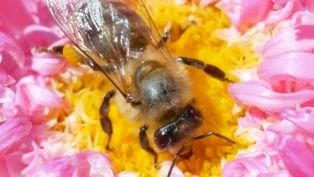
Preview: S7 Ep6 | 30s | Find sweet products at Hatch’s Honey and Hale Farm and Village, plus visit Lucky Shoes. (30s)
Providing Support for PBS.org
Learn Moreabout PBS online sponsorship













Support for PBS provided by:
Around Akron with Blue Green is a local public television program presented by WNEO