
March 2026
Season 10 Episode 3 | 26m 30sVideo has Closed Captions
Blue catches up on the entertainment scene, talking to local music and comedy acts.
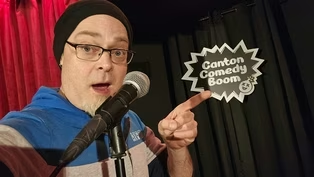
Blue catches up on the local entertainment scene, taking viewers on an eclectic journey through Northeast Ohio. First, Blue meets Al Mothersbaugh, a seasoned musician and the creative mind behind the band Massive Hotdog Recall. Next, he connects with composer Silas Hite in the wake of Hite’s album release before taking a trip to Canton for a segment dedicated to the city’s burgeoning comedy scene.
Problems playing video? | Closed Captioning Feedback
Problems playing video? | Closed Captioning Feedback
Around Akron with Blue Green is a local public television program presented by WNEO
March 2026
Season 10 Episode 3 | 26m 30sVideo has Closed Captions
Blue catches up on the local entertainment scene, taking viewers on an eclectic journey through Northeast Ohio. First, Blue meets Al Mothersbaugh, a seasoned musician and the creative mind behind the band Massive Hotdog Recall. Next, he connects with composer Silas Hite in the wake of Hite’s album release before taking a trip to Canton for a segment dedicated to the city’s burgeoning comedy scene.
Problems playing video? | Closed Captioning Feedback
How to Watch Around Akron with Blue Green
Around Akron with Blue Green is available to stream on pbs.org and the free PBS App, available on iPhone, Apple TV, Android TV, Android smartphones, Amazon Fire TV, Amazon Fire Tablet, Roku, Samsung Smart TV, and Vizio.
Providing Support for PBS.org
Learn Moreabout PBS online sponsorshipHey out there, Akronites!
Welcome once again to Around Akron with Blue Green.
And yes, we have an amazing show ahead of us today.
I'm going to meet up with a local trombone player slash musician.
Then I'm going to meet up with a composer who has an amazing studio.
Then it's off to downtown Canton to learn about the Canton Comedy Boom.
Now to kick this show off today, I'm going to meet up with Al Mothersbaugh to learn all about his musical past as a trombone player.
Let's go see what Al Mothersbaugh and the Massive Hot Dog Recall is all about.
- My mother sung in the house all the time.
She had pretty close to perfect pitch, and it was never.
She wanted me to play an instrument.
So guess they, you know, wanted me to stop talking and do something else and they gave me a violin.
And I can remember my dad in the other room when I was practicing, like, in fourth grade.
“Could you get this kid something else?
He's killing me.” So they made a lateral move to trombone.
I took lessons from Bob Paolucci.
That's Roland's dad back in the day, and I just, I sucked.
I was always last chair.
Still am.
And, you know, but I just stuck with it because my mom's dream was for me to be a marching Black Tiger.
Cuyahoga Falls Tiger band, because back in the 80s, we were untouchable.
It was a very cool marching band.
You know, a couple years out of high school, I was in an after hours with the fellas from a band called The TwistOffs, and they said, “Well, we have a trumpet player.
Do you want to, you know, play with us?” And then, you know, I was in that band for ten years.
For a minute, for, like, five years, we played like 200 gigs a year and traveled nationally.
I was in the band from 88 to 98 and we went out and actively searched a booking agent, and we found one in Lake Tahoe right around the corner.
So we bought a yellow school bus, and he had us going all over the country, mostly West Coast, opening for ska bands.
And he would send us out for weeks, five weeks at a time.
It was crazy.
We didn't know any better.
You know, I would never let my kid do that, right?
Of course, I grew up in the shadow of Devo, a huge influence on me.
I adored those guys.
You know, I really looked up to them.
And so I know in the back of my mind, that's really what I wanted to do.
But I— In 98, I had to leave because my wife was pregnant.
And I was freaked out about raising a family just like every dad would be and I quit, and grew my business.
I was watching TV and said, Massive Hot Dog Recall.
And I have, you know, a note app on my phone like everybody has.
I'm like, “I'll put that one down.” And I just thought about it forever and I knew that that would be the name of my band if I ever had one.
And we formed our first iteration of Massive Hot Dog Recall in 2016.
Massive Hot Dog 2.0 came about in 2021.
It was the year after Covid because there was no Porchrokr.
For those of you who don't know what Porchrokr is, pull your head out of the sand and look around in August.
And there's the best of, we could say it's the best day of the year because it really is.
It's fabulous.
Porchrokr 21, we were supposed to play on West Market in front of Ray's Place, the bar there.
We broke up three weeks before the gig and I was heartbroken, and it was just, everybody was just fighting and it was everybody's fault.
And including me and, you know, it, we broke up three weeks before the gig, and I was heartbroken.
I didn't know what to do.
Then my buddy John Gmerek, who's in my band now, called me and says, “Dude.” He was in a three piece called Xtra Crispy and it was him, Tony, and Jerry.
And he goes, “We're going to learn your music.” And we had three weeks.
And they would learn the whole set of Hot Dog music in three weeks.
And we played the gig and I was truly grateful.
I just couldn't believe it.
Now I'm going to go and bring my big fat horn section over to Xtra Crispy.
So I wrote a bunch of horn parts for every one of their songs, and their words gave them a rebirth, and now it's just incredible.
(band singing) My mother said to me one time, because my cousins are in Devo, and I was a little, I was probably in seventh or eighth grade when they broke with Whip It and all that, maybe older, but my mother, you know, she would always see my aunt, Aunt Meg talking to them on the phone.
And she looked at me.
She goes, “Don't you ever do this to me.” I'm like, okay, but be famous.
And I had always felt like in the back of my mind that you couldn't make a living as an artist, but back then it was if I understood it differently.
Now, I know it to mean that parenthetically, you can't make a living as an artist, but you still have to do it.
I could take that and run with it.
Art.
More people should do art because trust me, I tried to get my poor son Cooper to play trombone.
He hated it.
And I tried my daughter.
I tried her on sax, piano, trumpet, and it didn't stick.
But they're both actors.
They're both SAG-AFTRA union member actors.
(band singing) I'm obsessed with just trying to come up with the coolest music that people like.
I like seeing people's faces when they see something cool.
There's nothing, there's no better feel, it's like a drug.
And when the comedian gets a laugh on stage, for me, seeing people being like, yeah, this is really cool, I like it.
I, you know, I don't know if that means that I'm a shallow person or not, but that's what gets, that's what makes me want to work so hard.
- Next up, I'm going to meet up with a composer who's made music for video games, commercials, and movies.
And he has an amazing studio.
You're going to want to see it, to believe it.
Let's go see what Silas Hite is all about.
- I think when I first started getting into it, I was 11, and I don't know what it was, but I told my parents I'd like to study the drums, like to play drums.
My dad was a musician, and my mom dabbled with instruments here and there.
My uncles are musicians.
And so my dad was like, “I have a drum set in my junkyard.
We go to the city every couple weeks, maybe we can get you drum lessons there.” So I should back up and say, I grew up in a very small gold mining town that's borderline ghost town called Crown King, Arizona.
It's a beautiful little town up in the mountains, 6000ft elevation.
Pine trees and mountains everywhere.
Just gorgeous.
But dirt roads.
Only 100 people, and I went to a one room school.
So there was no music teachers, anything like that.
But we would drive to Prescott to get groceries every couple of weeks and, you know, take care of whatever business.
And so we went to a music shop there and they said, you know, we actually we do have a drum teacher, but he lives in the middle of nowhere also, but closer to you only about 45 minutes away in the desert.
And his name was Mel Zelnick, and he was an old jazz drummer who had played with Benny Goodman and Patti Page, and he was excellent.
And so I started taking drum lessons with him, and so did my dad.
When I graduated eighth grade, it was, there was three of us in that class, which was like the biggest class they've had in a long time, but there's no high school for people.
And this was before internet high school.
And so I went to a boarding school that was in like mid Arizona, and it was called the Orme School.
It just shut down after about 100 years.
But it was an excellent boarding school with kids from all over the world, kids from different socioeconomic backgrounds.
It was really great.
I got a big dose of culture from all these different kids and perspectives.
And then I went to U of A in Tucson after that for college, because they had an excellent percussion program.
I ended up getting my degree in music, art, and business because I knew I wanted to do music, but I also love making art and visual art.
And I also knew that there are so many successful musicians and artists out there who were like, incredible at their craft, but just, you know, couldn't make a living.
And the business part was really hard for them.
And so I thought, let me try and get ahead of that a little bit and take some business classes.
And it definitely helped being a freelance composer, for sure.
But while I was there, I, you know, I studied percussion, I studied composing, I interned in a recording studio, I worked as a DJ at the radio station, just trying all these different areas of music to try and figure out what really spoke to me.
And through process of elimination, it was composing.
I really liked making my own stuff, creating and recording.
I'm obsessed with recording.
In college, I was in bands as much as possible, also in school, but then out of school a lot playing around the local scene there because Tucson had a great local music scene.
And then I got to Los Angeles and I became an intern at my uncle's studio working there, because he's got a studio called Mutato Muzika.
And my two uncles, Mark and Bob Mothersbaugh are composers as well.
They gave me a shot as an intern there.
And I was able to work my way up from, you know, making coffee and running errands and doing intern stuff to composing a little bit.
And then finally they saw like, oh, he's okay.
He knows he's getting there, he's getting better at this.
And so gradually worked my way into scoring commercials, scoring TV, scoring video games, you know, some scenes from films, things like that.
Learning on the job with really high stakes pressure, which was great.
There's no better way to learn.
And of course, I had amazing people around me there to learn from and to try and hold myself up to their level, which is of course impossible, but a good goal.
At the time I wasn't playing live too much because I was just really focusing on like, I have to make this work.
This is my shot for this to be my career like, this is my big shot.
And so I did.
I became pretty successful there.
I worked with them for seven years.
And then in 2010, you know, it was a recession and work was slow there and slow everywhere.
And I had just reconnected with my wife.
At the time, we hadn't seen each other in 15 years.
We met here in Akron when we were kids, but reconnected, fell in love.
It became very intense.
She moved to Los Angeles and we both quit our jobs so we could be together more.
And that's when I became a freelance composer in 2010.
So it's 2026 now.
I've been freelancing for 16 years.
I was doing movies, TV shows, video games, commercials, all when I was working at Mutato Muzika, and they all sort of evolved together at my uncle's studio.
And when I left, I just sort of, you know, went after all of that because I really like the variety.
I wouldn't want to just score films or just do games or something like that.
But while I was working for him, I was able to score some, you know, pretty big titles, particularly a bunch of The Sims franchise, which is like still a very popular game and a Simpsons video game, a Frogger video game, like all kinds of stuff.
I just sent my resume.
These are games that I've written some of the music for, you know, to these video game houses and, you know, picked up from and some of them would get back to me and say, okay, we'll hire you.
The last one I did was for Warner Brothers.
I'm not sure if it'll be out, though by the time this is out, but it's a handheld game based on a very, very popular cartoon that's been around forever.
So it's going to be a big one.
It's going to be cool.
It's a mobile game, a lot of mobile games these days, but usually I do like 1 or 2 films a year, usually a TV series, usually a video game or two a year, and then lots of commercials mixed in.
And now the podcasts have budgets sometimes I'll do podcasts too.
At first it was to just make a living doing music was a big enough target, a big enough goal.
Got that.
But that's also like a continual goal that I have to keep achieving over and over.
Like we said, there's no making it where you're like, okay, that's done.
I've got that in the bag for the rest of my life.
So there's that base level goal.
I always want to be able to pay my bills, live comfortably, not get another job outside of music like I want to.
But then, you know, you start tacking on more goals.
For me, becoming a better musician on whatever instrument I'm interested in.
There's types of films I would love to score.
You know, everything from a James Bond film to just developing an ongoing relationship with a filmmaker and making multiple, multiple films where we can grow together and grow a style like, let's say, Tim Burton and Danny Elfman, for example.
My goals of continuing to make records and having that be, get out there more and more and have that be a bigger part of my income, either through licensing or actually selling the records would be great.
I would love to spend more of my time working on just music that I think is super inspiring and cool without a client involved, and then putting it out in the world and having it come back, you know, monetarily, of course, who doesn't?
But yeah, that's a big goal.
- Now that we've learned a little bit about Silas Hite and his composing, let's learn about his albums and his most latest album release, Return of the Vampire Hustlers from Hell.
This is an amazing piece you're going to want to go listen to.
Let's go see what this piece all about.
- One thing I have had some luck with in my career, especially in the last maybe 5 or 6 years, is I've spent time making albums for myself in particular.
I always have, but I've made a lot more in the last 5 or 6 years.
And these are albums where there's no record label, there's no outside producers, there's no clients, nobody.
I'm funding it myself, and I'm writing exactly what I want to write.
And then when it’s done and I'm happy with it, I've been able to license those tracks and make some money back, which is great.
And because licensing is such a big part of composing these days, you know, it's become a bigger and bigger part of my business.
But it's also more and more fulfilling because no one's telling me what to do.
I can just do these crazy ideas, and because it's very authentic, people respond to it.
There's not like, you know, 15 ad executives saying, oh, change this, change this, change this until it becomes watered down.
It's a very authentic piece of art.
And so people respond to it and it gets licensed and rarely changed.
It's just used as is in a movie or commercial or whatever.
So that's been really cool.
If you think you can make a really cool piece of art, meaning music, make it, get it out there.
The challenge is getting it in front of people.
But you know, that's my challenge too.
But you get it in front of the right people who might use it, and it clicks with somebody.
They might use you as a composer for the rest of their career.
This album started out because my friend Derek Zimmerman, who goes by, “D-Wrex” online.
He and I would collaborate a lot, hang out a lot, make art, music, a lot of overlapping tastes.
But he would draw, he draws all the time.
And so he post his drawings on Instagram, you know, and he asked, do you have anything in your library that you know, any music that I could use with this particular drawing of this fake Italian movie that he made up, the Return of the Vampire Hustlers from Hell.
The title’s so long because we thought it was funny.
I said, well, what kind of music are you looking for?
He said, Italian horror, 1970s.
And I said, “Wow, I don't have anything like that, but I'd love to write something like that.” I started writing and then I realized, I want to dive into this more.
I want to do a whole album is that okay, can you sit on this piece of art and wait to put it out and, you know, make a whole record?
He was like, yeah, you know, this was four years ago at this point, five years ago, something like that.
And in the meantime, he kept drawing more and more and making art for what would be the individual singles.
My cousin Mason in Los Angeles is a script writer, Mason Mothersbaugh.
He wrote a script for the movie, which is excellent, and it's like, you know, it's like a gritty 1970s buddy cop slash vampire horror movie.
Meant to be very, very much in the B genre, you know, shot cheap, made cheap, looks cheap.
But that's why it's glorious.
And so I would love to get the movie made.
You know, we always talked about that, but I was like, I'm focusing on the record.
I'm going to get the record done.
I'm going to put that out.
You know, it'll stand on its own.
If the movie ever gets made, we can use some of the tracks in the movie, you know, and that would be great.
But I want this to be a standalone thing.
And so, you know, it's been a long process.
And in the meantime, Derek has continued to make original art for it to support it.
Videos out of his artwork.
He made a music video as well.
I recorded a ton of friends and family on this record.
My cousin, Al Mothersbaugh, plays trombone, my cousin Joe Mothersbaugh plays tuba.
My neighbor and friend Blaire Scott plays trombone.
My niece and nephew, Monica Cardarelli plays flute.
Michael Cardarelli played some searing guitar solos.
It's good stuff.
So, you know, I really like collaborating with friends and family when I can.
Another reason I wanted to create these albums is I've watched, like, interviews with comedians, for example, Pee-Wee Herman and other people that went to Groundlings Comedy School in LA or let's say, Chicago or wherever your comedy school is.
A lot of times they're hoping to get picked up by SNL, right?
Let's say Pee-Wee.
He went out, he thought it was a sure thing.
They turned him down.
He comes back, he's devastated, and he's like, well, I created this thing, this Pee-Wee Herman thing.
I'm going to put everything I have into it and make my own thing and make the industry come to me.
And I found that over and over That was really a common thing with a lot of comedians is they're like, I have to create my own content.
I have to create.
The problem with being a composer is if you just sit back and wait for a filmmaker to come along, a filmmaker might only make a film every five years.
So that's a long wait.
You have to know thousands of filmmakers.
So I started thinking about maybe I need to be more proactive in making my own stuff and putting it out there and seeing what that can become on its own.
- Next up, I’m going to head down to Canton to meet up with Lydia Carmany, the co-owner of the Canton Comedy Boom.
She's doing something very special down there, and it's amazing to me that she's not only working with comedians, she's working with kids.
It is very important to me to put out there.
And if your child is a child that likes acting or even comedy, you should get them in a program like this.
Meet that child where they're at.
Let's go see what the Canton Comedy Boom is all about.
- I've been performing pretty much since I was a little kid, pretty much as far back as I can remember.
I had a really wonderful mentor and drama teacher in school.
Her name was Sharon Lee, and we've actually officially named this theater after her the Sharonlee theater.
She was my director for a number of plays and musicals throughout my middle and high school years, and so I just kind of got used to being on stage.
I would do band and choir and things like that.
I did a little bit of music and kept doing that after high school, throughout college, have really grown to appreciate the performing arts generally, and really want to keep them going here in Canton.
I started doing comedy in about 2018.
I was actually living in Los Angeles at the time.
And where I was for about eight years, I just did some open mics and a couple of little shows.
And then when I moved back to Canton in 2020, I began looking for places to do comedy, which didn't exist for a couple of years because everything shut down.
But I started finding some open mics around 2022 and immediately realized there just weren't enough places getting a platform to comedians, especially female comedians.
So I started running shows in the space that we're sitting in right now, and it has morphed into something a lot bigger than I ever expected.
So a friend of mine named Alex Coon, who actually runs the Massillon Museum.
She has twin daughters who are absolutely hilarious and amazing.
And one day she said to me, my daughters have been asking me if they can go and do comedy sometime.
Do you think there's a world in which we could do something for them?
And I said, of course.
And we set up Kids Doing Comedy show.
There was really no rehearsal or workshopping beforehand.
It was just kids who wanted to come up and tell jokes.
Most of them had knock-knock jokes that they had written down, but it turned into something a little miraculous.
Because more and more kids started coming each time.
So about a little less than a year ago, we asked for a grant for this program from Arts in Starke, and they awarded us a grant to do showcases here every three months with the kids, but to also offer workshops before each of those shows for kids to learn joke writing, sketch and now improv comedy.
And we've had, I believe, at the last couple of shows between 15 and 20 kids on stage, all told, and they've grown to just really, really love it.
Some of them are writing their own full five minute sets now of jokes, and they're really amazing.
And we've been able to hire teaching artists, people with a lot of experience in these different, you know, comedy mediums to come out and teach them.
So it's become something that was more of like a, a grassroots little get together with a bunch of kids to this actual structured program where they can come and learn from people in these fields who have done it for years and grow in those crafts and find out what they want to do.
And a lot of them have stuck with it.
I think we have 4 or 5 kids who have done all 6 or 7 of the shows that we've put on so far, and a lot of kids are also brand new and have found that they absolutely love it.
I believe we've had seven showcases with the kids, and the last three of them have been with this added workshop element.
But then we had a couple unofficial workshops before that for the kids.
So I think we're going on to our eighth kind of go round of the workshops and, and showcases for the kids, and then we do at the end of each showcase, an open mic for kids who might not have wanted to commit to everything beforehand but see their friends or their siblings or cousins up there telling jokes and say, “You know what?
I can do this.” And a lot of the kids who tell jokes at the open mic come back to the next workshop.
Thank you once again for watching this episode of Around Akron with Blue Green.
If you have any questions or comments, you can catch me on social media.
And now, if you want to see the full interviews, many of which are over an hour long, you can check out the podcast, Blue Green's World.
Thank you and have an amazing day!
Preview: S10 Ep3 | 30s | Blue catches up on the entertainment scene, talking to local music and comedy acts. (30s)
Providing Support for PBS.org
Learn Moreabout PBS online sponsorship













Support for PBS provided by:
Around Akron with Blue Green is a local public television program presented by WNEO