
March 21, 2024 - PBS NewsHour full episode
3/21/2024 | 57m 46sVideo has Closed Captions
March 21, 2024 - PBS NewsHour full episode
Thursday on the NewsHour, the Justice Department and 16 state attorneys general sue Apple for maintaining a monopoly. With a vote to avoid a government shutdown set for Friday, House Speaker Mike Johnson works to keep his chaotic majority intact. Plus, an Arizona lawmaker talks about why she publicly announced her decision to terminate her non-viable pregnancy.
Problems playing video? | Closed Captioning Feedback
Problems playing video? | Closed Captioning Feedback
Major corporate funding for the PBS News Hour is provided by BDO, BNSF, Consumer Cellular, American Cruise Lines, and Raymond James. Funding for the PBS NewsHour Weekend is provided by...
Support provided by:

March 21, 2024 - PBS NewsHour full episode
3/21/2024 | 57m 46sVideo has Closed Captions
Thursday on the NewsHour, the Justice Department and 16 state attorneys general sue Apple for maintaining a monopoly. With a vote to avoid a government shutdown set for Friday, House Speaker Mike Johnson works to keep his chaotic majority intact. Plus, an Arizona lawmaker talks about why she publicly announced her decision to terminate her non-viable pregnancy.
Problems playing video? | Closed Captioning Feedback
How to Watch PBS News Hour
PBS News Hour is available to stream on pbs.org and the free PBS App, available on iPhone, Apple TV, Android TV, Android smartphones, Amazon Fire TV, Amazon Fire Tablet, Roku, Samsung Smart TV, and Vizio.
Providing Support for PBS.org
Learn Moreabout PBS online sponsorshipAMNA NAWAZ: Good evening.
I'm Amna Nawaz.
Geoff Bennett is away.
On the "NewsHour" tonight: The Justice Department and 16 state attorneys general sue Apple for maintaining a monopoly.
With a vote to avoid a government shutdown set for tomorrow, House Speaker Mike Johnson works to keep his fractious majority intact.
And an Arizona lawmaker talks about why she publicly announced her decision to terminate her nonviable pregnancy.
(BREAK) AMNA NAWAZ: Welcome to the "NewsHour."
The Department of Justice and more than a dozen states sued Apple today in a landmark antitrust case.
They argue that the tech giant has created an illegal monopoly in the smartphone market by using excessively restrictive hardware and apps that keep customers locked into Apple's ecosystem and that puts a -- quote -- "choke hold" on competition.
That includes its payment and messaging systems and basic connections with other apps.
Doha Mekki is the principal deputy assistant attorney general at the department, and she joins me now.
Welcome to the "NewsHour."
DOHA MEKKI, U.S.
Principal Deputy Assistant Attorney General: Hi, Amna.
It's nice to be with you.
AMNA NAWAZ: So, the Department of Justice is arguing here that Apple's monopoly comes at the expense of developers, of rival phone makers and also consumers.
Tell us more about that.
How specifically are consumers being harmed?
DOHA MEKKI: Sure.
So, today's lawsuit was filed about alleged monopolization, monopoly maintenance, to be specific, by Apple that we allege has artificially thwarted competition in the smartphone market.
And, specifically, we allege that Apple imposed restrictions on apps, products and services that threaten to disrupt Apple's smartphone monopoly.
And so consumers really suffer the consequences of that.
Sometimes, that looks like higher prices for smartphones, including the iPhone.
It looks like disrupted innovation by potential developers that harms the entire ecosystem for smartphones.
And it also means that Apple is thwarting technologies and emerging paradigms that may make consumers device-agnostic altogether.
AMNA NAWAZ: So part of Apple's response, as I'm sure you have seen, says the lawsuit threatens what they call the principles that set them apart in the market.
Here is part of their response now.
They say: "If successful, this lawsuit would hinder our ability to create the kind of technology people expect from Apple, where hardware, software and services intersect."
Doha, as you know, part of the Apple appeal, what makes them so popular is that they have this integration across this suite of systems and apps.
Everything just kind of works together.
Is there a sense here that DOJ is punishing them for what customers like them best for?
DOHA MEKKI: Absolutely not.
The United States is in favor of consumer electronics and products and services that work for consumers.
And competition is the best way to make sure that there is ample opportunity in the market for different kinds of providers to offer more of what consumers want.
The United States government in its lawsuit is also very in favor of privacy and security.
And, specifically, none of the conduct that we challenge in our lawsuit is necessary to ensure privacy and security.
AMNA NAWAZ: So, part of the DOJ's challenge here is to prove that the benefits Apple delivers to consumers don't outweigh its alleged antitrust practices, right?
How do you do that?
DOHA MEKKI: So there will be many months of discovery and a long road to trial in this case, which we very much look forward to.
And one of the things that we will focus on is really developing a full record ahead of trial about all of the ways that Apple undertakes anticompetitive and exclusionary conduct.
And, obviously, Apple will have an opportunity to put forward any alleged justifications for its conduct.
And it's our burden to show that the exclusions and restrictions that they deployed in their App Store, through developer guidelines, et cetera, outweigh what's required to deliver their products and services.
AMNA NAWAZ: So if the lawsuit's successful, what kind of changes could DOJ be looking Apple to make?
Could you be looking at structural changes, for example, breaking the company up?
DOHA MEKKI: So that's really a legal question.
Our burden right now is to demonstrate an antitrust violation.
And it is a black-letter law in the United States that a remedy really has to be tailored to redress the violation and prevent its recurrence.
And so it's too early right now to say what the precise contours of a remedy are.
But it is the role, the tradition and longstanding goal of the Justice Department to take on monopolies and pry open markets that have been encumbered by abuse of monopoly power and make sure that the forces of competition can take hold, so that we are protecting the opportunity for next-generation technologies and disruptive services and products that Americans have always looked forward to.
It's about making sure that the next generation of Apples are allowed to take hold.
AMNA NAWAZ: This lawsuit does follow years of regulatory scrutiny of Apple.
We know they have already fought off a number of other antitrust challenges.
What prevented the DOJ from taking action sooner, action that might have saved some of the consumers, it says, were now harmed?
DOHA MEKKI: This lawsuit was actually filed after a methodical, careful, and very deliberate investigation.
As you know, we take our cases and our facts as we find them.
And we only file lawsuits when we are confident that we have real competition concerns that can't be addressed short of going to court.
And so that's what happened here.
And so there's no doubt justice delayed is justice denied, and we will be excited to try our case just as soon as it's ready.
AMNA NAWAZ: That is Doha Mekki, principal deputy assistant attorney general at the Department of Justice.
Thank you so much for your time.
DOHA MEKKI: Thank you so much for having me.
AMNA NAWAZ: In the day's other headlines: The quest to end the grinding war in Gaza took Secretary of State Antony Blinken to Egypt on his latest Middle East mission.
Blinken met in Cairo with President Abdel Fattah El-Sisi and later with his Arab counterparts.
And he voiced hope about mediated talks in Qatar between Israel and Hamas.
ANTONY BLINKEN, U.S. Secretary of State: The negotiators continue to work.
The gaps are narrowing.
And we're continuing to push for an agreement in Doha.
There's still difficult work to get there, but I continue to believe it's possible.
AMNA NAWAZ: Meanwhile, in Gaza City, smoke billowed from a fourth day of fighting around the Al Shifa Hospital complex.
The Israeli military said it's killed more than 140 Palestinian gunmen there.
Ukraine's capital city has suffered its heaviest barrage of Russian missiles in weeks.
Military officials say all 31 of the missiles were shot down.
Still, falling debris caused extensive damage to residential buildings.
In all, 13 people were injured in the attacks, including a child.
The European Union today formally took up the question of using frozen Russian assets to help Ukraine's military.
The interest on those assets could provide more than $3 billion a year.
E.U.
leaders met in Brussels, and German Chancellor Olaf Scholz was among those endorsing the plan, despite Russian warnings that it amounts to theft.
OLAF SCHOLZ, German Chancellor (through translator): I am quite sure that we are sending a very clear signal to Putin here.
He has made a miscalculation if he believes that we are not able to support Ukraine for as long as it is necessary.
And the use of windfall profits is a small, but important component.
AMNA NAWAZ: The European move came as $60 billion in American aid for Ukraine is still tied up in Congress.
Back in this country, sentencing concluded today for six white former law enforcement officers who tortured two Black men in Mississippi.
The final pair received federal prison terms of 27 years and 10 years.
The six defendants admitted to torturing Michael Jenkins and Eddie Parker after breaking into a home without a warrant in 2023.
The Biden administration has announced it's forgiving a new round of federal student loan debt.
The announcement affects 78,000 teachers, nurses, firefighters and other workers in public service jobs.
It cancels nearly $5.8 billion in student loans that they still owed.
That makes nearly $144 billion in federal student debt forgiven so far by the administration.
And on Wall Street, computer chipmakers led the way, and major indices finished at record highs again.
The Dow Jones industrial average gained 269 points to close at 39781.
The Nasdaq rose 32 points.
The S&P 500 added 17.
And a passing of note.
Richard Higgins, one of the last survivors of the Pearl Harbor attack, has died in Bend, Oregon.
He was a U.S. Navy radioman when Japanese planes attacked on December 7 of 1941.
In later life, he became an engineer.
Richard Higgins was 102 years old.
It's believed that about two dozen other Pearl Harbor survivors are still living.
Still to come on the "NewsHour": why suicide rates are higher among tank units than the rest of the Army; Californians approve a plan to address homelessness and mental health; the life-threatening risks associated with eviction; and Dartmouth basketball players push the boundaries on unionizing college athletes.
Congress is on the verge of passing a large spending deal six months into its fiscal year and with less than 48 hours left before a partial government shutdown.
Lisa Desjardins has more on what has made this Congress one of history's most dysfunctional -- Lisa.
LISA DESJARDINS: Right.
That dysfunction is one of the defining characteristics of this House of Representatives.
We have a narrow Republican majority that has made governing unpredictable and at times impossible.
The basement of the U.S. Capitol is a messy place of power, of lawmakers in a thin majority and dim light.
For the past 15 months, House Republicans' regular meetings here have showcased the most chaotic majority in modern American history.
WOMAN: A speaker has not been elected.
LISA DESJARDINS: Not just the 15 votes it took to find a first speaker, nor the unprecedented ouster of that speaker in just 10 months.
MAN: The office of speaker of the House is hereby declared vacant.
REP. KEVIN MCCARTHY (R-CA): This is a whole new concept of individuals that just want to burn the whole place down.
It doesn't work.
LISA DESJARDINS: But other failed votes that should be easy.
MAN: The nays are 216.
The resolution is not adopted.
LISA DESJARDINS: To keep government going, Speaker Mike Johnson has repeatedly suspended the rules to pass key legislation like spending bills.
MAN: This will be a five-minute vote.
LISA DESJARDINS: Common internal divide has taken an uncommon form.
REP. DAN MEUSER (R-PA): We need to be instilling trust.
We need to be instilling confidence, not showing dysfunction.
However, I know they don't mind the debate either.
And they don't mind it being public as well.
LISA DESJARDINS: And that is the point, to some.
REP. CHIP ROY (R-TX): Like we all said the border is a number one issue.
What are we going to do about the border?
Nothing, right?
LISA DESJARDINS: If you recognize that face of House Freedom Caucus member Chip Roy, it may be for his repeated public criticism of Republican decisions.
He's one of 19 or so GOP rebels who say the party compromises too much.
They have power in part because of the slim three-vote margin in the House.
And, starting next week, disorder will make that even tighter... REP. KEN BUCK (R-CO): Too many Republican leaders are lying to America.
LISA DESJARDINS: ... with the departure of Colorado Congressman Ken Buck, who has blasted Republicans as pushing lies for former President Donald Trump.
Now, leaving months before his term is up, he is blunt.
REP. KEN BUCK: It is the worst year of the nine years and three months that I have been in Congress.
And having talked to former members, it's the worst year in 40, 50 years to be in Congress.
ERIN PERRINE, Republican Strategist: I think that this is a tough moment that can really define the conference overall.
LISA DESJARDINS: Erin Perrine is a Republican strategist who worked for Kevin McCarthy in House leadership.
She sees bright spots, including wide agreement last week on the bill to limit TikTok.
But the underlying tension remains.
ERIN PERRINE: Some people are never going to want to compromise.
They want to stand where they want to stand.
But to be able to get the conference to move legislation together forward, that's the big thing.
LISA DESJARDINS: The situations been a bit of a nightmare for Republicans like Sarah Chamberlain, who heads the Republican Main Street Partnership that includes 75 House members, with a creed focused on governing.
Chamberlain has watched debates turn into public disarray and knows of worse behind the scenes.
SARAH CHAMBERLAIN, President, Republican Main Street Partnership: I mean, there's almost been fistfights.
And it's funny.
We're not the the Parliament in England.
I mean, there truly have been very close to some real problems on the floor, and certainly in conference.
LISA DESJARDINS: Fistfights?
That's, like, from another era.
SARAH CHAMBERLAIN: Right.
The Democrats are ready.
The Democrats should be the group were working against, not fellow Republicans.
LISA DESJARDINS: In her alliance are members fighting for their political lives in swing districts and she says fighting for sensible governing on the floor of the House.
REP. MATT GAETZ (R-FL): Patriotic Americans.
LISA DESJARDINS: She points to rebels like Matt Gaetz of Florida who have used social media and the small margin to derail what should be simple votes, like on the rules for debate.
SARAH CHAMBERLAIN: No one ever does that.
But now it gets done on a pretty regular basis, which is unfortunate.
They don't want to be on the team and maybe they're OK being in the minority.
At Main Street, we certainly do not want to be in the minority.
LISA DESJARDINS: But what Republican hard-liners want is to dig in.
What others in their party see as a nightmare, they shrug off.
REP. TIM BURCHETT (R-TN): In the last 200-plus years, show me a year that isn't dysfunctional.
Everybody just looks back on it through the rose-colored glasses of time.
But it's always dysfunctional.
LISA DESJARDINS: Some of your mainstream guys in swing districts say they're getting hurt by it, because the Republicans look like they can't govern.
REP. TIM BURCHETT: So I'm supposed to compromise my views?
No, I'm not going to compromise.
The country's too important to me.
LISA DESJARDINS: In the small Capitol basement, it's all a massive test for a new speaker trying to govern with members who don't agree on what that means.
Now, hard-liners say the disorder is within GOP leadership, that they skirt rules and bend or break pledges.
But the majority of Republicans I speak with say, no, the issue is the hard-liners, that they demand untenable positions, like allowing a government shutdown.
Some hard-liners see shutdowns as leverage, even right at this moment, Amna, and others see them as a disaster.
AMNA NAWAZ: A fascinating look inside the conference.
But, Lisa, remind us why this all matters.
I mean, who's ultimately impacted by all this disarray among House Republicans?
LISA DESJARDINS: We have been used to dysfunction before, but this is sort of a special situation this last year-and-a-half.
When you have this level of dysfunction, there is not time, there is not the room on the Hill to deal with the real problems that we have in this country.
Let's take the deficit and the debt, something I think both parties agree needs to be addressed.
While these hard-liners have spent a lot of capital trying to deal with it, in truth, what's happened is, they have gone the other way.
While they have sort of held the line on spending here, there isn't time to actually get work done.
Another thing that's important here, Amna, is, this is why we have continued risks of shutdown.
We almost had a debt ceiling problem.
And this is the rest of the world looking at America as an unstable democracy.
Just this week, on Monday,Vladimir Putin in Russia called American democracy a catastrophe.
So, our reputation in the world is at stake with how the House of Representatives is able to do or not do its job.
And, of course, the majority is also at stake for Republicans.
AMNA NAWAZ: The world is watching.
Lisa Desjardins, thanks, as always.
LISA DESJARDINS: You're welcome.
AMNA NAWAZ: The patchwork landscape of abortion restrictions in a post-Roe America can be both confusing and dangerous.
This is true even for some lawmakers, one of whom took to the floor of the Arizona State Senate to describe her own recent experience with a nonviable pregnancy.
STATE SEN. EVA BURCH (D-AZ): After numerous ultrasounds and blood draws, we have determined that my pregnancy is once again not progressing and is not viable.
And, once again, I have scheduled an appointment to terminate my pregnancy.
I don't think people should have to justify their abortions, but I'm choosing to talk about why I made this decision because I want us to be able to have meaningful conversations about the reality of how the work that we do in this body impacts people in the real world.
AMNA NAWAZ: Eva Burch is the Democratic whip of the Arizona State Senate, and she joins me now.
Senator Burch, thank you so much for joining us.
And let me just begin by saying how very sorry we are for your loss.
STATE SEN. EVA BURCH: Thank you so much for having me.
And I appreciate the sentiment.
It's obviously an unfortunate thing to happen, but I'm so glad that I have the opportunity to turn this sad moment into something that's powerful and meaningful and has the opportunity to effect change.
AMNA NAWAZ: Well, tell me a little bit about your decision to share that decision publicly.
How easy was it to decide to speak out on the floor like that?
STATE SEN. EVA BURCH: Well, of course, it's a complicated decision, but I don't know that it was a difficult decision.
I started going through this process.
And, as I was having my initial consultation where you kind of have to have this counseling in Arizona, it became really clear to me that I was being told who I was in that counseling meeting and that my provider didn't want to say the things that they said.
And I felt a strong sense of responsibility to take ownership of that back and to tell people who I was, instead of the other way around.
I knew I had an opportunity to do that.
I know that there is the stigma about who the abortion patient is.
And the way that I was being treated was unacceptable to me.
And I had to speak out about it.
AMNA NAWAZ: Tell me a little bit about what the reaction has been like from your fellow lawmakers, many of whom may disagree with you on this issue.
STATE SEN. EVA BURCH: I have a lot of respect and appreciation for my fellow lawmakers.
I have good relationships with many of my fellow lawmakers on both sides of the aisle.
But we do have an extremist Republican leadership in the Arizona Senate.
And I'm not particularly surprised that I don't think that I was heard by the leadership in the Arizona legislature.
But what I do know is that I was heard by so many other people.
I have had an overwhelming response of people reaching out to me, telling me their own stories, sharing their experiences.
And it makes it really clear to me that we're in an environment where people are ready to be heard themselves and they're ready for change.
AMNA NAWAZ: You did lay out in your speech the multiple steps, as you just mentioned there, that Arizona State law currently requires women to go through to legally get an abortion, including an invasive, vaginal ultrasound that you didn't need.
But you also said your medical provider was -- quote -- "forced to tell me multiple things that don't apply to my situation and some that are just transparently factually false."
What did you mean by that?
STATE SEN. EVA BURCH: Well, several things that were specific to me was that, for example, I was told that adoption was an option for me or that parenting was an option for me.
I didn't have a viable pregnancy.
It's cruel to tell someone that they can be parenting when that's not really an option for them.
This was a wanted pregnancy.
We would have been very happy to carry a healthy baby to term, but that wasn't in the cards for me.
I was also told that, if I chose to continue my pregnancy, that the father would have to support me financially, which also wouldn't apply to my situation.
I have a very loving and wonderful relationship with my husband, but I certainly don't need to be financially supported in that relationship.
And that wasn't a practical application to my situation as well.
Providers are also forced to talk about the probable anatomical properties of the fetus at the time of the abortion.
And, in my case, that also didn't apply.
My embryo was dying and was not subject to the probabilities of a healthy pregnancy.
And, again, it was just cruelty for the sake of cruelty.
It was clear to me that it wasn't medical providers, it wasn't experts who were putting this list of counseling together.
It was people who were opposed to abortion who were trying to be coercive and convinced me to make a different decision.
AMNA NAWAZ: Senator Burch, you have made clear your views and your beliefs on this issue.
But, as you know, there are many people in Arizona, many people across the entire U.S. who don't share those beliefs.
They don't believe that you should have a right to an abortion at all or after a certain point.
And they may ask, why terminate a pregnancy at all?
Why not continue to carry it even if it means miscarrying?
What would you say to those people?
STATE SEN. EVA BURCH: Well, I would say that those people should not have an abortion if they feel comfortable and if they would want to carry to term themselves.
But I would say that people don't have to feel obligated to explain their stories and to explain their situations to others to gain their approval in order to have autonomy over their decision-making and over their health care.
Now, are there reasons other than a medical necessity or other than a nonviable pregnancy that people get abortions that can make other people uncomfortable?
Of course there are.
And that would maybe have high disapproval from other individuals?
Of course there are.
But we also have to look at the reality of what the outcomes are for people who seek abortions and are unable to get them.
And there are real, serious consequences there as well that should be considered.
These patients are more likely to be the victims of domestic violence.
They're more likely to be evicted.
They're more likely to not be able to afford basic needs for their homes.
Their living children are less likely to be developing normally.
They're more likely to have developmental delays.
There are so many consequences that can happen when someone is unable to make a decision for themselves.
And I think that we have to allow people to make those decisions, because it usually is the right decision for them.
The vast majority of patients feel good and confident about the decision that they made.
And I think that we have to allow them to do that.
AMNA NAWAZ: That is Democratic Arizona State Senator Eva Burch joining us tonight.
Ms. Burch, thank you so much for your time.
Alarming suicide rates among the military and veterans can be traced to the stress and trauma from the long wars in Afghanistan and Iraq.
But those conflicts are over, and suicides remain at what the Pentagon calls an unacceptably high level.
As Nick Schifrin details, a new report reveals that, within the Army, armor-brigade combat teams, which revolve around tanks, have the highest suicide rates.
NICK SCHIFRIN: Since 9/11, more than 30,000 active-duty service members or veterans of the post-9/11 wars have died by suicide.
That is more than four times the number of those who have died in combat.
Secretary of Defense Lloyd Austin has repeatedly said that even one suicide is too many and that the department must do more to prevent suicide.
A new report by The Army Times found the highest rates of suicide are among soldiers in the Army's tank community.
It was written by senior reporter Davis Winkie, who joins me now.
And I'm also joined by Craig Bryan, a former Air Force psychologist, member of a congressionally chartered study about suicide in the military, and author of the book "Rethinking Suicide: Why Prevention Fails, and How We Can Do Better."
Thanks very much, both of you.
Welcome to the "NewsHour."
Davis Winkie, let me start with you and your extraordinary report.
You found that, between 2019 and 2021, tank brigades experienced a suicide rate twice as high as the rest of the active-duty force.
Why?
DAVIS WINKIE, Senior Reporter, The Army Times: Nick, it's tragic, frankly.
New trends in suicide prevention research are linking daily hassles and sustained stress over time with higher suicide rates.
That functions by stripping away the resilience of somebody and potentially making them more vulnerable to suicidal behavior if they experience an acute stressor in their lives.
A lot of people in the Army community have known for a long time that the tank brigades are not OK, that they have been run ragged over the past decade.
But I didn't realize how deeply that had impacted service members down to the core of their beings.
There are service members who do their three- or four-year contracts and never know anything but the relentless grind that these types of units have experienced.
NICK SCHIFRIN: What you're talking about is what you call operational tempo, what the military would call operational tempo.
Talk about that a little bit more and also about what you call a lack of cohesion.
What did you find in these tank brigades that aren't necessarily in other brigades?
DAVIS WINKIE: What we found for armored brigade combat teams is that, because they have been in such high demand overseas over the past 10 years, that their op tempo, as it's shortened, got largely out of control.
They would spend nine months abroad, come home, and they would have 18 months just to prepare to do it again.
And over the course of those 18 months, they would have to spend a lot of time in the field, away from their families preparing for the next deployment, or in their motor pools fixing their vehicles for the next training exercise.
And that really compounded over time.
That combined with manning requirements that essentially say, if a unit is going to deploy to Europe, it needs to have this many of its slots filled.
What that meant functionally was that in order to have a brigade meet those requirements to go overseas, you would have to break down other armored brigades to fill in their empty slots.
And when it comes to a loss of cohesion, that's referring to the fact that tank crews would be broken up in order to achieve those administrative requirements.
And, Nick, you can't exaggerate how tight-knit and close a tank crew is.
And that loss of cohesion can't be overstated when it occurs.
NICK SCHIFRIN: Craig Bryan, let me turn to you.
What's your reaction to this?
What stands out most in these findings?
CRAIG BRYAN, Author, "Rethinking Suicide: Why Prevention Fails, and How We Can Do Better": Yes, I think one of the things that stood out to me as soon as I heard about the statistics was the focus on the tank community as a whole.
I think, when many of us think about military suicide, tankers are not necessarily what comes to the forefront of our thoughts.
We have long seen and understood suicide as something that is sort of a characteristic of the person.
And so we think of, in many ways, resiliency or suicide risk being something that a person has.
But what we understand is that over half of those who die by suicide do not have a mental health condition.
This is true within the military, as well as outside the military.
And we know that for those without a mental health condition who struggle with suicidal thoughts and die by suicide, oftentimes, it is environmental life stressors that are much more common.
The prevailing thinking right now about suicide prevention just really has not embraced that complexity.
NICK SCHIFRIN: Secretary of Defense Lloyd Austin, as I said, has discussed combating suicide as a priority.
And the department has a campaign to reduce the number of suicides, including foster a supportive environment, improve mental health care, address stigma, revise training, and promote a safety culture.
Are those working?
CRAIG BRYAN: Well, I think it's a little bit too early to tell.
Being a part of that congressionally mandated review panel last year, we offered over 100 recommendations of ways that we believe the Department of Defense could change how they approach suicide prevention.
And many of those have only started to be implemented.
And so I think it will take a little bit more time for us to see what works and what doesn't work.
But I think one of the key things, key takeaways from that committee that many of us served on was that, right now, the DOD doesn't really seem to have a centralized strategy as it relates to suicide prevention, and that a lot of the way that it thinks and approaches this issue is very reactive in nature.
NICK SCHIFRIN: Davis Winkie, is that what you have also seen, the DOD be reactive and not have a centralized strategy?
DAVIS WINKIE: What I have seen of Army suicide prevention is that, as Dr. Bryan said, it's largely focused on it as a individual problem.
That approach has -- appears to be inadequate, in that it doesn't account for systemic risk factors that cut across multiple installations, such as armor brigades and their operational tempo.
And, frankly, for them to consider that as a systemic suicide risk factor would require the Army to take a very hard look in the mirror about what it's asking its soldiers to do.
And the institution isn't always incentivized to be as self-reflective.
NICK SCHIFRIN: Eight members of the 1st Battalion of the 66th Armor Regiment, you spoke with current and former, they spoke on the record.
That is not common for those who cover the military.
Why did they do so?
And did they risk their own careers in doing so?
DAVIS WINKIE: Traditionally speaking, members of the military are not supposed to speak out on matters of policy, especially on matters of policy that could cast the service in a negative light.
And when I spoke with these soldiers and veterans, I made sure they understood the risks.
I made sure they understood the different ways they could possibly face reprisal.
And they had a number of reasons for speaking out anyways.
They were loyal to each other after having gone through so many deaths in such a short time.
They were loyal to those they'd lost.
But, most of all, they understood the message that it would send for them to put their names to their words and say, this wasn't OK.
The Army needs to hear us.
NICK SCHIFRIN: Davis Winkie, the series is called "Broken Track."
Dr. Craig Bryan, thank you very much to you both.
CRAIG BRYAN: Thank you.
DAVIS WINKIE: Thanks, Nick.
AMNA NAWAZ: California voters have narrowly passed a ballot measure that will fund billions of dollars to help the state tackle its homelessness crisis.
William Brangham looks at the initiative that just passed by a razor-thin margin.
WILLIAM BRANGHAM: About a third of the people who are homeless in America live in California.
And, for years, it has been an endlessly vexing problem for the state.
Since many of these people also suffer from severe mental illness and addiction issues, the newly passed Proposition 1 includes a $6.4 billion bond to fund 11,000 housing units and treatment beds.
It also funds $1 billion for homeless veterans.
Today, Governor Gavin Newsom celebrated the victory.
But opponents say it doesn't do enough to keep people from becoming homeless in the first place and that it gives the state too much control over mental health spending.
Christine Mai-Duc has been covering all of this closely for The Wall Street Journal.
And she joins us now.
Christine, thank you so much for being here.
I laid out some of those top-line numbers, but can you explain a little bit more about who this is most intended to help?
CHRISTINE MAI-DUC, The Wall Street Journal: Yes, absolutely.
So, from the beginning, Governor Newsom and all of the allies behind this effort have been clear that this is about helping those who are the most desperate, the most in need of help in terms of mental health services, in terms of substance abuse disorders, and also homelessness, so, basically, kind of these twin crises of substance use disorder and homelessness, really trying to get those folks who are in the most dire of need off the streets.
WILLIAM BRANGHAM: So I have read that it's about - - estimated about 180,000 people who don't have a place to live in California.
Not all of those people are mentally ill or substance abuse issues.
But 11,000 beds or treatment openings doesn't seem like it closes the gap that much.
CHRISTINE MAI-DUC: It certainly isn't going to erase the problem overnight.
And you're right.
Not all of the folks who are on the streets in California suffer from mental illness or suffer from substance use disorder.
What researchers do know is that, sometimes, those two challenges can precipitate about with homelessness or being on the streets can actually exacerbate those conditions.
So, really, what we're looking at here is an attempt to create some of the spaces that are needed for treatment.
WILLIAM BRANGHAM: And what was the opposition to this?
I mean, this seemed like a particularly narrow victory.
How do you explain what the opposition was here?
CHRISTINE MAI-DUC: So, the opposition came from really two distinct places.
One was a number of mental health advocates who were concerned that the portion of this measure that would actually divert some funding away from existing mental health programs and put it toward housing would be detrimental to the mental health system in California.
The tax that was passed in 2004 that funds this that is going to be redirected, it makes up basically a third of the state's mental health system, public mental health system at the moment.
And so there was some concern that current and existing programs might be harmed by that.
And the other concern is that, as California and other states really reexamine what the balance is between kind of compelling people into treatment, kind of certain involuntary methods of trying to get folks off the streets and into treatment, whether for mental health issues or substance use issues, that more of this money might go to locked facilities or promote more involuntary treatment, which is not something that many, many advocates like the ACLU and other civil rights groups support.
WILLIAM BRANGHAM: They're arguing that it's - - that some of those measures might be too coercive for people who don't or may not be ready for that treatment?
Is that the argument?
CHRISTINE MAI-DUC: I think there's always a concern when there's a question over whether someone will be put into treatment or in a facility involuntarily.
Kind of the original sin of all this was the deinstitutionalization during the 1950s and 1960s and the shutdown of a really big mental health kind of system and infrastructure in the state that wasn't really replaced with anything else.
So, going back to those days, in terms of locked institutions, is not really what everybody wants to do.
That said, I think there are some questions.
And this is an ongoing policy issue in California.
There's going to be some laws that are implemented that change what conservatorship means and include substance use disorder among the reasons that somebody can be put under a conservatorship and have those decisions - - and have those decisions made for them.
WILLIAM BRANGHAM: I mean, California is not unique for suffering with these kind of public policy issues, but California has had a very longstanding problem with this.
Does your reporting help us understand why California has been struggling with this for so long?
CHRISTINE MAI-DUC: Certainly, the lack of affordable housing in California really does not help the situation.
There has been an underbuilding in California for decades.
There's, some folks say, millions of units of housing short in terms of the population and what's needed.
And so it's harder to build in California.
It becomes more expensive to build in California.
The state and local governments have tried to kind of change some of the policies and laws to help with that in recent years.
But, really, even as more and more money and billions of dollars gets put toward homelessness issues, folks are falling into homelessness as quickly as we can bring them out in a lot of cases.
WILLIAM BRANGHAM: All right, Christine Mai-Duc of The Wall Street Journal, thank you so much for sharing your reporting with us.
CHRISTINE MAI-DUC: Thanks so much for having me.
AMNA NAWAZ: With pandemic protections like eviction moratoriums and emergency rent assistance drying up, eviction filings have risen more than 50 percent in some cities, and new research shows that housing instability can have deadly consequences.
Stephanie Sy has that story.
STEPHANIE SY: As the cost of housing in the U.S. continues to soar, new research shows a link between eviction and premature death, a link shown to be even stronger during the pandemic.
During the first two years of the COVID-19 crisis, the mortality rate was more than twice as high for renters facing eviction.
We spoke to renters across the country who have faced eviction about the toll housing instability took on their health.
SABRINA DAVIS, Missouri: My name is Sabrina Davis.
I live in Kansas City, Missouri.
I was evicted in February of 2021.
MACARIO GARCIA, Texas: I am Macario Garcia.
I live in Dallas, Texas.
I was faced with eviction and I am currently still struggling.
BREE DAVIS, North Carolina: I am Bree Davis.
I currently live in Durham, North Carolina.
I am the mother of a wonderful 10-year-old son.
We were evicted in December of 2022.
MACARIO GARCIA: After two years of struggling to pay rent, I get faced with eviction, and all I could feel was my blood pressure drop.
During that moment, I saw myself in the street.
Here in Dallas, we have a homelessness problem and I saw myself like that.
SABRINA DAVIS: After living in a house that I was renting, we're here and complaining about high utility bills, the landlord, instead of fixing the issue, decided he would hand me an eviction.
I mean, where was I going to go?
That was my main thing, is, oh, my God, I can't be homeless.
BREE DAVIS: There was no cushion for a working mother and a son who was excelling in school.
We were supposed to be a part of a community.
And the decline immediately happens, the sleepless nights, the diet changes, the anxiety.
MACARIO GARCIA: Your mind is just racing and it's the one topic in your mind, eviction, eviction, eviction.
SABRINA DAVIS: I suffer with chronic pain on my neck and my toes.
So when I got evicted, that stress intensified that chronic pain that I was already living with.
BREE DAVIS: It was about a six-month or seven-month span, Airbnb and hoteling it until we found a room to rent.
We didn't have a kitchen to cook in.
Everything was microwaved at some point or eating out.
In addition to that, we're open to COVID and viruses and colds.
And there is a fear of going to the doctor.
You're trying to pay for home, for a roof over your head every night.
So God forbid you get sick and have to pay for medicine or examinations.
MACARIO GARCIA: I decide that the extra $100 to $200 that I had to spend for the two weeks, until next pay period that it was going to be for food, it's no longer for food or transportation.
It's for late fees, it's to catch up on a rent.
SABRINA DAVIS: My hair was falling out really bad.
It was horrible.
It was scary.
And I was having such stress that one day I was having heart palpitations.
I got really clammy and sweaty and nauseous.
I didn't think I'd make it to the other side.
BREE DAVIS: If you aren't relatively healthy entering this, you're going to be depleted at the end.
It's a disease that has no name at this point, other than eviction.
STEPHANIE SY: We're joined now by Nick Graetz From Princeton University's Eviction Lab.
He's the lead author of a recent study that found a link between eviction and mortality.
Nick, thank you so much for joining the "NewsHour."
Before we go into your study, what do you understand about who is impacted by eviction?
NICK GRAETZ, Princeton University Eviction Lab: So, we have known for a long time.
Tenant organizers and advocates have been sounding the alarm that this is -- seems to often be Black tenants, especially women with children.
And in this new study, what we found, close to 30 percent of Black women renting with children are threatened with eviction each year.
And we need to think about these disparities as the result in a lot of ways of racist housing policies, which have segregated certain Americans to really high-cost, unregulated, often exploited of rental markets, where eviction just becomes sort of part of the business model.
STEPHANIE SY: And in your new research just published, you do look at court records.
These are people that are facing eviction filings, threatened with eviction.
And then you look at excess mortality.
What made you want to study the correlation between evictions and health?
NICK GRAETZ: You know, we have a lot of reason to think eviction has a lot of terrible consequences for health, both in terms of chronic stress and mental health.
And mortality serves as sort of a social mirror, the culmination of all the mechanisms linking eviction and health, so whether that's prioritizing rent over preventive health care and food, or experiencing really intense housing precarity after an eviction.
We found that renters threatened with eviction, mortality rates during the pandemic were about double what we would have expected based on pre-pandemic mortality rates, which were already extremely high for folks facing eviction.
STEPHANIE SY: How do you delineate what was associated with the eviction versus what other factors that same group of folks you looked at might have been going through during the pandemic, for example, lack of access to health care?
NICK GRAETZ: It's tough to parse out those different pathways.
I think we think of an eviction filing as really an indicator of risk of an acute event happening, such as the eviction itself, but also a more general indicator of financial distress.
And we know that the threat of an eviction has health impacts, even if it doesn't ever happen to you.
So the constant stress of making rent or facing eviction is traumatic.
There's an expression, the rent eats first.
We know that tenants tend to sacrifice other needs, like food and health care, when rent goes up, which often can precede an eviction.
So all of these consequences sort of compound over time in ways that shape health, both leading up to and following the event of an eviction.
STEPHANIE SY: But to be clear, your research doesn't really look at causality, right?
I mean, how strong is the evidence that you're talking about?
You're bringing up pathways.
I don't see that your paper necessarily proves that.
NICK GRAETZ: That's right.
Yes, so we're not making a claim here about the causality of the eviction event itself.
We're sort of comparing how mortality changed among folks who were filed against during the pandemic compared to the kind of mortality rates we were seeing among that group prior to the pandemic.
So, right, this is sort of a descriptive finding, rather than a causal finding, of pointing out that there is really a really big spike in excess mortality for these folks, sort of induced by that first year or two of the pandemic.
STEPHANIE SY: And yet, even with the limitations of the study, it seems clear from your study that you have found sort of an anomaly, something we wouldn't expect with just the number of excess deaths with people facing eviction court filings.
What do you hope people, lawmakers, policymakers take from this research?
NICK GRAETZ: So, I think of the lesson I would want to take away from this is moving towards creating a country where quality housing is affordable for everyone, and also pointing out that we were experiencing a housing crisis before the pandemic.
And so these data sort of show how these things were exacerbated by COVID-19.
But I think that, today, as rent burdens hit record highs and evictions are increasing again, we should really be thinking about those policies to reduce evictions and guarantee affordable housing, and not just housing policies, but also those critical health policies.
STEPHANIE SY: Nick Graetz from Princeton's Eviction Lab, thanks so much for joining us.
NICK GRAETZ: Thanks so much for having me.
AMNA NAWAZ: March Madness is officially under way.
But underlying the excitement of brackets and potential upsets is a conversation around athletes' efforts to unionize.
Last month, the Dartmouth men's basketball team voted 13-2 to form a union, after the National Labor Relations Board ruled that the players were employees of the private university.
But, this week, the Ivy League's board said it would not enter into a collective bargaining unit with the team, saying adamantly that they are not university employees.
John Yang explores what could happen next.
JOHN YANG: Amna, this is the latest challenge to the student-athlete model that has defined college sports for so long.
Recent court decisions have pushed the NCAA to allow athletes to make money from their names, images and likenesses and to get limited payments to cover living expenses.
But allowing players to enter into collective bargaining for things like health benefits would be a whole new ball game.
Gabe Feldman is director of Tulane's Sports Law Program, and he's also the school's associate provost for NCAA compliance.
Gabe, there are all sorts of -- there so many steps to go here.
Dartmouth is appealing this to the National Labor Relations Board.
But, potentially, how big a deal is this?
GABE FELDMAN, Tulane Sports Law Program Director, Tulane University: It's massive, potentially.
As you said, there are many steps to go, and Dartmouth has announced that they are going to refuse to bargain with this union.
But, assuming it does go all the way and it is affirmed and that the Dartmouth men's basketball players can unionize, it is likely that virtually every college athlete in the country will be able to unionize and collectively bargain over their compensation and their other terms and conditions of employment.
So, it would completely upend the system of college sports we have had in the past.
It might lead to massive salaries on some ends and lower salaries on other ends, but it would certainly fundamentally change the relationship between the college athletes and their universities.
JOHN YANG: And the heart of this dispute is what qualifies as an employee.
Dartmouth, as you said, is not going to bargain with this union.
They said: "Varsity athletes in the Ivy League are not employees.
They are students whose educational program includes athletics."
The NLRB says they are employees because they get compensation, I can't remember, six pairs of shoes every season and tickets.
How do you weigh those?
What do you -- how do you look at those two competing arguments?
GABE FELDMAN: Well, I think you look at the past several decades, and every court that has looked at this has said that college athletes are not employees, because what they're doing is part of the educational system.
And we have seen a shift as there's more and more money pouring into high-end college sports, where people have said, well, these athletes are working really hard.
They are generating a lot of money for their schools.
The schools are controlling every hour of their day, and they're getting compensation through athletic scholarships.
For Dartmouth men's basketball players, it's very different.
They're not generating a lot of money.
They are not receiving athletic scholarships.
Yes, they are under the control of their coaches and their athletic department, but it's a very different analysis.
So I think this is a tough case for the Dartmouth men's basketball players to win.
It may be that many college athletes are employees because they are doing work for the benefit of their schools, but it may not be that Dartmouth men's basketball players are employees.
So this still may have a massive impact down the road, but I'm not sure it's clear that it's going to affect Ivy League players and athletes at the DII, DIII and really non-power football or basketball levels.
JOHN YANG: Well, there is a similar effort going on at a power school.
USC, University of Southern California, is trying to do the same thing.
Is this going to have any effect on USC's case, do you think?
GABE FELDMAN: Keep in mind, the National Labor Relations Act only applies to private employers.
So it would only apply to private schools.
Dartmouth is a private school.
Sol are all of the other schools in the Ivy League.
But the majority of Division I schools and the schools in the -- what used to be called the Pac-12 are public schools.
So the NLRA does not apply to them.
What's interesting in the USC case is, the NLRB is arguing that the conferences are also the employers of the athletes.
And because all of the conferences are private, if they win that case, it means that every athlete at every school, public or private, would also be covered under the NLRA.
So they would all have the right to unionize.
I think USC, if you look at the technical factors of employment status, probably, those football players and basketball players have a better argument because they are receiving compensation in the form of athletic scholarship, as opposed to six pairs of sneakers that the Dartmouth men's basketball players are receiving.
JOHN YANG: I mean, in addition to college athletes, there are a number of other programs, similar programs in college, like the marching band that marches at halftime for a football game.
Might they want to try to claim that they're their employees of the university?
GABE FELDMAN: I think they might.
We're certainly seeing the growth of unions on college campuses for student workers.
And it might be that the music student or the marching band student argues that they're doing just as much work as the college athlete.
And they're also getting free gear and they're getting free travel and they may be getting preferential admissions.
But what the National Labor Relations regional director said that distinguishes Dartmouth athletes from potentially Dartmouth musicians is that the music program does not exercise as much control over the musicians.
And they don't -- unlike with the athletes, they don't say if you're going to be a music student, you can't take certain majors and you have to miss class so that you can go to your rehearsals or your practices or your performances.
So that's the line that was drawn in the Dartmouth case.
But I do think it might open the door for not only all college athletes, but, as you said, other college students on campus who are working hard and believe that they should be protected by federal labor law.
JOHN YANG: Gabe Feldman from Tulane University, thank you very much.
GABE FELDMAN: Thanks for having me.
AMNA NAWAZ: And finally tonight: Some 1,100 World War II soldiers who served in the so-called Ghost Army received long-overdue recognition today at the U.S. Capitol.
During the war, they belonged to units that specialized in trickery to outwit the Germans.
Their methods included inflatable tanks, sound effects and phony radio transmissions.
All told, they carried out 20 highly secret operations.
Today, three of the seven known surviving members accepted the Congressional Gold Medal, Congress' highest honor, on behalf of their comrades.
REP. HAKEEM JEFFRIES (D-NY): We salute the ingenuity of their spirit, creative brilliance and the bravery they displayed in risking their lives to confuse and deceive the Nazis on the battlefield.
REP. MIKE JOHNSON (R-LA): They gave their talents and their lives to defeat the Nazis and preserve freedom around the world.
And, for that, we are forever grateful.
AMNA NAWAZ: The U.S. Army estimates that the Ghost Army's work saved the lives of up to 30,000 American servicemen.
And that is the "NewsHour" for tonight.
I'm Amna Nawaz.
On behalf of the entire "NewsHour" team, thank you for joining us.
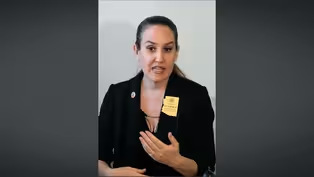
Arizona lawmaker on decision to end non-viable pregnancy
Video has Closed Captions
Arizona lawmaker explains why she publicly announced decision to end non-viable pregnancy (6m 27s)

Calif. passes homelessness plan, critics say it's not enough
Video has Closed Captions
Californians approve plan to address homelessness, critics say it's not enough (6m 6s)

How dysfunction has defined the House
Video has Closed Captions
How dysfunction has defined the House (6m 30s)
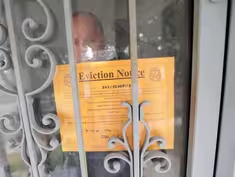
How evictions can have deadly consequences
Video has Closed Captions
How evictions and housing instability can have deadly consequences (8m 7s)

Military suicide rates highest among tank brigades
Video has Closed Captions
Study finds military suicide rates highest among tank brigades (8m 34s)

Unionizing marks latest challenge to student-athlete model
Video has Closed Captions
Push for unionizing marks latest challenge to student-athlete model (5m 38s)

Why the DOJ is suing Apple in a landmark antitrust case
Video has Closed Captions
Why the DOJ and 16 states are suing Apple in a landmark antitrust case (5m 58s)

WWII 'Ghost Army' soldiers receive Congressional Gold Medal
Video has Closed Captions
WWII 'Ghost Army' soldiers receive Congressional Gold Medal (1m 6s)
Providing Support for PBS.org
Learn Moreabout PBS online sponsorship
- News and Public Affairs

FRONTLINE is investigative journalism that questions, explains and changes our world.

- News and Public Affairs

Amanpour and Company features conversations with leaders and decision makers.












Support for PBS provided by:
Major corporate funding for the PBS News Hour is provided by BDO, BNSF, Consumer Cellular, American Cruise Lines, and Raymond James. Funding for the PBS NewsHour Weekend is provided by...