Capitol Journal
March 27, 2026 - Week in Review
Season 21 Episode 56 | 56m 39sVideo has Closed Captions
al.com Reporter Maggie Kates Natalie Steed & Melanie Poole Dr. Louis Lambiase
TBDWith the Legislature on spring break, all eyes are on Washington as Congress continues negotiation a DHS funding deal and, once again, Alabama's delegation is in the thick of it. Todd's guests: ▶️ al.com Reporter Maggie Kates ▶️ Natalie Steed & Melanie Poole of The American Village ▶️UAB Medicine's Dr. Louis Lambiase
Problems playing video? | Closed Captioning Feedback
Problems playing video? | Closed Captioning Feedback
Capitol Journal is a local public television program presented by APT
Capitol Journal
March 27, 2026 - Week in Review
Season 21 Episode 56 | 56m 39sVideo has Closed Captions
TBDWith the Legislature on spring break, all eyes are on Washington as Congress continues negotiation a DHS funding deal and, once again, Alabama's delegation is in the thick of it. Todd's guests: ▶️ al.com Reporter Maggie Kates ▶️ Natalie Steed & Melanie Poole of The American Village ▶️UAB Medicine's Dr. Louis Lambiase
Problems playing video? | Closed Captioning Feedback
How to Watch Capitol Journal
Capitol Journal is available to stream on pbs.org and the free PBS App, available on iPhone, Apple TV, Android TV, Android smartphones, Amazon Fire TV, Amazon Fire Tablet, Roku, Samsung Smart TV, and Vizio.
Providing Support for PBS.org
Learn Moreabout PBS online sponsorshipFrom ou statehouse studio in Montgomery.
I'm Todd Stacy, welcome to Capitol Journal.
We start this week's coverage in the nation's capital, where at this very moment, negotiations are still underway in Congress to fund the Department of Homeland Security.
That agency's lapse in funding surpassed 40 days this week.
Frustrating traveler with long TSA checkpoint lines and raising concerns about terrorism threats amid the war in Iran.
Lawmakers in Washington spent the week trying to find a deal to end the stalemate.
And once again, Alabama's delegation is in the thick of it.
Alex Angle report from Capitol Hill on the latest.
In a bid to in the six wee long Homeland Security shutdown, senators approved early Frida morning funding for most of DHS, except for immigration enforcement.
Now the measure moves to the House, where Republicans are unhappy with that deal.
Instead, they're now proposing their own bill that would fund all of DHS for a couple of months during the middle of the night.
At the U.S.
Capitol, senators unanimously approved a deal to fund DHS agencies, including TSA and FEMA, through September.
But they left out Ice and Border Patrol.
It came after senators including Katy Brett negotiated for hours behind closed doors.
Both sides blame the other for the 40 plus day shutdown.
We could be standing here right now passing a funding bill with a list of reforms.
If Democrats had made the smallest effort to actually reach an agreement, but they didn't.
Democrats held firm in our opposition that Donald Trump's rogue and deadly militia should not get mor funding without serious reforms and we will continue to fight for those reforms.
But speaker Mike Johnson outright opposed the deal Friday, lessening the chances that the shutdown would end quickly.
This gambit that was done last night is a joke.
Instead, Hous Republican leaders want to fund all of DHS through May 22nd, but that's pretty muc dead on arrival in the Senate.
And House Democrats are opposed to that plan.
Congressman Dale strong, a member of the Homeland Security and Appropriations committees, warned about the dangers of the prolonged impasse.
You look at the threa that this creates for America.
It's unacceptable.
It should never happen.
As of Friday afternoon, the House expects to vote on the new Republican measure as soon as Friday night.
It would then also have to go back to the Senate.
In the meantime, Trump's orde will ensure TSA agents get paid.
Reporting on Capitol Hill Alex Engle, Capital Journal.
Thank you.
Alex.
The Alabama legislature is on spring break this week, offering lawmakers, staff and even us in the media a brief respite before the fina stretch of the session begins.
Randy Scott reports o what to expect when the session resumes on Tuesday.
Six days.
That's what the 2026 regular session has come down to.
A lot of work is taking place and more work is still before lawmakers.
Speaker of the House Nathaniel Ledbetter remains optimistic.
Everybody's excite because they worked really hard for a long period of time to get their bills out and and toward the end of session, that happened some.
And I know that the Senate is still in, and they were going to move through several bills today.
And among the bill before lawmakers, house Bill 541 from Representative Ernie Yarborough.
This measure seeks to change ho Alabama voters are classified, whether they're Republican, Democrat or independent.
The reality is you're having to make a choice based on what you want to vote for right now in the primary middle doesn't stop that, right?
My bill doesn't preclude anybody from from it doesn't keep anybody from voting in the primary that they want to vote in and stop that.
But after the corresponding general, you got year and a half, two years or, you know, you got you examine, you determine which candidate or candidate you like.
You make the decision where you want to vote.
You know which primary in your area.
So and then the general is just obviously the general is the same for everybody.
House Democrats oppose thi bill, asking why should voters have to choose a label to have their voices heard?
Let m be clear about what's at stake.
First, the proposal woul disadvantage independent voters and that numbers are growing every year.
These are thoughtful citizens who evaluate issues, not party lines.
Second, it threatens voter privacy.
Voting should remain a personal protective act.
Third, it reduces participation.
Every new requirement becomes another barrier.
And finally, we must remember this government rol is to protect the right to vote, not to define a voter's political dinner.
HB five for one was approved by the House an now makes its way to the Senate.
Another measure to watch House Bill 527.
It sets up a new process for overtime tax relief.
Representative James Lomax sponsors this proposal.
Well, this provides a cap.
So it's a $1,000 tax credit.
It's not just all overtime wages being, tax free.
This is very similar to what they're doing on the federal level now.
It's based on up to $1,000 of called qualified overtime pay per, year.
And, the fiscal note on that is about $37.4 million.
I think, as you recall last time, due to whether gamify the system or whatever, it was about 400 million.
So, we don't want to gut the ETF in any way, but we want to provide tax relief to those, that are working hard.
How many Alabamians do you think that would qualify for this?
Do you have you got any kind of idea what you said, what the fiscal note was?
Yeah, approximately 800,000.
It was kind of the numbers were tracking based on overtime wages.
And how did yo it does the year the amendment also mirrors federal law, the number of years that it sunsets on three years.
It does believe so.
HB 527 was approved in committee and is making its way to the House floor at the state House.
Randy Scott, Capitol Journal.
Thank you.
Randy.
Before lawmakers left Montgomery for spring break, members of Alabama's Student Retention Council mad a stop here at the statehouse, hoping to convince more college graduates to build their careers here at home.
The group represents students from Alabama's public universities, and it's focused on connecting graduates with opportunities here in the state.
Capital Journal's Jeff Sanders reports.
The goal is simple keep more Alabama graduates in Alabama.
The Student Retention Council was launched in 2022 after research showed many students were open to staying in the state after college, but far fewer were certain they would.
Gordon Stone, with the Higher Education Partnership, says the council brings together student from all 14 public universities to focus on keeping more graduates in the state.
Bringing our student leaders together to talk about not only what they currently are experiencing on their campuses, but what that means to the state of Alabama and the opportunities that the state of Alabama has for them and their peers when it comes to choosing their place of employmen or their their their next step, if you would, after college, students say one of the biggest challenges is awareness, making sure their peers know what opportunities already exist across Alabama.
Jacksonville State senior Johnathan Duncan says being a part of the council has change how he sees those opportunities.
There are a ton of program existing to connect our students to other and other important things within the state.
Internship programs.
Fuel Alabama does a great thing.
Innovat Alabama is doing a great thing.
There's just a ton of program all around in these categories that, you know, we just don't necessarily all know about.
And they're doing these fantastic things already.
And for some students, the decision comes down to both opportunity and lifestyle.
Casey Caruso, a student at the University of South Alabama, says the state offers both.
My message to them is Choose Alabama.
The best thing that you can d is exploring the opportunities that are allotted to you within the state.
We have the best resources, some of the best cost of living in the country.
Why not capitalize on those things?
And that's what I tel my peers stay here in the state.
There's no need to leave and give your talent to another state where you can do all of those things here.
Students also told lawmakers continued support will be key to growing those opportunities and keeping more graduates in the state.
This project is important.
This project is something tha has been important in the past, and it's something that's going to be important still in the future, and just to continue to support us to be there.
We're grateful for the support that they've given us so far and where we're going in the future.
The quality of life one.
Right.
You know, raising a family, being able to, you know, buy a house and be successful.
Not only that, but also the vibrant event culture in the state.
So those are the type of things that are going to make a student want to stay.
A recent grad stay, or even someone who's considering coming to Alabama for college to stay here after they graduate.
And leaders say the impact goes beyond individual students to the state's long term economic future.
So we will see the legislators to know we're watching.
We're paying attention.
We're we're in this game with you to make sure that more opportunities are available.
Students say the next step is expanding outreach throughout communities and campuses, making sure that graduates are aware of the opportunities available in Alabama.
Reporting from the statehouse in Montgomery.
I'm Jeff Sanders for Capitol Journal.
Thank you Jeff.
This week, Governor Ka Ivey announced a major milestone in Alabama's effort to expan High-Speed internet statewide.
The state's final plan under the federal Broadband Equity Access and Deployment Program or Bid, has now been approved.
That will unlock nearly $460 million for 63 projects aimed at connecting mor than 90,000 homes and businesses that currently lack reliable service.
The funding will be administered to the Alabama Department of Economic and Community Affairs, or a Deca, which is also finalized agreements with broadband providers across the state to reach some of the most rura and previously unserved areas.
A Deca director, Ken Boswell, said the impact could be transformational.
What it does is, is those that would not otherwise have had internet.
They will have a parity, if you will, from those that do have it and those that don't have it.
I think it will improve the lives of people from the standpoin of education, health, economic development, you name it, they can work from home.
So it gives that parit to the rural areas of the state versus urban and metropolitan areas.
Hopefully carry out everything that Governor Ivey has been wanting to do since 2017.
And that is make sure that everyone has access to broadband.
We actually came from almost nothing from today on 17 two.
We're we're ahead of most states as far as it goes, or I'd almost go as far as say, it all state.
We're leading the charge, if you will.
And it's all because of her vision in making sure that all Alabamians have broadband accessibility.
We'll take a quick break and be back with more Capitol Journal.
Stay with us.
Alabama Public Television is your place for quality educational services.
Free professional development for educators and childcare providers with access to free, curriculum aligned videos, lesson plans and instructional resources with PBS Learning Media and all the PBS kids programs, parents know and trust.
Learn something new every da with Alabama Public Television.
Visit us at AP tv.org/education to learn more.
Born Henry Louis Aaron on February 5th, 1934, in mobile.
Baseball icon Hank Aaron first honed his baseball skills while growing up in Alabama.
He is best known for breaking Bab Ruth's record of 714 home runs, ultimately hitting 755, a record that stood from 1974 to 2007.
During his career, Aaron was a member of the Milwaukee and then Atlanta Braves for 21 seasons and made the National League All-Star team every year from 1955 to 1974.
He won three Gold Glove Awards for outfielder, and his lifetime records for most runs batted in and most extra base hits still stand.
Aaron was elected to th Baseball Hall of Fame in 1982, with 97.8% of the votes cast in 2002.
He received the Presidential Medal of Freedom, the nation's highest civilian honor.
Welcome back to Capital Journal.
Last month, aptX aired a new frontline episode focused on PFAs chemicals found in drinkin water in Georgia and in Alabama.
All is the result of the carpet industry in Dalton, Georgia.
That documentary was made possible because of a multi outlet investigative reporting team, including at AL.com.
Here's a clip.
Unanswered questions about pee boss also known as Forever Chemicals.
So with their forever, how do we address them?
Our collaborative investigation, our reporting in northwest Georgia has brought us before.
Numerous people whose drinking water is contaminated with land is contaminated.
Food is contaminated of the chemicals known as pee fresh.
All the onus was on EPA to prove that there was an existing chemical, causing a proble before they could take action.
Once they get into people, their body levels stay high for 3 to 15 years.
And the companies that produced and used them, these are major employers within these communities, and it is big, big industry.
Now, as part of Frontline's Local journalism initiative, who should be held accountable is basically a finger pointing game between the chemical industry the carpet industry and others contaminated the carpet industry's toxic legacy.
The forever chemicals have spread far down the regional river, whereas where in Alabama, places like Gadsden have been impacted.
Gadsden is about 100 miles west of Dalton of the carpet capital, and they get their drinking water from the Coosa River.
Early 2016, state officials sent out a memo saying we are concerned about the fast levels in eight water systems in Gadsden was one.
And so that really set alarm bells off in Gadsden where they said, what is this?
Where's this coming from?
And so they were kind of able to conclude that the fast was coming from the carpet companies.
And joining me next is a key member of that reporting team, AL.com environmenta and natural Resources reporter Maggie Cates.
Maggie, thanks for coming on Capital Journal.
Thank you for having me.
I really appreciate it.
When congratulations on some really, compelling reporting.
It must be really interesting to work with such a team like that and then to see it come to life, even on film.
Yeah.
Yeah.
This was far and away the largest project I've ever been a part of.
And the film just elevated it to another level.
And it was really special.
And I mean, all of those journalists that worked on the project, on the film, because there are a lot more people behind the scenes that you se that you don't see in the film.
They're all fantastic.
So let's talk about this issue.
You know, it's I've watched it.
I mean, it's it's worth watching to explain it, but I was hoping you could, share for our audience.
Start from the beginning.
What are PFAs chemicals?
How did they get into drinking water?
Where did this all begin?
Yeah.
So PFAs chemicals are sometimes called forever chemicals.
So if you ever see that term out there, that's what those are referring to.
And it's a class of chemicals that are manmade.
They don't exist in nature.
And they give stain and water resistance to fabric to anything, basically carpet.
I grew up with Scotchgard.
Right?
Yes.
I don't know which company that was, but you sprayed it on carpet and magically, it didn't get stain.
Yes.
So Scotchgard the original Scotchgard was PFOA was, which is one of the most, pernicious, one of the most persistent chemicals as far as we know, in, in, in the environment, they don't use it anymore.
But stain master if you remember, stain Master, that's another one of the original's PFOA.
And also it's been phased out of use but it's it's still out there.
So these chemicals are really useful for a lot of things, as you can imagine, giving things stain resistance, but they don't break down.
And so what has been learned in the last couple of decades is that it takes at least several decades for them to break down.
That's why they're called forever.
And exactly, exactly.
And so the chemical, the chemical manufacturers, the major ones, three M and DuPont sold PFAs chemicals to the carpet industry, which is sort of centered in Dalton, Georgia.
And what happene was, is that the carpet company said, hooray, you know, this is this is going to change our industry.
And it did.
You know, it made carpet a lot more, and durable, persistent, and a lot, you know a lot more appealing to people.
And so, you know, they worked fas into their manufacturing system, and then the waste from those carpet companies goes to Dalton Utilities, the sewage and water provider in town.
They treat it, and then the spray it out in a forest nearby.
It's called a, land application system.
The water.
Then, you know, the water sprayed on that land.
And it's what it's supposed to do is, you know, sink into the soil where it will be filtered.
But what ended up happening is instead of sinking in the into the ground, it ran off into the river, into the saga River, which eventually becomes the Coosa River and comes into Alabama.
And because fast, don't break down it, they stay there.
And so, you know, water systems downstream of the carpet industry, really unwittingly, you know, are supplying pee fast.
Everybody, if they got their water from the Coosa River.
And what do these chemicals do to health?
I mean, you saw what the documentary labeled as, you know, cancer risks and things like that, low birth weight.
I mean, this is these are serious things.
Yes, yes.
So the research is still emerging.
They feel fairly confident that, PFAs have been shown to increase your risk of kidney cancer and testicular cancer, developmental delays, low birth weight and infants.
One of the early one of the early health effects that they saw was, how they, you know, how, pregnant workers at these factories, you know, started having, you know, issues with their newborns.
So there is sort of emerging evidence about ulcerative colitis, prostate cancer, really a whole range of health issues that they still haven't really figured out if fast are, you know, harming you in that way.
Well, let's talk about in the next steps because I kno that there are ongoing lawsuits.
Obviously, you know when this stuff happens you know that it's going to be litigious, which it should be.
I mean there's a reason for that.
What about accountability.
Right.
And where does that land.
Because obviously the like you mentioned, the big chemical companies.
I know they're settling lawsuits and things like that, but what about the carpet companies?
Because what what if there are a lot of them are claiming is that, hey, we didn't know tha these were dangerous chemicals.
We just thought we're get, you know, talk to three, talk to DuPont because we didn't know we were just treating carpet and selling it, which I can understand.
But then you come to a well, what did you know and when did you know it kind of situation.
Right.
So what what have you found out about when these carpet companies or the chemical companies knew that these chemicals were harmful, knew that they were getting out into the water and therefore could be held liable?
Yeah.
So the the in the last couple of decades, three and DuPont have been sued many, many times across the country for PFAs issues not just related to the carpet industry.
Right in, Minnesota three and settled with the state for $850 million related to fast incidence.
So this has been a big issue for the chemical companies for a long time.
And what's come out, as you know, people have sued and dug into this issue is that the companies new, almost from the beginning, that these chemicals were harmful in some way, or at least they knew they don' break down in the environment.
And we're seeing pregnant workers in our factories get sick.
And, you know they just sort of like learned more and more over the decades, but never said anything.
And so what the carpet carpet companies knew when is still a bit of an open question.
The carpet companies, as yo said, have said they didn't know and they blame the the chemical manufacturers.
The other reporters that worked on the project with me, Dylan Jackson and Jason Deren, fantastic reporters.
They really dug into the court documents and what they found was, you know, in the lat 1990s, you know, 1998 and 1999 is when the chemical manufacturers finally went to the carpet industry and said, this is a concern we have.
And it Mohawk, one of the largest, carpet manufacturers.
They kind of shrugged it off at first.
Where it shore.
Shore Industries is is also one of the largest carpet manufacturers.
They had, you know, they had a very different approach where they really freaked out and they were like, this is a huge liability.
And there's a really great story in the documentary, where Bob shore, the man who founded Shore Industries, he's holding, you know, a carpet sample in his hand.
He's in a boardroom, he's holding a carpet sampl in his hand, and he's pointing at the Scotchgard logo, and he's like, you know this isn't a label, it's target.
And I got 150 million of these or some crazy number out in the marketplace.
You know, what am I supposed to do?
And he actually threw the carpet sample at the executives from shore and from the chemical manufacturers and stormed out.
So, you know, they the documents seem to point to the carpet industry knew by the late 1990s, the Fox and PFOA were not phased out completely until about 2005, if I'm recalling correctly.
So that's it.
Okay.
That's a big gap there.
Yeah.
You know, if you know or at least you know something and you keep on doing i and that does lead to liability.
What else is because the I want to get to Gadsden.
You reported on the Gadsden situation.
I mean, we're downstream, right?
Coosa River flows, right, you know through the heart of the state.
Yeah.
What happened in Gadsden?
How did they find ou and what's been done about it?
Yeah.
So, it was 2015, 2016 when the state environmental and the state environmental regulators started to realize that this was an issue, not just in Decatur, where the three, major, manufacturing plant is, but throughout the state.
And so they were kind of trying to get Georgia's environmental protection department to do some testing and work with them.
Sort of an unknown whether or not that actually happened.
But at some point, Adam contacted Gadsden and a handful of other cities and said your water is at extremely high level, has extremely high levels of PFAs.
You know, and and you said unwittingly they had they had no idea.
Yeah.
They had no idea.
And so, you know, that warning from Adam came after the EPA, you know, realized how dangerous PFAs were and alerted people that they were going to be lowering their threshold.
And keep in mind, thos guidelines are not enforceable.
There's no law out there in Alabama that says you have to keep your water below a certain threshold for PFAs.
What you do have to do is test it, but you don't have to do anything if it if it crosses the threshold right.
So EPA says these ar more dangerous than we realized.
We're going to be lowering the threshold eight and freaks out and says, okay, here are these eight cities that have high levels of PFAs in their water, higher than you know, wha this threshold is going to be.
And so that is when Gadsden, you know, woke up and said, we need to do something.
And eventually, you know, testing done by the state, done by the EPA, determined that the source of their PFAs were, the carpet industry's in in Dalton, Georgia.
Interesting.
Well, what happens next?
I know we talked about lawsuits.
You might we see legislation?
I mean, what what comes next?
Do you think after all this has really been exposed and it's pretty high profile.
I'm doing a frontline documentary.
Yeah.
You know, it's hard to know what's going to happen.
The lawsuits, Gadsden lawsuit, initial lawsuit was settled.
They do still have a second lawsuit pending that the Supreme Court pretty, pretty much knocked it down pretty far.
It's still out there, but it's still out there.
Still pending.
But the Supreme Court basically, you know, dealt a blow, dealt a real blow to it.
There are other lawsuits in, five star, five star water supply district around here.
Prattville area.
The Coosa Valley Water District, Clanton Water District, and Talladega and Shelby counties.
They they have a shared water treatment plant.
They have all sued in the last few years, the chemical manufacturers and the carpet manufacturers.
And so those lawsuits ar still out there, still pending.
You know, we don't know, you know, how thos how those are going to end up.
Should we be worried, like, should I be worried about turning on the tap water and drinking water?
I mean, I'd hate to put that on your.
No, no.
You know what I mean?
I mean, we keep talking about a lot of water systems.
From Prattville.
That's the, Fountain City.
It's got some really great water.
Should that should people be worried about that?
And, I mean, what are their filters and things that you could use like Brita or things like that, that take away or are we just kind of helpless?
We're definitely not helpless.
I don't want anyone to think that we're helpless.
There are water treatment systems out there that can remove fast from the water.
They are very expensive.
The one is called granulated.
Activated carbon.
And that's basically like a charcoal filter.
And then one is called reverse osmosis, which is, sort of a fancy name for pushing water through very, very thin membranes.
Those are pretty advanced, and very expensive for utilities to take on.
If you have the means, you can purchase an at home filter for your water.
It's not like a Brita.
It you know, it attaches at, yo know, your water line outside.
And it can filter your water.
But those are not cheap either.
So.
Yeah.
Well, we'll we'll certainl want to keep talking about this.
Look while I have you switching gears because you, you know, I hope folks will go online and see your body of work because you've done a lot in your, what, 4 or 5 years now?
Four years.
Yep, yep.
Yeah.
Your most recent story has to do with kind of what's going o with the oil situation, right.
Rising oil.
And so kind of, maybe have to do with environmental regulations, with the oil industry responding to what's going on in Iran.
I saw the term God squad uses the special committee.
Can you explain to our audience what's going on here?
Yeah.
So, the God Squad is a committee.
It's called the Endangered Species Committee, but it's nicknamed the God Squad.
Of cabinet level officials that can decide if certain projects will be exempte from the Endangered Species Act, which requires, you know, species that are determined to be endangered, to be protected.
It is meant to be a last resort, right?
It's supposed to be I think in the 19 in the sorry, I think in the years since, it's formed, like since the 1970s, they've only met three times before this.
The true emergencies, true emergencies where you absolutely cannot reach a resolution.
And so last week, or maybe even the week before now, Secretary of the Interior Doug Burgum, who is the chair of the committee, called the committee and said we need to consider exempting the oil and gas industry in the Gulf of Mexico, Gulf of America from Endangered Species Act protections, because they didn't really state a reason in the initial call of the meeting.
And so the center for Biological Diversity, you know an environmental advocacy group, they filed a lawsuit to try and stop the meeting because they said, well, we don't know what this is about.
You know, you didn't follow proper procedure.
And we're just, you know, we're worried that if you exempt the entire oil and gas industry that you are going to drive the rice as well to extinction.
For those of you wh who don't know the rice as well is found onl in the northern Gulf of Mexico.
It there are about 51 estimated left.
Been a concern for a while.
It's been a concern for a while.
It's extremely rare.
It only lives here.
And so scientists in the federal government did say the oil and gas industry, you know, new oil and gas leases in the Gulf do jeopardize the continue existence of the rice as well.
And there were other species as well.
But really, the most extreme concern was with the whale.
So, you know, they filed this lawsuit, you know, going back and forth.
And then last night, the Secretary of the interior, Doug Burgum, his attorneys, filed their response and said that the Secretary of War, Pete Hegseth, called this meeting.
He requested that Burgum call this meeting because he says that the oil and gas industry i a matter of national security.
That is something that Donald Trump has said many times.
Is that increasing domestic energy production is a matter of national security.
And certainl the timing with the war in Iran.
Yeah.
When I'm guessing that's that's how it's related.
Right.
You seen gas prices go up.
And I'm guessing eliminating or pausing maybe environmental protections would allow more, more production, or at least that that stand to reason.
That's the thought.
Yes.
Is that, you know, the endangered species laws can slow down, like slow down production or, you know, create barriers.
Well, you know, at the very least, it's good for people to know this, right, that it's happening.
And that's why I thought your reporting on this was just interesting and and valuable.
So I think you in meetings coming up on Tuesday.
Right.
So we know.
Yes.
So the meeting will be held on Tuesday, tomorrow morning Friday morning at nine a am eastern.
So 8 a.m.
our time.
A judge will hear the center for Biological Diversity's request to halt the meeting, temporary restraining order to halt the meeting.
And he will determine whether or not that meeting will go forward.
If he does then they will meet on Tuesday, and they'll discuss exempting the oil and ga industry in the Gulf of Mexico from all endangered species Act protections.
And it's important to note that that doesn't just apply to the whale, the rice as well.
It also applies to sea turtles, Gulf sturgeon, fish, any kind of endangered species that lives in the Gulf, they would be exempted.
So it's really much broader than it kind of seems.
So it's very sort of complicated issue, but it's it's really quite broad.
So.
Well, again, thank you for your reporting on this issue.
And again, congratulations on what you know, again is very important reporting on the the carpet industry.
So I'm going to try to figure ou But yeah it's valuable I appreciate yo sharing with, with our viewers.
And I think everyone's going to go on and on and, and watch that frontline episode, so they definitely should.
It's on YouTube.
It's really, really fun.
Absolutely.
Maggie.
Thanks again.
Thank you.
We'll be right back.
You can watch past episodes of Capital Journal online any time at Alabama Public Television's website.
aptv.. org.
Click on the online video tab on the main page.
You can also connect with Capital Journal and link to past episodes on Capital Journal's Facebook page.
Born in Fairfield, Alabama.
Willie Mays is one of the greatest baseball players to ever play the game in 22 major league seasons, mostly with the New York and later San Francisco Giants.
Mays had a 302 lifetim batting average and amassed 3283 hits, 660 home runs, and an untouchable total of 7095 career putouts from the outfield.
Mays was the National League Rookie of the year in 1951, and played a significant role in the New York Giants World Series victory in 1954.
The most memorable moment and Mays.
His career occurred in the first game of that series, when he made a running over the shoulder catch at the warning track, popularly known as The Catch.
Mays earne two MVP awards, was awarded 12 Gold Gloves, made 24 All-Star game appearances, and was a first ballo Hall of Fame inductee in 1979.
In 2015, President Barack Obama awarded May a Presidential Medal of Freedom.
You're watching Alabama Public Television celebrating 70 years of service to Alabama.
Welcome back to Capitol Journal.
Joining me next are Natalie Steed and Melanie Poole of the American Village in Montevallo.
Ladies thanks for coming on the show.
You're very welcome.
Well, I should say American visual delight, of course, but we're preparin for the America 250, you know, big celebration, obviously, American Village there in Montevallo is going to be really headquarters for Alabama and everything.
It's going to be celebrated all throughout the state and throughout the country.
But I was hoping you could give us an updat on how preparations are going.
I mean, I'm excited about it.
We're going to be there live.
I can't wait to talk more about that.
But, Melanie, I'll start with you.
How is the American Village preparing for this?
Amazing really once in a lifetime event?
Back in 2023 we were honored to be designated by Governor Ivey as the Semi Quinn Centennial Celebration capital in Alabama.
And what better place to celebrate America's milestone 250th birthday than American Village, a campus that is devoted to teaching American history and civics and preparing our young people and all of our citizens to be, citizens, good citizens of Alabama and of America.
That's right.
Natalie, now you're tasked with really coordinating the entire 250th anniversary for the whole state.
I can't imagine what goes into all that, but how's it going?
And what can we look forward to?
It's going well.
We've spent the last three years planning, how we're going to implemen implement statewide activities.
And we're excited to start to see those come to life, through communities across the state.
So we've been working wit semi-colons, Centennial schools, semicolon, Centennial cities.
We have a legacy project that we're working on, and we have community grants available.
To help implement programing project and events at that local level.
Well, that's good to know, because, look, I'm from a small town.
I grew up in Prattville.
And yes, 4th of July was a big deal.
Every year I'm no.
It's that way in a lot of towns.
And so I know that a lot of towns throughout the state probably want to mark this occasion in a big way.
So y'all are offering support for that.
We are we have funding available for municipalities, counties and American history organizations.
And so our hope is that we can provide a little extra for them to add educational content programing this year to this year's celebrations.
Really tie in that 250th anniversary of the signing of the Declaration of Independence.
Absolutely.
Now, how how would folks, if I, you know, was mayor of a town or city council down?
How do I find out about that?
Well, our website hold all of our resources so you can find sign up informatio for to become a school, a city.
Sign up for the grants.
And that is America 250 al.org.
Okay.
All right.
I know y'all have some websites too.
You got the American Village websit to tell people how to get there.
We do.
Everything about American Village is at American village.org.
Our festival website.
This year's theme is Sweet Home to 5 where freedom feels like home.
And that website is Sweet Home to 50.com.
This year's festival is too big for just one day, so we are celebrating both July 3rd and July 4th, which if you look back in history both days are significant.
So I hope they'll be som some telling of that, you know.
And that it's such a big deal.
And I'm so glad that we're taking it, making it such a big deal.
Talk about what people can expect on those two day from the festival.
Absolutely.
So we have what we call a family of Alabama artists.
We have 18 musical artists from all across the state performing on two stages.
We have Taylor Hicks, Blind Boys of Alabama, Miles Morgan, Damon Johnson, PJ Dragons, Rick Carter, lolly Lee, you name it.
We have a full cast of wonderful musical acts.
We have a stunt dog show that'll take place six times over the two days.
We have a celebrity chef's kitchen and eating contest.
How many pecan pies can you eat in five minutes?
How many Gulf shrimp can you eat?
We have a wonderful kids zone.
And we have wha we're calling America's stories.
So we are inviting attractions and storytellers, people from across our great state to come and tell their story about Alabama and the par we played in America's birthday.
Absolutely.
It also, it's coming at a great time because you all have invested so much, and your donors have invested so much in updating the American Village.
The last time I was up there, I think was, December or Novembe and it some of your new exhibits had opened and it's just fascinating.
I hope folks will even before the 250 go and spend time there, because it's really an immersive experience.
And, and it's, it's way, way beyond what really, you know, started out, years ago.
Talk about these new exhibits and these new investments.
Absolutely.
It is the newest building.
It American Village is our Independence Hall.
It is three phases.
So you start out in the west wing of independence Hall.
You step into Boston on the eve of Paul Revere's ride.
And you were definitely immersed in that time period.
You travel through the four year and into to, sensory overload in our theater.
So there is an original film there, choosing to be an American people that takes you from the point of being British colonies up through the, razor's edge, where we were debating becoming a new country.
From there, you travel into the central building.
You walk into what appears to be a normal portrait galler with oil paintings on the wall.
But all of a sudden they're talking, they talk.
And it's a very, engaging experience.
You actually walk across the hall and you're surrounded by the, delegates to the convention, signing the Declaration o Independence of your very own, and the new wing of independence Hall.
The east wing will house th Carl Harrison Museum of George and Martha Washingto that is currently in Columbiana, that is moving to American Village and will be there before July 4th.
And didn't did I hear that it's going to be the largest collection of George and George Washington memorabilia, if you will, outside outside of Mount Vernon.
It absolutely is right here in Alabama.
Now we talk about the importance of our younger generation.
You know, as the two 50th goes forward, the importance of the younger generation, understanding some of these concepts.
There's a lot of noise out there.
There's so much distraction with social media.
But understanding the importance of how this country was founded and building a foundation for the future, right.
So we at American Villag on a daily basis, feel like it's important for our young people to understand those liberties, the freedoms and what they mean to us.
We can't cherish, and value what we don't understand.
So education is key to all that we're doing with the Semi-Colon Centennial, not only at American Village, but also in the communities through our schools.
We have an educational toolkit that's free for educators across the state and the country.
It's been downloaded in over 20 states now.
And the white House task force has downloaded that.
So we're very proud of that effort.
That has resources for teachers to implement throughout the school day.
Throughout the school year.
Well, that's fantastic.
And it's great to see Alabama playing a leading role.
And, no you do have to practice saying something by coincidence, any place into any need for practice.
I need some more practice before we go live on, on July 4th.
Absolutely.
We're going to be at the American Village, for the for America's two 50th, and we're really excited about that.
We'll be talking more about it but it's time to get prepared.
And I really appreciate y'all coming on and sharing all the work that's going in.
And thank you for all the work.
I mean, it takes, you know, like I say, I work behind the scenes to make this a success.
And it's going to be and I'm really excited.
So thank you ladies.
Thank you.
Thank you.
Thanks for having us.
We'll be right back.
Birmingham's Ric Whitfield is the nation's oldest operating ballpark and served as the home field of the Birmingham Barons, Birmingham Ace and the Birmingham Black Barons for decades.
The Birmingham Barons inaugurated the new field on August 18th, 1910, by defeating the Montgomery Climbers.
The Black Barons played there between 1924 and 1950.
Rick Wood hoste Birmingham's minor league teams for several season through 1987, from 1967 to 1975.
The Barons were owned by Ensley native Charlie O. Finle and were part of the Kansas City and later Oakland A's organization.
More than 100 members of the Major League Baseball Hall of Fame have played at the field, including Ty Cobb, Babe Ruth Satchel Paige, and Willie Mays.
Today, the historic field is managed by Friends of Record and hos local amateur and college teams.
The Birmingha Barons still play a ceremonial throwback game at the ballpark every year.
The Rick Wood Classic, which celebrates Barons teams of the past and this historic field.
Welcome back to Capital Journal.
Joining me next is Doctor Lewis Lum, BRC dean of Uab's Regional Medical Campus here in the capital city.
Doc, thanks for coming on Capital Journal.
Thanks for having me.
It's exciting.
Yeah.
Well, I want to get to thi event that y'all are putting on.
Sure.
But first, I wanted to ask you to remind or enlighten our audienc about Uab's regional campus here in Montgomery.
A lot of folks may not know that that's the case.
And just there's there's a statewide footprint.
It's not just there in downtown Birmingham.
Yeah.
So so UAB actually has three regional campuses outside of Birmingham.
There's one in Huntsville, one in Tuscaloosa.
And then of course, ours in Montgomery.
We've actually UAB has been teaching in in Montgomery since the 70s.
So it's more than 50 years, believe it or not.
But in 2012, they decided to formalize the arrangement.
And they put a campus at Baptist South down on the Southern Boulevard.
And we've got 20 ish third year medical students about the same numbe of fourth year medical students.
Those are the ones doing their clinical rotations.
We now have a we have an internal medicine residency with about 30 internal medicine residents.
And now we have a psychiatry residency that just started.
Wow.
And so we have all the faculty members are base here, their internal medicine.
We have about eight full time, teaching internal medicine faculty.
We have about four, psychiatry faculty, plus a lot of community doctors help us.
And then we also UAB also has a multi-specialty clinic where we have specialists in endocrinology, rheumatology, gastroenterology, breast surgery cardiothoracic surgery, urology.
And I'm sure I forgot one, but it's quite the right one that said, yeah, and they're all based here in Montgomery because the idea is UAB doesn' want to just be in Birmingham, but they want to be a statewide and provide service and help the healt of all of the people of Alabama.
One that was out there, a major hospital, maybe not as quite as dramatic as TV.
But I can see that, you know, being a teaching hospital and all that.
Well, that's a that's great, I appreciate.
Sure.
Okay, y'all got this.
Montgomery health policy meeting coming up.
Happens every year now.
Talk about what led up to this event.
What?
Your Madison annual event and why you're putting it on.
Yeah.
So the the Kenmore family, doctor Rex Kenmore was a cardiologist with ties to Montgomery, and, he, he and his family have endowed the campus.
And also this, this particular the Kenmore lectureship.
And they've been very generous, and they've given us a gift to allow us to put on the Montgomery health policy meeting.
And what what we decided to do about four years ago was to build a meeting around the Kenmore Lecture, Distinguished Lecture in Medicine, which is our keynote, and to to sort of bring in experts and try and explore, areas where people are interested, areas of policy, and basically issues of the day.
And so we've talked abou in the past health disparities, we've talked about a workforce, health care workforce.
Last yea we talked about mental health.
And this year we're goin to talk about healthy living and and how we ho we can try to become healthier.
And what UAB and what the what the government, what the Department of Public Health are all trying to do to help Alabamians be healthier?
Yeah.
Doctor Harris is a frequent guest on here.
I see he's part of your lineup, and I always appreciate him coming on because he talks about things like that, like screenings.
You're hearing a lot more talk about, look, let's let's nip this in the bud before it starts.
And healthy living and things like that.
We'll talk about this line up.
I mentioned Doctor Harris, but it's a pretty impressive group of folks you got speaking.
Yeah.
So Doctor Harris obviously is he's the he's going to deliver the Kenmore lecture and, distinguished lecture in medicine.
And he's you know, he's actually, internationally recognized as a leader in public health.
So we're actually very excited to hear from him.
And you're right, he's he's, he's been great and he'll brag on that.
And, no, I mean, he's it's it's, you know, what a prophet, you know, in his own hometown.
Yeah.
Yeah.
So he's but he's, but he's really, super.
And he gives a great talk to.
So he's going to delive the keynote right before that.
We're going to have cardiologist from West Virginia who is, she does cardiovascular outreach for West Virginia Universit and is a real expert, and diet and its relationship to cardiovascular health, and also and in terms of real world of people who live in rural areas and, and, and live in the South and, and that sort of thing.
And so how, how how do you make that work with our culture and with what's going on?
And she she's wonderful.
Allison Bailey before that, we're going to have a, Harvard faculty member, Peter Cohen, who I think i one of the more exciting talks we're going to have this year.
We're going to talk about supplements and, and, you know, the the lack of regulation.
And a lot of people don't know that the FDA regulates prescription medicine, but is specifically precluded from regulating dietary supplements.
And so that's why you get a lot of these weird claim and you don't know what's in it.
As a matter of fact, his lab has shown that a lot of times what you see on the shelf isn't even in the bottle, really.
And so he's got a lot of different, I'm fascinated by tha because if you just turn on it Instagram or Facebook or whatever, yeah, you're going to get inundated with ads saying lose weight quick or whatever.
And yeah, you're right, they're supplements.
They're not medicine.
It.
So it says this product has not been evaluated by the FDA and who knows what's in it.
Right.
And so as long as they say, not to treat any specific disease, but it'll tell you like what condition to take it.
They, they kind of run really, really close to it.
And sometimes there's actuall in the natural medicine, there's actually the same compound that are in regulated medicine, but people are taking them.
But to me the biggest worry is you don't know what's in the bottle.
You know, Doctor Cohen's lab has shown that's either 0 or 300% and a lot of cases.
And so you don't know, it's, and so, you know, if you if you're going to take supplements, you should be well informed and you should know what's in it.
And actually, what's interesting is because the federal government's not really in this space, a lot of states are coming in and trying to protec their public and saying, fine, you want to take supplements?
That's up to you.
But at least you should know what's in the bottle.
Yeah, that's interesting, which is one of the many reasons why this is a really interesting line up.
How do folks go?
It's April 16th, correct at the RSA Activity Center.
And what type of person might benefit from this?
Is it just the medical community or it could be anybody?
No.
I think, you know, I think pretty much anybody could go.
I think, you know, anybody who's interested in getting informed.
But, you know, people in this, in this building who are and who want to be informed about health care issues and might be making policies or laws that I would encourage them to come in.
We've had members of the legislature, we've had Supreme Court people and people from the governor's office before.
I think the business community, I think people who are interested in being health, you know, healthy and finding out about this stuff can all come.
And it's free because of the cannabis.
You know, the they allowed us to to offer it free to the public.
We just need a registration.
So either Google Montgomery health policy meetin or they'll be there's a website and we'd like you to to register so we know you're coming.
Absolutely.
And it's a fascinating time to be having, conversation about health policy.
I mean, look, where how many years post-Covid, if that's even a thing.
But there were so many lessons learned from that.
And now we're in this environment where, you know, you got a secretary of health and Human Services who has some different views.
Doctor Harrison, I've talked about that.
So maybe a really good time to be gathering folks and talking about some of these, the impact of some of these public health policy, decisions.
Yeah.
I mean, I think that what what all of the changing times have really shown us is that we have to inform ourselves and that to the more tools that the individual can have to understand this, the better.
And that's wh we're trying to bridge the gap with reliable sources.
It's not just some influencer on the internet who says, buy this thing or something like like that, but we're trying to be at least reliable, evenhanded sources for for information so people can make up their own decision.
Absolutely.
Well, you're a trusted sourc and I appreciate you coming on.
And we encourage everybody to go to the health policy meeting.
Dot, thanks again for coming on.
Thank you so much for having me.
We'll be right back.
Alabama Public Television is your place for quality educational services.
Free professional development for educators and childcare providers with access to free, curriculum aligned videos, lesson plans and instructional resources with PBS Learning Media and all the PBS kids programs, parents know and trust.
Learn something new every da with Alabama Public Television.
Visit us at AP tv.org/education to learn more.
You can watch past episodes of Capital Journal online any time at Alabama Public Television's website.
aptv.. org.
Click on the online video tab on the main page.
You can also connect with Capital Journal and link to past episodes o Capital Journal's Facebook page.
That's our show for this week.
Thanks for watching.
We'll be back next week, starting on Monday as the legislature resumes here at the state House.
For our Capital Journal team, I'm Todd Stacy.
We'll see you next time.
 New
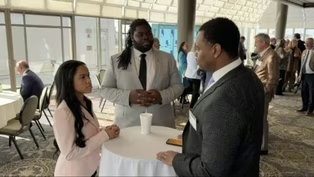
NewAlabama student leaders push to retain graduates, highlight in-state opportunities
Clip: S21 Ep56 | 3m 9s | Student leaders are working to convince graduates to build their careers in the state. (3m 9s)
Providing Support for PBS.org
Learn Moreabout PBS online sponsorship
- News and Public Affairs

Top journalists deliver compelling original analysis of the hour's headlines.

- News and Public Affairs

FRONTLINE is investigative journalism that questions, explains and changes our world.












Support for PBS provided by:
Capitol Journal is a local public television program presented by APT