Vermont This Week
March 27, 2026
3/27/2026 | 26m 46sVideo has Closed Captions
Hundreds protest Act 181 on Statehouse steps
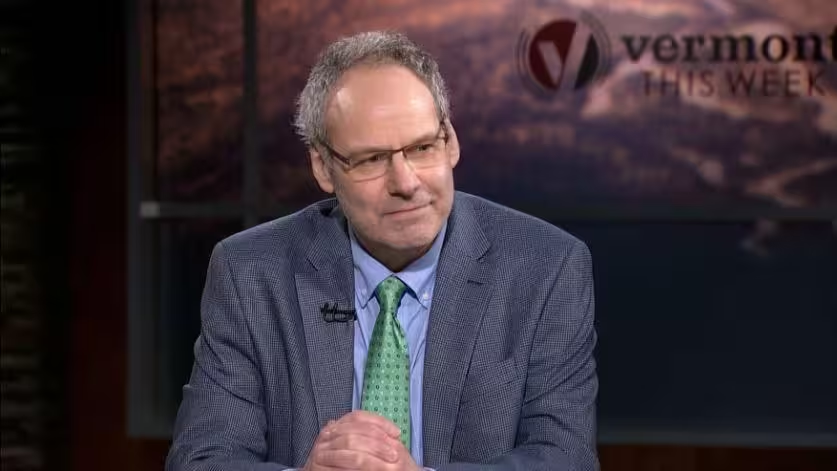
Hundreds protest Act 181 on Statehouse steps | Lawmakers advance property tax bill whittling increase down to 7% | Legislature considers establishing “forensic facility” | Moderator - Mitch Wertlieb - Vermont Public; Carly Berlin - Vermont Public/VTDigger; Colin Flanders - Seven Days; Shaun Robinson - VTDigger.
Problems playing video? | Closed Captioning Feedback
Problems playing video? | Closed Captioning Feedback
Vermont This Week is a local public television program presented by Vermont Public
Sponsored in part by Lintilhac Foundation and Milne Travel.
Support provided by:


Vermont This Week
March 27, 2026
3/27/2026 | 26m 46sVideo has Closed Captions
Hundreds protest Act 181 on Statehouse steps | Lawmakers advance property tax bill whittling increase down to 7% | Legislature considers establishing “forensic facility” | Moderator - Mitch Wertlieb - Vermont Public; Carly Berlin - Vermont Public/VTDigger; Colin Flanders - Seven Days; Shaun Robinson - VTDigger.
Problems playing video? | Closed Captioning Feedback
Where to Watch Vermont This Week
Vermont This Week is available to stream on pbs.org and the PBS app.
Support the crew
Help Mitch keep the conversations going as a member of Vermont Public. Join us today and support independent journalism.Providing Support for PBS.org
Learn Moreabout PBS online sponsorshipSeveral hundred protesters gathered on the statehouse steps this week calling for lawmakers to repeal a major land use reform law.
We are not against housing.
We are not against environmental protection.
We are against policies that place every burden on the people with the fewest resources and the least political power, and then call it progress.
Plus, House lawmakers advance a property tax bill, whittling increases down to 7%, and a bill under consideration in Montpelier would establish a facility for mentally ill offenders.
All that and more ahead on Vermont this week.
From the Vermont public studio in Winooski.
This is Vermont this week, made possible in part by the Lintilhac Foundation and Milne Travel.
Here's moderator Mitch Wertlieb.
Thanks so much for joining us.
I'm Mitch Leeb.
It's Friday, March 27th and with us on the panel today, we have Carly Berlin from Vermont Public and Vtdigger, Sean Robinson from Vtdigger and Colin Flanders from seven days.
Thank you all so much for being here.
We're going to dig into some statehouse stuff that has been going on for a while now.
And Carly Berlin, I want to start with you because again, we're bringing up issues of housing and certain acts that have been put into play even a couple of years ago.
Let's talk about act 181, which drew those protesters I was talking about at the top to the statehouse.
Give us a general idea.
First of all, what act 181 is basically aimed to do?
Right.
So act 181 is itself an overhaul of act 250, which is Vermont's signature land use law.
The way that act 250 has worked for the last 50 years or so, broadly speaking, is a proposed development triggers act 250 review based on how big it is, what act 181 was trying to do, and it was passed two years ago to say, actually, we should review projects based on where they are.
So the change it made was to relieve areas that are already developed, think downtowns, village centers from needing to go through the act 250 review process for new development, new housing projects to try to encourage more home building.
Yeah, because we know the housing crunch.
We want more housing.
Exactly, exactly.
That's the idea.
And then on the other hand, it also strengthened some conservation measures in other parts of the state.
Okay, so the folks who were protesting generally and there were a lot of them there.
What are their sort of main complaints with that 181?
Right.
So like you said at the beginning there, their call was to repeal the entire thing, but they're really focused on those conservation measures that I just mentioned.
You know, the the rural landowners who came and protested or basically arguing that those conservation rules will impede development in rural parts of the state, will impede their own, you know, rights there to developing things on their private property.
The overall argument here is that the benefits of act 181 flow to Vermont's more urban areas, and that rural areas get the short end of the stick.
So is it directly related to housing or would it be other projects?
I mean, I'm I'm wondering if this is separate, you know, from from housing issues necessarily.
No, I mean, it's it's all related.
I mean, part of the argument from, you know, these these more rural conservative protesters and lawmakers to who who have been listening to them, is that these, conservation focused measures would make it harder to, to build in more rural parts of the state.
There's a new, rural part of that's part of act 181 called the road rule.
That would mean if you want to build a private road over a certain length in most areas of the state, you'd need to get an act to 50 permit.
Now, imagine if you're, you know, the Vermont dream for many people is to build your house deep in the woods and have that nice view and have your privacy.
If you want to build a road over 800ft.
The law says you'd need to get a permit to do that.
You know, part of what act 2081 was trying to do is to to really funnel more develop towards those already developed places that have infrastructure, that have zoning, what have you.
Those the kind of smart growth idea.
And I think we're seeing a bit of a rebuke towards that approach more broadly.
I'm curious than the the folks who are backing 181, maybe some of the Democratic lawmakers, they've heard these complaints.
What is their response to these complaints?
Yeah, I mean, they're Democrats are lining up now behind a bill that just passed the Senate yesterday to actually delay a lot of the pieces of act 181 by a couple of years.
The thinking there is that they've been getting a lot of feedback from critics, that, you know, the maps that are getting drawn to determine what's going to be enacted in the future and what won't, are not satisfactory up until this point.
So that delay has already passed the Senate.
It's going towards the House, you know, Republicans on the Senate floor.
As this was getting debated, though, don't think that those delays go far enough.
They were trying to, there was an amendment to to actually repeal one piece of these these conservation measures, these tier three areas that we've talked about on the show before.
That did not fly the amendment failed.
There was another that would have delayed those tier three rules a little longer.
Again, more kinds of conservation focused regulations.
That also did not pass.
And briefly, Carly, there were, as we said, hundreds of protesters here.
Did that surprise you with all that response?
Because, again, this bill was put into place a couple of years ago, but now we're seeing the reaction to it.
Exactly.
I mean, the what the bill did two years ago with the act did was to to kind of lay out this framework for how to change act 250.
But it set up that a lot of process, like years worth of rulemaking, rulemaking and mapmaking that's still going on.
And, you know, as these draft maps have gotten in front of people, you know, residents have and municipal officials, lots of people have gotten, have felt like they've they've missed the mark.
So, as we've seen, these land use rules kind of come into focus years onward from the passage of the bill, we've seen this, ire really spell out from beyond the statehouse.
And I think, it's going to be interesting to see what this sort of new force of people can, can push lawmakers to do.
Yeah.
We'll keep following your reporting on that.
Thank you so much for the update.
Sean Robinson, I want to turn to you now because, this is the problem we have been talking about for so long, and it is still this problem here in Vermont in property taxes is the issue.
The Vermont House advanced the property tax bill, which cuts the increases down to about 7%.
Let's hear first what, before I come to you, I want to Senator Thomas Chittenden and Governor Phil Scott had to say about this issue.
There is a strong argument for spreading the, buy down across multiple years in order to smooth the increase in property tax rates.
As much as that can be sound fiscal policy.
It is hard politics, for voters.
Vermonters are looking for relief, and the property tax bills have jumped tremendously over the past few years.
I get it, you know, you'd like to have some money for next year.
But at the same time, when school boards hear that there's another $50 million in the coffer waiting in reserves, I'm pretty certain that they're going to spend it.
So, Sean, what what are the the different factors there?
I mean, we're talking again about a buy down.
It sounds like, you know, Democrats wanted, to save some of that buy down this year to have the property taxes be a little bit higher.
The governor says 7%.
He's not going to do it.
Yeah.
That's right.
So there's a lot of different numbers here at play.
And ultimately, you know, like what Carly's talking about.
This is really about affordability at the bottom line and how to make Vermont an affordable place to live.
So folks might remember, in December when the administration came forward with their estimates for, the kind of average property tax rate increase we would see for this year, that number was 12%, right.
So now, you know, we've we're in the state House.
We're in the middle of the session working through these proposals.
And the bill that the House passes every year to set a property tax rate, the yield bill.
We've that's, you know, been approved this week.
And the number there, like you heard, is 7%.
So less than 12%, right.
But it's not going as far as the governor wants to go.
When the governor came to the legislature at the beginning of the session in January and presented his plan, his budget plan for the year, his proposal would get that average rate increase down to 4% from 12.
I think it's worth remembering to that these are, average numbers.
Right.
So we see 4%.
Right.
But someone's tax bill might be higher than that, might be lower than that increase.
Right.
So it's an average number.
But yeah.
So we're kind of have a few different numbers floating around.
And like, you know, Senator Chittenden talked about these are really political decisions too.
They are for sure.
But is there a game of chicken going on here?
Because it sounds to me like what the governor saying is he's going to veto anything that comes across as just the 7%, that 7% increase.
Yeah.
That's right.
And, you know, I should say too, that, the, the kind of other important number here is, this 105 versus 50 ish million.
You heard 50 million on the cliff, I think.
Right.
So, the governor said, you know, let's take $105 million this year and spend all of that amount to buy down the property tax rate that so he gets down to that 4% ish number.
The House this week said, you know, we're actually not comfortable using that full amount right now.
You know, let's spread it out over two years.
And, you know, like Senator Clinton said, like there's so much political pressure on the legislature and on the governor right now to do something about affordability and about property taxes that this debate, you know, as much as he says, like it could be sound fiscal policy to spread that out.
There's also a lot of pressure to do as much as legislators can right now.
You can see both sides of this, I think.
But there is that kick the can sort of problem.
Because, again, if you spend all that $105 million buy down now, what happens next year when this problem you know, we have to assume is going to come up again?
Is the money going to be there to buy down property taxes next year?
Right, exactly.
And, you know, part of the argument against the buy down this year, right?
Is that we just did it last year.
And part of the reason that the buy down is such a large number, over $100 million, is the proposal is because accounting for the tax rate increase that we bought down last year.
So it compares.
And there's a cliff right that you're create when you do that with one time allocations year over year.
So yeah it's it's a really fascinating political debate.
And you're right that we're just kicking the can down the road.
It's interesting how, legislators seem to all agree, and the governor agrees with them, too, that they're like a buy now and it's not good policy, and we don't want to do it.
Right?
Right.
But here we are still debating how to address this education affordability issue, because we haven't yet figured out how to address these underlying structural problems with how we pay for our very expensive and pretty inefficient education system across the state.
What's the next step in this process?
What are you looking forward to to see happen next?
Right.
So now that the, house has approved this language, it's going to go to the Senate and there will be much more scrutiny there.
And, you know, we'll we'll see where it lands in the Senate.
But to your point earlier, you know, the governor has a lot of political power, of course, right?
He's got the bully pulpit.
He's got the election results from 2024 that gave him a lot of Republican support in the legislature, who can uphold a veto if he chooses to do that.
And yeah, we'll see.
And the state, the Vermont House has advanced the 2027 state budget.
What do we know about that?
Yeah.
So, that budget is, you know, we were talking about differences with the governor.
The budget that the House has approved this week is actually quite similar at the very top line to what the governor proposed in January.
They are both, about $9.3 billion, only off by about $1 million.
So, you know, that's a very small drop in the bucket, almost a rounding error on a $9.3 billion budget.
Some of those differences in the House version, come down to some new state government positions, that the House has proposed.
There's rate increases in there for some of the designated agencies who provide really key social human services to folks like home based care, for certain conditions.
There's more money in there for some tuition grants for, low income students going to Vermont State.
And sort of overall, even though the top line number is the same, there is about $17.5 million in additional spending from the state's general fund.
In the version of the budget that the House passed.
Now 17.5 depends on your perspective, if that's a lot or not a lot.
But here's a number to consider.
Also, the House Appropriations Committee, in the process of developing the budget over the last couple months, heard about heard, you know, a lot of testimony from a lot of stakeholders.
And they had about $250 million in requests from other legislators, from the public, from lobbyists, from advocates in, you know, requests in money to spend above what the governor had recommended.
So they went from 250 down to 17.5.
Right.
And I can't do the math right now on my head, but it's that's not a lot.
That's not.
Yeah.
Yeah.
There's there's a gap there.
And of course the Senate will have their say there may be some differences there.
Right.
Yeah absolutely.
And that's worth noting right, that none of this is final.
Right.
Everything I've just spent the last ten minutes talking about could change.
Right.
And that's why we we follow the politics and we, we follow it.
So yeah.
But now we know up to this date on Friday, March 27th where we are, thanks to you.
So I appreciate that we're totally up to date there called Flanders.
I want to turn to you, a story that you wrote about in seven days, which is really interesting.
It's about establishing something in Vermont.
One of the few states, I guess, that does not have this sort of thing.
A forensic facility for folks who have, mental illness problems and have acted out in violent ways.
If you could just sort of set the stage for an example that you wrote about was a gentleman who ended up, shooting his daughter a terrible story.
He was found not, he was found not capable of defending himself in court.
But then the state didn't know what to do with him.
Basically, why don't you pick up the story of, what happened there?
Yeah.
So that's, this is a few years ago out of Orange County.
A man named James Perry, who in the early stages, the stages of the pandemic, was holed up in his home, was becoming increasingly delusional, was harboring a lot of paranoid thoughts, and, and his family was worried about him.
And one day, his daughter came by with cookies to check on him, and he shot her at point blank range with a shotgun.
He was arrested and put in prison.
And for several years there was debates over whether or not he was competent to stand trial.
He was eventually deemed competent, but the judge, based on an evaluation from a psychiatrist, decided that at the time of his crime, Mr.
Perry was, clinically insane.
He was legally insane.
He was he was not capable of, knowing what he was doing and the consequences of it.
And so that put to rest the question of whether he was culpable for the murder.
But it raised another really, really hard question of what do we do with him now?
And that's hard, because in Vermont there is only so many places you can put someone who has been deemed either incompetent or not guilty by reason of insanity, but who is still considered a risk to the public.
And, Mr.
Perry's own family was pleading with the judge in this case.
Please do not let him go back home.
We do not trust that once he is placed back into this society and dealing with all of the triggers that he was dealing with before, that he will be safe.
And so this bill seeks to address cases like that.
And we've had a handful of others in very high profile murder cases in Vermont where this has come up and it's really difficult on both the prosecutors trying to figure out what to do with this, but also for the families of the victims who often feel like justice is being delayed for years on end because they can't get closure now, one of the things that I read in your article was suggested was perhaps someone like Mr.
Perry could be, taken care of in one of the state prisons.
But that doesn't sound like a very therapeutic environment.
Yeah, certainly.
The debate right now is what do we do with these people?
The proposal is to create what's known as a forensic facility, which, has come up time and again in Vermont.
And there have been proposals.
And there was one proposal a few years ago to put it inside of the state psychiatric hospital.
We carve out a piece of that where we would put people who are facing criminal charges.
That proposal never went anywhere.
There's been calls to maybe we build a specific facility outside of the prison system, but as we know, it's very hard to build any sort of facility like that with the juvenile women's prison.
And so the proposal here, the thinking is that we are already caring for a lot of these people in our prisons.
It makes sense to carve out space in the prison system where we would house criminally, defendants who are facing serious criminal charges, where there are mental health aspects at play, and they are tailoring this bill at the time right now to be very narrow and just address people facing life sentences, which would be maybe 3 to 5 defendants per year.
And the idea would be that if you're not competent to stand trial, you would be housed here and you would receive treatment.
You would also maybe even receive civic lessons on how the criminal justice system works, because competency refers to your ability to understand the proceedings and aid in your own defense.
The concern here, like you mentioned from Civil Liberty advocates, is that, we are taking people who have not been convicted of a crime, putting them in prison indefinitely.
And there are scenarios, by which somebody could spend years on end in a facility like this without ever having their case adjudicated because of the competency issues.
And so that's the balance at play here.
But supporters of the bill say it's addressing a really important and dangerous gap right now in our system between the criminal justice system and the mental health system.
It's a really thorny problem.
And the other thing that I found really fascinating about it was that there are sometimes they say that somebody has been treated enough to the point where they can understand now the charges have been brought against them.
I found that and, you know, I know that you're not a psychologist by trade or what have you.
But, you know, I found that kind of fascinating.
How do you determine when a person is ready to, I guess, be competent enough to stand trial and then are they still going to be mentally competent afterwards?
These are very difficult issues, right?
Yeah.
And I think competency, the way that I've come to understand it is it's a fluid concept.
And one moment you might be competent, you might understand, you might have been receiving treatment in a hospital for 90 days.
You stabilized.
That's decided because in Vermont, the bar for hospitalization is so high, and we only have a handful of beds where you can actually be place that a decision can be made, that you've been treated enough.
You don't need to be in the hospital, but you can't be put in prison.
And so we'll release you back into the community on what's known as an order of non hospitalization, which you, then receive treatment that you don't have to comply with.
And so, exactly that, that you could be competent one day, not competent the next month, competent again the next month.
And it's it's the problem right now according to supporters of this bill, is we have no program designed to restore people to competency and try to keep them there long enough so that their criminal proceeding can be handled, because that's really what we're trying to do here, is make sure that the justice system can play out.
But if you're not competent, you don't even get your day in court.
The victims families don't get their day in court, and the criminal proceeding is put on pause, sometimes for years on end.
There's a case out of Brattleboro.
It's been pending for years and years because the defendant is just refusing to even undergo a competency evaluation.
And very briefly, Colin, is there anything on the horizon for this?
Is there any suggestions about what you know may happen here?
Yeah.
So that's coming up for a vote in the Senate next week.
It seems likely to pass the Senate, but I think it might run into some problems in the House where some important committee chairs have been skeptical of the idea of creating a forensic facility, especially in the prisons.
And so I have no idea where it's going to go from there.
All right.
Curly Bill and I want to turn to you now because, sort of, you know, riffing off of what Colin was talking about here, there's also the problem that Vermont has and is struggling with for so long a response to homelessness.
There is a bill looking to restructure Vermont's response.
What can you tell us about that?
Exactly.
So this is there have been efforts the last couple of years to restructure Vermont's homelessness response that have mostly centered around trying to wind down the motel voucher program that houses a very large portion of Vermont's homeless population and try to redistribute money towards building up more shelter, transitional housing, affordable housing, etc.
none of those prior efforts have had enough bipartisan support to, earn Governor Scott's signature.
So last year's effort was was vetoed and couldn't be overturned.
What's interesting about this effort is it is looking like it has that cross aisle support.
There was just a vote, earlier this afternoon in the House, to advance that that had, broad support, among Democrats and Republicans.
What this does mainly is it, it does cut down the number of motel rooms in use over time.
And really, what it's trying to do is create a more unified structure within state government for responding to homelessness.
You know, right now, the motel program access this, you know, kind of benefit program.
Some people even, chief to it being called a program at all separately, you know, another division of government gives out, grants for building shelters.
The idea here is to try to create this more unified approach for people to to move through this system, you know, get off the streets into a low barrier shelter into, more kind of service rich settings and ultimately move out of homelessness.
Sounds like a bit of a compromise, because we know the governor is not being crazy at all about the motel voucher program, but this wouldn't end that.
It would just sort of rely on it less.
Exactly.
So and that's part of the rub here.
An earlier bill that was introduced at the beginning of the session and was then scrapped, would have ended the use of motels within two years.
You know, Democratic leadership has said that that's simply unrealistic to do it.
It takes a long time to build more shelter and more housing.
And that's been the crux of this problem for so long as everyone agrees the motels are not a great place for people to be sheltered, but an absence of them.
Many people end up outside.
Does it sound to you little like this has some momentum because of the bipartisan, at least initially, support for this?
Yeah, I think so.
I mean, even just seeing this vote in the House today was encouraging for its prospects.
The governor's administration has said they like the direction it's taking.
So we'll have to see what happens in the Senate.
Okay.
Sean Robinson, if Vermont had unlimited amounts of money, that would be great because then we could use state funds for flood recovery projects.
This is something else that's being contemplated.
Now, I should ask you first.
You know what?
What is the plan here?
If there is one?
Yeah.
That's right.
Talking about yet another huge challenge right up until the issue.
So, for the third year in a row, last July, we had major flooding in the state.
There was damage was really concentrated last July.
And some towns in the northeast Kingdom that saw really bad infrastructure damage.
But the difference this third time around was that when Vermont went to the federal government, when we applied for disaster aid from FEMA, President Trump came back and said, no, you're not going to get the money you're asking for.
We appealed that decision and then got another rejection and said no.
So now the question is, we have these really small communities in the kingdom that need support to rebuild this critical infrastructure.
Where is the money going to come from?
It's not going to come from the towns themselves.
So the Scott administration, sort of halfway through the house process, last couple months of building the budget bill said, you know, we've actually figured out a way, we think to pull up some existing state money to make those, towns and the kingdom and remove, not to make them whole, but to at least help out with some of the cost of rebuilding.
Now, the difference is, have these towns gotten the aid from FEMA?
It could have covered up to 75% of the cost of the damage.
The state right now seems to be willing to pay about half of the cost.
So and in terms of that amounted to about $1.3 million is a consideration right now in state money.
But that money is coming from where exactly?
Within the state coffers.
Yeah.
So there's some disagreement about that.
And it's a little bit complicated.
Folks might remember that, in the budget for this current fiscal year, there was $50 million set aside to respond to federal funding changes.
Some of that money was used last fall to, continue providing snap benefits when the federal government was shut down for that record shut down.
That was where the Scott administration proposed this money coming from for these towns in the kingdom.
The House in its budget proposal this week has come up with a slightly different source of the money.
So we'll see kind of where it ultimately, shakes out where that money comes from.
But there does seem to be agreement, you know, across the party divide, if you will, that it's important that the state fill in this gap.
And of course, like this raises a really interesting question for the future, right?
Because the flooding last July caused really bad damage, but it was in a fairly more localized part of the state.
Right.
But if we have a huge flooding event like we had in 2023, again, is the federal government going to be there in the way that it's been in the past to help the state out?
Vermont State budget can probably absorb $1.3 million, but can it absorb ten times that?
I don't know, and that's a policy decision.
But it's a really, really consequential policy decision.
Yeah.
And you just read my mind to thinking about as we're coming up on those warmer months again, are we going to be hit with more of this flooding?
That's all we've got time for.
Except I do want to say, give a shout out to if he's watching my my new friend Wes, who helped me get home from New York City.
We rented a car after Amtrak delayed our train by four hours.
We hopped on the train, drove back together.
I made some new friends from Vermont, and we beat the train back by two hours.
So West, who works for the Secretary of State's office, thank you very much for bringing me along on that ride and helping me out.
And thanks to our panel today, Carly Berlin from Vermont Public and Vtdigger, Sean Robinson from Vtdigger and Colin Flanders from seven days.
I'm Mitch Wertlieb, thanks for watching.
We'll see you next Friday on Vermont this week.
 New Episode
- News and Public Affairs

Top journalists deliver compelling original analysis of the hour's headlines.
 New Episode
- News and Public Affairs

FRONTLINE is investigative journalism that questions, explains and changes our world.

 New Episode
 New Episode
 New Episode
 New Episode
 New Episode
 New Episode


 New Episode
Support for PBS provided by:
Vermont This Week is a local public television program presented by Vermont Public
Sponsored in part by Lintilhac Foundation and Milne Travel.