Vermont This Week
March 29, 2024
3/29/2024 | 26m 45sVideo has Closed Captions
Tensions High Over Proposed Annual State Budget
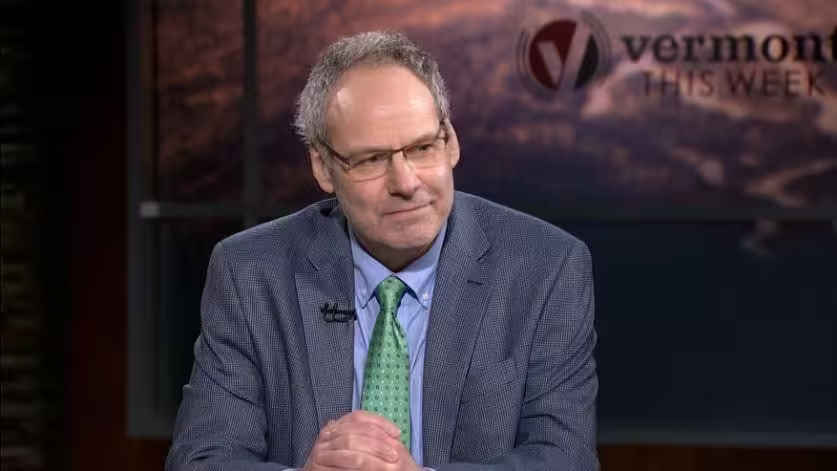
Tensions High Over Proposed Annual State Budget | Gov, Legislature at Odds Over Land-Use Bill | Burlington City Council Unanimously Approves Major Zoning Overhaul | Panel: Colin Flanders - Moderator, Seven Days; Mark Johnson - WCAX; Sarah Mearhoff - VTDigger; Stephen Biddix - NBC5.
Problems playing video? | Closed Captioning Feedback
Problems playing video? | Closed Captioning Feedback
Vermont This Week is a local public television program presented by Vermont Public
Sponsored in part by Lintilhac Foundation and Milne Travel.
Support provided by:


Vermont This Week
March 29, 2024
3/29/2024 | 26m 45sVideo has Closed Captions
Tensions High Over Proposed Annual State Budget | Gov, Legislature at Odds Over Land-Use Bill | Burlington City Council Unanimously Approves Major Zoning Overhaul | Panel: Colin Flanders - Moderator, Seven Days; Mark Johnson - WCAX; Sarah Mearhoff - VTDigger; Stephen Biddix - NBC5.
Problems playing video? | Closed Captioning Feedback
How to Watch Vermont This Week
Vermont This Week is available to stream on pbs.org and the free PBS App, available on iPhone, Apple TV, Android TV, Android smartphones, Amazon Fire TV, Amazon Fire Tablet, Roku, Samsung Smart TV, and Vizio.
Support the crew
Help Mitch keep the conversations going as a member of Vermont Public. Join us today and support independent journalism.Providing Support for PBS.org
Learn Moreabout PBS online sponsorshipTensions are running high in Montpelier as lawmakers work to craft the state's annual budget.
The super majority is out of control and off the rails.
Our revenues aren't keeping up with our spending, but our revenue growth is very strong in the state of Vermont.
We need to hold the line on spending.
Defending their spending plan, Democrats say the Republican colleagues are using misinformation to create fear.
Plus, a proposed land use bill has the governor and legislature at odds again?
And the Burlington City Council unanimously approves a major zoning overhaul.
That and more ahead on Vermont this Week.
From the Vermont Public Studio in Winooski, this is Vermont this Week made possible in part by the Lintilhac foundation and Milne Travel.
Thank you for joining us.
I'm Colin Flanders.
It's Friday, March 29th.
Joining us on our panel today, we have Mark Johnson from WCAX, Stephen Biddix from NBC Five.
And joining us remotely, Sarah Mearhoff from VTDigger.
Thank you all for being with us.
Now, Sarah, I want to start with you and the news out of the state house this week.
There is a strong words coming from the Vermont GOP, which held a press conference this week, sort of calling out their Democratic colleagues as having an out of control spending habit.
And that same day, Governor Scott came to a press conference, delivered the same message and brought a bit of back up.
How to Williams Williams, Williamstown business owner with him to deliver a message.
We have a video that the taxes that our business is seeing monthly to the state by weekly and payroll built into every transaction we take on top of increasing property taxes and the endless permitting and fees to upgrade our building to meet current state code and fire code and make sure that it's safe for people to come is bankrupting our small business.
Sarah I mean, you can hear that pretty emotional message.
You're at that press conference.
What did you make of it?
I was there, yeah.
I think that the the goal of the press conference and in bringing Amanda there to to give her real life experience was to put a face to the the debate in Montpelier that's so hot this year as to is the legislature are simply spending too much Republicans and governor Scott would argue yes that spending is out of control are some of the words that were used this week by both Scott and House Republicans had a press conference earlier this week, as you said, Off the Rails was another characterization that we heard from House Minority Leader Patty McCoy.
And Amanda, when she came to the press conference, she was I mean, as you heard, she said that these taxes and fees are bankrupting her business.
She was talking a lot about the the fear that she has this coming summer.
Vermont is going to see an increase in its payroll tax, and that's largely attributable to the child care bill, the overhaul that was passed last year.
And she said that she's so fearful of this and that it's really threatening her, her business and her livelihood and her and her kids and her husband.
And that the the property tax debate that we've talked about so often on this show is also contributing to this.
And she says it's it's bankrupting her and she can't afford it.
And she almost issued a call to lawmakers.
I don't remember her exact quote off the top of my head, but it was something like I voted for a lot of you and I want you to see me.
And when you are voting to increase taxes, I want you to think of my face and see me when you take those votes.
Yeah, and obviously, this is nothing new.
I mean, we hear from the Scott administration year after year where the legislature will come out with some proposals.
Scovell say he doesn't like them.
Lawmakers move forward anyway and then we kind of sit back and wait to see whether they have the votes to override.
But correct me if I'm wrong, it feels a little more heated this year.
And I'm just curious, do you have any insight into why that is?
It's an election year.
I think it really boils down to that.
The the Scott administration, I mean, there's there's there's been a dynamic for years now at this point, this tension boiling and kind of simmering under the surface of, you know, the Democratic supermajority in the legislature has quite literally said in the past, we don't need the governor to get our priorities done.
We have the votes to override him and the governor that the tack that he has taken is to speak directly to the people with these press conferences that he livestreams every single week and take shots at the Democratic supermajority and say, you know, you're not listening to me.
And even more broadly saying you're not listening to your constituents like Amanda.
I think that this has the I wrote earlier this week that the dynamic is on steroids this year.
And I do believe that.
And I would say that a part of that, at the very least, if not all of it, is attributable to the fact that it's an election year.
Economic times are really hard nationwide right now.
Vermont is not the only state experiencing a housing crisis and historic inflation, but we certainly are experiencing it.
And I think people are feeling that crunch the property tax question is a huge issue that we're reckoning with.
A third of state budgets were voted down because people can't afford their bills.
And I think that that is really the message that Republicans are going to take to the polls this year.
We also asked the governor about his efforts to recruit down ballot candidates, more moderates and Republicans for the legislature.
And he said he's been making some calls so long.
Answer to your question of why this is happening, I think the fact that it's an election year has a lot to do with it.
Yeah.
And market at risk of offending you here.
You've seen a good number of these debates over the years.
I'm just curious, could you tell from your from your vantage point, I mean, is anything sticking out to you as particularly interesting here?
Yeah, you know, I would say, really, it has less to do with it being an election year because this is pretty much the same refrain we've heard even in off years.
I think it really gets more back to some of the other factors that Sarah mentioned, you know, the cost of living.
I think we're all feeling that, you know, you go to the grocery store and it just seems like everything is more expensive.
And, you know, the £800 elephant in the room really is this property tax question.
So I think it's a little bit here.
A little bit there.
I think the Republicans and many people are seeing kind of a mission creep and Democrats over the year wanting to expand more and more programs.
It's only a couple of percent here and there.
But combined with just the general increase that it's causing all of us to live in this huge unknown, I mean, if the legislature does nothing about this property tax situation.
Wow.
Yeah.
And where are the biggest disagreements that you're seeing, Stephen?
I mean, walking through the halls of the statehouse, what are people most at odds about?
I think a lot of it's the way the wording comes through.
I mean, there was just talking about Governor Scott using these press conferences to really go at Democrats.
And Emily Long, the House majority leader, didn't mince her words in a statement either this week, using phrases like misinformation and that they're not looking at the nuances, because the way the Democrats have looked at the budget or the spending package they've pushed through is that this is an investment into issues that they're hearing.
Meanwhile, the governor and Republicans may call it taxes and more money that Vermonters are going to have to fork over.
But what they say that they're hearing is people want help with public safety.
So they're raising taxes to help create more positions within the judiciary.
And they've also said a lot of these increased taxes, whether it's corporate tax, a share, the wealth tax that affects those making over half a million dollars a year, it's having the more wealthy kind of pay their fair share compared to nickel and diming middle to low income Vermonters.
Yeah, but what's interesting, too, is that there are an awful lot of wealthy people who are willing to sign on to that.
I know Representative Emily Kornheiser is also talking about this idea of taxing unrealized capital gains.
I think there is some relief on the part of some people that that was removed.
Yeah, well, in Sarah, when we were talking earlier, you mentioned that you found it interesting, the decision to have to bring out a business owner who, when we're talking about the wealth tax, might not be qualifying at the top levels of earners and yet delivering that message, it seemed like a bit of a strategic choice to you.
I think so.
And I mean, she's certainly a relatable person, right?
She's a small business owner.
And Williamstown.
And she talked a lot about how she lives with her family.
And she and her husband often forgo paychecks just to make the ends meet and to keep their business afloat, or that they bought the property that they did in Williamstown, because they really care about the community and they want to see it uplifted.
They didn't want the building going into disrepair.
They wanted another business along their main street.
And I think that was a very intentional decision, too, to cater to, you know, the the small Main Street businesses, the backbone of a local economy, whereas the the tax proposals that we're seeing on the House Ways and Means that have garnered so much vitriol this week, they would primarily target high earners, corporations.
I mean, the the income the marginal income tax bracket that was proposed by House Ways and Means would be for income exceeding $500,000.
That's not most Vermonters.
It's certainly not Amanda, from what it sounds like, although I don't know her business.
And the corporate taxes are related to corporations.
And then the property transfer tax that they're floating is related to property purchases exceeding $750,000, which is way higher than the media own house price in Vermont, even with the real estate market becoming what it has become.
So this what I've noticed from some of the messaging coming from the GOP related to these three specific tax proposals specifically is that they are decrying increases in taxes.
I notice that they leave out in their statements that these taxes are primarily on the wealthy, and that seems to be a really key part of the philosophy official position of the Democrats is that, yes, we're raising taxes, but we're raising taxes on the people most able to pay them.
They would say in order to benefit a greater number of Vermonters.
And, Stephen, this isn't the only debate going on at the state house, another area where the Scott administration and lawmakers are sparring right now is a land use bill.
It's one of several looking to reform activity.
And I know we've been hearing about that for years.
Can you talk to us about this current proposal?
What's going on?
Yes, this current proposal passed through the House this week.
And if you take a step back to a couple months, I'm sure we all saw going into the session, Governor Scott housing, housing, housing.
He was maybe his biggest priority going in.
And there was a tripartisan press conference at one point for what's called the Be Home bill at the time, which would have had major act to 50 changes.
And this bill just does not cut it for the governor.
So it does create some exemptions and it puts municipalities into different tiers and it would create some for act to 50 exemptions for places like Burlington, Rutland, you know, some of the bigger cities and municipalities we have here and Vermont.
But in other tiers, it would make it kind of where we are at right now in Tier two and Tier three automatically trigger act to 50 and make things even more difficult.
But those behind the bill say this was never a per se housing bill in the first place.
This was a land use Act 250 bill, which has now turned into the housing bill for the session once the Senate gets their hands on it.
But the administration not happy with it.
The housing commissioner calling it a bureaucratic disaster to me earlier this week, because there's also some governance changes when it comes to Act 250.
Now, creating a professional board as well.
So the administration not happy with its progress, but hopeful that the Senate might add some of their things that they want in going forward.
Yeah, and as the state House grapples over that question, I know municipalities are taking a close look at what they're doing or how they can promote housing in Mark, I know there was some news on a Burlington this week, a big zoning overhaul.
I think we have a sound bite from both the mayor and a local resident speaking about the changes.
Name a problem in this city and more.
Housing is probably the solution.
It will be the first time in about 70 years that Burlington's residential zoning has made it easier to build, not harder in our existing neighborhoods if we're going to increase housing, we need to make sure it's affordable and we can't just rely on market forces and landlords to do that.
It hasn't worked.
We need to tie it to legislation that ensures some of this housing will be equitable and affordable.
So these changes would make it easier for developers to build multifamily housing in areas that is currently banned, including on the lot of single family homes.
You would think in a city that desperately needs housing, any attempt to bring more would be pretty widely agreed upon.
But this was a controversial change.
Mark, what?
Why is that?
Yeah, it certainly was.
I think people are resistant really to any change.
I have not seen an issue lately that has generated more discussion on places like Front Porch Forum.
It isn't really that big a change when you really come right down to it with this would allow is for two units for example two buildings to be on a lot that now restricts it to one.
It's talking a lot about in what they call infill.
But as I say, I think people just feel really threatened by any change at all.
We're really only talking maybe a couple of hundred units.
I think one of the issues that it doesn't really address and that's also being discussed is, you know, what's the University of Vermont going to do?
And there was recently an agreement that was cut between the city and UVM to build more housing and, you know, that's really the issue here.
You've got 11,000 plus students at the University of Vermont.
They create this huge pressure in the Queen City on housing, you know, where the vacancy rate for rental units is one or 2%.
So, you know, people are calling this some big major reform.
But in reality, I think you've got to really step up to the plate here.
Yeah.
And I know that this was one of the points of Mayor Marilyn Weinberger's ten point housing plan he came out with a couple of years ago.
This was he's approaching his final week in office now.
I know.
Just curious, I mean, you've been covering him for a while.
I actually found a clip of you from back when he was first running, moderating a debate of his.
I just want to get your brief reaction to it.
What do you make of his tenure?
What do anything stand out to you?
Well, I think he's right now touting his accomplishments because he's also contemplating running statewide.
I know he has talked to people about whether or not he should run for governor.
So this is the time where you want to really kind of pull out the list of your accomplishments.
You know, it's a mixed I would say it's a it's a mixed grade that he gets.
Certainly, when he came into office, there is the mess that was created by Burlington Telecom that was pretty easily dispatched with by selling Burlington Telecom, getting the city's credit rating back.
And but that was also now ten, 12 years ago.
So what have you done for me lately?
Are we better off now than we were four years ago?
As Ronald Reagan famously said?
And, you know, I think Merle Weinberger, particularly if he wants to run against Phil Scott, is really going to have a challenge trying to explain why the city is having some of the many problems that it's having today, you know, record number of opioid overdoses.
I'm not saying that this is his direct responsibility, but, you know, it's on his watch.
So, you know, if you're going to claim credit for things that are good that are going on on your watch, I think you've also got to explain at least why these other things are going on.
You know, I don't remember in the last two or three years, we've had so many cases.
You know, your organization's covered in gunfire incidents.
I think there are a lot of people that don't necessarily feel the same level of safety and comfort that they do in the city of Burlington.
So, you know, I'm not sure what if I were him, what I would be stressing in terms of looking at a potential statewide bid.
Yeah.
And those are also that's a good primer for the incoming mayor, who is Emma Mulvaney Stanek, who is going to be having to tackle some of those same issues.
Yeah, I mean, being a mayor in a major city, even as small as Burlington these days, it's got to be one of the toughest jobs in America.
There's no city out there that isn't dealing with a homeless crisis, opioid crisis.
I mean, these are profound problems that really require a multi point approach.
And, you know, one thing that Maria Weinberger I think has done a good job on is that he's brought in a bunch of different agencies, people like the Howard Center, a bunch of different groups that really try to look at this in a multidimensional kind of way.
You know, I think you mentioned Emma Mulvaney, Stan, it could be Democrat John Shannon and I would wonder, too, if I were Merle Weinberger, if there is any sort of message in there for him on that, too.
A Democrat that he endorsed getting pretty easily beat.
So, yeah.
So as we wait to see what morrow does, I know we are already hearing it's hard to believe, but it is an election season.
We're already hearing some statewide candidates come out and announce they're running for reelection.
This week we heard from Representative back of balance.
We have also heard from Charity Clark, the attorney general.
Sara, I'm wondering if you could just give us a brief overview.
It's been two years.
It's hard to believe it's already been two years since these two women made some serious history here in Vermont.
What have they accomplished?
Do you have any sense of what their prospects might be?
Well, I think in terms of prospects, the major thing to remember is that they are incumbents.
Of course.
And then thus far, we have no challengers to either Representative Valiant or Attorney General Clark in the past two years, I think balance freshmen cycle has really been defined by the Republican majority in in Congress in the U.S. House of Representatives.
I mean, it just started out with a real bang, with a historic number of votes to even get Kevin McCarthy in the speaker's seat.
And then, of course, his ousting.
She has it's hard to be in the minority party, of course, to get your priorities done.
But in a dysfunctional minority party, it's arguably even harder.
And so I think that the the big selling point that she's going to be making to Vermonters is that I have been stymied by this this dysfunctional Republican majority.
And give me another chance to get more done for Vermont.
And I'm sure that Democrats nationwide are really banking on a blue wave this election cycle, obviously TBD, whether that materializes.
And Attorney General Clark, I've been noticing from her over the past two years and just generally nationwide in recent years, there has been a real trend of attorneys general and state attorneys general putting a foot in national issues via lawsuits and amicus briefs and things like that.
You know, her lawsuit against stands out to me.
And the the damages that she alleged Meta and Instagram specifically have caused to young people in Vermont.
That was a real moment, I think, where she was trying to make a mark and purposefully did not sign on to the the nationwide federal lawsuit like most attorneys general did.
She filed her own.
And so I think those are the sorts of things that she's really going to be pointing to and asking voters for another term.
I'm going to you know, when it comes to somebody like back a ballot, I think Vermonters have a pretty high tolerance for allowing representatives to serve more than two years.
You know, Peter Smith is the last person I can remember that got bounced that after one term.
I mean, frankly, there's not an awful lot you can accomplish in your first term.
So I think really we're seeing these folks come out now.
It's all about fundraising.
I mean, you have to start so early raising money, so you do it now.
I mean, we're barely at the end of March.
Yeah, that's totally right.
And I kind of want to stick with you, Mark, on this topic of retrospect, action.
And and another thing you covered this week, which I found really interesting was Doug Hoffer, our state auditor, released a report sort of looking back on the state's handling of the EB five scandal.
You read through the report, you spoke to Hoffer for quite a while.
What did you learn?
Well, I think the significance this of this was is that Doug Hoffer, the auditor recounts, is an independently elected office, unlike many others who've looked into this, you know, the Department of Financial Regulation and the Agency of Commerce and Community Development all report to the chief executive, the governor.
So this was an opportunity to have somebody who is independently elected take a look at what the role was of state government.
And I think his conclusion was that there wasn't any corruption on the part of state government officials per se.
But A this program was set up wrong.
You don't have the Agency of Commerce and Community Development, which is trying to promote and be a booster for development, also trying to be the watchdog it is.
The state eventually brought in Department of Financial Regulation to try to do that.
I think he indicated that public officials were way too trusting, particularly of Bill Stanger, one of the developers who is a is charismatic, somebody who had a track record, somebody people wanted to believe.
I think he also notes it quite some length that there were a number of red flags here that just went unnoticed.
And that may be very well because people just didn't want to believe that this was a program that was rife with fraud.
I thought one of the other interesting things that came out in this report is the first time I've seen actually anybody really report and talk about what is the status of these investors today.
And I was surprised that the investors in there were eight projects, the seventh one, this biotech firm that was going to make artificial organs.
Those investors wound up doing much better than many of the other ones because they were in some cases, shifted to other EB five projects in other parts of the country.
So, you know, the bottom line is most of these folks overseas invested to get green cards.
And Halfords report shows that about 60% of them have got their green cards, which also means that 40% did not.
So, you know, it was it was a it was a good opportunity to have somebody independent of the administration really look back and see what went wrong here, which was a lot.
Yeah.
Thanks, Steve.
And I want to bring you in here on a completely different topic, but there was perhaps one of the greatest sounding state house working groups put together this week.
And I'm talking about the the mushroom study bill.
Could you give us a little on that?
Yeah.
So we had crossed over, you know, just a few weeks ago at the state House.
And one of those bills that Senate Health and Welfare was looking at was decriminalizing psilocybin, which is it?
Mushrooms, magic mushrooms.
If you would call them, but also looking at using them kind of in the medical world.
Well, they figured out it was going to make cross-over with the decriminalization part because of the committee balancing it would have to do for that.
So it ended up kind of happening was it was turned into a study.
So now there's going to be a group put together to look at, hey, what are the benefits, what are the effects of psilocybin?
We've kind of seen nationally different states and municipalities toy around with this a little bit.
Some people thinks it can help with depression's other medical issues.
Governor Scott was asked about it at his press conference this past week where he pretty much just said there's a lot of information for me to even still learn in my administration to learn.
So not too hard of a stance taken either way there, but certainly going to be an interesting one going forward.
We've seen whether it's Sportsbet, marijuana the past couple of years and this could be the next one in the chain.
Yeah, yeah.
And a bit of a rough transition here, but I, I can't help but think of the psychedelics and then the eclipse coming up.
I imagine there may be some people out there who may be dabbling.
I wouldn't give any advice, but we are going to have, I think a lot on that next week.
But I just want to ask briefly, Mark, do you have any plans?
I know.
I mean, you're in the Burlington area.
It sounds like it's going to be pretty hectic.
Do you have any plans for the eclipse?
Well, I'm considering after the discussions I've had with some people that maybe I'd like to rent out my house.
I mean, the amount of money that people are getting for hotel rooms and just to sleep in your backyard, a pitch, a tent is just remarkable.
I mean, this is the number of people they're talking about, hundreds of thousands of people coming to Vermont to watch this all.
It's just hope.
It's a really nice day out.
Yeah.
Yeah.
And I know that around the state and including in Burlington, they are trying to plan for this of how do we handle if there are 50, 70, even 100,000 people in the area?
I know there's some concerns about backups on the interstate.
We'll hear a lot more about that next week.
But it looks like we're wrapping up here.
I really appreciate everybody coming.
That's all we have for this week.
Thanks so much for our guests.
Mark Johnson from WCAX.
Stephen Biddix from NBC Five.
And joining us remotely, Sarah Mearhoff from VTDigger.
It's great to have you all here today.
I'm Colin Flanders.
Thanks for watching.
And we'll see you here next week.

- News and Public Affairs

Top journalists deliver compelling original analysis of the hour's headlines.

- News and Public Affairs

FRONTLINE is investigative journalism that questions, explains and changes our world.












Support for PBS provided by:
Vermont This Week is a local public television program presented by Vermont Public
Sponsored in part by Lintilhac Foundation and Milne Travel.