
March 4, 2024
Season 2 Episode 197 | 26m 29sVideo has Closed Captions
U.S. Supreme Court Ruling Puts Trump Back on Colorado Ballot.
UK law professor and constitutional expert Josh Douglas discusses U.S. Supreme Court's ruling restoring Donald Trump to Colorado election ballot.
Problems playing video? | Closed Captioning Feedback
Problems playing video? | Closed Captioning Feedback
Kentucky Edition is a local public television program presented by KET
March 4, 2024
Season 2 Episode 197 | 26m 29sVideo has Closed Captions
UK law professor and constitutional expert Josh Douglas discusses U.S. Supreme Court's ruling restoring Donald Trump to Colorado election ballot.
Problems playing video? | Closed Captioning Feedback
How to Watch Kentucky Edition
Kentucky Edition is available to stream on pbs.org and the free PBS App, available on iPhone, Apple TV, Android TV, Android smartphones, Amazon Fire TV, Amazon Fire Tablet, Roku, Samsung Smart TV, and Vizio.
Providing Support for PBS.org
Learn Moreabout PBS online sponsorshipbranch.
>> The right to vote should not be left to the discretion of the sitting Governor.
Kentucky voters should decide.
Well, lawmakers in Frankfort move to expand voting rights.
>> Civil rights movement to the news today.
>> We look back 60 years as some of the biggest names in the civil rights movement marched in Frankfort.
For Hopkinsville.
It adds so much notoriety.
Kentucky writer is the talk of the town.
Production of Kentucky edition is made possible in part by the KET Millennium Fund.
♪ ♪ >> Good evening and welcome to Kentucky.
Addition for Monday, March 4, I'm Casey Parker Bell filling in for Renee Shaw.
>> In 2019 Governor Andy Beshear restored voting rights to over 140,000.
Kentuckians who've been convicted of nonviolent felonies but served their time in Kentucky.
There are still over 100,000 formerly incarcerated people who cannot vote.
Lawmakers on both sides of the aisle say it's time for change.
Here's more from Kentucky additions Clayton Dalton as we begin tonight's Legislative update.
I didn't believe having a productive life as possible because of the way I was treated by the legal system.
How was treated in prison and how was treated after prison.
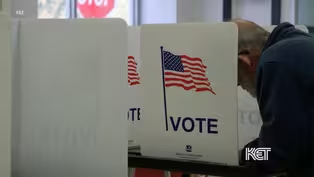
>> Kentucky is one of less than 10 states that permanently bars people with felony convictions from voting Marcus Jackson who served time in prison, said being stripped of the right to vote, made him feel ostracized >> I never KET that I lost my right to vote because of the conviction.
I really wasn't planning to vote but finding out that he was taken for the rest of my life, reinforced my belief that I did not have a place in this world.
Once the mistake was made and I was labeled a felon, the only people in place is willing to accept me where the people and places some of you to be the least.
I never felt like myself with certain people and certain places, but it was better to be excepted somewhere.
Didn't know where it all.
>> Cut her hair and a Democrat from Louisville sponsored the bill.
A similar measure in Twenty-twenty gathered support from members of both parties.
That bipartisan support remains today.
>> One of things that makes this country so great.
Is our right to vote.
And what I wish is there are more people in this world fighting for the right to vote.
And I supported this several years ago and I support this again.
Now.
And if you've done your time and it's part of becoming a fully functioning contributing member of our society is getting your rights back and making you a full person.
And part of that is serving in this democracy and making your vote.
So let's get this passed.
House Bill 5.66, restores other civil rights, including the chance to serve on a jury and run for public office.
>> But those rights wouldn't be restored until 5 years after a person's release.
>> The five-year wait period feels arbitrary to me.
I think there might be a three-year summer in the Legislature right now.
Would you speak to how that was settled on that?
There's wait period at all.
And then what the time period should be.
>> I will say that I am open to have wait for the civil rights portion or putting a weight on to it.
However, I am not willing to waver on the automatic restoration of for the vote.
>> Supporters say the bill is collectively good for society.
According to the most recent report from the Sentencing Project, nearly 162,000 citizens cannot vote despite the governor's 2019 executive order, that's 4 and a half percent of the total voting eligible population in Kentucky and at 11 and a half percent of the voting eligible African-Americans, the most sacred principle of democracy as that individuals be allowed to have a voice and how they are government.
The right to vote grounds.
All other rights, empowering citizens to become participants in government rather than mere petitioners.
If the bill reaches final passage, Kentucky voters will have the final say.
>> Choosing whether to amend Kentucky's constitution by a ballot initiative.
House Bill 5.66 is still awaiting its first vote for Kentucky edition.
I'm Clayton Dalton.
According to Kentucky's current Constitution and executive pardon is the only way a person with a felony.
>> Could have their voting rights restored.
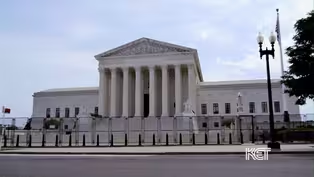
Former President Donald Trump will be back on the ballot in Colorado and unanimous decision.
The U.S. Supreme Court ruled Trump could not be excluded from the state's primary election ballot for his part in the January 6th attack on the Capitol, the Colorado Supreme Court trying to disqualify him under Section 3 of the 14th Amendment known as the Insurrection Clause of the Constitution.
We spoke to Josh Douglas, a constitutional law expert and professor at the University of Kentucky College of Law about the ruling and why unanimous decision does not mean the justices are united on the issue.
>> It was pretty clear from the oral argument that the court would reject the Colorado Supreme Court decision kicking Trump off of the ballot.
I do think it was a little bit surprising.
We should be careful about how we talk about the case and that it was unanimous in its result, but not unanimous in its reasoning.
And there were some separate opinions that really calls into question the approach.
The majority tough driving.
The court's decision was this desire to say what one state can do it on their it's for national office has got to be a national body.
And the court did make a distinction between a state invoking Section 14, not the 14th Amendment.
Section 3 for a state office, you know, say someone running for governor and the state Supreme Court declares them ineligible because they engaged in insurrection.
So the point said states can do that.
The difference here that the Federal National Office and it would be dangerous for one state to make that determination for the nation.
And I think it's important to recognize that, although the court spoke with one voice just on the ultimate holding that Trump is eligible or lease the Colorado Supreme Court could not better.
And Ellen what it said about whether Congress could do so out on that promise to do so.
I was pretty fractured.
Unfortunately, the courts majority opinion seem to pose more questions than answers on this aspect.
So what the court said is that any time Congress is passing a law pursuant to the 14th Amendment, it has to follow this test known as we grew in some portion out to be what the court really did hear the court's majority is it gave itself more hour, get kind of gave itself powers to review anything Congress would do in this which is a little bit strange in some ways we think about the history of the 14th Amendment.
If you know, it's true that only Congress has the power to invoke the 14th Amendment section 3 and the cleric help candidate ineligible.
It seems a little bit strange for the court to say, but we can review that decision.
And here are the various standards that we would apply.
Senate term in Congress acted appropriately or not, although and case of a hugely national importance.
The court wanted to speak and you do with a unanimous voice.
It really wasn't unanimous.
Here.
Today's decision also is efforts by main in Illinois to get Trump taken off the ballot.
>> The Kentucky Court of Appeals signs with the Kentucky General Assembly over a bill that removes members of the Executive Branch Ethics Commission appointed by the governor and allows other state officers to appoint members.
Governor Andy Beshear sued after lawmakers passed House Bill 3.34 in 2022. in a statement, Attorney General Russel Coleman praised the ruling.
He says this prevents the governor from, quote, packing the commission, according to W H o Yes.
The governor says this is another attempt by the General Assembly to strip him of his powers.
He says he will appeal the decision to the Kentucky Supreme Court.
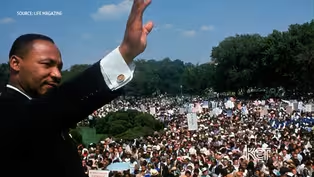
Tomorrow is the 60th anniversary of the Frankfort civil Rights March that included Doctor Martin Luther King Junior.
The Fraser Museum in Louisville observed that anniversary with some of the original marchers in attendance to talk about the March and the civil rights movement in Kentucky.
>> I understand the to the editor of the Black owned Louisville defender newspaper decided to organize a march on from her.
Remember, this is coming on the heels of the march on Washington and Doctor King's I have a dream speech in August of 1963, as the organizers wrote to those who made the decision to March in Frankfort.
And I quote You as a believer in the cost for human dignity are making your wishes known by participating in this historic petition of our elected officials for a redress of grievances.
People came from.
>> called >> these people, you know, that's the been the place it might be from wind.
Just people who came from all over the state 2000 people to leave you with about that.
they >> It was all to you.
Why the money on Washington made it to my home front foot.
>> With 64 civil rights Bill.
That only made it to 66 civil rights bill, you can not be so similar.
Rights was all in the world that.
>> And on the Kentucky Commission on Human Rights was >> When people do that with any of the state Human Rights Commission, well, first, the so launches in 64 that made the foundation for the passage of legislation says C. But then the commission and the same authority as a of law, the rest of the complaints of discrimination, all of that never been in place.
It not been for the last 2 days before the civil rights movement continues today.
So when we talk about what was going on with the fight for Israel, and I believe that what we're seeing now >> is also in the frame for are trying to make of this a little too on not only what our Shaw's that what many of these folks the mayor has a little bit of the people who but I hope our top stories from all our mothers and our great man.
>> our troops marchers will reenact the 1964, march on Frankfort and the Capital City Museum.
Participants will march to the Capitol for a program at noon on the Capitol steps.
Kentucky edition will be there for that March.
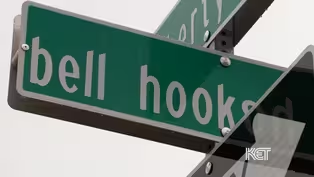
A new Street sign Grace's downtown Hopkinsville in honor of in a bid to native daughter to those who KET her growing up.
She was Gloria Jean Watkins to the rest of the world.
She's best known as Bell hooks.
Well, Rodgers explains how her home town is celebrating and preserving her legacy.
>> We didn't her work.
It's helped me to just become a more open-minded person.
Jada Poindexter is one of the countless young women and Speier by the works of Bell Hooks from of all about love it.
It's amazing.
First of all, and it really just shows see you.
How the world needs so much more love that one of the main problems with the world, Jay to herself, a young writer wrote the poem belonging as a Black woman featured at Friday's dedication of Bell Hooks Way.
>> I was really John to write about belonging as a black one in because there's been so many times that I haven't felt like that I belong to wherever I am simply because of the color of my skin.
>> Perhaps Bill Hooks with say the same.
She wrote nearly 40 books on the topics of race, gender and class and is known the world over as a feminist icon.
>> Her works go beyond the borders of any mask.
One of the things that she was concerned about was leaving a legacy.
So this just is the icing on the cake.
>> Glenda Motley led the charge to honor her late sister with her own street and the city where they were born in Rays.
>> That she would be very happy.
The fact that her hometown Hopkinsville is naming a street after her.
>> The new site now prominently displayed just steps away from her mural and the bell Hooks legacy room at the pay Royal Area Museum.
>> Was absolutely wonderful.
It's emotional to me.
The room includes photographs and personal items from hooks Perea home offering an intimate look at her life and books in particular on feminism, leave a lasting impact.
>> It's a way to get to understand that people should treat people fairly ship, treat people with respect.
Shell love, show care, show concern.
>> Hopkinsville, embracing the legacy of the woman who despite her fame have seen her on TV.
And now it's yeah.
I know.
Gloria never shied away from her western Kentucky roots to have bill folks say in her writings that I am from Hopkinsville, you might go to the map and see where in the world is that and then you might come here.
>> And when you do, you just may pass by or turn down the street that bears her name.
I'm going to think.
>> Well, for a gene, there you are.
How about that?
>> For Kentucky Edition.
I'm Laura Rogers.
>> The documentary becoming Bell Hooks airs again this Wednesday on KET.
Why?
And on March 31st at 2, one central right here on KET.
You can watch any time a ktv dot org.
♪ ♪ March is colon Cancer Awareness Month and you might see more people wearing blue.
The Kentucky Cancer Program is encouraging people to wear blue all month and talk about screening for colon cancer because it is preventable and treatable.
When caught early Kelsey Start sat down with the honorary chair of Colon Cancer Prevention month.
Who explains why it's so important.
>> Well, we're here with a familiar face.
Madeline Abramson is the former first lady of Louisville, former second lady of Kentucky.
>> And also the honorary chair of Cancer, Colon Cancer Prevention Month, which begins here in March.
Tell us why you got involved in this cause in the first place.
You've been doing this a long time.
Well, thank you for letting me join you today.
Yes, Sir.
>> Ben, the honorary chair of Colon Cancer Prevention month for over.
25 years I had we say the opportunity to have a fairly young age and that was quite intimidated by that.
And after that, it the results were fun, but it may be real last that.
How important it is to talk about colon cancer and a knot.
It's not a taboo subject.
It's something we all need to be discussing in.
I'm thinking it's the second leading cause of cancer deaths in Kentucky.
So it's important that we in and our loved ones get a screen.
And so March is the the month where we talk colon cancer and prevention and screening in those screenings are so important.
But you're right.
It's kind of a taboo subject.
It's getting better, I think.
But >> still, second leading cause of cancer deaths.
So who should get screened?
And when?
it's recommended.
Beginning at age.
45 that people get get screen.
But if they have a >> a family history or other other factors that might even be earlier.
So I think the best thing is for people to talk with your primary care physician and see what's right for them.
>> And it's one of those cancers to that is preventable.
And it's treatable.
As long as it's caught early on.
early on, there are very few symptoms.
So that's West screening is so important because >> if you wait long enough for the symptoms to show up, then it's and that's not that's not >> let's talk about those A lot of people say it's not as bad as you think.
It will It's a fairly easy process right?
>> It is a an easy process and there are multiple forms of of screening available.
Well, that's what's so important for people to speak with their physician to see which form of testing is is right for them.
>> does insurance cover it?
I know that's at one thing.
A lot of people talk about I can't afford it.
>> Well, cover said that there also available programs throughout the state for people to take advantage of a state do not have insurance or are they are under ensure that that shouldn't be a barrier to getting screened.
>> And it colon cancer is on the rise particular demographic.
People ages 45 to 49.
And so that's why they say 45 is an important time, too.
>> Start, right?
Yes, it used to the recommendation was.
>> Have a screening 15 or older, but because of the prevalence of colon cancer at a younger age that the the threshold was moved to 40 fact.
Yeah.
So that has changed.
And so that's something to KET in mind.
there are programs that will cover And if you want to find more about how to get screened, the Kentucky Cancer program is.
>> screenings all month long all across the state.
So you can get in touch with the Kentucky Cancer program to find out some of those screening Syria.
Back to you.
♪ ♪ >> When someone with special needs graduates from high school there options for the next chapter may be limited.
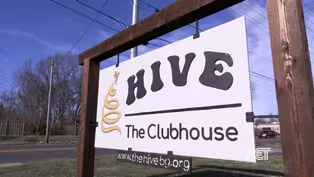
The clubhouse in Bowling Green is providing a safe space for those adults offering community and connection.
Well, Rodgers takes us to the hive.
>> We're transitioning from middle school to high school.
And I was absolutely terrified.
>> Our oars linson Tay will turn 30 this year, but it was another milestone some years ago that had her pondering his future.
It just hit me like a brick in the chest.
His next transition would be out of school into Those concerns expressed by other parents in the same boat.
I was worried like Graham, Richardson's mother, Janice, the special ed programs at school and very interactive and very involved.
But the day they graduate, which he graduated at.
21.
>> There's not any thank to go to anymore and will pass those out on had the skill set the tools and resources to support network.
>> 2 provide for him.
I realized I was in the minority.
She began intensive research on what services were available and what was needed for special needs adult.
Yeah.
And I played early.
I would talk to anybody that would hold still long enough.
Listen to me.
I went every conference, every seminar, every state advocacy network, everything.
In one day on a drive home from Frankfort and Epiphany.
And it just hit me.
The high.
The skies opened up and just saying when I KET that was it and Akron, him for his villa Taishan information, vocation and education and the symbolism of the productivity of a beehive.
>> We may be small may be unseen but needed.
>> It's very as parents to have a place that our loved ones can do to and not only go to but be focused on their success in the future.
The hive has been a game changer for Graham.
His mother says here he's able to socialize and learn helpful life skill.
>> They really work with each participant on what's going to make you successful, independent, able to do more on We're all family here and it's a pretty cool place to be.
And really far, Bethany Jones graduated from high school in 2008 today.
She comes to the hive twice a week.
We go out and have fun and learn to live here.
And it's really important to have an education really is that education includes healthy, living with nutrition and exercise.
>> Art science kitchen safety and recipe.
>> I want to learn how to make a chocolate cake.
I don't know how to do that.
Yeah.
>> The high brings peace of mind to parents and caregivers.
We as parents have very few places that we can take our loved ones and not feel like we have to worry that their behavior.
>> When we come to the hive, Graham is is much able to be Graham as he possibly want And just like bees, build a hive working together toward a common goal.
The same can be said for this time.
>> From downers to families to members to direct support professionals.
Everybody has been a part of what makes it cool thing that it is now and the unique thing that it is now for Kentucky edition.
I'm Laura Rogers.
The high to serve more than 500 people since it began in 2017.
>> They're mostly funded by grants and donations.
Membership costs.
$25 a month.
All they although they don't turn anyone away.
♪ ♪ Henry Clay, Abraham Lincoln and an alternate spelling of Kentucky are to be Gibbs has all of that in tonight's look at this week in Kentucky history.
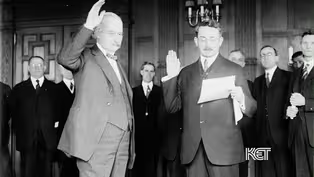
♪ >> Lexington's Henry Clay was sworn in as a member of the U.S. House of Representatives on March 4th, 18, 11.
It didn't take long for him to move up the ranks even though he was a freshman, he became speaker of the House the same day.
If I became secretary of state on March 5th 18, 25 after his appointment by President John Quincy Adams.
This week we observed both of Abraham Lincoln's presidential inaugurations is first was March 4th, 18 61.
His second was March 4th, 18.
65.
>> Lexington received its first telegraph message on March 6, 18.
48, it was a message from Louisville Center after the building of the first telegraph line earlier in the year.
The Kentucky General Assembly Chartered the Louisville and Nashville Railroad often called the Ellen and on March 5th in 18 50, it became an important union supply route during the Civil War.
Albert Beef all born in Frankfort became secretary of the interior on March 5th 1921.
It didn't end well.
Ball was a central figure in this game to allow oil companies to drill on public land in exchange for bribes.
The Teapot Dome scandal, the ball went to prison.
He was the first cabinet secretary to do jail time.
Were Kentucky ended with a instead of a Y until March 7.
17 89 when the Virginia General Assembly change that Kentucky was part of Virginia at the time.
And that's a look back at this week in Kentucky history.
>> I'm Toby Gibbs.
>> Kentucky looks better with a while and Kentucky observes important anniversary tomorrow.
It's been 60 years since a major civil rights march in Frankfort.
That included Doctor Martin Luther King Junior.
Frankfort plans a reenactment of that March on the capital.
Kentucky Edition will be there seeing here more tomorrow.
We hope you'll join us again tomorrow night at 6.30, Eastern 5.30, central for Kentucky Edition, we inform connect and inspire.
You can subscribe to our Kentucky Edition.
Email newsletters and watch full episodes and clips at KET Dot Org.
You can also find Kentucky Edition on the PBS video app on your mobile device and smart TV.
Send us a story idea.
Public affairs at KET Dot Org and follow KET on Facebook X, formerly known as Twitter and Instagram to stay in the loop.
I'm Casey Parker Bell.
Thank you for joining us tonight.
And I hope you have a great evening.
♪ ♪
Video has Closed Captions
Clip: S2 Ep197 | 3m 15s | A new street sign graces downtown Hopkinsville in honor of native daughter bell hooks. (3m 15s)

Video has Closed Captions
Clip: S2 Ep197 | 4m 18s | The Kentucky Cancer Program is encouraging people to wear blue all month. (4m 18s)
Video has Closed Captions
Clip: S2 Ep197 | 3m 37s | Restoring voting rights to formerly incarcerated Kentuckians finds bipartisan support. (3m 37s)
Video has Closed Captions
Clip: S2 Ep197 | 3m 51s | The Hive offers resources for adults with intellectual and developmental disabilities. (3m 51s)
Video has Closed Captions
Clip: S2 Ep197 | 3m 6s | Frazier Museum commemorates the 60th anniversary of the March on Frankfort. (3m 6s)
This Week in KY History (3/4/2024)
Video has Closed Captions
Clip: S2 Ep197 | 1m 58s | A look back at this week in Kentucky's history. (1m 58s)
Video has Closed Captions
Clip: S2 Ep197 | 3m 8s | UK law professor on SCOTUS ruling restoring Donald Trump to Colorado election ballot. (3m 8s)
Providing Support for PBS.org
Learn Moreabout PBS online sponsorship
- News and Public Affairs

Top journalists deliver compelling original analysis of the hour's headlines.

- News and Public Affairs

FRONTLINE is investigative journalism that questions, explains and changes our world.












Support for PBS provided by:
Kentucky Edition is a local public television program presented by KET