
March 5, 2026 - PBS News Hour full episode
3/5/2026 | 57m 46sVideo has Closed Captions
March 5, 2026 - PBS News Hour full episode
March 5, 2026 - PBS News Hour full episode
Problems playing video? | Closed Captioning Feedback
Problems playing video? | Closed Captioning Feedback
Major corporate funding for the PBS News Hour is provided by BDO, BNSF, Consumer Cellular, American Cruise Lines, and Raymond James. Funding for the PBS NewsHour Weekend is provided by...
Support provided by:

March 5, 2026 - PBS News Hour full episode
3/5/2026 | 57m 46sVideo has Closed Captions
March 5, 2026 - PBS News Hour full episode
Problems playing video? | Closed Captioning Feedback
How to Watch PBS News Hour
PBS News Hour is available to stream on pbs.org and the free PBS App, available on iPhone, Apple TV, Android TV, Android smartphones, Amazon Fire TV, Amazon Fire Tablet, Roku, Samsung Smart TV, and Vizio.
Providing Support for PBS.org
Learn Moreabout PBS online sponsorshipGEOFF BENNETT: Good evening.
I'm Geoff Bennett.
AMNA NAWAZ: And I'm Amna Nawaz.
On the "News Hour" tonight: The war with Iran widens, threatening energy infrastructure and risking more countries being pulled into the conflict.
GEOFF BENNETT: We speak with Iranian Americans, who express hope and fear about what comes next.
KOWSAR GOWHARI, Iranian American: I'm really concerned for the future of Iran politically.
Also, on a personal level, I'm very concerned for my family and friends.
AMNA NAWAZ: And President Trump replaces Homeland Security Secretary Kristi Noem after months of controversy over the immigration crackdown.
(BREAK) AMNA NAWAZ: Welcome to the "News Hour."
We have two major stories tonight.
The president today fired Kristi Noem as the secretary of homeland security, the first member of his Cabinet to be ousted in his second term, but first to the war.
GEOFF BENNETT: Just days after the U.S.
and Israel launched the war with Iran by targeting and killing its supreme leader, President Trump today said he should be involved in selecting the country's next leader.
As the war spreads across the region, the U.S.
State Department says the U.S.
embassy in Kuwait will be closed until further notice.
And there's little sign of a letup, as the U.S.
and Israel pressed the attack inside Iran, where more than 1,200 people have been killed.
In Tehran today, residents watched in shock as dark plumes of smoke engulfed a beloved landmark, the Azadi, or Freedom Stadium, destroyed, once a sprawling sports complex that seated 12,000 people today reduced to a charred shell.
Not much remains but smoking ruins of the building that once hosted international games to packed crowds.
The U.S.
says it is targeting Iran's ballistic missile infrastructure, military equipment and drones.
And Israel today said it shot down an Iranian fighter jet.
But across Iran today, multiple cities were rocked by explosions.
In Iran's northwestern city of Urmia, the Iranian Red Crescent posted this video of what it says is widespread damage to residential areas.
The Iranian Health Ministry said more than a dozen hospitals and other key parts of Iran's health infrastructure have been damaged so far and four health workers were killed.
The World Health Organization said it has verified 13 of those attacks.
Today Iran's foreign minister denounced the U.S.
for sinking an Iranian warship, calling it an atrocity at sea.
He said Iran is no longer looking to negotiate.
ABBAS ARAGHCHI, Iranian Foreign Minister: Well, I think, now, six days after the war, it is clear that the U.S.
has failed to achieve its main goal, which was a clean, rapid victory.
We are not asking for a cease-fire.
And we don't see any reason why we should negotiate with the U.S., when we negotiated with them twice, and every time they attacked us, the middle of negotiations.
GEOFF BENNETT: And as Iranian media showed videos of crowds gathered in support of the regime for a fifth consecutive night, the conflict keeps growing wider.
Even Azerbaijan, to Iran's north, has now been drawn into the fight.
Officials there say several Iranian drones hit an airport and a school, which Tehran has denied.
Several were injured.
The country's president vowed to respond.
ILHAM ALIYEV, President of Azerbaijan (through translator): Those dishonorable perpetrators who committed this terrorist act against us will regret it.
They should not test our strength.
All necessary instructions have been issued and additional diplomatic measures will follow.
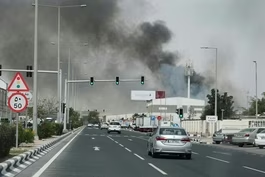
GEOFF BENNETT: Tehran's onslaught also continues on Gulf state energy.
Bahrain said an Iranian missile slipped through its air defenses and set a state-run oil refinery ablaze.
And as the critical Strait of Hormuz remains effectively closed to tanker traffic, energy concerns have rippled all the way to China, the world's largest importer of oil and natural gas and the biggest buyer of Iranian oil.
Beijing said today its government dispatched a Middle East envoy with the hope of starting talks.
MAO NING, Chinese Foreign Ministry Spokeswoman (through translator): China believes that war and force cannot fundamentally solve problems.
Dialogue and negotiation are the right path.
GEOFF BENNETT: But dialogue remains elusive.
On the streets of the Lebanese capital, Beirut, more buildings toppled from Israeli airstrikes.
At least 100 people have been killed.
Israel says it's targeting Hezbollah command centers.
Traffic snarled today as residents rushed to flee after Israel told people to evacuate the city's southern suburbs, a Hezbollah stronghold.
Israeli officials say it's too soon for diplomacy, among them, the country's far right finance minister, who said Beirut would soon look like a war-ravaged Gaza.
BEZALEL SMOTRICH, Israeli Finance Minister (through translator): You wanted to bring hell on us.
You brought hell on yourselves.
Dahiyeh will look like Khan Yunis.
GEOFF BENNETT: For his part, President Donald Trump today looked beyond the war, telling Axios that he needs to be personally involved in the selection of Iran's next leader.
He said the current likely successor, the late supreme leader's son Mojtaba Khamenei, would be unacceptable.
In a separate interview with Reuters, Mr.
Trump encouraged the Iranian Kurds, trained by the CIA, to fill the vacuum.
"I'd be all for it.
If they're going to do that, that's good."
That's as the Pentagon also released the names of the two remaining U.S.
soldiers killed this past weekend when Iran struck a tactical operation center in Kuwait, 45-year-old Major Jeffrey O'Brien of Iowa and 54-year-old Chief Warrant Officer Robert Marzan of California.
Their remains and the remains of four other American service members killed in action will soon be returned to U.S.
soil.
The largest U.S.
military base in the Middle East is in the small Gulf nation of Qatar.
And joining us from its capital, Doha, is special correspondent Leila Molana-Allen.
Leila, it's good to see you.
So you're in the Gulf right now.
Based on your reporting, how are these attacks affecting countries across the region?
LEILA MOLANA-ALLEN: We have.
We have come here just as many people are thinking about leaving as this conflict escalates.
This has been unprecedented for the Gulf nations.
Hundreds of cruise and ballistic missiles, of drones have been launched at these countries by Iran.
On the first day of the conflict.
Nearly as many were fired at the UAE as were fired at Israel, the country that was attacking Iran.
The calculation seems to have been that maybe the UAE is the most able to ask the United States to stop.
Now, at the moment, the missile defense systems here are doing a pretty good job of taking down those missiles.
The drones are trickier.
But the issue here is that what the Gulf nations have built is stability.
That is their key.
And Iran doesn't have to destroy these countries.
It just has to pierce that stability to stop their success.
The second issue, of course, is they built it on wealth.
Now, already with those missile defense systems spending huge amounts of money, but also attacks on tourism, on hotels, on airports, and the stopping of three of the largest traffic airports in the world for almost a week now in the Gulf at a cost of over a billion dollars.
Now, the initial reaction, of course, is anger at Iran.
Yesterday, Iran's foreign minister called the Qatari foreign minister, saying that, we are not attacking the Gulf.
We're just attacking the American presence there.
The Qatari foreign minister responded, that was completely untrue.
They're dragging the Gulf into a war that is not their own.
And even though the Gulf has always been neutral thus far, he said these attacks cannot go unanswered.
Now, that would be a huge change in the stance of the Gulf nations if they decide not to be neutral anymore.
But the longer-term issue here is these U.S.
bases.
Now, thus far, Gulf nations have hosted U.S.
bases because they seem to believe they will get defensive capability from the U.S.
in return.
The issue, of course, is that in the past few years with the reduction of the military presence in the Gulf, already they were starting to feel maybe that wouldn't happen.
And last year in 2025, with the attack on Hamas operatives inside Doha, that was seen as an absolute crossing of the line.
So that would be another huge strategic shift in the region if they stop hosting those bases.
GEOFF BENNETT: And, Leila, we know communication with Iran is extremely difficult right now, but I understand you have managed to reach some people there.
What are they telling you about how this war is affecting daily life?
LEILA MOLANA-ALLEN: It is incredibly hard to reach anyone inside Iran.
What they are saying when you manage to get through to them in moments of connectivity is that the streets are completely empty.
People are just staying inside, absolutely terrified.
They say the bombing is terrifying.
It's constant.
It's everywhere.
Some people have thought about trying to move in Tehran to the north of the city, this great Tehran region of over 16 million people, but they haven't got any petrol, and the roads are completely packed.
So, many are just staying put inside their houses.
Now, while Israel and the United States say that they are only attacking military and government infrastructure, that simply isn't reflected in the number of civilian deaths we're seeing.
In these densely populated areas, like the capital, many people live right next to these government buildings, and their homes are taken out when those strikes hit.
And it's so important to remember that in Iran no one has access to any air raid sirens, to any shelters, and they don't have any missile defense capabilities, which were all knocked out last year.
So Iranian civilians are completely defenseless.
And the other issue they're facing, of course, is that they don't have any communication.
The Internet's completely down.
Phone lines are completely down.
GEOFF BENNETT: Leila Molana-Allen in Doha for us tonight.
Leila, thank you.
AMNA NAWAZ: For additional perspective now, we turn to retired Rear Admiral John Kirby.
He's the former White House national security communications adviser in the Biden administration.
Admiral Kirby, welcome back to the show.
Can I begin by just asking for your reaction to a little bit of news we heard from the Iranian foreign minister, saying earlier his country is ready for a U.S.
ground invasion, that they're prepared to fight U.S.
troops on Iranian soil?
We know President Trump hasn't ruled out ground troops.
What do you make of that?
Could that actually happen?
REAR ADM.
JOHN KIRBY (RET.
), Former Pentagon Press Secretary: I don't think that that's what the administration wants to do and I think they have been kind of clear, although they're keeping their options open, and obviously you don't want to foreclose any decision space by the commander in chief.
It doesn't appear that they're very enthusiastic about moving in on the ground and that kind of an option.
And as for what the Iranian foreign minister said, I mean, that's the kind of bluster you would expect to hear out of these guys to intimidate or to bolster their own sense of morale and perhaps point to their readiness to fight a ground invasion.
But I really don't see that right now as a strong option, and it certainly doesn't seem to be something that the Trump administration is really leaning towards in any great -- with any great energy.
AMNA NAWAZ: What about what we have heard from President Trump, in that he would back Kurdish militias if they launched an offensive inside Iran?
In your view, is that good policy and what kind of impact could it have on the war?
REAR ADM.
JOHN KIRBY (RET.
): You know, I think I need to know more about what their plans are.
I do worry a little bit about trying to foment an uprising when you clearly aren't going to be on the ground yourself to help direct how that goes.
I mean, you're counting on another party here, who may be well-trained or not, to sort of take it in a direction that you're expecting it to go.
And I think it could be very, very unpredictable.
I also think it's important to remember that, as your reporter just indicated, the Iranian people are staying indoors.
They haven't -- for 50 years, they have really not had the opportunity to develop a strong organized opposition or resistance effort.
They don't have arms and ammunition.
The regime still does.
So it's very unclear to me that this would be able to at scale literally foment an uprising that could topple the regime.
But, again, I think it's only been an idea floated here today.
We don't have a whole lot of more information about it to really judge it.
But it does worry me in terms of the additional violence it could visit upon the Iranian people, who are defenseless right now.
AMNA NAWAZ: If you take a step back and look sort of a broader picture at this war, the way it's been carried out so far, we have seen an evolving explanation from the administration about why it's being carried out, about why now it was begun as well.
And part of it centers around the idea that Iran is weaker now than it has ever been and that this prevents a nuclear-armed hostile regime in Iran.
In your view, is that worth it?
REAR ADM.
JOHN KIRBY (RET.
): I think, first of all, I'm not shedding any tears about the loss of the supreme leader or the pressure that the regime is under.
I get behind nobody in my hatred of what the regime has done in the region and to the Iranian people.
It is unclear.
Because the messaging on this has been sort of all over the place, it's really unclear to know and to be able to take confidence in the fact that this was something that really did present the kind of imminent nature of a threat that needed to be responded to as quickly and as swiftly as it was.
And I think we need to have more information before the American people can really make a judgment about that.
And while it's good to see a Pentagon out there doing briefings, and Secretary Rubio on Capitol Hill talking to the press, I think there's an awful lot more transparency that the administration really should come forward with here to the American people to kind of answer exactly those questions.
AMNA NAWAZ: If it does result in regime change, though, to a regime that has been hostile to the U.S., hostile to U.S.
allies, is that worth it?
I mean, if President Biden had had a chance to assassinate the ayatollah, would he have taken it when in office?
REAR ADM.
JOHN KIRBY (RET.
): Let me put it this way.
If, as a result of all this, a government can be formed in Tehran that is responsive to the needs of the Iranian people, a government that they have a vote, that they have a voice, that they get to install, and can bring them into the community of nations, which so many young Iranians really want to do, then obviously that is a good outcome of all this.
But the history doesn't point us in that direction.
The history says that, when authoritarian regimes are toppled or fall or collapse, most likely, they are replaced by other authoritarian regimes.
I hope that's wrong.
I hope that's not what happens.
But I'm concerned right now about the what next and certainly what's going to be a government in Iran that can be responsible in the region.
And, right now, I just don't see any signs that there's been enough of strategic thinking and long-term thinking about exactly what comes next.
There's lots of talk today about what's bombed and what's destroyed and what the Iranians can't do anymore militarily.
But I don't think we're hearing enough about what is in their future and what can be done to make Iran a more peaceful nation and, again, one that's responsive to the Iranian people.
AMNA NAWAZ: As part of that administration talk about this war, as you mentioned it there, we have heard from the secretary of defense talking about the U.S.
sending death and destruction from the sky.
We have seen him accuse the media of wanting to make the president look bad when we report on U.S.
soldiers who are being killed.
As someone who was responsible during your time there in the Biden administration for managing the message and communicating with the public, what do you make of how this administration is talking about this war?
REAR ADM.
JOHN KIRBY (RET.
): Well, when you hear the Joint Chiefs chairman, General Caine, do his briefings, they're very thoughtful, they're very contextual.
He's keeping it to the facts and the figures, and he's being very realistic and pragmatic about what we're doing and the resistance we're facing, the retaliation by the Iranian military, and he lays it out pretty clearly.
I think it's really important, when you're talking about issues of war and peace, that you're direct and simple and concise with the American people.
They need to know, they deserve to know, how their military is being used in their defense.
And, again, I take no backseat to anybody in terms of my hatred of the regime, and so hitting them while they are weaker or getting weaker, certainly from a military perspective, makes a lot of sense.
But I do think it's important, when we're talking about war, when we're talking about military operations, that we do it in a way that is respectful of the unpredictability and the uncertainty of what's going to happen in the coming days and weeks.
The truth is, we don't really know.
And I think humility when you're talking about war and peace is always a good thing.
AMNA NAWAZ: That is retired Rear Admiral John Kirby joining us tonight.
Thank you so much for your time.
Good to speak with you.
REAR ADM.
JOHN KIRBY (RET.
): You too.
Thank you.
GEOFF BENNETT: There are more than a half-million people of Iranian ancestry living in the U.S.
We spoke with some of them to learn how they're feeling about the war and what might come next.
ZAHRA ASSAR-NOSSONI, Iranian American: My name is Zahra Assar-Nossoni.
I'm an American Iranian.
I moved to U.S.
14 years ago to pursue my Ph.D.
I grew up in Iran my entire life, but I did not see any future to stay and work there because the government - - because of the government.
HAMID KASHANI, Iranian American: My name is Hamid Kashani.
I came from Iran in 1973 following graduating from high school to attend higher educations in the United States.
REZA EBRAHIMI, Iranian American: I am Reza Ebrahimi.
I'm 37 years old.
I came to United States on the age of 27 in 2015.
I'm a volunteer firefighter.
I'm a member of the sheet metal union.
I'm a U.S.
citizen.
KOWSAR GOWHARI, Iranian American: My name is Kowsar Gowhari.
I was born in 1979 at the heart of revolution.
Parents were students here in the U.S.
I was 8 months when they decided to go back to Iran.
I grew up in Iran.
And in 2003 after graduating from undergrad, I moved to the U.S.
and ever since I have been living in the state of Maryland.
ALI TAROKH, Iranian American: My name is Ali Tarokh.
And I arrived here 13 years ago as a refugee, to the U.S.
Refugee Admission Program from Iran.
BETTY EMAMIAN, Iranian American: My name is Betty Emamian.
I came to United States in 1982.
I left Iran in 1978.
It is very difficult to watch, especially for us in diaspora, because we're not there, we're not in the forefront.
We're praying that the men and women of Iran who are opposing this regime get their country back.
And at the same time, we just take it day by day and glued to the news channels and social media outlets.
ZAHRA ASSAR-NOSSONI: I woke up Saturday morning.
I woke up to the news.
Definitely, at first, it was shocking.
It was scary.
But then we heard the news that the supreme leader was targeted and was killed.
That was the start to feel for us, it was an exhale, the exhale of like, OK, there's finally some justice.
KOWSAR GOWHARI: Although I know, again, that the grievances were very, very valid, very legitimate, I don't see any foreign intervention bringing any betterment of life to Iranian people.
So, with worry and sadness and anxiety, I watch the news, and I'm really concerned for the future of Iran politically.
But, also on a personal level, I'm very concerned for my family and friends.
I'm hoping for the cease-fire soon, because this war won't benefit anybody, any parties involved.
REZA EBRAHIMI: When they started dropping bomb, like, we were like so excited.
I was happy.
I was like, my heart was coming out of my chest.
But I was crying at the same time.
I couldn't believe it.
HAMID KASHANI: You never want your country to be invaded by an outside force.
You don't want the innocent lives lost.
But in the current situations and what occurred just a few weeks ago with the massacres in the streets, we realized that the people are -- hands are empty against a vicious regime that has no qualms about mass killing of its own people.
REZA EBRAHIMI: We can build it again.
The damaged regime down to Iran, it's more than whatever the bomb going to do it.
On Sunday, we had to go to a rally.
I was excited to talk to people.
It is very important for every single Iranian.
We always talk about it.
Show Americans who we are.
KOWSAR GOWHARI: We go to protests.
We want to be seen.
We want to be heard.
I mean, it's chaos just seeing those pictures of these schoolgirls killed in Minab elementary school.
It became very impactful in terms of making diaspora understand what the impact of military intervention would be.
ALI TAROKH: I used to be a political activist.
And, in 2009, after the election, I was arrested.
I was in solitary confinement for four months.
And, later, they put me in prison for two years.
I don't like the regime.
I want them to go.
But I learned it's very important how to make changes, OK?
I am against any foreign intervention.
It's very hard to see this war happen inside Iran.
And my most frustration is on Iranian diaspora pushing for that war, and they sold the war as a good thing.
REZA EBRAHIMI: War is tough.
But everything has a cost, yes.
But, also, we always look at the daylight after it.
We believe on Reza Pahlavi.
His father built Iran very strong.
ALI TAROKH: Since the war started, I prepared myself for any scenarios, bad news.
And, today, my mom called me.
And, whew, they are ready to be killed, OK?
And this is the reality.
HAMID KASHANI: We did witness the result of the invasion of Iraq, for example.
And we saw the aftermath for years and years and years.
And then we saw what's happened in Afghanistan.
So we are definitely worried about the outcome in Iran.
ZAHRA ASSAR-NOSSONI: Living in this moment, it's really scary, because, again, I was born in Iran.
I grew up in Iran.
I know these people, but we're all hopeful and positive and hoping there will be a light at the end of this tunnel.
AMNA NAWAZ: Well, since its joint attack with the U.S.
on Saturday, Israel has faced a wave of drone and missile attacks from Iran and has also come under fire from Iranian proxy Hezbollah in Lebanon.
Producer Karl Bostic spoke with Israelis in Tel Aviv today.
And Nick Schifrin brings us their stories.
NICK SCHIFRIN: Today in Tel Aviv, Shaked Ze'evi and her daughter's neighborhood park is no longer a safe haven, just behind them, their apartment, windows blackened and gutted by an Iranian missile.
SHAKED ZE'EVI, Mother: Our house got hit.
The windows in the kids room fell.
NICK SCHIFRIN: Today is the first day that she and 1.5-year-old Gaya have returned since last weekend's attack.
So she hugged her daughter just a little tighter.
SHAKED ZE'EVI: It's really sad, really sad.
I don't know what we're going to do.
NICK SCHIFRIN: Iran has fired hundreds of missiles and drones at Israel.
The deadly fireworks and the sirens are constant.
Toddlers understand and inherit their parents' fear, so Ze'evi tried to turn her daughter's frown upside down.
SHAKED ZE'EVI: So every time there is a siren going on, she would start repeating it.
Wee, wee, wee, wee.
We're trying to do it at home with smiles and musical kind of way, so she won't be scared.
So we would run through the shelter laughing and singing, trying to make it more -- not as scary.
Gaya, at 1.5 years old, knows when it's time to go to the shelter.
NICK SCHIFRIN: The city is filled with broken windows, some cleaned up by 18-year-old Israeli-American Ron Shifroni.
He's a volunteer who delayed college in the states after growing up here in Israel.
RON SHIFRONI, American-Israeli Volunteer: We kind of grew up on this mentality in Israel where we always got to help each other no matter what happens.
And we're ready for every scenario.
And then, whether it's a rocket or October 7, we're just -- all we grew up is the values of going and helping out each other.
NICK SCHIFRIN: He cleans up inside people's damaged apartments.
He wants to serve in the military, but didn't think he'd end up in the middle of war in the country of his birth.
RON SHIFRONI: It's really devastating that it's my home country, it's my home after all, so I really -- I want to live in peace.
NICK SCHIFRIN: But Israel is not at peace, and for every damaged house is a displaced family... SHANINE ROTH, Israel Resident: Hello.
NICK SCHIFRIN: ... trying to turn a hotel into a makeshift home, Shanine Roth (ph) greets her grandmother, Dorica Israeli; 84-year-old Israeli is older than the state of Israel, but she knows this is a different type of war.
DORICA ISRAELI, Israel Resident (through translator): Here the wars don't end, and this war is a bit harder than the previous ones.
Roth has translated for "PBS News Hour" and was translating for her grandmother when interrupted by this city's shattering soundtrack.
(SIRENS BLARING) SHANINE ROTH: Yes, we need to go.
NICK SCHIFRIN: This is their routine, made normal since October 7.
They walk away to a nearby shelter and to an uncertain future.
(SIRENS BLARING) NICK SCHIFRIN: The sirens are all too routine outside Sheba Hospital, as is outgoing missile defense hunting incoming Iranian missiles.
And in these times of war, this passageway doesn't only lead to a shelter, because three stories down through reinforced doors is a fully functioning hospital that has 2,000 beds and three operating rooms and has operated almost constantly since last summer's war with Iran.
DR.
YOEL HAR-EVEN, Sheba Medical Center: Almost all the activity of Sheba and other hospitals went now underground due to the different ammunition that we are getting from Iran.
NICK SCHIFRIN: Dr.
Yoel Har-Even is a vice president at this hospital with thousands of visitors every day and staff that must cope with their own displacements and find their own moments of peace.
DR.
YOEL HAR-EVEN: We don't have time to play.
We need to be ready within a few hours and start moving our patients from the upper floors to the basement.
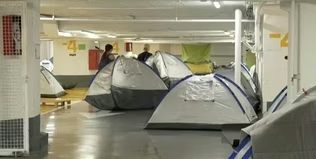
NICK SCHIFRIN: That shift also apparent in Dizengoff, the city's largest mall, where behind the reinforced door four floors down is now the city's largest shelter; 4,000 people rushed here just last night, including 12-year-old Eden, 10-year-old Lev, and their father, Jeffrey Lubotta.
JEFFREY LUBOTTA, Evacuee: We do actually live not far from a bomb shelter, but it means no sleep through the night, up all the time running outside to the bomb shelter and it's crowded, cramped, lots of dogs.
So here we can just remain, sleep through the night, have space, and during the day there's a mall above us, little shopping, little food collecting.
NICK SCHIFRIN: A little humor helps, and the kids are happy they don't have to go to school.
But for many here, beneath that facade is pain.
SIENNA, Evacuee: I think as a nation we have got collective trauma.
I think it's like something that's kind of on the whole we all have.
NICK SCHIFRIN: Sienna, who declined to give her last name, admits she doesn't know when she will feel safe again living above ground.
SIENNA: Yes, I'm processing the possibility I might be here for a week or two.
I might be here for a few months.
Who knows how time goes on.
NICK SCHIFRIN: She and everyone here try to bring some color to the concrete.
SIENNA: We learn how to get on with it, but this is not how every day should look.
We're just trying to find the best in an absolutely horrendous situation.
At the end of the day, people are dying, people's homes are getting destroyed.
NICK SCHIFRIN: And that means it is not easy.
As the country wages war, some of its residents are driven underground.
For the "PBS News Hour," I'm Nick Schifrin.
GEOFF BENNETT: Now to our other major story of the day, the first Cabinet shakeup of President Trump's second term.
This afternoon, the president fired Homeland Security Secretary Kristi Noem.
Despite the decision, Noem went ahead with a previously scheduled speech in Nashville, making no mention of her dismissal.
She had faced bipartisan criticism in recent months over the agency's handling of the immigration crackdown, delays in emergency response, and a $220 million ad campaign in which she was prominently featured.
President Trump says he has created a new role for her called special envoy for the Shield of the Americas.
He also announced his choice to replace Noem.
That's Senator Markwayne Mullin of Oklahoma.
Lisa Desjardins is here with more.
So, Lisa, what was the breaking point?
LISA DESJARDINS: As you say, Noem had been under increased scrutiny because of the ICE crackdown in American cities and the documented deaths of Americans and violent detentions that were on videotape.
Now, it does seem, however, that really the breaking point was testimony this week and that $220 million ad campaign that you mentioned, which prominently featured her.
Some of our viewers have seen that footage before.
And that ouster really came especially during a key moment that I saw and our viewers saw when we reported on this, when Senator John Kennedy of Louisiana questioned her about this.
SEN.
JOHN KENNEDY (R-LA): The president approved ahead of time you spending $220 million running TV ads across the country in which you are featured prominently?
KRISTI NOEM, Former U.S.
Homeland Security Secretary: Yes, sir, we went through the legal processes, did it correctly, worked with OMB?
SEN.
JOHN KENNEDY: Did the president know you were going to do this?
KRISTI NOEM: Yes.
SEN.
JOHN KENNEDY: He did?
KRISTI NOEM: Yes.
LISA DESJARDINS: Senator Kennedy told me he spoke with President Trump that night and that Trump not only denied what Kristi Noem had said, but he was sharply angry about it.
GEOFF BENNETT: So how did Senator Mullin get to become the nominee?
As I understand it, the president likes watching him on television.
LISA DESJARDINS: Right.
Mullin is well liked by the president and he has friends in the Cabinet, Secretaries Rubio and Hegseth, for example, as well.
He's known as loyal.
He's good on television.
It seems to -- the president seems to think that.
But what's interesting here, Geoff, is that Senator Mullin told us today that he found out about this nomination barely a moment before we did, before the president announced it himself.
He said, quote to us, that: "It was a little bit of a surprise for us."
He said he hadn't even had the chance to call Secretary Noem or his wife yet.
He was already talking to the press, hadn't called either of them.
He did praise Noem, but he said he's going to look for ways to improve.
SEN.
MARKWAYNE MULLIN (R-OK), DHS Secretary Nominee: Is there always lessons to be learned?
Listen, my wife and I, we have -- over the years, we have been fortunate enough to purchase companies and grow our companies, and every day there's something you can do better.
And so I think there's an opportunity to build off successes and there's also opportunities to build off things that maybe didn't go quite as planned.
LISA DESJARDINS: If confirmed, Mullin would head one of the largest agents in terms of personnel.
Of course, it is also in a shutdown.
There's also political stakes here.
As you know, Republicans have been on a rockslide on what used to be one of their best issues, immigration.
GEOFF BENNETT: So tell us more about him and what his leadership, if confirmed, would mean for DHS.
LISA DESJARDINS: He's an interesting man.
Let's take a look at his biography, first of all.
Mullin is a lifelong Oklahoman.
He's a businessman, owned a family plumbing business, as well as real estate and a farm or ranch.
He was elected to the House in 2012 and the Senate 10 years later.
He searched on several committees.
The most prominent ones are Senate Armed Services and Appropriations.
Mullin is also a member of The Cherokee nation.
He has a big personality.
He walks the halls bouncing a rubber ball almost like Steve McQueen-style.
He also is -- people are wondering what he would mean as a secretary.
It's not clear yet.
We don't know what his homeland security experience is exactly.
He indicated that it's Trump's policy, that will enforce that.
But I do want raise, just last month, he was in on a conservative radio talk show.
And he said he's open to some kind of legal status for DACA recipients or folks who are undocumented and came here more than 10 years ago.
GEOFF BENNETT: We used the caveat earlier if confirmed.
I guess I will ask the question.
LISA DESJARDINS: Right.
GEOFF BENNETT: Is he someone who can get confirmed?
LISA DESJARDINS: The assumption right now is yes.
Senators always have a leg up when they go for confirmation, even more when they're Republican.
You need just 50 votes right now for confirmation as a Cabinet secretary.
There are 53 Republicans.
Democrat John Fetterman of Pennsylvania already says he is a yes.
Now, other Democrats say they're hoping that perhaps this could help them in DHS negotiations about the shutdown.
But they don't think that he will change policy.
This is Trump's policy.
One ace he has in his pocket, Geoff, he can vote for himself.
GEOFF BENNETT: Really?
LISA DESJARDINS: Senators have that ability on the Senate floor.
It's unusual, but it is allowed.
GEOFF BENNETT: Lisa Desjardins, our thanks to you, as always.
LISA DESJARDINS: You're welcome.
AMNA NAWAZ: The day's other headlines.
A group of more than 20 states is suing the Trump administration over its planned 15 percent global tariff, saying the president is overstepping his power.
The lawsuit is led by the Democratic attorneys general from Oregon, New York, California and Arizona.
They argue that the president cannot -- quote -- "sidestep the Supreme Court" after the justices struck down the president's original slate of tariffs.
It comes a day after a federal judge ruled that companies who paid tariffs before the Supreme Court's decision should be refunded.
The Trump administration is likely to appeal that ruling.
Defense Secretary Pete Hegseth told Latin American countries today to step up their fight against drug cartels, or the U.S.
would, in his words, go on the offense alone.
Hegseth was speaking to military officials from more than a dozen governments at what the Pentagon called the first Americas Counter Cartel Conference.
He also said a failure to act could threaten their shared Christian heritage.
His comments were echoed by Deputy White House Chief of Staff Stephen Miller, who compared the fight against cartels to past battles against Islamic extremist groups.
STEPHEN MILLER, White House Deputy Chief of Staff: The cartels that operate in this hemisphere are the ISIS and the al-Qaida of the Western Hemisphere and should be treated just as brutally and just as ruthlessly as we treat those organizations.
AMNA NAWAZ: Today's meeting comes after months of U.S.
military strikes on suspected drug boats in the region that have killed at least 150 people.
President Trump is due to host a group of Latin American leaders for a security summit at his Florida golf club this weekend.
Meanwhile, in Cuba, officials say Washington's oil blockade of the island is at least partly to blame for a widespread blackout that left millions in the dark.
Musicians played on darkened streets by Havana's famous seawall as locals were forced to play dominoes by the glow of a rechargeable lightbulb.
Crews have been working day and night to restore power, and state media reported today just over half of Havana is back online.
But for those enduring yet another outage, the frustration and anger are growing.
MIGUEL LEYVA, Havana, Cuba, Resident (through translator): Bad.
I'm bad.
I don't have words to describe what I'm going through, heat, mosquitoes and no electricity.
The food could go bad.
I know all the problems there are, but it's been more than 24 hours now.
AMNA NAWAZ: Cuba has long struggled with an aging electric grid and the Trump administration's blockade of the island has only made matters worse for locals.
Officials warn it could take up to four days to fully restore power.
Turning now to the war in Ukraine, 200 Ukrainians returned home today, as did 200 Russians, in the latest prisoner swap between the two countries.
In Ukraine, there were tearful reunions.
Some of the freed prisoners were captured as early as 2022 during the siege of Mariupol.
That's according to President Volodymyr Zelenskyy, who also thanked the U.S.
for -- quote - - "making the exchange possible."
Negotiations to end the war remain at a standstill, but Kyiv and Moscow have regularly agreed to swaps like this.
Officials say another one could come tomorrow.
Health Secretary Robert F. Kennedy Jr.
says more than 50 medical schools have agreed to teach more about nutrition after pressuring universities to embrace his recommendations for months.
He made the announcement today alongside Education Secretary Linda McMahon.
Kennedy said the schools will now require 40 hours of what he called comprehensive nutrition education.
ROBERT F. KENNEDY JR., U.S.
Health and Human Services Secretary: More than 30,000 physicians each year will now graduate equipped with nutrition education to help prevent, treat, and reverse chronic disease.
This is how we implement the MAHA agenda.
AMNA NAWAZ: Kennedy and McMahon insisted the initiative was not a mandate, but some universities have expressed concern about federal interference.
And it comes as Kennedy has been pivoting away from talking about his controversial push to overhaul vaccine policy and focusing more on food and nutrition.
On Wall Street today, stocks sank after the price of oil spiked to levels not seen since 2024.
By the close, the Dow Jones industrial average dropped nearly 800 points.
The Nasdaq fell around 60 points.
The S&P 500 also ended the session lower.
And we will be back shortly for a conversation with the former CEO of Goldman Sachs about today's economic concerns and his new book.
GEOFF BENNETT: But, first, take a moment to hear from your local PBS station.
It's a chance to offer your support, which helps to keep programs like the "News Hour" on the air.
For those of you staying with us: The private space industry is booming, and smaller start-ups are beginning to make a name for themselves as well.
AMNA NAWAZ: Well, our science correspondent, Miles O'Brien, has this encore story of one company in New Zealand that's catching some attention of its own.
MILES O'BRIEN: Hi, Michael.
What's this room called?
MICHAEL PEARSON, Engineering Manager, Rocket Lab: So this is the Mission Control Center.
MILES O'BRIEN: Another day, another pair of launches on tap for the world's second most frequent flier to space after SpaceX, Rocket Lab.
Launch director Michael Pearson showed me their mission control room for the rocket they call Electron.
MICHAEL PEARSON: It's ramping up and up, so last year, we did 16 launches.
This year, we're doing 20 or so.
We will continue to accelerate that, and before long we will be doing one a week, maybe more.
MILES O'BRIEN: Brisk, but still well short of the record-setting pace set by SpaceX.
Elon Musk's company has logged more than 160 Falcon 9 launches this year.
MAN: Starlink deploy confirmed.
MILES O'BRIEN: Most of them to deploy its Starlink Internet constellation.
MICHAEL PEARSON: With SpaceX, they have unlimited money and unlimited people, right?
We have had to be a bit more scrappy.
MILES O'BRIEN: Scrappy, it reflects the culture of its country of origin, New Zealand and its CEO, Peter Beck, a rocket company founder who didn't begin with billion-dollar deep pockets.
Beck grew up in a small town in Southern New Zealand telling anyone who would listen that he wanted to build rockets.
I imagine there was some skepticism.
PETER BECK, Founder and CEO, Rocket Lab: That's an understatement.
There was no trodden or obvious pathway.
Had to start from zero and build it up, growing this company in adversity.
MILES O'BRIEN: He founded the company in 2006.
His second hire was Shaun O'Donnell, now the chief engineer of special projects.
SHAUN O'DONNELL, Chief Engineer for Special Projects, Rocket Lab: So this facility is called APC, our Auckland Production Complex.
MILES O'BRIEN: So all electrons flow through here, right?
SHAUN O'DONNELL: That's right, yes.
The final assembly and testing all happens here.
MILES O'BRIEN: He gave me a tour of their bustling rocket factory.
SHAUN O'DONNELL: We designed this facility to be able to build one Electron launch vehicle a week.
MILES O'BRIEN: He took me to the power pack, which houses nine Rutherford engines.
They are 3-D printed, so they can be manufactured faster at scale, the first of their kind to reach orbit.
The rocket itself is the first orbital vehicle made entirely from carbon composite materials.
SHAUN O'DONNELL: So, very lightweight construction, which differs from a lot of the rockets, which are made out of aluminum.
MILES O'BRIEN: Electron has enjoyed a long run of smooth sailing off the launchpad, 74 successful missions out of 78 attempts, a 95 percent reliability rate in an inherently risky business.
SHAUN O'DONNELL: The main purpose of the fairing is to predict the payload.
MILES O'BRIEN: O'Donnell took me to the fairing, the pointy end of the rocket.
Electron is built to deliver small payloads, weighing no more than about 660 pounds, to low-Earth orbit.
It may not look like much, but the miniaturization of electronics and sensors has dramatically shrunk satellites.
Rocket Lab has carved out a near-monopoly in launching small communications, Earth imaging, and sensing platforms for private customers, NASA, and national security agencies.
MILES O'BRIEN: Rocket Lab is getting bigger with a holistic approach to space.
It launched NASA's CAPSTONE mission to the moon, built the satellites for the ESCAPADE mission to Mars, and is planning a privately funded mission to Venus.
Beck's goal?
To be an end-to-end player in space.
PETER BECK: You're able to build a satellite using your own components, launch the satellite on your own rocket and operate the satellite in orbit.
So, for us, this is where we have been driving methodically to go.
MILES O'BRIEN: But to get there, they need a bigger rocket.
And that is what they're building right now.
It's called Neutron.
So, at this point, you have a basic design, but the design work doesn't end.
Is that the idea?
SHAUN D'MELLO, Vice President of Neutron, Rocket Lab: The design really never ends.
MILES O'BRIEN: Shaun D'Mello is the vice president in charge of the Neutron program.
The rocket is designed to deliver nearly 29,000 pounds of payload to low-Earth orbit, 40 times more than Electron.
This right now is a missing piece for Rocket Lab, isn't it?
SHAUN D'MELLO: Yes, it's quite literally the big piece, one of the big pieces of the puzzle here.
It closes that loop on being end-to-end.
MILES O'BRIEN: It's not as large as SpaceX's Falcon 9, which can carry about 50,000 pounds to orbit.
But Neutron would put Rocket Lab in the same league.
SHAUN D'MELLO: There is a pretty significant demand for launch right now.
There's only a handful of launch vehicles available.
Basically, You have Falcon 9 launching at a high rate, and the market's looking for more alternatives.
CARISSA BRYCE CHRISTENSEN, Founder and CEO, BryceTech: Launch historically is a hard place to make money.
I think this is going to be a challenging trip.
MILES O'BRIEN: Carissa Christensen is founder and CEO of BryceTech, a space and defense consulting firm.
Rocket Lab's timing is opportune.
The commercial CARISSA BRYCE CHRISTENSEN: What we're seeing now is the results of about a decade of investment by venture capital firms and super angel billionaires that's led to an unprecedented growth in the number of companies, growth in the number of launches, growth in the number of satellites.
We're at a moment where we're waiting to see if the revenues catch up with the investment.
MILES O'BRIEN: The global space economy is now more than $600 billion annually, with nearly 80 percent driven by commercial providers.
That momentum was underscored recently by Blue Origin's successful debut of its long-awaited New Glenn rocket, signaling growing competition beyond SpaceX.
MILES O'BRIEN: You want to beat SpaceX?
PETER BECK: No, I don't see it about beating SpaceX.
The definition of success here for me is building this long-living, multigenerational space company that just keeps having impact year after year after year after year.
MILES O'BRIEN: The company hopes Neutron will arrive on its launchpad at Wallops Island, Virginia, in the first quarter of 2026.
It aims to launch soon after that.
The space economy is looking up.
For the "PBS News Hour," I'm Miles O'Brien in Auckland, New Zealand.
AMNA NAWAZ: The markets had their worst day today since the war in Iran began, and oil prices saw another big jump.
I spoke about the broader concerns around these latest events yesterday with Lloyd Blankfein, the former CEO of Goldman Sachs.
He's also the author of a new book called "Streetwise: Getting to and Through Goldman Sachs."
And I began by asking him about the potential economic impact of the war in Iran.
LLOYD BLANKFEIN, Former CEO, Goldman Sachs: Generally, these kind of geopolitical events, as long as they're not long in duration and no big surprises, they generally don't affect markets other than in the short term.
What would be a problem that would affect the longer term?
I suppose if they close the Straits of Hormuz, oil prices stayed up, that would feed into inflation, and that would create other kinds of dislocation.
I personally don't expect that, but as somebody in the risk management business, I would be prepared for those eventualities.
It's certainly possible and certainly a concern.
So there's a lot of worries, but everything could actually work out.
AMNA NAWAZ: If it's a shorter conflict, you're saying.
That's what... (CROSSTALK) LLOYD BLANKFEIN: If it's a shorter conflict.
Well, if it's a long conflict, but it doesn't -- but there's no great effect.
We're not dealing in a part of the world that's a really big part of the global economy other than the fact that it sources a lot of energy.
AMNA NAWAZ: There's so many wonderful insights in your book about you navigating both good times and really tough times running Goldman Sachs, and you have talked too about how everything has cycles.
And you said something about how we're getting close to the end of the late stages of this, meaning the good market cycles.
We're due for a kind of reckoning.
That caught my attention.
Are you worried about a recession?
LLOYD BLANKFEIN: One has to, but I would say my base case is that things are going pretty well.
For example, GDP is pretty good.
We have inflation is getting under control.
It's not where exactly the Fed would like it, but kind of almost where it would like it, into a world where there's -- where employment's very good, growth is pretty good, always concerns, inflation, a concern, but pretty tame.
Into this pretty good market, pretty good economy, we are probably going to lower rates.
For sure we're going to lower rates.
It's a question of how much and when.
And we have a lot of fiscal stimulus coming in.
The Big Beautiful Bill or whatever you would like to call it, has to come.
And, by the way, there's stimulus owning two big expenditures by the hyperscalers who are investing in A.I.
And A.I.
itself is kind of stimulative if it creates more productivity.
So I'd say all the signs are good, and usually when all the signs are this good, I really worry.
AMNA NAWAZ: You write in the book about growing up in East New York, in Brooklyn, about growing up in the projects there, about your very humble beginnings.
And you talk about how that kid from Brooklyn is always kind of in you, whichever room that you're in.
And I wanted to ask you about another tough time that I know you helped to navigate Goldman Sachs, which was the 2007-2008 financial crisis.
And there was a sense that the crisis ended with financial institutions being bailed out and homeowners who ended up in foreclosure not being helped.
And there was a sense of sort of unfairness to it all, right?
LLOYD BLANKFEIN: Right.
AMNA NAWAZ: People who are still very much reckoning with it.
LLOYD BLANKFEIN: I think that's a major contribution to the polarization we feel to this day.
AMNA NAWAZ: Well, I want to ask you more about that too, but in terms of that kid from Brooklyn, when you're in that room, do you -- does that sense of unfairness speak to you?
Do you get why people saw that as unfair?
LLOYD BLANKFEIN: Sure.
And I understand why it happened.
And, again, not to challenge the predicate about bailouts and who got who got helped and who got that -- and all these institutions were all different from -- all difference from each other.
AMNA NAWAZ: Yes.
LLOYD BLANKFEIN: But, certainly, we had a financial bubble.
Individuals were buying houses they couldn't afford and multiple houses, making investment.
There was a relaxation of discipline.
It felt like to people that trees were growing to the skies.
Certainly, as between consumers and retail and the financial institutions themselves, the government should want to help out the individuals and the people and let the big institutions fend for themselves.
But we were into a recession and a banking crisis.
The government never wanted to bail out or even help the banks.
The problem with the banking crisis is that the banks themselves, when they get money, they have to husband it, they have to restore their reserves.
And unless you put the banking system in better shape, you aren't going to be able to do anything for the real economy.
And that's really what happens.
And, unfortunately, one of the consequences of that was to disproportionately help what people would have regarded as less deserving financial institutions at the expense of the general public.
And that's a situation that pertains -- that we're still wrestling with this today more than 15 years later.
AMNA NAWAZ: Yes, and that people are very much still grappling with, right, in terms of digging out of financial holes.
LLOYD BLANKFEIN: And it bears out.
We just talked about the tailwind that we have in the economy.
That has been very good for people with assets, because assets have been going up in value, assets including stock, one form of assets.
But all assets have been going up in value.
But if you're part of the economy that doesn't have assets, you are -- you haven't been participating.
And so the gap between the people with assets and the people without assets have widened out.
And, again, there's the polarization.
So you can ask two people to comment about the economy.
One will say it's fantastic, and another one say, what are you talking about fantastic?
I'm barely scraping by.
Both are right,because we really do have a bifurcated economy at this point.
AMNA NAWAZ: And you do posit this question in the book that, had we not lived through that crisis, we may not have had as polarized a society and maybe would not have elected Donald Trump.
You really believe that?
LLOYD BLANKFEIN: Well, I don't know.
There's other things.
You never know the -- you take one path.
You never know what would have been the other.
I would say it is a contributor to the overall malaise that we seem to have.
AMNA NAWAZ: There is this expectation of additional rate cuts coming from the Fed.
LLOYD BLANKFEIN: Yes.
AMNA NAWAZ: And we have also seen this president really assail the Federal Reserve and go after Chairman Jay Powell in a very personal way.
He's made clear he really wants to exert more political pressure on the institution to see the policy he wants to see in place.
LLOYD BLANKFEIN: Yes.
AMNA NAWAZ: I believe you know Kevin Warsh, right, his nominee to replace Powell in May.
LLOYD BLANKFEIN: Yes.
AMNA NAWAZ: What is Warsh up against in this role?
How would you guide him in this moment if you could give him advice?
(CROSSTALK) LLOYD BLANKFEIN: He's a big -- he can guide him.
He's very capable, very capable.
AMNA NAWAZ: Are you worried about the political pressure he will face?
LLOYD BLANKFEIN: Oh, yes.
Those are two different things.
So let me just say, I think it's absolutely crazy to be assaulting the Fed.
It does no good.
Look, we are a debtor country.
We need creditors to finance our deficits, buy our treasury.
If you -- if people think you're going to default, they're either not going to lend to you or they're going to charge a higher interest rate.
They may think, how could the U.S.
default?
We borrow in dollars and we print dollars.
How could we default?
The way the U.S.
can default is by inflating our currency, inflating the dollar, ruining the purchasing power of our currency.
That's how the United States default.
Who protects our creditors against the default, against the U.S.
inflating its currency to the point where it loses its purchasing power?
That's the Fed.
By attacking the independence of the Fed, by going at the Fed, you're telegraphing to your creditors that they may not be protected, that the dollars that they lend to you, that they hope to get back in 10 years, won't be worth what they thought it was worth.
So maybe they won't lend to us at the current rate.
So I just think it's very, very bad practice to undermine the independence of the Fed, because it's not just the Federal Reserve who hears that you're doing that.
It's the people who lend to us that are hearing that you're doing that.
AMNA NAWAZ: Lloyd Blankfein, former CEO of Goldman Sachs and now author... LLOYD BLANKFEIN: Now author.
AMNA NAWAZ: ... of "Streetwise: Getting to and Through Goldman Sachs," thank you so much for being here.
LLOYD BLANKFEIN: Well, thank you very much, Amna.
GEOFF BENNETT: Join us again tomorrow night for the analysis of the week's headlines with David Brooks and Jonathan Capehart.
And that is the "News Hour" for tonight.
I'm Geoff Bennett.
AMNA NAWAZ: And I'm Amna Nawaz.
On behalf of the entire "News Hour" team, thank you for joining us.

Iranian Americans express hope, fear about what comes next
Video has Closed Captions
Iranian Americans express hope and fear about what comes next (5m 47s)
Iranian strikes on Gulf nations risk pulling more into war
Video has Closed Captions
Iranian drone, missile attacks on Gulf nations risk pulling more countries into war (3m 33s)
Israelis take shelter as Iran and Hezbollah launch attacks
Video has Closed Captions
Israelis take shelter as Iran and Hezbollah launch attacks: 'Here, the wars don't end' (5m 50s)
John Kirby on concerns about Iran's future after the war
Video has Closed Captions
John Kirby on concerns about Iran's future after the war (6m 57s)

Lloyd Blankfein on his memoir and broader economic concerns
Video has Closed Captions
Lloyd Blankfein on his memoir 'Streetwise' and broader economic concerns (8m 4s)

News Wrap: States sue Trump over planned 15% global tariff
Video has Closed Captions
News Wrap: More than 20 states sue Trump over planned 15% global tariff (4m 40s)
Trump fires Noem amid controversies over DHS leadership
Video has Closed Captions
Trump fires Noem amid controversies over her leadership at DHS (4m 58s)

U.S. and Israel widen strikes on Iran's infrastructure
Video has Closed Captions
As U.S.-Israeli strikes intensify, Iran says it's no longer looking to negotiate (5m 9s)
Providing Support for PBS.org
Learn Moreabout PBS online sponsorship
- News and Public Affairs

FRONTLINE is investigative journalism that questions, explains and changes our world.

- News and Public Affairs

Amanpour and Company features conversations with leaders and decision makers.












Support for PBS provided by:
Major corporate funding for the PBS News Hour is provided by BDO, BNSF, Consumer Cellular, American Cruise Lines, and Raymond James. Funding for the PBS NewsHour Weekend is provided by...