
March 8, 2024 - PBS NewsHour full episode
3/8/2024 | 57m 46sVideo has Closed Captions
March 8, 2024 - PBS NewsHour full episode
March 8, 2024 - PBS NewsHour full episode
Problems playing video? | Closed Captioning Feedback
Problems playing video? | Closed Captioning Feedback
Major corporate funding for the PBS News Hour is provided by BDO, BNSF, Consumer Cellular, American Cruise Lines, and Raymond James. Funding for the PBS NewsHour Weekend is provided by...
Support provided by:

March 8, 2024 - PBS NewsHour full episode
3/8/2024 | 57m 46sVideo has Closed Captions
March 8, 2024 - PBS NewsHour full episode
Problems playing video? | Closed Captioning Feedback
How to Watch PBS News Hour
PBS News Hour is available to stream on pbs.org and the free PBS App, available on iPhone, Apple TV, Android TV, Android smartphones, Amazon Fire TV, Amazon Fire Tablet, Roku, Samsung Smart TV, and Vizio.
Providing Support for PBS.org
Learn Moreabout PBS online sponsorshipGEOFF BENNETT: Good evening.
I'm Geoff Bennett.
AMNA NAWAZ: And I'm Amna Nawaz.
On the "NewsHour" tonight: The Senate races to pass a spending package and avoid a government shutdown.
GEOFF BENNETT: Why many Americans say they're unhappy about the state of the economy, even though indicators say it's improving.
KYLA SCANLON, Writer, Video Creator: When you tell them that things are getting cheaper, but their rent is not getting cheaper and their food is not getting cheaper, of course they're going to feel bad.
AMNA NAWAZ: And Hungary's far right prime minister, Viktor Orban, visits the United States, meeting former President Trump, but not President Biden.
(BREAK) GEOFF BENNETT: Welcome to the "NewsHour."
President Biden is on the road tonight, hoping to build momentum for his reelection after last night's State of the Union address.
AMNA NAWAZ: First stop this afternoon was Philadelphia.
His campaign said it's the start of a sweep through the major swing states.
The president told supporters he's ready to take the fight to former President Trump.
Tomorrow, he heads south for a campaign appearance in Atlanta.
Former President Trump has posted a $92 million bond to cover a defamation judgment in New York.
That filing today lets him put off actually paying the penalty while he appeals.
A jury found he sexually abused the writer E. Jean Carroll in 1996, and then falsely accused her of lying about it.
The former president also consolidated his grip on the Republican Party, as its national committee approved his leadership team.
North Carolina Party Chair Michael Whatley was voted in as RNC chair.
Mr. Trump's daughter-in-law, Lara Trump, will become the national co-chair.
The Trump team has promised not to use RNC funds to pay his legal bills.
The nation's jobs market put up healthy numbers in February.
The Labor Department reports that employers added a net of 275,000 positions.
That's up nearly 50,000 from January.
At the same time, the unemployment rate hit 3.9 percent, as more people began looking for work.
And hourly wages had their smallest gain in more than two years, which could help lower inflation further.
Efforts to get humanitarian aid into Gaza intensified today.
The European Union announced a ship loaded with supplies could arrive this weekend.
The vessel will sail from Cyprus in a pilot operation for a maritime corridor extending than 200 nautical miles.
Today, the European Commission's president, Ursula von der Leyen, inspected preparations at Larnaca in Cyprus.
She said it's critical to act now.
URSULA VON DER LEYEN, President, European Commission: The humanitarian situation in cap Gaza is dire, with innocent Palestinian families and children desperate for basic needs.
This is why Europe is financing a major humanitarian aid effort for Palestinians in Gaza and in the region.
AMNA NAWAZ: President Biden announced plans last night to build a temporary pier to move more aid into Gaza.
The Pentagon said today it will take several weeks to get the facility up and running.
A U.N. report blamed Iran today for crimes against humanity in the death of Mahsa Amini and the unrest it sparked in 2022.
The investigation found physical violence led to Amini's death for allegedly violating rules on wearing headscarves.
Nationwide protests erupted as thousands surged into the streets.
The report found the ensuing crackdown used everything from shotguns to sexual assaults.
More than 500 people were killed.
Today's International Women's Day was marked by celebrations and calls to action.
Supporters of women's rights in Spain and across Europe rallied for gender equality, and women in Afghanistan staged a rare protest against Taliban restrictions.
Rally-goers in Turkey demanded basic rights.
AYSEN SAHIN, Turkish Protester (through translator): The pressure on women is not just physical.
It is psychological, economic, even digital.
We are fighting against all kinds of violence.
We still have not gained equal labor and wage rights.
We do not have our freedom in this country.
AMNA NAWAZ: In France, supporters marked the day by formally inscribing the right to abortion in its Constitution after lawmakers approved it on Monday.
The Biden administration won a round today in a legal fight over immigration.
A federal judge in Texas upheld a program to admit 30,000 migrants a month from Cuba, Haiti, Nicaragua, and Venezuela on humanitarian grounds.
Texas and 20 other states argued it's an economic burden on them.
They're expected to appeal.
A federal jury in New York has convicted the former president of Honduras, Juan Orlando Hernandez, of helping to funnel tons of cocaine into the U.S.
The verdict came two years after Hernandez was extradited to the U.S.
Prosecutors said he took millions of dollars in bribes from drug traffickers.
He could get life in prison when he's sentenced in June.
The U.S. military has cleared its workhorse Osprey aircraft to return to duty.
The entire fleet of several hundred Ospreys was grounded in December after a fatal crash in Japan.
The Osprey hovers like a helicopter and flies like a plane, but it's had a history of deadly crashes.
Officials say they're imposing new safety measures.
On Wall Street, stocks pulled back as shares in the high-flying chip maker Nvidia took a tumble.
The Dow Jones industrial average lost 68 points to close at 38722.
The Nasdaq fell 188 points.
The S&P 500 dropped 33.
And a passing of note.
The Japanese anime artist who created the hugely popular "Dragon Ball" has died after suffering a cerebral blood clot.
Akira Toriyama began the "Dragon Ball" manga, or comic series, in 1984.
It grew into video games, films, and television adaptations, and heavily influenced Japanese anime.
Akira Toriyama was 68 years old.
Still to come on the "NewsHour": David Brooks and Jonathan Capehart weigh in on the week's political headlines.
The sound designer of "The Zone of Interest" discusses his Oscar-nominated work on the film; plus much more.
GEOFF BENNETT: Today's latest jobs report is proof again of a labor market that has been resilient and often stronger than expected.
That was part of the president's message during the State of the Union last night as well.
But many Americans don't feel the economy is strong overall, or helping them or their families.
A number of polls have shown this, including one from The New York Times this week that found 51 percent of Americans believe the country's economic conditions are poor right now.
So, why the disconnect?
Economics correspondent Paul Solman explains.
SETH READ, ESL Teacher: I think, if you talk to the average person the street, they are going to say that the economy is not doing well.
And I tend to agree.
PAUL SOLMAN: Seth Read is a teacher in Northern Virginia.
SETH READ: I am doing fine, but still living paycheck to paycheck.
PAUL SOLMAN: Alyssa Gonzalez co-owns the Treehouse Cyclery in Denver.
ALYSSA GONZALEZ, Co-Owner, Treehouse Cyclery: I have kind of accepted more of like a realistic view of the world, where things aren't going to get better.
Nonprofit executive Erik Hicks was the most succinct.
ERIK HICKS, CEO-Integrator, Metro Caring: I don't feel great.
PAUL SOLMAN: But how can people feel so bad and even tell pollsters just that if the economy has been doing so well, low unemployment, inflation easing?
KYLA SCANLON, Writer, Video Creator: I publish these social media videos every day, TikTok, Instagram Reels, YouTube Shorts.
PAUL SOLMAN: Kyla Scanlon is a writer, social media personality and demystifier of economics.
KYLA SCANLON: It's getting like hundreds of comments a day telling me how people were perceiving the economy, because I would make a video being like inflation is going down, like the market's OK. And people were like, no, I feel really bad.
PAUL SOLMAN: The words she coined to describe what she was hearing, vibecession.
KYLA SCANLON: The vibecession is this idea of a disconnect between consumer sentiment and economic data and why people feel bad about the economy, despite the economic metrics telling them that the economy is doing OK. PAUL SOLMAN: In fact, the consumer sentiment index has noticeably improved, says economist Justin Wolfers.
JUSTIN WOLFERS, University of Michigan: People seem to be a little bit more willing to admit that, in fact, that long nightmare of the post-pandemic recession and hard times and recovery behind us, and people seem a little more willing to admit that things are doing OK. PAUL SOLMAN: But many Americans say they remain unhappy with the economy.
Why the disconnect?
Well, the key reason for a lot of people, prices are still higher than they were pre-COVID.
Seth Read used to shop at Safeway right next to his apartment.
Now he drives to Aldi for less expensive groceries.
SETH READ: Everything's going up in price.
PAUL SOLMAN: But lower inflation doesn't mean lower prices.
It just means prices are rising more slowly than they were, Scanlon explains.
KYLA SCANLON: If you're thinking that inflation going down means that prices are going down, you're going to be very confused when you go to the store and your box of cereal is not cheaper.
You're like, but I heard on the media that inflation is going down.
What's going on?
PAUL SOLMAN: Well, cereal prices barely budged this past year, but they rose by more than 25 percent during the pandemic and still aren't back to where they were pre-COVID.
Same for eggs, which nearly tripled, but at today's average of $2.50 a dozen still almost double what they were pre-COVID.
Alyssa Gonzalez now looks for cheaper items.
ALYSSA GONZALEZ: A lot more canned foods, box foods, just like 12 pack of ramen noodles because it gets the job done.
PAUL SOLMAN: And food manufacturers themselves have pushed prices higher than their costs, says Scanlon.
KYLA SCANLON: Firms are out there just raising prices and they're telling you that.
In their earnings reports, they're like, yes, we're going to expand our profits.
PAUL SOLMAN: This is so-called greedflation, firms taking advantage of consumer expectations that prices will keep going up.
And why wouldn't they?
KYLA SCANLON: Like, well, duh, they're going to do that.
They're companies.
That's their goal, is to make a bunch of money.
PAUL SOLMAN: And then there's shrinkflation, firms charging the same for what turns out to be a lesser quantity.
Here are recent examples flagged by the Web site Consumer World.
SETH READ: You're getting less and you're paying more.
The little divot at the bottom of sauce containers is becoming more.
So you're getting less sauce.
And it's just -- it's kind of ridiculous, to be honest.
PAUL SOLMAN: There's one group especially sensitive to food prices, the least well-off, who spend more of their budget on food.
ERIK HICKS: They're not able to make ends meet.
PAUL SOLMAN: Erik Hicks runs a Denver area food bank.
ERIK HICKS: The community and the members who are coming to access services aren't able to pay for the rising prices in groceries and food and other resources.
PAUL SOLMAN: And get this.
Cheaper food went up at twice the rate of premium foods during the pandemic.
But, to Scanlon, the real killer is housing.
House prices have gone up, mortgage rates and people's rents.
KYLA SCANLON: And so when you tell them that things are getting cheaper, but their rent is not getting cheaper and their food is not getting cheaper, of course they're going to feel bad.
ALYSSA GONZALEZ: It feels a little daunting to know that I will be renting for a while and renting prices going up so much every year.
PAUL SOLMAN: For Alyssa Gonzalez, homeownership is out of the question.
ALYSSA GONZALEZ: I don't believe that I will be able to buy a house.
It's something that I have kind of just accepted.
PAUL SOLMAN: So many face additional financial stressors with the end of COVID checks and the higher cost of borrowing.
And then there's the renewal of student debt payments.
Gonzalez has over $100,000 worth.
ALYSSA GONZALEZ: If I factor that into my normal bills of close to $2,000 a month for just rent, and then groceries and all the other things, then it's just not feasible.
PAUL SOLMAN: Not feasible for Gonzalez to pay back her student loans.
ALYSSA GONZALEZ: It sucks because I'm not going to ever be able to pay off that debt.
And it's one of the things that impacts me with my credit and being a business owner and just being able to apply for loans and get cars or anything like that.
And so it kind of feels unsolvable, but it's so big of a problem that there's nothing I feel like I can do about it.
PAUL SOLMAN: Even yuppies feel worse than they did during COVID.
BRETT MEAD, Attorney: The yuppie lifestyle subsidy was in full force.
Ubers were cheap, Airbnbs were cheap, food delivery apps were cheap.
PAUL SOLMAN: But not anymore.
So, Brett Mead fellow yuppies feel relatively worse off.
BRETT MEAD: I think they feel negative about the economy in part because their cost of living has gone up.
But economist Wolfers thinks something else is driving the pessimism reflected in some polls.
JUSTIN WOLFERS: The way that people answer these public opinion poll questions has fundamentally changed.
What these tend to do instead of saying, well, here's the newspaper articles I read and here's what I see around me, they think, is my team winning right now, my team being Republicans or Democrats?
Those who lean Republican reliably now were more optimistic under Trump and incredibly pessimistic under Biden, and Democrats are the opposite.
What I think that tells us is less about the reality of the economy and more about how partisan and polarized views have become.
PAUL SOLMAN: Even so, the economic reality for Seth Read, at least, compared to that of his parents at his age, is kind of a bummer.
SETH READ: They had a house.
They had two cars.
They had stable incomes.
They were definitely much more stable than I feel.
Rising costs of childcare are the number one reason why my fiancee and I haven't even thought about having kids in the near future.
PAUL SOLMAN: So maybe it should come as no surprise, a statistically good economy for many, but for more than a few Americans, a bad economic vibe.
For the "PBS NewsHour," Paul Solman.
GEOFF BENNETT: Funding the government is down to the wire.
Senate lawmakers are cutting this close, running up a midnight deadline to pass a major spending bill and prevent a partial government shutdown.
Lisa Desjardins has been following the latest.
So, Lisa, here we are again, friend, on the brink of another federal government shutdown.
The most pressing question, are they going to get this done?
LISA DESJARDINS: Let's take a look at our U.S. Senate floor right now, shall we?
Here's what lawmakers are doing, who don't usually meet on Friday, by the way.
There they are taking a vote.
Just a few hours ago, it wasn't clear they were going to be doing this.
They have just begun, finally made a deal over how to actually vote for this spending package that would avoid a partial shutdown.
So, basically, to sum up where we are, it looks like we will get this spending package through the Congress, probably in the next couple of hours or so, just barely in time for President Biden to sign it before midnight.
GEOFF BENNETT: All right, so walk us through the spending deal that the Senate is debating tonight.
LISA DESJARDINS: Right.
There's a lot to talk about here.
It's significant in a few ways, but let me give you the broad outline first.
This is significantly large.
It is $460, a little bit more than that, billion dollars.
It covers about a quarter of discretionary funding that Congress controls.
We're talking about a lot of agencies, Agriculture, Energy, Housing, Interior -- that's your national parks, by the way -- Department of Justice, Veterans.
One thing I want to point out, it fully funds WIC.
That is a program for Women and Infants and Children.
Millions more mothers and children will get benefits because of this deal.
Overall, though, it holds most funding flat for federal government.
That's something conservatives want.
And that's one reason it's significant.
We have seen huge increases in spending in recent years.
We still have a deficit problem, but this at least cuts that down.
One reason it does that, spending cuts.
Here's who's getting cut in this deal.
The FBI, a 6 percent cut, the Alcohol, Tobacco and Firearms 7 percent cut.
The EPA, now, Republicans have bragged about getting a 10 percent cut out of this deal.
Eh.
You know, we like to do the math.
The truth is, it's really a 4 percent cut for most of the EPA once you take out the Superfund, so a lot in here.
GEOFF BENNETT: And this bill has also received attention because of a provision about guns and veterans.
What's the controversy there?
LISA DESJARDINS: Right.
I want to talk about this.
This is a provision that has been hotly debated, but was put in here as a compromise.
Conservatives wanted it.
Right now, let's look at what the policy is for our veterans when it comes to these sort of guns.
Veterans who are declared mentally incompetent by the VA are referred to the Department of Justice.
The Department of Justice then puts them on the list where they will be blocked from gun ownership.
That's the current policy, but this deal would reverse that.
Now, I have to tell you, of course, this is very controversial.
Veterans especially are a group that we know have higher rates of suicide, has been rising.
And they are more likely to use firearms in their -- if they do decide -- if they do turn to suicide.
Now, this is an instance where we talk to advocates on both sides who just see this provision differently.
AUTREY JAMES, The American Legion: Well, a veteran goes, gets their benefits.
They may or may not be having any mental health issues, but they're put in a position where their guns can be taken away.
And many times, that alone, the idea that that can happen, is what stops veterans from either going to the VA or stops them from asking for mental health from the VA. VANESSA GONZALEZ, Giffords: This is a system that has been in place for 30 years already.
Is it perfect?
Absolutely not.
No government system is perfect.
But it is a system that has been working.
And so again, to the point that this was unnecessarily reckless, we're going to stand behind that because it just didn't need to be touched.
And, again, the fallacies that this is taking something away from veterans is not conscientious.
LISA DESJARDINS: So what you heard there is, on the one side, people saying, listen, veterans are being dinged for perhaps minor financial incompetency and their rights being taken away.
But on the other, you're hearing the danger from those gun control groups.
And one issue in particular that's been brought up here is that shooting in Lewiston, Maine, in October that Laura Barron-Lopez covered, in particular, 18 people there were killed by a veteran.
And it has been found just this week by Boston University.
They looked at his brain and they found damage consistent with grenade injuries, kind of heavy impact.
His job was being a grenade trainer.
And they have found that that -- the conclusion of the report was that that impacted his symptoms.
So that was a veteran who was not flagged and was able to get a firearm; 18 people were killed.
So this is right in the middle of that debate.
Right now, though, Congress is deciding to release -- take out this restraint on veterans, at least for the foreseeable future.
GEOFF BENNETT: OK. Well, meantime, Lisa, it looks like we have another funding deadline just a few weeks away.
And that's going to include more hard-to-agree-upon issues like border security.
So how is this all shaping up?
LISA DESJARDINS: I know.
I don't love ending this on this note because we have all been through quite a week, Super Tuesday, State of the Union last night.
But people have to be aware that a much harder deadline is coming up on March 22.
That includes, as you know, the defense spending contentions possibly, health, border immigration, all of that wrapped up in this much harder deadline March 22.
I don't know if the lawmakers will be able to come out with an agreement or not.
They are optimistic, but we will see.
So we will be back here talking about it.
GEOFF BENNETT: All right, Lisa Desjardins, thanks, as always.
Appreciate it.
AMNA NAWAZ: Hungarian Prime Minister Viktor Orban is meeting with former President Donald Trump today, after a visit to Washington yesterday, where he met with no one from the Biden administration.
Orban delayed both European aid to Ukraine and Sweden's bid to join NATO.
Nick Schifrin examines Orban's relationship with global conservatives and why he's resisted some of the Biden administration's top priorities in Europe.
(APPLAUSE) NICK SCHIFRIN: From Turkey to Texas.
VIKTOR ORBAN, Prime Minister of Hungary (through translator): My country, Hungary, is the Lone Star State of Europe.
(CHEERING AND APPLAUSE) NICK SCHIFRIN: From Moscow to Mar-a-Lago.
DONALD TRUMP, Former President of the United States (R) and Current U.S. Presidential Candidate: There's a great man, a great leader in Europe, Viktor Orban.
NICK SCHIFRIN: A gadfly to what he calls globalists.
MAN: There's no problem with so-called Ukraine fatigue, for sure.
We have Orban fatigue now.
NICK SCHIFRIN: Cherished by conservatives.
TUCKER CARLSON, Former FOX News Anchor: He thinks families are more important than banks.
He believes countries need borders.
VIKTOR ORBAN: They hate me and slander me and my country as they hate you and slander you and America you stand for.
We don't have same-sex marriage and all that kind of things.
NICK SCHIFRIN: This week, Hungarian Prime Minister Viktor Orban visited Washington, D.C., to meet his American supporters.
He spoke at the Heritage Foundation, but met no Biden administration officials.
And today's meeting with former President Donald Trump comes one month after Orban effectively gave Trump his endorsement.
VIKTOR ORBAN: And make America great again.
GLADDEN PAPPIN, Hungarian Institute of International Affairs: More and more, we have seen that the liberal international agenda has been pushed everywhere.
So, Hungary decided to push back.
NICK SCHIFRIN: Gladden Pappin is the president of the Hungarian Institute of International Affairs, a research institution attached to the prime minister's office.
GLADDEN PAPPIN: After President Trump lost in 2020, a lot of American conservatives, myself included at that time, were looking around to see what a successful form of conservative government looked like.
Conservatives can't just stand in opposition.
They have to offer something.
They can't just be anti-government.
They have to offer a vision of governing.
That is available in Hungary.
It's different and distinct.
NICK SCHIFRIN: Domestically, Orban supporters say he and the governing Fidesz Party support families and their version of family values, including defining marriage between a man and a woman.
And they have achieved nearly full employment and offered citizens cheap energy by relying on Russia.
GLADDEN PAPPIN: He is showing that a more conservative alternative in government is not only possible, but can be very successful.
NICK SCHIFRIN: But Orban's critics, who sometimes fill Budapest streets, accuse Orban of snuffing out free speech, silencing independent media, and neutering the judicial branch to create what Orban himself called an illiberal state based on national values.
KIM LANE SCHEPPELE, Princeton University: Orban is actually modeling for the Republican Party in the U.S. how you can actually lead with culture wars and wind up with dictatorship.
NICK SCHIFRIN: Kim Lane Scheppele is a Princeton professor who worked in Hungary's Constitutional Court in the 1990s and has studied Hungarian constitutional law ever since.
She says Orban might be Europe's longest-serving head of government, but became so by changing the Constitution and gerrymandering districts to ensure one-party control.
KIM LANE SCHEPPELE: The last free and fair election in Hungary was in 2010.
He's since rigged all the other elections.
So he doesn't have the whole country behind him, but he will look like a great success because he wins elections overwhelmingly, which he does because he got to write all the rules.
NICK SCHIFRIN: Most recently and most worrying for the U.S., Hungary resisted approving Sweden's bid to join NATO and European Union support for Ukraine.
In each case, Orban got what he wanted, Swedish jets and 10 billion euros the E.U.
had frozen over Hungary's violations of the rule of law.
KIM LANE SCHEPPELE: Orban is trying to rattle the institutions on which America has really relied in Europe, the E.U., NATO, also the Council of Europe, that whole network is really threatened when you have a dictatorship in the midst using this veto power to transactionally change the policies of all those organizations.
NICK SCHIFRIN: Pappin disagrees.
GLADDEN PAPPIN: Well, I think he's trying to defend the interests of his own country.
NICK SCHIFRIN: And he says Europe is threatened by an ideological alternative.
GLADDEN PAPPIN: I think there is a battle for the heart of the European Union and even for Western civilization itself.
And I think sometimes the pressure that is put on Hungary's because it is within the West, it is within Europe, but it represents an alternative way, this more conservative approach, which is still very successful.
NICK SCHIFRIN: Orban provides a road map.
His allies believe that road is and leads right.
DONALD TRUMP: Probably, like me, a little bit controversial, but that is OK. NICK SCHIFRIN: His critics think the road falls off the cliff.
KIM LANE SCHEPPELE: He has outsized influence among people who really have the aspiration to stay in power forever, who need to win elections, and want to do it through whipping up culture wars.
This is the recipe that can come to a country near you.
NICK SCHIFRIN: And whether any of that recipe is served up in the U.S. could hinge on the November election.
For the "PBS NewsHour," I'm Nick Schifrin.
AMNA NAWAZ: An impassioned State of the Union address by President Biden served as an unofficial kickoff to the general election.
On that and what lies ahead in the race for the White House, we turn now to the analysis of Brooks and Capehart.
That is New York Times columnist David Brooks and Jonathan Capehart, associate editor for The Washington Post.
Great to see you both, as always.
Jonathan, thank you for joining us from Philadelphia, where we know the president is appearing today.
Let's talk about that speech last night, though, because the numbers are in, according to Nielsen, huge numbers for President Biden.
Some 32 million Americans tuned in to watch.
That's 18 percent higher than last year.
And as we noted, it was a pretty fiery delivery.
Some unscripted back-and-forths, we will call them, including moments like this, unfolded.
JOE BIDEN, President of the United States: We have two ways to go.
Republicans can cut Social Security and give more tax breaks to the wealthy.
That's the proposal.
(SHOUTING) JOE BIDEN: Oh, no?
You guys don't want another $2 trillion tax cut?
I kind of thought that's what your plan was.
(LAUGHTER) JOE BIDEN: Well, that's good to hear.
You're not going to cut another $2 trillion for the super wealthy?
That's good to hear.
AMNA NAWAZ: David, going into the speech, you said you were looking for some poetry.
Did you find any?
DAVID BROOKS: I said pugilism.
I didn't say poetry.
I said pugilism.
I got a lot of pugilism.
(LAUGHTER) DAVID BROOKS: So, we got a lot of boxing.
So I guess, on a day's reflection, two thoughts come to mind.
The first is that the Democrats have had trouble figuring on how to respond to the Trump era.
And so the first era -- the first response was the Michelle Obama, they go low, we go high.
And that's clearly gone, because they're going super partisan and they're going super strong with the fight.
And I think a lot of Democrats just wanted to see the fight.
And so he's come out as a pretty partisan fighter.
And I think a lot of Democrats will be very pleased by that.
The second is just reflecting on all the moving pieces in that speech and how they touched a lot of bases to reassure Democrats.
And I'm most struck by the fact that he led with Ukraine.
It's so unusual to begin a State of the Union speech with like one issue and then one issue that, frankly, turns around the whole political universe.
Like, I was looking at these liberal Democrats on the floor thinking, yes, more defense spending, more military systems, and all the Republicans are saying, no, no, no, no.
So, like, what world am I in?
Because in the Republican -- my world, the Republican Party is for more defense, more aggressive foreign policy.
But we have seen a reversion of the political universe.
Finally, on that Social Security thing, he's kind of wrong.
Donald Trump has explicitly said there will be no cuts to Social Security and entitlements.
So it's kind of unfair.
But he clearly wanted that fight, enjoyed the fight, got to have the fight.
AMNA NAWAZ: And it was the same moment last year that goaded the same congresswoman, Marjorie Taylor Greene, into a little bit of a back-and-forth.
DAVID BROOKS: Right.
AMNA NAWAZ: But, Jonathan, over to you now.
Look, the president did have some lingering concerns he was trying to address going into the State of the Union.
Did he do what he needed to do in those remarks?
JONATHAN CAPEHART: Yes, he absolutely did.
And, David, you got the pugilism because I think not only Democrats wanted to see the president fight.
I think lots of Americans wanted to see, is this guy really alive, as, you know, the Republicans keep saying he's practically dead, that he's senile?
And the man who showed up yesterday was decidedly not.
And in that clip you played, yes, it was sort of reminiscent of last year.
He was negotiating in real time, trying to paint them into a corner in real time.
Sorry, but someone who's not all there can't do that in front of a crowd of people on live television in a high-stakes address.
What he did overall, I think, was reassure the country and reassure -- reassure the country and reassure Democrats that not only is he willing to fight, but he's willing to fight for the things that he's accomplished.
He's willing to fight for the things he wants to try to do and that he's willing to fight for them in the same way that Republicans or MAGA folks view Donald Trump as fighting for them.
AMNA NAWAZ: Jonathan, he didn't mention Donald Trump once by name last night, though.
Should he have?
JONATHAN CAPEHART: No.
Well, I think that that was on purpose, because even though David says that last night was a very partisan speech, he didn't mention Donald Trump's name, until today.
His rally here in Pennsylvania wrapped up about 20 minutes before we -- before this segment, and he used Donald Trump's name a lot.
He's not shying away from the fight at all.
AMNA NAWAZ: David, I want to ask you about the Republican response.
That was delivered by first-term Alabama Senator Katie Britt.
Much of her remarks focused on immigration and crime, but part of her message was on the economy.
Here's what she had to say.
SEN. KATIE BRITT (R-AL): The American people are scraping by, while President Biden proudly proclaims that Bidenomics is working.
Goodness, you all, bless his heart.
AMNA NAWAZ: David, she is 42 years old.
She's accomplished in her own right, but unique among Senate Republicans because she's also a mother to school -- to school-age children.
Who are Republicans hoping to reach?
(CROSSTALK) DAVID BROOKS: Yes, I'm her last defender.
AMNA NAWAZ: OK. Go for it.
(LAUGHTER) DAVID BROOKS: So I thought she did a completely adequate job.
I expect to do our segment from my kitchen from now on, just to stay in tune.
There are a lot of parts of the country where you're supposed to show how smart you are, but, most of the country, you don't do that.
You show you have good feelings, you're concerned about your family, you're equal, and you're like, just nobody's better than me, nobody's - - I'm no better than anybody else.
And I thought she exemplified a style of communication that may not be popular in the media world, but is popular in most of the country, and most people will look at her and say, yes, maybe she overacted a little, but she was, I thought, a compassionate, smart, effective person.
She happens to be completely wrong on what we just showed.
We just had 275,000 new jobs.
Like, we have one of the greatest economies.
We have the greatest economy in the world of any major economy.
So the idea that people -- that Joe Biden is puffing up the economy is just completely wrong.
Now, it is true that American people are in a bad mood.
I think it's -- I call it a pessimism bubble.
But she -- I thought she was completely fine and will appeal to a lot of moms, a lot of suburbanites who are just not super into politics, but they sense that something's wrong with the country, maybe spiritually, morally, relationally, and they will think, well, I sort of -- I know people like her.
AMNA NAWAZ: Jonathan, many of those voters that David's talking about are some of the same voters, the former Haley voters we were talking about, that President Biden was making sort of an appeal to himself.
Could she reach some of them?
JONATHAN CAPEHART: I mean, maybe.
Maybe she can.
I mean, those are voters who are up for grabs.
But maybe she is from the MAGA wing of the Republican Party, and the folks who are voting for Haley might not like her.
I mean, I think David's being charitable in saying that she maybe overacted a bit.
I mean, it was -- it made it difficult to watch.
Between the range in her octaves and how she was saying what she was saying and performing what she was saying, it was kind of hard to hear what she was saying.
And the other thing is, I know if, Hugh Hewitt, who is one of the most conservative thinkers out there, fellow columnists at The Washington Post, if he and I are in agreement about how bad the Republican response is, that tells me she was bad.
(LAUGHTER) AMNA NAWAZ: I think it is safe to say we are in general election mode right now.
And if that is the case, David, what was said last night and how it was said, what does that tell us about what we are going to see for the next eight months?
DAVID BROOKS: Well, I -- one of the nice things I loved about last night is we were talking about policy.
Like, Biden crammed that speech filled with policy, early childhood education, whatever, student debt forgiveness.
It was just... (CROSSTALK) AMNA NAWAZ: Tax reform, housing... (CROSSTALK) DAVID BROOKS: Tax reform.
It's, like, crammed.
AMNA NAWAZ: Yes.
DAVID BROOKS: And one of the problems with the anti-Trump world has been too much reliance on this.
Trump says some horrible things.
We all react, oh, that's so horrible.
We watch our favorite commentators who say that was really horrible.
And then we expect there to be some massive moral turn on him.
And we expect the indictments are going to lead -- we expect some -- like, something that will just wipe him off the face of the earth, and we will get to feel vindicated.
It feels good, this exercise.
It's been a total failure, because we have been doing it for six years, and Donald Trump is more -- politically in a better spot now than he has been ever before.
And so, to me, if Biden's going to beat him, it has to be on reminding people, oh, this policy, yes, I kind of like that.
I kind of like that.
Most people are not looking for moral leadership from politicians anymore.
They're looking like, who's going to make my life a little better?
And so I loved the emphasis on policy last night.
AMNA NAWAZ: Jonathan, you agree with that?
JONATHAN CAPEHART: No, I absolutely agree with it.
And, actually, it's sort of a vindication of what the Biden White House has been saying from the very beginning.
If we focus on getting legislative accomplishments, if we focus on getting wins on the board, if we focus on getting things into law that will then start making people's lives better, that we can then turn around and go back to the American people and say, look what we have done, not what we have promised to do, but what we have done, then that is half the battle.
And what we saw last night, I think David is absolutely right, that speech was crammed with all sorts of planned -- things that he's done and things that he wants to do, right down to the billions of dollars over 10 years.
And I think we are going to see the president talk about those things, both what he's done and what he wants to do, as he goes on the campaign trail.
And that's top of mind, because, like I said before, I just watched the rally.
It is the -- it's the State of the Union speech, just with Donald Trump's name in it.
AMNA NAWAZ: Jonathan, do you think that Mr. Trump and Mr. Biden will debate?
And should they?
JONATHAN CAPEHART: Yes, they should debate.
I don't know whether they will debate, but I do know this.
I think President Biden absolutely wants to debate.
The question is, does Donald Trump?
And that, I'm not -- I'm not convinced that he does.
DAVID BROOKS: Well, he said he does.
So you should debate.
It's a presidential campaign.
All of our lifetimes, they have debated.
I don't know when it started, but certainly since Nixon and Kennedy.
And so there absolutely should be a debate.
Whether it'll be useful, eh.
I mean, if you look at who wins debates, it doesn't lead to who wins elections.
Barack Obama had a terrible first debate in his reelect.
He cruised.
George W. Bush never did particularly well in debates.
He won twice.
So debates don't determine elections, but they should absolutely do.
It'll be fun for us.
AMNA NAWAZ: Thirty seconds left or so.
I have to ask you, David, the No Labels third-party group is saying they will be fielding an independent candidate.
What kind of impact would that have?
DAVID BROOKS: It could have an impact.
Mike Rawlings, the former Dallas mayor, I know him.
He's a very good guy, a very serious guy.
So these are not like half-baked people.
But I have long thought, looking at the data, that, whoever they put up, it's going to hurt Biden more than it's going to hurt Trump.
And I guess I still believe that.
AMNA NAWAZ: We will see.
David Brooks, Jonathan Capehart, always great to see you both.
Thank you so much.
JONATHAN CAPEHART: Thanks, Amna.
GEOFF BENNETT: The Academy Awards are being held in Los Angeles Sunday.
"Oppenheimer" is getting much of the buzz, but there's also excitement surrounding a film called "The Zone of Interest," with its remarkable soundscape evoking the worst of the Holocaust.
Special correspondent Malcolm Brabant visited Oscar-nominated sound designer Johnnie Burn at his studio as part of our arts and culture series, Canvas.
MALCOLM BRABANT: At an art cinema in Southern England 5,500 miles from Hollywood, the audience is preparing to be assailed by the sonic genius of Johnnie Burn.
JOHNNIE BURN, Sound Designer: I can't say how you enjoy it, because it's -- that might not be the right word, but I hope you appreciate it.
ACTRESS (through translator): And that's the camp wall?
MALCOLM BRABANT: "Zone of Interest" chronicles the mundane existence of a Nazi family living next to Auschwitz, while more than a million people are being murdered just over the garden wall.
For his depiction of the banality of evil, director Jonathan Glazer has earned multiple Oscar nominations.
JOHNNIE BURN: Jonathan Glazer is very clever.
He draws upon the collective knowledge that we all have of that period of time in history to paint pictures in your head.
MALCOLM BRABANT: And while the genocide of Auschwitz is ever present, the audience never casts eyes on it.
JOHNNIE BURN: I think sound is an extraordinary phenomenon.
For me, I believe that we react to it.
Immediately, you hear something, your subconscious and your primal brain starts appending history and artifacts and nouns to that in a way that with visual images you process it with sound.
You react to it.
MALCOLM BRABANT: This garden was a haven for the man in the white suit.
Rudolf Hoss on the right was the commandant of Auschwitz.
Hoss was captured after the war and executed in Auschwitz in 1947, not far from this backyard.
ACTRESS (through translator): The heartfelt time we spent in the Hoss house will always be among our most beautiful holiday memories.
JOHNNIE BURN: They would walk people into the gas chamber, and they believed they were going for a shower, but, obviously, they were not.
And that would create quite a noise.
MALCOLM BRABANT: Johnnie Burn worked his alchemy at home, to the alarm of his family.
JOHNNIE BURN: I have worked on many films in that back room, and some very loud grisly monsters and all sorts.
And it's never a problem.
But for this, I had to buy a soundproof door, because it really is the most violent film I have ever worked on.
And yet you don't see any violence.
MALCOLM BRABANT: In your drive to be authentic, how important was it for you, at the same time, to respect the sanctity of Auschwitz, and also to honor the memory of the people who died there?
JOHNNIE BURN: I knew there was great responsibility not only to make the film work through sound, but to make sure that the sound we were using was historically accurate and as faithful as possible to the atrocities that happened there, without going to the point of sensationalizing.
ACTRESS: The azaleas there.
There are also vegetables.
MALCOLM BRABANT: In this scene, it's the wife of the commandant and her mother's come to visit.
JOHNNIE BURN: There's obviously all the sound that's in the garden, but the sound that's telling the other story is what you're hearing from the other side of the wall.
What it actually is, is a collection of sounds that I have recorded over a period of a year, of finding things from research that represent what happened there.
MALCOLM BRABANT: Heavy industry, soldiers marching, the echo of the orchestra that played inside Auschwitz, and riots in Paris.
JOHNNIE BURN: I wanted to go out into the world and find where screaming actually exists.
And given the context of what you're watching in the film, placing those sounds in the background very quietly is an awful lot more convincing than having a sort of actor recreate it.
MALCOLM BRABANT: Talk us through what's happening here.
JOHNNIE BURN: So, this is the boys in their bedroom at night.
And the elder boy is on the top bunk looking at some teeth.
MALCOLM BRABANT: Gold teeth.
JOHNNIE BURN: Gold teeth.
MALCOLM BRABANT: Extracted from corpses in the gas chamber before they were incinerated.
JOHNNIE BURN: There's a particular sound here that the boy hears.
It's a rhythm of his daily life.
MALCOLM BRABANT: The suggestion, that is the sound of the furnaces working overtime to eviscerate evidence of the Nazis' crimes.
JOHNNIE BURN: I made something here with my fireplace and some tubes to fan the flames in a microphone, and I layered that up to become a thicker, bigger sound.
MALCOLM BRABANT: Which provides the backdrop to one of the movie's most powerful scenes.
It's the end of the day, and he's in his garden having a cigarette.
JOHNNIE BURN: This is the sound of what happened afterwards.
This is, I think, just over the garden wall with the crematoria and the gas chambers.
MALCOLM BRABANT: Burn had to track down a vintage Nazi motorcycle to add one key detail.
JOHNNIE BURN: They used to run motorbikes at Auschwitz in order to preserve the sanity of the guards.
Can you believe?
MALCOLM BRABANT: To drown out the screams.
JOHNNIE BURN: Absolutely, yes.
MALCOLM BRABANT: As awards season reaches its zenith, the accolades keep coming.
MAN: The BAFTA goes to "Zone of Interest," Johnnie Burn, Tarn Willers.
(APPLAUSE) JOHNNIE BURN: Good evening.
Yes, it's funny to be standing here.
My mother wouldn't have understood this.
She always said to me, what do you mean you do the sound on films?
They sound all right to me.
(LAUGHTER) (APPLAUSE) JOHNNIE BURN: And I had to explain to her.
I did.
MALCOLM BRABANT: Johnnie Burn and his sound team may have won Britain's highest film award, but the Oscars are a much tougher prospect.
As always, there's a very strong field, but that it appears that "Zone of Interest"s main competitor is "Oppenheimer," the film about the father of the atomic bomb.
JOHNNIE BURN: I have had it said to me by many of my very illustrious peers that what you have made here is one of the most significant pieces of sound design in cinema ever, potentially.
So, great.
And that's Jonathan Glazer's, really, more than anything else.
MALCOLM BRABANT: Burn only has two days to wait to discover whether the academy feels the same way.
For the "PBS NewsHour," I'm Malcolm Brabant in Brighton.
AMNA NAWAZ: And we'll be back shortly.
But, first, take a moment to hear from your local PBS station.
GEOFF BENNETT: It's a chance to offer your support, which helps to keep programs like the "NewsHour" on the air.
For those of you staying with us, the band the Goo Goo Dolls is on tour again, playing favorites and some new songs, all while celebrating the 25th anniversary of their breakthrough album, "Dizzy Up the Girl."
In this encore feature, I spoke with the lead band members about innovating while preserving their classic sound .
"Iris," the enduring power ballad off the Goo Goo Dolls 1998 album, "Dizzy Up the Girl."
The song skyrocketed the band to fame.
The album sold over four million copies and produced three additional top 40 hits.
Now, 25 years later the band's lead singer and guitar player, Johnny Rzeznik, and bass guitar player, Robby Takac, are still performing to sold-out crowds.
It's the 25th anniversary of "Dizzy Up the Girl."
How does that strike you?
JOHN RZEZNIK, Goo Goo Dolls: It's kind of like, wow, where did a quarter-of-a-century ago?
And I think we lost sight of how fast we were moving, because as soon as "Dizzy Up the Girl" came out, that was when we, boom, a big explosion of sort of success.
And we're from Buffalo, New York.
So you have pragmatism sort of in your DNA.
So it was like keep your head down.
You get the ball.
Just keep running until they take it from you.
And they haven't taken it from us yet.
So, I'm not saying.
ROBBY TAKAC, Goo Goo Dolls: Still running.
GEOFF BENNETT: Yes.
Yes.
JOHN RZEZNIK: Still running.
Yes, still doing this.
GEOFF BENNETT: Rzeznik and Takac formed what started off as a punk band under a different name in the late 1980s in their hometown of Buffalo, New York.
By the late '90s, their unique sound and anthemic rock hits made the Goo Goo Dolls a household name.
Now the band is back in a big way with their Out All Night Tour, hitting 45 cities in support of their newest album, Chaos in Bloom, here at Merriweather Post Pavilion in Maryland and debuting a new song.
Your new song, "Run All Night," which is about trying to escape your circumstances and not giving up hope, tell me about it.
JOHN RZEZNIK: I think you pretty much nailed it, though.
That song is very much about not giving up and not letting the terror of the world stop you from being human.
I feel as though there's there's this -- this rush to make human beings obsolete.
And it bothers me.
I don't think it's going to work.
As much as A.I., automation and all this kind of stuff, I just -- I just believe that the human spirit will win in the end.
GEOFF BENNETT: Despite drastic changes in the music industry, with streaming and new technology, the Goo Goo Dolls say they are still writing songs they same way they always have.
ROBBY TAKAC: We slid under the door of a closing door on the music industry.
JOHN RZEZNIK: We have the luxury of being able to go out and play live and having a big catalog of songs.
And that's still great.
But, like, I work in a studio in Manhattan a lot.
And there's just writing rooms in there.
And so these young writers who are great, they will get together with these TikTok kids.
And it just looks exhausting, because it's like they constantly have to have GoPro cameras on them.
GEOFF BENNETT: Yes.
JOHN RZEZNIK: And we got to find a viral moment, and all this nonsense.
It's like, no, man, you need to -- you need to make an emotional connection.
Like, this is all superficial.
This nonsense is just -- this is all superficial.
It's like, what do you got to say?
Like, when you're not pretty anymore?
(CROSSTALK) JOHN RZEZNIK: It's like you better have something to say.
And making that emotional connection is the most important thing.
GEOFF BENNETT: And now they're connecting their old favorites with a new audience.
When you look out into your audience, who do you see?
JOHN RZEZNIK: There's a lot of younger kids, 20-somethings out there, which is, like, all right, that's cool, and people our age and older.
It's pretty much like a couple of generations of people coming out to see it now.
And the tours have been getting, like, incrementally bigger despite that break during COVID.
It's been really gratifying.
And it's like -- it's fun to see, like, a young kid singing your song.
The other night, we pulled this kid.
I think he was 19.
What is your name?
JAKE, Audience Member: Jake.
JOHN RZEZNIK: Jake!
He held up this big sign.
Can I play guitar on "Name"?
ROBBY TAKAC: Which is tuned in a crazy way.
GEOFF BENNETT: Yes.
JOHN RZEZNIK: I use a lot of alternate tunings on my instruments.
GEOFF BENNETT: I was going to ask you about that.
Yes.
JOHN RZEZNIK: Yes.
So I play my guitar on a lot of alternate tunings.
People with Joni Mitchell and Stephen Stills and Jimmy Page and Ry Cooder and all these people have done this.A lot of blues players have done a lot of that.
And I was like, wow, I can write songs with one finger.
And this is amazing.
That's why I do that, you know?
And later I came up with that phony-baloney story about being influenced by Joni Mitchell and Jimmy Page.
(LAUGHTER) JOHN RZEZNIK: But we were a three-piece band at first.
So, I started tuning the guitar because I had to play a solo and keep the rhythm going at the same time.
GEOFF BENNETT: Oh.
JOHN RZEZNIK: So, it was a way to fill it up so it didn't drop out when I was playing guitar solo.
GEOFF BENNETT: Yes.
JOHN RZEZNIK: So I would have all these droney strings playing while I was like... GEOFF BENNETT: An approach that resulted in a string of megahits with memorable opening chords.
A number of the songs open with a really simple guitar riff.
And then and then the beat drops in.
JOHN RZEZNIK: Yes.
GEOFF BENNETT: Was that intentional?
JOHN RZEZNIK: Yes.
ROBBY TAKAC: I guess that's a little bit of a coincidence too.
The songs that we know, like "Slide" does that, "Name," does that like.
"Iris" does that.
Holy cow, I think you have recognized the trend.
(CROSSTALK) GEOFF BENNETT: I'm a bit of fan.
I know a little bit about your music.
JOHN RZEZNIK: Well, it's -- I never noticed that.
But I am a guitar player.
So I like to start songs with like a top line, some signature thing that just is like a little hook that says, oh, I know this song.
Here comes that song.
GEOFF BENNETT: Yes.
JOHN RZEZNIK: And that's kind of our "Iris" is at the beginning and all those other songs that you mentioned.
I have to look into this now.
GEOFF BENNETT: Is there any songs that when you perform, you're in a groove, and it just feels -- it just feels right?
ROBBY TAKAC: Yes.
JOHN RZEZNIK: Sometimes.
(CROSSTALK) ROBBY TAKAC: I mean, to me, "Slide" is always when.
We always play that kind of early.
And the first song everybody knows is that one.
It always feels great to play that song.
JOHN RZEZNIK: Yes I still love that.
You start playing the guitar riff at the top of the song, which, apparently, we do in every song, but... ROBBY TAKAC: But maybe this is why.
I know where you're going.
(LAUGHTER) JOHN RZEZNIK: This is why.
Because you play ding, ding, ding, ding, ding, ding.
GEOFF BENNETT: Yes.
Yes.
(CROSSTALK) JOHN RZEZNIK: Yes!
I never get sick of, like, turning the microphone around and listening to them sing it.
I sat on my sofa at like 2:00 in the morning with a guitar and a pen and a piece of paper and, like, wrote this song.
And, like, to connect like that, that's an amazing thing.
That's something A.I.
can't recreate yet.
Yet.
(LAUGHTER) GEOFF BENNETT: Did you envision that for yourself 25 years ago, that you would reach this level of success and that it would be enduring?
ROBBY TAKAC: It's like any relationship.
Like, it's going to do what it does.
But if it's important enough, you're going to figure out how to get to the next day.
And people ask how you get a band to stay together for decades like this.
I can't answer that.
But I can tell you how to do it for a few days.
And then you just need to keep doing that.
Like, you can't stop doing that.
JOHN RZEZNIK: It's definitely.... ROBBY TAKAC: And then, all of a sudden, it's 40 years.
It's crazy.
JOHN RZEZNIK: Yes, it's definitely a day at a time.
ROBBY TAKAC: Yes.
JOHN RZEZNIK: If you're focused on the work, on the work, which is the creative part of it, learning the idea of do what's best for the song, I'm just lucky that we have been able to last so long.
And I think it's just being consistent and just working.
GEOFF BENNETT: When people think of the Goo Goo Dolls, what do you want them to think that your ultimate message is?
JOHN RZEZNIK: I think the overarching message in all the songs is, wow, everything is really screwed up.
But it's going to be OK. (LAUGHTER) (MUSIC) GEOFF BENNETT: Online right now, our digital "PBS News Weekly" show looks back at a big week in politics, from a contentious election season to President Biden's State of the Union address.
That's on our YouTube page.
And be sure to tune into "Washington Week With The Atlantic" tonight on PBS.
Moderator Jeffrey Goldberg and his panel discuss the president's fiery State of the Union address and the 2024 presidential rematch.
AMNA NAWAZ: And on "PBS News Weekend," as former President Trump cements his hold on the GOP, we look at the future of the Republican Party.
And that is the "NewsHour" for tonight.
I'm Amna Nawaz.
GEOFF BENNETT: And I'm Geoff Bennett.
Have a good evening and a great weekend.
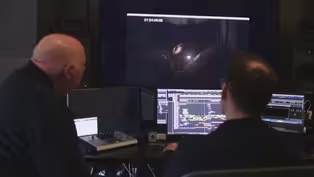
The art of sound design in the film ‘The Zone of Interest
Video has Closed Captions
Clip: 3/8/2024 | 6m 47s | The art of sound design in the Oscar-nominated film ‘The Zone of Interest’ (6m 47s)
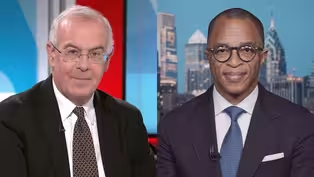
Brooks and Capehart on Biden’s State of the Union address
Video has Closed Captions
Clip: 3/8/2024 | 11m 35s | Brooks and Capehart on Biden’s State of the Union and what’s next in the 2024 race (11m 35s)

How Hungary’s Orbán gives Trump an ‘illiberal’ roadmap
Video has Closed Captions
Clip: 3/8/2024 | 5m 40s | Hungary’s Orbán gives Trump an “illiberal” roadmap for American conservatives (5m 40s)
What’s in the new spending bill the Senate is racing to pass
Video has Closed Captions
Clip: 3/8/2024 | 5m 47s | What’s in the new spending bill the Senate is racing to pass to avoid a shutdown (5m 47s)

Why many Americans feel unhappy about the country’s economy
Video has Closed Captions
Clip: 3/8/2024 | 7m 48s | Why many Americans feel unhappy about the economy despite indicators of improvement (7m 48s)
Providing Support for PBS.org
Learn Moreabout PBS online sponsorship
- News and Public Affairs

FRONTLINE is investigative journalism that questions, explains and changes our world.

- News and Public Affairs

Amanpour and Company features conversations with leaders and decision makers.











Support for PBS provided by:
Major corporate funding for the PBS News Hour is provided by BDO, BNSF, Consumer Cellular, American Cruise Lines, and Raymond James. Funding for the PBS NewsHour Weekend is provided by...