Vermont This Week
March 8, 2024
3/8/2024 | 26m 45sVideo has Closed Captions
Town Meeting Day | Nearly a Third of All School Budgets Fail
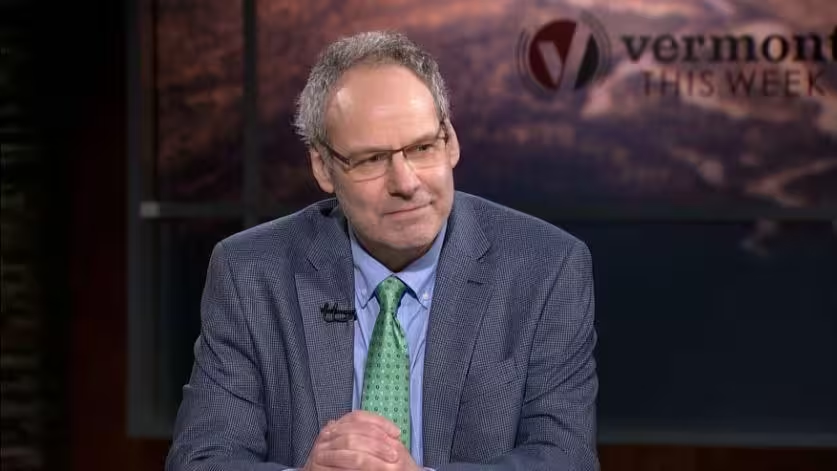
Nearly a Third of All School Budgets Fail on Town Meeting Day | Progressive Emma Mulvaney-Stanak Elected Mayor of Burlington | Vermont’s Aging Population | Panel: Mitch Wertlieb - Moderator, Vermont Public; Lola Duffort - Vermont Public; Colin Flanders - Seven Days; Mikaela Lefrak - Vermont Public.
Problems playing video? | Closed Captioning Feedback
Problems playing video? | Closed Captioning Feedback
Vermont This Week is a local public television program presented by Vermont Public
Sponsored in part by Lintilhac Foundation and Milne Travel.
Support provided by:


Vermont This Week
March 8, 2024
3/8/2024 | 26m 45sVideo has Closed Captions
Nearly a Third of All School Budgets Fail on Town Meeting Day | Progressive Emma Mulvaney-Stanak Elected Mayor of Burlington | Vermont’s Aging Population | Panel: Mitch Wertlieb - Moderator, Vermont Public; Lola Duffort - Vermont Public; Colin Flanders - Seven Days; Mikaela Lefrak - Vermont Public.
Problems playing video? | Closed Captioning Feedback
How to Watch Vermont This Week
Vermont This Week is available to stream on pbs.org and the free PBS App, available on iPhone, Apple TV, Android TV, Android smartphones, Amazon Fire TV, Amazon Fire Tablet, Roku, Samsung Smart TV, and Vizio.
Support the crew
Help Mitch keep the conversations going as a member of Vermont Public. Join us today and support independent journalism.Providing Support for PBS.org
Learn Moreabout PBS online sponsorshipNearly a third of all school budgets fail on town meeting day, leaving school boards, state leaders and voters alike wondering what's next.
It took us a couple hundred years to get here.
We're not going to get out of it in a couple of months short of draconian cuts or some new magic revenue stream.
It's going to take a few years to figure out what sort of system Vermonters want and what sort of system Vermonters can afford.
Plus, progressive Emma Mulvaney Static makes history as the new mayor elect of Burlington.
And we'll discuss how Vermont's aging population is reshaping the state.
Coming up on Vermont this Week from the Vermont Public Studio in Winooski.
This is Vermont this week made possible in part by the Lintilhlac foundation and Milne travel.
Thank you for joining us on Vermont this week.
It's Friday, March eight by Mitch Weitlieb and joining us on our panel today we have Lola Dufort from Vermont Public Colin Flanders from Seven Days and Mikaela Lefrak from Vermont Public.
Thank you all so much for being with us.
And I want to start with you.
March 5th, not a great day to be a town budget, a school budget, I should say.
What happened here?
How unusual is this for so many school budgets to be voted down and why?
Why did it happen?
Well, it's very unusual.
You know, it might be historic.
We need to hedge a little bit because of record keeping.
But, you know, if you just look at the last ten years, the worst year for school budgets was 2014.
About 14% of budgets failed that year.
Twice as many failed this year.
Right.
So that gives you a sense of the scope of sort of how comparatively bad this is.
And the reason that we got here is largely because, you know, education spending went up an unprecedented amount and people were looking at property taxes going up an average of 20%.
There was also a lot of discussion about that in the media.
So it's possible that all of that kind of ambient anxiety sort of compounded.
But, you know, at the end of the day, this was mostly, I think, a referendum on the affordability of the current system.
Governor Phil Scott has been talking about this for a long time now and, you know, he has his ideas about ways to deal with these school budget issues.
And what are some of the things that he's saying about ways to possibly fix this problem?
Well, he is pointing to proposals that he has made in the past.
You know, he hasn't formally put anything on the table.
But he said, look, I've been beating this drum for a long time now.
He's mostly using this as an opportunity to wag his finger and say, I told you so to Democrats and see if we had implemented some of my prior ideas after student ratios and maybe a statewide teacher's contract.
We would be in a different place right now.
And, you know, I think kind of rhetoric aside, I think he and Democrats are increasingly sort of on the same page and that something really big needs to change.
And that be probably a big element of that is is consolidation.
Right.
And, you know, I heard him at his press conference this week say, quote, A former politician, Chap Smith, speaker Shep Smith, who is saying, you know, like everyone wants to save money.
A lot of people agree we need to close small schools, but no one wants it to be their own right.
And that is sort of the tension that we are seeing.
And we saw this on Tuesday as well, where, you know, there were a couple closure items on the ballot and voters said no.
Right.
So we have these two messages coming from voters.
We can't afford this.
And please don't close my small school.
Right.
And something's got to give somewhere, it seems.
Right.
McKayla, you had a program on Vermont Edition recently where another thing was brought up, and this was about maybe revamping the system entirely.
What happened there on that program?
Yeah.
I mean, it's something that, as Lola was saying, that a lot of folks are calling for right now.
We need to think big picture here, make some short term tweaks and then look long term as well.
We had on Representative Peter Conlin, who you heard at the top of this show, is the chair of the House Education Committee.
And he has been saying for a while now that we're at an inflection point and we need to think about revamping the entire way that we fund schools and structure this system.
What exactly that means, I don't know yet by easier thing to say than to do, but I know he and many of his colleagues have been working on that for a while now.
And to Lola's point about the consolidation, and I think that's something that we were hearing on our show on Vermont Edition a lot from some of these superintendents who, you know, kind of feel stuck between a rock and a hard place.
I spoke for one to the superintendent of the Mt.
Abe School District Unified School District in Madison County, Patrick Green.
And he was saying, you know, we we basically put forth a budget that was going to provide the exact same services as we have in the past.
But we were asking for people to be paying a lot more for it for a number of different reasons, to the tune of about a thousand extra dollars in property taxes on a $300,000 home.
And people were saying to him, We just don't have more to give.
And he said, I get that.
But at the same time, there's a lot of things that he thinks could change in their district and in their county.
There's four school districts in Madison County.
There are almost more.
And he's saying, you know, we got to we got to look to the future and think about ways to maybe make it more efficient system.
Collin Flanders, you wrote an article in Seven Days.
The feature article recently called An Aging Population is Transforming Vermont Schools, Workplaces and Communities.
How does this consolidation issue, especially that Lawlor was talking about, come into this?
Because I would think that in rural communities there are some tough decisions to be made and nobody wants to see a beloved local school closed.
Yeah, that's right.
I mean, at the heart of this conversation, it's really a story about birthrates right in Vermont.
Our birthrate is lower than anywhere else in the country.
And the gap between the number of people who are born each year and dying each year is only growing in favor of death.
And so we have communities across the state that are looking toward a future where they are possibly shrinking over the next decade or two decades.
That leads to less opportunities.
A kind of creates this spiral where if you're a young person looking around, you're seeing the population of people over 65.
Bigger and bigger businesses consider whether that's a place that's actually growing.
You move out of state or you move to a different part of the state.
There's fewer kids around.
There's less need for a school.
And then the school has a conversation.
Do we need to be here anymore?
I want to say to the point about school closures, this is driving a lot of this conversation of do we need as many small schools?
Representative Peter Coleman made a good point when I was talking to him about it's really unfair to ask local school boards, many of whom are are primarily made up of just unpaid volunteers who are spending their own time asking their neighbors to consider closing what they consider to be the heart of a community.
And we are, like Lola said, we are seeing that tension point where the state needs to take a bigger role in some people's eyes.
We're hearing that from superintendents who, look, we need help.
We cannot be the ones driving this conversation.
And the state, for its part, does not seem to be diving into the conversation of school closures.
When I talk to the Agency of Education, they were continuing to say this is a local decision.
I think something's got to give there.
And forgive my penchant for puns here, but this is can seem like an age old problem, you know, the aging demographic in Vermont.
But as you pointed out in the article, it hasn't always been this way.
In the 1960s, late sixties, early seventies, there was an influx of younger people coming in.
Yeah, Vermont was a real benefactor of the back to the land movement, as it was known.
And over the sixties, 1780s, we did see a lot of in-migration.
And that led to sort of a little baby boomlet, as you want to call it.
In the nineties, we were having a much different conversation about schools overflowing with children.
We didn't have enough space in some cases, and you can see how differently that's changed.
For the last 30 years, we've lost about 30,000 students in our public school system.
And so, yeah, I mean, you're totally right.
We I just don't see something like that changing anytime soon.
We are not probably not going to have a bunch more babies moving forward and attracting people to the state is difficult when we don't have housing and we hear that constantly.
People struggle to find homes here when they want to move for a job, they want to move for family.
So I think we do need to adjust the reality that this is probably how our school system's going to look for the foreseeable future.
How do we adapt to that?
Lola, I know that some of the schools school budgets were postponed.
This was to give ostensibly time for school officials to look at this problem, recalibrate, perhaps.
What's the deadline for these new school budgets to come up for a vote?
And what happens if they don't pass and the next time around?
Right.
So, you know, school districts that postponed have until April 15th for their initial vote.
But, you know, your deadline for your final vote in terms of getting a budget passed is as soon as you can do it right.
The new fiscal year starts July 1st.
So you really want to get it done before then.
But, you know, between school districts that postpone their vote and school districts that have to revote and school districts that are, you know, since school districts don't actually vote on town meeting day.
Townsend, Vermont, like to be quirky, have their own tradition.
So there are some that have yet to vote.
And so actually statewide, the picture for school spending collectively is still a little bit murky.
Right, because we have a lot of towns left to go.
But, yeah, I mean, that's we really won't know sort of what the total picture looks like until probably, you know, April, no matter what, though, property taxes are going to go up.
This for most people, this year.
We can pretty much depend on that.
Yeah, I mean, a lot of the increase is baked into the budgets that already passed.
And and, you know, no matter how much school districts cut in the budgets that have yet to pass, it's going to go up.
Lawmakers are going to try and soften the blow.
They're looking for one time revenues to kind of buy down this property tax increase.
But they've also made clear that they don't want to buy a they can't buy down the whole thing.
It's too much money.
They don't have it.
And B, they don't want to buy it down too much because you create kind of a cliff, right?
If you use one time money to buy down an ongoing expense.
Right.
What you do is you you shield people from a new higher baseline and then you have to you're kind of haunted by that the next year.
And so they don't want to kind of dig themselves into an even deeper hole, you know, next year.
I'm just really curious, too, about what are school districts going to do to get across the finish line?
I mean, you go back, maybe a school district goes back and votes six weeks from now and cuts $1,000,000 out of their budget.
Is that going to be enough?
I mean, we have we have heard a lot of these costs are things out of school districts control.
So, I mean, beyond I have to imagine we're going to be seeing layoffs right?
We're going to be seeing layoffs.
I think some of that also could be I mean, a lot of schools are struggling to staff.
Right.
And so a lot of this might also happen via attrition.
Right.
But yeah, I don't think we should shy away from that, that in a lot of places, the only place to cut is personnel.
You know, there are some school districts that have some money parked away in a capital reserve fund so they can take that out.
I think South Burlington as an example, without cutting personnel.
However, when you take money out of your capital reserve fund, you pay for that later, right?
Because Vermont schools are in terrible, terrible shape.
So, yeah, we're looking at some really tough decisions because, you know, the inflationary pressures on schools right now are really intense.
It's health care.
It's you know, labor shortage, which is requiring higher salaries.
And it's also all of the social services that we are increasingly asking schools to deliver.
All of that is super expensive.
And, you know, a lot of the pressure, too, is there was COVID money from the last couple of years that's now no longer available.
So the pressure is on now.
It's like the bill is coming due.
There was some other action happening on town meeting day, of course.
Mikaela There was some action on things that were not dealing directly with Vermont.
We're talking about ceasefire resolutions, right.
In several towns.
That's right.
A number of towns, about a dozen, I think, passed resolutions calling for an immediate cease fire in Gaza.
Of course, this is referring to the the violence been going on between Israel and Gaza since October 7th.
These are, of course, non-binding resolutions.
It's more of a statement of values from a town.
I find it interesting, the one town new thing in their resolution acknowledge the pain that has occurred on both sides here.
But for the most part, these are resolutions kind of announcing some sort of solidarity with the Palestinian people.
And then in Burlington, of course, there was a big debate over passing a similar resolution back in December.
There was a66 tied vote on the city council, and it did not pass after many, many hours and days and weeks, frankly, of of debate, I do want to acknowledge something really nice that happened in the town of Brookfield, because there were some workers there who were acknowledged for what they did in post flood recovery.
And we've got some we've got some clips for what happened in Brookfield article tendency of the town to offer a selectboard to pay a bonus of $500 each to the three road crew members Tim Ritchie and Rob as appreciation for their efforts on the repair of our roadways during and following the July storm.
On the day of the storm, the day after they were at the garage and out monitoring and dealing with the flooding situations 24 hours straight, the do not go home and not sleep.
And they work continuously through the summer trying to put the roads back together.
These guys were amazing and everybody was affected by working with mud and ice and you name it.
And they were out there all the time.
Not only do we need to appreciate our gratitude about this flood and what they did, but since we've gone through five months this week, $500 seems like a small amount of money to express our appreciation.
So I'm glad to do that.
Those in favor say, I was opposed.
Okay, no one opposed.
So a nice moment there to recognize some of the really hard work that folks were doing in Brookfield as folks try to recover from the historic flooding that happened.
History was made as well in Burlington with the election of the new Burlington Mayor, Emma Mulvaney.
Stanek Mikayla, what can you tell us about the historic of making election here?
Yeah, I think this frankly surprised a lot of us at this table.
Evan Mulvaney, Stanek pulled out a win to become Burlington's next mayor.
She will assume the seat sometime next month.
She went with 51% of the vote to her opponent, John Shannon's 48%.
There are also two other folks in the running, and they secured a much smaller proportion of that vote.
Yeah, I think this was a really interesting race calling in that you have your colleagues at seven days or looking into what exactly happened.
But, you know, this race, I think, was largely dominated by conversations around public safety and the opioid crisis.
John Shannon, the Democratic candidate, was taking a harder line along around public safety.
She made it very clear that she was standing by the police chief, John Murad, who was appointed by the current mayor, Miro Weinberger, Emmet Mulvaney.
Stanek wouldn't say one way or another whether she's going to, you know, advocate to keep Murad in his seat.
But I think she is somebody who is taking maybe a more community based approach to policing and might not support everything that the current police chief has been doing.
So it will be interesting to see what happens there.
But yeah, the progressives really, really showed up to to support Emma Mulvaney's standing.
They did.
And kind of an amazing moment, I think, in 159 years, the first woman mayor ever elected in Burlington, first openly gay candidate, elected to mayor.
And here's what Emily Beverly Stanek had to say at a victory speech.
I did not see a leader like me when I was growing up in central Vermont.
I did not see a woman.
I did not see a mom who has young kids.
I did not see a clear leader.
And it took years.
And that matters because we need to know, our young people need to know, our adults need to know.
Everyone needs to know that representation matter.
So it's an historic election.
Colin Flanders I'm curious though, as Mikaela was talking about, this is a progressive who wins perhaps a surprise election, but the city council in Burlington is still made up largely of Democrats.
Do you think that there will be any kind of tension there with their priorities?
Do you think that they'll be able to work together?
I I think the short answer is, yes, there will be tension.
I think that's inevitable.
And in Burlington, the progressive and the Democratic Parties are kind of the two parties, and they're constantly at odds over things.
We've seen this with outgoing Mayor Miro Weinberger throughout his tenure there and often unable to sometimes get things across, even though Democrats held a majority at sometimes or a plurality, rather.
But I do want to linger on this idea for a moment that this is a surprise, because I think in this race in Vermont, in general, we lack polling.
So it's kind of hard to get a pulse on how people are feeling.
And in this race where public safety dominated the conversation and I think it's easy to fall back on the conventional wisdom that the tougher on crime, quote unquote candidate in Joan Shannon would have appealed more.
And she had stances where she wanted to break up homeless encampments, arrest people for using drugs in public.
Emil Mulvaney Stanek had a more nuanced approach, and it seems to have won over some people.
I mean, we're digging into this now and it's seeming like, am I benefited from people crossing over from maybe they voted for Democratic city councilors, but then chose her as a mayoral candidate?
She seems to have had this broad appeal that I think some people underestimated.
And I will say to that, Joan Shannon has a long tenure on the council.
That's a long number of years to rack up votes, that people can judge her position on things.
And I think she did rub some people the wrong way over the years.
On her stances.
So I think it's a confluence of factors, but it is really fascinating to see to see this happen.
Yeah, the problems are still.
Lola, go ahead, please.
I was going to say I mean, I I'm I think a lot of people are drawing parallels between what happened in this election and what happened in the Democratic primary where Sarah George, the, you know, very progressive state's attorney in Chittenden County, was challenged by a much more tough on crime candidate.
And I think yeah, I think in that election, too, people were expecting it to be closer for her to win, but she or for her to lose.
And the opposite happened.
So, you know, we've seen these two votes where this was the central issue and that community has pretty emphatically chosen a more progressive path, which is super interesting.
Yeah.
And I think it kind of speaks to sometimes the loudest voices in these conversations dominate even in our news coverage, and doesn't always reflect how the broad majority is feeling.
So it's always a moment too, for news organizations like the like when you're surprised by something, that might mean you need to do a little more reporting.
So I think that's a moment we're reflecting on.
Too.
Interesting to note, too, that Burling Tony INS did pass a public safety tax.
So they are thinking about ways of dealing with these issues of crime.
And it's something that the new mayor will have to deal with as well.
But they did pass that as well.
We noted that.
Yeah, yep.
Yeah, that's right.
It's it's meant to help fund some of the police and fire department services.
And in Burlington, as everyone's been hearing, those services are in high demand lately, especially the fire department, which is seeing its call volumes just rise through the roof.
And they have been dealing with staffing shortages over the years.
So I think they would both say it's desperately needed and that passed by a pretty wide margin.
So I think people in town do recognize the need to make sure that the public safety apparatus is operating as as best it can.
You know, Vermont is no stranger to firsts, and I love it when the state sort of makes history, even if it's a little bit of a footnote.
Michela I'm thinking here about the visit that we had from Nikki Haley, who before she suspended her Republican presidential campaign.
She can just paraphrase for paraphrase a line from my favorite movie.
She'll always have Vermont.
I always have Vermont.
That's right.
Right before the primary, she came to Vermont, made a couple of speeches, and it whatever happened, worked.
She did win here 50.2% of the vote, about 36,000 votes to Trump's 33,000.
She won Vermont's nine delegates.
But it's not going to be enough to push her to the White House.
She did drop out of the race soon after that primary.
She also won in Washington, D.C. and yeah, making history in Vermont.
There you go.
Do you see your old stomping grounds?
As I understand it?
And it does seem that she was helped a lot by Vermont's open primaries system in which Democrats can vote in the Republican primary.
And it seems like she got a lot of, let's call them, protest votes in a way to take that away from Donald Trump.
Exactly right.
But yet again, it's like it's not going to be enough for Biden was making making a statement which I think was heard and then feel move on from there.
That's right.
Lola in Montpelier, again, they're dealing with trying to clean up from the massive flooding.
I know that one of the things that passed there was something called a just cause evictions, protection.
What can you tell us about that briefly?
Yes.
So there's been a movement in Vermont these last couple of years to pass just cause eviction.
It's a tenant protection that basically gives existing tenants like right of first refusal.
It means that your landlord can't decline to renew your lease for no reason.
Right.
And often it also protects against de facto eviction because the rent skyrockets too much.
We saw this is also passed in Essex.
This is also passed in Winooski and it's passed in Burlington.
Burlington, but was in 2021.
I think so a while ago.
Another interesting thing is at this point, this is just symbolic, right?
Because charter changes in Vermont require the approval from Montpelier.
And very interestingly, these tenant protections are being blocked by at this point, actually the Democratic supermajority.
I mean, certainly Governor Scott has vetoed these measures in the past.
And now Democrats are saying we're actually not even going to try and, you know, pass this.
So, you know, the organizers of the Montpelier effort were saying, we know right now this is not going this is probably not going to pass in Montpelier.
But we want to send a strong message that communities want this.
And we're hoping that, you know, eventually lawmakers will listen to it to us.
But we should know, too, that in the central part of the state in Rutland, there was a measure passed to keep fluoride in the water system.
This comes up every once in a while, but that that passed.
So there's going to be fluoride there.
Dartmouth's men's basketball team, this is kind of a fascinating story.
I don't know how many of you've been following this one, but they have voted to unionize now saying that they are employees of the school.
The school is going to push back on that.
So it's not the last we've heard of that one, but we're going to be following that story as well.
And I do have to give a shout out.
And McKayla, I want to thank you for putting this story on my radar.
The Valley News reporting that the Hartford Girls Division two ice hockey team won their first state championship ever in the program's history 30 years.
And this was a team that only four years ago it only won one game.
And you were saying, too, that there was actually a very nice story about this, about one of the players, the coach's wife, I think, had died of cancer and they were sort of dedicating this to that.
Yeah, it was just a story of the team coming together.
One of the players during a halftime committee gave a really rousing speech and really motivated this.
The team to pull out this with.
It was one of those stories that I just found myself crying throughout.
But Mitch, we love your sports report, so I couldn't say it.
I know these sports 40 more, so I had to bring it up here and I really appreciate that.
So congratulations to the Hartford Girls hockey team beating the Sasquatch to win their first ever D to state championship.
That is all the time that we have for this week.
Thank you so much to our guests, Lola Duffort education reporter for Vermont Public reporter Colin Flanders of Seven Days and Mkaela Lafrak reporter and host of Vermont Edition on Vermont Public.
So great to have you all here today.
I'm Mitch Wertlieb.
Thank you so much for tuning in.
And let's talk again soon and.

- News and Public Affairs

Top journalists deliver compelling original analysis of the hour's headlines.

- News and Public Affairs

FRONTLINE is investigative journalism that questions, explains and changes our world.












Support for PBS provided by:
Vermont This Week is a local public television program presented by Vermont Public
Sponsored in part by Lintilhac Foundation and Milne Travel.