State of Affairs with Steve Adubato
Marcus Randolph; Teresa Williams; Brian McGovern
Season 6 Episode 26 | 27m 15sVideo has Closed Captions
Marcus Randolph; Teresa Williams; Brian McGovern
Marcus Randolph, President and CEO of Invest Newark, sits down with Steve Adubato to discuss the pressing issues impacting Newark; Teresa Williams, Executive Director, of Spring Street Community Development Corp., highlights the initiatives combating food insecurity; Brian McGovern, LSW, Chief Executive Officer of North Jersey Community Research Initiative, discusses care and treatment for HIV.
Problems playing video? | Closed Captioning Feedback
Problems playing video? | Closed Captioning Feedback
State of Affairs with Steve Adubato is a local public television program presented by NJ PBS
State of Affairs with Steve Adubato
Marcus Randolph; Teresa Williams; Brian McGovern
Season 6 Episode 26 | 27m 15sVideo has Closed Captions
Marcus Randolph, President and CEO of Invest Newark, sits down with Steve Adubato to discuss the pressing issues impacting Newark; Teresa Williams, Executive Director, of Spring Street Community Development Corp., highlights the initiatives combating food insecurity; Brian McGovern, LSW, Chief Executive Officer of North Jersey Community Research Initiative, discusses care and treatment for HIV.
Problems playing video? | Closed Captioning Feedback
How to Watch State of Affairs with Steve Adubato
State of Affairs with Steve Adubato is available to stream on pbs.org and the free PBS App, available on iPhone, Apple TV, Android TV, Android smartphones, Amazon Fire TV, Amazon Fire Tablet, Roku, Samsung Smart TV, and Vizio.
Providing Support for PBS.org
Learn Moreabout PBS online sponsorship- [Narrator] Funding for this edition of State of Affairs with Steve Adubato has been provided by The Healthcare Foundation of New Jersey.
Rutgers University Newark.
PSE&G, committed to providing safe, reliable energy now and in the future.
The Port Authority of New York and New Jersey.
Moving the region through air, land, rail, and sea.
TD Bank.
The Fidelco Group.
Holy Name.
This place is different.
The New Jersey Economic Development Authority.
And by IBEW Local 102.
Lighting the path, leading the way.
Promotional support provided by The New Jersey Business & Industry Association.
And by AM970 The Answer.
[INSPRATIONAL MUSIC] - Hi, I'm Steve Adubato.
It is my honor to welcome Marcus Randolph president and CEO of Invest Newark.
Good to see you, Marcus.
- Good to see you too, Steve.
Thank you.
- You got a website, it's up.
Tell everyone what Invest Newark is.
- So Invest Newark is the official Economic Development Corporation for the City of Newark.
We work very closely with Mayor Baraka, with Deputy Mayor Allison Ladd and economic housing development to carry out the economic development and housing initiatives for the city and on behalf of the residents.
- You know, this housing piece, the need for affordable housing in Newark, there's a digital divide.
We'll talk about, just a little bit about the internet but there's a housing divide, if you will.
There is, there's a whole range of issues that are complex in the city of Newark around property and affordable housing.
Talk about what the problem is.
- Yeah, sure.
So, you know, we need to increase the home ownership rate in the city of Newark.
We need to figure out ways to generate wealth, via that home ownership program as well.
But we also have a number of people who need very very affordable housing, whether that is rental housing or just an affordable, you know, monthly mortgage.
So we're trying to, you know come of this in a couple different ways.
Obviously, if you've been in Newark, you see a lot of cranes, a lot of tall buildings going up and that's gonna be great for the city.
There's gonna be some affordable units there as well.
We gotta make sure that affordable opportunities are being out into all the wards, you know, not just downtown.
- You know we're gonna be talking about, I'm gonna ask you about land banks in just a minute but this is part of a larger, this segment, part of a larger series we're doing, focusing on urban issues.
One huge issue are these land banks and it's not just in Newark but it's across the country in urban communities.
What is a land bank and why do they matter?
- Yeah, yeah, great question.
So there's, it's about 250 land banks operating across the United States.
The Newark Land Bank is the only one in the state of New Jersey.
And essentially what it does is it allows us to have a generally a not-for-profit vehicle that can sort of assemble these properties, essentially bank them and figure out ways to make them useful again get them back on the tax rolls for the city.
What we're doing is we're creating home ownership opportunities with ours but there's also gonna be some other interesting projects.
Some market rate will come out of this, but there'll be some commercial property development as well.
- So, I wanna be clear so everyone understands this.
Who purchases the land and puts it in a bank, a not-for-profit?
- So we get our properties from the city of Newark.
So the city has a log of properties that are either vacant or underutilized and we get those in tranches and they move over here to the land bank and best Newark oversees that.
Then we figure out ways to get them to get them active again.
- And then how are people able to purchase them as first time, often first time homeowners at an affordable price?
- Right, right.
Great question.
So there's a couple of ways that that can be done.
One of them is if a person who is renting an apartment right now has a Section 8 voucher, there is a way to - Section 8 , let everyone know that a Section 8 is a section of federal housing law that allows for that promotes affordable housing.
I'm sorry, go ahead.
- Right.
And provides a subsidy for their rent.
They can use that voucher once they've been qualified to go toward a mortgage.
They can become a homeowner while using, still using that voucher.
But we also have a couple of other programs that are specifically designed for first time homeowners.
One of them is called Resident Advantage, and that's if you're currently a Newark resident, you know you get priority for some of the houses that we're developing.
We also have another one that's, again, still for first time homeowners, but you don't have to be a current resident of the city in Newark.
- Mm.
Marcus do this for us, Newark fiber.
- Yes.
- I'm curious about this because this whole issue of high speed, low cost internet service.
People, so many people watching right now are thinking like, what are you talking about?
We have that, well, you may have that but that is not accessible and available to everyone across the state and every community particularly in urban communities.
What are we talking about here regarding the internet and why is it so critically important to a vibrant economic, economically strong community?
Talk about that.
- Yeah, yeah.
You hit the nail right on the head.
It's absolutely critical to build a strong economy.
You know, the pandemic really brought it home.
We saw a lot of people in the city of Newark who their children could not access the online learning.
People could not work from home.
They didn't have reliable access to the internet.
And then we also know that we do a lot of things now on the internet.
I'm talking to you right now on the internet.
People have, you know, they talk to their doctors, a number of things.
So, it's critical, but what we really need to make sure is that it's available, that it is affordable and reliable.
Obviously there are a number of different ways to get internet access but studies show there's still a lot of people, not just in Newark, but in Newark, that don't have any access.
And that poses a real challenge for them just to sort of, you know, live day-to-day.
- Yeah.
I don't wanna belabor this point but for us to do this programming remotely we have to make a significant investment as a not-for-profit organization.
Not-for-profit production company, to try to ensure as best we can that the quality of what we're doing is what it is.
That the internet signal, the, not even a signal, but the internet is strong.
That, but again, that costs real money.
And to assume that everyone is able to do that as an individual, much less a corporation is doesn't make sense and it's not realistic.
Real quick before I let you go, Marcus.
- Sure.
- You're committed to this work.
You were born and raised where?
- Born in Morristown.
- Morristown, another community that's more complex than people realize.
Real quick before I let you go, you're particularly excited about this work being someone from New Jersey who cares deeply about urban communities like Newark because?
- Well, good question, because, you know, I'm a New Jersey native.
I've always been fond of Newark.
You know, my parents have a history of Newark, in Newark, I should say.
But for me, you know, I look as an opportunity to be of service, to be an advocate for the people of Newark.
You know, Newark is our city and it's everybody's city in New Jersey.
We should really be trying to do our best to make sure that it continues to be a thriving city.
What's good for Newark is good for New Jersey.
- You know, many years ago, Mayor Ken Gibson the late Mayor Ken Gibson was quoted as saying, "where American cities are going, Newark will get there first."
It's interesting, he said it 50 years ago.
It still is relevant today.
Marcus Randolph is president and CEO of Invest Newark.
I cannot thank you enough.
Appreciate it, Mr. Randolph - Thank you so much, Steve.
- You got it.
Stay with us.
We'll be right back.
(grand music) - [Announcer] To watch more State of Affairs with Steve Adubato, find us online and follow us on social media.
- We are honored to be joined as part of our Making a Difference series, not-for-profit leaders Making a Difference, Teresa Williams, Executive Director of Spring Street Community Development Corporation based in Morris County.
Good to see you, Teresa.
- Thank you, great to be here, Steve.
- You got it, the website will be up.
Tell everyone what Spring Street is and the work you're doing.
- Absolutely.
So we're based in Morristown, New Jersey but we serve the Morris County area.
One of our primary programs, it's pretty well known, Table of Hope, is our soup kitchen and mobile food pantry operation that we have been doing.
Since the height of the pandemic, the Hope Mobile Food Pantry has been throughout Morris County feeding the those who are in need, you know, those suffering with food insecurity.
And we've also operated a soup kitchen since 2013 here in Morristown.
So at the height of the pandemic, this mobile food pantry, it really has been on a mission just trying to reach and help those who are really struggling with food insecurity.
So that's the capstone program.
We have other programs.
We do tutoring for the youth, we have recovery and reentry programs, and we work with maternal child health issues with pregnant women.
- You know, it's interesting.
People have perceptions, right, "Oh Morris County, it's one of the wealthiest counties in the state of New Jersey."
So why would there be a not-for-profit that's serving those who are struggling pandemic, "post-pandemic", you know, whatever that means to different people.
There is a community that does not fall into the wealthy, one of the wealthiest counties in the state or in the nation.
Who exactly are we talking about?
And is it not a fact, Teresa, that that community, that population is expanding?
- That is correct.
There's a term, United Way has done a study and we call these families, ALICE families, which are asset limited, income constrained, employed.
- ALICE is the acronym.
- Exactly.
But what that is people are working, people are out here, they're working, they're working hard but they can't make ends meet, they can't keep up with the cost of living.
So they have to make decisions.
You know, do I pay my electric bill or do I buy groceries?
You know, they have to make these difficult decisions daily.
And we primarily are serving those families.
Our volunteers, we can't do this without our volunteers who are out here every week, we have 50 or so volunteers.
They are surprised at the people that they see because it's not normally what we would have, you know, we would think is coming to get food.
So it's a diverse group of people, very diverse group.
You know, we see elderly, we see youth, you know, we see families, we see veterans.
So it's a very diverse group, but the majority, it is homeless, yes, we do serve homeless individuals.
But most people that we serve are actually working.
- You know, as I listen to you, I keep thinking, okay, so we're taping this in the fall of 2022, it'll be seen a little after, somewhat into the winter, and the inflationary issues, inflation, inflationary issues, inflation, things cost more, it's only, we hope it gets better, but it may get worse and right now it's challenging.
How does inflation negatively impact the people you're talking about, when things simply cost more?
- Well, right now with the increased food prices, and obviously gas and just overall inflation has affected people tremendously because their salaries aren't really keeping up with the inflation increases and it's very, very challenging for people, very challenging.
- So it's interesting.
There are many programs, but one of them that jumped out to me that I want you to talk about is this program, the SOAR Program.
What is the SOAR Program and also, my understanding is you created this program in cooperation with someone very close to you, your husband.
- Yeah.
- Talk about the SOAR Program and also the connection to Pastor Sidney Williams, Sr, excuse me, Jr., I apologize.
- Absolutely, so our tutoring program, SOAR, Student Outreach and Academic Reinforcement is actually one of the first, that's the first program we started at Spring Street.
My husband and I actually were missionaries in South Africa before we came to Morris County, to Morristown.
So being missionaries, you know, we have a heart for service.
So when we came here, it's kind of like what you said, Steve, this is a wealthy county, you know, there's no poverty here and we kind of felt that way when we arrived.
So we had met with some of the different stakeholders in the community and talked about, you know, what do you see are needs in this community?
So the superintendent at the time had informed us there are some children slipping through the cracks, and it tends to be Black and brown children here.
- Excuse me, superintendent in schools?
- Okay, go ahead, I'm sorry, that some children, particularly Black and brown- - Slipping through the cracks, you know, in terms of their education, you know, keeping up with the testing and those things.
So that was the impetus for us starting the SOAR Program.
So we said, okay, we're gonna focus, we started off with fifth graders, you know, because the transformation from elementary to middle school is drastic because they go from these small schools to this huge school and everybody knows you need to understand fifth grade math before you can do anything else.
So we started with fifth graders and we've been doing this since we arrived here in 2011.
- That's the SOAR Program, right?
And what does it stand for again, Teresa?
- Student Outreach and Academic Reinforcement.
- I cut you off.
I'm sorry, finish your point.
- So we've been doing it since we arrived, it's very rewarding, it's in partnership with the Morris School District, and we also provide mentoring, we work with the local universities who provide tutoring to the students, which is great 'cause they're great mentors for the students.
And what we have seen is that all of the students, 90% of the students that come through the SOAR Program have increased their scores in math and language arts.
So we're very happy with the program and we're looking forward to starting it up again this year.
- I need to follow up on this.
You and your husband, Pastor Sidney Williams, Jr. You talked about the work in Cape Town, South Africa coming back here.
How, 'cause this series, as I said, Making a Difference, People Making a Difference, how, first, how did the two of you find each other and did you find each other through your work trying to make a difference?
- We found each other in New York.
- And then you go to South Africa?
- We were both in the corporate world, so we weren't doing any of this stuff when we met each other.
And you know, you have these epiphanies in life and you start to look out what's important to you.
So we made some drastic changes and we got rid of basically everything we owned and left to go to South Africa with our four kids and two dogs.
So that's what happened.
We decided to make a change.
But when we met, we were not in this field, no.
- Well, again, I don't want to minimize what you just described and people can take from this what they will, but what you said is so profound, so important, so significant, and it's people like you, leaders like you, leaders like you and your husband who not just make a difference every day, but make a decision to give back in a very extraordinary way and give up so much from a monetary perspective, I'll get off my soapbox now.
Teresa Williams, I cannot thank you, best to you and everyone at Spring Street, and also to your husband, Pastor Sydney Williams Jr. as well.
Thank you, Teresa, appreciate you joining us.
- Thank you so much, Steve.
- Okay, stay with us, we'll be right back.
(grand music) - [Announcer] To watch more State of Affairs with Steve Adubato, find us online and follow us on social media.
- We're now joined by Brian McGovern, Chief Executive Officer of the North Jersey Community Research Initiative.
Good to see you, Brian.
- Good to see you.
Good morning.
- Good morning.
We're taping in the morning.
It'll be seen later in the day, in a lotta cases.
Hey, let's talk about where we are.
First of all, talk about your organization as we put the website up, and then I'm gonna get into a whole range of issues that are so important to all of us, not just certain populations.
Go ahead.
- NJCRI was born as a HIV/AIDS organization in '88.
But today, it's really blossomed into, really, a community service health center, a social service center, that serves the needs of the people, depending on what's coming up at the moment.
A great example of that is how we've handled COVID, monkeypox, some of the infections that are causing our communities some harm and trying to get us back on track.
- Talk to us, Brian, about where we are with HIV rates in New Jersey and the nation.
- Sure, I don't actually have the numbers in front of me right now, but HIV has really had an upsurge after COVID and during COVID.
A lotta services were down.
People weren't coming out of the houses.
But people were still connecting at high risk.
So our numbers have more than doubled the last two years, of new infection rates, and so that has been kind of an explosion in New Jersey.
The state's very well aware of that and we are all working on bringing those numbers back down.
One of the neat things that's going on that's on a state and the national level, which is HIV prevention and care.
So they're really combining the two, and with this strong testing model and health screening model in the community, what we're doing is we're helping people either get into preventive care, what is known as kind of PrEP, as a lotta people might know, and I could tell you more about that, or care, HIV care.
And many people today, HIV positive, are living very healthy and are undetectable, and therefore untransmittable, of HIV disease.
- I'm gonna go- - So this has really helped.
I'm sorry.
- I'm sorry for interrupting.
Go ahead.
Finish your point.
- No, so this is really helping reduce HIV infection in our community and really bringing down, and the goal is to really eradicate HIV as this epidemic.
- I wanna talk about monkeypox in just a moment, but tell us about the Total Health Awareness Program.
What is it, as we keep the website up?
- So that program is a program that actually does a lotta work in the community.
It works with, primarily, an MSM population, or men who have sex with men, or high-risk HIV people.
What we do is we go out in the community or we serve people, literally, in the clinic or on a mobile unit in the community, and we will do healthcare screenings for HIV, other STIs, hep C. - STIs, clarify that.
These are sexually- - Sexually transmitted diseases.
And so these are usually higher rates than HIV, so people kind of ignore them, and they can be treated with medication.
So they're not a long-term illness, but they are something that has raised those rates and we're trying to get those down.
So with all that, we can do screening and we can get people on preventive medication, or HIV treatment, literally in the street, where we'll bring out medical doctors and so on that will help us.
- So lemme ask you something, Brian, and I asked you a little bit about this last time you were with us, but I wanna follow up on this.
As we talk about monkeypox, as we talk about the population most affected by monkeypox, to what degree do you believe that, for some watching right now and to many across this state, this region in this nation, nah, that's not really my issue.
That doesn't affect me, because it does disproportionately impact men having sex with men.
To what degree do you believe that is connected to a longstanding, not just a stigma, but prejudice and just, frankly, a lack of concern about the community we're talking about, the people, the human beings, we're talking about, discrimination.
- Absolutely.
Absolutely.
- I know it's a loaded question, but go ahead.
- No, it's a great point.
I think HIV and the word stigma are so connected, I think is... What we're concerned about is the same thing with monkeypox.
It is true monkeypox has a higher rate of infection right now in the world of gay men, and I will say that we've had a great population coming in, of gay men to get vaccinated.
And so that's great to see.
And we're also using that tool to reach out to some of these people that might not be coming in every day for an HIV test or an STI, find out about their other parts of their health.
And so we use that as a tool to also give them those other opportunities, which is awesome.
The other, though, the stigma part of that, where we have to be careful, is the general population.
Depending on your work, maybe you're a massage therapist, you're touching other bodies all day, you're living in a commune situation where you could be sharing other clothing or bedding or something like that, but you're not having sex with someone.
We still could get monkeypox.
So we have to think outside the box of how this could affect, so we don't put a stigma on someone who says, "I'm not in that box.
"I'm not gay.
"I'm not LGBT, so I'm not at risk."
Many of our healthcare workers understand that and will navigate themselves if they're at high risk and will get that, but we want the general population to understand that just as much.
- Again, the website continues to be up.
There are so many people directly affected and others who are friends, family members, directly affected.
But in many ways, as Brian just described, this is all of our issue, and if it's not, if we don't see it that way, I'll get off my soapbox, that's part of problem.
What is the Rainbow Program?
- The Rainbow Program is a new program that we started this year and it's about inter-partner violence for LGBT.
So why we call it inter-partner instead of domestic violence or violence between a husband and wife is, one, in the LGBT community, people may not be married, two, it might be a transgender person being, violence towards them in the community.
It might be an intimate relationship that's not, maybe, a long-term one.
So it really broadens that definition of the relationship violence.
And so it's one of, it's first and unique in our state, and- - What's it do, Brian?
I'm sorry.
What exactly does it do.
- I'm sorry.
So what it does is anywhere from a hotline where people can call in.
- P.S., let's put the hotline up.
Sorry if you're doing this while we're doing this show.
Put the hotline up and, say, you call the hotline, what happens?
- When you call the hotline, you will get live people that will walk you through whatever service you might need in that area, from medical attention, from an emergency room, to respite care, to get way from that environment, to find a place of shelter and/or mental health or support that way.
And lastly, last placement or court.
If you need someone to be an advocate for you in court, we can set that up, as well.
So basically full service, what you might need in that area.
- 30 seconds left.
This work is incredibly important now, more than ever, because?
- Because it's not, we're getting to a place where HIV/AIDS is coming to a more manageable place, with this, really, four-pillar, we're looking at, of healthcare, prevention, looking at all areas of what someone might need.
And as a result of that, I've seen this as something that, finally, we could look at getting a better handle on, getting more under control.
- I wanna thank Brian McGovern, Chief Executive Officer of the North Jersey Community Research Initiative.
Brian, thank you for joining us.
I promise that you'll continue to be a part of our programming to keep us up-to-date on issues that matter to a very large segment of our community.
Thanks so much, Brian.
- Thank you.
- You got it.
I'm Steve Adubato.
That's Brian McGovern.
We'll see you next time.
- [Narrator] State of Affairs with Steve Adubato Is a production of the Caucus Educational Corporation.
Funding has been provided by The Healthcare Foundation of New Jersey.
Rutgers University Newark.
PSE&G, The Port Authority of New York and New Jersey.
TD Bank.
The Fidelco Group.
Holy Name.
The New Jersey Economic Development Authority.
And by IBEW Local 102.
Promotional support provided by The New Jersey Business & Industry Association.
And by AM970 The Answer.
- Hello, I'’m Dr. Luke Eyerman, a family medicine specialist at Holy Name.
When was your last visit to your primary care doctor?
Throughout the pandemic, many patients have put off their annual physicals and screenings, but preventative healthcare is critical for early detection of illnesses and to avoid future health problems.
Your doctor can also help you develop a wellness plan to achieve your personal health goals.
Your health can'’t wait.
Be proactive and talk to your primary care doctor today about scheduling your annual physical.
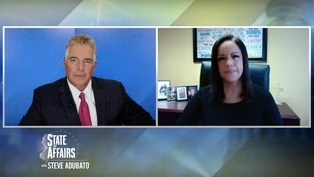
Combating Food Insecurity in Morris County
Video has Closed Captions
Clip: S6 Ep26 | 9m 31s | Combating Food Insecurity in Morris County (9m 31s)
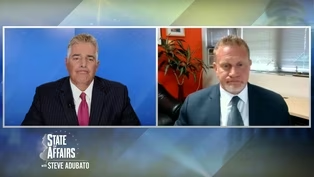
The Importance of Preventative Care and Treatment of HIV
Video has Closed Captions
Clip: S6 Ep26 | 10m 1s | The Importance of Preventative Care and Treatment of HIV (10m 1s)
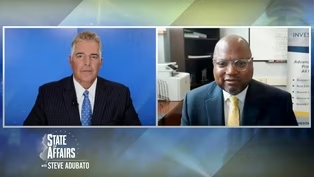
The Pressing Issues Impacing the City of Newark
Video has Closed Captions
Clip: S6 Ep26 | 8m 37s | The Pressing Issues Impacing the City of Newark (8m 37s)
Providing Support for PBS.org
Learn Moreabout PBS online sponsorship
- News and Public Affairs

Top journalists deliver compelling original analysis of the hour's headlines.

- News and Public Affairs

FRONTLINE is investigative journalism that questions, explains and changes our world.












Support for PBS provided by:
State of Affairs with Steve Adubato is a local public television program presented by NJ PBS