Margin of Victory: Saginaw Valley's Role in Winning World War II
Margin of Victory: Saginaw Valley's Role in Winning World War II
Special | 57m 44sVideo has Closed Captions
Michigan's role in the "homefront army" producing materials needed to win WWII.
In WWII, Michigan was at the center of the "homefront army," and the Saginaw Valley produced everything from synthetic rubber to tanks and ships for the war effort.
Problems playing video? | Closed Captioning Feedback
Problems playing video? | Closed Captioning Feedback
Margin of Victory: Saginaw Valley's Role in Winning World War II is a local public television program presented by Delta Public Media
Margin of Victory: Saginaw Valley's Role in Winning World War II
Margin of Victory: Saginaw Valley's Role in Winning World War II
Special | 57m 44sVideo has Closed Captions
In WWII, Michigan was at the center of the "homefront army," and the Saginaw Valley produced everything from synthetic rubber to tanks and ships for the war effort.
Problems playing video? | Closed Captioning Feedback
Where to Watch Margin of Victory: Saginaw Valley's Role in Winning World War II
Margin of Victory: Saginaw Valley's Role in Winning World War II is available to stream on pbs.org and the PBS app.
Local production scene on Delta College.
Public media are made possible with support from viewers like you.
Thank you.
It was 7:50 a.m.
by the clock on the Aloha Tower when the drone of planes was faintly heard.
At 7:55 a.m.
All hell broke loose... Yes, that was very deceitful moment.
About 200 of Japan's messengers of death swooped in over half a civic paradise.
On they came, wave after wave, all fearlessly.
They had little to fear.
Yesterday, December 7th, 1941.
A date which will live in infamy.
“Men your battle stations... and God bless” At that moment, the United States officially entered World War II Soldiers from across the country prepared for combat.
Many enlisted.
Others were drafted, and the fight was on.
all across this country, from small towns to big cities, American workers came forward by the millions to fight the battle from the home front.
Michigan was on the manufacturing front lines.
By February 1942, vehicles for civilian use were no longer being assembled in Seoul.
Autoworkers accustomed to manufacturing cars had to quickly learn to build airplanes and tanks.
Gear plants were converted to gun plants.
Shipyard workers launched hundreds of ships, and top scientists invented products used to keep our soldiers safe and fortified our fighting machines.
Anyone that sent overseas was called on to support the war effort here at home.
Millions of Americans became cogs in a huge war production machine.
Guns, planes, ships, and many other things have to be built in the factories and the arsenals of America.
We must be the great arsenal of democracy.
For us, this is an emergency as serious as war itself.
The strength, skill, speed and sacrifice of the homefront worker was a major factor.
Perhaps the key factor in winning World War II These brave and unselfish men and women truly provided the “Margin Of Victory”.
The state of Michigan sent over 600,000 soldiers to battle during World War II.
And closed to 10,000 of those men & women came from right here in the Saginaw Valley.
This call to arms didn't just go out to soldiers.
It went out to ordinary citizens who were pressed into service here on the home front.
And when the bombing of Pearl Harbor set the wheels of war in the motion, the gears were already turning here in the Tri-Cities.
Behind locked doors and almost 100 General Motors plants throughout the country.
Like thousands of secret military secrets that Hitler would give his best Panser divisions to know.
Putting these plans is being designed and built a large part of the avalanche of weapons that will break the back of the axis.
As General Motors makes victory its business.
The call to action was all that was needed.
General Motors and the UAW donated some of their plants to help build products for the war.
One of those facilities was GM's Saginaw Steering Gear division.
Months before the U.S.
entered World War II GM agreed to build a new plant in Saginaw in exchange for a contract to assemble machine guns.
Construction began in November 1940 on the Hamilton Street facility, and starting in March 1941, 516 men punched in at the gun plant.
Their hiring almost everybody that walked in the door because, we had had a couple thousand people there and they got in plant.
If you had any skills at all and you had a job opening there.
Paul Wendler was hired at the gun plant in June 1941 to work on the line.
He eventually became a foreman and established a long career at Saginaw Steering Gear after the war.
After Pearl Harbor, the pressure was on.
We went to three shift operation day & night.
We were pouring out, machine guns.
We had a lot of tooling problems of the magnitude of building machine guns was not related to the automobile industry.
12 days after production began, Michigan Governor Murray Van Wagoner had the honor of firing the first machine gun to come out of the plant.
The A4 Browning was mounted on a tripod and could fire 400 rounds of ammo per minute.
The gun could be affixed to a vehicle or used by the infantry.
The Gear was able to really produce the machine gun at a much higher capacity than what the government anticipated, and a much lower cost.
Reasons why we were able to develop processes that didn't exist in the in the manufacturing of firearms.
Up to that point, we were able to look at the design and design it to be more manufacturing friendly.
We're able to reduce the number of types of steels that it required to manufacture, going from 37 down to 21 and eventually to 18.
And we were the first company to really start using the new tool that's out there.
And that's time motion study.
And we were able to look at the operator's wasted motions and reduce those to, to the point where we drove 90% of the cost out of the gun by the time we were done producing.
We had to produce guns.
The demand was there, and so people were hired right off the streets, were put on the machine, and they were trained right there on that machine up there on.
And, there were what we call job setters that, worked with the employees.
The plant was contracted to produce only 280 weapons in that first year.
Instead, over 28,000 machine guns were put in the hands of American soldiers in that same time period, an astonishing increase of 10,000% The plant never for a minute closed down.
It was go, go, go...we had to have the guns.
That was rush, rush, full blast.
Besides being able to produce more guns than planned.
General Motors was also able to cut production costs.
The War Department was set to pay the corporation $667 per weapon, but GM was able to manufacture the weapons for $141, saving the government over $500 per gun.
The quality of the weapons produced was more important than the quantity and the cost, so every gun that left the plant was test fired before it went into the hands of an American soldier.
We had basement firing range in the basement of the plant, both ends, one machine guns on the other end of the carbine rifle.
So every gun was fired and not only fired for the gun itself, but the accuracy just for made on the sights.
Things of that sort.
One gun got, pointed up as ceiling still firing, and the bullets come right up through the upper floor... where the people were.
and, a hole in the floor.
Besides the A4 Browning workers at the Saginaw Gun Plant also assembled the A6 machine gun.
This weapon was similar to the A4, but had a shoulder stock and rested on a bipod, a two legged stand.
Its portable design was used specifically by the infantry, When he government came during year and said the A4 is a fine gun, but it's heavy.
It takes too many men to operate it.
We need something that's a little lighter.
So Steering Gear started developing what they call the A6, which was a bipod instead of a tripod.
One individual could carry the whole gun, the bipod, with it because it had a carrying handle on it, and they put a, sheet metal shoulder stock on it so they could lay down and fire it, which was a big advantage because not as much of the soldier was exposed to enemy fire laying down as it was setting up.
Plus the A4 could only elevate 20 degrees and A6 You could shoot it straight up in the air.
So when the Americans invaded Italy, which was a very mountainous country, the A4 wasn't really practical at all because it was good for shooting on flat ground, but not in a mountain country.
And so the A6 was much more effective that you had the same rate of fire, but you could carry a lot easier.
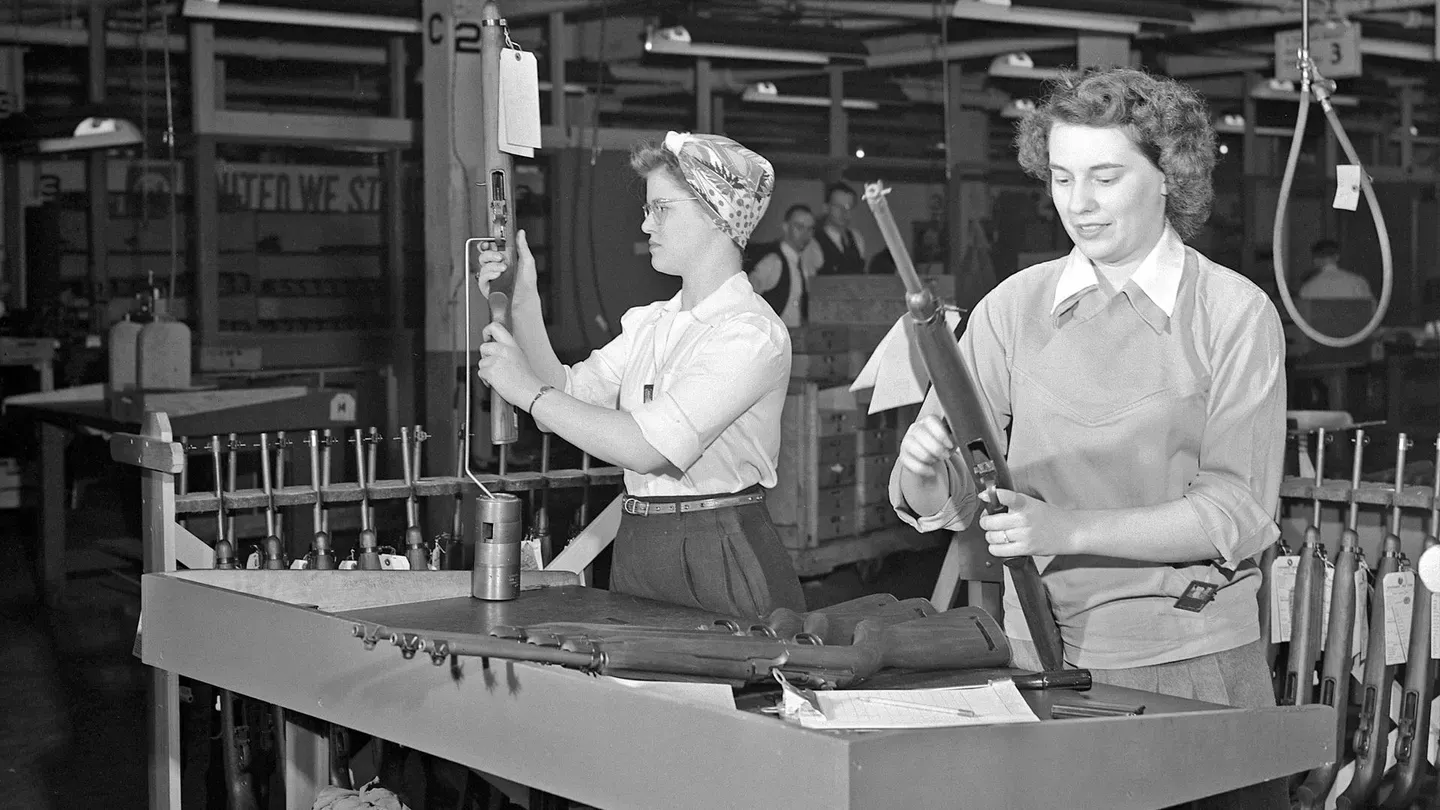
The M1 carbine was a lighter, more efficient rifle carried by many soldiers stationed in non-infantry divisions.
Although the 30 caliber weapon was produced in Saginaw for only a short time, many still refer to the M1 as the “Saginaw Carbine”.
A lot of people think that the company made the whole carbine.
Saginaw made like 8 or 9 parts out of 50 some parts or 70 parts, or how many parts we in them.
They made the basic receiver, the bolt, the slide, the trigger, the housing, and the barrels.
The other parts came from factories all over the United States that supplied parts to all the other ten companies.
The stocks were made in Grand Rapids, again in Saginaw, and each component was assembled in a group and all put together on an assembly line basis and came out with the finished product.
You can tell the parts that Saginaw Steering Gear made because they have a little “SG” stamped everyplace on the gun, where they made the part... on the stock, on the receiver, on the barrel, on the trigger housing, on the slide and on the bolt.
The Army had developed the Garand, the 30/6 Garand in 1936, and they were coming out with it.
But the Garand weighs over 9 pounds and the carbine only weighs a little over four and a half pounds.
So it was half the weight.
So it was a lot easier to carry.
And what they wanted to do was replace a 19-11-45 Colt automatic or semi-automatic, with a gun that had a longer range and more firepower.
And if making weapons wasn't enough, what little space remained on the floor of the gun plant was taken up by the manufacturing of 37 millimeter projectiles, special armor piercing rounds that were used in guns outfitted in tanks.
Workers were able to put out 30,000 shots per day.
The military draft and enlistments were taking men by the thousands overseas.
In order to keep up the demanding war production schedule, plants needed to maintain their workforce.
Women not only took over as head of the household, but millions also took to the factories, filling jobs traditionally held only by men.
There was such a strong need for women in the workforce that companies and the government used films and posters to get ladies on the production lines.
It was unusual that women taking job running machines.
But I'd say maybe 30-40% of our employees at the time, or women.
Lois Thurston was 17 years old when she applied to be a typist at the gun plant.
I wanted to help the war effort, so I decided to get a job, try to get a job.
I went over to the gun plant and applied, and I applied for a typing position, which, I was so nervous I flunked and they felt sorry for me and offered me a job in the plant, so I, I started there, did my tests and, and got my working papers and started the next day inspecting the receiver on the carbine.
By 1943, Saginaw manufacturing plants had hired over 8600 women to work on the line.
The starting wage of the gun plant was $0.88 per hour, even though they were doing men's work, these “Rosie the Riveters” were required to take special precautions while on the job.
We had to cover all of our head.
Everything would be our hats would be down to here.
I know what he had us cut like a “snood” They called it in your hair.
It would be all tucked in.
You look like a zombie.
You felt like a zombie.
And.
But there were very few men working.
They were the bosses.
The men were the bosses.
We had one lady.
She was a very, very chunky lady that, she had nothing to do but watch the ladies, that they didn't spend too much time in the restroom.
And I can remember we went in there was open on the bottom, and we go in just because of her.
We put our feet up so she couldn't see the feet, and she couldn't bend over far enough to see whether we were there or not.
We used to delight on that to see if if we could just get by her.
Now, this is just some of the things that we did for fun.
You know, there was, very little talk, very talk to you because you had to keep so busy.
It was a time for change in America with many more women in the workforce.
Someone had to care for the children.
Those without relatives to help with childcare relied on government established daycare, which at this time was a new concept when married women with small children have to take jobs, everything possible will be done to provide daycare for the children.
One of the daycare facilities established by the Saginaw Board of Education was at the Jerome School.
Employers and government agencies who established the institution saw it as a powerful recruitment tool to encourage women to enter the workforce.
Women were not the only people filling the vacancies at the plant.
Companies were actively recruiting workers from all walks of life to fill their open positions.
African-American workers from the South were encouraged to come here, and some even had their travel cause paid to work at places like the Malleable Iron Foundry in Saginaw.
Send your ticket and $10 to eat until you get here.
But when you make second payroll, do you take the amount of that ticket and $10.
The working condition at the Malleable line was rough.
It dust and gas and smoke.
I don't care what color you went in at eight hours, you came out black.
When I went there I said 3 weeks ...long as Im gonna be here I'm leaving here.
I'm getting out of here.
Okay?
I ain't no way I'm gonna stay here.
After I did three weeks, I said maybe Ill do three more.
it just the way I did after two weeks.
That's it.
3o odd years later... Malleable iron, which became a division of General Motors in 1917.
Produced armisteel during World War II.
Armisteel was used to cast everything from guns to tanks.
The iron your were pouring was more than 1750 degrees hot.
I guess the temperature had to be around 95 on 100.
Your smoke drifted all through the plant and the foundry, and you sweated and the dirt would stick to your face and your hand.
During the war, malleable Iron employed over 3500 men and women.
Lupe Ortega worked at the plant for only a few months before going off to war.
One of my first jobs there was, grinding tank blocks.
These weighed about 80 pounds apiece.
We had to pick them up, put them on the table and grind them down, pick them up there and throw them in a hopper so they could take them away.
Grinding...we had the wheel that was about two inches thick and probably two feet in diameter.
And every now and then one of those would break and pieces flew all over the place.
And if you happen to be standing in the right place, you had it.
And I thought, that's I don't want that to happen to me.
In the department where I happened to work, it was all minorities, the only white people who were around were, the ones wearing neckties.
bosses everybody else around.
Lupes wife Carlotta also worked at Malleable Iron during World War II but there was a lot of heavy work being done by women, mostly because a lot of the men were going to war.
They had a shortage of strong men that could work there.
So the women were doing the work and they were, I don't know how many shifts they had, but they had several shifts.
I didn't last there very long.
As an incentive to increase production and lower costs, General Motors awarded war bonds to those employees who made suggestions that save the company time and money.
Often these ideas helped decrease the number of hours workers logged on the lines and reduced the production cost to the government.
Besides needing workers, the plants also needed raw materials.
Metal, rubber, and gas were rationed during the war years in order to keep up with demand for these materials, scrap drives were organized to collect the valuable metal, tin cans, and even metal toothpaste tubes were collected.
Machines that no longer needed to make cars were melted down, and even some vehicles were donated to the war effort.
Each one of us saved everything that we heard, read, or seen that would help our men in the service.
And as I said, we saved the gum wrappers to get the silver off of that, and everybody saved the toothpaste.
All tin cans was never, never a tin can thrown out.
If there was one on the street, you stopped and picked it up.
And so it was a whole different, way of life.
The war business was booming for General Motors.
The company proved it time and time again by using the same successful methods honed in automobile manufacturing and applying it to the production of munitions.
Saginaw steering Gear acquired an idle plant in Grand Rapids to produce the M1 carbine rifles.
Bullet manufacturing was moved from Saginaw to Atlanta, Georgia, where more rounds could be produced at a faster rate.
Fred Kleinfeld is the nephew of William Bud Dufner.
Dufner was the esteemed general manager of Saginaw steering gear during the war years.
My uncle.
Bud Dufner, was transferred from the foundry division to take over the operation of the gun plant.
They needed someone who had skills in innovating and developing new processes, and to create a manufacturable gun that it could be mass produced.
Dufner exerted a great effort to make the plant more productive and efficient.
These efforts were so successful that the gun plant received the coveted Army-Navy E Award.
Under his leadership, E awards were presented by the U.S.
War Department to companies and their employees for excellence in wartime production.
Getting that Excellence award... The Army Navy was terrific They have a pins to wear, and it really boosted the morale and the fund drive giving.
And the people worked long hours, very long hours.
They spent, all the time they could making guns.
Our total production in the war years, 1941 to 45.
We we manufacture 412,000 Browning machine guns, 517,000 M1 carbines, and 13,700,000 projectiles, particularly the 37 millimeter projectiles.
General Motors converted 100% of manufacturing to war materials from the smallest ball bearing to the largest tank.
By the end of World War II the auto industry in Michigan produced over $50 billion of war related equipment.
This production was in large part responsible for the Allied victory, and Saginaw should be proud of the role they played in that monumental task.
While the workers in Saginaw were making the weapons used in battle down river here in Bay City, production was underway for the naval fleet long before the formal declaration of war.
at the Defoe Boat and Motor Works, which once occupied a site right across the Saginaw River.
They were building ships for both the British and US Navies.
This location, being so close to the mouth of the Saginaw River, was ideal for building and launching ships.
During the First World War, Defoe produced 40ft sped torpedo chasers and 98ft steam mine planters for the Navy.
As tensions over the Second World War were building overseas, the axis powers of Germany and Japan warned the U.S.
to stay neutral or face war on two fronts.
Company founder Harry Defoe knew what was coming and started to prepare his company.
Defoe Boat Motor Works changed its name to Defoe Shipbuilding in 1941 to better fit the firm's mission building ships and specifically warships.
The name changed from Defoe Boat and Motor Works to Defoe Shipbuilding Company, says volumes about what happened to the company during the war.
They went from a small quality based interest to a major international factory, one of the largest employers in the area, and they were able to step up production to a feverish rate and still hold true to Harry Defoe's values of quality.
He was out in the yard.
He was through everything to see what was going on.
Then he'd go back over to the office later on in the morning, he'd be back out there again.
And of course the word was out there.
If you lay it around, get off of your duff.
Here comes Father Defoe.
And he was out there all that time, and he was very long after everybody went home.
He might leave that yard by 530 the evening.
Sometimes he might come back down there, at night on his own.
On the weekend we come down there just on his own.
And the operation for there was a day, if he could do it, we can do it.
One of the first ships to come out of the company was the patrol craft.
Two prototypes were built and launched in the spring of 1940.
Defoe received a contract to design what would become the PC vessels.
They were successful and at design the second PC that was part of that design contract... The hull was what was used for all future PCs, and it opened up the door for Defoe to receive future war work.
It gave them a good reputation with the Navy Department and as a “can do” business.
They did all the designing and the development of everything right through the construction, through the launch of the delivery.
And that was the first, patrol craft that we got into, for the Navy because of their work on the patrol craft, the fall shipbuilding was awarded other military contracts.
And by early 1941, the company was building minesweepers and submarine chasers, as their war production began to ramp up quickly.
The success of the PC 451 and 452 really proved to the Navy that Defoe was a legitimate shipbuilding interest and that they could produce more ships, and thus they got more contracts for war effort.
After Pearl Harbor was attacked, large numbers of men went off to war, and women had to take their place.
On the first day, the shipyard began hiring women, there was a line at the door of the company's employment office.
One day my father came home from work at Defoe's.
He worked as a tank tester, and he mentioned to me that they were hiring women at Defoe... And I thought, well, I'm old enough.
I think I'll go over there and try it.
And I stood in line with all the rest of the women and I was hired.
I was the first woman to be hired.
I was hired as an electrician's helper.
Norma and her coworker, Caroline Underdown, had the distinction of being the first two women from any building yard selected to attend specialized training in New York City.
Mr.
Defoe asked us if we would go to New York, to the Brooklyn Navy Yard to learn how to waterproof cables underneath the waterline.
And, you said we were going to tell anybody except our mother and fathers that it was secret.
When we were through with our training, we came back to Defoes and we had to teach the other electricians how to do this process.
Rosemary Pope also worked for Defoe Shipbuilding.
She worked in the shipyard office and had personally asked Harry Defoe for a job at the company.
Well, I saw an ad in the paper for, help at Defoe Shipbuilding Company in the payroll department.
And so I thought, well, my dad knew Mr.
Defoe Maybe that would help.
So I decided I'd call him.
I called him up.
He came to the phone himself.
I told him who I was, and I said I'd like to apply for the job that I saw advertised in the paper.
Well, he said, that sounds good.
He said, you come in tomorrow and you see my son Bill, he's the personnel manager.
So I did, and I got the job.
World War two was funded through the sale of war bonds, and Rosemary's job at Defoe was to purchase the bonds for the workers.
Almost 100% of the workers at Defoe participated in buying bonds through the payroll deduction.
And it was very successful.
And we won several awards from the government, which was a flag separate flag that we could fly.
On December 7th, 1943, a yard tug was christened the Jack Boyce in honor of the first former Defoe employee to lose his life in the armed services during the war.
The tug continued to serve the yard for many years.
After the war ended, Demand for Defoe warships was increasing rapidly.
The company needed to find a new way to make them faster and more efficiently.
The shipbuilding industry was revolutionized by what is now known as the “rollover method”.
The ship was built upside down on a specially designed cradle.
Constructing boats in this manner eliminated the need for overhead welding, which in turn made workers less tired and increased productivity.
Prior to the rollover method, ships were built from the keel up with scaffolding, overhead welding, and a lot of wear and tear on the workers.
Once the vessel was ready for completion, the ship was “rolled over” or turned right side up, and its decks and superstructure were completed.
Before launching.
The rollover method was true ingenuity.
Just like Henry Ford's assembly line revolutionized auto manufacturing.
The rollover process allowed the full to produce one patrol craft vessel per week at one point, and that was unheard of, and they were able to share the rollover method with other shipbuilders, which ultimately helped the allies win the war.
The rollover method proved very successful and production dramatically increased.
And the Navy, well, they wanted another class of ships to be built.
The new vessel would be used to escort ocean convoys, but it had to be smaller than a destroyer.
This new vessel class was called the Destroyer Escort or DE, dubbed the Tin Can of the US Navy, Defoe workers built 17 DEs before the end of World War II Destroyer escorts were very significant during the war.
They were used for, convoy duty and also for protecting the large battleships.
They were also used during D-Day.
They could get close up to the shore because of their shallow draft.
To defend the mid landing.
The company built one destroyer escort and then realized they could also construct this ship using the rollover method.
In order to implement this method, the cradles which supported the hulls had to be bigger.
Two larger cradles were set up on the north end of the shipyard and production was underway.
The first destroyer escort was rolled over in early spring of 1943.
This was the largest hull to be rolled over.
She was 306ft long, 36ft wide, and 13.5ft depth a hole.
This DE was named the USS Bull and launched in March of 1943 with much fanfare.
In 1943-1944, my grandfather, who worked at Defoe, would take me to the launches and it was a very exciting time.
There were people all over, but I do remember the bands.
The high school bands would be there.
There would be, a lot of fanfare.
That would be bunting.
They always had some celebrities like that.
The mother or the wife of the person that the ship was named for, and they'd have speeches and they'd break the champagne bottle and, and down the ship would go in with a big splash.
So it was it was quite an exciting time, especially for a kid 6 or 7 years old.
Between 1943 and 1945, production at Defoe was at its peak.
The company employed 4400 people.
War craft were being launched and delivered regularly.
The fall shipbuilding was given many awards during the war years for its contribution to the war effort.
Before the end of the war, Defoe received a contract to build another type of ship, the Landing Craft Infantry.
Large or LCIL.
This large landing craft was needed to carry infantry and vehicles to the shore.
They built around 50 some of them.
They could put in large amount of troops or equipment like tanks and trucks and whatever they wanted.
They were used in the Pacific extensively.
They were, very effective.
They carried 20mm cannons on them.
They were very fast.
They could lay smoke, they could do just about anything.
The construction process for the landing craft did not employ the rollover method.
Most of the steel parts for the ship were fabricated in Detroit, then trucked north to Bay city for assembly.
The war production jobs brought a large influx of people to Bay City.
Well, during the war years it probably had, three shifts, over 4000 people working in there On the destroyer campaigns and over 1600.
So, I mean, a lot of this, a lot of the city in the way of economy and work for the people, people came from all the way, all the Thumb and all the way up north...as far as West Branch Twining and Turner.
They came from out in the Thumb to work... It just meant a lot of the whole area.
The last wartime ship built by the was a freight and ammunition carrier.
The Y F class was built on the old patrol craft line.
After the Japanese surrender of 1945, government contracts at DeFoe were canceled.
When the women went to work at DeFoe, we were told the Navy would only allow women to work for two years or the duration of the war, which had come about the same time that two years was up.
So, then, then we were laid off after that two years.
From 1939 until 1945, the Defoe Shipbuilding Company produced an astonishing 154 vessels for use in World War II The company never again saw the huge amount of work that they did during the war, and when the last of the government contracts dried up Defoe Shipbuilding permanently closed its doors in 1976, bringing an end to Bay city's robust shipbuilding era.
Defoe Shipbuilding wasn't the only Bay City Company manufacturing products for the war effort.
Cranes made at Industrial Brown Hoist were sent all over the world, and they were used to load planes on aircraft carriers and munitions and things like that.
You could tell an Industrial Brown Hoist crane by the placard on the side of it.
That's said Industrial Brown Hoist, Bay City.
Aladdin Homes, a company which started shortly after the end of the lumbering era, supplied housing for the army.
The five manned military huts could be built in 75 minutes and taken down in 32.
In 1942, they were awarded $1.8 million in government contracts.
The Dow Chemical Company has played a significant role in global enterprise since the early 1900s.
With its strength in research and innovation, the company has had a long history of developing products found not only in homes and businesses, but also used specifically by the military.
When World War II began, Dow's products and processes were ready to be implemented, when the call to arms came.
So as the fighting intensified overseas, Willard Dow and the other Dow Chemical executives knew they needed to be ready.
We knew that the government and the military needed these products.
And we we worked hard to, make them a success.
During the First World War, Edward Barstow, a scientist at Dow, began a look at magnesium chloride, byproduct in brine as a source of magnesium metal.
By the end of World War I, the company was turning out 1,500 pounds of magnesium per day.
In 1937, the company moved its foundry operations from Midland to Bay City.
During World War II 3300 men and women worked at the Bay City Plant.
Magnesium was a very important part of the war because it was the first war in which aircraft were, a major factor.
They needed lots of magnesium, which was really the basic metal for what aircraft were made.
Dow Chemical developed a revolutionary process to extract magnesium from seawater.
For the first time, man was mining the ocean.
It was considered one of the greatest chemical engineering feats in history.
In 1941, a magnesium plant opened in Freeport, Texas, and Dow once again was on the manufacturing front lines.
With the need for more military vehicles and the shortage of steel, magnesium proved to be a very valuable war material.
It was strong and lightweight, which made it ideal for aircraft.
The metal was forged at the wheels for planes, castings and other assemblies.
It was hot work for those who took jobs in the magnesium foundries.
Irma Gies was 21 years old when she applied at the foundry in Bay City... I was willing to take any kind of work that they had to offer, and I feel I was so fortunate to be able to take the test and pass it to become a core maker, and I made the mold that they poured the hot magnesium into it and every mold... they were timed.
So some molds you made ten an hour, but some molds you made 50 an hour before the war.
Dow did not employ women in the foundries, but the need for workers opened the doors, providing women with a new opportunity.
But there were not a lot of women at that time.
They were just starting to come in.
I really think that there was only one you could call it a batch or a group of people that went in a ladies that went in ahead of us, and they told us the day we were hired, in the day the war is over, you are all through and you will not be working to Dow.
For Dow Chemical, the high demand for magnesium meant big business for the company.
It was tremendous technological advance which were absolutely essential to the building up of thousands of aircraft for the war.
Another shortage brought Dow into the spotlight.
Natural rubber supplies had been cut off by the Japanese, and despite rubber drives, there just wasn't enough rubber to meet the demand.
Dow scientists made the rubber shortage a top priority.
They developed a synthetic rubber using the chemicals of styrene and butadiene.
This was good rubber that was produced from these two materials styrene & butadiene.
Most of them were no good.
For instance, they tried to put them out of automobile tires.
You might drive the car to the grocery store.
The tire would fall apart.
It was just brittle.
Not suitable at all.
Not only was synthetic rubber used in tires, but it was also used to make life rafts and other items.
The rubber program was was absolutely critical.
You know, we had used about 600,000 long tons of natural rubber per year in the early 40s.
And when the Japanese shut it off from the Pacific, there was no, rubber available.
We did not have a synthetic rubber industry.
And in the United States, I think we produced probably 2500 long tons of of rubber.
So if you talk about needing 600,000 and you look at 2500, it's a pretty small shot.
And, that, that had to be resolved because you could not have built a, the war machine that we built without rubber.
The US Rubber Reserve program selected Dow styrene process and making synthetic rubber.
Construction of styrene plants for synthetic rubber production quickly began.
It came about rather quickly because it had to come quickly.
The Japanese cut off the flow of natural rubber from Malaysia, and countries like that.
Dow had to confront that right away, because we would not have won that war with Germany if we did not have that synthetic rubber.
And even today, there is no No other synthetic rubber has come up to do what would the, government reserve styrene butadiene rubber would do.
If we hadn't been attached to the rubber reserve company or to the government... things wouldnt have gone so fast...no question about money.
Money was available... we could get steel, we could get engine or compressors, pumps, all the things.
These were big plants, tall towers.
One of our towers was, about 240ft.
The speed with which they plant, or constructed, designed and constructed was remarkable.
Besides synthetic rubber, ethylene led to the development of many plastic based products.
Two well known household names were still new to the market in World War II Saran was used to wrap equipment for shipping overseas and woven into insect screens for use of the tropics.
Tents and canvas were made water resistant with Saran coatings.
Saran could also be used as a seamless pipe and other tubing.
Styrofoam light air filled plastic had many applications for the military and for our soldiers.
It was used in the Coast Guard for life saving rafts and life preservers because it was lightweight and buoyant.
One of the very early things that was done, for example, in England, the, the channel buoys, you know, they're basically hollow metal tubes that are anchored to provide navigational guides.
And the German fighter pilots used to love to do come along and, machine gun them and sink them.
So one of the questions came, well, can you, can you fill up the inside of one of these, these bouys with with styrofoam?
And the answer was yes.
We had a couple of our engineers went to, went to England and, they actually came up with the process of, filling these bouys with styrofoam.
So even if you shot holes in them, they still wouldn't sink.
And they spoil the sport of the German fighter pilots.
But there were a lot of a lot of things that happened along those lines.
Other products produced by Dow Chemical included styrene, a derivative of styrene used in parts of radios, transmitters and receivers.
Ethocel was another plastic used in making goggles, canteens, and parts for airplanes.
Liquid at the cell was used to make uniforms, water, and chemical resistant.
Without Dow, it would have been very difficult, for example, to to get the magnesium to get to the rubber.
Even even products like styrofoam were in their infancy.
But they were... they were useful.
We we knew that Dow was playing a key role.
And in getting the raw materials that the military needed.
The company received six E awards for their wartime contributions.
By the end of World War II the Dow Chemical Company implemented 58 wartime projects worth $200 billion.
$50 billion came from the company.
One other important byproduct evolved from Dow Chemical during World War II... Corning Glass of New York was conducting silicone research and approached Dow to discuss the possibility of manufacturing the resins and fluids they developed with a handshake agreement on April 9th, 1942... Dow Chemical and Corning Glass joined forces to manufacture silicone products that were both heat and moisture resistant.
Bob Fleming worked at Corning Glass, then came to Midland.
After Dow Corning was formed.
Corning had done the research of basic research, and it was obvious that they used materials were very important.
Corning had no experience in manufacturing any chemicals.
All they did was melt sand with various other things.
So they were looking for a partner.
And Doctor Sullivan, who was the director of research at Corning.
knew Dr.
Edward C. Britain, who was organic research man at Dow.
So he suggested that Corning had to get together with some chemical company, and that's why the partnership was formed.
The first product to come out of this unofficial agreement was DC four, a silicone based grease used to block moisture and insulate ignition systems to prevent Allied planes from stalling at high altitudes.
Bill Kuhlmann worked at the Dow Corning plant during World War II to DC four was one of the early compounds, but it was a very important, compound because it was used in, the, harnesses going to the spark plugs, on the aircraft.
And, it was able to take high temperatures.
And if you put an organic grease, like axle grease on, they would simply melt and run off.
But DC four was a grease that adhered to the spark plug and prevented this flashover, allowing the airplanes to travel at 30,000ft.
DC four was also essential in the bombing of Tokyo during the later stages of the war.
The compound was used to seal the ignition systems of the Boeing B-29 Superfortresses used in the raids.
It allowed the planes to fly at 35,000ft for a full eight hours.
Without the product, a plane engine would fail in a matter of minutes.
DC four wasn't used just on planes.
It was reported that soldiers deep in the Asian jungles rub DC four on their feet to prevent jungle rot, and applied it to their boots to repel water.
In February 1943, the joint venture became official, and the Dow Corning Corporation was granted a charter to operate by the State of Michigan, but the company had a problem.
Magnesium was an essential ingredient in production because priority for magnesium was given to the war effort.
Dow Corning would need special permission before a plant could be built.
Commander Hyman Rickover paid a visit to Midland to check on the progress of the resins to be used by the Navy.
He asked company executives what was needed to proceed with plant construction.
The answer was magnesium.
Using his military influence, Rickover placed a priority order through the government that included a supply of magnesium, and soon construction of 1st Dow Corning plant began on Saginaw Rd.
Because, the war, we did have shortages of materials to build with.
So, the those that were in charge of construction, they had to do a little scrounging around to find the right materials, and they could pick up used ones once in a while.
Workers started at the new plant in May 1944, and DC 4 was in full production in its own facility.
Dow Corning produced two other products for military aircraft a resin used in high temperature electrical motor insulation and a de-foamer, used so engine oil would not foam out of aircraft engines at high altitude.
Dow Corning spent two and a half years building a successful corporation.
But once the war ended, the company lost all of its customers and sales dropped to zero.
Today, new products and innovations keep Dow Chemical and Dow Corning major players in the global marketplace.
Both companies continue to develop products for the automobile, airline and agriculture industries and thrive today.
The Saginaw Valley is known for its rich farmland, and during World War II manual labor was used to get the work done out in the fields.
But many people don't realize that that manual labor was in the form of German prisoners of war who were brought here after being captured on the battlefields of Europe.
Because of the labor shortage, the Emergency Farm Administration Labor Program was created to obtain help from local farmers in the fields.
In 1943, in accordance with the terms of the Geneva Convention, the federal government deployed prisoners of war to local farms of the Saginaw Valley.
The Bursma Electronics Building in Bay City has a connection to these prisoners of war.
It's hard to tell from the outside, but this building, now occupied by Bursma Electronics, once housed German prisoners of war brought to Bay city to work in local farm fields.
But Don Gies remembers he grew up near this former Bay City P.O.W.
camp.
I grew up in a neighborhood here and remembered seeing all the German prisoners.
They had guard towers at two corners of the lot here.
And, this one time they were playing soccer, and the ball come across the street & not knowing better I threw the ball back to him and they all were happy and said thank you in German.
At the time, I didn't understand German, but they, seem quite happy about it.
The other thing on Sunday is the guards used to take 10 or 12 prisoners and walk them up down the street for exercise, and at that time the people were sort of scared, you know, they all stayed in the houses.
They went by.
And, it was some remember about six years ago that happened.
Many P.O.W.
camps were scattered throughout the state, including what is now the MBS International Airport.
During the war, it was called Camp Freeland and was the home to almost 1000 German prisoners of war.
During the 1944 sugar beet season, Ernie Abraham was hired to transport the P.O.W.
from the camp at MBS to Frankenmuth Farms.
I have to be out in Freeland at, at least at 7:00 in the morning and then take the prisoners, 24 prisoners to Frankenmuth.
That's where they were hauling sugar beets.
And, and the guard was along.
And, so then I would take them to, to their farm wherever they were scheduled to go.
And then I would go home and do some farming work.
And then around 3:00 I'd start out again and, go to pick them up.
When the P.O.W.
was left for the farm in the morning, they were usually issued a lunch.
Typically baloney, but they would often discard that in favor of the more tasty fare that was often served to them by the farmers.
They didn't have a real good lunch.
I heard that it was just a little baloney and bread, but we, And we didn't have much money, but we had beans, we had potatoes, we had cows so there was some milk, and I made scalloped potatoes, a big pan of scalloped potatoes, and a big pan of baked beans.
And and my husband took them out that out to the field for the prisoners to eat, help warm them up and give em a little energy.
Those prisoners were, really pleased, working in Frankenmuth.
They for the reason that they got very good food.
The farmers would bring out a wagon, and then they set up a big, spread of food.
And these guys would stand on each side of the wagon and they would enjoy the food.
And they had a, bonfire out in the field to be warmed up by.
And, they had a guard.
The guard was dressed in a long overcoat.
And they had a gun.
And I don't think he was worried about the prisoners because pretty soon he said, would one of you please hold the gun and let me work in the sugar beets for a while so I can get warmed up?
Arnold Kern was 15 years old when the prisoners began to work on his family's farm in Frankenmuth.
Taking sugar beets out of the ground was hard work, and it took a lot of time.
We used, migrant workers and, but we couldn't get them.
So the sugar company arranged with the government to get these prisoners.
And these prisoners stayed at, which is was Tri-City airport at the time.
And there was another group that set the Caro Fairgrounds.
So they were brought out to the maybe the whole thumb to take out beets.
And it probably didnt have those men to do this... the farmers would have to they could do it themselves.
Of course, in the fall of the year, there was a lot of other crops that had to be taken care of.
So they saved the crop... that time.
The prisoners worked in the fields 12 hours a day.
They were paid $0.80 a day in canteen credits.
The credits were used to purchase items at the camp store.
P.O.W.
labor included hoeing, weeding and blocking and harvesting, and many of the prisoners reported being treated very well by the farmers.
Because of its rich German heritage, the farmers were able to easily communicate with the POWs, and many of them forged friendships that lasted years beyond the war.
After these, men left, after the war went back home, my parents would send, food to them and clothing.
And of course, when they sent clothing, they put a little, note in the pocket with the address.
So those guys wrote back.
But, there's one person.
Robert Klein was his name.
He always wrote.
And then he sent stuff to my parents gifts or some.
And then they formed a friendship that lasted for many, many years.
The Michigan agriculture industry was saved by P.O.W.
labor.
In 1944, 36% of the food produced was handled by POWs, and in 1945 it was reported that without that P.O.W.
labor, Michigan farmers would have lost $2 million in crops.
Now, that doesn't sound like a lot of money today, but at that time it was a huge amount.
The end of the war brought our men home and back to work.
Many had jobs waiting for them in places like steering Gear, DeFoe and Dow.
The plants had to be converted from military use back to civilian use.
Farmers were back in the fields and life became relatively normal.
But due to the valiant efforts of the men and women who were on the home front, many of our soldiers would not have made it through the war, let alone return home.
It was everyone's dedication during this tumultuous time that brought the nation together.
Because of the huge quantity of goods produced by Michigan manufacturing companies, the state earned the title the Arsenal of Democracy.
Factories were a national asset, producing not only weapons and vehicles, but life jackets, mint oil for chewing gum, and food rations.
World War II was a time when our nation stood together to fight for victory, both overseas and here at home, and when the war was finally won, the people of the Saginaw Valley were very proud to have been part of the battles that brought peace around the world.
There are memorials all across the nation to those that served, but very few for those that struggled mightily here at home, for they truly were the “Margin of Victory”.
















Support for PBS provided by:
Margin of Victory: Saginaw Valley's Role in Winning World War II is a local public television program presented by Delta Public Media