
Maria Farris, IL Agriculture in the Classroom
12/22/2022 | 26m 46sVideo has Closed Captions
Maria Farris, IL Agriculture in the Classroom
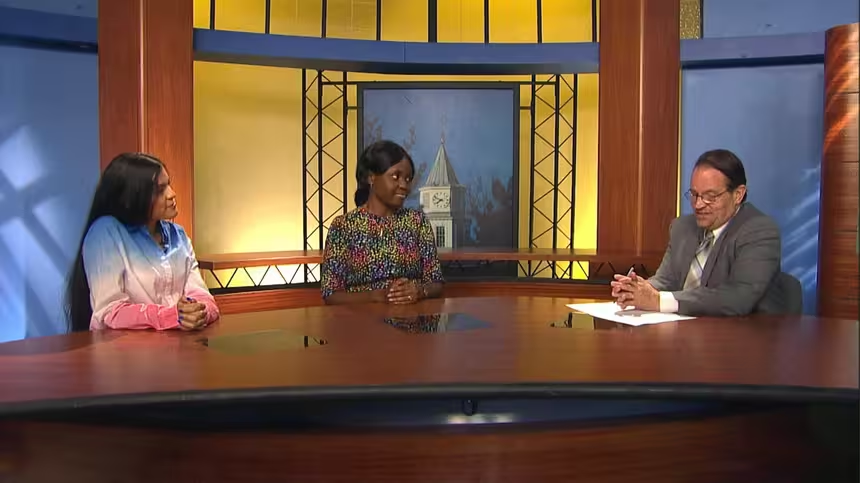
Fred Martino talks with Maria Farris, Williamson County Classroom Coordinator for Illinois Agriculture in the Classroom. On "Saluki Sleuths," the story behind the Paul and Virginia fountain. SIU Carbondale is home to not one, but two statues of Paul and Virginia, two characters from a French novella. We uncover the story behind these statues and how they found homes at SIU.
Problems playing video? | Closed Captioning Feedback
Problems playing video? | Closed Captioning Feedback
Eye on Education is a local public television program presented by WSIU
Maria Farris, IL Agriculture in the Classroom
12/22/2022 | 26m 46sVideo has Closed Captions
Fred Martino talks with Maria Farris, Williamson County Classroom Coordinator for Illinois Agriculture in the Classroom. On "Saluki Sleuths," the story behind the Paul and Virginia fountain. SIU Carbondale is home to not one, but two statues of Paul and Virginia, two characters from a French novella. We uncover the story behind these statues and how they found homes at SIU.
Problems playing video? | Closed Captioning Feedback
How to Watch Eye on Education
Eye on Education is available to stream on pbs.org and the free PBS App, available on iPhone, Apple TV, Android TV, Android smartphones, Amazon Fire TV, Amazon Fire Tablet, Roku, Samsung Smart TV, and Vizio.
Eye on Education
Eye on Education features interviews with people making a difference in all facets of learning. From Pre-K through higher education, we highlight efforts to prepare students to become the world's future leaders in every discipline.Providing Support for PBS.org
Learn Moreabout PBS online sponsorship(upbeat music) (lens beeps) - "Eye on Education."
I'm Fred Martino.
Coming up a program that teaches students about one of the state's biggest industries, Illinois Agriculture in the Classroom.
But first, an iconic part of the campus at Southern Illinois University Carbondale, as Anna Twomey of the SIU Alumni Association explains, it dates back to the late 1800s.
- These two have watched over SIU through fires, riots, and even vandalism.
They've become a symbol of hope and protection.
But the Paul and Virginia, we all know so well, the pair that sit right here in front of Shryock Auditorium are actually just a copy.
The original fountain sits about a half mile away from here at the Stone Center.
- And as you walk in this way, you immediately see on your right the Paul and Virginia Fountain.
- [Anna] Kathryn Sime takes us to the Stone Center Courtyard where the original Paul and Virginia are surrounded by nature.
- My name is Kathryn Sime.
I'm Senior Director of Gift Planning with the SIU Foundation.
- [Anna] Katherine oversees a group of SIU legacy donors known as the Paul and Virginia Society.
As part of that role, she's learned a lot about the fountain's journey to SIU.
- It's a representation of the Enlightenment School of Education is the idea that the best education is really grounded in nature.
- Catherine says the original Paul and Virginia was brought to campus in 1887, more than a hundred years ago.
At the time it was located in front of the Old Main building, which once stood close to where Shryock is now.
The fountain was moved away from this spot after campus unrest in the late sixties during which Old Main burned to the ground.
Years later, the duplicate, cast in bronze took its place.
- The fountain was named after a French novella by Jacques-Henri Bernardin de Saint-Pierre.
The novella is "Paul et Virginie."
- [Anna] Kathryn says, it's a dramatic story called, "Paul and Virginia," first published in the late 1700s.
- The novel itself is problematic when viewed through a 21st century lens, but it really impacted many people in time.
It came out in 1788.
- [Anna] The theme of the fountain centers around two young children who grow up to be lovers.
- It's the story of two children who were left with their mothers on this tropical island.
And they just grow up with this natural education, learn to be their best selves away from the artifice of society, which is the overall theme.
And of course ultimately they fall in love.
But then of course, because it's French and tragic, they get separated and somebody has to go back to society which is just all tears.
- [Anna] The story has inspired centuries of artwork, including operas, novels, and even movies.
- There is an iconic scene in the novella where Paul and Virginia are sheltering under a rainstorm and she has an umbrella and she shares it with him.
It's supposed to be this very pivotal scene in the story.
- [Anna] Paul and Virginia's statues and fountains have been replicated around the world.
We spoke with Susannah Munson at the University Museum.
She says, what makes SIU's Paul and Virginia unique, is that it shows the pair as young children instead of teenage lovers.
- There are many different variations on the sculpture of Paul and Virginia across the world.
It was a very popular story and a lot of people created sculpture to represent it.
Our sculpture doesn't look like most others.
But in the 1800s, Paul and Virginia sculptures were a really popular type of sculpture that people had in their home gardens.
- [Anna] It's possible the model for SIU's Paul and Virginia statue may have come from the first official World's Fair to be held in the United States in 1876.
- I'm Eric Jones from Property Control.
I've been interested in Paul and Virginia for a long time.
- [Anna] Eric tracked down the World's Fair connection through a memo a former SIU University Museum curator wrote to the Philadelphia Museum of Art which had a similar statue.
- Story goes that this particular fountain was based on a little terracotta garden sculpture, like a garden gnome that was popular at the World's Fair of 1876.
People liked lots of little garden doodads in Victorian times.
So it wasn't originally, they weren't all fountains, they were just sculptures.
- [Anna] According to a catalog from the 1876 World's Fair the terracotta sculpture was located in the Italian section and stood about 47 inches tall.
- The World's Fair was a big deal in those days because people didn't have the look at the outside world like we do now with television and the internet.
So that was where people got the latest ideas and there were people from SIU who went to the fair on the train, even though it seems far, it was in Philadelphia celebrating the hundredth anniversary of our nation.
- [Anna] We spoke with SIU architect Brian Gorecki who was part of recent repair work to both the original Paul and Virginia Fountain and the replica.
Brian says it's possible the replica fountain sits atop the oldest structure on campus.
- The original was a donation from the class of 1886 and it arrived here on campus sometime between 1886 and 1887 apparently.
And I believe that perhaps the base of the fountain was actually here prior to that.
- [Anna] Brian has scoured through dozens of photos dating back to the late 1800s.
He believes the base of this fountain has been around since SIU's beginning the 1870s, when we were known as SIU Normal University - In 1883, there's a fire that pretty much destroyed the normal building.
I'm suggesting that the fountain base survived and at some point in time later, 1886-ish, an obelisk appeared in photographic evidence, I should say, from relatively that point in time.
And then 1886 to 1887 is when we know we documented that the fountain, the statue appeared on campus.
I feel that the fountain base that we're standing here with is the oldest structure on campus.
- [Anna] The recent repair work done to both the original Paul and Virginia and the replica was sponsored by the class of 1965.
- Well, all the capstones were removed.
We repointed tuck pointing, basically repairing the masonry joints of the entire fountain.
We replaced the capstones, new mortar, the stone base of the Paul and Virginia statue.
There was a couple pieces that were broken.
- [Anna] Over the years, Brian says the umbrella has been stolen or vandalized numerous times.
The university facilities department now keeps an extra on hand.
- The umbrella is more true to the original circa 1887 fountain in that it's more rounded and the tip where the water actually comes out of the top, that's more true to the original.
Based on photographic evidence, we were able to figure out a more authentic tip and umbrella.
One detail I found interesting as far as Paul and Virginia, the way they face has changed over the years.
- [Anna] Brian says in the late 1800s, the pair started out facing east, the same way they're facing now.
- However, there's some pictures between now and back then where they were facing west.
For example, there's some pictures when Old Main was here, and Paul and Virginia was facing Old Main.
So those details, you wonder, okay, who turned them around?
Or did they turn around on their own?
- You never know.
To many, the statues of Paul and Virginia are a symbol of strength and hope.
They've watched over SIU's campus and they've inspired donations that help students and programs at SIU Succeed.
Legacy donors from the Paul and Virginia Society have made commitments to SIU through their wills and estates that total more than 60 million.
- I love the image of the umbrella, because an umbrella provides coverage, it provides protection.
And in many ways, that's what the gifts from our donors do.
- It's an old Saluki tradition that if you toss a coin into the fountain on your way to class before a test, it'll bring you good luck.
- For me, Paul and Virginia, they are all about survival.
They've been here almost since the beginning, and they've survived not only the burning of Old Main but all kinds of vandalism problems.
- I've always gotten the impression that it is a really important part of campus life as well.
It's a good landmark.
It's been here forever.
A lot of people have interacted with it in various ways over the years, and every time they do the summer concert series, everybody is out here next to Paul and Virginia.
Whether or not they understand the importance of it, they know that it's right there.
- Thanks to Anna Twomey from the SIU Alumni Association for that report.
Next, Illinois agriculture in the classroom.
And I'm pleased to welcome Maria Farris.
She is the classroom coordinator for Williamson County.
Maria, thank you so much for being with us today.
- Thank you.
- It is great to have you here.
And I wanna start with a little history of the Ag in the Classroom program.
- Sure as I know the history, it started from ag teachers and farm wives.
What they wanted to do is show some of the farming aspects to children.
And it's bloomed from there to the point where now we have over 80 coordinators in every county.
And we have 102 counties in Illinois.
But some of the coordinators aren't in every county.
But we have our curriculum in every county and Ag in the Classroom is now a national program but Illinois is the best, because we have the most coordinators and we have the most curriculum.
- That is wonderful to hear.
And we're not only the best in agriculture in terms of education, but number one in a lot of areas, like the biggest producer of pumpkins.
We've had the agriculture director on the show, and let's get at that agricultural literacy, what it is, and why it's really important for all students.
- Sure.
It's important that students be able to tell where their food, their fiber and their fuel come from.
A lot of it is taken for granted.
I can take this ear of corn.
To you, it's probably an ear of corn that maybe is squirrel food.
But to me, there's over 5,000 different things that this corn can be made into.
And that's part of my job is to address all the different parts of agriculture, whether it be the high fructose corn syrup that comes from here, or maybe the cattle feed that comes from here.
Kids just think it's sweet corn.
And my job is to teach them that it's a whole lot more than that.
- That there's feed corn, there's corn we use in our gasoline making ethanol.
So there's just so many uses for it and it's great for them to learn more about this and not just students that are interested in getting into agriculture, but everyone, all students.
- Sure, for my job in Williamson County, I try to go to every fourth grade class, and I've done it now for 14 years.
So now I have high school kids that see me and say, "Hey, I remember when you taught me about corn."
So our lessons are geared towards make and take things and also make an eat.
And when kids have hands-on experience, they learn more.
So it's pretty neat that they remember the lessons that I've taught 'em.
- That is so great and that is definitely true.
A very important educational concept.
You mentioned you sometimes see students many years later, and I'm sure some of them, you may have been their first in-depth experience learning about agriculture and some of them later on, may even be interested in a career in agriculture.
I wanna talk about career opportunities.
- Sure, well I think we're the number two industry in Illinois is agriculture.
Most people think with agriculture, it's farmers with overalls.
But agriculture encompasses just about everything in life.
If you think about it down to, well, I'll take pizza.
If you think about pizza, if we had to grow that pizza ourselves, it would take over two years.
And I don't think everybody would be able to make their own pizza, because there's so many specialty jobs within that.
So there could be a career as a horticulturalist, a career as a mill person that grinds our wheat.
A person that's a veterinarian that could help with the makings of the ingredients of pepperoni and hamburger and all of those different things.
So if you think of the careers in the form of a pizza, it's infinite.
And the scientists, this last month I talked about corn and that it's a renewable resource.
With that there are scientists making all kinds of different things with corn.
So there's the scientific approach, there's the hard work approach, there's the mechanical approach.
We have a resource called an Ag Mag.
And on the back of every Ag Mag, there are career opportunities that kids can learn about through each one of those.
- That is so great and important to help them understand the diversity of of career options.
There are so many.
You mentioned resources.
Let's talk about some of the resources in Ag in the Classroom, and those that have been most popular with students and with teachers.
I know there may be a difference there.
Students may like certain things that teachers don't and vice versa.
- Well, we offer a wide range of resources.
Our most popular thing is called an Ag Mag.
We have probably 30 different Ag Mags.
One of them might be pumpkins or corn.
And each one of those has an activity that they can learn.
They can learn about how Illinois processes that.
We are number three in raising pigs.
We're number one at raising soybeans, number two at corn.
So it encompasses all of that.
And of course we can't talk about all 5,000 things that corn gives us, but the Ag Mags give the kids an idea of, wow, this isn't just corn.
This is a whole lot of things.
I think the most popular thing that kids like, is for me to come into the classroom.
I feel like a superhero when I have my vest on, and I go in there, they all know that I'm going to talk about agriculture and that I've got something fun for them to do and something that they're gonna learn about.
In Williamson County, our county has the world's largest worm and cricket farm.
So Timberline Bates gives me worms for the kids to study.
So I talk about worms, and then I take live worms for them to touch and to feel.
And it's like I brought a Siberian tiger from somewhere.
They think it's that exciting.
And I always talk to the teachers, and I say "It's a worm," but they get so excited.
And I think that's what Ag in the Classroom what makes us special is we might take an ear of corn, but it's something that they can see, something that they have a little bit of knowledge about.
Or they can dig up a worm in in the dirt and find it and look at it.
And then we teach them to appreciate agriculture for what it is because we all take it for granted.
- [Fred] Yeah.
- But the classroom visits are probably the best.
And I try to go to every fourth grade class.
Now I might go to a class that has 10 classes of fourth graders.
So sometimes that's a challenge.
I think I have over 800 4th grade kids in my county.
- [Fred] Wow.
- And I try to get to all of them.
But I have teachers from other classes saying, "Hey, why don't you come to us?"
Well, I can only be one person.
So we're always looking for volunteers.
I can give them the lesson and I can give them the resources.
And if they'll help me teach about what they're passionate about, then I can spread agriculture out to more people.
- And I imagine if folks look up Illinois Agriculture in the Classroom online, if they Google that term, they could find contact information to volunteer.
- [Fred] Sure.
- Great.
Great.
- As far as the teachers go, we offer professional development for them.
It can be online or we have different classes that they can take.
One of the things that I started in our county...
I think "Eye on Education," has found that there's a teacher shortage.
There's also a substitute teacher shortage.
And most people don't appreciate substitute teachers.
So what I decided to do was to lift substitute teachers up.
I got all of the different entities that helped me and I said, "Hey, will you give me some things to give to substitute teachers?"
So I worked with the regional Office of Education, and they have a subs for substitute teachers program.
So they teach substitute teachers on a one day class.
And then they have me come in, and I give them something to teach extra.
And I give them different things that will help them become a better substitute teacher and let them know that we're proud of them.
And through that program, the Illinois Ag in the Classroom has liked that so well, that all of us are trying to lift up substitute teachers, and eventually we're gonna try to take it nationally to support substitute teachers.
- That's great.
Especially since there are more subs out there with the teacher shortage.
I'm sure they really appreciate that.
Let's talk about some of the other outcomes that you've seen from this program.
- As far as the outcomes go, we just within August and September, our total Illinois Ag in the Classroom has seen over 101,000 kids in two months.
Just in Illinois.
Teaching them about apples and pumpkins and corn and things like that.
We can do that through different commodity groups.
It's called IAA, it's a foundation that raises money for each of our Ag in the Classroom coordinators.
They give us that money so I can get $8,000, I take that $8,000 and I have to match that $8,000.
And then through that I'm able to reach as many students as I can with that money.
So our commodity groups donate money to us to be able to reach more kids.
- That really is great.
And another resource for education that I wanted to ask you about is online learning, the use of the internet.
And I'm curious how that impacted your work.
It's been a big topic over the last couple of years, of course with the pandemic.
- Well, at first we didn't know what to do.
It was a new horizon, and since I'm older, I'm not technologically gifted.
And I have a nephew that's a producer and he said, "Oh Maria, you should just go online and do your things."
And that wasn't comfortable for me.
So what I did was I developed different kits.
We have lesson plans that have the standards that teachers can use.
We have all the directions, we have pictures of what it's supposed to look like and we give them everything.
What I would do is put it all in a bag, and I would call the teachers, ask them who would be interested in it.
And then the Illinois Ag in the Classroom did professional videos to where if they did this kit the Illinois Ag in the Classroom taught them if they needed extra help with that.
- That's great.
I'm glad there were adjustments and ways to do this with all of the restrictions that we faced over the the last couple of years.
How did you personally get involved in Ag in the Classroom?
- Well, we raised chickens.
And my family's always raised a garden.
I've lived in southern Illinois all my life.
So to me, I thought I was always in agriculture.
But then I met my husband and he lived on a farm that had a hundred acres.
So I went with him to his house, and his family was all worried 'cause their combine broke down.
And I thought I was an ag literate person, but I told his family, I said, "I have picked corn all of my life at home.
I'll help you.
What are you worried about?"
And his dad, they all looked at each other, and they smiled and his dad took me out to this corner of their farm and had me look, a hundred acres of corn.
And he said, "Here's your bucket."
So I know that I'm an ag illiterate person, or I was at that point.
But we would always take our animals...
I always encourage people to be involved in their school.
So we would take our chickens to show them.
And honestly, I was an athletic trainer before, but since I had kids I decided I wanted to be home with the kids.
And I found that there was a part-time job teaching agriculture.
So I called for an interview, and when they called I said, "Oh, I can't make the interview.
I'm showing my turkey to the kindergarten classes at Carterville."
And I think I got the job just on the phone call.
- Well I'm sure a lot of people are gonna be interested after seeing this conversation.
Tell me how can people learn more about the program?
- Well, they can look up Williamson County Ag in the Classroom on Facebook, or they can go to https://agintheclassroom.
We have to do that 'cause we just got a new website.
- And I'm sure if they search for Illinois, Agriculture in the Classroom on Google, it'll come up as a search result.
- Sure.
- All right, Maria, thank you so much for being with us.
- You're welcome.
- Such a great program.
Well, thank you so much for joining us as well.
My guest was Maria Farris.
She is Williamson County Classroom Coordinator for Illinois Agriculture in the Classroom.
That's "Eye on Education."
For all of us at WSIU, I'm Fred Martino.
Have a great week.
(upbeat music)













Support for PBS provided by:
Eye on Education is a local public television program presented by WSIU