One-on-One
Maria Laurino; Peter Ubertaccio; Howard Haughton
Season 2022 Episode 2513 | 27m 58sVideo has Closed Captions
Maria Laurino; Peter Ubertaccio; Howard Haughton
Maria Laurino discusses the history of Italian Americans; Peter Ubertaccio talks about the future of higher education for Catholic institutions; Howard L. Haughton talks about the ways the organization helps people who are struggling with poverty, hunger, homelessness, and addiction.
Problems playing video? | Closed Captioning Feedback
Problems playing video? | Closed Captioning Feedback
One-on-One is a local public television program presented by NJ PBS
One-on-One
Maria Laurino; Peter Ubertaccio; Howard Haughton
Season 2022 Episode 2513 | 27m 58sVideo has Closed Captions
Maria Laurino discusses the history of Italian Americans; Peter Ubertaccio talks about the future of higher education for Catholic institutions; Howard L. Haughton talks about the ways the organization helps people who are struggling with poverty, hunger, homelessness, and addiction.
Problems playing video? | Closed Captioning Feedback
How to Watch One-on-One
One-on-One is available to stream on pbs.org and the free PBS App, available on iPhone, Apple TV, Android TV, Android smartphones, Amazon Fire TV, Amazon Fire Tablet, Roku, Samsung Smart TV, and Vizio.
Providing Support for PBS.org
Learn Moreabout PBS online sponsorship- [Narrator] Funding for this edition of One-On-One with Steve Adubato has been provided by IBEW Local 102.
Lighting the path, leading the way.
Bank of America.
Englewood Health.
Delta Dental of New Jersey.
Everyone deserves a healthy smile.
The Fidelco Group.
The Russell Berrie Foundation.
Making a difference.
PSE&G, committed to providing safe, reliable energy now and in the future.
The New Jersey Economic Development Authority.
And by Johnson & Johnson.
Promotional support provided by Jaffe Communications.
Supporting innovators and changemakers with public relations and creative services.
And by NJBIZ.
Providing business news for New Jersey for more than 30 years, online, in print, and in person.
- This is One-On-One.
- I'm an equal American just like you are.
- The way we change presidents in this country is by voting.
- I'’m hopeful that this is the beginning to accountability.
- Life without dance is boring.
- I don't care how good you are or how good you think you are, there is always something to learn.
- I did do the finale, and guess where my trailer was?
A block away from my apartment, it couldn'’t have been better!
- People call me 'cause they feel nobody's paying attention.
-_ It'’s not all about memorizing and getting information, it'’s what you do with that information.
- (slowly) Start talking right now.
- That's a good question, high five.
(upbeat music) - Hi, I'm Steve Adubato, and it isn't just because I happen to be from descendants from Italy, but, a whole range of people watching right now are, they are from other, the descendants of other people from other parts of Europe and other parts of the world.
But I'm fascinated by this topic and that's why we have Maria Laurino, who is a journalist and author of this compelling book.
It is called "The Italian Americans: A History."
It is right in our home, in a very special spot.
Enough about me.
Maria, why is this book so important, and what is the compelling story of Italian-Americans in this country?
- First of all, thanks Steve it's a pleasure to be here with you.
And I'm very happy to be able to talk about this today, the story of Italian Americans.
Because I do think it's a history that is relevant to our time right now.
The Italian Americans were the, the Italian immigrants were the largest group who came here from Europe during the Great Migration.
And their experience and their struggle, I think has many universal impacts and similarities to the immigrant struggles that we're seeing today.
You know it was very interesting when I began writing this book, I was asked to write the book for PBS documentary.
And my experience as an author had been to write personal stories, "Were you always an Italian?"
Was my first book-- - It was great, check it out, PBS did a great job with that.
It's a wonderful documentary.
- Oh, yeah the documentary is excellent.
And it was a very personal experience and what it meant to be Italian American.
And then I got to really move the lens back to the much larger experience.
And one thing that I have to say Steve that really surprised me in looking deeply into the history, was how many tumultuous political events Italian-Americans were linked to during the 20th century-- - Such as?
- I can start with the 1920's radical anarchism because of the-- - Sacco and Vanzetti.
- Exactly, Sacco and Vanzetti trial.
What happens is, many, the community is tarred for the accused action of a few.
And it was hard to be an Italian American man, swarthy, you know, looking a little swarthy on the streets on the 1920s you were, could be considered a radical anarchist.
Very interesting analogies to what the Muslim community faced after 9-11.
The decades move on, fascism in the '30s.
Mussolini was considered a hero to many in this country.
The Saturday Evening Post serialized his autobiography.
Will Rogers loved him, they thought he was stopping communism from coming to Europe.
Well, by the end of the decade when we saw the hearts of fascism, Italian Americans who felt very good about the support of Mussolini then became tarred as fascist sympathizers.
- And not American, and not American enough, and not patriotic enough.
- Exactly, exactly.
And it only worsens, right?
Because then we get into war, you know, we're fighting Italy, and something I learned while I was researching my book which I never knew was that I think my grandmother was actually considered an enemy alien during that time.
I learned how frightened that my family was, because if you weren't a naturalized citizen, by, when we were in, during World War II, the government labeled you an enemy alien.
The thinking was, well, these people aren't loyal, they haven't taken the citizenship test.
But many women were like my grandmother, they were illiterate and they couldn't take the citizenship test.
My mother told me, I never knew this, she was in her '90s at the time when I was asking her.
'Cause Italian Americans keep their secrets too, they don't like to talk-- - Yeah, we do.
- And she said, "Oh"-- - Especially family secrets.
- Exactly, exactly.
- Just leave it at that.
- And she said, "You don't know what it was like, we thought mama had to go back to Italy, we were scared, we were really scared."
On the West Coast, 10,000 Italians were removed from their homes because they were feared to be enemy aliens.
And in fact-- - During the war, during World War I.
- Well, yes, and during World War II the government actually had planned to put Italian-Americans in internment camps.
- They did, well let me put this, go back to the immigration issue.
And it only because, I was talking to my mom about this, my, her father Luigi Cavello, my grandfather, who I was very close to, born in 1899, came to the United States in 1921.
Waited seven years for my grandmother to, when they had enough money to build a home in Newark, New Jersey.
But I remember that in 1923 the federal government changed the immigration laws dramatically because they did not want certain immigrants coming in, including Italians, because they would mess up the bloodline of Anglo-Saxon elites.
Do I have that right?
- That's a very important point.
1924 Johnson Reed Act.
It set quotas for Southern Europeans and Eastern Europeans.
It was predominantly targeted against Italians and Jews.
They did not want them coming into the country.
In fact, there's a political cartoon that's very relevant when you think of all the anti-immigrant sentiment that's been going on in the past decade or so.
It was from the early 1920s and it was called, the unrestricted dumping ground of Europe.
And it had these caricatures of rats, rats swimming over with faces of supposedly Italians.
And in fact, the caricatures looked like Mexicans today, you know, and they have with, they're holding a stiletto, I mean just like the worst stereotypes, and, they have these banners on their head one says mafia.
- You know Donald Trump did a very clear job in 2015 and 16 describing who he thought immigrants were coming over illegally.
And by the way, I'm gonna clarify this.
In your book you talk a lot about, you know, illegal immigration and everyone's against illegal immigration, but, and again, a lot of Italian-Americans that I'm around who say, "Our grandparents, our parents did it differently."
Not exactly true because the laws were different, it was easier to get through the process and not so quote, legal if you will.
- Yes, no, you're absolutely right.
That is a fallacious argument, that, "Well, my grandparents or my relatives did it differently."
Basically when our relatives and our grandparents, great grandparents came over, if you could get on a boat, you could come over.
It was, there weren't no laws.
And then-- - No, they screwed up your name at Ellis island they would screw up your name and give you the name of the town you came from, but at least you got in.
- Right, right.
Unless you had trachoma which many had, the eye disease, and then they sent you back, you know, really just horrible, horrible journeys.
But yes, and then it was because, exactly, as you're saying, the Anglo-Saxon elite.
And remember there was a eugenics movement going on during the 1920s.
This notion of pure blood and who had pure blood.
And they did not want Italian Americans here.
And that's when the very restrictive law went into place.
- But as you fast forward and you see so many Italian Americans accomplishing great things in this country.
And again, by the way, we had Maria a while back, she wrote a wonderful book, it was called, it was and it's called, "Were you always an Italian?"
And I believe that was the great governor, Mario Cuomo, who asked you that question a while back, and you did a, started to figure out how connected you were to your Italian heritage.
That being said, where do you think Italian-Americans most are in our country today?
And I don't mean just politically and ideology, ideologically, but in terms of assimilating into the culture.
A and B, why are there so many Italian Americans who aren't as open-minded to other immigrants as they were about their people?
- Exactly, exactly.
Well, one thing Steve is, I think we need to know our history, I think a lot of Italian-Americans don't know the facts of this past, because it's a lot of history that's not taught in our schools.
You know, I think if we taught immigrant history in our schools of all ethnic groups, we would have much greater understanding toward each other.
And how America has always welcomed us warily at best.
And I really do, I really feel that if we're more open and understanding of our history, we'll see those parallels and we'll see those analogies.
And I think Italian-Americans should feel very good of where they are today.
I mean, many are very, very economically successful, they found their place in the world, but, you know, many of us also long to know about who we are in that history, and how that history may have affected who we are.
And, I think there's just some very, very interesting lessons in that.
I also think Steve, I'll just add one thing that I think the younger generations, also are more curious about, you know ethnicity-- - I know my son is, my oldest son Nick, at Fordham is fascinated by Italian culture.
- Well that's, I mean, that's great, and that's how it will continue, and I think there's this quote that, "To be rooted may be the most fundamental human need."
And I think we need to feel rooted and that's why it's, this gives us a lesson, a book of who we are and where we came from, and where we can go.
- We have follow-up on this, because you have a connection to "The Sopranos," you and Michael Imperioli.
And by the way, check out our interview with Michael on steveadubato.org it'll be up on your screen.
Michael was compelling as an artist, writer, director, fascinating, he's an actor as well.
On "The Sopranos," you and Michael I believe co-wrote an episode for "The Sopranos" talking about the Columbus parade, which was a huge part of my life growing up in Newark, and the conflict between the Italians and whom?
- Yes, yes, the Native Americans.
Now I have to say that was, I did a, I had a small contribution to that.
I actually, it was mostly Michael and David Chase who did the Italian-American part, the anti-- - I'm sorry, David who?
I'm joking.
- David Chase-- - I'm joking.
(laughing) But hold on, here's the thing I wanna get at.
That episode, so compelling, so interesting, how do you feel as an Italian American, I know I feel, not just about, let's not do Columbus days, and Columbus Day, Indigenous People's Day, let's take out a lot of the statues.
I have very mixed feelings about that, you?
- About the, taking rid of, getting rid of the statues and-- - Yes.
- Yeah.
Yeah, I know it's a very, very complicated question and history.
One thing that I think we also need to think about that troubles me about some of the Columbus Day, the kind of thinking around this, is that I think that we always have to be careful to not fall into nationalism.
And that we need to understand our sort of shared immigrant experience.
Columbus Day became a federal holiday in 1934.
And there was a lot of fighting, there's been a history of fighting about Columbus Day.
And in the '30S the fighting about Columbus Day was between Italian-American groups who were pro-fascist and Italian American groups that, who were anti-fascists.
And there were Columbus Day parades that were quite ugly with people doing the fascist salute going down the, going up fifth avenue.
So it has a very, very difficult tumultuous past that I think we need to think about, and I think we need to think about it as a kind of immigrants day, you know?
That the Italian-American progressives at the time were saying, "Let's look at this holiday to talk about the struggles of Italian American people."
And I think if we think about that and think about the struggles of all immigrants, you know, we can all learn from that too.
- Hey Maria you got a lot of people thinking, and that's the point of this conversation, that's the point of your book, Maria Laurino, the book is, "The Italian Americans history."
And it's not just about Tony Bennett and Frank Sinatra, it's about a whole bunch of other people, (indistinct) Ferrara, and, speaker Pelosi, countless others.
Hey, listen, thank you so much Maria I can't thank you enough for joining us, we appreciate it.
- Thank you, always a pleasure to see you Steve.
- Well done, stay with us we'll be right back.
- [Narrator] To watch more One on One with Steve Adubato find us online and follow us on Social media.
- We're now joined by Doctor Peter Ubertaccio, who's Vice President for Academic Affairs at Caldwell University, one of our higher ed partners.
It's good to see you, Doctor.
- Thanks for having me.
- You have experience, not just at Caldwell, but at other institutions of higher learning.
You're in Massachusetts, right?
- I was in Massachusetts for 20 years before I joined Caldwell.
- Let me ask you a question.
While we're doing this program at the end of 2021, into 2022, it'll be seen then, the future of higher education overall, affected, impacted forever by COVID, but are Catholic universities affected differently?
And if so, in what way?
- You know, we are affected a little bit differently, because we choose to approach education from a holistic perspective.
So, Catholic institutions very much care about the spiritual, as well as the intellectual, growth of our students, their physical and mental wellbeing.
Now, many institutions do that, so, we're certainly not alone in that, but it's really part of our mission, it's core to our identity, and it's expensive, right?
So, a holistic approach is a high-touch approach, and when you're in a moment that is furthered by the pandemic, not necessarily caused by the pandemic, where costs are a significant factor, it does, I think, hurt Catholic institutions a little bit more than it might otherwise, but it also, I would say, makes us a bit more popular, because people are looking for a values-based education in a world that is very uncertain.
- And let me also share that I'll be teaching a course in the spring semester at Caldwell University for the seventh straight year.
It's in a doctoral program for educational administrators on crisis leadership, if you will, and I really enjoy my time on campus, but that's the point, I will be on campus.
Last year I was not.
What is the biggest difference you have found, because you've taught, you've higher ed administrator as well, in person versus the remote experience?
- Well, I would say that I'm a big champion of both.
When both are done well, they are transformative, but you know what we went through for the past year, going into two years now, is not necessarily quality online instruction, but a forced remote instruction due to the pandemic.
And so that's very different.
So, when you're back on campus, and we look forward to welcoming you back, you're gonna have a wonderful in-person experience with students.
That can be replicated in an online asynchronous, or synchronous environment, it just needs to be planned for, and at the outset of the pandemic, we didn't have any time to plan for that.
- You know, I'm not gonna get on my soapbox here, but I'm a big fan, when I have taught or facilitated a leadership or communication seminar, of what I like to call forced engagement.
You call people out by name, you invite them in, you get them to participate, engage them.
I don't buy that it's impossible to engage people when you are remote, but that's for another subject.
Can we talk politics?
Some people say, "Why would Steve bring this up?"
Well, you're a political scientist by background, and you study the parties.
You study our representative democracy.
Question, given how fragmented we are into 2022 as a nation, how polarized we are, what do you think that means for our ability to come together when it matters most on the issues that matter most in our lives?
- I think we're losing that ability.
It's a great frustration of mine.
It's a great concern of mine.
The ties that bind us together have frayed, and in some instances, and in some places, I think they're increasingly beyond repair.
So, those of us who are interested in democratic life, and our civic health, know that we need to be working- - Democratic with a small D. - Democratic with a small D. The norms of a small D democratic society.
And one of those norms is you have to be willing to live with people with whom you disagree.
And when we see increasing use of, say, political violence, to achieve certain ends, that's an indicator that we're no longer willing to live together with one another, and it's a scary moment.
- Peter, you got a silver lining for us?
You don't have to make one up, but I have to ask, because I don't want people to say, "Adubato's got these people on," and I, by the way, have the same concerns you do, "and it's so negative."
We're trying to understand how it got this bad, and what we need to do.
Is there a silver lining/opportunity in this?
- Oh my goodness.
Yes.
Our country has been in very difficult places before.
So, while I'm very concerned about the moment we're living in, it's not quite the same as the early 1860s.
And so, I think we need to understand our own history, and I would say, what gives me hope are the young people I work with here at Caldwell University, and I see the aspirations they have for themselves.
I see students who are struggling with their education while taking care of their family and working two jobs, and still, they are optimistic about their ability to do all of those things.
And I see the pathways that they wanna take, in helping professions.
And so, I think that we have a lot to worry about, as a society, but I think when we look to each other, we make that choice to look to one another, and to look to what our young people want to do, there's a lot of reason to be hopeful about the future.
- Hey, Peter, I wanna thank you for joining us.
We appreciate it.
- Thank you, Steve.
Thanks for having me.
Thank you so much, Peter.
Appreciate it.
Stay with us.
We'll be right back.
- [Narrator] To watch more One on One with Steve Adubato find us online and follow us on Social media.
- We're now joined by Howard Haughton, who is Chief Executive Officer of Eva's Village in beautiful Paterson, New Jersey.
Good to have you with us, Howard.
- Thanks for having me, pleasure to be with you.
- Listen, we're doing this program at the end of 2021, seen in 2022.
I actually just saw you on "NJ Spotlight News" with Congressman Pascrell and the mayor of Paterson as well, talking about this opioid crisis in your community, a grant that you've received from the state.
A, how serious is the opioid crisis?
B, what are you and your colleagues doing at Eva's Village to confront it, 'cause that wasn't your original mission?
- That's correct.
Our original mission was to feed the homeless, help the people that are hungry, that just didn't have access to everyday resources.
And, it grew.
We've been here for nearly 40 years.
We're celebrating 40 years next year in April.
Glad that we're still here, and we've grown tremendously, but that growth has shown that there's a big need in the community.
Anyone that comes into Paterson knows, the minute you get off of the highway, you see it, it's staring you dead in your face.
The first light you get to, someone's coming up and asking you for help.
It might be someone that has been using and abusing substances, and they want help, but they're not able to accept it in that moment.
And the fact of the matter is that that exists in every block that's in our surrounding community here.
It's significant, it's prevalent.
- How do you help them?
How can you help them potentially?
- Well, what we've done traditionally, the model has been to counsel people.
Abstinence is one way, and it's typically, when a person has gone through an overdose, and they've been reversed.
And they're saying at that point in time, "I don't wanna go through that anymore, please help me."
The numbers show for Paterson in 2020, that 2,400 people were engaged in treatment services.
For us, this initiative, the OORP Program, is different.
Very simply, we're going out to the community before you're overdosing.
We're engaging you.
We're going into the highest crime-ridden area, with the highest number of incidences, and we're going there with food, and this is where Eva's is unique.
We're taking food from our community kitchen.
People donate food every day.
We prepare it, we prepackage it.
We go out with 100 meals to a site, stand there, folks are waiting for us now to come out there, they're expecting us.
We give out food.
We're talking to you, we're engaging you.
First thing is, if you're hungry, you can't hear what we're saying, but if we're feeding you, now you can listen, right.
We can all sit down at a table and talk over a meal, and now that you're being fed, and you have a relationship and a rapport, and you're seeing me come out every week, now you're telling me your stories.
And as a result of that, I can now say to you, "I've been where you are."
We have our peer recovery specialists who say just that, "I've been where you are.
"Look at me, "I'm no longer in need of what you're going through, "let me help you."
We're fortunate, we've touched, in a four-month period, 1,800 people, engaged 1,800 people in four months.
- That means a lot more people because they have families.
By the way, let's put up the Eva's Village website, as Howard is laying this out.
I'm sorry I interrupted.
Go ahead, Howard.
- We have written referrals, 379 referrals.
Those referrals are important, because rather than saying, "Let's get you into a detox program or abstinence."
We're now saying, "Hey, guess what?
"There's something called MAT, Medication Assisted Treatment, "that will allow you to fight that urge "and curb that which you've been fighting, "and then we can get you some additional counseling."
So, it's a combination of tools that we're using.
- Howard, let me jump in here.
As you're talking about this very complex, it's not even one issue.
The opioid crisis involves so many different aspects of not just a medical problem, a clinical problem, a health problem, a societal problem, a community problem, a quality of life issue, but it's exacerbated by COVID is it not?
And the work of Eva's Village, exacerbated and made more difficult because of COVID, talk about it.
- Absolutely.
First and foremost, we know that COVID caused everyone to shelter in place, if you will.
So, imagine those that either were homeless or those that were down on their luck, just making ends meet one day at a time, and now they have higher stresses because of COVID, or those that were barely employed, barely bringing in enough income that can't do it now.
It's actually caused an increase in need for support services, and unfortunately, we are not seeing that increase in money or revenue to meet the needs.
- So, it's hard for us.
- You're not.
So if we put up the number right now, and we say you need volunteers, and you're also raising money, it's not our business to be involved in fundraisers for nonprofits, but this is part of a series we're doing called Making a Difference.
You are making a difference, you're a not-for-profit, as we are, but you survive, much less thrive, because of dollars, no money, no mission.
- That's exactly correct.
- Where does your money come from right now?
Is it corporate, foundation and individuals?
- So private donations are coming from corporate, foundation and individual.
We have special events, various appeals, but we also have grants that we get from the state and fee-for-service monies, because we do not.
We not only have a social service component, we also have a clinical or healthcare component.
So, the healthcare component is funded through mostly, largely government dollars, low reimbursement rates, and the social services through private money.
- But real quick, before I let you go, some people say, "You know, nonprofits, that's charity work, "and that's nice, but it's not a priority."
The reality is government can't do it.
Corporations, their mission is different, and when we get support from them to do what we do, whether it's public broadcasting, what you do, your work is way more important.
That's great, but nonprofits are the lifeblood of a community.
30 Seconds, help us understand nonprofits are more important than ever before.
- Absolutely, let's understand, nonprofits is just a tax status.
At the end of the day.
- 501c3.
- Nonprofits compete against.
That's it.
They just compete against one another, right, and so you're wanting to, and that's why when you're giving, you're making a choice about who you're giving to.
Are they making the greatest use of your dollar and having the greatest impact?
So, we've gotta be competitive.
We've gotta be able to recruit and retain the top talent to provide the best services possible, and we're governed by healthcare regulations, just like every other healthcare institution.
- Hey, Howard, I wanna thank you and your colleagues at Eva's Village for the work you do every day to make a difference in the lives of those in and around Patterson that are struggling disproportionately, just largely because of their zip code and their circumstances.
And, you have an open invitation.
Thank you, Howard.
- Thank you, pleasure.
- You got it.
I'm Steve Adubato, thank you so much for watching.
And, we had that website up for a reason, find out more about Eva's Village and all of the not-for-profits that we featured in our Make a Difference series.
We'll see you next time.
- [Narrator] One-On-One with Steve Adubato has been a production of the Caucus Educational Corporation.
Funding has been provided by IBEW Local 102.
Bank of America.
Englewood Health.
Delta Dental of New Jersey.
The Fidelco Group.
The Russell Berrie Foundation.
PSE&G.
The New Jersey Economic Development Authority.
And by Johnson & Johnson.
Promotional support provided by Jaffe Communications.
And by NJBIZ.
♪ It only gets better ♪ ♪ When we stand together ♪ ♪ To tough through ♪ ♪ And get by ♪ ♪ Even though it's harder than ever ♪ ♪ 'Cause we're gonna make it ♪ ♪ Long as we don't break it ♪ ♪ Just do right ♪ ♪ There's no sights ♪ ♪ We must know it's part of forever ♪
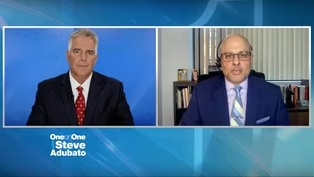
Eva's Village and Their Contribution to the Local Community
Video has Closed Captions
Clip: S2022 Ep2513 | 8m 21s | Eva's Village and Their Contribution to the Local Community (8m 21s)
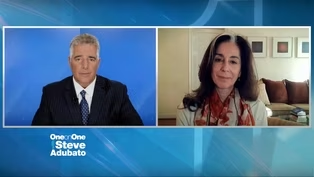
The Evolution of Italian History and Immigration Laws
Video has Closed Captions
Clip: S2022 Ep2513 | 13m 5s | The Evolution of Italian History and Immigration Laws (13m 5s)
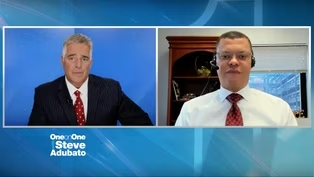
The Future of Higher Education in a Digital World
Video has Closed Captions
Clip: S2022 Ep2513 | 6m 56s | The Future of Higher Education in a Digital World (6m 56s)
Providing Support for PBS.org
Learn Moreabout PBS online sponsorship
- News and Public Affairs

Top journalists deliver compelling original analysis of the hour's headlines.

- News and Public Affairs

FRONTLINE is investigative journalism that questions, explains and changes our world.












Support for PBS provided by:
One-on-One is a local public television program presented by NJ PBS