
Marijuana Beneficiaries
Season 2 Episode 2 | 26m 43sVideo has Closed Captions
Flatland looks at who currently benefits most from the emerging marijuana industry.
The legalization of medical marijuana in Missouri has resulted in $30 million in sales in June of 2022 alone. As an upcoming ballot measure seeks to legalize recreational use, Flatland looks at who currently benefits most from this emerging industry and whether those affected most by damaging policies of the war on drugs are getting a fair cut.
Problems playing video? | Closed Captioning Feedback
Problems playing video? | Closed Captioning Feedback
Flatland in Focus is a local public television program presented by Kansas City PBS
Local Support Provided by AARP Kansas City and the Health Forward Foundation
Marijuana Beneficiaries
Season 2 Episode 2 | 26m 43sVideo has Closed Captions
The legalization of medical marijuana in Missouri has resulted in $30 million in sales in June of 2022 alone. As an upcoming ballot measure seeks to legalize recreational use, Flatland looks at who currently benefits most from this emerging industry and whether those affected most by damaging policies of the war on drugs are getting a fair cut.
Problems playing video? | Closed Captioning Feedback
How to Watch Flatland in Focus
Flatland in Focus is available to stream on pbs.org and the free PBS App, available on iPhone, Apple TV, Android TV, Android smartphones, Amazon Fire TV, Amazon Fire Tablet, Roku, Samsung Smart TV, and Vizio.
More to Explore
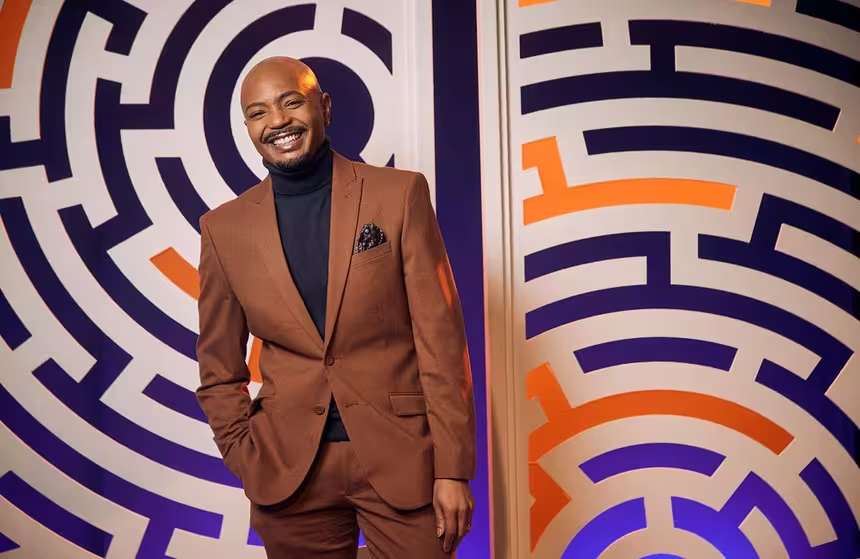
Meet host D. Rashaan Gilmore and read stories related to the topics featured each month on Flatland in Focus.Providing Support for PBS.org
Learn Moreabout PBS online sponsorship- [Promoter] Flatland is brought to you in part through the generous support of AARP, the Health Forward Foundation and RSM.
- Hi, I'm D. Rashaan Gilmore and welcome to Flatland.
Every month we dig into one issue that's raising questions, causing tensions or has gone curiously unexplored in our area.
And for this episode, we'll be talking about legalizing recreational marijuana in Missouri.
(upbeat music) The medical marijuana industry has seen a lucrative four years in Missouri.
And this fall, voters will get to decide whether to legalize cannabis recreational adult use.
The language in amendment three also requires an automatic expungement of non-violent marijuana offenses from court records.
A measure that many criminal justice reform advocates consider a victory.
Let's take a look at who would benefit most from this new industry and whether or not it includes communities who are disproportionately harmed by the war on drugs.
(screen swooshes in) (pulsing beat) - There are about 550 bags in here.
Just got transplanted yesterday.
Fast forward, about 10 days, in your mind, almost two weeks.
This is kind of what they look like.
Every environment is very controlled.
We have these big industrial fans that kinda create somewhat of a vortex.
So not only is it hitting the top of the canopy it's also kind of coming from the bottom.
Just for smell really, I wish I could send it through the camera.
But just for smell alone, you guys gotta smell this.
You're starting to smell a little bit more.
The buds are a little bit more developed now, full swing.
Pump out 1,000 pounds a month here.
From there, they cut those buds off onto a table and put 'em all into this cure tube, and then they'll come right into here.
So that's kind of a real nice nug there.
Nice finished product.
Still needs to be trimmed up, but other than that, looking pretty good.
- So like, if you told little 15-year-old Joe, he's just gonna be hanging out, helping grow weed all the time.
- Yeah, right, right, right.
- I don't think I would've believed it.
- Yeah, I had a couple misdemeanor charges 'cause I was over 18.
So it'll always be on my record.
It doesn't really make any sense to me that people can make such a big profit off of it.
And my charge still exists.
They're not gonna wipe it clean amongst, again, mine was minor.
It was a misdemeanor, a couple misdemeanor charges.
But for some people that are doing pretty hard jail time a few years it's kind of insane to me.
- We got five dispensaries in the Kansas City area.
One of our partners here, Dante West.
Dante was incarcerated for cannabis.
Here I'm in Missouri, we're around the same age.
I'm 29, he's about 27.
I just get up and go and about to produce a lot more than the one pound conspiracy charge that he was charged with.
And he's over there sitting in prison.
- I was incarcerated back in 2017 for a first time marijuana offense.
And the state of Kansas sending me to seven years eight months in prison.
My grandmother had passed away, which was leaving my little eight, nine-year-old brother going to school.
I ended up getting out there, choosing a foster family for him.
And it was a final ride with my brothers.
And I never forget it.
We ride in the back seat and you just see two young boys as we get closer to the airport, just bust out in tears.
You don't only lose your freedom.
You kind of lose access to the loved ones, like the people that are affected by it.
- When you talk about people being incarcerated for marijuana that means they have been taken away from their family.
They have been taken away from their career, their employment, their school, their life.
Black and brown people are arrested at higher numbers, but they smoke no more than our white counterparts.
- Drugs are wherever you look for them.
If you look for them at a wealthy high school, at the parking lot as the kids leave at three o'clock in the afternoon, you're going to find them there, but you're also gonna find them at every other high school.
The war on drugs was designed by individuals that had a bad motive and that's well documented.
- America's public enemy number one, in the United States, is drug abuse.
- That is words from an administration and why they were going after particular people.
Really, really harmed communities by removing a series of people in that community, usually fathers, usually a breadwinner.
What are we achieving with this policy regarding drugs?
And when I looked at that, we were achieving little.
Should have been fought maybe through a public health lens instead of a criminal justice lens.
Maybe we would be so much better off today.
- Currently there is about 20,000 people arrested every year in the state of Missouri for marijuana offenses.
And the vast, vast majority of those are for simple possession.
So, we want to have this be a legal, safe and regulated and taxed product.
And that means having it go through the legal market.
And the amendment directs those $40 million of new state revenues to a few different places.
First thing is drug abuse prevention programs, then also services for Missouri veterans.
And finally, funding for Missouri's chronically underfunded Public Defender Program.
Will also be it expunging the records for all non-violent marijuana offenses.
- The funds would come from the sales of marijuana to pay for this expungement.
If you have this a record, you're gonna be disenfranchised at the polls.
You're not gonna be able to vote.
Automatic expungement to the degree that the burden of that is not on the person.
- It also ensures that those that got licenses under the previous medical marijuana system would be first in line to get the adult-use recreational licenses, which are far more lucrative.
When you talk to folks that have apprehensions about it, it's sort of falls into two categories.
There's some that don't think it goes far enough with some of its provisions, but the big thing that comes out, especially when you talk to Republicans is this idea that they feel like the medical marijuana system was corrupted.
And they feel like that the recreational system is an extension of that.
What they did in 2018 was set a minimum number of licenses that the state had to issue.
They decided that to use that minimum as the base of how many licenses they would put out.
But there was 192 dispensary licenses approved, which is more than a lot of states, but was far eclipsed by the number of people who applied.
And when we're talking about this, this isn't like going down to get your driver's license.
People had to invest a lot of money just to get to the point where they could apply.
They had to buy or rent property.
They had to start pulling in contracts for things like security.
A lot of times they had to hire lawyers or firms to help them draft these things.
- The people who paid for this market are gonna make sure that they get to keep that market.
So let's say 60 cultivation licenses in the whole state of Missouri.
Outta those 60, one guy can own five of those licenses.
And then he can own five of the dispensary licenses and then he can own five of the manufacturing licenses.
Let's go back to the cultivation facilities.
12 people can own the entire grow industry.
But I do want it to be legal and I want everybody to have a piece of that market.
- From simple investigation that we did last year it showed that there were folks that far exceeded the number of licenses they were allowed to have simply because of how they structure their ownership group.
They weren't technically the same company.
Where you had people who were connected through various businesses.
Maybe they both owned the cultivation, but they had five licenses, a piece for dispensary, whether it violated the letter of the law, I could probably say no, and that's the department's take.
Did it violate the spirit of the law, which was to try to diversify the market and get as many people involved as possible?
I think that's unquestionably true that it did.
And another big piece of this is racial.
There's not a lot of evidence that there's folks from brown and Black communities around the state who are able to get a lot of these licenses.
It creates the appearance of impropriety.
And when you have folks that have suffered under the weight of the war on drugs, who feel like they're being locked out of the financial benefits of legalization, it's gonna create some acrimony and some bad blood.
These micro loans, those are the things that folks point to as sort of trying to remedy some of this.
And I think it does get folks' attention that they are at least attempting to remedy some of the problems.
(somber music) - Everybody gets up and lives for somebody, especially after seeing my little bros cry in the back seat on the way to the airport.
That really just gave me the sense of motivation to kind of get in there and get to work.
But I just went in there and I just studied law, man.
And the whole time I was writing to 125 state representatives in the state of Kansas, about three years, six months into prison, just wrote a motion.
I ended up sending that motion in and this guy comes and sees me.
His name is Chris Biggs, former Secretary of State of Kansas.
And 30 days later, man, I get a letter in the mail saying, my conviction was overturned.
- As soon as he got out, messaged him on Instagram, hit him up.
We hit it off.
He's actually my roommate now.
So as soon as got out, I took him in.
I said, yeah, we'll get this figured out for you.
- We're letting you know that we're officially open for business?
(crowd cheers) - You know, the crazy story about Nate is he literally said, come live with me and let's learn the industry.
And the dude didn't even know me, right.
It was a crazy part, man.
The guy didn't even know me, who else is like me that's sitting there that hasn't been revealed.
Went out and did some things with kinda convicts and last prisoner project.
I wanted to give back to all the other people that was incarcerated.
- A special thanks to this guy.
One of the smartest men I've ever spoken to my life.
- I helped her husband got a prison in New Jersey and winning a New Jersey license.
You can't get time back so now you have to make the most with the time you got.
- All right, welcome back for the discussion portion of today's program.
With us in studio today is John Payne spokesperson with Legal Mo 2022 campaign.
Brennan England, Missouri representative for Minorities for Medical Marijuana, Nico Pinto, attorney and senior policy advisor with Bianchi and Brandt Law Firm and Dante West, formerly incarcerated for a cannabis conviction, but he's turned into a cannabis entrepreneur.
And Dante, I want to start with you, tell us a little bit about your story and how you went from somebody who was effectively victimized by the criminal justice system as either in possession or distribution of marijuana to somebody who's becoming a marijuana or cannabis entrepreneur.
- It's crazy, man.
Just over about a year ago, I was in there reading law books, man.
I was watching lifers walk by the cell with law books and a notepad.
And man, and then now I sit back here free over a year now.
Didn't even get a good exonerated.
And now I'm a licensee in New Jersey and I'm also gonna have a dispensary in Stockton.
So, it's crazy how it all turns out, but God is good.
You know, a lot of that I was incarcerated with, serving 30 years, 15 years, for cannabis offenses.
Just was a habitual offender.
In my case, I was just a first time offender.
I never had committed a crime and I got out incarcerated in Kansas.
Moved to Missouri, was able to learn a bunch of wisdom from a guy named Nate Ruby.
And what's crazy just applying in New Jersey with my bunky, person I was in prison with.
His father and I tell him he was a winner, man.
He broke down crying.
So, just giving everybody equal opportunity to be in the industry no matter what walk of life you're in.
- John, you know, if amendment three passes then effectively what that means there is that there are gonna be opportunities for people like Dante, who on the one hand did not get to benefit from it, but now will get to benefit from it.
But I'm just curious.
I mean, this used to cause a lot of harm.
How do we begin to repair that harm that has been caused to people like Dante?
- We're gonna automatically expunge the all non-violent marijuana offenses.
There's a order of operations in which that goes and the amendment, the misdemeanors come first.
And then the felonies will come after that.
Wipe the slate clean for literally hundreds of thousands of people with those offenses here in the state of Missouri.
And then there's also a minimum of 144 new business licenses that will be reserved for people who are social equity applicants in one form or another.
It can be people that have a cannabis offense that is now being expunged or who are related to those individuals or who come from communities where there was a high rate of cannabis enforcement and convictions, or also just areas of high poverty or places where the school districts are unaccredited.
There's a number of different criteria that we use, but all those licenses must be majority owned by those individuals.
And then the final thing I would add in there is also we reserve a third of the revenue for the Missouri's Public Defender Program.
And really that is aimed at broader criminal justice reform, because I think an issue in our criminal justice system, it tends to work pretty well if you have enough money to go and hire a good criminal defense attorney, but if you have to rely on the public defender system and it's not nothing against the public defenders themselves, but they're very overburdened, they have way too many cases.
And so, you may not get a fair and just trial, because you're not really getting good representation.
So we wanna make sure that's something that we can help provide to people.
- Another aspect of this is who gets penalized.
And as we learn from Dante's story, it's not always equitable.
And we know that about the criminal justice system writ large.
It causes me to think about this other piece, Brennan, and I have to ask you.
Your work specifically sort of advocates on behalf of minority representation.
Do you feel like in terms of these 144 micro-business licenses and some of the other things there will be equitable representation and access to those licenses?
- There are some concerns and there have been, John and I, John's been awesome enough to be part of a forum that I hosted back in April to address some of these concerns and M4MM actually, some of the national organizers, full disclosure, gave some oversight to Legal Mo as they were creating their language.
And I'll say that they did an okay job of that I think.
And the one thing I'll also say is that the climate is still ever changing and as we learn, - [D. Rashaan] Sure.
- we have to be nimble and we have to be malleable.
One of the main things with the micro licensing that is continuing to create a bad buzz is that there's a restriction on micro licenses only being able to work within themselves.
And that you can only have one license.
They're not fully vertical.
So, people are already trying to figure out how to create the right type of collaborations and the right type of chains for revenue to make them actually profitable and competitive and the weight that they'll be able to not only produce, but then the prices that they'll be able to offer.
- But it seems like it would both restrict access in market share for individuals who have licenses and who are hoping to build a scalable business.
So, can you walk us through that in the piece that Brennan was just talking about there, how that will look and work.
- Yeah, and I think I totally understand those concerns.
I think there were good reasons for us to do it this way, but also I think Brennan's right.
Things are ever changing.
So all these things are to some extent an experiment and I think this is a good way to go about it, but you know, if it's not, I think we're open to adjusting it as time goes on and trying to amend.
The reason that we kind of said that they would be kind of a closed loop, is that because that way the micro cultivators would always have a guarantee of the shelf space with those retail outlets.
- [D. Rashaan] I see.
- So that, essentially there isn't the bigger cultivators can't say, well, we're gonna come in and get all of that shelf space.
- So it's almost like a farmer's market, if you will.
I mean, you've got all these independent individual distributors.
And so, I wanna bring Nico and Dante back in, but I wanna go back to you for just a moment, Brennan, because I saw that you had a point that you wanna make a question in response to what John was saying, go right ahead.
- The thing that needs to be addressed is that there is no social equity platform for the traditional license structure.
The only thing that there is, is that they're saying that in the next round of licenses, that will be dispensed for traditional licenses, that there will be a certain amount of those that are allotted specifically for those that had micro licenses already.
It doesn't optically look or feel good to the minority community that were only being offered smaller licenses.
And then there are only, there are such restrictions on that.
I was talking to a coffee shop owner that roast his own coffee, and he said, "So you're a micro business, but you can't like me you can't roast your own coffee and then bag it yourself and then sell it across your own counter?"
I said, "No, we can't."
And to him, it was creating cognitive dissonance.
He's like, "How does this even make sense for a commerce structure?"
- So, it begs the question for me, Nico, what are some ways that other states have included social equity or repetitive justice into their legalization processes and in what ways does this differ here?
- This topic and this industry as a whole is ever evolving.
And so, what is happening today is not necessarily set in stone and is not necessarily what's going to be what's happening tomorrow.
And we see that across the country.
I've worked on legalization efforts in many different states.
And I can tell you 9 out of 10 of those, what passes on the ballot is not what actually becomes reality, five, six years down the road of implementation.
And there's lessons that need to be learned the whole time.
There's a lot of crossover with the expungement, like Brennan said.
The social equity component though, I have to agree with him.
It is kind of lacking.
When I read through it I was confused and I've read through a number of these ballot measures.
And I was still trying to put all of the pieces together.
What we've seen in some other states that have really tried to hone in on the social equity component is reserving licenses for social equity applicants.
Some states New Jersey, for example, opened up a structure where it wasn't required to be a social equity applicant, but it was highly favored to be a social equity applicant.
So what we ended up seeing by extension was a vast majority of the folks that were granted adult-use licenses, conditional licenses, 'cause they're still in that phase, were folks who would qualify as a social equity applicant.
The definition of social equity has remained pretty consistent in all of the different versions that I've seen in different states.
Where it's either you grew up in a neighborhood or a disadvantaged community, you were subject to the war on drugs, either directly or a family member, you have an adjusted gross income of a certain percentage of the poverty level.
One thing that is unique to Missouri that I have not seen yet is they're including veterans and especially disabled veterans in their definition of social equity.
And I have to say personally, I think that's awesome.
And I think that's a real testament to the respect that Missouri has for its veteran community.
And I hope that more states follow along that, because I think that veterans, especially veterans suffering from PTSD is something that we're not talking enough about in the legalization conversation.
- That as much as I completely support and we as an organization support and work for veteran advocacy, that only means that we're parceling out that small percentage even more between these minority communities.
And they are a minority community, which deserves to have place in this.
That is a concern though is that now we're giving a smaller piece of a smaller piece of a smaller pie, and then whenever it comes to the definitions of who qualifies, you're right, there are pieces that leave it to be somewhat ambiguous.
- What is the likelihood of a truly competitive and accessible cannabis industry emerging through the proposed legalization efforts here in Missouri for this ballot initiative?
And then where's the accountability kicking in to make sure that everybody who's supposed to benefit actually does?
- I think that restrictions on canopy size and numbers of licenses is very, very important to a very successful program.
And this is something I think the bill does or the proposed constitutional amendment does very well is limiting how much access there is from a commercial perspective.
If there's too much supply, it's basic economics.
If there's too much supply, nobody survives.
States like Oregon are finally starting to rebound after cultivators couldn't even give plants away.
We're seeing the same thing happen.
It's starting to peak its head in states like Arizona, which Arizona's a very competitive market.
- [D. Rashaan] Right.
- However, there's no caps on square footage that you can cultivate.
So, it opens the door for somebody who's very, very, very well capitalized to open let's say a million square feet.
There's nothing stopping them from doing that.
You have a micro business that's supposed to compete in the same marketplace as someone with a million square feet.
I mean, come on it doesn't take a genius to know that's gonna be next to impossible.
- Every month on our website, we answer your questions about life in Kansas City and the issues you care about through our curiousKC initiative.
Let's hear from our community reporter and my friend, Vicky Diaz-Camacho, about our question of the month.
- This month's curiousKC question comes from Eric.
He asked, "Who benefits from legal recreational marijuana in Missouri?"
- Yeah, I think who benefits is the people.
Can walk in and accessibly have it.
A lot of people just want freedom of just going into a store and just going to get it without have them going through the hoops or misleading people.
So, I think that's super valuable that everybody benefits from this cannabis and even prisoners.
People that, as this amendment shows, a lot of people will get expunged with low level offenses.
So, as this plant progresses it becomes legal, people's freedom and voting, people get a chance, of not being judged.
So that's important.
The people that get harmed is, the people that can't get employment in this industry, you get out on parole or probation and you don't have an opportunity in the Missouri industry right now.
So, and when I got out I couldn't even get an agent ID card until I proved that I got the case dismissed.
And then once I did get it awarded by Missouri and I was able to work in the facility, there's so many other guys that just don't get the opportunity.
So, really showing those guys that you can make an ancillary product like a pipe or rolling paper, that's non-plant touching and make a great business.
Packaging is huge.
So, finding things that are not necessarily cannabis is key, but let's get these guys opportunity to come in here, learn about the plant and hopefully, become an entrepreneur like myself.
- We talk about expungement, I think that is vital, it is necessary, appropriate, and long overdue.
However, what I'm concerned about is making people whole.
- That's a question that I think has been posed since the beginning of this legalization conversation.
And I have to say, unfortunately, I don't have a good answer for the restorative justice piece.
What is the right answer?
You can't go back and rewrite the past.
And so yes, expungement's great.
Yes, getting a clean record's great.
Yes, getting the ability to reassimilate back into society is great, but it doesn't change the fact that you lost time, you lost relationships, you lost business opportunity.
I just, I don't know how you come back from that.
And it's really unfortunate that we don't have a perfect answer.
And I hope one day we figure that out.
- And it may be that thing of, kind of to what John's point was earlier that we start where we are and we're getting the foot in the door, so to speak, and maybe there's that push toward that.
But what are your thoughts, Brennan?
- We host a monthly mixer, a minorities industry mixer.
And one of the things that I talk about is that expungement doesn't end with getting people out of jail, but it starts there and it finishes with repairing their lives, giving them opportunities to, again, reassimilate and then also benefit from the industry that is building itself directly on their backs.
There are clear answers to these things.
There are systems out there, there are programs to help people have accelerator opportunities to take them from prison to the licensing system.
And we can continue to implement those things.
I do agree that this is taking steps in a direction that more people benefit from the plant than have before and more people will be safe.
But when we're talking about a plant that we are four times more likely to be arrested for and over sentenced for as Black people, Black and brown people, we're talking about people that are still potentially over sentenced, sitting in jail for things, that based on the parameters of this language, they are seen as a more extreme criminal based on whether they were transporting the plant or based on their possession limit.
I think that the first people that benefit are the medical marijuana license holders.
The first people that benefit are those that have invested the most money for the longest, and they have reason to wanna protect their assets.
A lot of them are just trying to get out from the red, from what they've put in.
So I understand that they're gonna support language that protects them getting through the door first.
That does though mean that it's at the expense of people like you and me.
We are being left with social equity provisions that have a lot of holes and we can all agree that could be better.
And because we're in a conservative state and we're not in New York, is what I'm told many times, that Missouri this is the best we can do.
And I don't think so.
I think we can continue to do it better.
And I think we have the right team here.
John's reasonable and has always worked with side by side with me in times whenever we've needed to.
And I continue to pull an energy of calling people in instead of calling them out, because ultimately we all want the same thing.
It's just a matter of how we get there.
- And that's where we wrap up today's conversation for this episode of Flatland.
You've heard the voices of John Payne, spokesperson with Legal Mo 2022, Brennan England, Missouri representative for Minorities for Medical Marijuana, Nico Pinto, attorney and senior policy advisor with the law firm of Bianchi and Brandt and Mr. Dante West, a cannabis entrepreneur.
You can find additional reporting on recreational cannabis at Flatlandshow.org, where you can also submit your very own curiousKC question for next month's topic.
We hope that you can join us tomorrow, Friday August 26th for Twitter Space.
This has been Flatland, I'm D. Rashaan Gilmore, and as always, thank you for the pleasure of your time.
- [Promoter] Flatland is brought to you in part through the generous support of AARP, the Health Forward Foundation and RSM.
(gentle music)
Preview: Marijuana Beneficiaries
Preview: S2 Ep2 | 30s | Flatland looks at who currently benefits most from the emerging marijuana industry. (30s)
Providing Support for PBS.org
Learn Moreabout PBS online sponsorship
- News and Public Affairs

Top journalists deliver compelling original analysis of the hour's headlines.

- News and Public Affairs

FRONTLINE is investigative journalism that questions, explains and changes our world.












Support for PBS provided by:
Flatland in Focus is a local public television program presented by Kansas City PBS
Local Support Provided by AARP Kansas City and the Health Forward Foundation