
Mark Kelly
Season 13 Episode 17 | 26m 46sVideo has Closed Captions
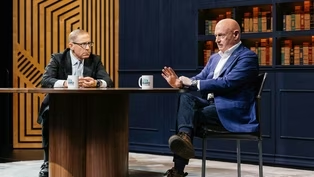
Senator Mark Kelly offers his perspective on the current US politics and world standing.
Senator Mark Kelly (D-Arizona) discusses his background as a Navy fighter pilot, NASA astronaut, and his perspective on current US politics and world standing.
Problems playing video? | Closed Captioning Feedback
Problems playing video? | Closed Captioning Feedback
Overheard with Evan Smith is a local public television program presented by Austin PBS
Support for Overheard with Evan Smith is provided by: HillCo Partners, Claire & Carl Stuart, Christine & Philip Dial, Eller Group, Diane Land & Steve Adler, and Karey & Chris...
Mark Kelly
Season 13 Episode 17 | 26m 46sVideo has Closed Captions
Senator Mark Kelly (D-Arizona) discusses his background as a Navy fighter pilot, NASA astronaut, and his perspective on current US politics and world standing.
Problems playing video? | Closed Captioning Feedback
Where to Watch Overheard with Evan Smith
Overheard with Evan Smith is available to stream on pbs.org and the PBS app.
Buy Now
Providing Support for PBS.org
Learn Moreabout PBS online sponsorship- [Narrator] Funding for "Overheard with Evan Smith" comes from HillCo Partners, a Texas government affairs consultancy.
Claire and Carl Stuart.
Christine and Philip Dial.
Eller Group, specializing in crisis management, litigation and public affairs communication, ellergroup.com.
Diane Land and Steve Adler.
And Karey and Chris Oddo.
- I'm Evan Smith, he's a former Navy pilot and NASA astronaut, who is the senior United States senator from Arizona.
He's Mark Kelly, this is "Overheard".
(audience clapping and cheer) The platform and a voice is a powerful thing.
You really turned the conversation around about what leadership should be about.
Are we blowing this?
Are we doing the thing we shouldn't be doing by giving in to the attention junkie?
As an industry, we have an obligation to hold ourselves to the same standards that we hold everybody else.
This is "Overheard".
(audience clapping) Senator Kelly, welcome.
- Great to be here.
- [Evan] It's very nice to see you again, sir.
- I should say, it's great to be back.
- Well, it's great to have you back.
I'm getting the impression that you and Pete Hegseth are not going to hug it out.
(audience laughing) - I'm not inviting him over for dinner this week, at least.
- Right, could you talk about where we are with this extraordinary controversy that we're in the middle of?
- It is an extraordinary case here.
And this all started back in November.
- [Evan] Yeah.
- I said something the president didn't like.
- [Evan] Yeah.
- I told members of the military, and I served in the United States Navy for 25 years.
- Right.
- I told members of the military in a video that you are not to obey illegal orders.
Very simple, not controversial.
- [Evan] Intuitive.
- It is written in the DOD's Law of War manual.
- Right.
- In fact.
President didn't like it.
He said I should be hanged, executed, prosecuted.
Couldn't even get the order right.
(Evan and audience laughing) - Right, if you're successful on the first- - [Mark] Yeah, you want to go.
- You probably got a problem with the other ones, right.
Yeah, right.
- And then they tried to indict us.
- [Evan] Yeah.
- You know, myself and five colleagues, Alyssa Slack and four House members tried to indict us.
That failed.
- Right.
- By the way, they tried to indict us for seditious conspiracy for restating the law.
- Yeah.
- In the United States of America.
- What a moment this is.
- Where we have the right to speak our minds.
- Right.
- First Amendment, freedom of speech.
So when that didn't work, at the same time, Pete Hegseth, they looked into recalling me to active duty and court martialing me.
That's kind of complicated because in the Constitution, you can't be in two branches of government at the same time.
- At the same time, right.
- So then they sent me a censure letter and said they were reevaluating my retirement rank and looking at demoting me and taking away my pension or reducing my pension.
This is after 25 years of service.
- How many combat missions did you fly?
- 39.
- 39 combat missions on behalf of our country.
(audience clapping) - And then four space shuttle flags.
- Four space shuttle- - As a navy astronaut.
Because they were doing that, I sued Pete Hegseth.
And initially, I got a... (audience clapping) Thank you.
It wasn't on my bingo card for the year that I'd be suing the Secretary of Defense.
- Right.
- For him coming after me.
So I sued him.
District court, we got a preliminary injunction to stop that.
He appealed, last week we were at the DC Circuit, the Court of Appeals.
- Right.
- And on Thursday, we heard the oral arguments, both sides.
Their side, which is the Department of Justice defending Pete Hegseth says their take on this is, well, if you're retired from the military and you wanna have the right to speak freely, you should give up your retirement.
(audience laughing) The guy actually said that.
- Yeah, straight face and all.
- Yes.
- Yes.
- And that's what they... And here's the thing, this isn't about me.
- Right.
- This is about 2 million retired service members that they're trying to silence.
- [Evan] Right.
- But they're not gonna shut me up and I'm not backing down.
- Yeah.
(audience clapping) - Because there is a lot at stake here.
- Right.
- I mean, retired service members have a role in our discourse.
- Right.
- Especially on military matters.
- [Evan] Yeah.
- I'm also on the Armed Services Committee in the Senate.
It's my job to hold these people accountable, the Secretary of Defense and even the president.
- [Evan] Right.
- When they make bad decisions, which in my view they often do, it's my role to call 'em out on it.
- [Evan] Yeah.
- They don't like that.
They wanna shut people up.
- So this is unresolved for now, but TBD- - Yeah, we'll see what happens.
- We'll see what happens.
- We're waiting for the- - Right.
- Appellate court decision.
- Right.
- And then we'll see what are the next steps.
- So speaking of the Secretary of Defense, which is what I call him, by the way, whatever they call him in Washington.
- That is his title.
- His title is Secretary of Defense.
- He does not get to change the name.
- I wanna talk about the military conflict that we are in the middle of.
Despite the fact that some people seem to say, well, it's not really a military conflict, or it's not a war, it's a war.
Why are we in Iran?
And for God's sakes, when will we be done there?
- Well, the president hasn't made a clear case why we are there.
- Yeah.
- He doesn't have a strategic goal.
- Yeah.
- He didn't have a plan.
He didn't have any kind of a timeline or an exit strategy.
So he finds himself kind of stuck.
- It's not as if we've not been told that, you have not been told.
- We have not been told.
- Yeah.
- He's had a moving kind of set of reasons.
He's gone from... At the beginning he said, "Well, if we start bombing Iran, we'll get regime change in a few days."
And he ignored anybody around him who told him otherwise, and the unintended consequences of this, one of which is having the Strait of Hormuz closed.
- [Evan] Yeah.
- So when that didn't happen, he said, "Well, this is about getting their uranium," despite the fact that he said last summer that Operation Midnight Hammer obliterated their nuclear program.
- Right.
- Which it did not.
I mean, I immediately... I sit on the Armed Services and the Intelligence Committee.
I've also dropped a lot of bombs on a lot of things.
- Yeah.
- It's hard to destroy stuff completely.
- Yeah.
- With that kind of combat power.
So then it went on to be the ballistic missiles.
Well, we're gonna destroy the Navy.
Then one thing we were told was there was an imminent threat of something happening in the future.
(audience laughing) Think about that for a second.
What's imminent about the future?
Like nothing.
So a moving target on what the strategic goal was, now, the Strait of Hormuz is shut down.
But bigger picture is like what was in this for the American people?
You know, gas prices, I don't know what they are here- - I can tell you because I put gas in my car today.
Four and a half bucks a gallon.
- Four and a half.
I've seen close to five in Arizona.
- Yeah.
- And he has no answer for what to do to open the Strait of Hormuz.
I've been in and out of that strait a number of times- - Yeah.
- On an aircraft carrier.
1989, 1991, dealing with this similar kind of problem.
- Right.
- It's harder now.
- Yeah.
- Because of the Iranian's ballistic missile capability and the ability to have an effect at a long range.
- Let me take the president at his word.
There were a bunch of kids in the White House the other day for the reintroduction of the Presidential Fitness Test, right.
And with those kids standing in the Oval- - By the way, I wanna see Donald Trump do the test.
(audience laughing) - When that happens, you can come back and we'll talk about what the result of it.
So he had a bunch of kids in the Oval, and instead of talking about the fitness test, he said, with these kids standing there, slack jawed, "Iran was going to launch a nuclear weapon against us in the next two weeks."
So let me take the president at his word.
He said that, he believes that.
Do you believe that?
- No, that was not the case.
They don't have the ability to do that.
- [Evan] Yeah.
- They don't have a nuclear weapon.
They have enriched uranium at 60%, needs to go higher.
It used to be much, much lower, it was at 3.56%.
- Right.
- Under the Iran deal under President Obama, which Donald Trump tore up.
- Yes.
- The reason we are here is because in 2018, Donald Trump tore up that deal.
- You have no doubt that that's why?
- No doubt.
- No doubt, yeah.
- The enrichment level would be much lower today, probably be below 4%, but it went up to 60%.
To get to a nuclear weapon, you gotta get that above 90%.
- Yeah.
- Now, could they have made a decision to do that?
Yeah, of course.
Not gonna do it in two weeks.
- Not two weeks.
- They don't even have the delivery system- - Right.
- To deliver a nuclear weapon to the United States.
And the former, you know, leader, the Ayatollah Khomeini had said and kept the enrichment at 60%, they weren't developing a nuclear weapon.
But now, because of this, what happened last summer and us going to war against Iran, who's to say whether the new ayatollah, his son, or some other leader- - Right.
- At the IRGC, might decide, "Hey, let's race to get a nuclear weapon."
- Yeah.
- So I think the threat against the United States now is higher than it's ever been - Higher, right.
- Because of the actions of this administration.
- And it's hard to imagine that they don't look at what has happened over the last few weeks, where they have resisted completely collapsing before us.
They're continuing to mess with us, continuing to do things that are causing us to not be able to leave this conflict.
They have to view this as a victory for themselves, right?
- Yeah, it's not a victory for the Iranian people certainly.
- No, but as a state actor, they have to think we showed the rest of the world that when the United States, with all of its might, comes after us, relatively speaking, not a very large power globally, we've been able to resist pretty well, up to this point.
- Well, I think they probably feel good about the fact that they could shut down the Strait of Hormuz.
- There you go.
- In a way that they- - Right.
- Didn't realize that they could do based on the information they had from decades ago.
- Yeah.
- But get back to the Oval Office for a second.
- Yeah.
- Why do that to some little kids?
Like really.
Why tell them that they were... That we, as a nation, were about to be attacked with a nuclear weapon.
- Yeah.
- Like, that's not the role of this president.
President's job is to try to bring people together.
- Right.
- I mean, he's even trying to divide in the Oval Office, you know, with children.
And it just doesn't... It's incredibly disappointing.
- So this actually gets me to something that I'm a little bit obsessed with, I'll acknowledge, in this era, and that is the obliteration of norms.
- Right.
- You know, there was normal behavior, there were guardrails up that protected us against weird things happening.
You know, we had Congress as a guardrail, we had the media as a guardrail, we had the courts as a guardrail.
We all understood that even if we disagreed, there were certain things you didn't do.
- [Mark] Right.
- All of that now seems to be totally upended.
So that you have kids in the Oval Office who were just doing pushups on the White House lawn, come in to talk about fitness and all of a sudden, "Hey, kids, two weeks from now, the Iranians are gonna bomb us off the face of the earth."
- Yeah.
- Right, that's not normal.
I mean, I'll acknowledge, whether you like it or not.
- These kids have enough to worry about.
- Right.
- With like gun violence in their classrooms.
- Right.
- Right, and having to do lockdown drills.
And now, they're starting to think, "Well, the president said it, this must be true."
- So is this the end of norms?
I mean, I keep wondering if the after will be the same as or different from the before.
Because presumably, we get out of this period that we're in, but I don't know that we're gonna be able to restore the normative behavior that we got used to and took for granted, in fact, previously.
- Depends on who we elect as the leaders of this country.
- Yeah.
- And I do also think that Donald Trump is a rather unique political actor, individual.
- [Evan] Yeah.
- That anybody that comes after him is not gonna be able to model that kind of behavior, and I would hope Democrat or Republican- - Yeah.
- That you're gonna have somebody that's gonna try to get us together as a nation, instead of his instinct is every single opportunity, let's try to divide us.
- Yeah.
- You know, we are stronger, more effective, and we'll have a much better future if we all realize that we are in this together.
- Right.
- It's a dangerous world out there.
- Yeah.
(audience clapping) But, of course, you know that for the rich and powerful people in this country, polarization is a business model, right?
People talk all the time about wanting to bring us together, but it's actually working for the people who tore us apart.
So how do you get past that?
- Well, I think you gotta put some energy behind it.
- Yeah.
- You know, and we gotta work at it.
- [Evan] Yeah.
- And you gotta be committed to doing it.
And you gotta be committed to like bipartisanship.
- Right.
- Which I am, and I, you know- - Yeah.
- Work across the aisle with my Republican colleagues.
We've got, you know, good Republicans in the House, in the Senate.
- Yeah.
- People you can work with.
People that... In general, we all have the same goals, right?
We want our country to be safe.
We want people to get decent healthcare.
We want 'em to have jobs, be able to raise a family.
We want our kids to get a good education.
It's just kind of how do you get there?
- [Evan] Yeah.
- Now, I will say over the last 30 years, at least, maybe longer, there's been policies, laws passed in Washington, DC that has done some things that have made it very hard for average Americans to just get by, to live their lives.
- [Evan] Yep.
- This nation, the United States, we have, collectively, folks in Washington, not me, have transferred an enormous amount of our country's wealth from the middle class and hardworking people to the top 1%.
It's unsustainable.
- Yeah.
- And it's not just about the fact that it makes it harder for people to afford their lives.
It's also one of these things that divide us, right?
There's the billionaire class and, you know, they control as much of our country's GDP.
- Right.
- More now than the majority.
And it's unhealthy, it is an unhealthy situation- - That is not a bipartisan issue.
- That is not a bipartisan issue.
- There is not bipartisan agreement- - That's right.
- Of what you- - Well, that's why this president passed this, what he calls the Big Beautiful Bill, that has tax policy in there.
- Yeah.
- That kicks people off of healthcare, kids off of their- - Right.
- SNAP benefits, also, they can give another big tax cut to the wealthiest Americans.
74% of that tax cut- - Goes- - Goes to the rich.
- Right.
- And what do other people get?
Well, some people get no tax on tips.
By the way, that expires.
You know, what doesn't expire in that bill?
The one year depreciation schedule on private jets.
(audience laughing) That's continuous.
- Yeah.
I hear you talk, Senator, about the importance of bipartisanship and working across the aisle.
There is a divide among supporters of your party on that subject at this moment.
Some people think, yes, bipartisanship bring the country together.
But there are Democrats I know who say you guys are like Charlie Brown thinking that Lucy is not gonna pull the football up.
And the Republicans are Lucy.
When they say we wanna work across the aisle, you run toward that ball thinking they're serious and you end up flat on your back every time.
- Right.
- Right?
- Yeah.
- So tell those Democrats why they're wrong and you're right.
- Well, I say we gotta run towards the football faster and kick it.
- Before they pull it out.
- Before they pull it out.
- Is that what it is, yeah?
- That's all we gotta do.
- Yeah.
(audience clapping) You know, this has implications for now, but it's implications for after this election is over.
Because should the Democrats take back one or both houses of Congress, there's gonna be a question about what your priorities should be.
Should you not look backward and should you say we're gonna do right by the American people, make their lives better or should you look back at the last two years and say, there have to be consequences, there has to be accountability for wrongs, for misdeeds, for corruption?
What do you think the affect of the party should be come January of next year if you guys have one or both houses?
- Well, I think we've gotta look ahead.
- Yeah.
- Move ahead.
- Right.
- In a positive way and take some very proactive steps to improve the lives of the American people.
People that are really struggling.
- Yeah.
- I got a call the other day from a woman who... We helped her daughter get back on her healthcare, my office did.
- Yeah.
- She'd gotten kicked off of her healthcare- - Constituent.
- A constituent in Arizona, helped her get back on.
The daughter has cancer.
She texted me last week.
And she was very thankful six months ago when we were able to do this.
- Yeah.
- But she texted me last week and she says, she says she doesn't know what she's gonna do because she can't afford to put gas in her car to drive her daughter on the 300 mile round trip to cancer treatment.
And she's never had to ask people for money before and ask for a handout.
- Right.
- But she's desperate 'cause gas prices are so high because this president decided to take us- - Yeah.
- To war against Iran.
- [Evan] Yeah.
- So we've gotta have policies in place that, and I do, I've got proposals- - Right.
- I've introduced legislation to suspend the federal gas tax is one of 'em, Cost of Living Emergency Act.
- Right.
- And other things that we can do, steps we can take- - And if you can't get 'em done now, you'll get 'em done if you have a majority.
- Well, and we've still got the president in the White House until January 20th of 2029.
- Right.
- So we've gotta get him on board with these too.
So when I say, you know, bipartisanship, we also have to convince this president- - Looks up.
- At the right moment that hey, you've gotta take these steps because this is not working.
- Right.
- And at the same time, you mention accountability as a looking back kind of thing.
I don't look at it that way.
We are a country of laws.
People have to be held accountable for the most egregious things.
- Yeah.
(audience clapping) - You know, the amount of corruption we've seen out of this administration, it's unprecedented, it's outrageous.
- Yeah.
- I mean, it's really obscene what we are seeing.
The pay for play, the, you know, donate to my ballroom, million dollar fees at Mar-a-Lago, crypto scam, meme coins, businesses around the world.
There needs to be investigations and, you know, for the you know, the most serious stuff, I mean, I think there has to be... These people need to be held accountable.
- You can do both.
- I think we can do both.
- And you have to do it.
- And we have to try to do both.
- Right, your party, let me ask you about the ideological divide in your party, and then I wanna switch subjects.
Right now, in places like Maine, and Michigan, and Iowa, we're seeing an ideological divide in the Democratic primary.
Healthy, not the first time this has happened, but there it is.
Can you put Humpty Dumpty back together for the fall in some of these places?
Will the Janet Mills supporters be able to support Graham Platner in Maine depending upon how the primary in Michigan turns out for the senate race?
Can the people who lose get on board with the person who ultimately wins?
Like there's a question within Democratic circles, whether you guys can, again, hug it out.
- Yeah, well, I think you often see that in both parties.
- Yeah.
- And when you get to election day, you know, a lot of this stuff falls on partisan lines and then we're all fighting for the 10% in the middle.
- Right.
- You know, a lot of times those might be independents.
- Yeah.
- State of Arizona, there's more Republicans registered than Democrats.
- Yep.
- So for me to win, I won in 2020, a hard race, I won in 2022.
I got, you know, the 14%, 13%, 14% of Republicans to vote for me.
- You needed them.
- Yeah, you need them.
- And you won.
- And I think that's true in a lot of these states.
- Right.
- The states that you just mentioned, it's the same thing.
- Right.
- You know, this isn't rocket science.
- And you know rocket science.
(audience laughing) - I know a little bit.
- A little bit.
- Yeah, yeah.
What this is about is like which side is gonna work harder.
- Right.
- Getting up to November, raising more money, knocking on more doors, making more phone calls.
- Right.
- And I think all those races you mentioned, we can win those elections.
- If you don't agree with somebody 100% of the time, what did Reagan say?
Reagan said, "What do I call somebody who agrees with me 80% of the time?
A Republican."
- Right.
- Right?
- Yeah.
- You have to figure out how to make peace with the fact that you don't agree on- - 100%, right.
- I wanna spend the last couple of minutes we have talking about Congresswoman Giffords.
- Great.
- Your wife, I looked it up.
She was elected 20 years ago this year, right?
2006.
- That is correct.
- Right, and she was shot, I remember the day she was shot was January 2011, right?
- January 8th, 2011.
- 2011.
What an extraordinary life she has led since.
Horrible that she went through this.
Just devastating to all of us who knew her.
But also, God, is she a light in the dark, right?
For how she's lived her life, what she's done, how she's come back.
- Right.
- She is at a funeral today.
- Yep.
- For a victim of gun violence.
- For eight kids.
- In another... For victims.
- Yes.
- In Louisiana.
- Yeah, in Shreveport.
- In Shreveport.
- Louisiana, she flew on an overnight flight.
- Yeah.
- To get there, to be there for those families, for that community.
- Extraordinary.
- Yeah, I mean, it's an issue that we together founded an organization now named after her, Giffords, that deals with this horrible issue of gun violence.
- Yeah.
- Makes our country stand out in the worst of ways.
- Right.
- And if we let some people, you know, get their way on this issue, you're gonna have a gun, everybody's gonna be armed, and nobody's gonna be safe.
- [Evan] Yep.
- I'm a gun owner, I'm a supporter of the Second Amendment.
At the same time, we just can't continue to be so stupid about it.
- Yeah.
- And let dangerous people have easy access to firearms.
So that's what Gabby is fighting for.
Sensible laws that most Americans agree with.
- Yep.
- Things like background checks for gun sales.
- Well, the public agrees with that.
- That polls at 90%.
- Right.
- You know what polls at 90% in our country?
- Nothing.
- No, two things.
- Two things, oh, really, okay.
- Free money and ice cream.
- Okay, well.
(audience laughing) You got me, okay.
- I mean, so it seems pretty logical that we should be able to get this passed- - At 90%.
- But because of the money that is put into our political system from corporations and other special interest groups- - [Evan] Yeah.
- It's become really, really hard to fix some problems that seem rather simple.
One of the things we could do, and we should do, and we have to do, is campaign finance reform.
(audience clapping) John McCain used to work.... I'm in John McCain's senate seat.
- [Evan] Right.
- So John McCain used to work on this.
- That's more of a legislative issue or more of a legal issue?
- The campaign finance reform?
- Yeah.
- It's both.
- It's both.
- The End Citizens United decision- - [Evan] Right.
- You know, what the Supreme Court decided there that like money is... Corporations are like people and money's- - Yep.
- The same as speech.
You know, that decision has then made this to fix it.
It's gotta be sort of through the courts, until we get a case there, undoes it, and then there's things we can do- - So maybe it originates in Congress.
- Or could originate in the courts.
- Could originate in the courts.
- But we need to overturn- - Right.
- The Citizens United decision.
- Yeah.
(audience clapping) It occurs to me I don't know this.
You've been with Congresswoman Giffords for how long?
- Oh, over 20 years.
- I remembered, maybe you don't- - We were married in 2007.
- Right.
So I don't know if you remember this.
I remember meeting you when you were still an astronaut.
You were Houston, she was still a state legislator in Arizona.
- Yep.
- And she was coming to Austin to look at the University of Texas Law School.
- She was.
- Because she was thinking, "I'm gonna get outta politics."
- Yep.
- "I'm gonna move to Austin, so I'm at least gonna be closer to him."
And you all in came and sat on my couch, in my office.
- I remember that.
- A mutual friend introduced us.
- Yep.
- And we visited.
I was thinking that had to have been 22, 23 years ago before- - it was probably 2000... Probably the beginning of... End of 2005.
- Yeah.
- Beginning of 2006.
- [Evan] Extraordinary to think about.
- Yeah.
- How long ago that was and how much has happened, good and bad.
- A lot has happened.
- A lot of, yeah.
But she and you both keep going.
- The shooting in January 2011 changed both of our lives forever.
- Of course.
- She lost her job over it.
She resigned from Congress.
I left NASA.
- Right.
- I left the Navy because of that.
Our lives are both a lot different today than they were before.
But I'll say this, they're also similar in some ways.
We're both lifetime public servants.
- Yep.
- You know, her service is different now.
Running an organization to deal with this issue, mine in the United States Senate.
I also look at it a lot like my service before.
You know, flying combat missions.
You know, being in the Senate can sometimes feel like that.
- Sometimes, right.
(audience laughing) - Or sometimes you just want to get in a rocket ship and just like go.
(audience laughing) - See you later, right?
- See you later.
- Amazing.
- Like Artemis, talk about something that, you know, was bringing our country together.
- Bipartisan, that's exactly- - Bipartisan, it was just- - Yeah.
- It was fantastic.
- Kind of great.
All right, we have like 30 seconds left.
Are you gonna run for president?
(audience laughing and clapping) - There's another election between now and the presidential election.
- [Evan] Right.
- I have not decided.
- Yeah.
- And Gabby and I'll, you know, talk about it and make the decision at the appropriate time.
- Let the record show, I'm gonna look right at the camera, he did not say no.
(Mark and audience laughing) Senator Kelly, thanks so much for being here.
- Thank you.
- Give Mark Kelly a big hand.
Thank you.
- Thank you.
- I really enjoyed it.
Thank you very much, all right.
Visit our website at austinpbs.org/overheard to find invitations to interviews, Q&As with our audience and guests, and an archive of past episodes.
- But I think it's healthy to have a president only for eight years.
Our founding fathers did not wanna see somebody get into office and become a king, an authoritarian.
That's not who we are.
We fought a war to get away from that.
- [Narrator] Funding for "Overheard with Evan Smith" comes from HillCo Partners, a Texas government affairs consultancy.
Claire and Carl Stuart.
Christine and Philip Dial.
Eller Group, specializing in crisis management, litigation, and public affairs communication, ellergroup.com.
Diane Land and Steve Adler.
And Karey and Chris Oddo.
(bright music playing)
Video has Closed Captions
Clip: S13 Ep17 | 12m 41s | Senator Mark Kelly offers his perspective on the current US politics and world standing. (12m 41s)
Providing Support for PBS.org
Learn Moreabout PBS online sponsorship New Episode
- News and Public Affairs

Top journalists deliver compelling original analysis of the hour's headlines.
 New Episode
- News and Public Affairs

Today's top journalists discuss Washington's current political events and public affairs.


 New Episode
 New Episode
 New Episode
 New Episode
 New Episode
 New Episode

 New Episode
Support for PBS provided by:
Overheard with Evan Smith is a local public television program presented by Austin PBS
Support for Overheard with Evan Smith is provided by: HillCo Partners, Claire & Carl Stuart, Christine & Philip Dial, Eller Group, Diane Land & Steve Adler, and Karey & Chris...