State of Affairs with Steve Adubato
Mark Murphy; Dan McGuire; Dr. Mary Ann Fuchs; Shan Byrd
Season 4 Episode 34 | 27m 48sVideo has Closed Captions
Mark Murphy; Dan McGuire; Dr. Mary Ann Fuchs; Shan Byrd
Mark Murphy shares the leadership lessons he's learned and his perspective on the nation’s leaders; Dan McGuire discusses how COVID-19 has impacted the homeless in New Jersey; Dr. Mary Ann Fuchs talks about the mental and emotional strain of the pandemic on nurse leaders; Shan Byrd discusses the role of educators in helping students understand trauma and the connection between race and trauma.
Problems playing video? | Closed Captioning Feedback
Problems playing video? | Closed Captioning Feedback
State of Affairs with Steve Adubato is a local public television program presented by NJ PBS
State of Affairs with Steve Adubato
Mark Murphy; Dan McGuire; Dr. Mary Ann Fuchs; Shan Byrd
Season 4 Episode 34 | 27m 48sVideo has Closed Captions
Mark Murphy shares the leadership lessons he's learned and his perspective on the nation’s leaders; Dan McGuire discusses how COVID-19 has impacted the homeless in New Jersey; Dr. Mary Ann Fuchs talks about the mental and emotional strain of the pandemic on nurse leaders; Shan Byrd discusses the role of educators in helping students understand trauma and the connection between race and trauma.
Problems playing video? | Closed Captioning Feedback
How to Watch State of Affairs with Steve Adubato
State of Affairs with Steve Adubato is available to stream on pbs.org and the free PBS App, available on iPhone, Apple TV, Android TV, Android smartphones, Amazon Fire TV, Amazon Fire Tablet, Roku, Samsung Smart TV, and Vizio.
Providing Support for PBS.org
Learn Moreabout PBS online sponsorship- [Narrator] Funding for this edition of State of Affairs with Steve Adubato has been provided by The New Jersey Education Association.
NJM Insurance Group.
Serving New Jersey'’s drivers, homeowners and business owners for more than 100 years.
Valley Bank.
PSE&G, committed to providing safe, reliable energy now and in the future.
Englewood Health.
Johnson & Johnson.
The Turrell Fund, supporting Reimagine Childcare.
ADP, always designing for people.
And by MD Advantage Insurance Company.
Promotional support provided by The New Jersey Business & Industry Association.
And by New Jersey Monthly, the magazine of the Garden State.
Available at newsstands.
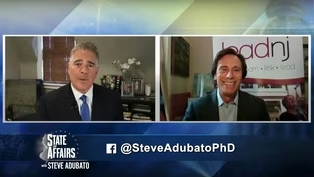
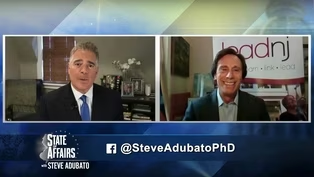
[INSPRATIONAL MUSIC] - Hi, I'm Steve Adubato welcome to another very compelling program where we kick off with our good friend who we have not seen in a long time, but he's doing important work.
He's Mark Murphy, president of Lead New Jersey.
Good to see you, Mark.
- Thank you, Steve, good to be with you.
- Tell everyone what lead New Jersey is and why it matters now more than ever.
- Oh, amen brother.
Well, first of all, it's a pleasure to be with you, Steve because you were in, member of the inaugural class to Lead New Jersey.
- I thought Lead New Jersey was not acknowledging that.
(laughs loudly) - We absolutely do.
- It was a great class, great class.
- We are a blessed fellowship, almost 1900 strong of leaders from across our state in all manner of professional endeavor from business to professions, academia, non-profit government leaders.
And we put together an annual seminar series for leaders across the state to learn more about the issues that affect our state and our communities and to learn from one another with leadership skill building exercises and what we like to call deliberative democracy.
Which is coming together, and learning from one another.
- So let me ask you this Mark.
And again, I was honored to be part of the inaugural class of Lead Jersey, back in the day, let's say that's the way when people use that expression, to try to hide how old they are, but I'm gonna try this Mark.
Going into 2021.
This will be seen in 2021 public sector leadership.
Describe the essence of great exceptional public sector leadership.
We're also gonna use this segment on our Lessons and Leadership show program on News 12+, so go ahead Mark.
- You bet.
I mean, nothing consumes more of my time.
These days, particularly then kind of dissecting.
What are the leadership needs today?
First of all, I would say leadership is not someone else's concern and it is not a job title.
In a deliberative democracy, every one of us has the chance to step up.
But what we look for in terms of public leadership at this moment, particularly is transparency.
Are people who tell you the truth and don't dillydally around with what they wish was true.
So look at Phil Murphy, look at Andrew Cuomo.
- Andrew Cuomo.
- New York, and how they have responded to COVID with scientists, right at their elbows, trying to balance opening the economy with taking the precautions that are certainly necessary with COVID-19.
- You know, on our, and again on our Lessons and Leadership program.
I do with my colleague, Mary Gamba, we often ask about the number one leadership lesson people have learned and you and I have known each other a long time.
When you were heading up the fund for New Jersey we worked together then on a whole range of public policy issues what would you say in your varied diverse career?
The number one lesson you've learned about leadership is Mark?
- I think the most important thing is actually not so much what you say, but in your ability to listen and this is what's lost so much in the current era of demonizing opponents, is the ability to really listen to the concern of others.
Take those words in to help shape our own perceptions our own responses.
Too often, we're so busy formulating our response that we can barely hear the other person talking.
No wonder we're still polarized when we don't come together and think collectively about how we can meet some of our most pressing issues.
- Let me try this Mark.
You talk about how polarized we are and we are we're polarized media, polarized citizens, polarized National Leadership Congress and the president Joe Biden as we, this program will be seen again in 2021. compromise collaboration.
Not only seen as a bad word in the eyes of many, but what we had just had Julie Roginsky and Mike Duhaime on, saying that in some ways voters reward people for not collaborating, for not compromise, hold on to what we believe.
Let's stick together.
Let's stop the other.
That's not leadership.
- Well, we've been, first of all, such drastic polarization is not new to our Republic.
In fact, as long as there has been a United States, there's been disunity.
But certainly in the modern era, we can point to the mid 1990s, Newt Gingrich gave a modern face to the demonization of one's political opponent.
When you add in social media.
- Yeah.
- We can now get very precise in our messaging to very specific groups and not speak to the center, which must hold in a democracy.
I mean, Steve I'll say your work over decades on public television has been to try and create that center space where people can deliberate, can present ideas without shouting each other down.
- Very kind of you, by the way a plug about the center holding a wonderful book called "The Center Holds" by our good friend Jonathan Alter, extraordinary journalist.
The center has, 30 seconds left Mark.
The center has to hold because?
- Because without it, we are nothing more than faction.
Faction by party, faction by where we are in the United States.
And disunion is the biggest threat that faces our people right now.
It is not an external threat.
It is the demonization of one another.
- Mark Murphy is the president of a great organization called Lead New Jersey.
Mark, you honor us by joining us let's make sure we talk more about leadership and work together in the future, all the best Mark.
- Thank you.
And thanks so much for this opportunity, Steve.
You got it, I'm Steve Adubato, we'll be right back.
(grand music) - [Announcer] To watch more State of Affairs with Steve Adubato, find us online and follow us on social media.
- We're now joined by Dan McGuire, CEO of an organization called Homeless Solutions.
Good to see you, Dan.
- Thanks for having me, Steve.
- Homeless Solutions, what is it?
And why does it matter so much?
Particularly during these challenging times.
- Homeless Solutions is a nonprofit organization formed in 1983.
And we've grown to become the largest provider of homeless shelter and services to Morris County.
- So you came to us through our friends at Valley who told us about the work that you're doing and as a not for profit, but during COVID, My question is how much worse is the homeless problem?
- Well, it's certainly been a more challenging time to provide shelter and services, with the safety and health concerns around COVID.
And the shutdown we went through earlier in the year.
And in terms of, there's fewer beds, as we and other providers have to either downsize to keep people socially distant in a congregate setting, or some other providers have had to cease operations temporarily, on account of safety.
The real concern Steve, is yet to become manifest, because as you may know, the state has a an eviction moratorium in place that's keeping people from losing their apartments right now.
But that is an unresolved challenge, and we're afraid that all signs point to a tsunami of evictions that will come at some point, I just literally saw a statistic that said, upwards of 280,000 eviction filings are expected in New Jersey alone, to address over $1 billion dollars in rent arrears that are already accumulated around the state.
So, you know unfortunately that's going to lead to a slew of challenges to keep people housed.
Unless providers can come up with and government can come up with proactive solutions.
- And Dan I'm curious about this, people often think they know or understand who is homeless, what the homeless population is, and I'm not sure that most people are right about that.
- I think you're onto something, Steve, we're constantly surprised by people's misconceptions.
And to be to be clear, there are a swath of different challenges that cause people to become homeless.
And of course, mental health challenges or some drug and alcohol addiction are pervasive.
And with the opioid epidemic, still working itself out.
But for the majority of folks, particularly that we see, we have lots of people who you'd pass on the street every day or engage with, who are homeless, they may be working home, or they might be going through a just a rough patch.
If I can give you my favorite story is I was out working in my yard one day at home, and I had my Homeless Solutions hat on, and the Mailman had come by and handed me my mail.
And we got to talking, he had seen my hat and a couple of questions later, it was revealed that he and his family had actually been in our shelter and our transitional housing program, you just never know, who needs a hand up at any given time.
- You know, right now Dan.
So many people are worried about as they should, as we should, as I am worried about ourselves, our families, those closest to us.
However, for those of us who want to be helpful, outside of our own families, is there a way to do that?
And we'll put your website up, but is there a way for the average person who cares and wants to be helpful to help?
- Yeah, there is Steve, and I do appreciate you sharing the the website where people can go and find ways to volunteer and donate.
And certainly during COVID we have unique and periodic needs either for, you know safety related donations, or where our basically our supply chain of typical volunteer partners who would provide diapers or baby formula have been themselves disrupted and so we are scrambling to help people.
So folks who are watching your show can help in that way.
We have been challenged as you could imagine during COVID.
To continue the usual array of volunteer opportunities, we usually have over 600 people a year helping us from everything, from preparing meals nightly at our shelter, to teaching people financial literacy and hosting barbecues and birthday parties for kids.
All of that has been drastically downsized on account of, you know the need for distancing.
And unfortunately, I think we're about to head into a little bit more, of a rough period where we're gonna go back to like we were in March and April.
- By the way, I wanna make it clear that this will be seen after we're taping it right before Thanksgiving 2020.
And hopefully when this is seen, January, February, March it isn't as bad but your points well taken down.
- Hey Dan, I wanna thank you for joining us.
But more importantly for the work that you and your colleagues at Homeless Solutions are doing every day, engaging every day.
Dan, thank you.
I wish you all the best.
- Steve, I appreciate the time and your thoughtfulness, thank you.
- You got it.
That's Dan, I'm Steve we'll be right back right after this.
(grand music) - [Announcer] To watch more State of Affairs with Steve Adubato, find us online and follow us on social media.
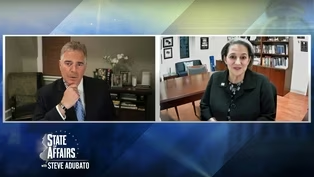
- We're now joined by Dr. Mary Ann Fuchs, president of the American Organization for Nursing Leadership.
Good to see you doctor.
- Thank you so much for having me today.
- Describe your organization and why it's so important, particularly for our frontline health care workers.
- So the American Organization for Nursing Leadership is the nursing arm of the American Hospital Association.
And we have as our core mission to really enhance health care through innovative and expert nursing leadership.
And we represent over 10,000 nursing leaders across the country, and 44 affiliate organizations across the states, providing expertise and education, advocacy and community.
And so from a nursing perspective, all nurses are leaders, we believe that and AONL provides those resources and support for those nursing leaders.
In the age of COVID does nurse.. How significantly different does nursing or nurse leadership look?
- Well, I'll tell you, nursing leaders have had some challenges during this time.
And however, I would say our core principles are always the same.
We're here to advocate for patients, we're here to advocate for our staff, making sure that we provide the absolute highest quality care, no matter what situation and making sure that the environment for nurses to practice is a safe one and one that is fulfilling.
So at a core that stays the same.
Now COVID provided us some different challenges and continue to provide us challenges.
We've actually surveyed our nurse leaders from across the country, with Joslin Marketing, which we were so lucky to be able to work with.
And we got responses, both quantitative and qualitative responses from over 1800 nurse leaders from across the country about their challenges, their concerns and their readiness moving forward.
And I would say that the top challenges, were really being able to effectively communicate constantly changing information, when we learn and continue to learn about COVID-19 the virus and how we have to change due to different changing standards across the country.
Second, really being able to provide adequate staffing, because these patients and the patients that we cared for, were so sick and required so many extra procedures.
And third, really having the appropriate equipment and supplies, adequate personal protection equipment, or PPE, still, to a certain extent is a challenge in the country.
And now what we're really finding through this process is just the ability to provide support to our staff during this really draining and tiring time.
It's a constant challenge.
So those are some of the leadership challenges that we've had as nurse leaders.
- You know, it's interesting, one of the areas that I've been struck by and I want you to talk about this, is this whole question of emotional and mental health, burnout, connect, put them all together.
To what degree do we non clinicians even begin to understand the mental and emotional drain and strain on nurse leaders?
- Well, you know, that's a great question, yeah.
- There's real burnout, how the heck do we avoid it?
And I just know that it's got to be really difficult for nurses.
And it's one thing to applaud and say they're heroes, it's another thing to try to really understand and empathize.
I'm sorry, go ahead, doctor.
- No, that's okay.
It's the entire COVID-19 challenge, or situation has really provided some consistent challenge.
Obviously, what we're seeing and we're learning are new ways and better ways to take care of patients early on, we didn't understand how to treat we're learning much more about those treatments now and are effectively caring for people in providing better outcomes.
But our nursing teams, including the leaders have seen more deaths, and they've had to manage situations that they've never really seen before at a rapid intensity of illness.
And, you know, during this process, our staff and nurse leaders have had to act as the surrogate families for patients, but because of the contagious disease, families weren't able to visit.
And often, our staff really had to act as the family and being able to communicate with the family be there to hold the patient's hand and provide the expert care.
And that was really draining.
On top of that, just wearing the personal protective equipment all the time, while they're in there providing patient care is also very, very challenging the equipment is very difficult to manage, it is difficult to wear, for example, a mask for 12 hours, can be really excruciating as it comes to be able to effectively breathe, sweat, all those physical types of things.
And so that provided additional challenge in addition, and since things were constantly changing in an environment, which nurses didn't have a lot of control over to a certain extent, it made it even more difficult.
And quite frankly, nursing leaders, and all of our leaders in our organizations, our health systems, our community really have the opportunity to understand that there's more distress that nurses are exhibiting now, there's more trauma in the situation.
So understanding and being able to provide emotional support is needed, making sure that our staff felt that they were in a safe environment to provide care, making sure they have the equipment, the supplies that were needed to be able to care for patients is really important, is still extremely important.
Our staff are afraid that they might bring something home to their families.
And of course, we want to be able to protect and provide for them as much as we possibly can.
So communities have surrounded our team members and our hospitals.
Our organizations have done different things to be able to support our frontline colleagues in order to make them feel safe.
- Dr. Mary Ann Fuchs, president of the American Organization for Nursing Leadership, I cannot thank you enough for joining us.
And thank you, not just to you but all of the nursing colleagues, your nursing colleagues and everything you do every day for all of us.
Thank you, doctor.
- Well, thank you.
You know, it's been a tremendous pleasure.
You know, the year 2020 was designated the Year of the Nurse and Midwife by the World Health Organization, we never knew we'd have to serve in this fashion.
We are the most trusted professionals and we rise to the occasion.
So thank you very, very much for having me today.
- Well said, Thank you, doctor.
I'm Steve Adubato.
We'll be right back.
(grand music) - [Announcer] To watch more State of Affairs with Steve Adubato, find us online and follow us on social media.
- We're now joined by Shan Byrd, who is a special educator for New Brunswick Public Schools.
Good to see you.
- Good to see you too.
- You specialize in trauma, trauma in our schools.
First of all, what is it?
And second of all, what is the role of educators in helping those struggling with trauma?
- So, a lot of times when we say trauma, we think of people coming back from war and suffering from PTSD but trauma has a much broader definition.
What it looks like in our schools is when we have those students that let's just say, are having behavioral problems.
If we really look behind things and look a little closer we'll find that they may have different traumas that they're experiencing in the home.
And as educators, we can just be very mindful of the traumas that they may be experiencing and begin to ask the question of, what happened, not what's wrong with this child.
- How do teachers get trained to pick this up, Shan and, and then act on it.
It sounds like a tremendous responsibility that we're putting on educators.
- So, it's not so much the training, it's more so an awareness and the exposure.
And in all of them, we also have to consider that as teachers are actually working with children they too themselves may be experiencing secondary trauma but it's a matter of awareness and then seeking out support.
- Is trauma exacerbated in the age of a global pandemic and if so, how?
- Absolutely, so many different layers.
If I start with students.
Now, they're locked in the home for several hours a day, unable to socialize with their peers.
Parents are besides themselves, right?
Because they are unable to effectively teach as an educator would and then teachers, many of my colleagues while they're trying to teach they have to care for their own children.
- That's right.
- It is absolutely exacerbated.
- Now, you presented at the NJEA convention, the virtual convention and our colleagues and friends at the NJEA told us about you.
So, I wanna follow this up with this question.
We're doing a series called Confronting Racism - [Shan] Yes.
- And all of its forms.
Race is a major factor when it comes to trauma.
Is it not?
- Absolutely, there have been studies recently that show that racialized trauma can have an effect on a person's DNA and then it can be carried out from generation to generation.
Absolutely.
- And it's so interesting that we, we we've had people I'm not gonna name names who actually argued with a serious face that systematic, structural racism does not, institutional racism does not exist.
You see it firsthand and work with your colleagues to confront that racism and deal with it.
- Yes.
- But what would you say to those who say, come on, we all have trauma.
We all have challenges.
It's no different for someone of color.
You say?
- I say, you haven't walked in those shoes.
race and trauma is everyone's responsibility.
Is it not?
- Yes, it is.
Absolutely, we all have a part to play.
- And for those of us who are white, who say, well, we don't see it.
It isn't for us to see because we experienced it directly as for us to empathize and try to imagine what it might be like to be in someone else's shoes.
Is it not?
- I would say as human beings, it's up to you to empathize, to take action and to use your privilege to assist those who do not have it.
- So well said.
I often say to people, you can have a lot of skills and tools as a leader, as a teacher, as an educator, whatever, but you can't teach people to care, either you do, or you don't.
And Shan Byrd, I wanna thank you for joining us and providing such a powerful perspective special educator for New Brunswick Public Schools.
And thank our colleagues at the NJEA for introducing us to you, all the best Shan.
- Thank you so very much.
- I'm Steve Adubato.
Thank you so much for joining us, we'll see you next time.
- [Narrator] State of Affairs with Steve Adubato Is a production of the Caucus Educational Corporation.
Funding has been provided by The New Jersey Education Association.
NJM Insurance Group.
Valley Bank.
PSE&G.
Englewood Health.
Johnson & Johnson.
The Turrell Fund, supporting Reimagine Childcare.
ADP.
And by MD Advantage Insurance Company.
Promotional support provided by The New Jersey Business & Industry Association.
And by New Jersey Monthly.
♪ It only gets better ♪ ♪ When we stand together ♪ ♪ To tough through ♪ ♪ And get by ♪ ♪ Even though it's harder than ever ♪ ♪ 'Cause we're gonna make it ♪ ♪ Long as we don't break it ♪ ♪ Just do right ♪ ♪ There's no sights ♪ ♪ We must know it's part of forever ♪
How COVID-19 has Impacted the Homeless in New Jersey
Video has Closed Captions
Clip: S4 Ep34 | 7m 39s | Lead New Jersey President On Leadership Needs of Today (7m 39s)
How Nursing has Changed During the COVID-19 Pandemic
Video has Closed Captions
Clip: S4 Ep34 | 8m 56s | How Nursing has Changed During the COVID-19 Pandemic (8m 56s)
Lead New Jersey President On Leadership Needs of Today
Video has Closed Captions
Clip: S4 Ep34 | 7m 39s | Lead New Jersey President On Leadership Needs of Today (7m 39s)
Providing Support for PBS.org
Learn Moreabout PBS online sponsorship
- News and Public Affairs

Top journalists deliver compelling original analysis of the hour's headlines.

- News and Public Affairs

FRONTLINE is investigative journalism that questions, explains and changes our world.












Support for PBS provided by:
State of Affairs with Steve Adubato is a local public television program presented by NJ PBS