
Market to Market - August 16, 2024
Season 49 Episode 4953 | 26m 45sVideo has Closed Captions
Commodity market analysis with Naomi Blohm.
On this edition of Market to Market ... Bin busting yields could become a bountiful burden. Lab-grown meat makers pushback against new laws. New regulations shorten the path for genetically edited seeds. And, commodity market analysis with Naomi Blohm.
Problems playing video? | Closed Captioning Feedback
Problems playing video? | Closed Captioning Feedback
Market to Market is a local public television program presented by Iowa PBS
Market to Market - August 16, 2024
Season 49 Episode 4953 | 26m 45sVideo has Closed Captions
On this edition of Market to Market ... Bin busting yields could become a bountiful burden. Lab-grown meat makers pushback against new laws. New regulations shorten the path for genetically edited seeds. And, commodity market analysis with Naomi Blohm.
Problems playing video? | Closed Captioning Feedback
How to Watch Market to Market
Market to Market is available to stream on pbs.org and the free PBS App, available on iPhone, Apple TV, Android TV, Android smartphones, Amazon Fire TV, Amazon Fire Tablet, Roku, Samsung Smart TV, and Vizio.
Providing Support for PBS.org
Learn Moreabout PBS online sponsorshipComing up on market to market.
Lab grown meat makers push back against new laws.
Bin busting yields could become a Bountiful burden.
New regulations shorten the path for genetically edited seeds and commodity market analysis with Naomi Blohm next.
What's next?
Doesn't happen by chance.
It happens when researchers and farmers work together to solve tomorrow's agronomic challenges.
We're committed to creating what's next because at Pioneer our name is our mission.
Family owned and operated for more than 60 years.
SUKUP manufacturing is a full service provider of grain handling, storage and drying equipment, helping farmers feed and fuel the world.
For over 45 years.
Steiner Tractor Parts has shared your love of antique tractors.
New parts for old tractors.
Learn more at Steiner tractor.co Tomorrow.
For over 100 years.
We've worked to help our customers be ready for tomorrow and trust in tomorrow.
Information is available from a Grinnell Mutual agent today.
This is the.
Friday, August 16th edition of Market.
To Market.
The Weekly Journal of Rural America.
Hello, I'm Paul Yeager.
The threat of inflation and existing high interest rates don't seem to have dampened the fire.
For conspicuous consumption.
Retail sales increased 1% in July, a 16 month high as purchases for cars, appliances and even groceries were on the rise.
The increase in prices for shelter and food pushed the consumer price index up 2/10 of a percent after a decline last month.
Year over year, CPI fell below 3% annual growth for the first time since March of 2021.
Purchases of everything from automobiles to groceries pushed the Producer Price Index, which tracks inflation before it reaches consumers.
A 10th of a percent higher.
Without food or energy core, PPI bumped up 3/10 of a percent.
Laws preventing citizens of other countries from owning land in the U.S. are on the rise, but so are laws stopping the sale of cell cultured meat.
Alabama and Florida already banned the lab grown product, but the new meat producers are taking exception to the ban.
David Miller has more on recent developments.
Today is the first.
Earlier this year, Governor Ron DeSantis of Florida signed a bill banning the manufacture, sale or distribution of food products in the Sunshine State that are made from cultured animal cells.
This week, Upside Food's one of the few commercial lab grown meat producers sued the state of Florida over the ban, signed in May.
The Institute for justice, one of the groups that filed the lawsuit, says the law violates the Constitution's provision prohibiting protectionist measures designed to favor in-state businesses at the expense of out-of-state competitors.
Upside foods products are create When asked for comment on the lawsuit, a spokesperson for governor DeSantis pointed to statements made in May at the bill signing.
We stand with agriculture.
We stand with the cattle ranchers.
We stand with our farmers because we understand it's important for the backbone of the state, it's important for our culture, it's important for our heritage.
So the bill that I'm going to sign today is going to say, basically take your fake lab grown meat elsewhere.
We're not doing that in the state of Florida.
For market to market.
I'm David Miller.
Ideal weather conditions have been more the rule than not this growing season in the Grain Belt.
Only two spots of exceptional drought are in the U.S. right now.
West Texas and western Montana from the Missouri River eastward.
Drought has been virtually erased until southern Ohio and West Virginia.
This has led to some very large estimates.
Peter Tubbs reports.
Multiple Midwestern states could be looking at record corn and soybean yields as harvest approaches.
DTN released its digital yield tour expectations for the season, and estimates that lingering drought conditions will limit the Ohio corn crop to 191 bushels per acre.
Ohio's soybeans have received consistent moisture, resulting in a 56 bushel per acre estimate.
The USDA is estimating 59 bushels in the state.
Indiana has the potential for a second record breaking yield year in a row.
Corn is trending towards 196 bushels per acre, nearing the 2023 record of 203 bushels per acre.
Soybeans are estimated to be 59 bushels per acre, close to the 2023 record of 61 bushels per acre.
DTN is forecasting a 212 bushel per acre average in Illinois, lower than the USDA's estimate of 225 bushels per acre.
Despite a cool and wet spring.
Soybeans weathered a hot and dry June to drive an estimate of 61.5 bushels per acre.
Iowa entered the spring in drought, but plentiful rains pulled the state into normal growing conditions.
DTN estimates the corn yield to be 205 bushels per acre, below USDA's estimate of 209 bushels per acre.
Despite a delayed planting season.
Soybeans are expected to reach 59 bushels per acre, nearing USDA estimate of 61 bushels per acre.
For market to market, I'm Peter Tubbs.
As many as 309 million people are facing chronic hunger and 71 countries, according to the World Food Program, including current war torn regions like Gaza and Sudan.
The task of feeding an ever growing world that has already surpassed 8.1 billion people falls on the backs of the world's farmers and ranchers.
Genetically modified seeds have helped fill the gap in many parts of the world, providing bounty where soil or weather conditions make it harder to produce enough to feed everyone.
To increase the availability of GMOs for commercial use, some of the rules in the US have been modified to speed up the process of bringing new strains to market.
Colleen Bradford Krantz has more in our cover story.
Many Americans likely missed hearing about the regulatory shift a few years ago inside USDA that allows for exemptions or speedier approval of certain genetically altered plants inside the Donald Danforth Plant Science Center in Saint Louis.
However, plant researchers absolutely had the new secure rule, which means sustainable, ecological, consistent, uniform, responsible, efficient on their radar.
Within the secure rule and identified specific exemptions for genome edited products.
And as well, it made life a little easier, even for genetically engineered products, because if you were working on a product that had a similar mode of action to another genetically engineered crop that had already received approval from USDA, then you're free.
The Workstream was a lot easier and less complicated.
Some have objected to the rule from the outset, including the Food and safety nutrition advocacy group center for science and the Public Interest, which also believes food made from currently approved GMO seeds are safe to eat and benefit farmers and the environment.
However, the 50 year old group is concerned that many plant breeders have too great a financial incentive to self-proclaimed eligibility for bypassing regulatory steps.
According to a 2023 Congressional Research Service report, the 2021 law helped expedite the time period for approval of certain biotech plants.
Federal officials say they have confirmed 97 exemptions as of July 2024, requiring an average of 52 days.
The approval process has consequently become less costly for some projects, and the report says it is primarily midsize and smaller entities that have applied for the nonprofit Donald Danforth Plant Science Center, which does research on food security crops and on plants that boost agricultural sustainability.
The changes mean getting improved seed into the hands of farmers more quickly.
One of the group's current projects focuses on teff, a small grain popular in the eastern African countries of Ethiopia and Eritrea.
Teff, a staple for about 80 million people, is turned into flour and used to make injera, a spongy flatbread.
So we had to go through a consultation process with the USDA, which we did, and they ultimately determined that the edited teff would not be subject to regulation.
So for us, that makes a big difference.
It makes it really reduces the complexity and the cost.
With downstream product development.
It means that we can go directly into open field trials without constraints, without having to deal with conditions of isolation, segregation and the like.
The Danforth Center has been working on a shorter stemmed teff that may be less susceptible to lodging, a condition where the plant falls over in heavy rains or high winds.
Typically reducing yield by a quarter.
The genetically edited teff is a modern take on the work done for wheat by Norman Borlaug, who used traditional breeding techniques over many years to reduce lodging, which moderated starvation, especially on the Asian continent, and resulted in what is known as the Green Revolution.
But now, since we know what genes contributed to the Green Revolution is now more than a technology called Crispr genome editing, now we can go find out similar genes in this crop and then knock it out so that the plant can be lodging resistant.
Getu Duguma, the lead researcher on the project grew up on a farm in Ethiopia, where his family raised teff and corn, doing the field work by hand.
It's personal because, I grew up with this grow.
I know the problems, so I know how much the farmers are losing by growing this crop because of the lodging issue.
So that's why I wanted to be part of that solution.
This is the first gene edited teff that is planted anywhere else.
And so that we want to replicate that where this crop is really very valuable.
But the main goal for us is to just, market this crop in Ethiopia.
We deliver these as free of charge to farmers there because we do humanitarian work.
This spring, the Bill and Melinda Gates Foundation gave the Danforth Center and an Ethiopian research institute.
They are working with a nearly $5 million grant to support their work on teff, because no foreign genetic material has been introduced.
Danforth hopes the edited teff can be grown without being subject to the Ethiopian agricultural policies that would govern genetically engineered crops.
Countries like Nigeria Kenya have already adopted the policy Favorable Policy against us for gene edited products.
So in a few years to come, I think that there should be a very favorable, policy in place for genome editing products.
Danforth has also genetically altered cow peas to protect them from pod borers in Nigeria, and cassava to protect it from a plant virus in Kenya.
The seeds are passed to African farmers without charging royalties unless the in-country partner chooses to set a fee.
McKenzie says breeding plants to endure weather extremes while spending less on regulatory steps is key.
So if we, you know, consider genetically engineered crops and foods, it's important to remember that these products have been approved in more than 70 countries around the world, including the European Union, for direct use in food for water processing in that.
And in every case, the regulatory agencies have all been unanimous in their approval.
We haven't had dissenting decisions anywhere.
For market to market.
I'm Colleen Bradford Krantz.
Next, the Market to market report.
USDA Monday report hung over the market for much of the week, with the stocks and carry out numbers remaining high for the week.
The nearby wheat contract lost $0.13, and the September corn contract fell $0.06.
1 million soybean acres were added by USDA, keeping these soy complex lower.
The September soybean contract cut $0.50, while September meal dropped 830 per ton.
December cotton declined $1.10 per hundredweight over the dairy parlor.
September class three milk futures surged 122.
The livestock market was mixed.
October cattle shed $2.85.
September Feeders fell to ten, and the October lean hog contract improved $1.10.
In the currency markets, the US dollar index lost 57 ticks.
September.
Crude oil improved $0.19 per barrel.
Comex gold gained 6990 per ounce, and the Goldman Sachs Commodity Index was up half a point to settle at 541.
Even.
Joining us now is one of our regular market analysts, Naomi Blohm.
Good to see ya.
It's good to be here.
Last week wheat was the story that had positivity to it.
This week it fell like everything else.
Why?
Well, what happened with wheat was more in line with the Egypt tender from last week.
So everyone was excited about that.
That was a significant purchase from Egypt.
The question was, are they trying to secure a 3.8 million metric tons from now through spring because they're worried about supply, or is it because they're worried about the geopolitical drama?
And the whole tender fizzled out.
So there were plenty of offers that came through.
But with the offers that came through, Egypt was asking to have financing help with it.
And so they didn't they didn't like the prices that came with the financing help.
And so they actually only purchased or agreed to a small portion of their needs.
So then it was, well, okay, we were hoping for a big demand push and it just didn't happen.
The USDA report, though, that came out this week, was supportive of we had, lower production than what was expected because of the lower harvested acres overall for all U.S. wheat.
And I think the biggest piece of that report is that global ending stocks for wheat continue to trend lower.
And so this is maybe the fourth year in a row that global ending stocks for wheat are trending lower.
And that in and of itself should be setting off alarms.
But for whatever reason, the world is thinking that of the places that grow wheat, everyone has just enough to get us by until we don't.
So I'm really keeping an eye on wheat.
I think that one might be the market place that all of a sudden can come to life.
such good value right now at this 550 level for the December Chicago futures.
and then of course, with all the still shenanigans, yet with Ukraine and Russia and it's not over yet.
Well, that's a place where we it's fallen out of the headlines a little bit.
And then when we see news reemerge, we just kind of shrug our shoulders.
But it's still a very serious, tenuous situation.
But the market doesn't seem to think so.
Is the market just immune to any news from there right now?
It does seem to be immune to the news, and I don't quite understand why.
So I think it'll be when we start to have maybe other countries show signs of struggle in terms of production.
We're seeing the Argentina crop now a little bit smaller.
and we know that things around the world aren't perfect.
There's quality issues with the wheat and France.
So there's I mean, there's a lot of issues that are out there.
We test the market that I think is like I said, it's going to eventually it's going to just start to percolate.
It's probably going to time out with the seasonals.
So it'll take until mid to late September.
But I think once it gets the fire lit under it, that wheat market is going to rally.
So you found sunshine somewhere.
Unfortunately it's not in the next two corn.
you mentioned stocks as a lower thing in wheat.
It's not the issue in corn.
It's the opposite.
Right?
That's going to hang on us for quite a while.
I think you said this week.
Is there anything that can chew through this pile?
so corn the issue.
Right.
2 billion bushel carry out.
That was again confirmed on the USDA report.
But the good news was that the report wasn't as bearish as what people were thinking.
So they raised the yield.
They lowered the harvest in acres by about 700,000.
But the end result another year with 2 billion bushel carryout 2 billion bushel carryout justifies $4 corn.
But the hope is that we're going to see demand start to pick up here soon.
I think the reality, though, the situation is that because of the grain that still is in farmers beans, that needs to come to town, yet we're not going to see the harvest low come maybe as soon as what we're hoping for.
To me it feels like with December corn futures staying below the $4 area, it might move down towards 375.
We're going to get through, September 1st notice day for the September grain contracts.
And then there's a lot of basis contracts where if people are going to have to be bringing the grain to town, price it or roll it.
And so we'll get through that in the next couple of weeks.
And then as we go into the month of September, then I'm really going to be looking for signs of a technical bottom of a seasonal bottom.
And when corn gets that cheap, then I think we're going to see the end users really come in and buy as much as they can because of the value that's there.
Last year I think we had an early harvest low.
You're not I don't hear that's what you're saying right now.
So let's speak about harvest, this new crop situation at the Iowa State Fair this week.
Oh, I had a couple of farmers tell me, yeah, we're here in 300 bushels to the acre.
We could be setting a ridiculously large crop.
What's that going to do to new crop sales?
Well, that's what we're also waiting to find out.
So we have to.
There's all crop grain that has to come to town.
There is going to be a crop tour next week, so we'll see what that has to say.
But the biggest thing is that we're not hearing farmers complain about what's growing in the field.
So that usually tells us that things are all right.
So but again, once we get out there, once we know what's in those fields and confirm it's as big as what we're thinking, once we get that harvest going, there's going to be tremendous value for end users to come in and buy a portion of it.
I think with as much global turmoil as is what's still out there and our U.S. election coming up, global end users are going to say, you know what?
This is good value.
I better show up and I better buy something just in case things get a little shaky in the world.
So I really feel we're going to see the export markets pick up.
And I really strongly feel that when we see that harvest low occur.
And again, I'm looking for it sometime mid to late September.
Then if you had been making any cash sales recently, that's going to be a really good re ownership opportunity.
But I don't think we're at the low quite yet.
In beans I've put it off long enough.
This is a tough week.
Any sign of positivity there?
unfortunately no.
So the reality is that we have 560 million bushel carryout.
That was more than what traders were looking for.
And with that, that is the most we've had in six years.
And so with corn or with soybean prices breaking below $10 and then going down to the 950 area November beans to me on a chart look like they're potentially ready to go one leg lower to $9.
But then that's when China's going to show up because that's tremendous value.
Our export sales to China overall right now are about 1 million metric tons.
Last year we were just over 4 million metric tons.
So they're watching the charts, too.
They're watching the seasonality of this.
They're waiting for one more price cut lower.
And then I think they're going to show up in a big way and purchase their needs.
So if you can hold out.
Well, I would say this.
There's a lot of producers, you know, who are going to be needing to sell it at harvest here.
So I think it's going to get worse.
But when it comes back for the price rally later, you know, it maybe only comes back to where we are now potentially a little higher because we are still dealing with 560 million bushel carryout.
It's going to take a weather issue in South America come December January to really get the market excited.
Spark in the dairy market this week.
Is that a long lasting spark?
It was a wonderful spark.
And it's all about the cheese.
So cheese demand is strong.
Our export market has been so solid.
Our cheese supplies are down from a year ago levels.
So the cheese price gained over $0.30 just in ten trading sessions.
And that's what pushed class three milk prices higher up to the $22 area.
I would say on this price spike higher, it would be a great opportunity to be locking in some sales because of the value that's there.
And we do have a milk production report next week, Wednesday.
So the milk production reports prior to this have been showing less and less and less production.
That's been supportive to prices.
But now that we've had cooler temperatures in the Midwest, we have cheap feed.
It is kind of a formula for production maybe to start to increase for the milk.
So I would say take advantage of the opportunity that is there.
Live cattle good exports.
Is that a sign of a peak or something else?
I think the exports picked up because the cattle price went on sale.
So we had that big sell off, and that's what pushed that export market higher.
USDA is looking for export demand to just hold steady and increase into the end of the year.
but overall, the technical damage has been done, and we've played the record of low supplies for a while.
So it doesn't mean that cattle prices are just going to crash and fall lower from here.
But we've run out of a friendly storyline to get it to really rally significantly.
So I feel that any bounces that we see for pricing is an opportunity to be making some sales, buying some puts, because I feel like the friendly story is kind of been played and long term technical support levels on charts have been broken.
So from a technical perspective, it looks weaker and the funds are starting to exit those positions as well.
So I would I would get defensive with the cattle market.
How about on hogs.
You going offensive there yet.
Or you Although the hogs are just kind of been in a sideways trading range, a kind of a bigger one.
But they're in kind of a lull for news.
So the export news has been kind of stagnant.
Our production numbers haven't done too much for changing.
So I feel like we're going to see more of a sideways trading pattern for the hog market.
I don't think it's going to be anything horrible for prices from here, but it's going to take some kind of a big new demand catalyst to get prices to rally.
So, probably a quiet market compared to all of the protein complex.
The hogs are going to be maybe quiet for a little while.
Well, I'll tell you what.
We have an incredible amount of questions.
We're going to get to a marketplace and it covers a big gamut.
So thank you.
And we'll pause it for right now.
Thanks, Naomi.
Thank you.
All right.
Naomi Blume and we do continue this discussion because that was analysis.
Then we're going to go to Market Plus.
And that segment you can find both analysis and plus on our website of Market to market.org.
We spent some time at the Iowa State Fair this week kicking off our 50th season.
We recorded two new episodes of the MTOM podcast and will be releasing those each of the next two Tuesdays.
Subscribe today to hear stories of our history and the outlook for agriculture from two of our regular market analysts.
Next week, we'll take a look at clothing manufacturers and rural America surviving while others have unraveled.
Thank you so much for watching.
Have a great week.
Market to market is a production of Iowa PBS, which is solely responsible for its content.
What's next?
Doesn't happen by chance.
It happens when researchers and farmers work together to solve tomorrow's agronomic challenges.
We're committed to creating what's next because at Pioneer our name is our mission.
Family owned and operated for more than 60 years.
SUKUP Manufacturing is a full service provider of grain handling, storage, and drying equipment, helping farmers feed and fuel the world.
For over 45 years.
Steiner Tractor Parts has shared your love of antique tractors.
New parts for old tractors.
Learn more at Steiner tractor.co Tomorrow.
For over 100 years.
We've worked to help our customers be ready for tomorrow.
To trust in tomorrow.
Information is available from a Grinnell Mutual agent today.
Video has Closed Captions
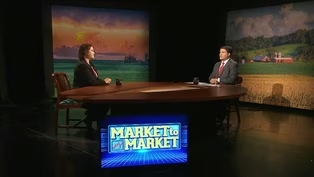
Clip: S49 Ep4953 | 11m 42s | Naomi Blohm discusses economic and commodity markets in this web-only feature. (11m 42s)
Providing Support for PBS.org
Learn Moreabout PBS online sponsorship
- News and Public Affairs

Top journalists deliver compelling original analysis of the hour's headlines.

- News and Public Affairs

FRONTLINE is investigative journalism that questions, explains and changes our world.












Support for PBS provided by:
Market to Market is a local public television program presented by Iowa PBS