
Market to Market - December 8, 2023
Season 49 Episode 4917 | 26m 45sVideo has Closed Captions
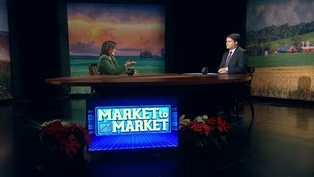
Commodity market analysis with Elaine Kub.
Agriculture steps in the spotlight at COP28. Crop insurance comes under attack over its price tag. A homegrown industry at the crossroads of commerce and conservation. And, commodity market analysis with Elaine Kub.
Problems playing video? | Closed Captioning Feedback
Problems playing video? | Closed Captioning Feedback
Market to Market is a local public television program presented by Iowa PBS
Market to Market - December 8, 2023
Season 49 Episode 4917 | 26m 45sVideo has Closed Captions
Agriculture steps in the spotlight at COP28. Crop insurance comes under attack over its price tag. A homegrown industry at the crossroads of commerce and conservation. And, commodity market analysis with Elaine Kub.
Problems playing video? | Closed Captioning Feedback
How to Watch Market to Market
Market to Market is available to stream on pbs.org and the free PBS App, available on iPhone, Apple TV, Android TV, Android smartphones, Amazon Fire TV, Amazon Fire Tablet, Roku, Samsung Smart TV, and Vizio.
Providing Support for PBS.org
Learn Moreabout PBS online sponsorshipComing up on market to market, agriculture steps in the spotlight at COP 28.
Crop insurance comes under attack over its price tag.
A homegrown industry at the crossroads of commerce and conservation.
And the commodity market analysis with Elaine Kub, next.
What's next?
Doesn't happen by chance.
It happens when researchers and farmers work together to solve tomorrow's agronomic challenges.
We're committed to creating what's next because a pioneer.
Our name is our mission tomorrow.
For over 100 years, we've worked to help our customers be ready for tomorrow.
Trust in tomorrow.
Information is available from a Grinnell Mutual agent today.
This is the Friday, December 8th edition of Market to Market, the weekly Journal of Rural America.
Hello, I'm Paul Yeager.
The Federal Reserve has long made clear they are looking for a soft landing on inflation in the United States.
Friday, another part of that target came into focus with reality hitting home.
Employers added 199,000 jobs in November, more in line with pre-pandemic norms, according to the Labor Department.
The unemployment rate dipped to 3.7%, close to the five decade mark reported back in April.
This figure has been below 4% for 22 consecutive months.
Farmers sentiment is on the rise, according to the latest Purdue University CME Group AG Economy Barometer.
The index rose five points to a reading of 115.
The Biden administration issued a final rule last week at reducing methane emissions, targeting the US oil and natural gas industries.
The announcement came at the United Nations Organized Climate Conference of Parties, or COP the 28th edition is being held in Dubai, where the assembled nations are working on plans to reduce greenhouse gas emissions.
David Miller reports.
If everything goes according to plan, the reduction in GHG is expected to hold worldwide temperatures at 1.5 degrees Celsius over pre-industrial levels.
Developed and developing nations have joined together over the last 28 years to sign non-binding agreements with the promise to hold the line on activities that could raise the planet's temperature.
Enforcement of the policies is largely based on peer pressure among nations, despite critics who say there is yet to be ambitious action.
The assembled nations are working on ways to reduce the amount of greenhouse gas emissions in the agricultural arena as a way to codify the idea.
Representatives from 140 nations have signed on to what is being called the Declaration on Sustainable Agriculture, Resilient Food Systems and Climate Action.
The signatories include the world's top three emitters of GHG EAS, the U.S., the European Union countries and China with the goal of achieving new policies by 2025.
The Declaration includes public support to promote an increase in income, reduce greenhouse gas emissions and bolster productivity, livelihoods and nutrition.
Behind the declaration is $2.5 billion in aid to help farmers make the transition to more sustainable, climate friendly agricultural practices.
We need to make sure that adaptation remains prominent in the outcome of COP 28.
We need to make sure that agriculture targets are included in the global goals for adaptation.
This truly is a historic moment for food systems and will really raise the profile of agriculture and climate in all these respective countries.
The United States government is focused on promoting climate smart agriculture to help reduce greenhouse gas emissions and feed a hungry planet.
We're also working with partners to rethink what, where and how we produce food in the context of a changing planet.
Our goal is for farmers, for ranchers to be able to sustainably achieve bigger yields of more nutritious crops at lower costs, using less land, producing fewer emissions for market to market.
I'm David Miller.
As agricultural committees held hearings on the next farm bill, one theme seemed universal Leave crop insurance in allowing for a safety net for producers.
A report this week on crop insurance cast an unfavorable light on large producers.
Here's Peter Tubbs.
Subsidies for crop insurance cost.
Over $17 billion for the 2022 crop year.
According to federal government statistics.
But there is a.
Study that suggests lowering the subsidy rate for high income farm operations could save taxpayers hundreds of millions of dollars each year.
The Government Accountability Office, an independent agency within the federal government, released a study this week that analyzed the costs of crop insurance subsidies to farmers and the payment of administrative fees to insurance companies that sell the policies.
The report found that the top 1% of crop insurance policy holders receive nearly 15% of the payouts made in 2022, coming in at a little over $2.5 billion.
Taxpayers subsidize an average of $0.62 for each dollar of crop insurance purchased.
Unlike other agricultural programs, there are no income limits to access the insurance subsidy.
The report also estimated that reducing the subsidy for the operations in the top 1% could save over $15 million annually and have little effect on the actuarial soundness of the program.
Proposals to place income limits on.
Insurance subsidies face a skeptical.
Audience in Congress.
I feel that we shouldn't take any chances with hurting crop insurance, whether it's for big farmers or small farmers, because I'm hearing the same message from any size farmer we have in Iowa for market to market.
I'm Peter Tubbs.
The lumber industry has been involved in many booms and busts.
The commodity takes longer to grow and pivoting is hard.
Over time, the regions producing large amounts of timber have shifted and those left behind have to change direction for their operations.
Josh Bittner reports.
In our cover story.
Timber is like any kind of crop corner beans.
It just has a lot longer life cycle than a year to year crop.
Professional loggers would like Midwest farmers to glance up from their fields to what they see as an overlooked resource.
The best advice I can give a landowner is if if they have a current or growing timber stand, you know, don't just put it on the back burner.
Cole SPURGEON Procures logs and timber for his southern Iowa family business Moravian Hardwoods in operation since 1968.
He harvests several species like oak, Cottonwood and Cherry, but says Iowa, Missouri and surrounding states, crown jewel is high quality black walnut, which accounts for 10% of global lumber exports.
We're after the trees that have very few limbs on them because we're using them for grade lumber, flooring, lumber, stuff like that.
So we don't want knots and defects.
USDA analysis reveals U.S. hardwood exports have more than doubled over the past 30 years, cracking over $1 billion in annual revenue.
SPURGEON says demand surged during the height of COVID, driving lumber prices the highest he'd ever seen.
It's rotten in the center of it, you know.
There's an evident holder that that tree is dying and it's on its way out.
There's a big tree somewhere suffocating it.
SPURGEON says the industry is selective and sustainable.
Livestock is very, very hard on trees stump warm showing there, though if it's invasive species or whether loggers will always battle Mother Nature.
Key, he adds, is proper management to help tree stands grow faster and realize potential profit sooner.
Step in near timber and every so often harvest the large mature trees that are ready to come out to give room for the littler trees to grow.
According to Iowa State University, Extension and Outreach.
Some 3 million of Iowa's total 26 million acres of cropland are forests with 85% under private ownership.
So that's where we come in to help private landowners manage their woodlands.
Iowa Department of Natural Resources District forester Greg High, Haida Brink gives recommendations for habitat hunting, ground and recreation.
He also marks timber sales and helps coordinate equitable transactions between sellers and loggers like.
SPURGEON Right.
We have, quite honestly, some of the best loggers in the world in the state of Iowa.
But you as a landowner have to understand that that loggers job is to buy your very best trees for as little as they possibly can.
That's business.
I compare that to me going to the sales barn to buy cattle.
If I'm at the sales barn and there's nobody else in the seats, I'm probably not going to stop the sale and say I'm not paying enough for these cows.
Well, that's what a loggers job is.
So it's up to you to get somebody on your side, whether that's a private consultant, whether that's a district forester, to help you through that process and try to build those trees out so you have some competition.
Officials say Iowa was a sawmill mecca during the second half of the 19th century.
One third of the nation's lumber supply log harvested from old growth forests in Minnesota and Wisconsin.
Travel by river and rail to sawmills on the Mississippi River before recession and deforestation doomed the region for generations.
But modern, sustainable forestry practices rose from the ashes.
So what I'm telling you is I'm standing in a clear cut that was done in the early eighties.
So if we look around, we have some fantastic trees coming here to bring, says state forestry.
And all associated ties are worth around $5 billion to Iowa's economy.
Value added endeavors have helped push the envelope.
Our company starts with the lumber that we receive from a primary sawmill.
Dry kiln operator, and then we start by ripping it up into strips that we further cut to length and machine and turn into a finished product.
It's just a very different scale of equipment.
You know, Logger might measure to the foot, cabinetmaker might measure to the 64th.
Mike Paul founded Boon based Swan Creek Cabinet Company, fresh out of high school nearly 35 years ago.
He grew up in the sawmill business, grading and stacking lumber.
While his primary market is residential kitchen cabinetry, with all parts manufactured at his shop, business to business manufactured components and moldings account for a quarter of sales.
And we buy hickory, we buy walnut, we buy cherry.
The quality of Iowa hardwoods is very good.
The primary manufacturers in the state, there are several very, very good ones.
It's a great resource and it's it's very local.
Our two main suppliers are within 2 hours of here.
So it makes great inbound very workable as well.
There's a lot of relevance and being able to take a natural resource and turn it into something that someone can use.
As rural America eases, the lingering sting of the coronavirus, unknowns remain, but optimism is in heavy supply.
Producers work to fill supply lines with various raw commodities and finished products and stewards remain.
Timberland owners of the crucial link between conservation and commerce.
We really encourage them to put a plan together.
That plan is so important.
It's your roadmap to successful forest management.
It's that follow up work that is so important, making sure that we have good trees coming for market to market.
I'm Josh Buettner Next, the market to market report.
Government estimates in South America and the US capped the movement from China buying American wheat for the week.
The nearby wheat contract added $0.29 while March corn went up a penny.
South American growing conditions improved, influencing the soy complex.
The January contract lost $0.21 and January mail dropped $8 per ton.
March cotton expanded by $2.08 per 100 weight Over in the dairy parlor January Class three milk futures improved $0.03.
The livestock market was mixed.
February Cattle cut 340.
January feeders put on $0.87 and the February lean hog contract subtracted a dollar 12.
In the currency markets, the U.S. Dollar Index gained 96 ticks.
January crude oil dropped 324 per barrel.
COMEX gold fell 7070 per ounce.
And the Goldman Sachs commodity Index fell more than 19 points to settle at five 3225.
Joining us now, regular market analyst Elaine Kub.
Hi, Elaine.
Hello, Paul.
This wheat story.
Last week it seemed like maybe the corner had finally turned.
Two consecutive weeks of nearly the same identical adds to the market.
Does that mean we've put the low in and we're headed higher?
Possibly, but maybe not for that reason.
I mean, I think that we might have an opinion about that just for the grain sector broadly, but not wheat specific.
We did still see some daily sales being made to China.
So that's good.
But I mean, wheat doesn't have a lot of a North American story at this point.
We've got our last big look at the conditions for the winter wheat crop before it goes into dormancy.
And it said 50% good to excellent rating, and that's better than last year.
But of course, Kansas is still largely in either moderate to extreme drought.
So, you know, we're just unknown and we just kind of have to paddle along here for the next few months.
So the Black Sea story is still alive and well, or is there other global issues at play here?
I think the driving factor for U.S. wheat prices is whether China continues to be a purchaser.
And maybe that because these daily numbers aren't perhaps enough to overall influence the the marketing year as a whole, but it's enough to keep some interest in that market.
All right.
So I guess right now, if I look at a chart and I'm a U.S. wheat producer, am I pulling the trigger and selling any?
No, I wouldn't.
Not at these prices.
All right.
Corn wise, again, some positive days and then a USDA report that doesn't really change things.
What did you see out of the report today?
Yeah, not a thing like barely any market reaction as far as how many cents it goes up or down by the end of the day.
And really not much changed on the supply and demand table either for the United States.
Anyway.
We're still looking at that same yield.
And when you look at the carry structure of the market, the contracts that are going out into 2024, we certainly get the sense that the market and the end users certainly believe in these numbers from the USDA that there is an abundance of corn out there at 175 effectively bushels per acre, and that may change as we get into December and January and we get some some measurements from surveyed measurements of how much supply is really out there.
But for the time being, this is what the market is trading.
And we had, what, six or seven days up and then kind of fell.
Confab estimates come in and say a little tech took a little top off that.
Do you buy the whole the corn is going to benefit more from a dry South America story.
No, no.
I think that we see the biggest reaction in the futures markets in the soybeans rather than the corn, when the day to day forecast weather forecast changes for South America.
That has been the case for the past several weeks.
There has been more volatility in the soybeans and certainly in the price ratio for what is effectively old crop soybeans to corn.
Now, it's it's these present these nearby contracts that you have the big boost for soybeans that they are overpriced compared to corn.
So it's being priced into soybeans, certainly more than corn.
So as you look at let's go to December 24, that's the chart there.
We have seen these margins shrink in terms of ranges.
I'm sorry, shrink.
What is that telling you?
That we are more side to side than hugely up or hugely down?
It's good.
I mean, compared to some other markets that are not experiencing that right now, we should be grateful.
And you can also see it just sort of in the overall volume of what's being traded.
It's relatively quiet.
We have moved past that harvest time frame when there's a lot of commercial activity going in there and hedging as they're buying, you know, from the farmers or hedging needs for the for the upcoming year.
So just it's just a quieter market at this time of year.
And seasonally, that's okay.
You know, we have a period of time where we might put in a harvest low and move up from here.
Always the question right where wins that harvest low?
I'll try not to ask it this way.
Let's go to beans, because that's what's next in the lineup.
We always talk about that.
So you look at again, the pressure from South America and but then there's this meal story, then there's an oil story, then there's gradual weather improvement, then there's a lot of factors here.
Which one stands out to you as the headline?
Well, I mean, we have to talk about the waste report.
That's really the only thing to take away from the watch report this week or today.
Was that the USDA did drop their Brazilian soybean production number to 161 million metric tons.
And, of course, as you mentioned, Kanab, certainly you can find other private estimates that would give you a different number one way or another.
But recognizing that there has been that much damage to the crops prospects already, that is significant.
Again, the market didn't really react in any big way and it's still a record large crop of soybeans from Brazil.
And it's still definitely the dominant crop in the world.
But it's a recognition that there is going to be some top taken off of that market.
And we need to continue to watch as that weather forecast changes from day to day.
However, I feel like there's almost a Jerry Maguire moment here where I need to say, show me the money with with soybeans, but show me the damage in South America, because they're as as it was said last week and the week before and the week before that, there's these oh, it's the worst crop.
Oh, no, it's not so bad.
Who do you believe?
Well, you can believe physical reality, the satellite.
There's satellite evidence that certainly in areas of Mato Grosso, areas of Bahia, they are below normal conditions in their vegetative index.
Down in the south, it's a different story.
So it's a mixed bag.
Certainly, it depends on what part of Brazil you're looking at.
But some very dominant soybean producing areas have received damage.
Okay.
So say say the tops taken off in Brazil.
What does that mean for China and U.S. producers?
Yeah, there's I mean, I think yes, I don't know exactly.
We don't know because it's it's a it's a developing situation as the next few months go on.
But I think there's certainly potential as we get into February, March of 2024, that you could see price wise, US soybeans are looking competitive.
They need they need a lot of work to catch up to the export paces that we'd like to see here that would be comparable to even last year.
But I think that certainly could happen.
So what is a signal that something might happen in those months that you're talking about?
I don't I don't guess I don't have a signal and I don't want to get too bullish either because these prices where they are right now, I think there's such a temptation to hear somebody talking about dry weather in Mato Grosso and think, well, I'm just going to put this on deep and maybe leave a market order out there for $14.
And if the market doesn't get to $14, I'll never sell the market may never get up to $14.
It almost made it there a couple of weeks ago and didn't make it because I bet there's just so much sitting out there waiting for that price tag and it may never come like, let's not get too bold up here just based on what may happen.
Because there are some regions of the country that had good crops.
Yes.
And that are sitting in and maybe there's a pile or two somewhere.
Yeah, that and that's certainly true if we if we go back towards corn.
Yeah, that was the big crop.
Lots of acreage that's certainly acknowledged in the areas that did have decent conditions.
Maybe not record breaking conditions, but there are areas that had good yields and are struggling to get the stuff move.
There is a lot of it out there.
In some places.
We could have spent the whole discussion on livestock, but we need to start with a question that kind of sets the tone of everything that's been happen.
And Scott in Montana wants to know, Please explain in simple terms, if possible, the rumors of risk protection programs being behind the drop in live futures.
I love a conspiracy theory.
I don't I'll say that.
So he's referencing the LRP insurance programs, which are effectively a put option for for livestock producers to get some financial protection based on how the futures markets behave.
They don't necessarily pay out on what the cash market is doing.
And we can certainly talk about all of the ways that the cash market is really much more resilient than the futures have been these past couple of weeks.
It has been certainly the volatility in life in cattle prices, feeder cattle prices and live cattle prices have both been driven by volatility in the futures market and specifically coming right out of Thanksgiving.
That Friday, out of Thanksgiving, there was just very, very little volume of trade and things just get really streaky when there's nobody to step in there and catch that falling knife.
So whether or not it was the LRP program itself involved in that, I don't know.
And obviously you would never be able to find that level of data in the CFTC reports.
But we always seem to have some type of a conspiracy story in these livestock markets.
So if I'm that producer who might not be someone who made protections or maybe I am someone who did make protections and I'm getting burned, what do I do?
Oh, you wouldn't be getting burned if you made the protections.
You're sitting pretty, right?
But I've read from someone say that they are getting burned even though they made the protections.
Well, the damage is that it does spill over into the actual cash market.
And this is just a really unfortunate time.
If you're, you know, a cow calf operator that's going out and selling calves.
Now, in this timeframe, we are seeing some bearishness spilling over into the cash market.
And that's that's bound to happen if you have a sale barn where folks are sitting there and watching futures drop $10 over the week, of course, the cash is going to respond in some ways to and to go to the live cattle piece.
The actual boxed beef prices are turning lower, about 10%, $10 per hundred wait since Thanksgiving, maybe $50 lower, 408 400 weight since the mid-June high.
So there is some fundamental real bearishness behind this.
But overall, prices have not fallen apart to the same degree.
Do you anticipate further falling apart either in live cattle or feeders on the future side?
On the future side.
Oh, certainly.
I mean, I think you should anticipate anything.
Do you anticipate it falling apart in cash then?
Not really.
I, I mean, because there is that sort of turning lower from the wholesale beef market.
And I think the Packers have this sort of bearish momentum.
I believe it.
Sure.
You could have some some more losses certainly in the next couple of weeks.
But ultimately, the overall supply and demand of this market, this picture there is still that that fundamental scarcity and the power that feedlots have and cow calf operators have.
When you go into 2024.
What's overhanging of the lean hog market?
Well, I mean, it's just kind of grim times profitability wise.
Certainly when you when you think about you've mentioned soybean meal prices as well, that could actually be a buying opportunity.
Right now.
You have to look at soybean meal at $400 a ton and think it could be going back up to $500 a ton and this could get worse before it gets better.
But the lean hog price is the actual negotiated lean hog prices that we're seeing right now.
They're kind of bumping along support that we've seen tested three times already in this past year.
And maybe maybe that will hold.
Maybe $70 is sort of a limit.
All right, Elaine, thank you.
We'll keep going here in just a minute.
All right.
All right.
Stand by.
That's Elaine Cobb, everybody.
Thank you very much.
And hold on, because we're going to pause the analysis, continue our discussion about these markets and our market plus segment.
You can find both analysis and plus on our website of markets to market talk.
Greg wrote us this week telling the stories of his first time watching market to market.
And now we want to hear more of yours.
Drop us an email to market to market at Iowa pbs.org.
Next week, a look at USDA's effort to increase the practice of double cropping.
Thank you so much for watching.
Have a great week.
Market to market is a production of Iowa PBS, which is solely responsible for its content.
What's next doesn't happen by chance.
It happens when researchers and farmers work together to solve tomorrow's agronomic challenges.
We're committed to creating what's next because a pioneer.
Our name is our mission.
Tomorrow.
For over 100 years, we've worked to help our customers be ready for tomorrow.
Trust in tomorrow.
Information is available from a Grinnell Mutual agent today.
This week on Markets are Market.
A look at USDA's effort to increase the practice of double cropping.
What appetite and commodity mark markets to market the weekly Journal of Rural America.
Video has Closed Captions
Clip: S49 Ep4917 | 12m 24s | Elaine Kub discusses the commodity markets in a special web-only feature. (12m 24s)
Providing Support for PBS.org
Learn Moreabout PBS online sponsorship
- News and Public Affairs

Top journalists deliver compelling original analysis of the hour's headlines.

- News and Public Affairs

FRONTLINE is investigative journalism that questions, explains and changes our world.












Support for PBS provided by:
Market to Market is a local public television program presented by Iowa PBS