
Market to Market - February 10, 2023
Season 48 Episode 4826 | 26m 45sVideo has Closed Captions
Market analysis with Matthew Bennett.
On this edition of Market to Market ... The state of the Union is rowdy. The president lays out his agenda for the year to a joint session of Congress. Plus, A startup gains momentum in preserving pollen. And, market analysis with Matthew Bennett.
Problems playing video? | Closed Captioning Feedback
Problems playing video? | Closed Captioning Feedback
Market to Market is a local public television program presented by Iowa PBS
Market to Market - February 10, 2023
Season 48 Episode 4826 | 26m 45sVideo has Closed Captions
On this edition of Market to Market ... The state of the Union is rowdy. The president lays out his agenda for the year to a joint session of Congress. Plus, A startup gains momentum in preserving pollen. And, market analysis with Matthew Bennett.
Problems playing video? | Closed Captioning Feedback
How to Watch Market to Market
Market to Market is available to stream on pbs.org and the free PBS App, available on iPhone, Apple TV, Android TV, Android smartphones, Amazon Fire TV, Amazon Fire Tablet, Roku, Samsung Smart TV, and Vizio.
Providing Support for PBS.org
Learn Moreabout PBS online sponsorshipComing up on Market to Market.
The State of the Union is rowdy.
The President lays out his agenda for the year to a joint session of Congress.
Plus, a startup gains momentum in preserving pollen.
And market analysis with Matthew Bennett next.
What's next doesn't happen by chance.
It happens when researchers and farmers work together to solve tomorrow's agronomic challenges.
We're committed to creating what's next because at Pioneer, our name is our mission.
Sukup manufacturing.
Celebrating 60 years of innovation as a family owned and operated manufacturer of grain storage, drying and handling equipment out of Sheffield, Iowa.
Learn more at Sukup.com.
For over 100 years, we've worked to help our customers be ready for tomorrow.
Trust in tomorrow.
Information is available from a Grinnell Mutual agent today.
This is the Friday, February 10th edition of Market to Market, the weekly Journal of Rural America.
Hello, Im Paul Yeager.
high is now in its third straight version.
In 2022, the amount nearly touched $1 trillion, with more than a third of that total coming from China.
The Commerce Department reported a rise of 12.2% last year, making the gap $948 billion.
However, agriculture is one sector contributing to reducing that imbalance.
The USDA said Friday 2022 was the best export year ever, as sales of U.S. farm and food products reached $196 billion.
The net farm income for this year revealed a fall of almost 16%.
The drop is being attributed to lower crop and livestock prices, coupled with increased operating costs.
Purdue University CME Group AG Economy Barometer was up four points in January on better expectations for the future.
Even though those surveyed expressed concerns over tighter margins in the months ahead.
On January 15, 1975, after just five months on the job, President Gerald Ford said, the state of our union is not good.
He cited high prices, even higher inflation, slow sales figures and a federal deficit of $30 billion.
Since that speech nearly 50 years ago all the presidents stepping to the podium in the House chamber have changed the sentiment of that line to project strength and optimism.
The party opposite the President is quick to disagree each and every time.
The 2023 version of the speech followed the script, complete with lofty goals.
Now to the hard part, getting something done.
Peter Tubbs reports.
President Biden delivered his second State of the Union speech this week and opened with a review of his administration's achievements from the past two years.
Folks, the story of America is a story of progress and resilience, of always moving forward, of never, ever giving up.
It's a story unique among all nations.
We're the only country that has emerged from every crisis we've ever entered, stronger than we got into it.
That's what we're doing again.
Two years ago, the economy was reeling.
I stand here tonight after we've created, with the help of many people in this room, 12 million new jobs, more jobs created in two years than any President has created in four years because of you all, because the American people.
You know, my Republican friends, if we could work together the last Congress, there's no reason we can't work together and find consensus on important things in this Congress as well.
The president asked for continued spending on infrastructure projects in both urban and rural America.
Field of dreams transformed to the heartland.
But to maintain the strongest economy in the world, we need the best infrastructure in the world.
We used to be number one in the world in infrastructure.
We've sunk to 13th in the world.
The United States of America, 13th in the world in infrastructure, modern infrastructure.
But now we're coming back because we came together and passed the bipartisan infrastructure law, the largest investment in infrastructure since President Eisenhower, the interstate highway system.
Projects are going to put thousands of people to work rebuilding our highways, our bridges, our railroads, our tunnels, ports, airports, clean water, high speed internet all across America.
Urban, rural.
Tribal.
And folks, we're just getting started.
We're just getting started.
I want to thank my Republican friends who voted for the law.
And my Republican friends who voted against it as well.
But I still get asked to fund the projects in those districts as well.
But don't worry, I promised I'd be a president for all Americans.
Well fund these projects.
And I'll see you at the groundbreaking.
The president closed with an optimistic tone.
Other nations are defined by geography, ethnicity.
But we're the only nation based on an idea that all of us, every one of us is created equal in the image of God.
A nation that stands as a beacon to the world.
A nation in a new age of possibilities.
So I've come to fulfill my constitutional obligation to report on the State of the Union.
And here's where I made my report, because the soul of this nation is strong.
Because the backbone, the backbone of this nation is strong.
Because the people of this nation are strong.
The State of the Union is strong.
For Market to Most of our lawns are covered in snow or brown and are waiting for spring to begin.
The no mow May movement looks to be expanding in 2023 as lawn owners are asked to keep the lawn long, to allow pollinators to have more options and more early season food sources.
The small and mighty pollen carries big weight in agriculture.
Colleen Krantz looks at the scope of the issue in the seed industry in our cover story.
For at least a century, scientists and entrepreneurs have been trying to figure out how to preserve plant pollen, many types of which die within an hour of being shed.
If the problem could be solved, pollen could be distributed whenever and wherever needed.
A University of Nebraska small grains expert says some modest progress was made in the past by keeping pollen cold and controlling humidity.
But storage life was limited.
Those discoveries weren't enough to prevent major yield losses when weather related challenges hampered the success of natural pollination.
We're talking about expanding it from maybe an hour to a few hours or maybe a day, and that's not really long enough if we're trying to make a lot of pollinations or say we have a stress window that's occurring.
The challenge remained.
How could these dust sized particles be collected, preserved and redistributed on plants in a way that the extensive time and money invested didn't cancel out any financial benefit?
I would definitely say that pollination preservation, while we understand mechanisms that contribute to it, we haven't been able to reach our goals at a commercial scale.
Power Pollen an Ankeny, Iowa based company says it has not only made progress on preserving pollen longer and maintaining its viability, but they are also able to collect and redistribute within cornfields on a large scale.
We got together and really started brainstorming and came up with the fact that pollen is an uncontrolled aspect of agriculture where it's just left to weather, the elements, timing.
And we felt that if we could build a solid technology around the ability to preserve pollen, that it would be a major step in agriculture.
That's been a long felt need.
Co-founders Jason Cope and Todd Krone, who worked at what was then DuPont Pioneer, now under the name Corteva, decided to start out by focusing their efforts on seed corn production.
Not only is corn pollen easier to collect than the pollen from many other plants, but it is also considered a high value crop.
Power pollens leaders also believed they could save seed corn companies space in their fields by eliminating the need for rows of male plants.
Seed production is costly.
There's a lot of labor associated with it.
There's a lot of land utilization.
The male is only out there to produce pollen, and then those rows are actually mowed out.
So as you start to remove male from the field because you have preserve pollen, now you're increasing the overall productivity per unit of land.
The company started in 2015, now has 30 full time employees, a half dozen approved patents and more than 60 others pending.
Power Pollen has also landed contracts with two major seed companies.
Corteva, which is also a major funder of Market to Market, signed a licensing agreement with Power Pollen in 2020 and Bayer followed in 2021.
We've had a very successful field testing to date and so based on those results, we're really excited and look forward to continue collaboration with Power Pollen to explore this technology and to better understand how we can integrate the processes and how it can help us produce a reliable, high quality seed crop for our customers.
Working with Iowa based equipment manufacturer ALMACO, Power Pollen developed equipment for collecting and redistributing pollen in seed corn fields.
They also pinpointed an additive that kept the pollen from hardening into a brick, a problem that would otherwise make application nearly impossible.
We store it at four degrees Celsius, which basically slows it down and makes it just real comfortable.
And we keep a relatively high humidity so that it keeps its moisture content.
We've actually stored pollen now for it's getting close to two years.
Normally, it dies within 30 to 45 minutes.
The long term preservation, really, we consider that still in the R&D scaling phase, but that is really the ultimate end use for the technology is once we get that process scaled as well, then you can harvest pollen in South America and bring it to North America and utilize it a year later.
Cope says their biggest remaining challenge is to reduce the cost of the Power Pollen process to $50 an acre or less.
I think it does seem realistic that there's going to be a point in time where people go, remember when we used to plant our males and females out there and then cross our fingers that they were going to time together well?
And I hope they say it's hard to believe we used to do things that way just because this takes so much risk out of the equation.
The company is also focused on wheat pollen, which hides deep inside the plant's head and is more difficult to gather.
But experts say the ability to store and reapply a wheat pollen could speed up the development of a commercially relevant wheat hybrid in the U.S., a goal pursued for decades.
Theres not a lot of research going but we haven't quite reached the point where there are hybrid wheat varieties on the market for U.S. farmers.
Hybrid wheat could be a huge game changer.
With pollen preservation, we would be able to collect pollen from a field of male plants, maybe somewhere across the state where that plant is already flowering.
Frels says if climate change creates more barriers for natural plant pollination, being able to preserve pollen may become even more critical for many crops.
Challenges of climate change have the potential to really affect our seed production.
We may need more technologies like this.
I really hope we don't, but it's really good that we have these, you know, backups, something to come back to if we are seeing production concerns.
For Market to Market, Im Colleen Bradford Krantz.
Next, the Market to Market report.
USDA Supply and Demand Report left wheat stocks basically unchanged, but added some to corn and soybeans on the domestic side of the equation.
For the week, the nearby wheat contract added $0.29, while the March corn contract put on $0.03.
Exports were bearish, carry out is projected tight, and meal had a wide range of price action in the soy complex.
The March soybean contract improved $0.11, while the March meal contract expanded to 90 per ton.
March cotton shrank by $0.03 per hundredweight.
Over in the dairy parlor, March Class III milk futures gained $0.30.
The livestock market was mixed as April cattle cut $0.18.
March feeders put on $4.58 and the April Lean Hog contract sold off $3.15.
In the currency markets, the US dollar index added 81 ticks.
March crude oil surged $6.49 per barrel or almost 9% higher.
COMEX gold improved $2.70 per ounce.
And the Goldman Sachs Commodity Index finished almost 11 points higher at 597.40.
Joining us now is regular market analyst Matthew Bennett, another one of those road weary people that has been everywhere.
Well ask about your trip in a minute.
You didnt really get into too much wheat country, but let's start there.
Why is there optimism in this market, specifically Kansas City?
Because everything else seems to be screaming.
There's no reason for this to be gaining.
You know, I think there's just a couple of things factoredin.
Of course, you know, that crop went in the ground.
The wheat crop went into dormancy in pretty rough shape.
And we don't know what abandonment might look like.
We may have more than what we think here in the U.S. And then, of course, you look at what's going on in the Black Sea region as we talk here on Friday, I'll tell you what, a lot of unrest and I think it kind of got the market a little bit fired up.
The gains that you see on the week entirely on Friday.
But regardless, we had gains on the week.
So it's nice to see.
But I mean, the report didn't tell us anything.
And quite frankly, with a pretty solid crop coming out of Australia apparently, I guess I'm hesitant to buy into too much of the hype, but as of right now most people would tell you that wheat looks about as strong as anything if you're looking for a rally in one of the big three.
Okay.
So you're dealing with weak export sales.
It's a cheap product around the world.
We're having better weather everywhere except Kansas, Oklahoma, Northwest Nebraska.
Russia might do some more attacks on Ukraine.
Nothing says positive still.
I mean, I go back to that point.
So long term, how do you fit into a strategy around those factors?
I think a couple of things.
So if you're not getting a lot of wheat out of that region, which is the presumption you make on a day whenever there's a missile fired, of course, that certainly could hamper some of your supply, first of all.
Second of all, a lot of folks are talking about feed wheat around the world entering rations.
And if that's the case, then you're going to gobble up a few more supplies.
I mean, you look at the course of this wheat carry, not only domestically but over the globe, you see a continuing restriction over the course of time.
We just, we used to be 50% globally and U.S. Now, you know, you're looking at 30 maybe.
I mean, as far as wheat goes, that's pretty tight.
Looking at the chart we just put on the screen, it's still bouncing low.
What's a range on that deferred contract right now?
Oh, boy.
It's tough to say.
But I mean, I just don't see you getting more than $0.50 on either side of it right now.
I really don't look for a whole lot of price action.
I think if you get if you move up 20 or 30 cents you're just going to pull right back.
In fact, without fireworks on Sunday night, if you don't gap higher, if you will, you know, I think that you're going to be looking at rangebound trade still.
Corn wise, we talked about what USDA said, a yawn, dud, uneventful, whatever adjective you want for that one.
Nearby how much in your conversations with producers this week on the road, how many people still have corn left to price old crop?
More than what want to admit, you know, and I think that Illinois, for instance, there's a lot of corn that's moved.
And so a lot of this corn towards the end of harvest, in that November timeframe, you know, there's a lot of shuttle loaders getting booked to go west of the Mississippi into Kansas, for instance, feeding cattle.
You know, I think that basis levels for Illinois for a 214 state yield looked pretty decent.
And so you saw a fair amount of corn get booked early.
I think the thought process is that everyone signal later on.
We're going to be extremely tight.
I want to hold on for that.
But I think that a lot of needs are met, at least for the time being.
I don't think that you're going to see a lot of action, if you will, or hot basis levels, at least for the next, you know, 8 to 10 weeks.
I think on the backside of that, maybe you see a little bit more.
Well, what happens if exports all of a sudden pick up?
It's been pretty poor.
Is that why someone's holding on for 20% to 60% of their crop yet?
For sure, that is the main thing that we have to see happen.
I mean, sales and inspections, shipments, they just haven't been worth a darn.
And so if we don't want to see a further reduction this week, we've got to saw another 25 million bushel reduction.
I don't think anybody would have said much, you know, which would have only boosted your carry to a level where you're still nine and a half percent stocks to use.
You're still tight, don't get me wrong.
But there's still a little bit of air to come out of those sails if we don't see some serious action soon whenever it comes to sales and shipments.
This is the time to shine.
We know the bean shipments are going to slow down.
Here on Friday we actually heard of about a few bean cargoes that were purchased by China, 3 to 4.
But the bottom line is that's not going to be the case moving forward.
They're going to move toward South America.
All right.
Let's get to the new crop story, because it's fascinating to me, given a couple of the points that we mentioned earlier in this program.
When you have high inputs, a high inflation, high this, high that, not a lot of export possibility, the way it sounds from what I'm hearing you say, is the producer in a mindset that they think they can overproduce and produce their way out of a lot of expenses on that balance sheet?
I think that a lot of folks feel that way, first of all.
I think second of all, Paul, it's really hard to get our brains wrapped around the fact that we made so much money in ‘21 and 22.
And all of a sudden you're looking at, you know, like the U of I put something out where $350 to $400 an acre statewide on a good, productive farm ground.
That's what corn returns looked like.
The projection for them for this year is 75 bucks an acre.
So, you know, you start looking that well, I don't know if I want a 25%, you know, 75% haircut from what I had last year.
You know, a lot of folks don't like that.
And so I think that it's hard to wrap your brain around.
This is a different ball game that we're playing here this year because demand is lower, demand is lower here in the U.S., demand is lower in the world.
You look at the world numbers on this report, we're losing about 65 million metric tons of world production year on year, whereas carry outs only going down 11 million tons.
And so obviously, demand has taken a big hit, which its supposed to when you have high prices.
Well, you kind of answered a little bit of the question that we had.
It's kind of going to tie these two commodities together.
This is from Josiah in Illinois.
Wants to know aren't we due statistically and cyclically for corn and soy to be looking to get back to big carries?
Thinking ahead into ‘24 and 25 some have called 2023 the Great Reset.
What do you think of -- are we due?
I think that we're due, first of all.
Second of all, when you start and look at, you know, like, for instance, January report, February report, we've lost 210 million bushels of demand as far as corn is concerned on this balance sheet.
And they're also predicting that you've got a $6.70 average cash price for this year.
So what's that tell you?
High priced have curbed demand.
If we stay at $6.70, can you make the assumption that demand gets better?
I think that's a tough hill to climb.
And so, yeah, what you're probably going to see is if you have 90 million plus acres, which I think is pretty much a certainty in my opinion at this point and you use the same demand calculations, it doesn't take much for crop to get above 2 billion bushels.
And there's certainly going to be a carry in the market with a 2 billion bushel carry.
Lets get t beans quick.
Heavy on corn.
Sorry about that.
There's a lot of factors churning around in here right now.
What's going to win out at the end of the day?
You know, the thing is for beans, I think we overcomplicate it sometimes.
We're at awfully high price levels.
Okay.
So when you're about $15 beans and you're sitting here trying to figure out what I want to do as far as cash is concerned, sometimes I just run the math.
You look at what your net income is, your net returns per acre.
It's pretty hard for me to hold on to much more than gambling bushels, but new crops where it gets a little more complicated.
But at the same time, Paul, you know, a lot of folks have told me lately, I've missed the boat on $14 beans, you know.
Well, how many times have we sold $13.70 beans before we planted them?
And we haven't, We haven't had those opportunities in the past.
And so, yeah, input prices are high, but we're not as beholden to input prices as far as soybeans are concerned as what we are with corn.
So I kind of like stepping forward at least locking in some worst case scenarios.
Okay, good advice.
Livestock, live cattle demand still there?
Demand is still there.
Okay.
But it seems like we're kind of hitting up on some resistance.
You know, whenever we look at fat cattle, I guess for the present time, I look for us to maybe take a bit of a breather.
I don't think that we're going to fall back.
Long-term I'm still pretty friendly.
I mean, when you look at the fact that, you know, this is the smallest beef herd we've had in the cow herds down, what, 60 years is the last time that we saw levels this low cattle on feed report a couple of weeks ago, you know, in Texas, 79% of a year ago.
I mean, these numbers are the types of numbers that we haven't seen all come together at the same time.
Fundamentally speaking, this is an extremely dynamic story.
Now, if you would get your pastures to heal up and you get people retaining heifers, watch out for this fat cattle market.
You could see significantly higher prices into the third and fourth quarter and first quarter next year.
What about on the feeder side of that equation?
Feeders -- they're not giving away still.
And I don't think they're going to because most folks agree with a lot of what I just said.
Okay.
So the feeder market is going to still stay very strong in my opinion.
It's going to be very interesting.
Once again, if people retain heifers, the mad dash to get a hold of whatever feeders you can get a hold of, they've been a little easier whenever everyone's feeding heifers because they don't have anything to put them out on pasture for.
But feeder market, I don't see taking any sort of a haircut any time soon.
I think feeders will stay pretty strong and even if you see a little bit of a dip in the board, good luck finding a bargain as far as cash trade goes.
We talked about exports of grain.
Is that the story in hogs?
Pretty much.
Hogs can't get a friend right now.
They're just rough.
I mean, you're having a tough time.
If you could see exports pick up significantly, I think maybe you could get a little bit of life back in this hog market.
But for right now, it looks pretty rough.
Do you have a reason to hold any or do you got to make a sale right now if you're in hogs before it goes lower?
I mean, in all honesty, I don't know that I'm in a huge hurry.
You know, I don't know that you're going to go drastically lower.
We've already taken a pretty good hit, but at the same time, there's still folks making some money in here.
I know its pretty, pretty lean for your independent hog producers, but there's not a ton of them out there, you know, and so it's a little bit different subject.
We'll have a ton of time in Market Plus.
How about that?
Absolutely.
Thanks, Matt.
our discussion about these markets and your questions in our Market Plus segment.
Find that on our website of markettomarket.org.
Yes, we want to hear from you.
You have an open invitation to drop us an email any time markettomarket@iowapbs.org.
Next week we look at a homegrown industry that's at the crossroads of commerce and conservation.
Thank you so much for watching and have a great week.
Market to Market is a production of Iowa PBS, which is solely responsible for its content.
What's next doesn't happen by chance.
It happens when researchers and farmers work together to solve tomorrow's agronomic challenges.
We're committed to creating what's next because at Pioneer, our name is our mission.
Sukup Manufacturing.
Celebrating 60 years of innovation as a family owned and operated manufacturer of grain storage, drying and handling equipment out of Sheffield, Iowa.
Learn more at sukup.com.
For over 100 years, we've worked to help our customers be ready for tomorrow.
Trust in tomorrow.
Information is available from a Grinnell Mutual agent today.
Video has Closed Captions
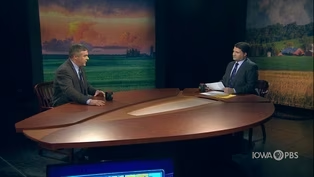
Clip: S48 Ep4826 | 12m 1s | Matt Bennett discusses the commodity markets in a special web-only feature. (12m 1s)
Providing Support for PBS.org
Learn Moreabout PBS online sponsorship
- News and Public Affairs

Top journalists deliver compelling original analysis of the hour's headlines.

- News and Public Affairs

FRONTLINE is investigative journalism that questions, explains and changes our world.












Support for PBS provided by:
Market to Market is a local public television program presented by Iowa PBS