
Market to Market - February 2, 2024
Season 49 Episode 4925 | 26m 45sVideo has Closed Captions
Commodity market analysis with Chris Robinson.
On this edition of Market to Market ... Land values defy pressures in rural America. European farmers keep their tractors in the public eye. A look at the expansion of no-till farming practices. And commodity market analysis with Chris Robinson.
Problems playing video? | Closed Captioning Feedback
Problems playing video? | Closed Captioning Feedback
Market to Market is a local public television program presented by Iowa PBS
Market to Market - February 2, 2024
Season 49 Episode 4925 | 26m 45sVideo has Closed Captions
On this edition of Market to Market ... Land values defy pressures in rural America. European farmers keep their tractors in the public eye. A look at the expansion of no-till farming practices. And commodity market analysis with Chris Robinson.
Problems playing video? | Closed Captioning Feedback
How to Watch Market to Market
Market to Market is available to stream on pbs.org and the free PBS App, available on iPhone, Apple TV, Android TV, Android smartphones, Amazon Fire TV, Amazon Fire Tablet, Roku, Samsung Smart TV, and Vizio.
Providing Support for PBS.org
Learn Moreabout PBS online sponsorshipComing up on Market to Market, land values defy pressures in rural America.
European farmers keep their tractors in the public eye.
A look at the expansion of No Till farming practices and commodity market analysis with Chris Robinson, next.
What's next?
Doesn't happen by chance.
It happens when researchers and farmers work together to solve tomorrow's agronomic challenges.
We're committed to creating what's next because at Pioneer, our name is our mission.
Tomorrow, for over 100 years, we've worked to help our customers be ready for tomorrow.
Trust in tomorrow.
Information is available from a Grinnell Mutual agent today.
This is the.Friday, February 2nd edition of Market to Market.
The weekly Journal of Rural America.
Hello, I'm Paul Yeager.
The job market appears to not read its own press clippings again, as the nation's employers had another burst of hiring.
The news has many economic observers asking what recession?
The government report says 353,000 jobs were added in January, with even more jobs being found at the end of last year, sparking a revision of December's report.
The unemployment rate stayed just above a half century low at 3.7%.
Wages even expanded by 6/10 of a percent.
The fastest gain in nearly two years.
The news could further complicate the Federal Reserve's action on interest rates.
This week, the Fed chair said a March rate cut is unlikely to occur.
The higher borrowing rate was thought to be a damper on the farm land sales market.
But cash stayed king, which led to a flurry of sales.
Peter Tub's reports.
Resiliency summarize the sale of farmland over the last six months of 2023, according to Farmers National Company.
The input costs have have settled somewhat, but they're still still pretty pricey.
And so even with all those factors, we're still seeing land values maintain the levels that they've increased over the past three years.
Schadegg, the company's senior VP of real estate operations, says the late rally came after a summer slowdown in land sales.
We got into the end of August, early September, and it's like they kicked it in high gear and we had one of the strongest well, maybe the strongest September we've ever seen as a company that allowed a lot of these operators to get into harvest, understand that they had better yields and they anticipated.
Traditionally, higher interest rates, slow the sale of farmland and other big ticket items.
We're finding out how much cash people have in their pockets, and it's more than we thought.
However, I'm going to say that going into 2024, we're already seeing an increase in lending and along with that, those higher interest rates.
So operators are going to have some additional expense to pay and in the form of interest rates on land loan.
And then just the fact that they're they're going in and there's a higher volume of requests for loans.
Schadegg adds the increase in demand for lending could change the way a sale ends.
And I think that we're going to we're going to start to see more know sales because of that and that and the no sales are are a combination of you know, there were a little bit too ambitious on what we think that land's going to bring today.
It's still bringing record values than what we've seen in the past 25 years.
Commodity markets, like always, are the key driver in keeping land values at a higher level.
There are still simply more motivated buyers than there are willing sellers.
It's just just as simple as that.
And that's where that competition is created and will be continue to be created.
For Market to Market, Im Peter Tubbs.
German lawmakers approved cuts to farmers fuel subsidies this week, stoking the fire already burning between farm gate and the halls of government.
Farmers in the Netherlands are expressing their anger over the cuts with their own blockades on the highways between Amsterdam and Brussels.
French farmers did start to ease some of their roadblocks after the French government offered money to answer a few of their grievances.
David Miller looks at the issues at hand.
European Union farmers took to their tractors again this week, keeping the pressure up in their weeks long series of protests.
At issue are cuts to Agricultural fuel subsidies, higher environmental taxes and increased imports of lower cost commodities.
Now, members of several European farm groups say there is a lack of support for their plight from the European Union Commission in Brussels.
In response, the EC announced plans to shield farmers from cheaper imports due to the nearly two year old Ukrainian war and will allow farmers to use land forced to live fallow for environmental reasons.
In France earlier in the week, where protesting has been more disruptive, government officials showered farmers with promises of help, including emergency aid and controls on imported food.
For market to market, I'm David Miller.
The Biden administration has taken up climate issues throughout their term through sequestering carbon and reducing greenhouse gas emissions.
This week, USDA officials highlighted small business owners who've received money to build renewable energy infrastructure and make energy efficient upgrades.
The genesis for these policies could be traced all the way back to the 1985 version of the Farm bill.
Farmers were doing some no till before Its inclusion in the measure, and its scope has expanded since.
As Colleen Bradford Krantz reports in our cover story.
I have very little erosion.
Northwest Missouri farmer John Hickman remembers motorists slowing down to stare as they passed his first no till field in 1983.
The practice of leaving crop ground undisturbed until planting was uncommon enough that a lot of rubbernecking took place.
I started on a road where everybody could see me.
That was a mistake.
In that drill, I had a lot of trouble.
I had to stop clean it out everybody go by lookin.
They thought I was nuts.
I know that.
But I lived through it.
After correcting the seed, planting depth on the drill, he had borrowed from the local Andrew County Soil and Water Conservation District.
Hickman began to see the value of saving time and fuel with fewer trips across his fields.
He soon, by his own no till planting equipment.
Took a while to get used to it.
I found out if you don't tell this ground for a couple of years, that ground gets solid.
You come by and won't make hardly any tracks.
You don't have to worry about getting stuck.
Main thing I get far more with less equipment and less time.
I didn't have to have a whole lot of help.
He ultimately converted all 1200 acres of his corn and soybeans to no till.
While neighbors had to clean out their terraces after heavy rains filled them with runoff topsoil.
Hickman, now retired, no longer needed to do so.
But when I was a child, we used to always, in the following year, plow plowing or thing.
It was fun because, you know, I still like to, even at my age today, I still like to turn a black dirt over and see that black.
And everybody goes.
They look good until I probably got 45 years old.
Then I figured out, I've got to do something different because it's taking too much time for as much ground as I was farming.
Jump ahead.
40 years and 74% of North Central and Midwest cropland acres are either no till or reduced till.
Now Hickman finds himself doing the rubber necking when he sees someone tilling a field.
I say, What are they doing that for?
Why would they till that steep ground?
Why would they do that?
Nationwide surveys conducted by the Natural Resources Conservation Service indicate that as of 2016, in one third of the nation's cultivated cropland or 103 million acres was farmed as continuous no-till, up from 20% a decade earlier.
Another third was reduced tillage, with the last third being tilled conventionally.
The east central states and northern pllains states have the highest adoption rates of continuous no till at 65 and 48% respectively.
In Andrew County for sure.
We're probably two thirds of it is no tail farmed as opposed to reduced tillage or conventional tillage.
With the new technology, with the planters and the herbicides, chemicals and the genetics of the seed, and and then the price of fuel, especially the price of fuel this year, any time they can reduce trips, they're going to put more money in the bank at the end of the year.
Ted Utz was an Andrew County soil and water conservation agronomist who helped convince Hickman and other early adopters to try no till.
You had 30% of the people were innovative and we were trying to find new and better ways to make a living.
Then you if you got those people on board and going, then you had the other third that were followers that would follow those innovators and proceed ahead.
Then you had the ones that they weren't going to change no matter what.
Andrew County along the Missouri River and prone to having more wind blown, less soils, had serious erosion issues in the early 1980s.
Much of the hilly ground has long since been terraced, but the high adoption rate of no till farming was also seen as a key in reducing erosion.
Some fields were losing 30 to 40 tons of soil per acre per year.
Generally, you could afford to lose five tons of soil per acre per year.
In Andrew County, most of it is ten or less right now, and a high percentage of it is probably under five ton.
Especially with the cover crops these days.
As of 2016, cover crops were used on just 6% of cultivated acres nationwide.
The 19 million acres with cover crops still represents an increase from a decade earlier when it had stood at just over 2 million acres.
In southwest Michigan, brothers Jake and Ryan Drozd say their family operation Drozd Family Grain has shifted some of their 7200 acres to reduced or no till.
But not the majority due to their area's climate and soils.
I'd say 80% of our ground is tilled in probably 20% is reduced till or no till.
Our reason for that is we only live about 20 minutes from Lake Michigan.
And the problem there is, is the lake effect snow ground doesn't freeze in the winter.
Like most places, the United States.
And so our ground is it's real.
It's real muddy.
If we tried to plant no till here, we'd break all of our equipment.
It's just there's just too many.
I mean, we'll get ruts that are, you know, that deep to that deep.
The farm sits on a flat region of the state, so they have a lower risk of erosion than hillier areas, along with traditional fertilizers.
Drozd Family Grain also uses microbe and compost mixtures on their fields to maintain soil quality.
We're we're trying everything we can to adapt, you know, to as much as we can because of the less money we can spend on stuff, the better.
We don't want to harm the soil because that's that's our that's the fruit of our labor.
I think the corn Belt is pushing really strong for no till, which is a that's a good thing, we should be.
For market to market, I'm Colleen Bradford Krantz.
Next, the market to market report.
The grain bowls failed to see a weather shadow indicating little, if any, hot and dry news to drive a weather story.
For the week, the nearby wheat contract lost a penny while march corn shed $0.04.
As quickly as the soy meal market gave, It took back a rally in the soy complex.
The March contract declined $0.21 and March meal added 7.80 per ton.
March cotton expanded by to 2.65 per hundredweight.
Over in the dairy parlor March Class three Milk futures improved $0.86.
The livestock market was higher as April cattle added $2.07.
March feeders strengthened $5.10 and the April lean hog contract gained $0.58.
In the currency markets, the US dollar index increased 55 ticks.
March crude oil lost $5.47 per barrel.
COMEX gold expanded $18.10 per ounce and the Goldman Sachs Commodity Index weakened more than eight points to settle at 549.30.
Joining us now, regular market analyst Chris Robinson.
Hi, Chris.
Good to be here.
You know, you're going have a hard time smiling with some of the things we're talking about this week, but we'll start with a positive thing in wheat that seemed to have some strength come Thursday, Friday.
Is that the indication of good things to come for wheat?
Wheat.
Every time we've had a decent rally has not been able to hold it.
And we're also fighting some technical things there to where we can't get above this trendline.
There's a trend that goes all the way back to to July.
So if we get through that, certainly the setup is there for a nice rally because the manage my money, the big spec funds, their bets short all the grains their bet long the cattle market.
But if they have a reason to cover those shorts that would help.
So hopefully wheat will lead the way.
You know, we just have to get more than a two day rally that can hold.
We have had no follow through.
You were commenting during one of the earlier stories talking about the European farmer story and you were mentioning that there is an issue of the French wheat producer is is feeling the pinch because of Russia, Ukraine.
Is that the story there?
Well, one of the stories is it again, I read so much stuff after everybody in this business does, but that's one of the things that people are concerned about because a lot of grain is coming in and it's much lower price than the the European grain.
So at the end of the day, that's pressuring farmers and that's one reason the farmers are upset.
And we're feeling it in the United States as well with that story.
So at what point is there like a percentage of that impacts this more than a winter kill or a demand story domestically?
No, I think that, you know, we did have some China business, which was nice.
It was nice to see them show up.
And generally, though, if there is a rally in that French milling wheat, it'll be we'll have a sympathetic rally.
So it's it's not directly correlated.
But, you know, we have to start somewhere.
We're at three year lows.
That's the problem of corn and wheat.
We're at three year lows.
And everybody for the last year has been like, okay, is the low end, is the low ends, the low end, and it's just been very, very difficult.
And so, yeah, I think if there is a rally, it could come from something in Europe.
You said three, which is going to prompt this question about corn that I don't think many want to hear.
But let's start with it.
Mike in Iowa wants to know, Chris, we are falling to that $3 corn really fast.
Is there any stopping it?
Sure there is.
Technically, there's we've got some.
And it's the talk about corn.
You've got to talk about all crop, a new crop.
So old crop is March.
That's what's out there and that's under a lot of pressure.
This this level, this this.
4.50 level 4.40 level is very, very big going all the way back to 2013 to 2017.
That was the top we remember that was considered a really good price, 4.30.
So we're kind of dancing with that level now.
I think if that was to fail, if the 4.30 support fails, then you'll see kind of a natural as the market tries to find support.
So I would anticipate that if that doesn't hold, we go to 4.20, 4.25 you know, as far as making the big call, the same people that, you know, last summer when we were at six $6 corn said we were going to eight.
I'd be.
I'm worried that just because we're at 4.40 doesn't mean we're destined to go to 3.50.
It's possibility.
It's always a possibility, but we're we're having we're putting up a very good fight.
This 4.40 level.
The old crop story in the United States is the amount of grains still in bins in the United States.
At what point do you spring that out?
I don't see a fall in prices springing it out.
Or do we?
I don't think so.
I think if a farmer did not want to sell at $6 corn, if they don't have to, they will hold it.
Now.
We'll see what happens if we drop another 20 every $0.25, $0.30., people take a second look and say, well, maybe we need to move this.
But I don't believe that the current farmers that have held this corn are going to be quick to sell, though.
And that's going to be probably the number one question this year is at what point will will or if you know, the farmers that are holding this grain, throw the talent and sell it.
So I don't know.
That's anybody's guess.
I would say that, you know, these big round numbers, 4.50, 4.25, if it starts getting posted down to $4, you may see some people have to do it.
What does that mean?
It means a banker.
It may be say, you know what, we're not going to give you an operating loan until you raise some cash.
And the only way to raise cash, unfortunately, would be to sell.
On the new crop side of things, though, I mean, we talked about how that that 25 and 26 had been a number of people had talked about for what to sell.
Let's talk December 24.
Any promise of higher prices ahead there?
No, we had our chance.
We had a little October blip up there.
Looked like that was going to be the start of something.
We were about 5.25 or 5.30, and we've just been grinding lower.
4.90 was a very, very big level for a long time.
It was the May low, the summertime.
Forget that.
Remember back in March when they had the banking crisis and, you know, we dropped sharply and people were saying, oh, here we go to 4.30 corn Now, we stopped at 4.90, and then we had that really excellent rally into June.
So 4.90 was a huge level, I think 4.90, $5 that is going to be now the now that's going to be the new resistance to get above.
And then, you know, as far as what's below, there is a lot of put strikes at the 4.75 every $0.25.
There's going to be a pause.
It's just kind of the way the market is.
But again, there's you're going to see two markets.
You've got the old crop corn and the new crop corn.
Do not forget about the risks you have for new crop corn.
4.75 is kind of right where we are right now.
I want to make sure that, you know, you've got a plan and this is going to be a year where you're going to have to know what your numbers are.
You know, what level is it not worth it?
And, you know, hopefully we can we can find a base here and we get some sort of rally.
Generally, we have some sort of spring rally, you know, between now and planning.
So we'll see.
The groundhog today said we're going to be early spring.
Maybe we'll get an early weather issue.
I probably should have spent some more time on beans given what's going on.
But a lot of the same things apply there.
We we've seen a key point come and go, $12.
We hit it for, what, 4 hours on Wednesday and it's gone.
Is that thing coming back any time.
New crop or old crop.
Old crop.
Yeah, old crop.
You know, we had that nice little blip because I remember last Thursday trying to turn the printing presses on.
They said they were going to rescue their their real estate market.
That was we had, we had a 25, 30 cent a nice rally in soybeans.
And again what happened There were no legs.
So I think that in the soybean market, which is still relatively in good shape, if you look at new crop soybeans, which is what I'm kind of looking ahead to, you know, we were right there fighting at that $12 level.
A month and a half ago we were at 13 bucks.
People were like, okay, here we go.
I would say this.
And the last time I was on around Thanksgiving, I said trying to find $12 beans, trying to defend $5 corn.
And I think that that's the level I think a lot of people are going to be looking at if we get corn back up north of five bucks, do something.
If we get beans north of $12, try and do something.
If you're in the cotton market right now, you're one of those only darlings of the funds.
How long does that party last?
As long as they want it to.
It's a good thing there's some good fundamentals driving cotton.
We've had a really nice recovery.
$0.90 is going to be a big target for next year's cotton, but I think we're at three or four month highs in cotton right now.
It's a it's a great recovery rally.
And it is it's the one silver lining.
And I was talking to some guys in the Delta today that, you know, are they going to plant cotton or beans?
Most of them are probably going to end up planting beans just because of the economics, because even today at $12 or, you know, 11.80 beans where we're at, that's still profitable for most guys.
But cotton is a great story.
If you're looking for a bull story.
Livestock doesn't have a bad story.
Or did it maybe have a reversal?
Live cattle first, please.
After the the report, I believe it was, We have our smallest herds since like 1951.
Yeah, that's the that's the headline smallest herds since 1951.
Beyond the headline then.
Well, if you look deeper.
In fact, it was like the last line in that report.
Actually, somebody sent it to me and pointed it out to me.
The the size of the the the the calves that are coming up next, 6 to 8 months, that's that's pretty significantly lower than a lot of people thought, six, seven, 8% lower depending on whose numbers you're looking at.
Boy, you can see it.
I wanted to talk about that today.
The deferred months for for not only live cattle but even feeder cattle.
They are just gone vertical.
So I'm talking about June, July, August.
We kind of have two markets.
So if you're a producer out there, we've got a tremendous recovery in the the spot months after we had that the debacle.
The October to this, you know, that was just a horrendous sell off.
We've clawed back a huge percentage of that, 50 to 60% of that.
But I think the big story is deferred.
That's a great opportunity for producers.
You know, expensive prices out there.
It's just like when we were at, you know, 6.50 corn, maybe it doesn't last forever.
It's a great opportunity for producers.
And for the the feeder cattle folk.
Some of those same things are applying right now right?
Oh, absolutely.
Yeah.
Yeah.
The feeder cattle, especially this rally post report, was really fueled by more feeder cattle than live cattle.
That's and then again, that has to do with the economics of the size of the herd that's coming out there.
That's, you know, it takes time to rebuild the herd.
Now, here's the other problem with this.
Usually when it hits the headlines, sometimes the headlines put the highs end, right.
You know, we're back here and and around Thanksgiving, we had the hot and dry in South America, Brazil, that was almost the top.
And then we had the $2 break in soybeans.
So take advantage of one of these markets, have these nice rallies, take advantage of it.
The hog producer did they take advantage of that blip this week?
A great you know, in December, we went from contract lows to talk about a complete recovery.
The funds have flipped and now got long.
They're long lean hogs.
They're long like the fat cattle, and they're also long feeders, a nice six month high and the lean hogs and again, the deferred months.
June-July, August, you're out close to a buck.
You're at the top of those prices.
You know, you don't have to do a lot to protect that revenue.
And I think that, you know, we've seen how prices can change so radically, so quickly when you get these rallies if you can't actually physically sell into them, then you need to put some sort of hedge on real quick.
We just saw the chart that was dragged down way up and way up.
What's the next stroke of that pen?
And we recovering a little.
For the hogs.
Hogs, Hogs are at the tippy top.
So we'll see if there's any more follow through.
There hasn't been a whole lot of follow through and a lot of the commodities when we've had these rallies.
So we'll see what happens.
But, you know, it's a great a great marketing opportunity.
Don't miss it.
I know one thing that happens.
We're at the end of our time.
Thank you, Chris.
Thank you, sir.
Hold on right there, because we are going to pause this analysis and continue our discussion about the markets in our market Plus segment, you can find both analysis and plus on our website of market to market dot org.
We want to know what is your favorite winter activity on the farm?
Drop us an email with your answer to market to market at Iowa PBS.org next week, opening the door to talk about farm transitions.
Thank you so much for watching.
Have a great week.
Market to market.
Is a production of Iowa PBS which is solely responsible for its content.
What's next doesn't happen by chance, it happens when researchers and farmers work together to solve tomorrow's agronomic challenges.
We're committed to creating what's next.
Because at Pioneer, Our name is our mission.
Tomorrow.
For over 100 years, we've worked to help our customers be ready for tomorrow.
Trust in tomorrow.
Information is available from a Grinnell Mutual agent today.
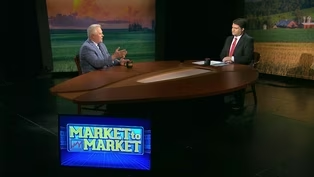
Market Plus with Chris Robinson
Video has Closed Captions
Clip: S49 Ep4925 | 11m 23s | Chris Robinson discusses the commodity markets in a special web-only feature. (11m 23s)
Providing Support for PBS.org
Learn Moreabout PBS online sponsorship
- News and Public Affairs

Top journalists deliver compelling original analysis of the hour's headlines.

- News and Public Affairs

FRONTLINE is investigative journalism that questions, explains and changes our world.












Support for PBS provided by:
Market to Market is a local public television program presented by Iowa PBS