
Market to Market - January 19, 2024
Season 49 Episode 4923 | 26m 45sVideo has Closed Captions
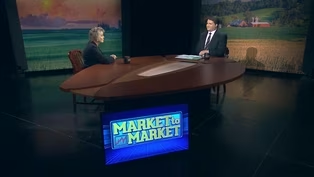
Commodity market analysis with Sue Martin.
On this edition of Market to Market ... Snow and cold blanket the country. World leaders meet on climate, soil and sustainability. A small insect makes a big impression on the landscape. And commodity market analysis with Sue Martin.
Problems playing video? | Closed Captioning Feedback
Problems playing video? | Closed Captioning Feedback
Market to Market is a local public television program presented by Iowa PBS
Market to Market - January 19, 2024
Season 49 Episode 4923 | 26m 45sVideo has Closed Captions
On this edition of Market to Market ... Snow and cold blanket the country. World leaders meet on climate, soil and sustainability. A small insect makes a big impression on the landscape. And commodity market analysis with Sue Martin.
Problems playing video? | Closed Captioning Feedback
How to Watch Market to Market
Market to Market is available to stream on pbs.org and the free PBS App, available on iPhone, Apple TV, Android TV, Android smartphones, Amazon Fire TV, Amazon Fire Tablet, Roku, Samsung Smart TV, and Vizio.
Providing Support for PBS.org
Learn Moreabout PBS online sponsorshipComing up on Market to Market snow and cold blanket the country.
World leaders meet on climate, soil and sustainability.
A small insect makes a big impression on the landscape and commodity market analysis with Sue Martin next.
What's next?
Doesn't happen by chance.
It happens when researchers and farmers work together to solve tomorrow's agronomic challenges.
We're committed to creating what's next because a pioneer.
Our name is our mission tomorrow.
For over 100 years, we've worked to help our customers be ready for tomorrow.
Trust in tomorrow.
Information is available from a Grinnell Mutual agent today.
This is the Friday, January 19th edition of Market to Market, the weekly Journal of Rural America.
Hello, I'm Paul Yeager.
The holidays may be behind us, but the ramifications of our spending is now a gift to merchants.
Retail sales were up 6/10 of a percent in December, according to the Commerce Department.
Some economists think this could set the tone for economic growth in 2024.
December home sales were down 1% after moving higher in November.
The existing market for the year was down 18.7%, a nearly 30 year low.
A continuing resolution arrived Thursday to keep the government open.
Enough Democrats voted with Republicans for the plan to pass and lawmakers were able to agree in time to depart Washington ahead of another winter storm forecast to impact 100 million Americans.
This caps an already busy week in the weather department.
Peter Tub's reports.
Winter arrived with a vengeance this week as snow and cold blanketed much of the country.
Ice was a source of trouble throughout the Pacific Northwest.
Coated roads made for dangerous driving in Oregon.
School and business closures were common in the region.
Heavy snow blocked rural roads in Iowa for days.
As two fronts crossed the state.
The second snowstorm dropped nearly a foot of snow over the weekend.
But the cold lasted for an extended period of time.
School cancellations were the norm as windchills in the 70 below range were recorded.
Snow depth across the country has increased dramatically over the last two weeks.
The highest totals were found from the western mountains to the upper Midwest.
Louisiana officials were forced to close the Lake Pontchartrain Causeway near New Orleans as a combination of sleet and a dip below freezing.
Put ice on the road.
Those along Lake Michigan and Chicago are used to winter.
But this week was a different kind of experience today.
And yesterday and the day before, particularly dramatic as.
We've had below zero weather and a 41 degree.
Lake and a west.
When the city of Philadelphia received its first significant snowfall in two years.
As sidewalks are being cleared.
Several residents found their way outside to enjoy the weather.
And my daughter's for she doesn't remember the snow.
So it's her first time actually checking it out.
So yesterday I said my snow today, you guys.
So they woke up this morning to see snow all over the ground.
They lost their.
Minds.
The moisture did improve the nation's drought picture, but more than half of the lower 48 remain in some form of drought from mark to market.
I'm Peter Tubbs.
Top climate scientists from around the world reported this month that average global temperatures last year crushed record highs.
Earth economy seems to be more tied to climate than ever before.
This week, leaders from several sectors of the planet assembled in the Swiss Alps.
David Miller looks at some of the connections being made.
For many of these this week, business leaders, top politicians and political activists gathered at the World Economic Forum's annual meeting in Davos, Switzerland.
Among the topics of discussion were finding ways to balance climate change with preserving the planet's natural resources while promoting economic development and feeding a hungry world.
Last year, the U.S. launched a food initiative called The Vision for Adapted Crops and Soils.
At this year's enclave, U.S. Secretary of State Antony Blinken spoke about the program that includes a partnership with the African Union and the United Nations Food and Agriculture Organization.
First, we're investing above ground.
Identifying the indigenous African crops that are most nutritious and most resilient to climate change.
Improving these varieties, delivering them to the world.
At the same time, we're investing below ground mapping.
Conserving, building, healthy soils.
There were also discussions about how to balance economic development and preservation of the Amazon rainforest and ensure.
Gustavo Petro, president of Colombia, laid out what he believed was needed to keep the environment from going past the point of no return in his country.
We need a flow of approximately $2.5 billion per year in order to revitalize the already deforested area and to maintain over the years the construction of a bio economy that is an economy with the forest and not against the forest.
De Silva, Marina, Brazil's minister of Environment and Climate Change, reiterated the need to combat inequality with sustainable food and renewable fuels.
Even as skill.
The big challenge is how we are going to make sure that all these comparative advantages that Brazil has can be increasingly transformed into advantages.
I don't know if that word exists instead of competitive advantages that are distributive advantages so that we can make Brazil, which may be a model of low carbon agriculture, a major supplier of food for market to market.
I'm David.
Miller.
Trees have been under attack in the Midwest for years.
Most recently, drought has thinned new plantings that haven't received enough tender loving care.
One specific type of tree is in the crosshairs of a small beetle.
The emerald ash borer has dug into and killed hundreds of millions of ash trees in North America as trees were harvested.
Entrepreneurs are finding creative uses for the lumber.
Cameron McCoy has more in our cover story.
Neighborhoods like this are becoming an increasingly common sight.
Ash trees with thinning upper canopies reflect bark damage and shoots of new branches at the trunk.
All telltale signs that these trees have been infected by the emerald ash borer.
Should be emerging right here.
That's an exit for a smaller Windsor emerald ash borer leaving the tree.
According to the Iowa Department of Natural Resources.
There are roughly 3.1 million community ash trees in Iowa, as ash is one of the most commonly planted street trees in the state.
The emerald ash borer is having a huge economic impact on the forestry sources of cities and towns.
Look at history.
And we had Dutch elm disease come through in Iowa.
The biggest years were kind of in the sixties and seventies and wiped out the elms, and then we had to replace these trees and this was the number one tree.
Green ash is highly resistant to salt and heat and handles a variety of soils and grows very quickly.
And so we didn't learn from that young disease.
We kind of went in, replanted lots and lots of ash or lots and lots of maples.
And so when we have an invasive pest like emerald ash borer and it came and it was able to run down those streets like we see here pretty quickly.
Emerald ash borer is kind of a unique insect.
It's an invasive insect, like you mentioned, not native to United States.
It comes from China, Korea, some of those Asian continent areas.
It was introduced in 2002 to Detroit, Michigan, and it's a primary killer of all in or ash trees.
The emerald ash borer was first discovered in Iowa in 2010 on an island in the Mississippi River.
Despite the Iowa DNR putting a quarantine on, moving the wood, the beetle continued to make a westward push through the state.
It went through the state tremendously fast.
But I have a publication we put out and it was looking at the railroad and the railway is what moved it quickly through Iowa.
They fly around in the spring, get on the cars, take a ride.
So the rail communities were hit the hardest.
Adult beetles live on the outside of the trees and feed on the leaves during the summer months.
The larva feed on the living plant tissue underneath the bark.
The tunneling and feeding activity of the larva is what ultimately kills the trees down.
And when the bark is peeled back, you can see the dizzying pattern left behind by the larva as millions of these trees are cut down.
Several factors come into play.
How do communities efficiently remove the wood from neighborhoods?
What's the financial cost of cutting down the trees?
And what should communities do with such a volume of wood when most of it is perfectly usable for other purposes?
Are these trees worthless?
It's a tough one.
So the ash market, believe it or not, pre 2002 was pretty good.
You know, you could sell and mill out most trees, urban trees.
They're tough because you don't know what's inside of that tree.
So it's really hard to dispose of these trees.
And what do you do with all of this wood when it comes down?
You know, just on this block alone, we're probably looking at, I don't know, maybe five, 600 trees that are going to come down in the next year or two.
That's a lot of wood material.
And we really don't have answers for it.
According to the U.S. Forest Service, if recovered and repurposed wood from the country's urban forest could produce nearly 4 billion board feet of lumber each year.
Upcycling is becoming a popular trend for urban wood.
The Iowa DNR forestry program is working to connect people all along the supply chain to build community business and consumer interest to embrace this underutilized resource.
There are some creative things happening.
There are a few smaller communities that have the wood milled out and they take the wood to work in their shop classes.
Others have turned them into benches.
The city of Waterloo ended up mulching the wood and turn them into pellets and then they get turned into power.
Pellets are burned for power.
So everybody's got some creativity with it.
A little different use, but not it's not universal.
It really depends on where you're at in the state.
We've got a lot more ash now than we ever had before.
Monty and Becky Button owned Bear Creek Hardwoods outside of Earlham, Iowa.
They are a full service lumber mill and kiln that takes locally sourced wood and repurposes it.
Used to be that they would just cut down all the trees, mulch them up or take them to a landfill.
And that was such a waste that wood is so beautiful and it's so purposeful that there has to be a better way to do it.
It's an easy wood to cut.
It's not really, really hard.
It's got great characteristics.
It's got a lot of nice grain edge like like Oak has, but it's a lighter wood.
As more and more ash comes into mills like Bear Creek Hardwoods, they are using the repurposed wood for a variety of projects.
We've done a lot with Ash is we will make dinner tables, Mantels.
We do a lot of flooring with ash.
There's really no limit on what you can do with ash because it's just a real nice, stable wood.
The fight in stopping this pest from infecting trees is over, and it's not clear if ash will ever rebound in the state again.
But like the local craft beer movement or the local food movement, mills like this are building a local wood movement, all of which can help improve local economies, repurpose a waste product and create something of lasting value for years to come.
And it's neat just to know that this item that we have was grown in our own soil as is just being repurposed.
And it's it's just very interesting to know that this is from Iowa.
For market to market.
I'm Cameron McCoy.
Next the market to market report.
Multi-Year lows were met this week even as winter kill moved across the U.S. We also had diminished rain forecasts in South America, which impacted the U.S. weather and the U.S. market for the week.
Let's talk about the markets.
The nearby wheat contract lost $0.04 while March corn dropped $0.02.
Technical resistance at $12 seems to be keeping the soy complex above that mark, with questions still remaining about the size of the Brazilian crop, the March contract declined $0.11 and March meal shed 560 per ton.
March cotton expanded by 277 per 100 weight.
Over in the dairy parlor February Class three, milk futures fell $0.11.
The livestock market was mixed.
February cattle added $3, March feeders improved four and a quarter, and the February lean hog contract shed a dollar 15.
In the currency markets, the US dollar index increased 99 ticks.
February crude oil expanded $0.84 per barrel, COMEX gold cut 20 to 50 per ounce and the Goldman Sachs Commodity Index lost more than eight points to settle at 538.70.
Joining us now, regular market analysts, Sue Martin.
Hi there.
This wheat market, there's always seems to be certain things that are built into it, winter kill being one of them.
So my question is really simple.
What's going to prompt is to rally into February.
Well, seasonality, first off, a lot of times you'll rally wheat into February, but the true time to rally is April, May.
And the there's been analysts that are talking about the concern over some damage for winter kill.
Now in parts of Kansas, you've got snow cover.
And I think that winter kills important.
But I wouldn't hang my hat on it because you don't know what damage has been done until the crop breaks.
Dormancy.
Seasonality is one thing, winter kills another.
How do I play my crop here?
My planning in wheat moving forward for the next month?
Well, I'm not wanting to make any cash sales at this time.
The U.S. farmer wheat farmers holding about 28% of the crop on farm.
That's not super bad.
And I think that the indicators I follow that are proprietary are showing that this wheat market, it may still flounder around.
But when you've got all the issues going on in the Red Sea, we've seen Algeria come in, take up to 900,000 metric tons, wasn't expected to take that much.
You've got Egypt that's been coming in quite often to the marketplace.
I think and we've got other countries, too.
But it seems like demand for wheat pretty good right now.
And I think it could be part of the concern.
One of not having enough supplies on hand.
You know, that just in time inventory, which is all goes back.
Goes back a couple of years.
Yes.
Go back.
But I think that with the wars breaking out in the Middle East, in the Red Sea area, and then you've got Russia and Ukraine and Russia is the world's largest exporter of wheat, I think that we're looking at a market that has potential.
To be a potential in corn.
I mean, we're at three year lows right now.
Well, I think we do.
I think we put a low in on corn and wheat excuse me, corn and soybeans this week.
And we had a target of 436 to 440, and we got down to 436 and three quarters and we kind of springboard out of there.
And now we have a run away.
I don't think Corn's going to run away, but I think you've got some lows stuck in here for a while.
Remember, February is crop insurance month, and I think this market feed usage should be very good.
I don't know if the February report will acknowledge it, but feed usage has been very good here so far.
In January and everything I see February is not going to be a whole lot different.
So I would have to say that's good exports.
China in the month of December took 27.1.
I think it was million metric tons and that was up about 6.6% more than a year.
Before course, they're coming out of lockdown.
You know, but they also have a huge supply of hogs that's been going through a liquidation.
Some would think, oh, well, gee, they won't need as much corn or soy meal.
Well, maybe we'll be surprised.
I think China's supplies were low.
And I think here's another country that I think is building reserves.
And then you've got the situation where you look at China.
And I think that we look at COFCO International Grain and they've been avid in exports or net exports.
But the delivery process like they were back in 2020.
And I think that when I look at China, I think they've already this week, this past week, they accepted or acknowledged six more GMO varieties.
And I think previously there might have been 17.
So then how does corn ward off any lower lows?
But then look at beans, how they stick and hold off on 12?
You kind of just said a whole bunch of things that sometimes playing to both of those markets are all of those factors that you just talked about at play in soybeans as well?
Well, yes.
Now, beans, the trade.
I know the public seems disappointed that the beans didn't do better in December and what have you, But the market was telling you something when it closed lower for the month of November after our nice rally in October.
And then you took out November's low in December.
What's it saying?
You know, the market's always right.
And I think the bear side of that equation is, well, yes, and it's all over the place.
What you hear for estimates, you know, we've got some really low balls in there.
I think we've priced in the 150 area, although CONAB And of course, USDA is not there yet.
But I think that when you look at the bear in Brazil or the bear in the trade, he's saying, well, but look at Paraguay, look at Argentina, and Argentina's coming back full bore this year.
Well, by the time and South America or Southern Brazil maybe has picked up a little more, So they'll make up for these losses that we're seeing in central and northern Brazil and especially in Mato Grosso.
Maybe, maybe not.
You know, when I look at Argentina, remember, they were importers of Brazilian beans.
They might not be needing to be importers this year.
And so that's one thing I think that when I look at Argentina's crop, you know, they've got a very progressive president now.
And I think that he's resisting, you know, he's not going to do business under the yuan or Brazil's willing to.
But I think that's where the bear came from, is that we're compensating in enough to make up for.
So instead of just looking at Brazil, we're looking at South America in mass.
Right.
So, Phil, I got to let you know, that was part of your question Sue was answering there.
I want to move to livestock here for a minute.
We talk about the weather and how cold it was.
We were looking at weights coming in this week.
It's not going to be a long term cold snap, is it?
And and does it have a long tail, though, at the at the Packer door?
Well, for one thing, the packer I think is still killing in the red.
And so now that he's passed this not being able and he was creative about thinking maybe less numbers so he slowed his processing or killed out.
But then we went through this weather and we had all these animals sitting in feedlots heavier than normal or what they should be.
And of course they've given up some of that weight.
I've heard £60 up to £100.
The other thing you're going to see is problems with feet, with hoofs.
And I think that when I look at the packer, he's done a creative job.
The problem is, is that now that we have the weight loss, okay, but take the weight loss and what was it versus a year ago?
We might come in £18.
Right now we're running about £18, I believe over 23.
And when we get into February, we might look back and we look at this weather and we might still be £18 over, I should say, over 22 and now over 23.
So because the weights dropped in the latter part of 22 and then 23, of course, we had heavier weights, we're starting to manage those weights now.
So I'm looking at cattle.
I could see the market still pushing a little higher here, although the packer maybe is going to be a little resistant, and especially with the warmer weather, the cut out drops.
But demand for beef domestically seems like it's slowed a little bit.
Well, kind of that news of the the retail sales at the top of the show, that's always one of those factors in there.
And you exclude certain things when we get to Consumer Reports which will be coming soon.
I want to circle back to something you said earlier about the lower feed costs.
That's the one bright side of a down corn market is the cattle feeder.
See it the same way?
Well, he might not it might not be cheap enough for him, but the thing is, cattle prices are beautiful compared to what they were a year ago at this time.
So we've got that.
The problem is you have those input costs and the and the producer was making good money here in the fourth quarter of last year.
And now with these animals losing all this weight in the feedlots, they're giving back some of that profitability.
And our cattle on feed inventory was 2% above last year and on placements we were 4% below.
So really nothing for you in that?
Exactly.
It was just a neutral report.
I think the more important thing is going to be the cattle inventory report at the end of this month.
I think that's going to be showing us less cows and beef cows especially, and also probably calves, smaller calf word.
In the final seconds.
You already kind of talked about China's reduction in their hog market.
Is there anything U.S. hog producers can look for?
Sunshine wise?
No, I think demand for pork is pretty decent right at the moment.
But when I look at the hog market, I think that I'm amazed that we haven't liquidated down more hogs.
And what the reports show.
I look at China and China's got record production, pork production, 50, almost 58 million metric tons this last year.
And I look at their largest pork producer and they I think they dropped 10% from the year before.
And then you have the second largest one, a whopping 58% less in the fourth quarter.
All right.
We'll pick it up in a moment.
Thank you, Sue.
You bet.
Good to see you.
Hold on, because we are going to keep going on this analysis and continue that discussion about these markets and our Market.
Plus, you can find both analysis and plus on our website of market to market dot org.
A reminder a good email goes a long way to getting our attention.
Drop us a line about the program to Market to Market at Iowa PBS.org.
Next week, he story of a professor hunting for unintended changes from genetic editing.
Thank you so much for watching.
Have a great week.
Market to market is a production of Iowa PBS, which is solely responsible for its content.
What's next doesn't happen by chance.
It happens when researchers and farmers work together to solve tomorrow's agronomic challenges.
We're committed to creating what's next because a pioneer.
Our name is our mission tomorrow.
For over 100 years, we've worked to help our customers be ready for tomorrow.
Trust in tomorrow.
Information is available from a Grinnell Mutual agent today.
This week on market to market, a professor hunts for unintended changes from genetic editing, which raises a lot of good and commodity market analysis.
Sean Hackett of Cash Offer Tips on how to market to Market.
The weekly Journal of Rural America.
Video has Closed Captions
Clip: S49 Ep4923 | 11m 38s | Sue Martin discusses the commodity markets in a special web-only feature. (11m 38s)
Providing Support for PBS.org
Learn Moreabout PBS online sponsorship
- News and Public Affairs

Top journalists deliver compelling original analysis of the hour's headlines.

- News and Public Affairs

FRONTLINE is investigative journalism that questions, explains and changes our world.












Support for PBS provided by:
Market to Market is a local public television program presented by Iowa PBS