
Market to Market - June 28, 2024
Season 49 Episode 4946 | 26m 45sVideo has Closed Captions
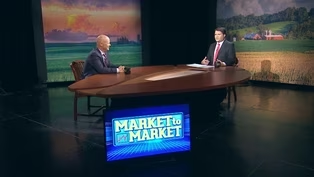
Commodity market analysis with Ted Seifried.
On this edition of Market to Market ... More than a foot of rain falls on the Midwest - creating havoc in two major watersheds. A pipeline carrying carbon gets the green light. And, commodity market analysis with Ted Seifried.
Problems playing video? | Closed Captioning Feedback
Problems playing video? | Closed Captioning Feedback
Market to Market is a local public television program presented by Iowa PBS
Market to Market - June 28, 2024
Season 49 Episode 4946 | 26m 45sVideo has Closed Captions
On this edition of Market to Market ... More than a foot of rain falls on the Midwest - creating havoc in two major watersheds. A pipeline carrying carbon gets the green light. And, commodity market analysis with Ted Seifried.
Problems playing video? | Closed Captioning Feedback
How to Watch Market to Market
Market to Market is available to stream on pbs.org and the free PBS App, available on iPhone, Apple TV, Android TV, Android smartphones, Amazon Fire TV, Amazon Fire Tablet, Roku, Samsung Smart TV, and Vizio.
Providing Support for PBS.org
Learn Moreabout PBS online sponsorshipComing up on Market to Market, more than a foot of rain falls on the Midwest, creating havoc in two major watersheds.
A pipeline carrying carbon gets the green light and commodity market analysis for Ted Seifried Next.
What's next?
Doesn't happen by chance.
It happens.
When researchers and.
Farmers work together to solve tomorrow's agronomic challenges.
We're committed to creating what's next because at Pioneer our name is our mission.
Family owned and operated for more than 60 years.
Sukup Up Manufacturing is a full service provider of grain handling, storage, and drying equipment, helping farmers feed and feel the world.
For over 45 years.
Steiner Tractor Parts has shared your love of antique tractors.
New parts for old tractors.
Learn more at Steinertractor.com or at (877)559-7887.
Tomorrow.
For over 100 years.
We've worked to help our customers be ready for tomorrow.
Trust in tomorrow.
Information is available from a Grinnell Mutual agent today.
This is the Friday, June 28th edition of Market to Market, the Weekly journal of Rural America.
Hello, I'm Paul Yeager.
While Supreme Court rulings and presidential debates dominated the news cycles, the economic train kept chugging with inflation.
Still the driver the government's preferred gauge of inflation, the PCE was unchanged last month.
The index year over year was up 2.6%.
New home sales fell 11.3% in May on signed contracts to build.
This was the steepest drop since September of 2022.
Durable goods orders added a fourth month of gains but extended the weaker pace of growth.
May recorded only a 10th of a percent increase.
Aircraft, computer equipment and motor vehicles were the leaders in the sector.
Drought has extended its grip on the eastern U.S. and the region south of the Great Lakes.
More than 45% of the country is in some form of drought.
Up almost 20 points in the month of June.
Conversely, rain keeps falling and regions used to storms bringing a foot of snow, not rainfall.
The flood swollen Blue Earth River near Mankato, Minnesota, was one of the most visual reminders of water's power.
A dam broke here Monday in the south central community, in the land of 10,000 lakes.
It really was more of a partial failure of the west abutment, as the water continued to run around the west side of the dam, and has resulted in additional erosion and slow cutting, as you can see.
We lost the Xcel Energy power substation, as well as a large park, storage building and materials that were stored in there.
More than a foot of rain fell into tributaries that feed the river, which led to catastrophic flooding.
Late Tuesday.
The torrent finally swept away a house next to the river, where rushing water cut into the bank, eroding the ground underneath the home.
The flows peaked yesterday at 34,800 cubic feet per second.
Currently, they're flowing at 33,000 cubic feet per second.
With that being said, that makes this the second largest flood ever of record at the Rapid Van Dam.
The previous second largest, largest flood of a record happened in 2019.
That caused significant damage to the dam.
The blue Earth flows into the Minnesota River and eventually to the Mississippi River.
Flood warnings are in place downstream as far as Saint Louis.
South Dakota was also one of the regions receiving copious amounts of precipitation.
Sioux Falls recorded 18in of rain in the end of last week, according to the National Weather Service.
This railroad bridge in North Sioux City, South Dakota, pushed back against the high pressure water flow before eventually collapsing.
Officials with the BNSF railroad said they are rerouting trains to avoid flooded areas.
The new pathways add hundreds of miles to each trip.
These images from farther south in Woodbury County, Iowa, show fast moving current carrying fields, stubble and other debris downstream into the Missouri River.
The farm fields here are swamped, with only time to offer relief.
Flood warnings along the Missouri are in place downstream to Kansas City.
Kelly Nieuwenhuis a farmer in northwest Iowa, says this year's crop has already received almost an entire annual amount of rain, and it's only late June, a stark contrast to the last couple of years.
We go from extreme drought to extreme flooding and in a 12 month period.
And so it's it's definitely interesting, you know, talking about 2011, I remember that because Interstate 29 was closed because of flooding.
And then 2012, we had one of the worst droughts in the country ever.
So, you know, tides can change in a hurry.
The area, new and House farms is well known for its contribution to making Iowa the top corn state as quickly as the water came up.
It receded.
However, some damage has already been done.
Well, right here where we're standing, this is the largest producing corn district in the US.
And so we've got acres that are hurt, and we've got even acres that aren't rounded out.
The fringe acres around there are going to be struggling.
So they're stressing the yield drop is happening.
So we definitely have a yield loss for the 2024 crop right now.
Downstream from the heavy rains, rivers like the Des Moines, which flows eventually into the Mississippi were rising midweek.
And communities were already experiencing high water and preparing for near record flooding.
More farm fields, some already behind because of extended spring rains, were ponding and flooding along the river's edge.
All of these same communities that are dealing with high water are also being blasted with near triple digit temperatures.
The forecast for the weekend is to stay in an active weather pattern, with a chance for more severe weather.
The Midwest Carbon Express, if completed, is expected to cost $5.5 billion and create a network of pipelines covering 2500 miles.
Those pipelines will carry liquefied CO2 under pressure that is a byproduct of ethanol production from 57 plants in Iowa, Minnesota, Nebraska, North Dakota and South Dakota.
The liquefied CO2 will end up in an underground storage facility in North Dakota.
This week, a major hurdle was cleared as David Miller reports.
Summit Carbon Solutions wants to take and forever control our land.
For there, a milestone was reached this week in the two and a half year battle over the construction of Summit Carbon Solutions CO2 pipeline.
Our environment.
The Iowa Utilities Board granted the Ames, Iowa based company the right to use eminent domain in the siting and construction of its Midwest Carbon Express pipeline in the Hawkeye State.
Again, it was, Lee blank as Summit CEO.
They took a great deal of time being diligent around the project and around the hearings for the project, which is why it took some time.
again, a lot of stakeholders that are affected here, a lot of individuals affected through this project.
So the fact that the IUB took took the time to hear as many and most as they could, I think was really, really, good judgment on their part to hear from all the stakeholders.
So glad that it's here.
Blank says that the use of eminent domain is their last resort.
We have, signed approximately 75% of the route voluntarily.
again, we're not going to be under construction for, at least a year.
So ultimately, our goal is to continue to engage with landowners on a voluntary basis.
And, and continue to work in that environment, without, you know, attempting to use that last tool in our toolbox.
the hope is and the focus of our company is to be transparent, open and honest, and try and find voluntary arrangements, with with those that we would be effective.
It was just the decision.
Was handed down after a comment period in late 2022 and a contentious hearing.
That took place over.
Four months last year.
The Emma Schmidt works for the Bold Alliance and is director of the Pipeline Fighters, a group of farmers, landowners and their neighbors that object to construction of the pipeline.
My county.
I don't think anybody is surprised by the decision.
I think we've been prepared and working towards this decision for years now, because we've known it's a bit of a kangaroo court going on, but I think we are really set up to progress forward and actually win and stop the pipeline.
Schmidt says the group, along with the Sierra Club, plans to appeal the Ruby's decision.
Really what it comes down to is that this does not promote the public convenience society.
That is kind of the legal standard that they have to meet and they don't.
This provides no benefit to anyone except for, you know, a few boys in their Wall Street offices and a few out of state and out of country investors.
Despite the green light, an Iowa Summit must meet several legal benchmarks before it can leave the starting line.
According to the IUB decision.
Construction permits must be secured in Nebraska, Minnesota and the Dakotas, as well as obtaining a permit to build the sequestration facility in North Dakota before work can begin.
It'll always be a bit litigious around the project, so I think the landscape is just going to be one of flux that we'll have to continue to deal with.
We don't anticipate it affecting the results, the end result of the project, we don't see anything on the legal landscape that would do that.
But we do anticipate challenges.
We think that will happen.
For market to market.
I'm David Miller.
Next, the Market to market report.
Not only was Friday the end of the month and the quarter, two major government reports influenced much of the trade for the week.
The nearby wheat contract lost $0.02 and the September corn contract fell $0.33.
USDA reported more soybean acres, despite 12.8 million acres left to be planted.
The August soybean contract shed $0.14, while August meal declined 270 per ton.
December cotton expanded by $0.38 per hundredweight.
Over in the dairy parlor, August class three milk futures weakened $0.56.
The livestock market was higher.
August cattle added.
2.28.
August feeders put on $0.92, and the August lean hog contract found $0.17.
In the currency markets, U.S. Dollar Index increased five ticks.
August crude oil expanded $0.98 per barrel.
Comex gold gained 540 per ounce, and the Goldman Sachs Commodity Index was down more than three points to settle at five 7765.
Joining us now, regular market analyst Ted Seifried.
Hi, Ted.
Hey, Paul.
So anything going on today?
You know, it's Friday, but yes, we had one of the biggest reports of the year today, Paul.
So we will hear about that.
We'll call that a tease because the wheat market didn't really have.
This wasn't really a report for the wheat market necessarily, but was it impacted?
you know, so the interesting thing about wheat is that this quarterly grain stocks number is what is effectively our ending stocks number for old crop.
but as far as acreage is concerned no big surprise there.
it came out pretty close to expectations.
Pretty close to the intentions.
Number.
So yeah, we're very early in the new crop marketing year.
So this is not as big of a report for wheat as it is for the row crops.
So, it was still kind of a bit of a bearish report above a 700 billion bushel old crop carryover.
New crop carrying is a bit of a bearish.
Report, but.
And when you look at that chart that was just on the screen I mean we were down at one point I think 17 and 19 days this week.
Do you see is that a dead cat bounce right now.
Wow.
yeah.
Paul we we had gotten to to intraday.
We had gone to 18% on a relative strength index.
daily we had gotten down to 22, 22% on a relative strength index.
I mean, it's just been an epic decline, like you said, down.
what have we have like 12 days straight?
and finally we had a bit of a bounce.
Technically, we needed it.
I don't know if there's much upside potential for wheat.
We've had the Russian, you know, weather issues, but they've been revising their crops higher.
Now.
that's all been absorbed, like, I don't know.
I think it really kind of depends on the.
I think we will follow row crops if they go higher, but I'm not sure about that either.
Let's go to road crops for a minute.
Corn.
To me and two other analysts.
Bearish surprise on acres.
Is that the lead story for you in this report.
Yeah.
You know Paul everybody wants to talk about acres because that's the number that we can all have right.
anybody can can make a guess on acreage numbers quarterly grain stocks is a much more difficult number to come up with.
You have to put a lot of math behind it.
I mean, you're looking at three months of of disappearance, three months of demand and trying to figure that out.
so, yeah, acreage was a bearish number.
I mean, we came out, for all intents and purposes, 1,000,003 higher than what the trade was expecting.
it was a very contested number going into this report because on one hand, you had a sloppy planting season.
You know, you had prevent plant in some areas.
you know, so where are we going to lose some acres of corn versus.
Okay, when we saw planting intentions, it was, you know, 6.2 million acres less than last year in principal acreage.
And even the smaller crops were losing acreage.
So there was a whole lot of acres that where'd they go?
And we didn't put up that many strip malls and subdivisions in that amount of time.
So we had a feeling that there were acres that could come back if we had a really nice planting window, but we didn't.
So then it was really a question mark.
End of the day, we gained acres.
Okay, that that doesn't really help the weather market ideas, right?
I mean, we've had some weather issues that we've wanted to be bullish about.
Market has not respond.
And and now we know why.
Because we have that acreage cushion.
And we have the quarterly grain stocks that came out 135 million bushels over expectations.
That is very significant.
Some of that will find its way onto the old crop balance sheet into the new crop, beginning stocks.
So when you look at new crop, beginning stocks going higher and bigger acres, that leaves us a lot more room for error as far as the national average yields concerned.
And that becomes then a weight we have to bear for the foreseeable future.
Well, the biggest problem that I see in corn right now is that on farm storage is up 37% year over year, right?
That means there's a lot of guys that are holding on to corn looking for the summer rally that we've had for the last three years in order to sell that corn, but that corn is going to have to move one way or another.
or at least a good portion of it's going to have to move before the new crop comes in.
And if we don't get the summer rally to sell, you're going to see a whole lot of pressure in August on corn as guys are throwing in the towel.
So that on farm storage number is the biggest concern that I have for corn.
I think I think the savvy traders have known that for a while.
I think that's why we haven't really responded to a weather issue.
The market generally draws out bushels with the stick rather than the carrot.
I mean, lower prices, lower prices bring out more bushels than higher prices.
It's just how it is.
And it's unfortunate, but that's how that works.
So you're contributing to the maybe the whole reason the funds were as short as they were.
They they knew something.
Maybe.
I think they just trade charts and trade momentum.
And there's just not been a good catalyst for corn to really go higher.
I mean, I want to speak positively on corn demand.
I the corn man's solid, but we have a big, big supply.
Let's do let's try to get you positive.
Jamey in Iowa wants to know.
Ted, with all the crops being flooded in the Midwest and the Eastern Corn Belt, praying for rain, is there going to be a rally?
And I'll amend this to say, any chance for a rally and what causes it?
Well, hi, Jamie in Iowa.
I have this report today.
I think could have it had the potential to spark or weather rally if we were to come in at 88 million acres for corn.
That's a lot less window.
that's a lot less cushion for any sort of problems with our national average yield.
I was really kind of hoping we'd see that, to be honest.
Paul.
but that was not the case.
Now that we have more acres than expected and go back to last year where we had some really tough conditions.
I mean, in a lot of places it was as bad as or, you know, like in 2012 and we still ended up with a 170 7.3 national average yield.
it's going to be tough.
It's going to be really tough at this point, Paul, to get excited about weather and corn.
Now, I do think corn demand is fairly solid.
so, you know, maybe that keeps a bit of a floor underneath us.
Corn is now very oversold, just like wheat was, So I wouldn't be surprised if we have just put in our sort of seasonal low for corn.
I would like to see a bit of a a recovery from here, but, I don't know, I just I don't have anything I can't do.
Jumping jacks, about $6 corn.
Paul, I just can't.
Can you do jumping jacks on 1133 of, August beans.
There's been a very strange thing happening with soybean spreads, old crop, new crop, either July versus November or August versus November.
We've had a very large inverse, which is not typical in a bear market, which is not typical in a you projected 350 million bushel carryover.
so it's been kind of tough to explain that.
And quarterly grain stocks for soybeans, I, I thought that was going to be the most interesting number on this report, because it would have gone a long way to explaining the the relative strength that we have in old crop beans.
If that quarterly grain stocks number came in well below expectations.
But it didn't, it actually came in above expectations.
Just like just like we talked about on farm storage for corn on farm storage for beans is up 44% from last year.
We've got we've got a whole lot of, bushels of beans sitting on farm right now.
So the tightness that we have in the cash market is, are, is artificial.
It's guys waiting to sell.
They want to see $13 beans to sell.
It's happened in in, recent years we've had that mid-summer rally to sell.
They're waiting.
They're hoping for that.
If it doesn't happen though, even worse than corn, you're going to have a whole lot of beans coming to town, right before harvest.
Just because we have to make room for for the incoming harvest.
You've got a potential train wreck waiting to happen for for beans towards the end of the year.
If we don't get a weather issue later on.
the the bigger problem too, is that we just don't have the demand that we would be normally used to seeing at this time of year.
We have virtually nothing on the books for China for new crop.
We've got some unknown destination sales, but new crop soybean sales as a whole are down.
I mean, it's the lowest level in like ten years.
It's really concerning that there is just no interest in soybeans at this level.
And you really fear that new crop beans are going to have to take $0.20 off to try to find that buying interest.
If that doesn't happen, there just 20, $0.20, $0.20, $0.20, 20 until we get that export business.
Because right now, the new crop, soybean demand from a export perspective looks really concerning.
You're talking we'll get into it and plus but I mean you're talking well below 11.
I almost hear you say well below ten.
in my current targets, 1080.
Okay.
All right.
We'll get to that in a minute.
did in livestock.
Was this a better day for livestock to how?
You know, I mean, any time that you have the potential for more corn bushels, whether it's.
We found an extra 135 million bushels in quarterly grain stocks, and we ended up with, over a million acres more than what we were expecting.
Well, that is, really nice.
news for for, you know, guys feeding corn.
So, Yeah.
No, I think the big winner from these reports, were, were cattle, you know, the cattle guys.
so, yeah.
No, that's good news.
not only that, I mean, we're we're headed into sort of, Well, not sort of.
We are headed into our peak demand weekend of the year in the form of 4th of July.
The question that I have, though, is, are Packers going to continue to be aggressive?
once we get past that and, you know, what's our what's our domestic demand?
Look like in the summer doldrums?
you know, beyond 4th of July until we get to Labor Day, I think we could potentially see a bit of a pullback.
But in the meantime, August live cattle posted the highest trade we've seen since October 12th.
so we are back to some really good levels again.
And we do have a it's an old story, Paul.
We we've been talking about it for a long time, but we do we do have a bit of a tightness as far as, animals are concerned with supply.
so there's reasons to, to have cattle trading at these higher levels.
I don't see a big break, but I do think that we could see a, a summer doldrums pullback.
Looks like the hog industry has already kind of had their pullback.
Yeah.
Or is there more opportunity to fall here.
Man.
You put a hog chart next to a chart and you say wow there's a lot of similarities there.
And a lot of that's because of fund liquidation right.
And they had gotten very long.
And now well they pretty much bailed on their their entire long position.
I'd like to say there's upside potential in hogs.
I'd at least like to say that I don't think there's a whole lot of downside potential from here.
The sort of volatility that we've seen in the last week or so in hogs, I think, is indicative of a bottoming sort of, activity.
I think there is chance for a recovery.
do we need to go back and make new contract highs?
I don't see that.
we have a lot of weight up front, which means there's there's a lot of, up front product.
But again, I think we've come down a little bit further than what I would call fair value.
What we have this week, hog inventory up a percent lower.
Farrowing is projected.
Herd grew over the last year, but further expansion is a question mark.
Do you agree with that sentiment?
I mean, when you have, a chart that looks like a falling knife.
Yeah.
Expansion is a question mark.
but okay, so that was a bit of a bearish report, but it was expected to be bearish.
I think that now that we've gotten that out of the way, we can start looking towards the future.
and the concerns about the replacements I think could give us a little bit of support.
Right.
I do think that we have to to chew through, pun intended, the upfront supply that we have.
All right.
But further down the line, I see I see potential for higher prices.
All right.
Thanks to appreciate it.
We're going to pause this analysis, continue our discussion about these markets.
In our Market Plus segment.
You can find both analysis and plus on our website of Market to market.org.
Since you watch this program we have a recommendation for you are MTM podcast season nine debuted last week as we continue our conversations with those in and around agriculture, weather, and energy.
Sound familiar?
Subscribe today wherever you get your podcasts.
Next week as an, we'll have an in-depth discussion on the economy on and off the farm.
Thanks for watching.
Have a great week!
Market to market is a production of Iowa PBS, which is solely responsible for its content.
What's next?
Doesn't happen by chance.
It happens when.
Researchers and farmers.
Work.
Together to solve tomorrow's agronomic challenges.
We're committed to creating what's next because at Pioneer our name is our mission.
Family owned and operated for more than 60 years.
Sukup Manufacturing is a full service provider of grain handling, storage and drying equipment, helping farmers feed and feel the world.
For over 45 years.
Steiner Tractor Parts has shared your love of antique tractors.
New parts for old tractors.
Learn more at Steinertractor.com or at (877)559-7887.
Tomorrow.
For over 100 years.
We've worked to help our customers be ready for tomorrow.
Trust in tomorrow.
Information is available from a Grinnell Mutual agent today.
Video has Closed Captions
Clip: S49 Ep4946 | 12m 32s | Ted Seifried discusses the commodity markets in a special web-only feature. (12m 32s)
Providing Support for PBS.org
Learn Moreabout PBS online sponsorship
- News and Public Affairs

Top journalists deliver compelling original analysis of the hour's headlines.

- News and Public Affairs

FRONTLINE is investigative journalism that questions, explains and changes our world.












Support for PBS provided by:
Market to Market is a local public television program presented by Iowa PBS