
Market to Market - March 1, 2024
Season 49 Episode 4929 | 24m 45sVideo has Closed Captions
Commodity market analysis with Elaine Kub.
As spring planting approaches, nearly half of the Midwest remains in a drought. Tinder dry conditions have been feeding wildfires across the plains. The clock is ticking on a resolution over water in the West. And, commodity market analysis with Elaine Kub.
Problems playing video? | Closed Captioning Feedback
Problems playing video? | Closed Captioning Feedback
Market to Market is a local public television program presented by Iowa PBS
Market to Market - March 1, 2024
Season 49 Episode 4929 | 24m 45sVideo has Closed Captions
As spring planting approaches, nearly half of the Midwest remains in a drought. Tinder dry conditions have been feeding wildfires across the plains. The clock is ticking on a resolution over water in the West. And, commodity market analysis with Elaine Kub.
Problems playing video? | Closed Captioning Feedback
How to Watch Market to Market
Market to Market is available to stream on pbs.org and the free PBS App, available on iPhone, Apple TV, Android TV, Android smartphones, Amazon Fire TV, Amazon Fire Tablet, Roku, Samsung Smart TV, and Vizio.
Providing Support for PBS.org
Learn Moreabout PBS online sponsorshipComing up on Market to Market.
As spring planting approaches, nearly half of the midwest remains in a drought.
Tinder dry conditions have been feeding wildfires across the plains.
The clock is ticking on a resolution over water in the west.
And commodity market analysis with Elaine Kub next.
What's next?
Doesn't happen by chance.
It happens when researchers and farmers work together to solve tomorrow's agronomic challenges.
We're committed to creating what's next because a Pioneer our name is our mission tomorrow.
For over 100 years, we've worked to help our customers be ready for tomorrow.
Trust in tomorrow.
Information is available from a Grinnell Mutual agent today.
This is the Friday, March 1st edition of Market to Market, the weekly Journal of Rural America.
Hello, I'm Brooke Kohlsdorf.
Paul Yeager is on assignment.
According to federal numbers, nearly 20% of the lower 48 are in some form of drought.
The dry conditions, coupled with record temperatures, laid the groundwork for wildfires that have spread across parts of Texas.
Oklahoma, Mississippi and Nebraska.
Thousands of square miles of tinder dry forest and grassland have burned.
The fire in the Texas Panhandle is the largest on record for the Lone Star State.
Burning houses and killing cattle that were in its path.
The dry conditions across the country have been part of a wake up call for those living in the southwest.
The clock is ticking for seven states to reach a deal over who gets water allotment out of the Colorado River.
As the deadline looms, it is stoking the debate over water for food production or water for city dwellers.
Katherine Sorensen is the director of the Kyle Center for Water Policy at Arizona State University.
Paul Yeager spoke with her for a recent end to end podcast and a portion of that interview is this week's cover story.
Here in the Desert.
We've known for decades how precious water is and what the risks are of not having an adequate water supply.
And so we've planned very carefully to make sure that we have one.
You know, particularly here in the Phoenix area and I think other cities across the nation are now buying themselves in really unexpected situations where they are also facing scarcity issues that they didn't think they would ever face, which is kind of interesting.
And pulling from the Colorado.
There's a lot of people who put a straw in to that river.
How has that changed over?
You know, give me a sense of obviously before the eighties, but maybe since the eighties where maybe that intensity has grown.
You know, that's a really good question.
So you know, farmers have me and Native American tribes have made use of the Colorado River for, you know, a very, very long time in the case of Native Americans, since time immemorial.
Farmers, you know, at more than 100 years.
So the use of the river dates back quite some time.
But of course, as farming acreage expanded, particularly after during World War Two, to grow cotton for raw material and other purposes.
And then as population grew as well, more and more people used more and more of the Colorado River water.
And so it is an overallocated system.
So sources one discussion we could get into in that but also the usage side of things which has the greater possibility for a solution here.
Yeah.
That well use I mean we have to live within what Mother Nature gives us, otherwise we will drain our reservoirs.
So.
So that's pretty clear.
Something on the order of 70% of the water in the Colorado River is used actually for agriculture.
So although a lot of people like to think that the increasing population of the Southwest is a main driver of the overallocation of the river, that's really debatable.
As you mentioned, a lot of people have straws in this river.
And so I would say that is overallocated, both because of agricultural uses but also because of the uses of the city.
So who's in the room for those discussions?
Mainly, it's the principals of the seven states that share the Colorado River.
So the principals of Wyoming, New Mexico, Colorado, Utah, as on the Nevada, California and of course, the Republic of Mexico.
It's a relatively small number of people.
Of course, those people then go back to their stakeholders within their states, of which you can imagine.
There are many.
And that's part of the challenge, right, is it's not just those people in the room that matter.
It's all their stakeholders back home.
So the Colorado River system the so lakes Palin need which are the reservoirs that feed the system, the largest reservoirs in the United States.
Those operate under guidelines that were set in 2007.
And those guidelines are set to expire at the end of 2026.
And so right now, the states and the Republic of Mexico are desperately negotiating new operating guidelines for those reservoirs.
And to put that in context, those new operating guidelines will basically dictate when shortage occurs, how deep those shortages are and potentially who has to bear those shortages.
So everything is at stake right now.
It's a really big deal.
The federal government has signaled that there isn't much time to figure this out.
I mean, it's already 2024 and whatever solution is arrived at and let's hope there is one.
The federal government still has to go through its whole NEPA environmental process and then publish the documents for comment.
So, you know, I, I think people are hoping that some skeleton of an agreement can emerge this spring.
I now want to move just a moment to the east of you.
I'm looking at Oklahoma, Kansas, Nebraska, to an extent, Wyoming.
Those that aren't necessarily directly in the Colorado basin, but are in their own water issues.
Then you move to the Mississippi in the Ohio Valley.
There's all these water issues.
What can or what should people in those states be looking at for guidance?
Where you're at and these decisions that are being discussed about with the Colorado?
You know, the first thing I would say is that I think they need to understand that things can get much, much worse than they even imagined today.
Right.
The climate is changing and that may have impacts that are much larger than what they have seen historically, that the past is not necessarily a guide for the future behavior of these river systems.
One of the tenets of Western water law is use it or lose it.
And if you're not using the water, then someone else has the right to use it because it's scarce resources.
And of course, just everyone understands that possession is 9/10 of the law.
And so that creates a perverse incentive for stakeholders and others to make more use of these resources to assert a stronger claim.
There's an old phrase, I believe it's a mark Twain whiskey's for drinking water, for fighting for is that still an accurate statement?
Always will be.
Always will be.
Yeah, I mean it.
And I think you'll see more and more of that in parts of the country that haven't had to face that issue before.
Water is scarce and it will only become scarcer.
But I want to and I want to end on a positive note, and that is that solutions are known.
Right.
And for all that it may be, people have been moving water from where it is to where they want it to go for literally thousands of years.
The full MTOM is available now.
Next, the market to market report.
We are recording this week's show on Thursday and our closing numbers reflect that change in the schedule in the markets.
Dry weather and the mixed message being delivered by this week's economic signals have led to mixed activity for the week.
The nearby wheat contract added $0.08 and the May corn contract added $0.16.
Even with dry conditions in the Americas and commodity demand remaining, high soybean contracts have been in a steady downward trend.
The May soybean contract dropped a penny, while May meal added a dollar 20 per ton March cotton expanded by $6.20 per hundredweight, a nearly 7% jump over in the dairy parlor April Class three milk futures fell $0.69.
The livestock market was lower, April cattle cut $2.55 April feeders shed $6.25 and the April lean hog contract declined $0.57.
In the currency markets.
The US Dollar index added 20 ticks.
April crude oil rose a dollar 43 per barrel.
COMEX gold increased $4.80 per ounce and the Goldman Sachs Commodity Index bumped up more than four points to settle at 556.95.
And joining us now is regular market analysis with Elaine Kub.
We were just joking that I think the last time I did the show, the last two times I did the show was with you.
So how lucky am I to get to have you again?
It's a pleasure.
Yeah.
All right.
So we're talking about we we, we are entering the second year of the war with Ukraine.
We're seeing that sanctions Russia, some new sanctions against Russia, Russia dumping lots of cheap wheat on the market.
And yet prices have gone up the last couple of weeks.
What gives?
Well, so there has been this sort of looming threat on not just wheat, but all of the grain sector.
A lot of funds selling have become very short.
They have amassed really large short positions in the market.
And so that means at any point in time, if they decide to get out of the market, that generally brings these higher prices that, as you mentioned, we have seen.
So we saw that certainly last week.
I think the funds you see, the March contract couldn't come off the board and they maybe decided to take some profits and get off of those positions.
That meant some higher prices.
But I don't think that it should be interpreted as some new direction for the market necessarily.
I think the wheat market will still be locked in a sideways pattern because of all of the bearish reasons that you just mentioned.
Russia has a lot of wheat.
That's who gets the tenders.
That's how the wheat market seems to be shaping up.
What about whether it's been so dry and unusual, the unusual barley warm?
When will that have an impact on the market?
Right.
So you're right that it will probably bring that winter wheat crop out of dormancy a little bit early.
Yeah, it could make some decisions about whether to graze or to harvest that for grain, maybe bring those decisions higher.
But for the time being, you look at the drought monitor or the story, the cover story about the fires, certainly it is still dry in the southwest and it's not positive for wheat conditions, but I don't think it's enough to move the market because it is such a global market.
Okay.
So moving on to corn, we there's been a lot of talk about have we reached the bottom yet?
It has settled down each week since the start of the year.
So are we at the bottom?
You know, I don't think that there is a specific bottom.
You might say that a market shouldn't go below the cost of production, and we're certainly bumping against that.
You look at the land grant universities across the Midwest and they're projecting that in 2024 to produce a bushel of corn is going to cost somewhere between 450 in some states.
And some of them are saying $5 a bushel.
And the futures prices looking out for 2024 are not there.
I mean, there's not profit in there except for folks who are maybe have ways to produce the corn really cheaply.
So if that's not going to be the bottom and support for the market, there's really nothing that is it could certainly continue moving lower.
Okay.
Well, what will be the thing that gets the market going in the other direction?
Yeah, especially because as I mentioned, there's that huge fund position of short positions.
So if something happened to spark a suddenly higher move, for some reason, all of them would want to flood out and we would see a big a big boost in prices.
It hasn't happened yet.
It could continue not happening for a very long time because there's really not much at this point in time that I could think of that would make that boost maybe South American weather.
But it's not bad enough to do it yet.
So we could be bouncing along here much longer than folks want to see.
There was some news this week about Southwest Airlines making some changes to try to use more renewable fuels.
And I want to talk to you more about that in market Plus.
But moving on to soybeans, our export numbers are still down.
China still isn't buying from us.
They're buying from Brazil.
Right.
So the question is, will this continue to keep prices down?
Right.
So not only is China buying soybeans from Brazil, but the United States is buying soybeans from Brazil.
That was the headline Reuters reported on this past week that really caught my attention that Southeastern poultry producers are buying shipments of soybeans from Brazil to bring to the United States.
And that kind of goes into the renewable fuels piece that you mentioned.
You know, we have such an expectation for renewable diesel to be a big demand driver for soybeans and soybean oil.
And it will and it probably already is.
And yet all of this demand piece and frankly, a shortage of supply isn't enough to move soybean prices higher in the United States, kind of just because there's so much feed grains, you know, if you in a world with $4 corn, you're just not going to have $13 soybeans, soybean meal.
The feed grains piece of the soybean market is still the driver of what the ultimate soybean price will be.
And in that world, like I said, when you have cheap DDGs cheap corn, you're not going to get super expensive soybean meal.
And soybeans themselves are just not going to be able to reflect, you know, admittedly bullish supply and demand.
All right.
Well, this leads us into a question that one of our viewers had, Matt is asking, At what point do we pay attention to the heat and lack of moisture in both Brazil and here?
The weather and the USDA have been on opposite ends of the spectrum and reality of how to grow crops needs to come back into play.
Yeah, so probably not in February.
As far as looking at North American weather, it's not an appropriate time to be really bullish about North American weather.
Yet Iowa certainly is in a drought, but we have time between now and planting.
Lesson planting is a long time off.
It doesn't seem like it when you go outside and it's 50 degrees in February and with an early Easter, I think folks are going to be really antsy to get out and plant early.
But really, it's not planting season yet.
We don't have to worry about North American weather and the South American weather.
The forecast is so mixed it's really hard to get bullish about it right now.
Can we talk about cotton?
Yes.
Okay.
So Cotton having a moment right now.
I haven't seen these prices in a couple of years.
So farmers in the south, are they going to start rethinking their corn and soybean acres?
I think absolutely.
Now, the cotton futures are definitely driven by the old crop is having that big surge in the big rally, but it's dragging the new crop prices along to the 80, $0.83, $0.85.
So when you look at that for a new crop scenario, that is certainly going to be more attractive than corn at these prices.
So I think absolutely cotton will be in there as an acreage player, very attractive to southern farmers.
Okay.
So cattle will the feeder market impact the cattle market this spring?
Well, yes.
I mean, so everything is impacting.
I think the cattle market is really at this point in time.
It has been driven, as you're saying, by the shortage of supply from the cow calf operation or from the overall beef herd.
But we're bumping up against prices now, where I start to wonder if it isn't the retail end of it, that will be the limiting factor.
We have choice boxed beef that is, you know, reaching that $300 level that it has.
Try it again a couple of times in the past last year and it couldn't really break above that.
So I feel like we certainly have a lot of bullish things to say about cold storage report showing that a disappearance of meat is happening, placements that were down in January.
There are bullish things to feel about the live cattle market, but I wonder if we bumping up against as high as the retail market can pay him.
At what point with beef do consumers start to say, I can't afford this?
Yeah, I don't know.
So ground beef on walmart.com is, you know, $4 or $4,40 thereabouts, depending on what variety you get.
So that doesn't seem too bad in this world where everything else has been inflated and we see so much food inflation.
I don't know that folks are going to necessarily balk at that.
And yet we just haven't reached above that.
As I mentioned in the box beef market before, we haven't tested it.
It certainly could happen and we certainly could see new fresh highs in the live cattle market to reflect that, too.
The cash market was steady or strong this week.
The feeder market has been great.
This year.
They've been enjoying some really great prices.
So how long will that continue and where do we go from here?
Right.
Well, prior to today, you mentioned the prices.
This week we saw that $6 drop.
But that is, again, kind of a function of the funds maybe in the market or just the illiquidity of the market.
The feeder cattle market, there are days when there's only 2000 or 4000 contracts that are traded on certain contracts.
So you could have really volatile days, but it doesn't change, as you were mentioning, the very fundamental scarcity of the number of animals that are out there.
So I honestly, I'm pretty confident that as we go forward, we'll continue to see strong prices and potentially make a run at a new at a new all time high of nearby feeder cattle futures prices, which would be above 257 from last September, certainly possible for the April contract when we get to there.
So it's certainly possible the scarcity is still there.
Kind of don't ignore the volatility in the futures market.
But that's a call to maybe do the LRP contracts, the things that can get you some protection if you do see the futures markets collapse.
Well, let's talk about hogs now, because they've also been enjoying some great prices.
Do you think that consumers are eating more pork because beef is so expensive?
And is that playing into what we're seeing?
That could be part of it.
And the other thing that has been driving pork prices higher is the bellies.
And that I think, sort of plays into, you know, this kind of warm and unseasonable weather we've been having honestly, maybe an expectation for spring summer grilling season to start a little early to have these belly prices surging the way they are bringing the pork prices higher, bringing the lean hog prices higher so that everything is sort of sort of ticking along that when we see the futures prices in the summer months looking above $100, that feels appropriate or it feels like an appropriate spread seasonally.
Okay.
We've got another question from one of our viewers that we want to ask you.
This is Robert in Minnesota.
What are your thoughts on the swine industry?
Has it turned the corner finally?
Gosh, I yeah, it would be.
That's the way that it would work, right?
Somebody would see these prices better, a little bit better and feel motivated to all of a sudden expand their operations or work into that into that seasonal swing.
I suspect it might be a little bit too vulnerable to really count on that long term at this point in time.
I don't know that it's going to be profitable all the way through 2024, but for now, we take what we can get.
Do we need to lock in feed needs?
You know, not a bad idea when prices are grain prices, feed.
Grain prices, as I mentioned, seem cheap.
And in recent terms, I don't know that there might not be better opportunities six weeks from now.
I do think that there's still potential for more weakness in the feed grains markets, but it's not a bad time to be buying China's buying, right.
You know.
So, yeah.
So it could be a buying opportunity.
What commodity are you looking at in the next six months where you see growth?
You know, one of the things that I wanted to highlight when I mentioned China buying in the export sales report this week, it showed, you know, China buying sorghum and we saw a big daily sale of sorghum, a vessel of sorghum going to China.
So if China's going to get in there and be buying feed grains at this point in time and sorghum specifically, that sort of makes or breaks that market.
And it's something for folks, you know, in that dry Kansas and Nebraska region to be looking at into 2020 for planting opportunities.
What about inputs if you haven't locked those in yet?
What do you think?
It's better.
It's a lot better.
You know, the fertilizer prices are back down towards their five year averages.
Anhydrous or anhydrous is maybe 770 per ton.
So it's not as terrible as it was a couple of years ago.
Nevertheless, the cost of production that we talked about a little earlier are certainly high.
It's driven more by land prices or interest costs than the raw inputs.
As we as you're asking about there, the fertilizer prices are a little bit better and energy prices seem to be keeping relatively stable.
So not the end of the world for input costs.
Yeah.
What about the dollar right now?
Where do you think that's headed?
Another good, stable market right?
These are these are and that's kind of the story for all of the markets at this point in time.
Day to day volatility notwithstanding, everything seems to have found a level that makes sense for its own supply and demand.
There haven't been any fireworks in this past week for us to really be talking about, which, of course, makes you suspicious that something is going to come in and create fireworks.
And if that does happen, the tendency for the grain markets will be to move higher as funds pull out of their short positions.
Okay, We've got about 30 seconds left.
So we'll end with oil prices.
Where do you see them settling?
It really depends, let's say, on geopolitical problems that we can't foresee.
I don't know that there's a reason to expect them to move really far out of the range where they're at with $80, let's say, for West Texas oil.
It seems to be a level that they have reached sort of an equilibrium that seems to be fair.
Okay.
Thank you, Elaine for your insight, as always.
All right.
Well, we are going to pause this analysis and continue our discussion about these markets in our Market Plus segment.
You can find both analysis and plus on our website of market to market dot org.
And many of the stations where you see this program maybe changing broadcast times because of their annual pledge drives.
If you believe in this service that you have trusted for nearly five decades, consider investing in your local public television station to keep programs like this one in production.
We thank you for your support.
And next week, we look at the economic factors affecting higher priced livestock.
Thank you so much for watching and have a great week.
Market to Market is a production of Iowa PBS, which is solely responsible for its content.
What's next doesn't happen by chance.
It happens when researchers and farmers work together to solve tomorrow's agronomic challenges.
We're committed to creating what's next because at Pioneer our name is our mission tomorrow.
For over 100 years, we've worked to help our customers be ready for tomorrow.
Trust in tomorrow.
Information is available from a Grinnell Mutual agent today.
This week on market to market economic factors on higher priced livestock.
An in-depth look at the livestock market with Ross Baldwin and Jeff Brant confirming that market to market.
The weekly Journal of Rural America.
Video has Closed Captions
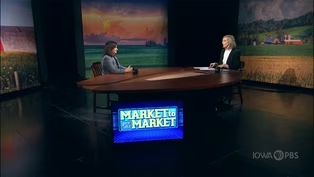
Clip: S49 Ep4929 | 9m 49s | Elaine Kub discusses the commodity markets in a special web-only feature. (9m 49s)
Providing Support for PBS.org
Learn Moreabout PBS online sponsorship
- News and Public Affairs

Top journalists deliver compelling original analysis of the hour's headlines.

- News and Public Affairs

FRONTLINE is investigative journalism that questions, explains and changes our world.












Support for PBS provided by:
Market to Market is a local public television program presented by Iowa PBS