
Market to Market - March 29, 2024
Season 49 Episode 4933 | 26m 45sVideo has Closed Captions
Commodity market analysis with Jeff French, Sean O’Leary and Don Roose.
The government provides guidance in two major reports. We look at the course set for 2024 in grains. And, commodity market analysis with Jeff French, Sean O’Leary and Don Roose.
Problems playing video? | Closed Captioning Feedback
Problems playing video? | Closed Captioning Feedback
Market to Market is a local public television program presented by Iowa PBS
Market to Market - March 29, 2024
Season 49 Episode 4933 | 26m 45sVideo has Closed Captions
The government provides guidance in two major reports. We look at the course set for 2024 in grains. And, commodity market analysis with Jeff French, Sean O’Leary and Don Roose.
Problems playing video? | Closed Captioning Feedback
How to Watch Market to Market
Market to Market is available to stream on pbs.org and the free PBS App, available on iPhone, Apple TV, Android TV, Android smartphones, Amazon Fire TV, Amazon Fire Tablet, Roku, Samsung Smart TV, and Vizio.
Providing Support for PBS.org
Learn Moreabout PBS online sponsorshipComing up on Market to Market, the government provides guidance in two major reports.
We look at the course set for 2024 in grains.
Panel analysis from Jeff French, Sean O'Leary and Don Roose, next.
What's next, doesn't happen by chance.
It happens when researchers and farmers work together to solve tomorrow's agronomic challenges.
We're committed to creating what's next because at Pioneer.
Our name is our mission.
Tomorrow, for over 100 years, we've worked to help our customers be ready for tomorrow.
Trust in tomorrow.
Information is available from a Grinnell Mutual agent today.
This is the Friday, March 29th edition of Market to Market, The weekly Journal of Rural America.
Hello, I'm Paul Yeager.
USDA issued two reports on Thursday with the goal of giving traders and farmers guidance on expectations of planted acres in quarterly stocks.
It is not the last word on what could happen in 2024, but as one of our market analysts likes to say, it is the word of govt ..
The report are three of our analysts.
We'll get to those three in just a moment.
But first, USDA said less corn will be planted and there is still a large supply of grain on the farm.
First the numbers for a shortened trading week.
The nearby wheat contract added $0.06 and the May corn contract gained $0.03.
Some of those new acres will be switching to soybeans.
The maize soybean contract lost a penny, while May meal dropped a dollar 40 per ton.
May cotton shrank by $0.15 per 100 weight.
Over in the dairy parlor, April, Class three, milk futures fel..
The livestock market was mixed.
June cattle cut 2.65.
May feeders shed 5.08.
And the April lean hog contract improved 2.05.
In the currency markets, the U.S. dollar index strengthened seven ticks.
May crude oil added to 2.25 per barrel.
COMEX gold expanded 56.20 per ounce.
And the Goldman Sachs Commodity Index increased almost eight points to settle at 582 even.
Our panelists here on this early taping of the program, we are going to dissect the crop production and the supply and demand reports.
Jeff French is the founder of AG Hedgers.
Don Roose is the CEO of U.S. Commodities inc. And Sean O'Leary is president of Hawkeye Commodity Brokers.
Gentlemen, thank you for joining us.
Appreciate it.
Thank you.
Thanks, Paul.
Don, you get the first question.
What's your headline from Thursday's report?
Well, I think in the big picture things you say, the big bear market that we had since last f.. and the deflation of the prices is also on hold.
And looking forward, it's all up to weather now and the price action that we had on Friday proved that out.
Paul.
Jeff, do you think it is a turn of the page or just a blip on Thursday?
Well, if you look at the corn market, it's a turn of the page, technically.
I mean, we closed above the 50 day moving average for the first time since October 22nd.
So, you know, I said it last time on the show.
These fund managers short 250,000 contracts.
I think they're going to be a little bit more uncomfortable over the weekend with that big technical gain in corn.
Sean, do you have a different headline for the report?
I I'd say no.
I think I think Don has a good point that we've been .. prior to these last few weeks and takes quite a bit for that scenario to change.
I think I think a producer's got to be in the mindset of being kind of a scale up seller, either on on paper cash.
Well, let's stick with corn then in that market, because I guess my argument before we started taping was didn't the stock numbers say that there's so much corn still left on farm that was not bearish enough to outweigh the bullish acres?
Yeah, I mean that had more more than one bullish story to it today.
And you know, that's because net change higher than we've had in several months and a sizable range on the day.
Don, do you get the sense that this will be enough to pry those bin doors open?
Well, let's look at you talk about the stocks numbers.
As of March 1st, the farmers still had 5 billion bushels.
60% of the corn in storage.
Of the 8.3 billion.
So I think the farmers out here on hold looking for a place to sell grain.
Obviously, nobody wants to own two crops when they hit the 1st of September.
So, you know, I think it's a market.
We've got a key reversal in the corn market.
Paul from back in February, the technicals are positive.
The funds are short.
You're going into a weather next week here.
It's going to come at us very fast.
And we have the Shafrina corn crop that we're watching..
So, no, typically we add risk premium to a market go.. And I my I suspect that's what we're doing.
How long does that risk premium last?
Well, you know, I think it goes it's like a card game.
I always say this business, you know, we'll see how the cards come out.
We'll see what the weather looks like.
But typically, I'd say into the middle of May, because there's still a lot of nervousness there.
But the producer, I think, has a lot to say about it.
When does he start to put grain in the pipeline?
Jeff, are you putting grain in the pipeline yet?
I think there was some I mean, we're $0.40 off the contract lows.
You look at the volume on Thursday, they traded over 330,000 contracts in corn in the May contract alone.
I mean, that's three times the normal volume that we've seen in the last month.
So absolutely, I think the funds were buying back some of their core some of their short positions.
But also, I feel that many calls that producers with, you know, a 0.50, 0.60 cent positive basis were selling $5 cash, corn.
You can't stop it from that.
Sean That's the old crop story.
Talk to me about the new crop story.
Did that change anything for you in Thursday's report?
I don't think so.
The nearby contracts gained a little more th..
I think that's a that's a positive for the old crop.
But I just.
I just think we're kind of entrenched pricewise, minus the this recent rally in a pretty bearish looking market.
And I think, as I said, producers I think would be wise to be scale up sellers.
$5 corn seems like a long time ago.
Did the phone ring end today with people thinking that it was time to move?
A little bit, yeah.
You know.
Should it be ringing louder?
I think I think you have to treat it as a, you know, a second chance at a previously mis.. Jeff, you did a little math.
Back of the napkin math I saw on X about where the acres are disappearing from in corn.
Where where do you see them?
Well, the beans are going to gain some.
But if you look at the aggregate of all principal crops compared to last year, we're down 6.3 million acres.
So, you know, I would my opinion would be that, you know, if we do have a dry spring and the planters can continue to roll, you know, you could see some corn acres increase.
I mean, if you look at the I states, Indiana, Iowa, Illinois, they're down 950,000 acres of corn.
Minnesota's down 700,000 acres of corn estimated.
So I think Mother Nature will dictate it.
But you could see maybe some more corn acres here this spring .. Do you buy that, Don?
Well, you know, I think when you look at it, where did all the corn acres, where did all the acres go?
And I think, you know, we lost about, what, 4.9 million acres, 1 million those we know went to CRP acres and the rest of them, the fringe.
What Texas, Kansas, were each down 5% on acres.
But remember, last year we you know what we had started out at 92 million .. We ended up at 94.6.
So last two years, you know, these acres are going to change, change a lot.
I guess that's what the market is trying to .. See if we can buy some corn acres.
Let's go fringe acres for a bit, Sean, let's go back to the wheat market for a bit.
Did we see the fringe areas, Oklahoma, Kansas, Texas, change any of their intentions with corn or wheat?
I think when you're talking about those areas and going back to what Jeff said about the I-states, you can't write it off, obviously.
But those aren't those aren't the the prime states where you're going to really see a difference in production.
What do you see for wheat producers that came as positive news or was it negative news for them?
I think that was pretty quiet for for the wheat market today.
No surprises for you there.
No.
I mean, I just think that the crop conditions I mean, they're much better than we've had here recently.
So I think that's generally good.
I mean, they're going to have a pretty good going crop right now.
You know, you're talking about the wheat acres as soft red winter wheat acres were down like 600,000 acres.
Hard red winter wheat was up like 300,000 acres.
So, you know, there's some movement around on the wheat acres and overall wheat acres are down, but soft red wheat balance table probably tightens up.
If I had to guess.
But let's look at the global picture, because Russia again large crop and you have war issues Ukraine that there's this continued global story.
So is there any does the U.S. wheat farmer need to just turn off the global news with their crop and just focus on domestic news?
Well, it's all it's all about Russia and their selling ability.
And remember, you know, we went to $13 wheat on the big Black..
So, you know, when you're down at this area, $5.50, $6 on s.. you know, you have to respect that.
What could happen in wheat market really follow the corn higher today.
So, you know, there's going to be issues around the world.
I mean, the Black Sea has some dryness right now and, you know, we've got a long way to go with our crop to pull.
Anything else on wheat.
I kind of put you in a corner.
I painted you earlier.
Sorry.
I don't I don't have a lot of wheat.
That's fine.
Customers.
Well, then let's start with soybeans, then.
What did you see out of the report today that was of interest to a soybean producer.
You know, pretty, pretty quiet.
All the numbers on beans, unlike corn, were kind of in the neighborhood.
And you saw that, you know, just down a few .. and in price wise, we're about where we were a week and a half .. go on on the being market.
So, you know, I think that's kind of mirrors what the corn market has done the past half years, though, been pretty weak.
Well, I have a question.
Let's see.
I'll let Don answer this one.
This one comes from Adam in Michigan.
He submitted it via X and he says, With the potential to increase soybean, you got to figure out where I'm at here.
This is really small.
Forgive me, with potential to increase soybean crush in t.. over the next decade, how long before corn acres might be pushed?
Also, will the dry subsoil indicators across the Midwest lead for an optimistic outlook for a spring rally in the new crop commodities?
Handle the first one about this crush story and how is that being factored in by the government like in reports today.
Well, I think what he's alluding to is we've got a lot of crushed plans coming on board for the biodiesel plants that are expanding greatly.
And, you know, the government's crushed numbers, probably about 30 million too low the exports, probably 30 million too high.
So called a zero sum ballgame.
But, you know, I think that's a great growth area, actually, Paul.
And I mean, biodiesel, I think is going to go just like .. We're running a huge percentage of our demand is from corn ethanol and I think that's where soybean oil goes.
Also, bottom line, I think for the soybeans watch the oil.
Oil is going to tell you if beans are worth $13 or $11.
Jeff, I take the second part of that question and let's talk weather.
It rained in the Midwest this week, that's headlines.
It was winter blizzards, Minnesota and the Dakotas.
Is that enough of a story to move markets?
Well, I think the bean market, the biggest story this week was agro consult down in Brazil raised their crop estimate down there.
They're up to 155 million metric tons.
They increased that size by 150 million bushels.
So they have a good crop coming on right now.
They're 70% harvested.
It's moving south down in Argentina.
If you combine all the countries, South America down there, I mean, we're looking at probably 215 million metric tons of beans.
I mean, you're talking almost 8 million bushels.
So we're quickly increasing the pipeline on the bean supply.
Who's buying the beans, though, outside of this country?
Do we know yet, Sean, who's interested in our beans?
I mean, do we have a good enough market to prop up to catch up to the export expectation?
I think that's going to be the battle for for our bean market with the competitiveness or lack thereof with South American prices in their numbers.
Do you see a day where we're back into the teens at all in beans and 24.
Weather is going to dictate that.
I think I talked to somebody about corn today and I just said, you know, $5 corn seemed like a long time ago.
And and I think that that's going to be the case for both of those markets.
Absent a real weather hiccup.
I'll put you out there to beans in the teens that are possible at all this year.
Well, I think, Paul, when you look at this, I think the whole world is kind of changed.
I mean, our production, our input costs are much different than they've been.
So your break evens at some place in time.
You know, you're going to look at what is your break even and other countries are just not going to be able to produce at the same level.
So hopefully that's where we go eventually.
You know, you talk about Agra Consult, One of the reasons that their production was so much higher on soybeans is because they took their acres up, 3 million versus Conab.
You know, is that really possible in one report?
So, you know, it's but anyway, I think, you know, this expansion around the world is going to come down to what's the profitability.
The story always with with beans and South America specifically is the extremes of the tales that we get.
Oh, whoa, It's so bad.
Oh Glee, It's so good.
Where's the middle right now with South Americans crop you just mentioned, there's discrepancies among people whose livelihoods are reporting this thing.
Well, not only livelihoods.
We've got the USDA and the CONAB, which is their USDA.
They're off.
The difference between those two is about 370 m..
So you know who comes closer.
So, you know, I think you have to get that discrepancy solved by the government first before the rest of us can solve it.
Because let's face it, everybody has good analysis.
But you always look at the governments to see what they have.
Jeff's had almost pop off when he was agreeing with you, right?
Yeah, I mean, it's the discrepancy between USDA and CONAB is bigger than our carry out.
So it's it's a big disagreement between the two governments.
Any what do you look for in South America?
I guess I get their opinions about what's yours.
I you know, I typically look at USDA being a government entity, not always that efficient.
I think some of the private forecasters are a little bit more accurate, both in South America and our our own hemisphere.
Do you see the possibility that that is what is going to provide us?
Is there continues to be a discrepancy, a wider trading range, or is that going to make us more in a narrow trading range?
Because of the inconsistent?
I would say it would add to the volatility, pro.. Yeah.
There's you know, any time there's uncertaint.. typically you're going to see a bullish reaction.
And even though that's a wide discrepancy and total numbers, it could actually be a positive for the market.
Did cotton gain at all in this report.
On the acres?
Yeah, They were In general.
I mean, as a as a general statement is.
There acres were about the same they were.
But is that going.
Up like for 440,000 acres.
I Should say?
Is that a positive for cotton Because they didn't lose acres is probably what I said.
Well, the old cotton is a lot higher compared to the you where they thought they would have.
I mean, people thought the acres were going to go up a million plus on cotton.
It didn't happen.
I think it's just an expensive crop to plant.
So I think they're just like, okay, is the price going to stay here.
And labor intensive?
I mean, you got to spray that crop nine, ten..
So the rally's been in the front month.
December has done nothing.
It's between 81 and $0.83 during this entire rally.
So we're just not seeing it.
You know, there's some guys that calling for 12 million acres.
We'll have to see how this plays out.
As we put a close on grains.
Is there any story that you think we missed?
No, we got it.
We get it, we nail it.
What do you have, Jeff?
You know, the on farm storage, we still have 24% more grain in the bins than we did this time last year.
I think that story will continue to dampen rallies or, you know, slow them down.
At least.
You.
Well, you know, the only thing I had is, you know, the bear market is on hold.
You know, this report gave it a breather.
We'll see if it can turn into anything bullish.
Do you get concerned about the long I mean, we're not trading Friday.
We have these issues where sometimes people start talking and things change on Monday.
Right.
That's that's a possibility.
I think in the case of corn, you see a rally like today and you've got to go back to that large net short position that doesn't all get flipped over in one day.
I think you're going to see some follow through buying on short covering at a minimum.
But I'm telling my producers, you know, be a scale up sell or for the time being, the last year you had an opportunity early and it was brief.
And that and that that has kind of been the story a lot lately has been this this brief window, Don.
This week, HPAI shows up in dairy cattle in a couple of states.
What is that going -- does that have any reverberations in the live cattle market or the feeder market?
Well, you know, when you look at it, I mean, the cattle industry just can't get back past the black swans.
It seems like every time we've got this bull story, we get hit again.
But, you know, basically, I think we'll have to see what happens.
I mean, so far, what does it do?
It throws the dairy calf cattle off of feed.
It makes them dry up.
Does that push it over further into the north, into the cow herd?
That's a concern.
But the real concern is with the publicity, 24 hour news cycle, does it slow demand down.
Cattle brake, $10, milk stays steady, I mean.
Well, yeah, I mean, that to.
That#s was I was looking at I mean, it's just big business right now in the cattle business.
I mean, you got to have downside protection.
I mean, plain and simple.
We had on Tuesday futures were we're still trying to find the market.
It's been a futures cash story.
The futures finally make some headway and becoming a little more attractive to people.
Well, we sold on record cash cattle prices la.. 190, 194.
And ever since that, we've gone straight down.
I mean, we're down $10 now.
We come back here off the lows a little bit here Thursday to close out, but close below the 20 and 50 day moving average funds long probably still 50,000 contracts.
And you know, the funds don't care about fundamentals.
They care about technicals and money flow.
So we'll see if it holds in their 100 day moving average held this week.
That was good to see.
But again, it just we're still within seven $8 of the highs.
A good time to be putting some protection here.
Are we pausing before a rally higher back in live cattle?
I think it'll have fairly good support on dips.
It's definitely got the volatility both on the up and on the downside.
Recently I've got a customer that called me last week and said, give me a quote on I think it was in August, feeder cattle, $300 call and he sold it for $1.75.
I thought I heard the number and I thought I just doesn't even sound right.
But there there it was.
What do you think when you hear a story like that?
Well, you know, I think the cattle industry, I think everybody knows, is bullish.
I mean, actually, realistically, if you figure it out, it's going to take almost four years to start to rebuild the herd.
So I don't think it's about the supply side.
I think it's about the demand.
What's the economy look like as we go forward?
What's the demand?
When you look at pork prices, poultry prices.. A guy you know well, Mark Gold was in that chair last week and he made a statement that he doesn't see beef demand slowing.
He says his steak restaurants are still full.
I think you've said something similar, but then online, we had a couple of arguments back and forth to to his comment that they don't buy that.
Is it, again, a view, a mixed view of who's up and who's down in the economy when it comes?
Well, I mean, domestic demand has been great.
And I totally agree that the if this market does move lower, it's it's not going to come from the supply side of the argument.
It will come from the demand or the headline risks that we've seen out here.
And we saw it here this week.
So, you know, again, very tight numbers.
We have all time high prices out here.
How long we stay here, That's the big question.
And, you know, nobody knows the answer to that.
Anything different in feeders that you see?
Well, the only the only thing I would bring up is what what see with the S&P, there's I think some fear that if you see a break in that market, that might be a time when you see a break in the demand sid.. And I guess I go back to what Don said about headline numbers.
When you see a 100 point loss and in one of those markets, you think it's a big deal, but it's since we're trading so high, it's not that big of a deal anymore.
So the headlines that they get fed into the algorithms kind of change things.
But you know, the only other thing I'd say about when you'r.. about the cattle business in January, Brazil's imports exports to the U.S. were up almost 50%.
So, I mean, price around the world will change things also.
So you got to watch everything.
Pigs report hogs and pigs here came out on Thursday before we taped what was in that report.
Sean.
I think all hogs and pigs was up 2%.
I don't really recall what they were looking for.
So what does that report tell you then?
Look pretty tame, I think all the estimates were we're kind of in line.
No, no big surprises, really.
You know, I think we know we were on a pretty big rally in the hog mar.. And I think the summer months are positive.
But all hogs and pigs, you know, we're up 1% versus what the trade estimate.
You know, we're you know, the pigs per litter.
It's amazingly just continue to be they compensate for the breeding numbers.
So overall, I think the hog market, the bull story I think in the hogs is down in 2025 because we've had this liquidation that's eventually comes home to be a positive, Paul.
Agree with that one?
Summer months and plateau plateaued up here.
We've got to above 100 a couple of weeks ago, traded quickly up to 104, 105.
And it kind of feels like we've hit a kind of a little bit of a ceiling up here, friendly hogs moving forward here.
But when you look at some of the margins that you can lock in as a producer in this June, July contract, can't help but get some locked in up here.
Do you feel more positive about the cattle or the hog industry right now?
In the next I'll give you six months.
I'll say the hog right now.
I mean, just from from the numbers standpoint, the second quarter on the cattle side, we will be dealing with the most animals of the year and now the numbers do get tighter down the road.
But I think we've seen the liquidation, the hogs, I think they're going to be supported here.
I'll still make you stick it to.
Do you feel more optimistic about hogs or cattle here in the next 6 months?
I think I do a little more optimistic on the ..
I think it looks a little bit more attractive.
The cattle, you know, it's one of those things where everybody talks about the same thing and it doesn't always pan .. Have you been watching the show a lot?
Sean O'Leary, everybody, thank you very much, Sean, and thank you, Don Roose.
Thank you, Jeff French.
Good to see you all.
And we are going to pause this analysis and continue our discussion about these markets in our Market Plus segment, you can find both analysis and plus on our website of market to market dot org.
We are so close to our goal of 10,000 YouTube subscribers.
Help us cross that threshold as you can stay current on new releases from us and episodes, the MTOM Podcast and news stories.
Hit Subscribe at YouTube.com/Market to Market.
Next week we look at the battle with feral hogs and Kristi Van Ahn Kjeseth joins us to share her views of the markets.
Thank you so much for watching.
Have a great week.
Market to market is a production of Iowa PBS, which is solely responsible for its content.
What's next doesn't happen by chance.
It happens when researchers and farmers work together to solve tomorrow's agronomic challenges.
We're committed to creating what's next.
Because at Pioneer, our name is our mission.
Tomorrow, for over 100 years, we've worked to help our customers be ready for tomorrow.
Trust in tomorrow.
Information is available from a Grinnell Mutual agent today.
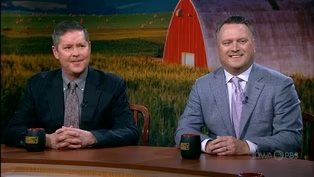
Market Plus with Sean O'Leary, Jeff French and Don Roose
Video has Closed Captions
Clip: S49 Ep4933 | 11m 44s | Market analysis with Jeff French, Sean O’Leary and Don Roose. (11m 44s)
Providing Support for PBS.org
Learn Moreabout PBS online sponsorship
- News and Public Affairs

Top journalists deliver compelling original analysis of the hour's headlines.

- News and Public Affairs

FRONTLINE is investigative journalism that questions, explains and changes our world.












Support for PBS provided by:
Market to Market is a local public television program presented by Iowa PBS