
Market to Market - May 22, 2026
Season 51 Episode 5140 | 26m 49sVideo has Closed Captions
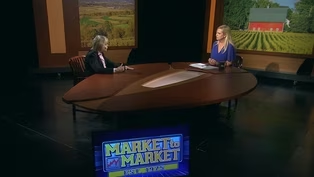
Commodity market analysis with Sue Martin.
On this edition of Market to Market ... The White House adds detail to the new trade deal, while China dodges the details. The drought continues to hammer the south and west. We’ll look at the ticking clock facing the dairy industry. And, commodity market analysis with Sue Martin.
Problems playing video? | Closed Captioning Feedback
Problems playing video? | Closed Captioning Feedback
Market to Market is a local public television program presented by Iowa PBS
Market to Market - May 22, 2026
Season 51 Episode 5140 | 26m 49sVideo has Closed Captions
On this edition of Market to Market ... The White House adds detail to the new trade deal, while China dodges the details. The drought continues to hammer the south and west. We’ll look at the ticking clock facing the dairy industry. And, commodity market analysis with Sue Martin.
Problems playing video? | Closed Captioning Feedback
Where to Watch Market to Market
Market to Market is available to stream on pbs.org and the PBS app.
Providing Support for PBS.org
Learn Moreabout PBS online sponsorship[Brooke Kohlsdorf] Coming up on Market to Market.
The White House adds details to the new trade deal.
While China dodges the details.
The drought continues to hammer the south and west.
We'll look at the ticking clock facing the dairy industry and commodity market analysis.
With Sue Martin next.
♪♪ [Announcer] I wouldn't be here without my customers.
Yeah, I'd like to thank the customers.
They're very dear to our hearts.
It's about the people that you're working with and the relationships that you have.
Thank you.
Thank you.
Thank you.
Thank you from the bottom of my heart.
♪♪ [Announcer] Tomorrow.
For over 100 years, we've worked to help our customers be ready for tomorrow.
Trust in tomorrow.
Information is available from a Grinnell Mutual agent today.
[Announcer] Support for Market to Market has been provided by a bequest from Philip Lietz of Alta, Iowa, in recognition of public television's commitment to agricultural programming.
[Announcer] Market to Market is made possible in part by a grant from the Corporation for Public Broadcasting.
[Announcer] This is the Friday, May 22nd edition of Market to Market, the Weekly Journal of Rural America.
[Kohlsdorf] Hello, I'm Brooke Kohlsdorf.
Paul Yeager is away this week.
President Trump swore in new Federal Reserve Chair Kevin Warsh this week, replacing Jerome Powell.
Trump is expecting Warsh to make interest rate cuts, but that remains to be seen.
Minutes of the last FOMC meeting show the committee has a wait and see attitude on any changes.
The report revealed the governors might raise rates if inflation stays above 2%.
Single family home building in April plunged 9% from its March reading.
Higher interest rates continue to plague the industry, putting a new home out of reach for many potential buyers.
Creighton's Rural Mainstreet index fell below growth, neutral for the fourth straight month of the bank.
CEOs surveyed more than half reported lower grain prices put the most pressure on the index.
They also said financial conditions for farmers and ranchers have deteriorated compared to a year ago.
President Trump came home from China saying he had a deal for Boeing.
Beans and beef.
The Chinese have confirmed they will buy airplanes, but there is a distinct lack of detail for the agricultural portion of the agreement.
Laurel Bower has more.
[Narrator] The White House announced this week that President Trump has secured historic trade deals with China after his visit last week with President Xi.
The administration claims China has agreed to increase its imports of U.S.
Agricultural products to at least $17 billion annually through 2028.
Chinese officials have yet to confirm which products would be purchased, but did recognize there is a deal, according to the White House officials.
With the world's second largest economy restored market access to 400 U.S.
Beef processors by renewing expired registrations and added some additional facilities to the list of approved providers.
China also resumed imports of U.S.
poultry.
After the USDA certified those products as free of avian influenza.
The summit reaffirmed purchases of soybeans already confirmed after Trump and XI struck a truce last fall.
In the current trade war.
But no additional purchases have been verified.
In addition, both countries have agreed to establish a Board of Trade to manage Commerce and non-sensitive sectors for Market to Market.
I'm Laurel Bower.
[Kohlsdorf] Record temperatures continue to be set as we see more violent swings in the weather.
Those high temps have made for dry conditions which have increased the number of wildfires.
Recent rains across the country did help recharge the soil, but a persistent drought continues to increase.
Peter Tubbs has a look at what might be next.
[Narrator] This week, the East Coast received an early blast of summer with highs in Philadelphia reaching into the 90s, with the heat wave expected to continue through the weekend.
[Lauren Authur] Today is extremely hot.
It honestly got hot sooner than we expected it to be.
[Narrator] Across the nation, widespread drought worsened.
Scattered rains in Texas lessened the drought slightly, but most of the state expanded its drought severity, leaving the area in exceptionally dry conditions.
Portions of the Corn Belt received 2 to 5in of rain, while nearby areas remain dry with widespread precipitation deficits of over an inch.
Broad portions of the wheat belt remain in extreme or exceptional drought conditions.
Forecasters also believe that the upcoming hurricane season will see fewer named storms than average due to a developing strong El Nino.
Nine of the last ten hurricane seasons have been graded as above average.
Strong El Nino formations push dry air into the Caribbean, making the formation of strong storms more difficult for Market to Market.
I'm Peter Tubbs.
[Kohlsdorf] Like any farming operation, the formula for successful dairy production involves more than just bringing animals into the barn twice a day.
One element involves cows being in the herd for 4 to 6 years and keeping female calves for future milk production.
However, the equation has changed as high prices are being offered for those offspring.
While there is a payoff now, there may be consequences later.
Colleen Bradford Krantz has more in our cover story.
[Narrator] In January, the nation's dairy farmers reported keeping 18% fewer heifers to serve as future milk cows than they did eight years earlier.
The downward trend has been consistent over that entire time period.
[Corey Geiger] This is a dynamic situation taking place in dairy farms.
That collective U.S.
Dairy industry replacement heifers all dairy heifers are at the lowest level since 1978.
So, we swung the pendulum a little too far, making beef on dairy calves.
[Narrator] Beef on dairy refers to when producers breed dairy cows to Angus or other beef bulls.
Those calves are then raised for beef instead of future milk production.
The strategy has become increasingly popular as beef prices surged in 2023, fueled in part by the smallest national beef herd since 1961.
[Corey Geiger] As beef prices started going up.
Dairy heifers are actually more valuable in feedlots than they were in dairy barns, because it was costing about 2000 a head to raise them.
So that's kind of when the beef on dairy movement began this past year.
National Association of Animal Breeders reported that there were 9.8 million units of beef bull semen sold in the U.S.
In.
Almost 80% of that was sold to dairy farmers.
So, there are a lot of these beef on dairy calves, and their prices are getting higher and higher.
[Narrator] But even with fewer dairy replacement heifers, the U.S.
Dairy herd overall has grown, increasing by 212,000 head from a year ago.
[Corey Geiger] The dairy cow herd is actually at the highest inventory here in over 30 years, at 9.6 million units.
If I'm talking to Dairy farm audiences, I'll say in some cases, the cows uterus has more value than the cow herself because of the value of the black calf.
The only way to grow the dairy herd is to retain dairy cows.
So, we pulled back on dairy cow culling.
What does that mean in U.S.
Dairy farms?
Our cows are getting older.
[Narrator] At Hansen's Dairy in Hudson, Iowa, the Hansen family has been breeding a small percentage of their dairy cows to beef bulls for more than a decade.
One of the owners, Blake Hansen, says while most of Hansen's dairies beef cross calves are processed, with the meat being sold directly to consumers, he has seen prices climb for others who sell at livestock auctions or to packing plants.
[Blake Hansen] Bull calves are incredibly high Holstein bull calves, that is.
And then, of course, the calves are even higher.
Yet it's the best thing that's ever happened to the beef farmers and dairy industry.
As far as I'm concerned.
We've been waiting for a long time for this price increase because there's been many years they haven't been making much money at what they do.
[Narrator] Hansen believes the trend could eventually tighten milk supplies and lift milk prices.
[Blake Hansen] That's going to limit the supply of heifers in general, and then that's also going to limit the supply of milk down the road, because farmers aren't going to have the supply of heifers to replace their cow herd.
For now, the price of milk is somewhat low, but I think by the end of the year or end of in the 2027, we're going to have some really high milk prices because the shortage of heifers.
[Narrator] Geiger, who believes USDA's replacement heifer data underrepresents the shortage, says the shrinking pipeline of future milk cows is likely to continue unless beef prices weaken or dairies begin running very short on replacements.
[Corey Geiger] This year, we're going to have 438,000 fewer dairy replacements becoming milk cows compared to last year, and this won't rebound until 2027, when we see an improvement of 285,000.
[Narrator] The shortage is already driving replacement heifer prices sharply higher.
Some say that could eventually force some dairy producers to step back a bit from beef on dairy.
[Corey Geiger] We have to change a little bit how we're caring for dairy cows as the herd gets older.
Eventually we have to pay the piper.
In this instance, they're going to we're going to have to call these older cows.
And that's why we dairy farmers really need to take a look at their replacement inventories.
In 20 15, 16 replacements were at $14,500.
It was easy to go.
It was cheaper to buy them than to raise them.
Well.
Now that price in October went up to a record 3100 .
those are steep, steep prices.
[Narrator] This early May auction.
And with the Wisconsin saw some dairy heifers selling for over $4,000 apiece.
[Narrator] Some dairies are already responding by spending a bit more on preselected genetics to have female calves.
[Julie Bacon] It's really kind of surprising because milk prices are so low, but we're still seeing record high prices for heifers, especially like the ones ready to go right into the milk line.
And personally, we're our farm is expanding and we are breeding more to using sex semen to try to get more heifer calves.
But you're still sacrificing because you could be selling that beef calf as an opportunity cost.
There.
[Narrator] The question remaining for producers is how long that window stays open.
[Corey Geiger] The first indicator it may be over is when the cattle ranchers start retaining heifers.
So, I think make hay when the sun is shining is a lot of farmers will talk about.
And this beef on dairy run is the time the sun is shining and it's time to make some hay on it.
[Narrator] For Market to Market.
I'm Colleen Bradford Krantz.
[Announcer] Next, the Market to Market report.
[Kohlsdorf] The market has been suffering from trade deal anxiety.
The White House says yes there is a deal.
But China's failure to provide any details is weighing on the trade for the week ending May 22nd, the nearby wheat contract added $0.11 and the July corn contract went $0.08 higher.
Good weather and uncertainty over China was coupled with the continued potential for a flare up in Iran.
The July soybean contract rose $0.20, while July meal declined $2.40 per ton.
July cotton weakened by $2.99 per hundredweight.
June Class three milk futures contracted $0.47.
The livestock market was down August cattle cut $8.55.
August feeders shed $11.27.
And the July Lean Hog contract fell $2.95.
In the currency markets, the U.S.
Dollar index was even.
July.
Crude oil dropped $4.76 per barrel.
Comex gold declined $44.30 per ounce, and the Goldman Sachs Commodity Index was lower by more than 14 points to settle at 736 20.
And here now, to lend us her insight on these and other trends, is our senior market analyst, Sue Martin.
Hi, Sue.
[Sue Martin] Hi there.
[Kohlsdorf] Yeah.
Thanks for being with us.
So again, no shortage of headlines this week.
We've got a lot of things to talk about.
So of course, the trade deal with China, President Trump's trip there last week and then the war in Iran and a possible deal with them.
Are those the two headlines that have weighed on the markets and the wheat market in particular, as we begin with wheat?
[Martin] I think with wheat, it's been those along with the weather.
And of course, there's been some rains that have come through hard red winter wheat areas, but not enough to really take care of the situation.
The wheat is far enough along heading towards harvest yields that I've heard so far out of Oklahoma have actually come in a little bit.
Well, very disappointing.
And of course, higher in protein, which is a sign of poorer quality wheat.
But then it's the soft red wheat that is enduring with too much rain, or will be, if we continue to see it continue.
And that's not good either.
You know, it could give us Fusarium and some concerns.
And so, I think that when I look at the wheat market, we've had a good rally on the hot, dry weather that we've had and the conditions.
And, you know, the wheat quality tour that went through Kansas.
So, I think if you want to be long, you're already there.
So, the markets seem to like a catch your breath moment.
We're heading towards harvest.
Usually as you get into the latter part of May, all the way into the middle of June, you're into what would seasonally be kind of a downtime just because of harvest pressure starting.
[Kohlsdorf] Okay.
What about corn?
What's pulling the corn market down this week?
[Martin] Well, I think that for corn, you know, it's I believe that in the corn market, the uncertainty of trade, there's been some thought and I'm a big fan of that thought that China has been buying U.S.
Corn.
I believe they've been buying it for seven months.
And, you know, an example, of course, last year's crop for China was not the best.
It was poor quality, horrible drought at to start with.
Then it ended up in floods.
When you're trying to harvest it.
And it was so bad that the government had to help farmers get it out of the fields.
Wheat was under the similar condition.
And then we note that they have a very vibrant hog industry, much to the disdain of the government.
They wanted it to shrink.
And it's maybe shrink a little bit, but not enough.
The conglomerate's expanded while the little guy kind of got out.
And so, they've got plentiful supply of mouths to feed for soymeal.
And so, I think that when you look at the corn market, for seven months, we've had sales announced to unknown destinations up until this past week and a week ago, the sales started to split between old crop and new crop.
Otherwise, all the other sales were, oh, crop sales in corn going to unknown destinations.
Now large sales go to Mexico, Japan and South Korea, but you don't see them tend to use unknown destinations.
An example this week we had export sales on Thursday that showed an unknown destination switch to China on sorghum.
It just shows their character.
They like to be ambiguous, I guess is, so to speak.
They realize that they're like the big elephant in the room.
And if that news was to get out that they're buying corn, which is relatively reasonable in price, I think that they think, oh, we're going to have a problem and the price will go up psychologically and rally and, oh, crop corn.
A year ago, the high was 521 basis of July contract.
We haven't been able to get over four 87.5.
So, the market's got room to rally.
If that news comes out.
One more thing on wheat.
We're finding that the U.S.
Wheat price is higher priced versus global markets, especially out of the EU.
And Ukraine or the Black Sea.
And so, we're seeing Russian wheat and also European Union wheat make it into Mexico if it's priced better for them to send into Mexico.
[Kohlsdorf] So that's not good news for us for wheat.
So back to the corn market.
What's it going to take outside of China continuing to possibly be buying corn to give us a little bit of a rally or to get a boost in the market?
[Martin] Well, it's interesting because we are in a year of a six, and I'm a big believer of patterning in markets and in like ending numbers of a year.
Over time, they tend to have a pattern more times than not.
So, since 1916, 11 years of a six ending in a six, I would say one of them was in May.
That would put the high in for the year for any lead contract.
And that was in the year of 1986.
Then we had a year where we had a high in June 1st year, and that was 2016.
We had three years with the high in July, two years in August, two years in September, and two years in December, which does show a tendency.
Nine out of those 11 years that we do have.
Your traditional fall break.
But and I think we're looking at something like that again now because we're looking for some transparency.
Markets don't like uncertainty or ambiguousness or whatever you want to call it, but I'm wondering because they're talking about $17 billion in ag markets, you know, other than soybeans.
It makes me wonder if China said to them, okay, we'll spend $17 billion for 26, 27, 27, 28 and 28, 29.
And maybe this year it'll be corn and poultry.
Maybe next year it's something else.
But so maybe that is why they're not giving us the particulars that this market really needs to hear.
And I wish they would try to define it better.
China's not going to give us anything as far as news, because then they'd be on the losing side of prices going higher.
So, I think that's my thought or perception.
But on the same token, for corn, we've gone into the crop coming into next week.
On Tuesday, we should see the downhill slide on the planting progress.
We should be pretty much nearing done.
And so that'll be complete.
Then in, I think another week, we start looking at conditions.
And then I think the market's going to say, okay, the crops planted.
Now what.
And I think the focus is going to shift to weather.
[Kohlsdorf] Okay.
Weather.
Well with beans I want to take a social media question because it has to do with what's happening in Iran.
So, Andy in Iowa is asking, could the closing of the Strait of Hormuz put a long-term slowdown on the acreage expansion in Brazil, or is this just a small speed bump?
And acreage will keep growing once the state reopens?
[Martin] I think in Brazil they're already talking that we're going to see acres this year.
Step back.
And of course, Brazil's making some alterations as to where they look to sell beans and what have you as well.
But I think over time they've had a pretty good progression of or expansion of acres.
But with the Strait of Hormuz.
Be it, it opens, let's say it does the price of crude oil and input costs aren't going to go down just this past.
Entity of producing, you know, phosphorus phosphate, urea, whatever inputs.
And they're talking about cutting production by half.
And that's not going to cheapen the price any.
And so, I believe, and we keep hearing this too, around the world, other countries talking about production going down, be it wheat, corn, soybeans.
So, I think we're looking at a situation that because it takes time to get them back up and running and get that fuel back out flowing, I think we're going to still see prices go higher.
And of course, I'm tremendously bullish.
Crude oil, it may take time, but I think next year we're going to see some very high prices in.
[Kohlsdorf] Crude.
Okay.
And I wonder if the grains will follow.
We have to get on to the meats.
There was a cattle on feed report today.
Was there anything in it you had a chance to look at it that stood out to you.
[Martin] Well, it was you know, it was already anticipated to be bearish.
You know, the average trade guess for on feed was actually 101.6.
And it came out at 102.
So just a little over that.
Then the placements number was guessed at 101.6 or excuse me, 104.6.
And it came out at 106.
So that's probably the bearish most bearish part of it.
And then marketings they were expecting Marketings to be around 90.6.
And it came out at 90.
So, it had a bearish tone.
It was expected to be bearish but it even was a little bit more.
[Kohlsdorf] Okay.
Was there anything else that you wanted to talk about with cattle.
They had kind of a it came down a little bit this week, right?
The market did.
[Martin] So we've had just to give you an idea since the 1st of May, which was our highest price in feeder cattle, August feeder cattle.
We have broke over $34 to Friday's low.
In fact, it might have even been in excess of that.
So, we've had a healthy break.
The cash market held around 260, and that's a little disappointing, I think, for the cash market.
Still pretty good.
And so, we encourage producers keep your cattle moving, get them gone.
Don't try to keep adding a lot more weight because this clock is ticking.
Yeah, we feel that the yield fours are showing up pretty abundantly.
And they may be always have been there.
And it's just now getting talked about.
But cattle are weighing heavy.
And now we're seeing heifers coming back to the marketplace on feed because of the fact of too dry in cattle cat cow calf country.
[Kohlsdorf] Yeah, we've been hearing that.
Okay.
Unfortunately, we've run out of time.
We'll talk about some other things in Market Plus though we didn't get to hogs and a lot of other things as well.
So, thank you.
[Martin] Thank you Brooke.
[Kohlsdorf] All right.
You've been watching the analysis portion of our program, and in a moment we will continue our discussion in an online only segment.
You can find it by searching Market Plus with Sue Martin.
Wherever you get your podcast.
You can also go to our website of Markettomarket.org to listen.
If you're working in the field or in the garden, take us along to stay connected.
We have three listening options to add to a walk, a field work, or a run to the co-op.
You can check out the market analysis, Market Plus and M to M podcast wherever you get your podcasts.
All right, next week we look at the battle blueberry growers face after harvest.
Thanks for watching.
♪♪ [Announcer] Market to Market is a production of Iowa PBS, which is solely responsible for its content.
[Announcer] Market to Market is made possible in part by a grant from the Corporation for Public Broadcasting.
[Announcer] Support for Market to Market has been provided by a bequest from Philip Lietz of Alta, Iowa, in recognition of public television's commitment to agricultural programming.
♪♪ [Announcer] I wouldn't be here without my customers.
Yeah, I'd like to thank the customers.
They're very dear to our hearts.
It's about the people that you're working with and the relationships that you have.
Thank you.
Thank you.
Thank you.
Thank you from the bottom of my heart.
♪♪ [Announcer] Tomorrow.
For over 100 years, we've worked to help our customers be ready for tomorrow.
Trust in tomorrow.
Information is available from a Grinnell Mutual agent today.
Video has Closed Captions
Clip: S51 Ep5140 | 10m 42s | Sue Martin discusses corn, soybeans, hogs and cattle on Market Plus. (10m 42s)
Providing Support for PBS.org
Learn Moreabout PBS online sponsorship New Episode
- News and Public Affairs

Top journalists deliver compelling original analysis of the hour's headlines.
 New Episode
- News and Public Affairs

Today's top journalists discuss Washington's current political events and public affairs.


 New Episode
 New Episode
 New Episode
 New Episode
 New Episode

 New Episode
 New Episode
 New Episode
Support for PBS provided by:
Market to Market is a local public television program presented by Iowa PBS