
Market to Market - November 10, 2023
Season 49 Episode 4913 | 26m 45sVideo has Closed Captions
Market analysis with Ted Seifried
What’s being done to minimize the damage from the latest HPAI outbreak, an in-depth discussion on an emerging market for U.S. commodities and market analysis with Ted Seifried.
Problems playing video? | Closed Captioning Feedback
Problems playing video? | Closed Captioning Feedback
Market to Market is a local public television program presented by Iowa PBS
Market to Market - November 10, 2023
Season 49 Episode 4913 | 26m 45sVideo has Closed Captions
What’s being done to minimize the damage from the latest HPAI outbreak, an in-depth discussion on an emerging market for U.S. commodities and market analysis with Ted Seifried.
Problems playing video? | Closed Captioning Feedback
How to Watch Market to Market
Market to Market is available to stream on pbs.org and the free PBS App, available on iPhone, Apple TV, Android TV, Android smartphones, Amazon Fire TV, Amazon Fire Tablet, Roku, Samsung Smart TV, and Vizio.
Providing Support for PBS.org
Learn Moreabout PBS online sponsorshipComing up on to minimize the damage from the latest HPAI outbreak.
# Higher inputs are replaced by another I-word in the I-states # as a cause of economic concern.
And an in-depth discussion # on an emerging market for U.S. commodities.
# And we'll have the commodity market # analysis of Ted Seifried next.
by chance.
It happens when researchers # and farmers work together to solve # tomorrow's agronomic challenges.
We're committed what's next.
Because at pioneer.
# our name is our mission.
Tomorrow, for over 100 years, we 've worked to help our customers be ready for tomorrow.
# Trust in tomorrow.
Information is available # from a Grinnell Mutual agent today.
# This is the Friday, November 10th edition of Market # to Market, the weekly journal of rural America.
# Hello, I'm Paul Yeager.
The National Turkey Federation # estimates 88% of Americans will consume Thanksgiving turkey # this year.
That translates to more than 46 # million birds.
Now, in the key # production areas, HPAI is again breaking out.
# But as David Miller reports, the size of the outbreak # is dramatically different than it was nearly a decade ago.
# In February of last year, high pathogenic # avian influenza returned to U.S. commercial flocks # after a several year hiatus.
Producers in Iowa, # one of the country's top poultry producing states, # have seen new cases in just the last few months.
# Mike Naig is Iowa's secretary of Agriculture.
# I don't think folks thought it was a surprise.
# I think we had done I think we all there was a constant threat.
And and as to the question # about whether or not our producers had been preparing # and whether we had been preparing, # the answer to that is ye outbreak, Iowa recorded 77 individual cases of HPAI, # that impacted nearly 3 million birds.
# Egg prices spiked as the virus rolled over the nation's number # one egg producing state.
Over the # past two years in Iowa, there have only been 41 cases # of avian flu, impacting just over 16 million birds.
# Now, what does that tell you?
That tells you # that farmers understoo Keep what's outside, outside and inside, inside.
# You shore up your buildings, you secure them.
# You think about protocols and the steps that every single day on a farm when you're moving in and out # and around buildings.
USDA helps # make producers whole by paying for a portion of the lost birds, # as well as the costs for cleaning # and disinfecting when the an The Iowa Department of Agriculture provides # for emergency response expenses like P Officials with the USDA say the chance of HPAI # infected poultry entering the food chain is extremely low # and that you cannot get avian flu from birds # that have been properly cooked.
Naig says the turkeys you se the grocery # of a shortage.
This is a constant # threat, as is African swine fever, # as is foot and mouth disease.
That is how we have to think of high path avian influenza.
That's the mindset # that our producers have to have.
That's the level of readiness # that we have to maintain here and at USDA is that # it could happen literally now at any time.
# For market to market, I'm David Miller.
# COVID 19 tangled supply # chains and rising inflation have been push by higher interest rates as the leading economic # sentiment influencer.
The benchmark interest rate # in October of 1981 was 15 and a quarter.
# The last time it was double digits was November of 1985, # and the last time the market was this high was early 2007.
# That cost to borrow money is where the rural economy # is focused for 2024.
As Peter Tubbs reports.
# Agricultural lenders see declines in 2020 for farm # profitability, according to a survey of lender # sentiment released this week.
Profitability is being viewe as likely for three quarters of borrowers in the current farm # year, and lenders believe that two thirds of borrowers # will be profitable in 2024.
The costs of rising interest # rates have become the largest concern for lenders, # replacing input costs, which dominated the balance # sheets of the farming sector.
In 2022.
And 2023.
# Strengthening economic growth in 2021 # and really even through 2022 and now this year # has been pretty good.
Video has Closed Captions
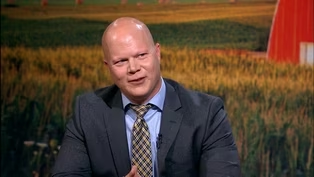
Clip: S49 Ep4913 | 10m 24s | Ted Seifried discusses the commodity markets in a special web-only feature. (10m 24s)
Providing Support for PBS.org
Learn Moreabout PBS online sponsorship
- News and Public Affairs

Top journalists deliver compelling original analysis of the hour's headlines.

- News and Public Affairs

FRONTLINE is investigative journalism that questions, explains and changes our world.












Support for PBS provided by:
Market to Market is a local public television program presented by Iowa PBS