
Martin Baron
Season 11 Episode 4 | 26m 46sVideo has Closed Captions
Former executive editor of the Washington Post Martin Baron discusses his new book.
Longtime journalist and newspaper editor Martin Baron joins Evan to discuss his storied career in journalism and his first book, Collision of Power: Trump, Bezos, and the Washington Post which covers the 2016 Presidential Election and Jeff Bezos’ purchase of the Post.
Problems playing video? | Closed Captioning Feedback
Problems playing video? | Closed Captioning Feedback
Overheard with Evan Smith is a local public television program presented by Austin PBS
Support for Overheard with Evan Smith is provided by: HillCo Partners, Claire & Carl Stuart, Christine & Philip Dial, Eller Group, Diane Land & Steve Adler, and Karey & Chris...
Martin Baron
Season 11 Episode 4 | 26m 46sVideo has Closed Captions
Longtime journalist and newspaper editor Martin Baron joins Evan to discuss his storied career in journalism and his first book, Collision of Power: Trump, Bezos, and the Washington Post which covers the 2016 Presidential Election and Jeff Bezos’ purchase of the Post.
Problems playing video? | Closed Captioning Feedback
How to Watch Overheard with Evan Smith
Overheard with Evan Smith is available to stream on pbs.org and the free PBS App, available on iPhone, Apple TV, Android TV, Android smartphones, Amazon Fire TV, Amazon Fire Tablet, Roku, Samsung Smart TV, and Vizio.
Buy Now
Providing Support for PBS.org
Learn Moreabout PBS online sponsorship- [Announcer] Funding for "Overheard with Evan Smith" is provided in part by Hillco Partners, a Texas government affairs consultancy, Claire and Carl Stuart, and by Christine and Philip Dial.
- I'm Evan Smith.
He's one of the most respected and accomplished newsroom leaders of the modern era.
His first book, "Collision of Power: Trump, Bezos, and The Washington Post" has just been published.
He's Martin Baron.
This is "Overheard."
(audience applauds) A platform and a voice is a powerful thing.
You really turned the conversation around about what leadership should be about.
Are we blowing this?
Are we doing the thing we shouldn't be doing by giving into the attention junkie?
As an industry, we have an obligation to hold ourselves to the same standards that we hold everybody else.
- Two.
- This is "Overheard."
(audience applauds) Marty, welcome.
Good to see you.
- Thanks.
Thanks for having me.
- Congratulations on this book, which I have to tell you, I love.
It's a great book.
One of the best books about journalism that I've read.
- Great.
Thanks very much.
- And I think at a time when people distrust journalism and distrust news organizations as a default, the great thing about this book, among many great things, is that it is transparent.
It shows the process, the inner workings of the business that we've been in, and it gives people something that they can at least better understand, if not necessarily embrace.
And it's not all flattering transparency, right?
- Right, yeah, I wanted to give people a real vivid sense of what it's like to be an editor of a major news organization, to really live through it with me.
And of course, we had a lot of successes, but we also, there are things that we could have done better.
- Right.
- And I wanted people to reflect on that and I wanted to reflect on that as well.
And look, journalists make mistakes, we have flaws.
- Human like everybody else.
- That's because, human beings, exactly.
- Exactly.
Let's do your career first, so we level set.
So you graduate from Lehigh University in 1976.
You immediately leave the paper, go to work for "The Miami Herald."
- Correct.
- You stay at "The Miami Herald" for a couple years.
1979, you go to "The Los Angeles Times," you actually stayed at "The Times" for a long time.
You stayed there for 17 years.
- Yeah, 17 years, right, the longest I've worked at any one news organization.
- At any one place, which I think we forget because we've come to associate you with some of your later jobs, but that's a long period of time to 1996.
You go to "The New York Times."
In 2000, you go to "The Miami Herald" for a brief stint as the top editor.
Within two years you go to "The Boston Globe."
You're at "The Boston Globe" until 2013.
You come to "The Post" in 2013, depart in '21.
I've got that right.
- That's right.
- Right, the overlay of that is that a year in, not even a year in, to your time at "The Washington Post," as the top editor at "The Post," Jeff Bezos buys the paper.
- Correct.
- Total surprise to you.
- Yeah.
I'd say.
- And you had no inkling going into the decision whether to leave "The Globe" for "The Post" that there may be a change in ownership coming.
- No, I had no idea.
And in fact, when I first learned of this, Don Graham, whose family had owned "The Post" for 80 years.
- Right.
- Asked me to come over to his place.
We talked, he apologized for this because he said, "I know that you didn't expect this."
And I said, "Look, I understand, I'm not naive about these things."
- Right.
- "These things happen."
And he said, "No, but I want to apologize.
You didn't expect it."
And I said, "No, that's okay."
And then we went through that a third time and finally he said, "Would you let me apologize?"
- You're being too forgiving.
- It was clearly a surprise.
I mean, the name of the parent company, by the way, was The Washington Post Company.
- Right.
- So who expects the Washington Post Company to be selling "The Washington Post," and certainly not the Graham family.
- Right, so that's a significant event that transpires, number one.
Significant event number two is Donald Trump decides to run for president, and to everybody's surprise, probably including his own.
- Yeah.
- He wins.
And so this book is really the story of two powerful public people.
The new owner of "The Washington Post," Jeff Bezos, the new president, Donald Trump.
He's a candidate for a period of time in the book.
Then he's the president.
And this powerful public institution, "The Washington Post," the convergence, the collision of those three.
- Yeah.
That is the collision.
I mean, here you have this legendary newspaper known for its role in Watergate.
Here you have one of the richest people in the world who buys it.
And then here you have a presidential candidate, unlike any we'd ever seen before, and a president unlike any we'd ever seen before.
- At what point in this time at "The Post" did you think, "There's a book here."
I'm really curious about your own awareness of this as a story that you needed to tell post "Post" and what you did during that time to prepare yourself to be able to write this book.
There are many instances where you say, "In this book, I went back and talked to person X about this thing that happened while I was writing this book.
And they said, Y or Z."
But you also have an extraordinary recall for details that you only could have known because you were taking notes at the time, so.
- Gee, how did you come to that conclusion?
- Yeah.
(audience laughs) - Yeah, you know, I mean, first of all, I think when Bezos acquired it, it was something that I need to keep track of.
Here was one of the richest people in the world who was acquiring us.
Frankly, I didn't even know what was gonna happen with me, because the usual equation is new owner, new editor.
- Right.
- And then a year after he got there, he named a new publisher and the usual equation is new publisher, new editor.
- New publish, new editor.
That's right.
- So really, I mean, what were the odds- - Because really, you reported to the pub?
- That I was gonna stay on?
I reported to the publisher.
- To the publisher.
- The publisher reported to Bezos, so.
- Right.
Certainly no guarantee you would keep your job depending upon who he hired.
- No, in fact, the odds were probably against me.
- High that it wouldn't.
- So yeah, that's just usually what happens.
- So you're taking notes the whole time?
- No, I kept notes here and there on certain things, not the whole time.
It's not like I walked out of every meeting and scribbled everything down.
But when certain consequential things happened, I kept a record of it.
And I kept certain documents and things like that, just because I thought it was historic.
And it was certainly historic when Trump came on the political scene in the summer of 2015.
And you're thinking, "Well, look, I'm a journalist."
I mean, if I don't keep track of this, I wouldn't be a very good journalist to sort of recognize that I'm living in the middle of a really historic moment for "The Washington Post," for the press generally.
- For America.
- And for the country.
- Right.
Indeed.
So let's talk about the Trump part of this.
You know, we have a sense now, looking back over our shoulders, of who this guy is, what this guy has been like, in a general sense, and specifically, as it relates to his views of the press.
He's been very hostile from the very first moment he stepped onto that escalator to descend and tell us that he was planning to run for president.
As a candidate he was hostile, as president he was more hostile.
This book for me was suspicions confirmed.
It was exactly as you saw it from up close as the rest of us saw it from a remove.
- Yeah, I mean, look, Trump was accustomed to really flattering coverage when he was in New York.
- Right.
- You know, as a public figure there, a man about town, a womanizer by his own account.
And he was just accustomed to being treated as a celebrity- - Well, he did two things from what I could see, Marty, and this, again, I have a little bit of knowledge of this from that time, paying attention at that time.
He both got positive stories written and he was able to squash negative stories.
- He did.
- Or to turn negative stories with his relationship with those institutions.
- No question, and there were some notable exceptions to that.
"The Village Voice" was a notable exception, "The New York Times," Tim O'Brien, who questioned his real wealth.
- Right.
- Who got sued by Trump.
- But they were the exceptions.
- So there were some real exceptions to that.
But notable exceptions.
- Right.
- But that's generally what he was accustomed to, was more flattering type of coverage.
When he becomes the candidate, and he very quickly became the leading Republican candidate after he announced and he said that Mexicans are coming across the border.
These are rapists.
- They're sending rapists.
- Maybe some of them are good people.
Then immediately he surged to about a third of support in the Republican party, and there was a large field of Republican candidates.
And so, you know, we had to look at him and look at his life and his career and look at it in depth, and we did that.
- Well in fact, you chronicle in this book that you took the position at the paper, we really need to take this guy seriously, and we need to scrutinize every aspect of his life and of his work in business.
And in fact, I believe, and I'm sure you believe as well, that the reason that Trump found you to be so noxious that he attacked "The Post," that he attacked "Post" reporters, was not because you were not doing your job, but it was because you were doing your job.
- Well, yeah.
Well, thank you for saying that.
Yes, that is true.
- Yeah.
- We were doing our job, and that is our job as journalists.
If somebody's going to move into the White House and become president, which is clearly the most powerful position in the entire world.
- Obligated, yeah.
- Then we in the press have an absolute obligation to take a look at who that person is, to really look at every chapter of his life and his career, and that's what we did.
And we even, we did so much that we decided we're gonna do a book on it, we're even gonna do more on it.
We enlisted another 20 reporters in that effort.
When Trump heard about it, he criticized us.
He criticized Bezos.
- And then cooperated.
- Yeah, he gave us 20 hours of interviews.
I mean, it was incredible.
He was the most, he's incredibly accessible, or had been.
So yeah, he gave us a ton of interviews.
But he also said, if he doesn't like it, he was going to, he might sue us.
And then he was asked whether he was going to read the book and he said that he wasn't going to read the book.
And our reporters asked him, "Well, how will you know whether you like it?"
And he said he had people who do that for him.
- For him, right.
Exactly.
Yeah, again, suspicions confirmed, right?
- Yeah, suspicions confirmed.
Exactly.
- You say at one point in this book, early on, something that seemed obvious to me, but you saying it kind of struck me.
And that is that for a lot of people in the public, when Trump starts to attack the press and "The Post" specifically, for a lot of people in the public, these attacks were long overdue.
You make the point that people actually out in the world reacted in a way where they agreed that, yeah, these attacks on the press are legitimate and the press is really terrible and bad and everything.
I mean, what happened that got us to this place?
- You know, it's interesting because actually at the time of Watergate, we were criticized by the president then.
Richard Nixon, Spiro Agnew, who was his first vice president, talked about the nattering nabobs of negativism.
- Nabobs of negativism.
We remember that, of course.
Right.
- Really bad alliteration, I would say.
- Although, nabob is a great Wordle word now, actually, so.
- Is it?
I gotta remember that.
So, thank you.
But in any event, and Nixon said that it was a political effort on the part of "The Washington Post" to sabotage his presidency.
All that reporting was validated over the long run.
Ratings for the press actually surged, trust was at a real high, and it's been declining ever since.
- Right.
- You know, I've been, I think people tend to gravitate to sources of information that affirm their preexisting points of view.
And that's particularly pronounced, I think now in the internet age, where people can pretty much find anything that affirms their preexisting point of view.
- Right, we live in the United States of confirmation bias.
As much as we may not like it, right, you can go a lifetime without hearing a point of view different from the one you- - Yeah, people are gonna find something that, even if they have the wildest conspiracy theory in the world, they'll find somebody online who says, "That's true."
- The interesting thing about this, one of a couple of different contradictions, is the right attacks "The Post" and journalism generally for being wrong and for attacking them and for having bias.
The left attacks the press for giving too much voice to people like Donald Trump, for airing his rallies, for not adequately fact checking him, for letting the virus out of the test tube as kind of a co-conspirator to Trump's.
You get it from both sides.
- Yeah, we do.
I mean, look, there were, first of all, I think it's very hard to generalize about the media.
It's like generalizing about politicians, generalizing about doctors and lawyers and things like that.
Somehow people feel freer to do that with the media.
That we're all the same.
We're not all the same.
There are a lot of different elements.
But certainly during the 2016 campaign, Fox News, and CNN, by the way, covered his rallies end to end without any contradiction, without any intervention, intermediation of any sort.
And that was a huge problem.
That was hundreds of millions of dollars, if not billions of dollars.
- Free advertising.
- Free advertising for him.
In terms of checking his misleading statements, falsehoods, lies, all of that, we did that very aggressively.
- Well, I remember "The Post" repeatedly, it was like 10,000 lies.
You were tallying them up, counting them up, and you printed sort of every lie at one point, if I remember.
- Yeah, I mean, we had a team of three people on the fact checker, the fact checker team.
I mean, they just couldn't keep up.
I mean, it was so hard.
I mean, in days it would be dozens upon dozens of- - A fire hose of lies.
- Yeah, exactly.
So, but you know, whether that resonated with the American public and certainly whether it resonated with Trump supporters, you know, I would say that it did not, obviously.
Look, he was saying what they wanted him to say, and one of the things they wanted him to say, as you alluded to, was to attack us.
There was a lot of grievance in the country, and I understand why.
A lot of communities in this country are really struggling.
Industries have disappeared.
People are working at jobs making salaries less than they did before.
There aren't opportunities for their kids.
They believe that the so-called elites in Washington and elsewhere, New York and elsewhere, are looking down on them, hold them in contempt, aren't paying attention to them.
And they wanted somebody to go to Washington to just punch us in the nose.
- To give voice to that, which he did.
- And he did give voice to that.
- Now, of course, the irony, the other contradiction that I thought of is, you know, and I think you point this out repeatedly in the book, is the attacks of the press, he calls reporters corrupt, he goes after institutions, and yet, he gives interviews, he's accessible.
He gave more press conferences than, well certainly Joe Biden's access to the press has been limited compared to Trump's, Trump was very available.
And even if he hated you guys, he would take Bob Costas's phone call.
- Oh, sure.
- Or in the case of "The New York Times," he would talk about how bad Maggie Haberman is, and then he would take a call from Maggie Haberman, a total contradiction.
- Yeah.
You know, I mean, he likes attention.
- Yeah.
- And he gets attention.
He wants to go to the big media outlets.
He wants them to validate him.
He also understands the press, I think, a lot better than maybe we understand ourselves.
- He is quite savvy about press.
There's no question.
- He's absolutely savvy.
He's real street savvy about a lot of different things, including about the press.
And so he uses it for his own ends.
- Yeah.
It's remarkable.
So one of the things that occurs to me that he did that is problematic as we look back over it, is he gave permission for people to threaten the press.
Right, I mean, you talk at one point in this book, I think it's after Trump gets elected.
Jeff Bezos comes to the newsroom for a meeting and you all are talking about what's the state of mind of the newsroom?
And you say, "Well, it's kinda like PTSD after covering his campaign."
And you say something to the effect of he was about to turn the middle finger that he was giving the press during the campaign into a fist as president.
And I thought, "Fist is apt."
Because really there was this threat, consistent threat, of violence to the press that he gave a permission slip to over time.
And journalists were targeted.
I mean, there were shootings in newsrooms, there were attacks on, physical attacks on journalists.
That's just an unforgivable state of affairs.
There's no way not to put that on him.
Is there?
- Well, I just, one thing, I have to say the shooting in the newsroom was in Annapolis, Maryland.
That had nothing particularly to do with Trump, but I do think that- - The environment that was created.
- But the environment was clearly one.
- The environment that was created.
- I mean, if you looked at his rallies, he was encouraging violence against protesters, he was encouraging attacks on the press, he would point people out on, when he became president, he would identify journalists by name for the very purpose of subjecting them to verbal threats.
- He was essentially doxxing them.
He was essentially doxxing them.
- Physical harassment, and that's what they suffered.
Physical threats.
And that is a really dangerous thing.
I mean, there was a point came where the publisher of "The New York Times," A. G. Sulzberger, met with Trump in the White House and warned him a about that, that somebody's going to get really hurt.
And what did Trump do?
He doubled down, tripled down, and made it even worse.
- Of course, I think, though, that the greater threat out of this period was the threat to democracy.
The idea that you no longer had facts you could trust, truth that was truth, reality that was reality.
I think about the way Trump and others during this period undermined, intentionally undermined, faith and confidence in institutions beginning with the press, so that when the press held him accountable, he could turn around and say, "See, I told you they were worthless.
That they couldn't tell you the truth."
And effectively the trust in the media, which was not any great shakes before, where we are now is a byproduct of this intentional effort to undermine.
- Yes, he considers it- - Confidence in the news.
- To be one of his great successes.
He's talked about that.
He's said that.
That decline and trust in the press he considers to be one of his great successes.
And keep in mind, I mean, after he got elected, but before he took office, he was interviewed by Leslie Stahl of CBS.
She asked him why he continued to engage in these attacks on the press.
- Pretty much admitted it.
- And he acknowledged, he said exactly that, what you just said, which was that I do this so that when you publish something about me that's critical, people won't believe you.
- Yeah.
One of the things I admire about you, Marty, is that you've been consistent the whole time about what the approach of journalism, and in your case, "The Post" specifically should be.
You said something, I've quoted you, paraphrased you, really, more than quoted you, something to the effect of, "Don't go to war, go to work."
That the job of journalism in a moment like this, where officialdom is attacking you every day, is don't be distracted by it.
Don't, well, fight back is the wrong way to think about it, but don't focus your attention on that.
Do your job.
There's no problem, including this problem, that can't be solved by doing your job.
That continues to be your point of view.
- Yeah, absolutely.
Listen, on Trump's first full day in office, he went to the CIA headquarters and he met with CIA agents.
He was standing in front of a memorial to slain CIA agents.
And what did he say?
"As you know, I'm at war with the media."
Seeming to actually try to enlist CIA agents in that war.
- In that effort, right.
- Because they work for him.
So a couple of weeks after that, I was asked for my reaction and I said, "Well, we're not at war with the administration.
We're at work."
- We're at work.
- And what did I mean by that?
I meant that we gotta, we have to think back to, well, why do we have a free and independent press in this country?
And let's look back to the First Amendment and why that was written.
And James Madison was the principal author of that amendment.
And he talked about freely examining public characters and measures.
So free, we understand.
Examining means something more than sonography, that we're really looking at who's responsible, who is going to be affected, who influenced these decisions, going deeper, going beneath the surface.
Public characters are obviously politicians, government officials, and the powerful institutions and individuals who influence them.
And then the measures are the policies.
That was the original assignment for the press in this country.
It's why we have a free and independent press.
That is our work.
- Right.
So let's talk about Jeff Bezos.
So, rich guy buys newspaper.
Automatically people go, "Uh oh."
Right?
That's not specific to him.
That's, I think, generally people are worried that a person with those sorts of resources available, that kind of influence, is not necessarily going to be comfortable with the work of an independent press.
So you go in assuming, "Well, this may not go well."
I came away from this book.
I mean, I had some sense of how this was going, but I came away from this book so admiring of him.
So admiring of his commitment to maintaining, preserving, and protecting your independence, offering you the support that he did, knowing that he would be attacked, and in fact, was attacked.
And Amazon was attacked by the president in retaliation for the work that you did at "The Post."
- Yeah, that's true.
I mean, he gave us our independence.
He said right from the beginning in the first town hall with the staff, "You can cover me and you can cover Amazon any way you'd like."
He never interfered in our coverage.
He never told us what to publish or he never suppressed anything.
He never suggested anything.
He didn't critique it, none of that.
And yet he came under enormous pressure, initially during the campaign in 2016, and earlier, actually.
And then during the Trump presidency.
And it was more than verbal attacks.
These were actually efforts to sabotage Amazon, the source of Bezos's obviously enormous wealth.
So he suggested that postal rates needed to be doubled.
Then he said, tripled, then he said quadrupled.
You got the sense he was making it up.
And then he intervened in the $10 billion cloud computing contract for the Defense Department, which looked like it was going to go to Amazon because of its enormous presence that it had in cloud computing and it's ongoing work with the intelligence community.
And then he intervened in that, ultimately it went to Microsoft.
- Microsoft.
Right.
- Then it got challenged.
Now it was rebid and it went up to a bunch of different companies.
- But the point is, in the midst of all of this, your owner never comes to you and says, "Marty, could you lay off?"
- He never did, not even involving his own personal life.
- In fact, he- - When he got divorced and he had an affair and all of that, he never said anything.
- And he seemed also, just a last word on him, is that he seemed to appreciate the legacy of "The Post."
I mean, the fact is, what Mrs. Graham built, and in fact, there's a funny story where he brings a present to the newsroom referencing that famous John Mitchell comment about Mrs. Graham's gonna get a body part caught in a big fat ringer during Watergate.
- Right.
- Right?
I mean, he buys a ringer.
- Yeah, he actually- - And he brings it to "The Washington Post" as a gift.
- He did, he came in on the weekend.
And he said, "Don't, I just need somebody to meet me at the door and I need to bring something up, a gift for you guys.
I don't wanna make a big deal out of it.
I'm just gonna be there, drop it off, and then I'm gonna."
So sure enough, he shows up, somebody takes it up, it's all covered.
He said, "Don't unveil it until your Monday morning meeting."
And we unveil it and it's a ringer.
And there with a message that says, "Just keep doing the work."
- Yeah.
- And that was the message that he wanted to send to us.
- Amazing.
- And he stuck to that.
He stuck to that.
- Yeah.
What is your view of the state of our business now?
I mean, we know about the economic challenges that we have.
We know about the contraction in our business, newspapers shutting down in some places, right?
What's your sense of where things are?
- It's hugely challenged on a lot of different fronts.
Certainly on the financial front, it's hugely challenged, particularly at the local level, which I think is the greatest crisis in our business.
The disappearance of a lot of local news outlets.
They need the public support.
And there are many places in this country where the newspapers have just disappeared.
- Yeah.
- And other media outlets have just disappeared.
And that's hugely concerning because democracy begins in all of these local communities.
That's really where it takes root.
So then there's the challenge on the political front and the constant attacks that we are subjected to from politicians and others.
And then there's this period, we live in a period, as you mentioned, where people, they don't share a common set of facts.
We can't even agree on how to establish that something is a fact.
- Right.
- Like, what are the elements you need in order to establish something as a fact?
So that represents a huge threat, not just to the press, which would be a parochial perspective for me, but it represents a huge threat to our democracy.
- Well, for all of us.
- Right.
And to a society that wants to progress.
- We're heading into another election cycle with former President Trump, not certain to be, but at this point, as we sit here, likelier than not to be the nominee of his party.
He may very well be president again.
It could happen.
What has the press learned, in your estimation, and how should this be approached differently heading into another election?
- Well, I think that people have learned that we, maybe we have to set aside some of the caution that we've had in the past in terms of the language we use to be more blunt and forthright with what really is happening here.
- Yeah.
- I also think we need to acknowledge that this is not politics, this is not normal politics.
What we're confronting right now is really a threat to democracy.
Look, I mean, this is not partisan really.
If you actually look at what Trump is saying, and he's quite open about what he intends to do, right?
So what he's talking about, what he said is, by definition, authoritarian.
I mean, it's not even, it's the definition of authoritarianism.
So he's the only person, the only politician I've ever heard who's talked about suspending the US Constitution.
- Yeah.
- He's talked about that.
- Right.
- He's talked about using the military under the Insurrection Act.
- Right, but you know, people shrug today at this stuff.
- Yeah, well.
- Something that just not long ago would've been seen as unbelievably abnormal.
People are like, "Well."
- Right, well, people ought to take a look at what happens when democracies die.
It's very hard to bring them back, okay?
So we should be very careful about and wary of losing our democracy.
- Right.
- So, you know- - The point is, we have a role to play in this business, in making certain people know what's going on.
- Well, the press has an essential role.
Look, there's never been a democracy without a free and independent press.
I mean, we in the press can't survive without a democracy, but a democracy can't survive without us either.
- Yeah.
We could talk for hours, Marty.
I just want to tell you again, thank you for this book.
- Thank you.
- Thank you for your extraordinary career, all the work you've done on behalf of all of us.
It's great to see you.
Appreciate you being here.
- Thanks for having me.
- Okay, Marty Baron, thanks very much.
(audience applauds) Great work, great.
Thank you, good.
Thank you.
(audience applauds) We'd love to have you join us in the studio.
Visit our website at austinpbs.org/overheard to find invitations to interviews, Q&As with our audience, and guests and an archive of past episodes.
- What's happening in Latin America and Central America in particular is emblematic of what's happening in a lot of countries in this world.
And that is that journalism is becoming criminalized.
And we need to think about that because as I said before, without a free press, you're not gonna have a democracy.
And the first thing that authoritarian governments do is go after the press.
- [Announcer] Funding for "Overheard with Evan Smith" is provided in part by Hillco Partners, a Texas government affairs consultancy, Claire and Carl Stuart, and by Christine and Philip Dial.
(bright music)
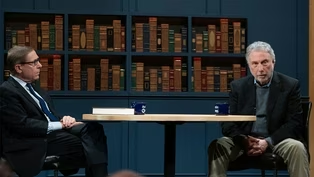
Clip: S11 Ep4 | 11m 7s | Former executive editor of the Washington Post Martin Baron discusses his new book. (11m 7s)
Providing Support for PBS.org
Learn Moreabout PBS online sponsorship
- News and Public Affairs

Top journalists deliver compelling original analysis of the hour's headlines.

- News and Public Affairs

FRONTLINE is investigative journalism that questions, explains and changes our world.












Support for PBS provided by:
Overheard with Evan Smith is a local public television program presented by Austin PBS
Support for Overheard with Evan Smith is provided by: HillCo Partners, Claire & Carl Stuart, Christine & Philip Dial, Eller Group, Diane Land & Steve Adler, and Karey & Chris...