
Martin Short, Jean Smart and more
Season 16 Episode 3 | 26m 42sVideo has Closed Captions
Martin Short, Jean Smart, Jung Ho-yeon, Sandra Oh, Lily James, Tom Hiddleston.
Martin Short ("Only Murders in the Building") and Jean Smart ("Hacks") discuss the joys of generational humor. Jung Ho-yeon ("Squid Game") and Sandra Oh ("The Chair", "Killing Eve") compare experiences working as a native Korean and a Korean-American actor. Tom Hiddleston ("The Essex Serpent", "Loki") and Lily James ("Pam & Tommy) talk about using American accents both on, and off, the set.
Problems playing video? | Closed Captioning Feedback
Problems playing video? | Closed Captioning Feedback
Variety Studio: Actors on Actors is a local public television program presented by PBS SoCal
Martin Short, Jean Smart and more
Season 16 Episode 3 | 26m 42sVideo has Closed Captions
Martin Short ("Only Murders in the Building") and Jean Smart ("Hacks") discuss the joys of generational humor. Jung Ho-yeon ("Squid Game") and Sandra Oh ("The Chair", "Killing Eve") compare experiences working as a native Korean and a Korean-American actor. Tom Hiddleston ("The Essex Serpent", "Loki") and Lily James ("Pam & Tommy) talk about using American accents both on, and off, the set.
Problems playing video? | Closed Captioning Feedback
How to Watch Variety Studio: Actors on Actors
Variety Studio: Actors on Actors is available to stream on pbs.org and the free PBS App, available on iPhone, Apple TV, Android TV, Android smartphones, Amazon Fire TV, Amazon Fire Tablet, Roku, Samsung Smart TV, and Vizio.
Providing Support for PBS.org
Learn Moreabout PBS online sponsorshipElizabeth Wagmeister: Have you ever wanted to learn more about your favorite Hollywood stars?
Jean Smart: The writing is phenomenal, it really is.
Elizabeth: Variety Studio invites you into the room with some of the biggest names in the business as they discuss their careers in critically acclaimed performances.
Lily James: That's an actor!
Tom Hiddleston: That's an actor, yeah, yeah, exactly.
Elizabeth: With Martin Short and Jean Smart, Jung Ho-Yeon and Sandra Oh, and Tom Hiddleston and Lily James.
♪♪♪ Elizabeth: Welcome to "Variety Studio: Actors on Actors."
I'm Elizabeth Wagmeister.
Clayton Davis: And I'm Clayton Davis.
In this episode, we're takin' a look back at some of the best television shows from the past year and the accomplished actors who brought them to life.
Comedic charm is the common denominator when Martin Short and Jean Smart come together to talk about their illustrious careers.
Martin Short's ability to make an audience fall in love with any character he plays is a gift that keeps on giving.
The two-time Emmy winner does it again as a curious neighbor in "Only Murders in the Building."
Oliver Putnam: No real job, few attachments, and lives alone in an empty apartment that probably has a drain in the floor.
Oh, that was some good back and forth.
Listeners love conflict.
Clayton: Jean Smart picked up her third career Emmy for playing a legendary Las Vegas comedian for the first season of "Hacks."
Now the series is back for a second season, and the grace and power of Smart has never been better.
Deborah Vance: You're the underdog, but you're gonna get back up because you're a Vance now.
So go kill him.
Aiden: Okay.
Deborah: Okay.
Aiden: Okay.
Deborah: Go!
Jean Smart: I was so excited when they asked me to do this with you.
Martin: I was thrilled because they gave me four possibilities, and the other three said no, they didn't wanna do it with me, so the fact that you were the fourth made my heart soar.
[both laughing] Jean: I'm just dyin' to ask-- Martin: Ask me.
Ask me anything, Jean Smart.
Jean: I just binge-watched your show, and I cannot tell you how much I love it.
I cannot tell you how much I love it, and the thing about it is what is--there's something about the style of the show that is so unique and so mesmerizing and so fun.
I can't--but I can't describe it.
I can't put my finger on it.
It's not like anything else I've seen.
Martin: I don't know either.
I don't know.
No, I don't.
Thank you very much.
No, I don't know, I mean, you know, the credits are kind of, like, "New Yorker."
Jean: Oh, yes, fabulous.
Martin: That's good.
Jean: And the music is fabulous.
Martin: I think the music is great; I think it's just, you know, great, creative people got together.
You know, it doesn't happen very often and as we know.
Jean: Yeah.
Martin: You know what's amazing about that show, too, is that every day-player, someone who's just there for the afternoon, because it's New York, is phenomenal 'cause they're from the theater, or they're, you know-- Jean: And that makes all the difference in a show.
Martin: It really does, but you have that too.
We were talking about--see, I've seen four episodes of season two, and they are phenomenal, and when Laurie Metcalf shows up-- Jean: Oh my, god, she's so funny.
Martin: Just hilarious.
Jean: Well, too, it's lucky because then, when you have a show that's really good and really popular, people are, like, asking to be on the show, which is really, really nice 'cause then you can-- Martin: But the Deborah Vance character is fascinating to me because you push this woman's narcissism right to the brink and--but, I mean, you as a person.
Jean: I don't know what you're talking about.
Martin: No, the character goes right to the brink of narcissism but also is massively likeable.
It's a very interesting thing to balance, I think.
Jean: Yeah, no, well, the writing is phenomenal.
It really is kind of amazing.
But, you know, your show does the same thing.
You're able to balance stuff that's screamingly funny and then go right to something that's dark and scary, and it totally works.
It doesn't feel forced.
Martin: I think great characters are complex and are both light and frothy and then have secrets.
In your case, this idea that you know that your drug-fueled daughter lets the paparazzi know, and you know that, and, yet you accept it because it's good for her esteem.
Jean: And I feel like I was a -- mother, so.
Martin: And the guilt of that, it's such a work of art, and you are the engine.
Jean: Well, thank you.
The same, back to you.
I mean, and Selena Gomez, oh, my God.
Martin: How great is she?
Jean: I had no idea she's-- first of all, she's very funny and dry.
I didn't expect that at all.
I don't know why.
But she's absolutely adorable, but she keeps up with the two of you.
I mean, it's amazing.
Martin: Well, here's the thing about Selena that's interesting.
I mean, this is a pop princess from 16 on, and because of COVID in season one, we never got to meet.
We just would read scripts over Zoom.
So I met her the first day of shooting, and I'm driving, and I'm saying to myself, "She could be a nightmare."
Really, this could be--I mean, what if she's a nightmare?
I'm stuck.
And she was exactly this lovely professional, adorably kind and sweet person who also believed that the only thing that you can cling to is making it, so you don't know if it's gonna be any good, so that the set experience has to be fun and light-- Jean: Exactly, and you know what?
There's no reason it shouldn't be like that.
First of all, life is too short, and secondly, you know, but don't you find-- Martin: Who's the biggest -- you've ever worked with?
Jean: Oh, Steve Martin, absolutely without a question.
Martin: Oh, I know that.
Jean: I played his wife years ago.
Martin: I mouthed that along with you.
[both laughing] Martin: How did you--did you get along right away with Hannah?
Jean: Yes, she's just extraordinary, and I auditioned with some young actresses, and I, just, I said, "Without a doubt, you know, she's the girl."
I believed that she was a writer.
You know, she just wasn't a typical starlet, you know?
Martin: She also makes you believe that she's a writer of that kind of writing.
Like, in the first season, there's a scene where she's saying, you know, like, "Why even have email when people just text?"
Jean: Or voicemail, yeah, voicemail.
Martin: Voicemail, and you're going over her jokes and you're saying, "There are no punch lines here."
Jean: Yeah, yeah, total-- Martin: But your reaction when she says that, selling that as a--you go, "Whah?"
It's just so-- Jean: My favorite response to her: "What?"
Ten times in every episode, "Huh?"
Martin: It's too funny.
Jean: So, now, are you guys gonna have a different murder every season?
Martin: Well, season one ended with the murder of Bunny, the character Bunny, so now, season two, so-- Jean: Oh, so you're gonna solve Bunny's murder?
Martin: Who killed Bunny.
Jean: Sounds absurd.
Martin: But, you know, the original premise of this was Steve's idea that, because we're old, we'll only solve--we'll solve murders, but they have to happen in the building-- Jean: That's hysterical.
Martin: 'Cause we don't wanna travel.
Jean: That is hysterical.
But, see, I think it's really fun, that generational difference in your show with Selena because that's what is at the core of, I think, what a lot of people like about our show, you know, is that "that thing."
Martin: And, you know, but unlike, also, the dynamic you have on your show is it's not just saying, "Oh, if you're old, you're not hip," "If you're old, you're out of step with the modern show business," because the reality is, when you say, "I don't get this," "There are no jokes here," we, the audience go, "We agree with you.
We agree with you."
It's fine to be in your head.
It's fine to be too hip for the room, but are you actually making the audience--because our audience aren't just comedic intellectuals.
When we play, our audience is from the city we're in and-- no, it's an ideal job for us, you know, because we like going to work, we like the hang.
In fact, Steve and I have a tradition, we're excited: if we finish together, we share a car ride home, and there's a bottle of wine and we-- Jean: While you're driving?
Martin: Yeah!
Don't be a suck.
No, no, no, we're in the back, and, of course, it's illegal, but we used to say with our driver, "Do you want Diet Coke or just Coke?"
One was red wine, and one was white.
And, but, anyway, we'll sit, and then park in each other's homes, and we'll talk about the day, and I'm saying, and so we're great friends who do this show, and then you add this brilliant Selena Gomez.
It's an ideal and the greatest New York actors imaginable.
Jean: Oh, my god, oh, my god, oh, my god.
Oh, really quick, do you read reviews?
Martin: What?
Jean: Do you read reviews?
'Cause, you know-- Martin: Well, you're 100% Rotten Tomatoes.
Jean: Your "New York Times" review was--you couldn't have bought that review.
Martin: I did.
It's on me.
Would you like to read it?
Elizabeth: Sandra Oh celebrated the historic win for Jung Ho-Yeon at the Screen Actors Guild Award, which sparked a new friendship between the two actresses.
Starring in one of streamings most-watched series of all time, Jung Ho-Yeon is the emotional centerpiece to the violence of "Squid Game."
Kang Sae-byeok: [speaking Korean] [speaking Korean] Elizabeth: And Emmy nominee Sandra Oh is front and center of two acclaimed series, playing an English professor in "The Chair," and returning to her award-winning role as an M15 analyst in the final season of "Killing Eve."
Ji-Yoon Kim: When I started, it was like, "Why's some Asian lady teaching Emily Dickinson?"
But we have a real opening here.
You're goin' for tenure.
I'm chair of this department.
The dean has my back, so let's just get your case through, and then let's shake this place up.
Sandra Oh: You know, Ho-Yeon, we were just shooting with Alexei, and immediately we're so close.
Immediately, you sat on my lap.
Immediately, we had this closeness, and as a Korean American, to have this link with a native Korean-- [speaking Korean] You know what I mean?--is really important, kind of monumental for me and, I think, for a lot of Korean Americans, and I've always been always interested in the native Korean perspective.
Like, how do you see us as Korean Americans?
Ho-Yeon Jung: Oh... Sandra: Sorry, I'm gonna start with a easy one.
[both laughing] Ho-Yeon: It was like, for me, I've been thinking about a lot about that because, when I came to U.S. for campaigning for "Squid Game," I met a lot of Asian American people, and says to me, "Oh, thank you for representing us," "Oh, we are so proud of you."
So I was, at the beginning, it was just happy.
Oh, it's like I can give, like, a good effect to people, but, like, I came from Korea.
I lived in Korea my whole life, and then it's just, kind of, "Am I allowed to represent them?"
And, like, I have, kind of, extra responsibility, you know?
Sandra: I thought a lot about that too, for you, and I just wanna--I wanna take that off of you because, like, this-- so, the other day, I was driving on Sunset Boulevard, and you were on there.
You were on the side of a building, so I'm driving, like, "Oh, there's my girl."
But then, also, I will say there was probably two more billboards where there is another Asian model, and I remember feeling I don't think I would've seen that four years ago.
So I understand that question that you have, and I'll also say, not to put any kind of pressure on you, but you are in the image-making, a very important part for, I think, Asian Americans, so I want to somehow relieve you of the pressure for that, but I feel like you, you know, know how to be yourself.
Ho-Yeon: It's like I'm trying, I'm trying, but it's just all I can do is just keep trying to not over-think about this responsibility but also cares about this responsibility because of the things go so quick for me 'cause it was just my first project.
I was like, "Okay, I'm going to be an actor," and then I did audition, and then I got it.
I was so happy, and then, while I'm filming, I was so happy, like, blah, blah, blah, and when the "Squid Game" came out, it's just like-- Sandra: Woo!
Ho-Yeon: Yeah, yeah, suddenly, oh, Ho-Yeon, you are here, so-- Sandra: An international superstar.
Ho-Yeon: People recognize me.
Even like you, I was like a little child in Korea, and "Grey's Anatomy" was, like, a huge thing in Korea because of you, and then you're kind of icon of us, and then, when I met you at SAG Awards, you know me, and that was like, wow, and then, like, there is, like, a bunch of people that already know me.
That feeling was, like, weird but also--but how about you?
I just wanted to ask 'cause you've been in this industry-- Sandra: For a long time.
Ho-Yeon: Yeah.
Sandra: For a long time.
You know, it's--I feel like yours is like this...and mine is like...and that's just different.
I think that it's your personal health, I think, I realize came first 'cause you can't ultimately depend on anyone else.
You have to somehow find it within yourself.
So I think almost the entire world has seen this "Squid Game" is about the ultimate survival.
Everyone is constantly trying to survive.
People are dying around them.
I mean, it's a TV show, so some of it is also hilarious, and it's like, you know, when we do stuff like that, what people can't see is that "Oh--" [splurt, splurt] "Here's some blood," you know what I mean?
So it's like--but there is an intensity.
Ho-Yeon: Yeah, it wasn't like that intense.
We were more, like, joyful to be intense, I think, and-- Sandra: That's wonderful, "joyful to be intense."
That's great, that's great.
Ho-Yeon: It was just, as an actor, to have those kind of scene is, I think, exciting.
Sandra: It's very exciting.
Ho-Yeon: Yeah, yeah, I'm the one who can understand her most in this world, so I know her like a stress, and I know how her life was so struggle and hard, so I was like--it wasn't that bad or sad.
It was like happiness.
It's weird to say it, but I felt that.
So with the "Killing Eve," also "The Chair," you build up, like, the relationship of the other actor's character with Villanelle and Bill.
It's so complicated.
It's just there's not only one emotion, so, like, how do you, kind of, communicate with the other co-actor?
Sandra: That's so interesting you're choosing Jay Duplass, who played Bill in "The Chair," and Jodie Comer, who played Villanelle in "Killing Eve," completely different!
Ho-Yeon: Oh, really?
Sandra: Yeah, completely different, right?
So you're talking about, let's say, with Villanelle and with Jodie, Jodie and I didn't really talk a lot.
No, we didn't really talk a lot because there was so much magic that was going on that we both knew we're not gonna touch it.
We're just not gonna talk about it.
It's gonna be very ambiguous, and I think that's some of what really works between the two characters.
You don't know what's happening between them.
They don't really know what's happening between them.
That's also the same feeling in, like, the kind of romance that Ji-Yoon is having with Bill in "The Chair," but they have a very long-standing relationship.
There's a lot of friendship that's going on there, but the difference is that I have four years with Jodie.
I had three months with Jay Duplass, who plays Bill.
We found that, whenever we were in a scene, we would somehow immediately get physically close, but it was because, I would say, Jay Duplass is--I love him.
He's great--great actor, and he's very open, so we were just like, "Okay, wide open.
Okay, let's get naked.
Okay, let's do this."
We had to find a quick way of becoming friends but having the history of being friends for a long time, so we would actually touch each other so then, when we would be in a scene, there is a bond.
Ho-Yeon: Mm.
Clayton: It's a British invasion when Lily James and Tom Hiddleston, two actors of this year's buzziest shows, which have each generated a huge fandom.
Clayton: Emmy nominee Tom Hiddleston plays double-duty in two wildly different roles, one, as a god of mischief, Loki, in the self-titled Marvel series, and the other as a man who questions the superstitious beliefs in the period drama "The Essex Serpent."
Will Ransome: You've heard the stories.
You wanna go have a look?
There's nothin' to see.
Go home.
Clayton: And Lily James completely transforms into Pamela Anderson, one half of "Pam & Tommy," capturing the raw emotion behind one of the biggest celebrity scandals in pop-culture history.
Pamela Anderson: You know, she didn't worry what people thought.
She never tried to please anybody.
She was just like, "You know what?
I am this bad, sex bomb, antiwar, workout-video-selling actress-chick, and if you've got a problem with it, -- you.
What's cooler than that?
Lily James: We were already talking about "Essex Serpent," which I've got to watch it, and it's so brilliant, and you're so incredible in it.
I kind of wanna know about that first meeting with Claire Danes, like, what that was like.
Tom Hiddleston: Well, she's playing Cora Seaborne.
She's the heroine of the story.
It's 1893, and she's out on the Essex Coast where there's been a earthquake, and she's digging around for fossils and has this keen interest in the natural sciences, and she runs into this very faithful and God-fearing community, and I play the reverend, somehow, and--but they had this very unusual meeting where they don't recognize each other, and they don't know the other person, so it's an interesting meeting.
Lily: Watching it, they kind of--the landscape has so much brutality, and it's so beautiful and atmospheric and dark, and it's Clio Barnard, she's incredible.
She captures, like, that kind of real world and a, kind of, like, truthful, harsh reality.
Tom: Yeah, she's amazing.
Lily: Why did you wanna do that job?
What was it that drew you to that role next?
Tom: You know, I think it was partly Clio 'cause I had met her years ago, and I really liked her, and we had a really interesting conversation, and I followed her work, and I read this, and it seemed so grounded and so interesting.
It was dealing with themes I thought were really resonant, dealing with uncertainty and anxiety, what happens to collective anxiety as it can start to sort of distort reality.
And your imagination, if you don't have all the answers, rushes in to fill the void.
And this war at the time between science and faith as a way of trying to explain life and find meaning in it.
So from the Essex marshes, to sunny Southern California, I really thought the work, your work, was extraordinary, I mean, just unrecognizable, the physical transformation and the vocal transformation, and it's sort of, you know, taking on a real person is--I know it's such a--feels like such an enormous-- Lily: Yeah, because you've played Hank Williams, right?
Tom: A long time ago, yeah.
Lily: Long time ago.
It's terrifying, isn't it?
Tom: It's different.
It's just you want to honor and respect and-- Lily: Right, and be a good custodian, look hot, and be respectful.
I felt, like, if I came at it with heart and with, like, with a total, sort of, understanding and desire only to be honest and to take care of the story and what happened as much as possible, that was all I could really do, but it was, you know, it's--I don't know if I'd do it again any time soon.
Tom: Right, yeah, yeah.
Lily: I felt like that pressure and desire to do her justice and to really morph was so frightening that I never worked harder, you know?
Tom: Yeah, right, of course.
I could tell.
So, yeah, where do you begin with becoming Pamela Anderson in terms of the physical transformation?
I'm sure you had amazing teams, hair, makeup, wardrobe.
Lily: Yeah, god, the best, like, the best, you know, that you could never, ever do a job without them.
I mean, initially, I started training 'cause I just had, like, pictures of Pamela everywhere around me, and I actually lost, like, 20 pounds, which is crazy but she--'cause I wanted to be athletic.
I wanted to be so strong as opposed to just, like, drop weight, and then I, yeah, had these prosthetic boobs, forehead, all those--it took four hours every day, and during that time, I would just, sort of, sit--I had, like, a montage of all her, like, interviews from the '90s, and I would just start tuning in to her voice and her, sort of a--almost learn it like a song, like, the pitch and the rhythm.
She speaks really, really fast, and then I would, like--her hair and her hands and, just, I just, like, watched her so much and stayed in her, kind of, like, the whole time.
Tom: Wow.
Lily: I mean, I didn't stay, like, in character, but I didn't speak English for the entire five months even at home.
Tom: Really?
Lily: 'Cause it was--I just thought, if I slip up once-- and now I do that awful thing where someone's talking American, and I start going, like, I start like talk-- Tom: You start talking American, yeah, there's lots of actors do that, and it's sort of--it's easier, isn't it?
Almost like you've played and established a chord at the beginning of the day, and you just wanna stay in the chord, you don't wanna-- Lily: Yes, exactly.
Tom: You don't wanna be in some other tune, you know.
Lily: Right, and I find it harder to-- Tom: And be caught out asking for a, you know, "Can I have a sandwich or something?"
Lily: Yeah, "I'm going to the loo.
Oh, no, the bathroom.
No, the restroom."
Tom: Yeah, yeah, yeah, exactly, yeah, wow, I can relate to that.
Lily: Yeah, what do you find?
Do you do it-- Tom: Well, so I suppose, yeah, the similar--the experience I had when I was playing Hank was I had these little, kind of, key phrases sometimes, and you look, I mean, to the outside eye, you look--I've looked completely mad, I mean-- Lily: Yeah, totally.
Tom: I think, "Wait, you know."
He had, like, a stock phrase.
He'd say-- [speaking in Southern accent] "If the good Lord's willin' and the creek don't rise, I'll be there soon.
Lola, put the coffee pot on.
Put the biscuits in the oven.
I'll be there quickly if not quicker."
[in normal accent] And I just would use to go and sort of-- Lily: It's so good it's still there.
Tom: It's mad though.
Lily: It's just like you won't lose it; I have the same thing with Pamela, certain things I'm like, "Oh, my god."
Tom: So did you think that people on the crew, did they ever get to know Lily James really, or were they just-- Lily: I don't think so, and nor was Sebastian, with Sebastian Stan, who was Tommy.
We really didn't get to know each other till we started doing press.
It was kind of almost awkward, and the days were so long, like, 18 hours, and I found that so hard.
It was like--but I guess it was 'cause of the prosthetic.
How has that been with you?
There's a little thing and with--to Loki, of, like, I guess you don't have any prosthetic, but the whole thing of being him and-- Tom: Yeah, I mean, Loki's changed so much over the years for me.
I love playing him--a huge journey, yeah.
Lily: What's that like?
Tom: It's amazing, I mean, I was cast when I was 29, and I'm 41, and it's still going, you know?
Lily: Credit to you for having, like, let him emerge and grow and shift and-- Tom: Well, yeah, and to everybody at Marvel for letting me do it, and the audience, actually, who, I'm sure, if they stopped being interested would let me know.
Lily: It's, like, amazing how funny--first of all, you're so funny, and then, also, it's like deeply vulnerable, which is-- and so moving, which is-- Tom: That's the cocktail with him.
Lily: Yes.
Tom: That's the weird-- Lily: So impressive.
Tom: Well, it's a writing thing, and a massive tip.
It's such an ancient character, and, you know, he's the god of mischief, so, like, I've been looking up, ages ago, in the dictionary, and it said, "inclination to playfulness."
I was like, "Yeah, that's an actor," yeah, yeah, exactly.
But then, also, the funny thing with Loki is he wants to let everybody know of his great high status, and there's nothing like, I mean, "status," for comedy, really, is anybody thinks they're important.
So if you pump up the hubris, then humiliation can follow, then it's hopefully funny, but you still play it with a straight bat.
Lily: Mm.
Elizabeth: We hope you've enjoyed our look inside "Variety Studio: Actors on Actors."
Clayton: Please join us again next time.
Jean: I love the theater schedule 'cause I'm not a morning person, I'm a night person.
Martin: So then, your 13-year-old comes in and says, "Mama, breakfast?
I'm hungry," and you've got the mask on, saying, "Not now, dear."
Sandra: Sadly, no one wants to film us talking anymore.
Ho-Yeon: Yeah.
Sandra: So-- Jean: "Don't bother Mommy."
Martin: "Don't bother Mommy very early.
Two p.m. Below, uh-uh."
Tom: Shall I start?
I'll start.
When do I start?
Is that okay?
Lily: Well, now I wanna.
Martin: Were we the best?
Jean: We were your favorite.
Thank you so much.
Martin: Thank you.
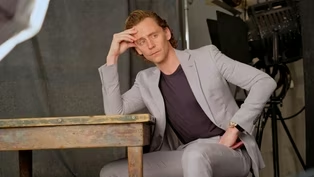
Martin Short, Jean Smart and more (Preview)
Video has Closed Captions
Preview: S16 Ep3 | 30s | Martin Short, Jean Smart, Jung Ho-yeon, Sandra Oh, Lily James, Tom Hiddleston. (30s)
Providing Support for PBS.org
Learn Moreabout PBS online sponsorship













Support for PBS provided by:
Variety Studio: Actors on Actors is a local public television program presented by PBS SoCal