One-on-One
Marty Smith Discusses Trust, Delegation, and Beyond
Clip: Season 2024 Episode 2688 | 12m 51sVideo has Closed Captions
Marty Smith Discusses Trust, Delegation, and Beyond
Marty Smith, ESPN Host and Author of "Sideline CEO: Leadership Principles from Championship Coaches" joins Steve and Mary to discuss the connection between sports and leadership and the importance of trust, communication, and delegation on a successful team.
Problems playing video? | Closed Captioning Feedback
Problems playing video? | Closed Captioning Feedback
One-on-One is a local public television program presented by NJ PBS
One-on-One
Marty Smith Discusses Trust, Delegation, and Beyond
Clip: Season 2024 Episode 2688 | 12m 51sVideo has Closed Captions
Marty Smith, ESPN Host and Author of "Sideline CEO: Leadership Principles from Championship Coaches" joins Steve and Mary to discuss the connection between sports and leadership and the importance of trust, communication, and delegation on a successful team.
Problems playing video? | Closed Captioning Feedback
How to Watch One-on-One
One-on-One is available to stream on pbs.org and the free PBS App, available on iPhone, Apple TV, Android TV, Android smartphones, Amazon Fire TV, Amazon Fire Tablet, Roku, Samsung Smart TV, and Vizio.
Providing Support for PBS.org
Learn Moreabout PBS online sponsorship(upbeat music) - Hey everyone, Steve Adubato here.
More importantly, I'm about to introduce you to a segment that we did on our "Lessons in Leadership" program that I wanna share with our broader audience.
It's written by Marty Smith, a book written by Marty Smith, "Sideline CEO: Leadership Principles from Championship Coaches."
Marty Smith's works over at ESPN, been a broadcaster there for about 15 years.
Marty talked to the greatest coaches in college sports, Nick Saban down in Alabama, a whole range of other coaches across the country.
And he really tried to ask them, "What's the connection between coaching and leadership?
How's it different coaching today in college sports with the transfer portal?"
What it is, kids can leave very quickly, go other places.
Coaches could have done that or did do that before and left the kids they recruited high and dry.
Name, image, likeness, athletes getting paid for their name, image, and likeness.
Whether you agree or not, that's what it is.
So the question is, what's it like leading and coaching in college today, in college sports today?
Well, Marty Smith talked about it and that's why we wanted to share it with you.
"Lessons in Leadership" is pleased to welcome Marty Smith, ESPN host and the author of "SideLine CEO: Leadership Principles from Championship Coaches."
Marty, good have you with us.
- It is such a blessing to be here.
I appreciate y'all offering me the platform to share about it, thank you.
- You got it.
First off, how'd you get into broadcasting?
- Dumb luck.
(Mary laughing) I studied print journalism in college 100 years ago before I had all this gray hair, and was a print reporter and columnist for about the first six or so, seven years of my career.
And then, in the fall around '05, '06, I got a phone call from ESPN and I was in the NASCAR world at that time, and they were putting together their broadcast team for re-injecting themselves into the NASCAR world.
And they called me and said everyone with whom they spoke in the garage area said my name, that I knew the race drivers well and I had a really good pulse of what was going on news-wise, and that they would like for me to consider maybe coming to ESPN and being a broadcaster.
And I thought they had the wrong number.
(Steve and Mary laughing) I thought they were calling my friend Marty Snider, who's a tremendous broadcaster, told them I would give them his number if they wanted it.
- Yeah.
- And they ultimately said, "No, man.
Just think about it."
And guys, I'm a guy who, I would rather crash and burn and fail because I tried, knowing that I couldn't, than wonder 30 years from now if I could've.
And so, I jumped in with both feet and now, I'm 18 years into my ESPN television life and full of gratitude every day for the opportunities that affords me.
- Well said.
Let me ask you this, Marty.
In the book, "Sideline CEO," you talk to all these coaches, including Nick Saban, University of Alabama.
I will admit that I do not root for, along with millions of others, (Marty and Mary Laughing) I do not root - All right.
- for the roll tide folk.
- No judgment.
- No judgment.
Tom Izzo, Michigan State.
- Whoo-whoo.
My son goes there.
- Mary's got a kid.
- All right.
- And Kim Mulkey at- - You got him surrounded.
- Yeah?
- Yeah, yeah.
Kim.
Okay, can we start with Kim Mulkey?
- Whoever you want.
Yes, sir.
- Passion, fiery, intense.
- Yep.
- Question.
As college sports evolve and change, name, image, likeness, transfer portal, et cetera, Coach K, I got a lot of props here.
I got some stuff on Coach K talking about how he had to evolve as a coach, as the game evolved, as players evolved, as the rules evolved.
Does Kim Mulkey need to change or is she just gonna be the way she is and that's it?
Go ahead.
- She has changed.
And in fact, she told me in the pages of "Sideline CEO" that what she believes is arguably the greatest endorsement of her coaching life is that her players laud her for staying current.
She continues to evolve, and you can be an absolute badass.
You can be demanding.
We as human beings want to be coached.
We want structure and we want those principles by which we are led, but we also want the individualism that we can be our authentic selves within that scope.
And she told me in the book that her players love that she allows for all of that.
And she is flamboyant, and she is passionate, and she is gritty, and I love every bit of that.
Just because you have that approach doesn't mean that you aren't evolutionary at the same time.
And if you're not evolutionary, you're gonna die.
Classic Eckhart Tolle.
- Change or die.
- Correct.
- The status quo- - Evolve.
I don't know if change and evolve are the same thing.
- Okay, I don't wanna play word games.
You differentiate, go ahead.
- I think evolution is continuing to grow yourself within the core principles of who you are.
Changing is altering the core principles.
- Hold on one second, Mary, as you jump in here.
Elvin Badger, our director told me about a year ago, "Steve, you came in with a crappy attitude.
You started the day off."
He's tired of me talking about this and he challenged me, and he said, "When you come in like that, it ruins the rest of the production day."
And I had to, other than being angry with him, but there is no better director, so I couldn't fire him.
So, (Marty laughing) I had to change.
Marty, I had to change.
I wasn't, I had to literally say, "That behavior - Did you change - is not okay."
- or did you evolve?
- Go ahead.
- Did you change the core way that you do your job?
- I changed the core way I approached my job with a- - You evolved as a human being.
- All right, Mary, jump in, 'cause I don't wanna put- - I am loving it.
I wanna have you on with us like all day long.
I am just grinning from ear to ear, but I agree.
But I wanna go back to something you said that just kind of rang true with me a little bit, talking about the authentic self.
How can there be an authentic self but also have a team culture, right?
Tom Izzo, I know obviously out of all these coaches, I'm not a huge sports person, obviously I've got my Yankees and the Giants and I watch them.
You know, it hurts.
But as far as Tom Izzo goes, (Marty chuckling) from what I see here, he's like the genuine real deal.
But how did- - He is, he is.
- Yeah, but how do you encourage your individual teammates to be authentic while also being a team?
How does that go hand in hand?
Don't they kinda- - I think, that's a great question.
I think that you have to establish a culture, which the culture is the energy that everyone in the building is walking around in every single day.
But it's incumbent upon the leader of that culture to meet everyone where they are emotionally, as an individual.
And if you do that and you allow, look, there's rules.
You can't just be, you know, it can't be the Wild West in terms of your personality or your authenticity.
You have to fit within that structure.
But at the same, like, I would say, you know, kind of guardrails are important in order to establish and sustain excellence.
But look at Deion Sanders right now in Colorado.
Like, what, he walked into an irrelevant culture and flipped it immediately with his personality, with the fact that he injected hope and belonging not only into the program, into the university, into the state of Colorado, but into every single kid that's on that roster.
- Yeah.
You can't not watch it.
I mean, plus his, you know, eyeglasses are always really cool, so.
(laughs) - Biggest story in sports.
- Exactly.
- And it doesn't matter that as we do this program at the end of September, they're three and one, it doesn't even matter where they end the, where they wind up at the end of the season.
But to me, - Correct.
- Deion Sanders is an extraordinary example of a dynamic, fiery, passionate, take-no-prisoners leader who said, "Listen, we're gonna start from scratch."
When people said, "I can't start."
No, he started from scratch.
No matter what happens, it's a dramatic improvement.
I'm gonna come back to something, Marty.
Do you believe that coaching as a leadership paradigm, that coaching players on the college level is dramatically different because of name, image, and likeness and the transfer portal, in that you invest in someone, just like we lost a couple of talented people in the last few years.
Gone, right?
But in college sports, it looks like, it feels like that person could leave immediately and you invest in them.
And how the heck do you build a team with a future with very little stability?
Because someone can go like that.
Go ahead.
- It's a great point, and I think that most coaches at the Power Five level specifically are still trying to figure that out.
I think it's a- - Well, at the top, that's the most elite level.
So, go ahead.
- Yeah, I'm sorry.
Yeah, at the top of college football, it's permeated most of college football because let's say you're a young person who just missed on Power Five, and you've had a great career in the Group of Five, and your dream has always been to go to the top level.
You now have the opportunity to do that because you're a developed player.
But I think that, again, going back to kind of the culture that Nick Saban, for example, is the standard.
- At Alabama.
- Is the standard.
He's created a culture where he makes it about the player.
"Do you want to go to the NFL or not?
Do you want to do whatever it takes every single day and have the self-accountability to demand greatness of self in order to achieve the dreams that you have?
I can give you the way.
I can show you, but it's on you in order to do it."
And so, the answer to your original question is yes, they've had to change.
Yes, it's different.
Yes, they're still working through the vast differences of kids can just leave.
But then, there's the rebuttal on the other side of that is coaches have always been able to just leave.
- That's right.
- So- - Which leaves those kids, those young men and, or women.
- Young men, right.
Young men.
- And women who played, that's it.
"Where's my coach?
You recruited me.
You talked to my parents.
You told 'em - That's right.
- you'd take care of me.
Now you're gone because you got a better deal?"
- That's right, and- - Tough stuff.
- It is interesting though, this is the most transformative moment in the history of NCAA athletics because of NIL portal, conference realignment, all those things happening at the same time.
- That's right.
- And I do believe that the players deserve the right to benefit from their name, image, and likeness but let's be real here.
What it was established to be was to benefit off your name, image, and likeness.
What it has become is pay for play.
- Yep.
I tell you what.
Mary, let's make sure we use this segment on the public broadcasting side too, because - Oh, this is... - there are societal issues, leadership issues, sports issues, cultural issues, financial, a lot going on.
The author is Marty Smith.
By the way, foreword, by Tim Tebow.
Fascinating.
Not just athlete, but just a really interesting guy.
- A great man.
- "Sideline CEO: Leadership Principles from Championship Coaches."
Marty Smith, thank you so much, our friend, and we look forward to having you on again.
- So grateful that you guys gave me the time.
I appreciate it.
Love your spirit, thank you.
- You got it.
"Lessons in Leadership," see you next time.
- [Narrator] One-On-One with Steve Adubato has been a production of the Caucus Educational Corporation.
Funding has been provided by Kean University.
Atlantic Health System.
The North Ward Center.
New Jersey Sharing Network.
Wells Fargo.
The Healthcare Foundation of New Jersey.
PSE&G, PSC.
And by The New Jersey Economic Development Authority.
Promotional support provided by Northjersey.com and Local IQ.
And by BestofNJ.com.
- [Young Girl] I was diagnosed with Cystic Fibrosis when I was two.
It's hard to grow up with CF.
But I have an awesome care team at Goryeb Children's Hospital.
Helping me do the things I want to do, like play lacrosse.
And now, I've been recruited to play in college.
- Where you go for pediatric care matters.
- [Announcer] Atlantic Health System, because every moment is a moment that matters.
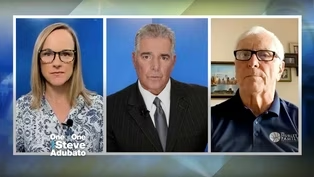
The Connection Between Sports, Leadership, and Philanthropy
Video has Closed Captions
Clip: S2024 Ep2688 | 13m 49s | The Connection Between Sports, Leadership, and Philanthropy (13m 49s)
Providing Support for PBS.org
Learn Moreabout PBS online sponsorship
- News and Public Affairs

Top journalists deliver compelling original analysis of the hour's headlines.

- News and Public Affairs

FRONTLINE is investigative journalism that questions, explains and changes our world.












Support for PBS provided by:
One-on-One is a local public television program presented by NJ PBS