Consider This with Christine Zak Edmonds
Building Community Through Local Food
Season 7 Episode 3 | 25m 45sVideo has Closed Captions
Meet the people behind Bloomington’s community-owned grocery store focused on local food.
Christine Zak-Edmonds talks with Mary O’Meara and Ron Slagel about Green Top Grocery, Bloomington’s community-owned food co-op. They share how an idea that began with local residents became a grocery store supporting area farmers and producers, offering ownership to shoppers and creating new ways for the community to connect around local food.
Problems playing video? | Closed Captioning Feedback
Problems playing video? | Closed Captioning Feedback
Consider This with Christine Zak Edmonds is a local public television program presented by WTVP
Consider This with Christine Zak Edmonds
Building Community Through Local Food
Season 7 Episode 3 | 25m 45sVideo has Closed Captions
Christine Zak-Edmonds talks with Mary O’Meara and Ron Slagel about Green Top Grocery, Bloomington’s community-owned food co-op. They share how an idea that began with local residents became a grocery store supporting area farmers and producers, offering ownership to shoppers and creating new ways for the community to connect around local food.
Problems playing video? | Closed Captioning Feedback
Where to Watch Consider This with Christine Zak Edmonds
Consider This with Christine Zak Edmonds is available to stream on pbs.org and the PBS app.
Providing Support for PBS.org
Learn Moreabout PBS online sponsorship(wistful upbeat music) - Will you consider this?
These two youngsters, I can call you youngsters, have it going today, you know?
Green is the word of the decade, I believe, and they are physically involved in Green Top Grocery in Bloomington.
And this is Mary O'Meara and Ron Slagel, and welcome.
Thanks for coming to Peoria!
- Super happy to be here.
- Yeah?
Okay!
Let's hear the story of Green Top Grocery.
Well, it's been around for a while.
So who's got the best history?
(laughs) - [Mary] What do you think, Ron?
- [Ron] Go ahead!
- Alrighty!
Yeah, so we are in our ninth year.
We're super excited to be coming up on 10, but Green Top started around 2011.
It was an idea.
People in the Bloomington-Normal community realized that there wasn't a health food store or somewhere that really focused on local and they were craving that, they wanted a space for that.
- [Christine] So it's not a franchise.
- It's not a franchise.
- This is an original idea.
- Yep!
We're completely independently owned by our community.
So they came together, multiple people talking about it.
They said, "Let's try to organize something."
The cooperative grocery store model exists, so they saw that.
They saw other communities having success with it and they started organizing, getting people together, and started planning how, like, "Let's open this store."
In 2012, they officially incorporated.
And then- - And got a grant!
Got some grant money.
- Yes!
Yep!
So that started all the, "Let's get grants, let's get funding, let's pick out our site.
Where's the building going to be?"
All that.
And it was a six year long journey from the idea to the doors open.
Which- - So you built!
I mean, you actually built a new building.
- Yes!
Yes, it was a new building, new area.
We have wonderful other local businesses around us.
It's a great spot.
And in 2017, the doors did officially open and it is a grocery store that was built by the community for the community.
- Which is awesome.
You're the general manager?
- [Mary] Yep!
- And then Ron, you're the president of the board.
So you became a member to begin with.
What does it take to become a member of Green Top Grocery?
- Well, anyone can become a member of Green Top Grocery.
- [Christine] Okay, I like that.
Okay.
- And anyone can shop there, member or not.
- [Christine] Mm-hmm.
I was there.
I shopped there.
- I realize that, yeah.
- [Christine] To check it out when I knew I was gonna talk to you, so go ahead.
- [Mary] Yep!
- But to become a member there's a, you buy, purchase a share of ownership.
It's $200.
And there are different ways that, you know, people, that the store can support people that may be a high hurdle.
There's things that can be done to break that $200 down.
But it's $200 to buy a piece of the store and to become an owner.
- And is that an annual fee?
- [Ron] It's one time.
- One time only?
- [Mary] For life.
- All right.
Okay.
Awesome!
- So that's a one time.
And it gets you a lot of perks to be an owner, but it's really a show of support on being a part of the community, of that local food community.
But of course you get to- You can serve on the board.
You can vote for who's on the board.
You have a say into how the store operates.
- So you work with local farmers.
Now, there are some other brands that are sold in other health food stores, but you work for all of the fresh produce, basically fresh everything.
Not necessarily only produce, but meats and produce.
And that's from local farmers.
- Yeah, there's a product mix.
So obviously in winter we're relying on our partners outside of the local sphere because our local farmers aren't able to produce, but especially in the summer, you're gonna see that produce department blown out with all sorts of local things.
And it's super fun since we're working with the local.
They have creative freedom and they can grow varieties that you don't see on a national level.
- Like purple carrots.
- [Mary] Yes!
- Those are so good.
- And purple bell peppers.
Those are one of my favorite things to get.
People don't even know purple bell peppers exist.
- [Christine] I know!
(laughs) - Yeah!
(laughs) So we'll see those.
And then, yep, all year round we have two whole cooler doors with local meat, your chicken, beef, pork, whatever it is.
We have local milk and bread all year round.
Tons!
A great collection of product mix within there.
- Mm-hmm!
Now, so you're pretty young.
You said that- - Thank you!
(laughs) - You said that when all this idea was coming around, you were only in junior high school.
- [Mary] Yep!
- All right!
So how did you get involved in it being so young and then all of a sudden having that light bulb come on?
- Yeah!
I've always been interested in the local food system, as silly or whatever that interest may be.
It doesn't strike a lot of people, but it struck me.
And I remember in high school, I was just constantly on YouTube watching farmers doing this.
"I wanna start a farm.
I wanna homestead."
You know, I was just very into that scene and how it bolstered the local economy, what it could bring to the local space.
So I started, you know, going to college for early childhood education.
Did that for a while and I said- - [Christine] It's not for you!
- "It's really the farming that I'm super into.
I'm gonna try to figure out if I can make that work."
So I was just browsing online for any jobs in the farming sphere, anything.
But it was the middle of winter, so no farms were hiring, and that's when I came across Green Top Grocery.
Green Top Grocery, at this point, I had never heard of it.
I was like, "There's no way this business exists and I haven't heard of it.
This is, like, everything I'm into."
- [Christine] So what year was this?
- This was five years ago or so.
- Okay.
All right.
- So I went in and I put in my application and they, I was just talking about how much I'm into the local food sphere, specifically the produce side of things.
And they weren't even hiring in the produce department, but they just saw my passion and my interest in it, and they said, "We'll take ya."
- [Christine] "We need you."
- Yeah!
Yeah!
- "We need you."
Okay.
- And I started there and then I just worked my way up and through.
- To general manager?
- Yeah!
- Yeah!
And how about you, Ron?
How did you get involved in it?
- I love, there's a lot to love about Green Top and the co-op structure.
But I have always, what was, what drew me to it was just the local aspect.
I'm from a small rural community that supports small business and it offers a lot of freedom and independence and, you know, to everyone there that lives there.
And I grew up in that type of community.
- [Christine] In that environment!
- In that environment.
- [Christine] Yeah!
- So I moved away into, I moved out of state for a while for career and came back and, you know, settled back in my roots here in Central Illinois and was looking for that in Bloomington-Normal.
And so, I was drawn to that local aspect and support local, buy local, eat local.
- [Christine] Right!
- [Mary] Mm-hmm!
- And so I became an owner in 2019.
And I served on the board for a little bit pre-COVID.
And for personal reasons, had to step off the board.
And now a couple, two years ago, came back to serve on the board again.
- [Christine] Right back on!
- Yeah.
- All right!
Now, so I was there.
You have special owner deals.
So I picked this up just so that we could take a look here.
So... So they pay their $200 and they're members forever.
And but then they get a little bit of a discount as well.
- [Mary] Yeah!
- They have other things that are available to them too.
- Yes!
So when you become an owner, the big thing that I like to tout is you get 1% back on all your purchases.
That excludes alcohol.
So you get 1% back, that comes off as a discount at the register.
And then when you buy local goods, you get 2% back.
So again, that's to encourage- - [Christine] People to come back!
- Yeah, and buy from your local farmers.
So that's huge.
1% to 2% back on your things.
You get this as a monthly flyer, your owner deals where you get that whole sheet of extra sales that are only for the owners.
We quarterly do 10 to 20% off your entire cart.
So that is if you spend over $150, you get 20% off of all of it.
So owners, they flock to the store.
- [Christine] I bet, yeah.
You have to have them take numbers, right?
(laughs) - Yeah!
Yeah!
And they fill up!
And, yeah, we try to just feed benefit, and show, like, ownership is what keeps the system going.
We're so appreciative and we wanna make sure that we are showing them thankfulness, not only in our word, but actually by giving them value back.
- Mm-hmm.
Exactly!
- You know, "Thank you for doing this."
Yeah.
- Well, and then you have a lovely little kitchen area and they get some hours there.
- [Mary] Yep!
- Where they could host events and have some cooking demonstrations or lessons and things?
- [Mary] Yep!
Yep!
- Have you done that, Ron?
- [Ron] I have!
- Have you been there?
- I've been there for a matcha.
- [Christine] Okay!
- Making and a lesson.
Yeah.
- Yeah.
Was it pretty good?
Did it turn out well for you?
- Theirs did.
Yes, theirs did.
(group laughs) - You need to tweak yours a little bit?
- Yeah, I needed to tweak mine a little.
(group laughs) - Right!
But it's kind of a, that's a nice perk.
And so people can have parties and different kind of events there just because.
- [Mary] Yep!
- And, but non-members can also rent that space.
Isn't that right?
- [Mary] That's correct.
- And then that's kind of a way to get them in?
- [Mary] Yeah!
So we- - That's part of your marketing?
- Yeah, we partner with people just doing their birthday parties, just wanting a space for whatever it may be.
And then businesses, third party organizations, they will rent it to host a class that they're selling tickets for.
Right now, like Carle and BroMenn, they're doing educational healthy eating classes in there.
The YMCA is as well.
So there's just so much opportunity that comes with that kitchen, and it can be used from your three-year-old's birthday party all the way up to these hospitals doing education.
- Right!
Right!
And they came to you?
- [Mary] Yep!
- Which is also very nice because then you're on the map.
- Yes!
Yes!
There's actually a need for those, like, rental spaces.
There's not a lot of opportunity for a kitchen that people can rent and utilize.
- [Christine] Well, a teaching kitchen.
Yeah!
- Yep!
- So Ron, are you gonna do any more?
Any in the teaching kitchen or are you just gonna shop?
- Yes, I'm always looking.
- Okay.
- I'm always looking.
Yeah.
- Good for you!
So how was it then during COVID because everything was so upside down and you had members who wanted to come in?
But, you know, we keeping six feet apart, go down the aisle this direction and all that.
How was it at Green Top Grocery?
- You know, it was certainly difficult.
For every business it was difficult to manage expectations and how we handle this, but yet we had the implemented six feet apart strips at the register, you know, spacing everyone out.
And, "Please wear your mask."
You know, expected that of customers.
But we saw in the whole co-op industry, 'cause there's co-ops all across the United States, saw a boost in people coming to the store because people were focused on their health.
They were worried about their health, they wanted to be eating things that they thought were better for them.
And also the co-op, it's such a smaller store.
It's so much less intimidating to go to.
You are being exposed to less people than a traditional store.
So people started finding comfort in going to the co-op.
You also connect with your community more at the co-op.
People wanted community.
They were craving it during COVID.
- Interesting!
- So surprisingly there was actually an increase in sales and in customer count during the COVID era as people fought or sought that comfort.
- But you're glad that's behind you.
(laughs) - [Mary] Very glad it's behind us!
(laughs) - [Ron] And that's one- - So?
Go on!
- Oh, and that's one of the things.
I was drawn to Green Top because of the support local.
Just because I was raised in that.
But what I came to saw were global and national economies are wonderful when they work.
- [Christine] Right.
- But when there's any type of breakdown or disruption.
- [Christine] Like supply chain.
- Supply chain!
Yeah.
We... Not many places have the, that local infrastructure, you know, for supply and distribution.
And so we really, I really saw a huge value in that.
And it's not just a warm and fuzzy, "Buy local, support local, support your local farmer."
It's really a community resilience thing.
- [Christine] Well, it is.
- You know?
- And the fact that this is, to use the phrase grassroots, because it really is, it started there and people are conscious, and we're farmland.
We are in the middle of the country and we're farmland.
And it's so good to know that even city folk who have situated in farm country, that they can make the best of it too.
And they know.
Yeah!
- [Mary] Absolutely.
- So now you're on the board.
How many members on the board are there?
Or do you know?
A lot?
- Well, I know we're full right now.
(group laughs) - Nine, yep!
- There's nine people on the board.
Yeah.
Thank you, Mary.
- All right.
- And so the store is doing real well and we have a full board and we have past board members that are there in the wings waiting and supporting and volunteer and provide that mentorship for staff and new board members.
So there's just a lot of support, you know, that's grown up over the last, particularly the last three or four years.
So Green Top from a store perspective, with Mary, is wonderful there at the helm.
But just as a functional organization is just in a really good place.
- Yeah, that's nice.
So how many members of the staff?
You were it for a while, weren't you pretty much?
And then the rest of it is volunteers who work there or stock the shelves?
- So right now we have about 25 people on staff.
And then, yes, we do have volunteers come in, which is amazing.
People- - [Christine] You can't get a whole lot of places without volunteers.
- No!
But since we're focused for the community and the community is the one who sought that this store was built, people have such a strong buy-in and they care so much about the store that, yeah, people come and they help us stock the truck.
And it's a really great way for us to connect with our customers and our owners, and they get to talk to us, we get to talk to them, and all of us get to work together to make this store a happy, successful spot.
So yeah, every truck day we have a few hands come in and they'll be in there stocking and doing that.
- [Christine] So when are truck days?
- Our big ones are Tuesday and Friday.
- Okay.
- So we get deliveries every single day, all week long, especially because we have so many local vendors.
We might get a hundred deliveries a week, you know?
- Oh gosh!
- Something like that, 'cause there's so many little ones from all these local guys.
- Right.
- But our big ones, Tuesday and Friday, and we have volunteers come out.
- [Christine] That's good!
- It's amazing.
- Gives them something to do.
- [Mary] Yep!
- And everybody benefits.
- [Mary] Yep!
- So is there, like, a national co-op organization that you partner with or that you belong to in order to make sure that what you're doing, what you're putting together is working?
- Yes!
Yes!
So we are a part of NCG.
NCG is a cooperative of co-op grocery stores.
So they help us kind of pool together resources and a lot of the, like, hard stuff of running a business, like getting deals, sales on your shelf, they help with that sort of stuff.
- Okay.
So they know what's moving and what should be marked at that price now?
- [Mary] Yep!
- During the season.
- They give us guidelines for all sorts of things, but since we are independently owned, they don't have say over us.
We have full control over what we can do and what we choose to do with the info and the resources that they give us, which is amazing.
- All right.
So then you have to go to your board and get approval.
And how often does the board meet and make some of these decisions on, "Okay, this is working really well, but this is not.
We have to kind of boot that one."
Those are the decisions you're making, right?
- Well, the board meets monthly.
And then of course as needed, meet virtually or in person in between, if we need to.
But we meet monthly and the board really is, our main job is to place Mary in her position and let her run the store.
- [Christine] Okay!
- And that's what we really try to do.
And we have policies and procedures set up so that we, the board, stays within our bounds.
We're there to represent the owners, and not just what the owners want, but what the owners- We're there to look long-term in strategy and direction so that we're fiduciary responsible for the store's long-term stability.
- [Christine] Okay.
- So we don't necessarily represent, like I said, the wants of the owners, except for the owners want the store to be stable and last.
- [Christine] Well, you know what?
- And to be there.
- That's the best kind of board to have.
That's for sure.
- And so, and yeah.
So that's.
But operationally and functionally and the sales and what's offered is really the buck stops with the GM, with Mary.
- [Christine] Hands off.
It's up to you.
You know the best.
- Yeah!
- So how many members, how many owners do you have at this point?
- Well, I looked at the wall yesterday and it was 2,888.
- [Christine] Wow!
- Yep!
So we're excited.
We're getting closer to 3,000.
Whoever's gonna be lucky 3,000, that'll be a huge milestone.
- So then they'll have the teach- You'll have some special party in the teaching kitchen, right?
- Oh yes, we should!
- Absolutely!
- Yeah!
- Absolutely.
- You're number 3,000.
- Yeah!
- So you have to look at what is the 3,000th anniversary gift?
You know, is it wood?
Is it?
(Mary laughs) I don't think we've gone to 3,000.
So what do you look forward to most in the future?
You've done all this, you've accomplished wonderful things.
Is there anything that you haven't been able to do yet?
Do you have- Have you set your sights on anything like that?
- I am just super excited to deepen our roots in our community.
I mean, right now, in the last year and a half, we've been getting our name out there so much more.
And we're seeing new faces constantly, and with that comes so much new opportunity.
So last year was the first year that we were able to do a really hard, strong partnership during the Thanksgiving season to donate a lot of food back to our local community.
- [Christine] Okay.
- And, you know, the more people that learn about us that come shop, the more support that we get, the larger we can make these community efforts.
- [Christine] Right!
- And that's what really excites me.
Just recently reaching out to local children's art organizations for the first time to partner during our events, come out and table, and they were super excited.
"Yes, it seems like a great fit."
You know, just bringing the community together more and more.
- [Christine] For awareness?
- Yes!
And being able to offer and give back to people in our area, that's really what gets me excited.
- So!
(clears throat) A lot of it's organic, but not all of it.
- Correct!
- Is that right?
Okay.
- Yep!
- And that.
But it's well marked what you have for.
And has that been a challenge?
Do people... They're okay with that?
- Yeah!
- Your owners and customers?
- Right now, I haven't heard anything for a while about it.
People are very understanding that it's a health food store, you know, and that health could be, it's non-GMO, it is labeled organic, or it is all natural.
You know, there's different labelings within that.
You do have people who are looking to eat only organic.
Organic can get tricky, especially in the produce area.
Like organic strawberries might not, just totally might not be available in the middle of winter.
- [Christine] Right!
- And people understand that.
They know that it is a more niche product outside of conventional.
So everyone is, they're happy to just have this spot where when you walk in, everything there pretty much is available to them.
It's clean in some way.
- [Christine] And labeled.
- Yep!
Yep!
- Which is good.
So, and the farmers, they're all very happy because what percentage of their product comes your way?
- Of their product, I'm not sure how much of theirs comes to us, but our store sales are about 33% local.
Which is actually really amazing when you think about the fact that we offer all your basics.
You know, we don't have a local canned tomato or a local canned olive, you know?
All these shelf stables, a local canola oil, we don't have those things.
So to think that still within that, 33% of everything is a local producer, that's astronomical.
- [Christine] It is!
Yes.
- Yeah!
And that's the meat, the eggs, the bread, the produce, the popcorn.
We have a huge local popcorn scene, which is really fun.
- [Christine] Okay.
- People love that.
- See, and I'm such a city girl.
I just found out in the last couple of years that there's certain popcorn.
I mean, it's not just any corn.
- [Mary] Yeah!
(laughs) - I mean, it is popcorn.
And you can put the whole ear in the microwave and pop it!
- And it's so fun.
Yeah!
- Yeah, it is.
It is.
I've showed my grandkids.
I just feel so special.
- Yeah!
- So you got, you know, a future ahead of you because, again, you're so young.
And you're young too.
You might have a little bit of gray in there, but, you know, you never know.
But you're just really excited to carry this on.
Now you're a board member and you've been off and on and you wanna remain on the board, you wanna remain involved.
And what's your favorite thing to buy when you go there as an owner?
- Um, I really like the garlic pasta salad.
- Oh, yeah!
- From the deli.
- [Christine] Okay.
(laughs) - That's one of my favorite things.
- [Christine] Okay!
- Anything in the deli is amazing.
- [Christine] Yeah.
- It really is.
- I sampled some of that.
That was very, very good.
And how about you?
What's your favorite thing to purchase there?
- [Mary] Favorite thing?
That's tough.
- Maybe we better not ask you that.
(guests laugh) Somebody might get mad at you.
- [Mary] There you go!
- Unfair question.
Unfair.
But when do you decide something new for the deli?
Who makes those decisions on what to supply the deli with?
- Yeah, so they have a manager back there, assistant manager, and then their team of cooks.
And we've had a lot of new recipes coming out in the last year and a half because we've added some wonderful people who are just looking to, yeah, like, how can we lift up?
How can we level up the deli?
Let's try some new things.
And they have the creative freedom to utilize what we already have in there to make new things.
- [Christine] And seasonal, obviously.
- Yep, of course.
So they get to experiment and try a new chicken teriyaki or whatever it may be, a new peanut cucumber salad.
They cook it up.
They hand it out to the store to sample.
We give feedback.
If we like it, we get it in the system and we start putting it out and we see what customers think, you know?
- And how often do you have your cooking classes, your kitchen instructions?
Your matcha?
(group laughs) - A lot of that is up to the third party folks.
- Okay.
- So it's whenever they reach out to us.
- Okay.
- So that might be, you know, there might be a month where there's four, there's one every week.
There might be a month where there's two.
Just this last Saturday, we did our first Co-op Explorers Class, which was a class for children, a part of our free fruit program.
So that was Green Top run, and they made butter together with local Kilgus milk.
Yeah, it was super fun.
- [Christine] Yeah, I bet!
- And they made flavored butter.
So that we're looking to do once a month and just get kids involved in food and- - Some kids don't even know that green beans are grown and not come in a can.
- Yep!
And so we're looking for all the ways to kind of close the circle on getting everyone in the family involved in where your food comes from, how you can eat healthy, all of that.
- All right!
So you're located on East Washington.
- [Mary] Correct!
- 921 East Washington.
And you have a website too, so people can find you.
So give that to us really quick.
We have about a minute left.
- It's greentopgrocery.com.
- All right.
Sounds good.
Well, thank you very much, Ron, for being here.
- Oh, thank you for having us.
- Now, we should get a picture of your shirt.
I know you got to watch your microphone.
- Oh, I do.
- But, and thank you, Mary, for being here too and sharing your passion and everything.
So this is his Green Top Grocery shirt.
Can you see that?
All right.
- Real food, real people, real local.
- [Mary] Yeah.
(laughs) - [Christine] And this has been real fun.
- Oh, thank you!
- So thank you.
And thanks for joining us.
Until next time, be well.
(wistful upbeat music) (wistful upbeat music continues) (wistful upbeat music continues) (wistful upbeat music continues) (bright chiming music)
 New
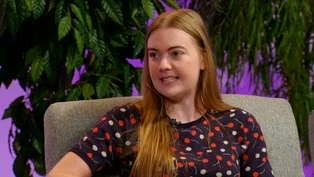
NewCreating a Place to Gather Around Food
Video has Closed Captions
Clip: S7 Ep3 | 1m 42s | Green Top’s community kitchen creates space for cooking, learning and gathering. (1m 42s)
 New
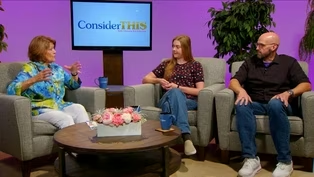
NewWhat It Means to Own Your Grocery Store
Video has Closed Captions
Clip: S7 Ep3 | 1m 56s | Learn how Green Top Grocery members become owners and have a voice in the co-op. (1m 56s)
 New
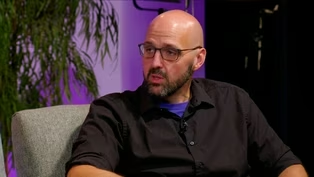
NewVideo has Closed Captions
Clip: S7 Ep3 | 59s | Mary O’Meara shares how her roots shaped her commitment to supporting local food. (59s)
Providing Support for PBS.org
Learn Moreabout PBS online sponsorship New Episode
- News and Public Affairs

Top journalists deliver compelling original analysis of the hour's headlines.
 New Episode
- News and Public Affairs

Today's top journalists discuss Washington's current political events and public affairs.


 New Episode
 New Episode
 New Episode
 New Episode


 New Episode
 New Episode
Support for PBS provided by:
Consider This with Christine Zak Edmonds is a local public television program presented by WTVP