
Mass Shootings, Abortion Rights, Election Primary
6/3/2022 | 26m 46sVideo has Closed Captions
Mass Shootings, Abortion Rights, Election Primary
On this episode of CapitolView, Host Jennifer Fuller joins Dave McKinney of Chicago Public Radio/WBEZ and Dave Dahl of NewsRadio WTAX to examine the week's news. From national stories including mass shootings and abortion rights, to a look at the 2022 Primary - which is less than a month away - we recap the big issues and look ahead to what may be coming.
Problems playing video? | Closed Captioning Feedback
Problems playing video? | Closed Captioning Feedback
CapitolView is a local public television program presented by WSIU
CapitolView is a production of WSIU Public Broadcasting.
Mass Shootings, Abortion Rights, Election Primary
6/3/2022 | 26m 46sVideo has Closed Captions
On this episode of CapitolView, Host Jennifer Fuller joins Dave McKinney of Chicago Public Radio/WBEZ and Dave Dahl of NewsRadio WTAX to examine the week's news. From national stories including mass shootings and abortion rights, to a look at the 2022 Primary - which is less than a month away - we recap the big issues and look ahead to what may be coming.
Problems playing video? | Closed Captioning Feedback
How to Watch CapitolView
CapitolView is available to stream on pbs.org and the free PBS App, available on iPhone, Apple TV, Android TV, Android smartphones, Amazon Fire TV, Amazon Fire Tablet, Roku, Samsung Smart TV, and Vizio.
CapitolView
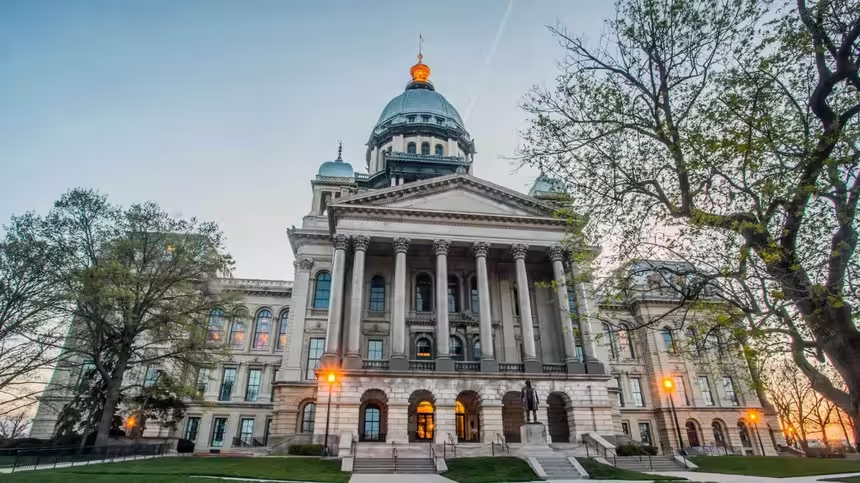
CapitolView is a weekly discussion of politics and government inside the Capitol, and around the state, with the Statehouse press corps. CapitolView is a production of WSIU Public Broadcasting.Providing Support for PBS.org
Learn Moreabout PBS online sponsorship(bright music) (camera beeping) - Welcome to "Capitol View," our weekly look at the happenings inside and outside the Illinois State Capitol.
I'm Jennifer Fuller.
Our guests this week are Dave McKinney of Chicago Public Radio, WBEZ.
Dave, thanks for coming.
- Good seeing you, Jennifer.
- And Dave Dahl, also with WTAX News Radio in Springfield.
Dave, thank you.
- Hello.
- We'll get right to it.
As we record this, we're seeing news on a national level again of another mass shooting, this time in Tulsa, Oklahoma at a medical center.
Meanwhile, the city of Chicago marked what's being called the most violent Memorial Day weekend in five years, nine dead, another 42 people wounded there.
Voters are demanding answers.
They're demanding change, but they say they're frustrated with a lack of action, and in many cases, on both sides of the aisle.
Can there be common ground on topics like background checks or perhaps an assault weapons ban?
Dave McKinney, I'll start with you.
- Well, I think the place to watch most closely I think is what Congress does right now.
There are efforts, particularly in the Senate, bipartisan group of senators right now are trying to hammer out something that would deal with background checks on a federal level that would include funding to beef up school security and mental health work.
And then there's also discussion around creating a red flag law that would allow the seizure of weapons for people who are threats to themselves or other people.
I mean, those things all pivot around whether or not there could be 60 votes in the Senate to overcome a filibuster there.
And the fact that Republicans look at this and perceive a real political risk to themselves in November, I think that's why you see them working so carefully right now with Democrats.
We've seen this show many, many, many times before though, where typically after these awful events in America, there is very little action.
So, you have to kind of look at it a bit skeptically but hopefully.
Here in Illinois, we've had a fairly restrictive set of gun laws.
It is legal for people to go out now, if you have a FOID card, to go out and buy an AR-15, but there are background checks.
In Chicago, there is an AR-15, an assault weapon ban, but Illinois has been on a bit more advanced with gun control than on a federal level, but still even here, as the data in Chicago shows, we are a crime-ridden state, a crime-ridden city, for sure.
- We see political leaders, particularly in the city of Chicago, and in some cases on a statewide level, pointing to the fact that many of the guns used in those crimes in the city of Chicago come from outside the state of Illinois.
As political leaders in Illinois talk about reforms, how critical is it, Dave Dahl, that some of this come from the federal level?
- Well, I think it's complicated, because you can't get people on board with things when you're talking about the state.
Is it really gonna matter what person is in the governor's office?
Is crime gonna go down under Irvin or Bailey than it is under Pritzker?
Is it gonna go up?
How much of an influence does the governor have over the crime rate?
Another thing I'd point out, going back to all of the mass shootings, and I read there have been 20 just since Uvalde?
That's really unbelievable.
But Rodney Davis was in town a little more than a week ago, Congressman from central Illinois, and this was right after Uvalde, and I said, "Sandy Hook," and I went there.
I said, "That was rich white kids, "and it's Republican country."
You'd think a lot of those families were Republican and might encourage some change, that was so outrageous.
And then Davis himself was at a baseball practice when a gunman started shooting up the ball diamond and wounded Steve Scalise.
You'd think Republican Congressman, themselves, would maybe be motivated to action after such a personal attack.
Davis said, "What's needed are stronger schools "and better mental health treatment."
He wouldn't go there with regard to guns, and a lot of people in the red part of Illinois and other red states I think agree with them.
Anything that looks like infringement on the Second Amendment, infringement on what they do with guns, what they're allowed to do with guns is unacceptable.
And as far as kids getting shot, well, thoughts and prayers.
- We're certainly gonna talk about the priorities of crime when it comes particularly to the Republican candidates for governor later on in the show.
I did wanna get to the end of Illinois' parental notification law when it comes to abortion care for minors.
That was allowed to expire at the end of May as a result of legislation that passed last year and was signed by governor J.B. Pritzker.
There was an event that marked that date in the Metro East region, where governor Pritzker talked about reproductive rights and abortion rights, policies that he wants to make sure are maintained in the state of Illinois.
Will this continue, Dave Dahl, to be a hot button issue for state politics given the way Illinois has gone over the last several years?
- Well, you ask about a hot button issue for state politics.
I guess we could say, we'll see what happens when we get through the next election.
But the Republicans running for governor saying they wanna make abortion more restrictive than it is, well, they need the help of the legislature, and you know how that can go in Illinois, not far, what with the Democratic super majorities, and I think they have succeeded in giving Illinois a reputation as a place with pretty liberal and permissive abortion laws, and the governor has said, "Abortion is healthcare."
That's something that he is trying to burn in and this Metro East situation, I mean, they're growing people from miles around, from other states, and I understand that there's gonna be another abortion clinic, a big one in Southern Illinois, if I'm not mistaken, Carbondale-Marion area.
- Carbondale, yeah.
- So, we haven't seen the last of it, and the people who wanna roll back some of the liberal abortion laws, I don't think they're gonna be quiet.
I don't think they're necessarily gonna be successful this year, but they won't stop.
- Dave McKinney, do events like this one this week with Governor Pritzker just solidify his stance on the issue, or is he trying to gain some traction in other areas do you think?
- Well, I think his record is pretty clear in the area of abortion rights.
There's a pretty strong belief, I think, in political circles that women voters, especially in the Collar counties are incensed by the likelihood of Roe versus Wade being overturned.
And that's a potent voting group that Pritzker looks at, you know, they're essential to him to get reelected, so I think that's really the overarching purpose.
He has a deep ideological rooting in this issue.
His mother was an abortion rights advocate, so it's something that's not unfamiliar to him.
This parental notification thing is an interesting, I mean, it's a relic of the period of time in Illinois government when Republicans ran everything.
It was a two-year window of time in the mid 1990s, and there was talk at that point in time of actually going a step farther and having a parental consent law as opposed to just a notification law.
But if you recall, in the mid 90s, we had Governor Jim Edgar in power at that point, and he was an abortion rights advocate, so he was the one who guided the issue more toward notification as opposed to consent.
And the law went through a great period of time where it was never even enforced, because there was a provision that required the Supreme Court to write rules, and the court never did that, and so, it was an issue that just kind of laid dormant for many, many years, and right now, it carries a great deal of symbolism for the people on the abortion rights side, especially as those rights are being eroded by the US Supreme Court, potentially.
- And by the way, don't expect Governor Pritzker to disappear from the Sunday network shows or cable news anytime soon.
He wants his national profile to remain up.
- We've talked about a couple of issues that remain in the headlines and among the talk of national news and national politics, but when it comes down to a local level, when you talk to voters, they're very concerned about the economy and particularly in rural parts of Illinois and in some cities where the economy may not be coming back as quickly as they had hoped after the pandemic.
We see the University of Illinois Flash Index, which is an indicator that takes a look at various tax receipts and other economic indicators.
It dropped slightly.
Anything above 100 on the Flash Index indicates growth.
Last month, it was at 106.
The most recent report said 105.7, so if you're running in Illinois, whether it's on a statewide or even a more local level, does this cause you any concern that Illinois' economy may not be growing as quickly as it was, or that there may be a slowdown on the horizon?
Dave McKinney, I'll start with you on that one.
- Yeah, the economy, I would say, is front and center.
Arguably, I would say it's probably even higher than crime in terms of importance for voters.
Everybody feels it every time you go to the gasoline pump and have to lay out $120 to fill your gas tank.
It's a moment where you're like, "Oh my gosh, how are we gonna do this?"
And the frustrating part for Democrats, and we heard President Biden and his people, this week, arguing that they're essentially powerless to deal with with the root causes of inflation here.
It's not happening just in Illinois.
It's not happening just in the US.
It's a worldwide phenomenon at the moment, and it's, unfortunately, I think an offshoot of the pandemic we've all come out of, so it's very hard to deal with, And I think most people, older people have not, well, young people have not lived through a period like this, and older people have to go back to the late 1970s to remember anything comparable to this, and the 80s too, where interest rates were high and borrowing costs high, and the cost of a pound of hamburger was high.
And I think that's also why we saw Illinois Democrats, when they passed a budget this spring, put this nearly $2 billion in what they call tax savings into the budget, where there was money dealing with savings at the gas pump, an inflationary gas component, wasn't gonna take effect, and the tax on food and groceries wouldn't kick in for a year, so they're sensitive to that.
They're trying to show voters they're doing something about it, but unfortunately there's just not a lot that they can really do that is gonna slow this down.
- The impact of the pandemic, the war in Ukraine, Dave Dahl, is there a place for challengers on either side of the aisle to capitalize on, you know, hey, this person is in office right now, and look what's happening, I could fix that?
- I think on all those things, especially the economy, you can look at who's in office now and say, "They've got it all wrong!"
And the person who's in office can say, "Well, look what the positives are!"
I think, especially with the Flash Index from 106 to 105.7, that's practically imperceptible, and since the end of the pandemic, I think the index has been fairly even.
So, I am not sure the facts support that we're in an economic downturn.
It's not rising fast enough for some people, but it hasn't really in a long time, certainly since the pandemic, and it was in the positive before the pandemic too, but not shooting up at any great rate.
So I think if I'm a candidate, I get to choose my own set of facts, and those- - I'm sorry, do voters care who's to blame for this, or do they just want someone to fix it?
- I think a lot of voters say, "Well, things are bad, so we need a change," and we'll see how bad they think they are, and if the candidates out there, this cycle, we're talking about governor, but pretty soon we'll be hearing about the presidential candidates, we'll see if somebody else has the recipe for change.
Illinois elected Bruce Rauner a few years ago, largely because he was not Pat Quinn, elected J.B. Pritzker, largely because he was not Bruce Rauner, so we'll see, obviously it's gonna be a referendum on how well the governor has managed the economy and maybe the pandemic too, although we haven't heard a great deal about the pandemic in some of the Republican attack ads.
- As we head into November, we're starting to see more and more money line up for particular candidates.
The primary is now less than a month away, early voting is underway, so there are already ballots cast in those primaries, particularly in the Republican race for governor, and we're seeing more money being poured in to the two front runners' campaigns, in the campaign for Richard Irvin, the campaign for Darren Bailey, millions of dollars in the last couple of months for both of them.
Is that money going to be enough for Darren Bailey to overtake Richard Irvin in the polling and eventually at the ballot box, Dave McKinney?
- Well, it gives Bailey the chance of at least being competitive, because what does all this money mean?
I think anybody who turns on their television can see immediately during the commercial breaks what it means.
You have ad, after ad, after ad, oftentimes the same ad playing multiple times in the same show or same news program.
And I think far and away, Richard Irvin is winning the battle of the airwaves at the moment, but Bailey is competitive.
And the real issue right now is money alone is not gonna win the election for the gubernatorial nomination.
It's gonna be likability.
It's gonna be which candidate sets themselves apart and describes why they think they're better, and who just engages voters better.
It sounds so simplistic, and it is simplistic, but I think in Bailey, you look at a guy who seems to be, really ever since he declared his nomination, to be working really hard.
His calendar is just jam packed with stuff.
Irvin has been doing more of a rose garden kind of strategy, being very careful about picking and choosing where he goes and who he talks to in the media.
I'm still among those who hasn't had a sit down with him, and I think it's kind of a thing where...
I remember campaigns in Illinois that have looked very much like this, and one in particular, it was back in 1996.
It was the year that Dick Durbin became US Senator for the first time, but on the Republican side.
There was a lieutenant governor for Illinois, named Bob Kustra, who had all of the party endorsements and seemingly had a clear path to the GOP nomination, but he wound up losing to this conservative guy on the far right fringe of the party, named Al Salvi.
He was a former state lawmaker.
And this race reminds me a little bit of that, because all of the money, all of the endorsements, pretty much are going Irvin's way.
And in Bailey, you have this guy who seems to have a big swath of support in the base of the Republican party, the Trump-loving base of the Republican party, so I think right now it is a very tight race, and I think on election night, it's gonna probably shake out that way.
- I'm guessing on June 9th, we're gonna look around and see a lot of people saying, "Oh yeah, I didn't vote," so I think what's gonna be big is motivating people to actually get out and vote, to get out the vote.
And one thing I think is interesting is Irvin is accusing Bailey and Sullivan of the same stuff that Irvin himself is being accused of, not being Republican enough.
And I think it would be a good conversation what does it mean to be a Republican in Illinois in 2022?
Does that mean, yes, I voted for Trump.
Yes, outlaw all abortions, no exceptions.
Yes, January 6th was legitimate discourse, and the election was stolen.
I forget where I saw it, but I saw a cartoon just yesterday or today about someone pointing to the gas prices and saying, "That's why you don't steal an election."
So, we'll see who really gets out there and who thinks that Bailey's the right one, or if someone who, if he's honest with himself, Richard Irvin is more moderate, certainly more moderate than Bailey.
Bailey's got the extreme right sealed off.
- Dave, to add to your point, I think an interesting thing to watch is whether or not, (chuckles) on June 29th, we see any number of Democrats pulling Republican ballots to cast votes for Bailey, because there's been some research in Georgia, for example, where Brian Kemp, the Governor, and the secretary of state there, Raffensperger, both benefited, I think, from 30 or 40,000 Democrats pulling Republican ballots to vote, essentially as a repudiation to Donald Trump.
And I think there is a strong belief among Democrats that Darren Bailey is a much more favorable matchup in the fall for Pritzker.
So, will there be some under the radar effort by Democrats to pull Republican ballots and cast votes for Bailey?
I've been wondering about that a lot since Georgia.
- You know, you both talk mobilizing voters, and one of the things that could mobilize some voters is an endorsement from former President Trump.
He's made endorsements in other races, in other states.
He's made endorsements in other races in Illinois, but as yet, we've not seen anything in the Republican race for governor in Illinois.
Would a Trump endorsement push either candidate above or below the winning line?
- Well, I don't know, maybe, especially if they were for Darren Bailey.
Bailey's been pulling for it for sure.
- It's starting to almost get so late in the process though, where a campaign's hands are tied in a way, because if you don't have enough time to buy up ad space on television stations to promote that, to produce ads, things like that, it becomes of less value the closer you get.
And I don't know, I don't have any particular insight into the brain of Donald Trump and whether he finds Darren Bailey to be appealing.
I do know that Bailey, I think in the past month, Mary Miller had a fundraiser at Mar-a-Lago, and Bailey made the trip there, and I think there were pictures of Trump and Bailey that circulated on social media.
I don't know if that's enough to make much of a difference.
You would hope, if you're Bailey, that there is some sort of recorded message by Trump or some really forceful language that he could hurry up and put on the airwaves, but time is running out.
If Trump is gonna get involved here, it's gotta be fast.
- As we record this- - And people are already voting by the way, early voting is underway.
- That's true, and as we record this, Republicans are preparing for a debate this evening.
We're recording on a Thursday, and of course, our program airs on Fridays, but as we record this, those GOP candidates are preparing to debate, all six candidates on one stage together on ABC 7 in Chicago.
Is it too late for any of the other candidates?
We talked a lot about Darren Bailey and Richard Irvin.
Is it too late for Paul Schimpf or someone else to make a run or say something that's gonna push them up into that leader role?
- Yes, the other two just have too much support.
- Dave McKinney?
- Yeah, you mentioned Schimpf.
He got the "Chicago Tribune" editorial endorsement, but it kind of reminded me a little bit of the Gary Johnson endorsement they did in the presidential campaign between Donald Trump and Hillary Clinton.
You look at a guy like Schimpf, and he has some seasoning in Springfield, but if you don't have money to be a viable candidate, that says something about you right there.
If you can't persuade donors to get behind you, then it signals broader problems with a campaign, and I don't see, we're long past the days of when an endorsement from a newspaper like the "Tribune" makes much difference.
And I just think the contours of the field right now look pretty well set.
And the only role that I think the Schimpfs and the Sullivans and the Rabines and the Solomons play is the role of spoiler, because if any of them wind up, they're all gonna probably be in the single digits at least.
And who are they pulling votes away from at the top of the field?
That's really the trick here.
I know, for example, in Lake County, McHenry County, there are all sorts of signs for Gary Rabine everywhere, and that would be an area you would think that Richard Irvin would wanna nail down.
He would wanna nail down the Collar counties as much as he could, but if, for example, a Rabine does well in those areas at Irvin's expense, then that signals trouble.
- Certainly, and we've talked a lot about what happens on June 29th, the day after the June 28th primary.
We'll be taking a closer look next week at what the candidates have to say in this ABC 7 debate, which is going on this week, and then we'll also be trying to take a look at will the Republican Party be able to come together behind one nominee heading into the November election?
That's a big question that will come up, starting June 29th and running into November.
Unfortunately though, we're out of time before we run out of topics.
I'd like to thank our guests, Dave McKinney of Chicago Public Radio and WBEZ and Dave Dahl of News Radio WTAX in Springfield.
Gentlemen, thanks so much.
- You bet.
- Thanks, Jennifer.
- You've been watching "Capitol View" on WSIU.
Tune in next week.
We'll have the very latest happenings from inside and outside the Illinois State Capitol.
From all of us at "Capitol View," I'm Jennifer Fuller.
We'll see you next week.
(bright music)

- News and Public Affairs

Top journalists deliver compelling original analysis of the hour's headlines.

- News and Public Affairs

FRONTLINE is investigative journalism that questions, explains and changes our world.












Support for PBS provided by:
CapitolView is a local public television program presented by WSIU
CapitolView is a production of WSIU Public Broadcasting.