One-on-One
Matt Rawitzer; Triada Stampas; Wesley Mathews
Season 2024 Episode 2702 | 26m 55sVideo has Closed Captions
Matt Rawitzer; Triada Stampas; Wesley Mathews
Matt Rawitzer, Executive Director of First Tee – Metropolitan NY, talks about using golf as a vehicle for growth; President and CEO of Fulfill, Triada Stampas, talks about food insecurity and the pathways to success that her organization provides; Wesley Mathews, President & CEO of Choose New Jersey talks about how a trip to East Asia has reaffirmed a 30-year partnership with the region.
Problems playing video? | Closed Captioning Feedback
Problems playing video? | Closed Captioning Feedback
One-on-One is a local public television program presented by NJ PBS
One-on-One
Matt Rawitzer; Triada Stampas; Wesley Mathews
Season 2024 Episode 2702 | 26m 55sVideo has Closed Captions
Matt Rawitzer, Executive Director of First Tee – Metropolitan NY, talks about using golf as a vehicle for growth; President and CEO of Fulfill, Triada Stampas, talks about food insecurity and the pathways to success that her organization provides; Wesley Mathews, President & CEO of Choose New Jersey talks about how a trip to East Asia has reaffirmed a 30-year partnership with the region.
Problems playing video? | Closed Captioning Feedback
How to Watch One-on-One
One-on-One is available to stream on pbs.org and the free PBS App, available on iPhone, Apple TV, Android TV, Android smartphones, Amazon Fire TV, Amazon Fire Tablet, Roku, Samsung Smart TV, and Vizio.
Providing Support for PBS.org
Learn Moreabout PBS online sponsorship- [Narrator] Funding for this edition of One-On-One with Steve Adubato has been provided by Horizon Blue Cross Blue Shield of New Jersey.
Here when you need us most.
The North Ward Center.
Hackensack Meridian Health.
Keep getting better.
NJM Insurance Group.
Serving New Jersey’s drivers, homeowners and business owners for more than 100 years.
PSEG Foundation.
Newark Board of Education.
New Jersey Sharing Network.
NJ Best, New Jersey’s five-two-nine college savings plan.
And by The Russell Berrie Foundation.
Making a difference.
Promotional support provided by New Jersey Globe.
And by NJBIZ.
Providing business news for New Jersey for more than 30 years, online, in print, and in person.
- This is One-On-One.
- I'm an equal American just like you are.
- The way we change Presidents in this country is by voting.
- A quartet is already a jawn, it’s just The New Jawn.
- January 6th was not some sort of violent, crazy outlier.
- I don't care how good you are or how good you think you are, there is always something to learn.
- I mean what other country sends comedians over to embedded military to make them feel better.
- People call me 'cause they feel nobody's paying attention.
-_ It’s not all about memorizing and getting information, it’s what you do with that information.
- (slowly) Start talking right now.
- That's a good question, high five.
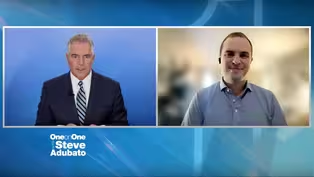
(upbeat music) - We kick off today with Matt Rawitzer, who is the executive director of a great organization.
It is called First Tee, and it's First Tee in Metropolitan New York.
Matt, how you doing today?
- I'm doing well Steve.
Thanks for having me and I appreciate you taking some time to talk about First Tee.
- Well, lemme put this in perspective for you.
I'm not sure how many years ago, but in Essex County at Weequahic Park, the Weequahic golf course, one of the three public courses in Essex County where I'm from, excuse me.
We were there for the kickoff of First Tee and I saw all these young kids from Newark, from Brick City getting involved in golf for the first time, put First Tee in context as we put up the website, because you're doing important things, particularly for kids otherwise would not have, would not have access to golf and everything it represents.
- Well, I appreciate that Steve, and that's awesome to hear that you are part of that opening at Weequahic Park, which was really our first foray into Essex County and has allowed us to do some amazing things with First Tee now going on over 15 years, we've had programs in Essex County specifically, but just for everyone that might not be familiar with what First Tee is, we're a youth development organization.
Our mission is to teach life skills through the game of golf.
That's an important part I always emphasize is that it's golf is the vehicle we use to essentially teach life skills such as respect, honesty, integrity, and our goal is to serve students who typically are in underserved, underrepresented areas who wouldn't normally have access to the game of golf.
So while golf is something that a lot of folks think is a high barrier to entry, it costs a lot of money.
They might not be welcome in certain places.
While sometimes those can be true, one of the things that we are so proud of at First Tee, it's kind of combating some of those, you know, notions of what golf is and ultimately we try to make all of the things that's great about golf, an opportunity for everyone.
So we do that through job opportunities, education, and all of that is centered around partnerships such as the ones we have in Essex County to make these available to those who have access to public spaces.
- So Matt, as as we put up the website, the question is how does a kid, how does, how would a parent of a kid get access to get involved with First Tee?
Because one of the things that we've learned in the media and communication information businesses, people will hear about something but not know how to access it.
Talk about that.
- That's also a great point, Steve and something we try to make sure it's very available to everyone.
So I know you guys are putting the website on the screen, that's the number one way.
Visit our website, take a look.
We have actually six campus locations across the Metropolitan New York area.
Two in Essex County and on our website- - Is it one second is it Weequahic and Hendricks Golf Course?
- Correct.
We have a program site at Weequahic Park Golf Course and Hendricks Field Golf Course in Essex County.
And again, take a look at the website and that has all our schedules, all the information to sign up for a class.
We serve students ages six to 18.
So no matter how old you are, there's gonna be an opportunity for you.
- Real quick.
Where does the money come from, because you're a not-for-profit organization?
We are a not-for-profit production company and we spend at least, and I say this all the time, at least half of our time raising money to be able to do what we do.
Your dollars come from?
- Also a great question for us, we are very, we take a lot of pride in the fact that really all of our money is fundraised privately.
We do that primarily through golf outings as I think a natural way for people to get involved and support our organization.
But we also have great partners through corporate partners such as Samsung, Morgan Stanley, MasterCard, and beyond that we also work with different foundations and grants.
Verizon, Blue Cross Blue Shield is a very important one for us in Essex County in particular.
So it's really going through and frankly kind of doing what we teach through the game of golf.
It's using the relationships and networks to find folks that really see where golf can take people, but ultimately how that makes them a better person.
So we go to individuals, corporations, like I said, and really anywhere that golf kind of exposes itself.
- And folks can go on the website not just to find out, but also if they'd like to contribute to the work of First Tee.
The coaches, I know that the coaches play an important role, but not just in how to follow through, how to putt, how to line things up.
That's the, those are the, the X's and O's, if you will of golf.
But the coaches at First Tee are more than that, Matt.
- Correct.
The coaches, and one of the points that I take great pride in with our Metropolitan New York chapter is that we have 15 full-time coaches on our coaching staff.
We take that approach to invest in our coaches because they're the ones who are really interacting with the students who are teaching those life lessons.
And again, while golf is the vehicle, ultimately we have folks that are former educators that worked at schools, they're former phys ed teachers, for example, our site director at Hendricks Field, Tom Grant, former phys ed teacher at Nutley High School.
And we take that approach because that's how we build relationships, develop frankly, what are the best opportunities for our students because we get to know them.
One of the things I really like to talk about is that across our chapter, the 3,500 students that we serve, we know the names of each one of those students as well as their families.
So having coaches that really take the lead on that and develop relationships is critical for us.
- Matt, do us a favor.
Our producers were telling me there's one particular young woman, was it a young woman who got involved in First Tee and it changed everything for her from Haiti, young woman from Haiti?
- Correct.
We had one young woman who joined us going back to about 2017, first generation immigrant family from Haiti.
Really just coming to New York and the United States for a better life.
She was entering high school and found First Tee through her school.
And we have a lot of outreach programs where our coaches will go really know those schools and make sure we have a great introduction to those students as well.
Going to the education component of our program, this young woman entered our Path to College program, which provides- - It's called a, it's called Path to College program, right?
- Correct.
It's a component of our First Tee program that provides sort of how to leverage those core values that we teach.
Honesty, integrity, perseverance, you know, we teach that on the golf course.
Now how do you apply that to your math homework?
So we provide one-on-one tutoring, peer-to-peer tutoring as well as SAT high school and college application help.
And this particular student really entered that right away knowing that she would need some help coming from a new country.
One of the things we do is college tours.
So we took this young woman on a tour to Yale.
She had never heard of Yale, gets on campus, looks around, this place is pretty nice, rightly so.
So four years later, skip ahead, through our Path to College program.
She ended up getting into Yale.
Going to Yale and she has now graduated with a degree in biomedical engineering all because she just showed up at a golf course.
- So folks, first of all, Matt, thank you so much for sharing that story.
All the best to the young woman you just described and shared with us and everyone else who's involved in First Tee.
I love golf and I learned to play at Hendricks Golf Course.
They public a golf golf course in on the border of Belleville and Newark, if you will, my hometown of Newark.
And so for so many kids getting into golf and what golf represents, not just how to play the game the right way, but meeting people in this Path to College program, it's all good stuff.
And Matt, to you and your colleagues at First Tee, wish you all the best.
Well done.
- Well, we appreciate it and again, I encourage anyone to get involved, visit our website, learn more, and very much appreciate you having us, Steve.
This is exciting.
- That's Matt from First Tee.
Stay with us.
We'll be right back.
- [Narrator] To watch more One on One with Steve Adubato find us online and follow us on Social media.
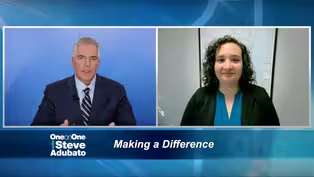
- We're now joined by Triada Stampas, who's President and CEO of an organization called Fulfill.
Good to see you, Triada.
- Thank you for having me.
- Great.
We're gonna put up the website.
Tell everyone what Fulfill is.
- Fulfill is the food bank that serves Monmouth and Ocean Counties at the Shore in New Jersey.
So, we serve a network of about 300 food pantry, soup kitchens, and other points of food distribution across those two counties.
- Triada, how bad is the food insecurity problem down in two counties, Ocean and Monmouth, that a lot of folks think, "Well, it's wealthy.
It's two of the wealthiest of the 21 counties in New Jersey.
What could the problem be?"
Please.
- You know, that's a great question, and I think you have identified, you know, one of the challenges that we face in this community.
Over 100,000 people a month are turning to a food pantry in just our two counties.
We are seeing need that is unprecedented, and we're past the pandemic.
We are past kind of the crisis point that we were all recently in.
And instead of seeing food insecurity drop, we are seeing the need for food assistance actually go up.
- Triada, what kind of families, what kind of people are we talking about who are now experiencing food insecurity that pre-pandemic may not have fallen into that category?
- Yeah, it really runs the gamut, Steve, and I think it's one of the challenges for us is that the common perception of who needs a food pantry or soup kitchen, I think is what people are most likely to see, which is someone who is unhoused or indigent.
And that's the mental image that comes to mind.
In reality, that is a small minority of people who are food insecure.
We are seeing working families, we are seeing senior citizens, anyone who has gotten pinched by the high cost of food and the inflation and cost of living that we've all experienced when their income hasn't been climbing at that same rate is turning to help that they may be never needed before.
- Triada, help us understand something.
In terms of government support, public support for the work you're doing, how much of your support is government taxpayer-funded support and what is on the private side?
Foundations, corporations, individuals, et cetera.
- So, food banks rely on a mix, and we do receive a significant amount of government support.
We turn to donations from individuals, from foundations, from corporations to supplement because we cannot subside on government assistance alone.
This really is an all-in effort for our entire society, really, to address food insecurity.
It is bigger than any one actor, bigger than any one entity to fix at this point.
And so we receive a significant share of assistance from both state, federal, and local government, but that alone doesn't carry us forward.
- And the corporate and foundation support comes from what kind of folks?
Who seems to care about the kinds of issues and the kind of people you're serving every day?
- You know, we're really lucky to have local businesses here at the Shore chip in, do fundraisers.
We have the creative class of musicians performing and donating a portion of their take to Fulfill, and the Jersey Shore does have a really well-established music scene.
We have major foundations like the Robert Wood Johnson Foundation, right, all of those big names as well as smaller local regional foundations that contribute to this cause.
So there are lots of folks who care, luckily.
The need is something more, however, right now than we are equipped to really address.
- Triada, help us on this.
There's an interesting program, the Fulfill's Culinary Skills Training Program.
What is that program and who benefits from it?
- So that is a job training program for folks who want to get their foot in the door in food service.
And so we provide a 13-week program for adults to learn.
I mean, I like to talk about it as everything from knife skills to life skills to, you know, help get your foot in the door in the food industry.
And so it is 12 weeks of instruction in the classroom and in the kitchen, one week in an externship with a local business, whether it's a restaurant, a catering facility, an institutional kitchen where you put those skills that you've been trained in into use, you know, in a real setting on the job.
And we think of it as a one-week job interview 'cause we work to identify externships at companies that are hiring.
We want our graduates to be able to seamlessly move from training into a real job that helps put money in their pocket and get them started in a new career.
- So, to Triada and her team, I just want to remind folks that part of our job is to feature not-for-profit organizations making a difference, which is why in many ways, I don't know, well over a decade ago we started calling the series "Making a Difference," not-for-profits "Making a Difference," and Fulfill clearly is one of those organizations in Monmouth and Ocean Counties where awful lot of folks go, "Well, really, seriously?
There are people who need help?"
And Triada has made the case in a very compelling and impactful way that that clearly is the situation.
Triada Stampas is the President and CEO of Fulfill.
Triada, thank you so much for joining us.
- Thank you for having me, Steve.
Really appreciate it, especially this time of the year.
- Yeah, our pleasure.
We're taping this right before the holiday season.
It'll be seen in 2024.
Thank you, Triada.
Stay with us.
We'll be right back.
- [Narrator] To watch more One on One with Steve Adubato find us online and follow us on Social media.
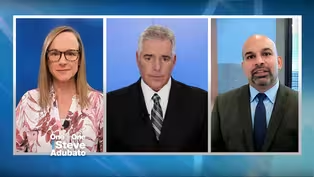
- Recently folks, I sat down with Wes Matthews, who's the President and Chief Executive Officer of Choose New Jersey.
It's an important not-for-profit organization.
And they were involved in a mission, if you will, to East Asia.
They went with Governor Murphy and a team of folks from academia, from the business community, from the Not-for-profit community, all about economic development, bringing business to the state of New Jersey.
And it also involved innovation and discovery, which is part of our Innovation And Discovery series as well.
So here it is, a one-on-one conversation with Wes Matthews.
You can't talk Discovery and Innovation in New Jersey unless you talk about going overseas and engaging in potential partnerships.
And we're joined by Wes Matthews, President and CEO of Choose New Jersey.
This is part of our Discovery and Innovation series.
Wes, great to have you with us.
- Thank you, Steve.
- Now again, we're talking about Discovery and Innovation New Jersey, you and the team along with Governor Murphy and a whole range of others.
And I believe choose was the key coordinator in this, went to East Asia for what?
And why is it so related to Discover and Innovation in New Jersey, please?
- Yeah, thanks again, Steve, for having me on.
So East Asia, the countries there are tremendous partners of New Jersey's, not just now, not just over the last few years, but over decades.
So when we talk about some of our key trade and investment partners globally, that conversation can't happen without the likes of Japan, Korea, Taiwan, mainland China, all in that conversation.
Again, if you look at each of those countries or island territories individually, they are key contributors to our economy and they have been for decades.
So it was a economic mission we wanted to do for several years.
The pandemic got in the way and we were very lucky, fortunate to be able to put this on with the governor and our largest delegation to date on this overseas mission.
- Before Mary jumps in, let me try this, Wes, because I've often thought that when it comes to going overseas like this, and I don't want, whether people call it a trade mission, I don't care what you call it, but you're, you're there to engage and connect with people and build relationships.
From your perspective, what is the connection, the correlation, Wes, between leadership, successful partnering, and building relationships with people you've never met before?
Please.
- Yeah, I think what's probably most important there is that you have a common vision for your economies and your countries or state in our regard.
So for New Jersey, those relationships that I say we've had over decades, we might have taken them for granted over the last 20 years.
And so it was important to us to signal more than anything, to send that signal to Japan, Korea, and Taiwan, that you are important to New Jersey, you are important to our economy.
You're important to our academic institutions.
And what we are trying to create here, as the governor often calls this innovation-fueled economy that those countries have done or are in the process of doing that we wanted to model and learn from and also share some of our lessons learned.
So I think more than anything, it's a very important signal to these countries around the world.
And, you know, just being, you know, cold-blooded about it, every other state in the country is also waving their flag abroad increasingly these days.
And so it's really important for New Jersey to do that.
And I feel we probably have the best value proposition and are led by a governor and folks in state administration and here in my organization, frankly, that have that experience doing that abroad over either their careers currently or in previous careers.
We wanted to take advantage of it and we felt we have a small window of time here to reestablish ourself and our primacy in these areas.
- Interesting stuff.
Mary.
- Yeah, I have a actually very selfish question for you, Wes, and it has to go with the film and media industry in New Jersey.
I know choose New Jersey along with so many other partners, have been a huge proponent for bringing more of film, media, TV into New Jersey.
Can you talk a little bit about that?
Why is that so important and why now?
- Yeah.
- To the state of New Jersey and our economy.
- Right, that is a great question and one that I love to answer.
You know this, but some of your viewers might not, and I guarantee, folks outside of our state often do not.
But New Jersey was the birthplace of the film industry in the United States, if not the world.
I mean, the motion picture was invented here just a few miles from where I am in Newark, in West Orange, Fort Lee was the film- - Edison?
- Yeah.
- Are we talking Edison?
- West Orange initially, yeah.
But Thomas Edison.
- No, no.
- You're right.
- Thomas Edison, yeah.
- That's right.
(all laughing) - No, Wes- - It's not too confusing In New Jersey, the names of our towns.
- That is right.
Thomas Edison in West Orange.
And Fort Lee, again, silent film capital of the country, if not the world.
And so I think again, over several decades, we lost our way in that industry.
And then Hollywood stood itself up and the film industry for all practical purposes moved as far away from New Jersey as possible to the other side of the continent.
And over these last few years, we realized that other states like Georgia were getting in the game in terms of film production with some of the most lucrative tax incentives in the country.
And so we thought, "Well why can't we do that and do that again?"
And so, we put some thought into it.
And again, under the governor's able leadership along with his partner on all things economic development, Tim Sullivan at the EDA and others here at Choose, we put this plan in place to re-envision or recapture core components of the film industry.
And that starts, you know, with pure economics.
So again, reinstituting one of the most aggressive incentive programs in the country to lure our production back to the state was a key component of that.
Producers already know what New Jersey has, you know.
Our counties and townships are film ready in many ways.
We have a commission that's doing great work over decades, but now they have tools in their quiver, so to speak, to allow them to win back some of this business.
And we've had great successes as you've seen over the last few years.
- And that is, is that the film commission?
- It is, yeah.
It is.
There's a longer official- - Yeah, I know.
That's why couldn't think of it.
I was putting that back on you, Wes.
- Yeah.
- And they're constantly attracting, their job is to attract film and media-related projects to the state.
Hey, Wes, before I let you go, before we let you go, real quick on this.
Innovation.
The term means different things to different people.
You're talking about Edison, not the town, but Thomas Edison over in West Orange.
But when it comes to economic development opportunities in this state, innovation isn't an option.
Constantly innovating and discovering and never accepting the status quo.
I know I sound like a cliche, that's not a strategy.
The status quo is not a strategy when it comes to discovering innovation.
- That's right.
- One minute on that before we let you go.
Thanks, Wes.
- Yeah, thanks again, Steve.
So I think, you know, in some respects, New Jersey has a very tough challenge here because we are an innovation economy.
We have been for decades, if not over a century.
For us to continually try to innovate and be at the leading edge of that takes a lot of work.
It takes a lot of work at state government.
It takes a lot of work at the municipal and county levels to constantly be ready to one, be ready to change, which is often the hardest thing to do, right?
But you and I both believe you innovate or die.
And as our innovation economy goes so well, the overall economy of New Jersey.
And I think, you know, again, that begins and ends with effective leadership at every level.
At state government, here at organizations like Choose New Jersey and the business chambers at the municipal and county levels.
Setting that vision and offering a strategic direction for the state economy and being able to put the resources in place to be able to accept those innovators.
'cause it's businesses of all sizes, including the startup economy.
It's the educational institutions and the students that we want that are gonna fuel the next chapter of our innovation story.
So it's all of that.
And then being able to create an economy that can be adaptable and resilient, I think is probably, you know, very important.
- Good stuff.
Important stuff.
Wes Matthews is the President and Chief Executive Officer of Choose New Jersey.
Check out their website to find out more about them.
Wes, we thank you.
Appreciate it.
- Thank you.
- [Narrator] One-On-One with Steve Adubato is a production of the Caucus Educational Corporation.
Celebrating 30 years in public broadcasting.
Funding has been provided by Horizon Blue Cross Blue Shield of New Jersey.
The North Ward Center.
Hackensack Meridian Health.
NJM Insurance Group.
PSEG Foundation.
Newark Board of Education.
New Jersey Sharing Network.
NJ Best, New Jersey’s five-two-nine college savings plan.
And by The Russell Berrie Foundation.
Promotional support provided by New Jersey Globe.
And by NJBIZ.
The North Ward Center continues to expand their services and outreach in Newark, from the childhood years to the golden years, Offering programs like preschool, youth leadership development, Casa Israel Adult Medical Day program our Family Success center, as well as a gymnasium.
And most recently Hope House, a permanent home for adults with autism, supporting and nurturing our autism community with Hope House 2 coming soon.
The North Ward Center.
We’re here when you need us.
Choose NJ CEO Discusses Recent Trip to East Asia
Video has Closed Captions
Clip: S2024 Ep2702 | 10m 19s | Choose NJ CEO Discusses Recent Trip to East Asia (10m 19s)
The Heightening Issue of Food Insecurity
Video has Closed Captions
Clip: S2024 Ep2702 | 7m 34s | The Heightening Issue of Food Insecurity (7m 34s)
Using Golf as a Vehicle for Growth in Underserved Areas
Video has Closed Captions
Clip: S2024 Ep2702 | 9m 43s | Using Golf as a Vehicle for Growth in Underserved Areas (9m 43s)
Providing Support for PBS.org
Learn Moreabout PBS online sponsorship
- News and Public Affairs

Top journalists deliver compelling original analysis of the hour's headlines.

- News and Public Affairs

FRONTLINE is investigative journalism that questions, explains and changes our world.












Support for PBS provided by:
One-on-One is a local public television program presented by NJ PBS