State of Affairs with Steve Adubato
Matthew Melmed; Audrey Lane; Brandon McKoy
Season 10 Episode 6 | 27m 28sVideo has Closed Captions
Matthew Melmed; Audrey Lane; Brandon McKoy
Matthew Melmed, Executive Director, ZERO TO THREE, talks about brain science and why high-quality care for children under three can play an important role in early brain development. Audrey Lane, President of Garden State Initiative, analyzes aspects of Governor Sherrill’s FY 2027 proposed budget. Brandon McKoy, President of The Fund for New Jersey, talks about ways to safeguard public health.
Problems playing video? | Closed Captioning Feedback
Problems playing video? | Closed Captioning Feedback
State of Affairs with Steve Adubato is a local public television program presented by NJ PBS
State of Affairs with Steve Adubato
Matthew Melmed; Audrey Lane; Brandon McKoy
Season 10 Episode 6 | 27m 28sVideo has Closed Captions
Matthew Melmed, Executive Director, ZERO TO THREE, talks about brain science and why high-quality care for children under three can play an important role in early brain development. Audrey Lane, President of Garden State Initiative, analyzes aspects of Governor Sherrill’s FY 2027 proposed budget. Brandon McKoy, President of The Fund for New Jersey, talks about ways to safeguard public health.
Problems playing video? | Closed Captioning Feedback
How to Watch State of Affairs with Steve Adubato
State of Affairs with Steve Adubato is available to stream on pbs.org and the free PBS App, available on iPhone, Apple TV, Android TV, Android smartphones, Amazon Fire TV, Amazon Fire Tablet, Roku, Samsung Smart TV, LG TV, and Vizio.
Providing Support for PBS.org
Learn Moreabout PBS online sponsorship- [Narrator] Funding for this edition of State of Affairs with Steve Adubato has been provided by The Turrell Fund, a foundation serving children.
The Burke Foundation Rowan University.
The fastest growing public research institution in the Northeast.
The New Jersey Education Association.
PSEG Foundation.
New Jersey Sharing Network.
Robert Wood Johnson Foundation.
Working to create a future where health is no longer a privilege, but a right.
Hackensack Meridian Health.
Keep getting better.
And by Horizon Blue Cross Blue Shield of New Jersey.
Promotional support provided by NJBIZ.
Providing business news for New Jersey for more than 30 years, online, in print, and in person.
And by New Jersey Globe.
[INSPRATIONAL MUSIC] - Hey everyone, Steve Adubato.
We kickoff the program with one of our most popular and impactful guests.
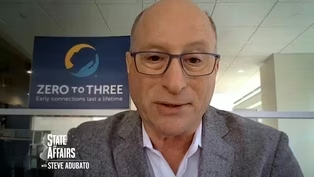
He's Matthew Melmed, who's executive director of a terrific organization called Zero to Three.
Matthew, good to have you with us again.
- Steve, it's a pleasure.
- Tell everyone, as we put up the website for Zero to Three, what it is and why it's so important, particularly in the area of childcare where we've done so much public awareness programming.
- Well, Steve, Zero to Three is an organization whose mission is to ensure that every baby has a strong start in life.
And the reason for that is that the most important period of learning in a child's life happens well before kindergarten in the first three years, and thus our name.
And during this time, a baby's brain forms more than 1 million neural connections every second.
And the early experiences that a baby and a toddler has helps them to learn to manage their emotions, to build relationships the rest of their lives.
In short, the foundation for who it is that we become as adults and the connection to childcare is that high quality early childhood education and childcare environments actually support development.
It's the experiences and the relationships that babies and young children have where they can have nurturing relationships, responsive caregiving, opportunities for learning that really form who we are and our identity from early on.
So I guess the bottom line, Steve, is you invest in babies.
We invest for the rest of our lives.
- Absolutely, and we'll put up the website for our initiative or the initiative that we're very much a part of, Start Strong NJ, which is creating greater public awareness around the need for accessible, affordable, quality childcare.
Not only its impact on families and on children, but also on the economy.
Along those lines, Matthew, did you just describe what is referred to as brain science?
- Yes, neuroscience has clearly demonstrated that we can strengthen certain neural connections in the brain based upon the fact that if children have really strong nurturing relationships with their parents and their caregivers, if they're in language rich environments, if they have opportunities to explore and learn and have support for their social emotional development, synapses in their brain strengthen.
And if conversely, they have a series of adverse early childhood experiences, they fear adults.
They don't connect with their caregivers in healthy ways.
The environment may have material deprivation or even toxic stress that forms other synapses to strengthen.
And those are the ones that get us in trouble in school and in life.
- Along these lines, Matthew, you understand childcare from a national perspective, from a perspective that most of us don't get to see who are very New Jersey centric.
That being said, public policy around childcare, is it literally state by state?
Because the federal government has, I don't even, I'm not even gonna call it a childcare policy, but they have so many programs and different federal agencies that impact childcare.
Is it literally state by state, Matthew?
- It's a combination, Steve.
Most of the funding is federal in nature, but how it is delivered is really driven by the states with federal guidelines.
And we do not fund it adequately enough, neither at the federal level or the state level.
And we have to think of childcare as a early learning opportunity.
An essential infrastructure, and from a public.
- Excuse me, does that include?
Sorry for interrupting.
Does that include daycare as part of it?
- Yes, when I say childcare.
- Right, I'm sorry.
- I, you know, I think daycare is a term that people don't use as much because you find that parents who have different work time and responsibilities, not just during the day, we need to be thinking about this as beyond daycare.
In fact, beyond childcare, we have to be thinking about it as early care and education 'cause that's really what is happening.
- So I'm curious about this, the return on investment.
How would you describe, Matthew, the quote, ROI, the return on investment for if, in fact, governments, state and federal government were to invest in the way it should be investing in childcare and not see it as charity or giving it away, but there's a return.
Describe that return, Matthew.
- Well, there's two principle returns.
One, it enables parents to work and enables them to work if their child is in a safe and supportive environment where they can focus on their work.
So I think that is clearly a strong economic driver.
The bigger return on investment is the return that happens when babies and toddlers and young children get the care and support and education that they need so that they are ready to enter school ready to learn and be able to have the emotional capacity to navigate that.
- Before I let you go, the Healthy Steps program, describe it.
It's the Zero to Three Healthy Steps program.
What is it and why is it so important and impactful, Matthew?
- Healthy Steps, it is, in essence, embeds within a pediatric setting where virtually every baby shows up.
A developmental specialist who could have the time and training to answer the key questions that parents have about their children's development or behavior.
And pediatrics can play a major role in supporting early learning because it's where virtually every baby comes.
Programs like Healthy Steps embed this developmental specialist.
New Jersey has secured Medicaid reimbursement for Healthy Steps, which expands it to many more families.
However, gaps still remain.
Only 54% of babies who receive Medicaid actually receive six of the recommended well-child visits in the first 15 months, and only 45% received developmental screening in their first three years.
So we've got a ways to go.
New Jersey is great in that it's opened the pathway for this program to scale, but we have to put the emphasis on making that happen.
- Matthew Melmed, we've had him many times, actually go on our website, SteveAdubato.org, look at past interviews we've done with Matthew on a whole range of childcare centric topics.
He's the executive director of a terrific organization called Zero to Three, part of a important coalition committed to affordable, accessible quality childcare.
Matthew, as always, thank you so much for joining us.
We appreciate it.
- Thank you, Steve, my pleasure.
- You got it.
Stay with us, we'll be right back.
(grand music) - [Announcer] To see more State of Affairs with Steve Adubato programs, find us online and follow us on social media.
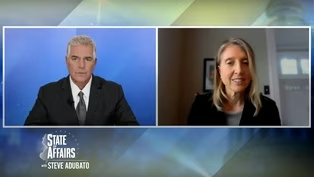
- We're now joined by our good friend, Audrey Lane, who's president of Garden State Initiative, and let me disclose one of our newest partners and underwriters talking about the budget process in the state of New Jersey so people can find out more.
Audrey, great to have you with us.
- Thanks so much for having me.
- Describe Garden State Initiative first.
- So, Garden State Initiative is a nonprofit, nonpartisan think tank, and we look into economic issues in the state and recommend policy solutions for some of those problems we're facing.
So, we look into energy, for example, our school funding formula, or transportation, and really see the impact on taxpayers and how we can maybe improve our policy to make this a better place and a better state.
- And budget transparency is a big part of that, particularly as it relates to is what I believe you call discretionary funding, which is a funny word.
What is budget transparency and how does it connect to discretionary spending?
- So, we intentionally use the word discretionary spending, because there are a lot of terms that are used in this realm and they often have a negative connotation.
We're really trying to be fair and unbiased with regard to our analysis of this, but you'll often hear others used to refer to this as either pork spending or Christmas tree items.
So, this is spending that goes on above and beyond the normal or the prescribed budget process in the state where there's a public process there's a give and take, and there's real analysis by the departments who proposed the budget and public input.
And these are things that are getting taxpayer dollars without that process.
And last year it added up to about $860 million altogether.
- We had Assembly speaker Craig Coughlin on, and we talked about this and he said, "Steve, there's a misnomer about this."
He goes, "Look, we're talking about legislators who fight for state funding for projects in their district that matter and are important."
He said, "So, to call it anything other than legislators doing their job is confusing and not accurate."
You say?
- Well, I say it's a process that's not done in a public way.
And yes, these are all great projects, right?
Everyone wants to buy a new firetruck, but why is this town having a state-funded firetruck and in another municipality that comes from your local taxes?
So, we all pay into the state tax bucket.
Why are some people getting more out of that state tax bucket and some people have to go more into a higher property tax bucket?
And that's really what we're looking at.
- And it's not my job to offer commentary, but as a former state representative, former legislator, who served on the budget committee, the answer to the question, which is not a rhetorical one, is because the legislators who have the ability to get it passed and are in the party of the majority can get it moved.
And those who are not in the majority don't have a lot of those items.
And you don't need to comment on that, but that's just a fact.
That being said, here's the thing that I often think about.
So, the Governor, Governor Sherill, who we just had on, check out our website SteveAdubato.org, it's on the bottom of the screen.
Check out that full half hour we did with the Governor.
A lot of it was about the budget.
Six, excuse me, $60.7 billion budget.
How the heck, Audrey, is the average person expected to understand legislature?
As a former, I served on the budget committee and have the time I was like, "What's really going on here?
I can't follow it."
How's the average person supposed to follow and understand the budget process?
- Well, they can look at NJBudget.com.
They could follow Garden State Initiative.
- NJBudget.com.
What is the difference between that and the overall site for the organization?
- Garden State Initiative is going to focus on a lot of different issues.
We're gonna look at energy policy, school funding formula, transportation, a variety of issues.
NJBudget.com is specific to the budget.
And so, look at both, but we're gonna boil it down and we're gonna look at it.
But to your point, Steve, even legislators aren't necessarily following it, because at the end of the day, and you know this, at the end of the June when the vote comes, you know, when it's called for a vote, oftentimes, the legislators are seeing the final budget minutes, hours right before, and that's hundreds of pages of data.
And so, this is voting on a budget sight unseen.
And so, it's really not fair.
It's something we've been fighting about.
We've been talking about budget transparency, as you know, for a couple of years.
This is a nonpartisan issue and it's something actually, that the Governor has been paying attention to and talking about.
And we're really pleased that there's two issues that we've paid a lot of attention to, both transparency and this discretionary spending that Governor Sherrill is paying a lot of attention to.
- And Audrey's colleague, Regina Egea, who is the chair, if I'm not mistaken, of Garden State Initiative.
Check out SteveAdubato.org.
A previous interview we did with Regina on these issues as well.
Real quick on this.
Energy, the Governor, two executive orders right out of the box, freezing, if you will, energy rates, utility rates.
Your organization, what is it that you expect the Governor to do on energy utility rates, A and B?
What really can a governor do?
- Well, this is, as you know, an issue that is front and center for New Jersey and for us at Garden State Initiative.
What we really need is not to just look at the rates.
We need to look at our energy portfolio and we need to reimagine the New Jersey Energy master plan.
The last update or iteration was done to it at the end of last year, and it really didn't make any substantive changes to it.
It still calls for a fair amount of offshore wind.
It still calls, you know, for a fair amount of intermittent energy, which is fine in itself, but we're lacking the energy we need in our state right now.
- We're at a deficit.
- We're in a deficit.
- Thank you for - We're importing.
- filling in my blank - No, no, no, listen.
- Yeah.
- Because people don't think that way.
Like, "What do you mean there's a deficit?"
Not a budget deficit, it's an energy deficit.
Go ahead, I'm sorry.
- It is, no, thanks for filling in the word there.
But when we have a bigger demand than we have supply, we all know what happens, and the cost goes up.
And the rate payers in the state are really feeling that now.
We need to reimagine the New Jersey Energy master plan.
We need to be realistic about our energy goals, not just environmental goals, but energy goals.
And these two can co-exist and we need to make sure that they do.
- Last question on this.
Tax policy.
When we had the Governor on, and again, check out that very in-depth conversation with Governor Sherrill, it's a full half hour, mostly about public policy, largely about financial budget issues.
The Governor made it clear several times, no tax increase.
Is that a fact that there's no tax increases?
- This is a tricky answer and it depends who you ask.
So, there were no, and welcome to, you know, New Jersey policy and politics, right?
But there were no outright tax increases and certainly, none for the residents of New Jersey.
That being said, there are certain tweaks to the business tax policy that will increase their costs next year.
And so, there were changes to what they can write down, as far as losses.
These will in effect the tax increase on businesses, which will also impact residents and anyone who pays for goods and services in the state.
So, it's semantics and you can answer it how you want, Steve.
- And also Michele Siekerka, the president of the New Jersey Business and Industry Association joined us.
She will answer that question as well.
Hey, Audrey, thank you to you and the team at Garden State Initiative.
We'll have more conversations about fiscal matters in the state of New Jersey.
Thank you, Audrey.
- Thanks so much for your time.
- You got it.
Stay with us.
We'll be right back.
(grand music) - [Announcer] To see more State of Affairs with Steve Adubato programs, find us online and follow us on social media.
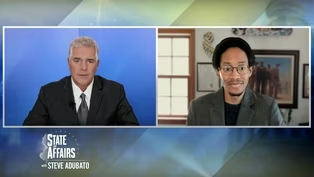
- We are pleased to once again have with us Brandon McKoy, who's president of the Fund for New Jersey, one of our newest underwriters talking about, or focusing on public policy in our state.
Brandon, good to have you with us again.
- It's great to be with you, Steve.
Thanks.
- Tell everyone, as the website is up for the Fund for New Jersey, tell everyone what the 2025 Crossroads report is, and why it's so important.
- So the Crossroads report is the results of a series of four public forums that we at the Fund for New Jersey held across the state last year in 2025, leading up to the gubernatorial election.
And these events brought together more than 300 attendees statewide.
Newark, New Brunswick, Camden, and Princeton, to discuss issues of democracy, economic justice, equity, environment, mobility, housing, education, just everything that sort of affects the day-to-day lives of New Jerseyans.
And so the result is what you see in the Crossroads report, and sort of represents a bit of a roadmap about what are the things that folks are hoping to see addressed when it comes to the lawmakers that represent them and the things that they need in order to succeed in this current state.
- Let's also make it clear that the Fund for New Jersey is a not-for-profit organization with no partisan affiliation.
That being said, there are a couple things I want that are so pressing.
Check on our website, SteveAdubato.org, the full half-hour interview we did recently with Governor Sherrill talking about many of these issues.
But the first one I wanna talk about is really, the question of protecting public health.
We have a series called "Trust in Public Health."
A lot of it's focused on vaccine confusion, let's say.
What does protecting public health mean to you and your colleagues at the Fund for New Jersey?
And why is it so critical at this point in time with the federal government and our state government seemingly, granted, have very different perspectives on what public health should look like, and what vaccine policy should look like.
Please.
- So I don't think we explicitly discuss vaccines or medical policy in this report, but I will say that public health is more than just your diet.
And what are gonna be the practices and sort of policies and structures that we implement, at a sort of local, county and statewide level to ensure that our communities are safe, that they're healthy, that they're able to do what they gotta do and live lives that are full of joy and prosperity.
And so yes, there's lots obviously that is dealing with what is your doctor telling you, what's your family doctor doing for you, and helping you to be healthy on a day-to-day basis.
But beyond that, it is about the environment or the community that you live in, the air you breathe, the water you drink.
- I'm sorry for interrupting.
Is lead remediation part of that?
- Absolutely, lead- - I'm sorry, gotta pick up that point, I'm sorry.
- Yeah, yeah, I mean, yeah, I was gonna say, housing, and is there lead in the walls?
Is there lead in the water?
So when we think broadly about what does a healthy New Jersey look like, yes, we gotta make sure that folks are getting good medical advice and good guidance, but I think we do a disservice to ourselves and the state as a whole if we only think about it in that narrow way.
It is about the 24/7 lived reality of our residents, and are they able to live in a healthy community no matter where they are?
- And along those lines, living in a healthy community.
How about being able to afford housing in this state, which is a critical piece of the Fund for New Jersey portfolio?
Talk about that please, Brandon.
- Absolutely.
Obviously, the construction of more affordable housing options and units in the state is crucial.
We have a deficit when it comes to needing to have more options for people no matter where you are, whether you're in Newark, or whether you're in Camden, or Atlantic City.
This is the, 2026 is the fourth round of the Mount Laurel decision.
And basically what that means on a legislative basis is that the state is in negotiations or conversation with every municipality around what is their affordable housing obligation, what do they have to construct, be able to contribute to the affordable housing need in the state.
And you see a lot of towns, I think historically, a lot of towns have resisted the construction of affordable housing based on a lot of sort of untruths, let's say.
But this time around we see a lot of towns really understanding that not only is affordable housing important for their residents, but it's important for the economy, and helps them have a more balanced and healthy economy as well.
- And P.S., we're going into this in greater depth on housing, affordable housing, but historically, there are towns that figure out ways to get out of it and cut all kinds of side deals to not build the affordable housing that the Mount Laurel decision, the Supreme Court decision, the edict was the responsibility for affordable housing needed to be spread throughout the state, not just concentrated in certain communities.
I'll get off my soapbox.
Advancing criminal justice reform.
So many pieces to this, but the most pressing part of this aspect for this for you, under the Crossroads New Jersey report with the Fund for New Jersey, is what, Brandon?
- Honestly, I think when we think about criminal justice reform, there's a certain expectation for how people will be treated by law enforcement, and making sure that their rights are protected.
But just as importantly as for folks who do go through the criminal justice system, that when they do their time, and get out and they return to society, that there's not barriers to success.
That there's not barriers to employment, not barriers to housing, not barriers to voting.
That they're able to be a full-fledged citizen again.
And there's too many spaces and places where we see that not being the case.
And so we want to ensure that anybody that has gone through that system has "paid their debt to society."
That means fully, that is paid, they've done their time.
We can't have a whole lot of folks in this state not being able to contribute to the economy, to our democracy.
That just creates a lot of harm, not just for them, but for what does justice look like going forward in the state of New Jersey.
And so we are proud to support a variety of organizations, including the ACLU of New Jersey and the Institute of Social Justice, and others, who do a lot of tremendous work on this issue.
But what does justice look like, especially for those who have been through the system, who have been imprisoned, or are now returning citizens?
And making sure that they can actually lead complete lives.
- Last time Brandon was with us, we talked about the 2030 census.
I'm gonna do it again.
Where are we now?
We got about a minute left.
Where are we now, Brandon, on the 2030 census?
And why is it so critical to representation, particularly of underserved communities in our state?
Please.
- I'm sure a lot of folks say, "Hey, it's 2026, why are we talking about 2030 census?"
- Yeah!
- But the census is a massive undertaking.
It's the biggest, most difficult thing that's not war-related that the country does.
And so we need to sort of think about, think ahead.
How are we gonna do this?
How, we're a state of 10 million people.
The importance of having an accurate census count really comes down to the fact that if we have an inaccurate count, or we're undercounting our communities, we're not gonna get the federal resources and dollars that we all deserve.
And so everybody wants to talk about being prudent with public dollars.
Well, the best way we can do that is making sure that we're getting every penny from Washington that we are owed.
And that is largely due, or sort of dependent upon what is our census count, what is the census data that we are developing and submitting?
And so we need folks to be ready to engage in the census for all the diverse communities that we have across the state.
And that'll make sure that we get our due.
- Brandon McKoy is President of the Fund for New Jersey.
This will be one of many conversations we have with him and other folks connected to the Fund for New Jersey, talking about people go, "Oh, public policy!"
Yeah, it matters to you.
And that's why we're covering it.
Thank you, Brandon.
- Thank you, Steve.
- You got it.
I'm Steve Adubato, that's Brandon McKoy.
We thank you for watching.
We'll see you next time.
- [Narrator] State of Affairs with Steve Adubato is a production of the Caucus Educational Corporation.
Funding has been provided by The Turrell Fund, a foundation serving children.
The Burke Foundation Rowan University.
The New Jersey Education Association.
PSEG Foundation.
New Jersey Sharing Network.
Robert Wood Johnson Foundation.
Hackensack Meridian Health.
And by Horizon Blue Cross Blue Shield of New Jersey.
Promotional support provided by NJBIZ.
And by New Jersey Globe.
- Next, please.
Okay, we need a neutral expression.
Sir, you're smiling.
- Oh, am I?
- [Narrator] Over 1 million lives in the US have been saved by organ donations.
So when you choose to become a donor, you're doing something good, which can make you feel really good.
- Next.
(woman sighs) - [Narrator] Register today at NJSN.org.
 New
NewAnalyzing Governor Sherrill's proposed 2027 budget
Video has Closed Captions
Clip: S10 Ep6 | 9m 34s | Analyzing Governor Sherrill's proposed 2027 budget (9m 34s)
 New
NewImproving criminal justice & safeguarding public health
Video has Closed Captions
Clip: S10 Ep6 | 9m 29s | Improving criminal justice & safeguarding public health (9m 29s)
 New
NewThe link between high-quality childcare & brain development
Video has Closed Captions
Clip: S10 Ep6 | 9m 7s | The link between high-quality childcare & brain development (9m 7s)
Providing Support for PBS.org
Learn Moreabout PBS online sponsorship
- News and Public Affairs

Top journalists deliver compelling original analysis of the hour's headlines.

- News and Public Affairs

Today's top journalists discuss Washington's current political events and public affairs.











Support for PBS provided by:
State of Affairs with Steve Adubato is a local public television program presented by NJ PBS