Vermont This Week
May 1, 2026
5/1/2026 | 26m 46sVideo has Closed Captions
Legislators at odds over UVM athletic facility funding
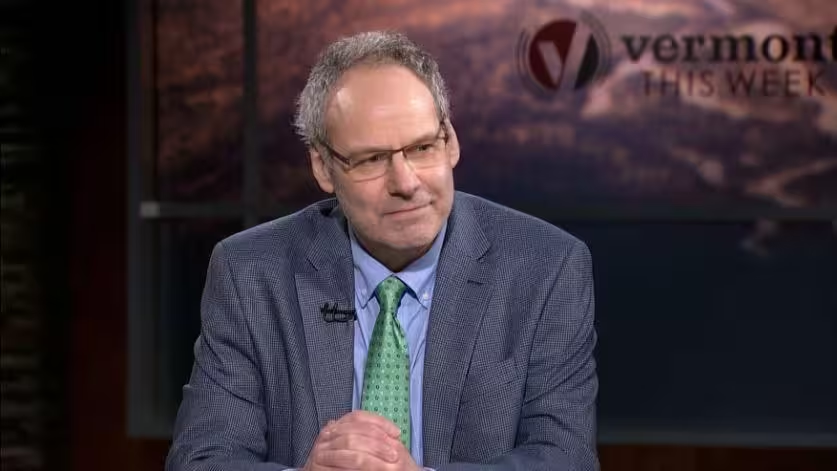
Legislators at odds over UVM athletic facility funding | Why does Vermont have the lowest birth rate in the nation? | Vermont’s lawsuits against the Trump administration | Moderator - Mitch Wertlieb; Calvin Cutler- WCAX; Colin Flanders - Seven Days; Erin Petenko - VTDigger.
Problems playing video? | Closed Captioning Feedback
Problems playing video? | Closed Captioning Feedback
Vermont This Week is a local public television program presented by Vermont Public
Sponsored in part by Lintilhac Foundation and Milne Travel.
Support provided by:


Vermont This Week
May 1, 2026
5/1/2026 | 26m 46sVideo has Closed Captions
Legislators at odds over UVM athletic facility funding | Why does Vermont have the lowest birth rate in the nation? | Vermont’s lawsuits against the Trump administration | Moderator - Mitch Wertlieb; Calvin Cutler- WCAX; Colin Flanders - Seven Days; Erin Petenko - VTDigger.
Problems playing video? | Closed Captioning Feedback
Where to Watch Vermont This Week
Vermont This Week is available to stream on pbs.org and the PBS app.
Support the crew
Help Mitch keep the conversations going as a member of Vermont Public. Join us today and support independent journalism.Providing Support for PBS.org
Learn Moreabout PBS online sponsorshipA divided state legislature considers using state scholarship funds to help finance a UVM athletic complex.
As governor, Scott continues to throw his support behind the proposal.
We've asked for 50 million.
This will leverage, probably another 100 million.
To finish.
This project, which I think will be beneficial not just to UVM, really to the state.
Plus, a look at why Vermont's birth rate lags behind the rest of the country.
And we'll discuss the lawsuits Vermont's joined against the Trump administration and what they've accomplished so far.
All that and more ahead on Vermont this week.
From the Vermont Public Studio in Winooski.
This is Vermont This Week, made possible in part by the Lintilhac Foundation and Milne Travel.
Here's moderator Mitch Wertlieb.
Thanks so much for joining us.
I'm Mitch Wertlieb.
It's Friday, May 1st, happy May day.
And with us on the panel today, we have Colin Flanders from Seven Days, Calvin Cutler from WCAX and Erin Petenko from VTDigger.
Thank you all so much for being here.
We're going to get right into it with this story that we teased there at the top.
The legislators and the legislature is at odds over UVM and its athletic facility funding.
We know that UVM would love to upgrade, things.
You know, they would love to see, improvements made to Patrick Gymnasium or some field house.
Bring in more people.
The governor all for this.
Calvin Cutler.
But it's not that clear cut when you get to the Senate and the House.
And let's take a listen to a couple of opposing views.
I just think to elevate and match the quality of our programs, both our athletic programs and our academic programs at UVM, we need facilities that meet the caliber of our students and our student body.
This is putting the cart before the horse, and it really feels like, an inappropriate use of funds for higher Ed trust fund board was not consulted.
Neither was, the SAC or the Vermont State Colleges.
Who are the recipients that would be impacted by not being able to receive these funds?
Okay.
So let's get into it.
Calvin Cutler, we're talking how much money are we talking about here that UVM would like to see in state funding to help pay for these facilities?
So UVM requested about $20 million to go to the Target Center, which has been in the works for over a decade now.
It's had fits and starts, but, they would like to see 20 million.
The governor asked for 15 million in his budget.
The House did not include any of this funding whatsoever.
And the Senate, this week sparred and passed the state budget that, has 12, a little over $12 million for this new center, has about $2 million for scholarships as well.
What's interesting about this is so we're talking, a surplus that came in to the Higher Education Trust Fund, from the estate tax.
So when somebody dies, you can the state can can, tax part of your your, your wealth.
Yeah.
So basically, there was a one time bump in the estate tax that gave us about 25, $26 million.
And so the Senate is saying, let's use some of this money to help this talent center project pencil out the idea from the Senate being, hey, this is economic development.
We can have bigger events, bigger concerts, we can have high school sports in there.
But, you know, you really start to peel the layers back on the onion and it's anything but clear, of, you know, how this money should be used.
If we're taking it from the Higher Ed Trust fund, what does this mean for the other colleges that are still getting their scholarships?
You know, we're talking the state colleges and also vstack.
They're still getting their allotted money, but they're not getting this extra.
Right.
So it really is raising questions about the benefits of UVM, like who benefits from this and sort of the Chittenden County area maybe benefiting other parts of the state, not benefiting.
It's it's really interesting.
There's a lot going on here.
It sounds like the argument that UVM and maybe the governor is making is, you know, all boats will float if the seas rise on this.
You know, if UVM does, well, this will benefit the whole state.
But I do have to ask, you know, we're talking about that surplus in money.
You mentioned Calvin.
It's not like the state of Vermont doesn't need that money for other things, right?
Yeah.
And, you know, to Representative Robbins's perspective there, I mean, there's a lot of competing interests this year.
You know, there's the federal cuts that we're going to be seeing in the coming years.
There's like the property tax question.
I mean, there's a lot of of folks at the state House are saying, is this where we should be putting money in this moment in time?
Who knows?
I mean, there is also a question of, you know, if you build it, they will come, right?
Is that actually the case?
I think, Mitch, you might have brought up before the show here, you know, there is no inked deal between UVM and the state, like UVM is going to use these facilities.
How often are other acts and other, organizations going to be able to use it?
I think there's still a lot of outstanding questions here.
But also, the governor this week brought up, you know, we don't have Memorial Auditorium anymore.
The, Burton higher ground proposal in the south end of Burlington that fell through.
So we really don't have a place that can host thousands of people indoors.
So, I mean, there depends on who you ask, but there is a need for it.
But again, yeah, it brings up all these questions about should we be using the, the, surplus from the trust fund on this.
Is this the best use of money?
I don't know, it's real.
It's a real bone of contention between the House and the Senate.
I mean, does this remind anybody of what I'm thinking about?
And I understand, use a little bit apples to oranges here.
But, you know, I'm a sports fan, and I know that every once in a while, you'll get a team that says an owner owns a team.
They say, you know what?
Unless the fans help pay for our new building, which we need, we're going to relocate.
It becomes like this game of chicken a little bit.
Colin and I just wonder if this is in some ways a microcosm of that bigger issue.
Obviously, UVM is not going to pick up stakes and leave, but you know, they're saying we need help here.
We're going to get it from the state coffers, even though they have quite a handsome endowment.
Yeah.
I mean, to me, it reminds me a little more of something a little more wonky, like the veggie program, the idea that if we invest upfront that we will get a return on investment.
And I know covering smaller towns over the years, this is always a fight that smaller towns have.
The idea of.
How much money should we be giving someone with the anticipation of making it back later on?
And in other states and in neighboring New York, a business can often get pretty strong incentives to move there, to open up.
I think of it similar to that.
I mean, the challenge here is that, like Calvin said, it very may well pay itself off down the road.
But at this moment in time, thinking ten, 15, 20 years out when people are struggling to make ends meet today, it is a really hard sell.
And that's coming from someone who lives in Burlington and who would probably benefit from this.
But it's just hard to know.
And I understand why some of the legislators are feeling like it's just not a good look right now.
Yeah.
I mean, you're talking about, rural areas that need a lot of help.
This would certainly be helping Chittenden County a lot, but, I mean, maybe that's part of the problem here, right?
That people are seeing this again as Chittenden County gets all the attention, in this case, the money, too.
Yeah.
I mean, we'll Chittenden County is, of course, a huge economic driver for the state of Vermont.
And so if you are going to bring in thousands of people to see a concert, you know, or know a con, I think the governor said this week that he would like to see there, you know, there that's of course, increased tax revenue.
But, you know, that's not necessarily going into those coffers in local municipalities that do host some of the state, call it, like, you know, Randolph or Castleton or others.
So, yeah, I mean, to Colin's point, it is kind of difficult to sort of measure the return on investment here.
But yeah, it's also interesting just how this is sort of kind of popped up as a flash point.
You know, while we're all still waiting on the education bill, I mean, the maybe we can get into the flow of the session.
But, you know, this is probably one of the bigger bones of contention in the state budget.
So we'll see.
I'll have to say, too, if they're going to get Noah Khan to come, they're going to need a bigger thing than the town complex would be.
At this point.
I mean, maybe he could play up in Highgate, but certainly we know he has become a much bigger draw at this point.
I think it's a fascinating we're going to have to keep our eye on that story.
And, we'll continue on with that.
But thank you for the update.
Colin Flanders, I want to turn to you on a story that we have talked about before.
This has to do with birth rates in Vermont.
We have talked about needing younger people in the state of Vermont.
Turns out we need people, period.
Vermont really has the lowest birth rate in the nation.
What have you found out here?
Yeah.
So this is a position that Vermont has held for at least the last decade.
And I think what's most surprising to me is if you go back a little further, if you go to the tail end of the baby boom, Vermont was actually producing more babies on average compared to the rest of the country.
And at some point over the last 30 years, we just diverge from the rest of the nation pretty strongly, and we have remained there ever since.
And I think there's a lot of different theories as to why we may have gotten there.
I think one of the main ones we're seeing is that people are increasingly holding off on having children until later in life, and as you might expect, that tends to lead to fewer children.
I think we're seeing more and more only children.
I think we're seeing people, too, who are getting to older ages and just thinking like this isn't panning out for me.
I think one of the things that surprised me in reporting this story is that the majority of people, overwhelming majority of people, still want children.
They're just having fewer.
And I think there's a bit of a misconception, particularly among conservatives, that the declining birth rates are sort of a symptom of selfish generations.
And again, being someone who comes from that, I, I heard over and over and over again that people really still want to have children.
They see value in parenthood.
They just don't feel ready.
And the main reason is affordability, economics.
Yeah.
I mean, that's what it seems to come down to, because when you dig into why our birth rate has gotten so low, you can take a look at the affordability problem in Vermont.
Say, like you were saying after the baby boom, there was like this rise in birth rates.
But in the last 20, 30 years or so, it's really gone down.
And you're finding that economics has a lot to do with that.
Yeah.
And if you talk to I heard from more than three dozen couples out there who are either actively considering whether to have kids, maybe they have one in there stopping after that, or they've sworn it off completely.
And I think the overwhelming majority of people say it just doesn't make financial sense.
And we feel like we cannot provide the type of life we want to provide to our children.
I think this is one of the first generations where, looking ahead, you're starting to wonder, can I give my children a better chance than I had to succeed?
And, it's not hard to see why people are coming to, the answer of that question of no.
I mean, if you think of the American dream, bear with me for a second.
Think of the American Dream.
And the foundation of that is often a career, a marriage and a house.
And after that, that's when you start to feel ready to have children.
What 25 year old can afford a house in Vermont right now?
I think there's very few.
And the thing is, when I see a 25 year old, you think that's pretty young to have kids 20, 30 years ago, that would have been a normal parent.
Oh, sure.
So we are just delaying longer and longer.
It's getting harder to establish yourself as an adult.
And that means it's getting harder to envision a life where you can have children.
And I think that's, there's a lot of debates over whether it's good or bad to have a larger population, a smaller population.
I think that's a little misplaced.
I think the fact is that people want to have children and they're feeling like they can't.
And I think that's a real concern.
In the people you spoke with, the interviews you did, did anyone say anything about what they would perhaps like to see the state do to help in this area?
Yeah.
I mean, I think the biggest thing time and again was the housing market being able to feel like you can actually get into the housing market right now, it feels impenetrable for a lot of people.
I think the other thing is childcare.
I think, if you talk to a national demographers, they say that there's no real silver bullet to gin up birth rates like at large.
But for singles, for individual families, the biggest thing is making them feel like they can maintain a career and also have children and so that often comes down to childcare.
And I will say Vermont took some big steps towards increasing affordability and access to childcare.
We've invested now hundreds of millions of dollars over the last couple of years into our system, and it's having real results.
But still, there are long waitlists.
It's still very expensive.
And in certain parts of the states there's still childcare deserts.
And so I think focusing on childcare is one thing that could have a demonstrable difference, but it's going to take years and years and years.
And when we're thinking about our aging population, you asked demographers about this.
They say it's it's really it's a hard sell to think that we're just going to have more babies and suddenly we're going to solve our population issues that can take ten, 15, 20 years for those people to get into the workforce.
And then and by that point, I mean, who knows what we're going to look like.
So I think it's adapting to our reality while also trying to make it a little easier for families to get by.
It's a fascinating population story, and there's another population story and potential that you have been writing about.
And this has to do with a drop in international migration to Vermont, but also up domestic migration, too, right?
Yes.
So, Vermont, actually had, I believe, the highest population loss from 24 to 25% of its population.
And there are four factors that go into that.
The low birth rate, like we just discussed, we have an aging population, so we have a pretty high death rate.
We're losing people domestically, which means more people are moving out of Vermont, then moving to Vermont within the country.
And then just within the past year, we have gone from relatively good international migration figures that are like helping to bolster those that population to, steep, steep drop and just to be clear, that loss in international migration is a national trend.
And the people that I spoke with said that it's pretty clear that that's due to the political situation and the decisions Trump has made to really tighten immigration and legal pathways to immigration.
And then the knock on effect of that is a lot of fear and uncertainty that is, you know, making people a little bit more hesitant to come here, you know, used to be like a family member would be like, oh, yeah, you can come here.
Now they're saying, stay away.
The, the international student population as well, we've seen a drop in the figures that at least several major universities in Vermont.
So, you know, it's, it's it's definitely like a combination of different ways that immigration has become harder.
And then the effect is, you know, the, the population loss and then the knock on effect of that is the economy of Vermont struggling because it doesn't have the tax base.
It doesn't have, the people to buy concert tickets or sports tickets.
The domino effect.
Yeah.
Exactly.
Yeah.
Exactly.
Yeah.
I was I was going to say, you know, when you think about the issues at the state House, you know, if you just take Governor Scott's budget address.
Right, or a state of the state, very rarely do you get everybody in the room applauding.
But when we talk about immigration and welcoming and asylum seekers and refugees, that is something in Montpelier that has broad support.
There is not a single person in the building that will tell you, you know, that that is against bringing more people in from from out of the country.
So that's really that's fascinating to see that that trend.
Yeah.
Well, it also makes me wonder too then, you know, Governor Scott has obviously a lot to do as the governor of the state of Vermont.
But part of this issue, as Erin is bringing up here, is a lot of the federal, laws that have to do with immigration are keeping people from coming here.
Now they're scared about that.
Governor Scott is still trying to ride that fence about when he should pull back on criticism of the Trump administration or, you know, say some things about it.
And here's an example where he could be leading in this in this area.
Right?
Yeah, it could potentially I mean, we really yeah.
You're right.
I mean, the governor really has picked his battles.
You know, the during the second Trump administration.
And I think that's frustrated a lot of, Democrats that support the governor.
Yeah.
I mean, this could be an area that, you know, the governor could be more outspoken about, but it really hasn't organically come up, you know, until now.
So who knows, maybe maybe this will spark it.
But again, I mean, yeah, it's definitely been a different tone that the governor's taken, you know, and really picking his battles, with the Trump administration this time around.
Well, other state officials, certainly have, jumped into the fray with the battles with the Trump administration.
You've been writing about this, too.
Vermont has, has been part of a lot of multi-state lawsuits against the Trump, against the Trump administration for a wide variety of things.
And you've been writing about how those lawsuits have fared.
What did you find out?
Yes.
So, I think that, the graphic on the screen might say 48, but we've actually gone up to 49 just because while I was writing the story, the attorney general signed on to another lawsuit.
These are big multi-state lawsuits.
So Vermont, very rarely takes a front, leading role in these lawsuits.
I don't believe they've been, like, the main plaintiff on any of them.
But, you know, the, the attorney general feels like this is an important way to make back some of the money.
Vermont might be losing through, you know, budget cuts or other, like, loss of federal programs and things like that.
So, you know, so far, we haven't had a lot of, like, you know, final this is the ruling.
We have won or we have lost because these there's.
So many appeals and just keep going and going where a lot of.
These things, so, you know, they can, they can say like there's a preliminary injunction from a federal judge, but theoretically it could be appealed all the way up to the Supreme Court.
But so far, 20 out of the 49 lawsuits have had either, like, a definitive success or like a favorable ruling, like a preliminary injunction.
One of the more recent definitive successes, just to give you an example, is the gender affirming care lawsuit.
So, the Multi-State coalition got a pretty definitive ruling from a federal judge that, the Trump administration can't restrict gender affirming care.
But on the other hand, we have had some definitive failures to.
So the, the multi-state lawsuit, protesting the lay off of, I believe it was federal employees on probation.
That one just, you know.
They all part.
Yeah.
Yeah, I think that they they finally just withdrew the lawsuit because they were not getting the results that they wanted.
But even then, you know, they they argue that it was worthwhile in order to give the, the federal employees time to kind of, you know, adjust to that situation.
Is there value as well, perhaps in even some of these ones that that don't come to fruition in, in putting a spotlight on the issue, for sure.
Yeah.
I talked to a constitutional law expert and he was like many of these relate to principles about like equity or like the balance of power and what the, what the president is or isn't allowed to do as an, as the executive branch.
And he was like, you know, this, this is, the the magic of constitutional law is that an individual can be as powerful as the president in those situations.
He made it that constitutional law.
It sounds like he's going to say that sounds inspiring a little bit.
You know, that that's a little bit of hope there and say, you know, you can you have some power as a as a citizen in this country.
Calvin Cutler and keeping in this vein here, this is a fascinating one to me.
There have been suits against federal officials for constitutional violations.
There's a part of the U.S code that allows that, but not against federal officials.
So Vermont now, I guess the House has passed a bill saying, that there can be, lawsuits brought for constitutional violations, right?
Yes.
Actually, the the governor let this go into law without his signature.
Great transition, by the way, from from one to the other.
Yeah.
So basically, the legislature was working on a bill earlier this year that would allow people to, you know, sue individual, you know, federal officials for, you know, if there were alleged violations of people's constitutional rights.
And, you know, this has been moving forward, the governor let it go into law without his signature because it's pretty clear it's it's likely that we may face a lawsuit, from this this bill, the attorney general feels like we're on solid ground.
But, I mean, certainly this is one way that the legislature has been trying to respond to constituents.
And, you know, there were a lot of concerns when Minneapolis, protests were happening out there and what some saw as just a broad overreach of executive power.
So this is Vermont pushing back on on that.
And then, of course, you know, Vermont had its own run in with Ice, officials in March, just, just last month.
So I'm wondering if this had anything to do with that, situation, too.
Yeah, absolutely.
Although it's worth noting, though, that this bill is not retroactive.
So people that were at the protest or felt like, you know, they were wronged cannot sue any of those officials.
The at that protest, it's worth pointing out.
But, it's also, you know, there's been a number of ice bills, I'll call them that have sort of been moving through the state House, like one would ban ice from conducting, you know, raids or arrests at courthouses and schools and things like that.
There's another one about masking, which is also seen a setback.
So this has been sort of a priority that's kind of been bubbling in the background.
You know, this session.
Tell me a little bit more about the masking issue.
I know that's been a big concern for a lot of people saying, you know, Ice officials should not be hiding behind these masks, but why?
Why is that particular issue not getting much traction?
For.
Vermont?
Yeah.
There was a ruling out of the Ninth Circuit Court of Appeals, I believe, in California, late last week, which basically ruled that states do not have the authority to basically mandate that federal law enforcement adhere to certain policies.
And that includes either identifying themselves with, like, a badge or a number or, you know, not wearing a mask.
So this bill is still moving forward, although it's just for local law enforcement and Vermont State Police.
That kind of takes out 90% of what the bill was about, though.
And so it was a pretty big blow to, to the bill.
And then there was also kind of the outline concern, like a lot of, you know, people that were supporting law enforcement were telling me along the time, like, you know, Ice has become very politicized.
And, you know, these are people at the end of the day that are just working a job.
This is what people have been telling me, that they're working a job in the federal government.
And there is a concern that, you know, people could be doxed and their family members could be affected.
So it's interesting to see how it's landed.
But, as of right now, this this piece of the bill is not moving forward.
It might be hard to sue somebody when you don't even know who they are or what their face looks like or their badge.
So I'm just interested in that, the dichotomy there.
Yeah.
I mean, it's an interesting point.
And we're going to have to, you know, this is the kind of thing I think, as you said, it's not retroactive.
So Vermont is looking at this as any future actions that may come up and you never really know what happened in South Burlington, a month ago came as a surprise to a lot of people.
And that was a pretty, it was a pretty tough event for all of us to, to witness.
Calvin, I know that Vermont is having some problems with, its staffing of prisons right now.
What's going on there?
This isn't a new problem.
This is really gotten it started during Covid, and it's gotten worse.
Northern State Correctional Facility, you know, has been seeing big shortages in, in staff members, you know, in part because of the, you know, work environment.
It's tough.
There's the wage angle to it.
You know, there's a lot of turnover that we've seen in some of these jobs right now, kind of back in the napkin math, about two thirds of jobs within the prison are unfilled right now.
Two thirds.
Yeah.
And so that, you know, there's sort of the corrections perspective of, you know, what that means for the staff inside.
But also the inmates too.
Right.
You know, there's like the stress and the burn out and the mandatory overtime for correctional officers, but then inmates, you know, if there's not enough people to stay, staff, people are in their cells for longer.
You know, people might not be getting the right programing or, you know, enrichment, if, you know, if we can call it that behind bars.
And if the ultimate goal is, you know, of incarceration for some people is to rehabilitate them.
And after they serve their sentence and get out into the community.
Well, if they're not receiving that programing, then what are we doing?
So it's a real tough, a tough, tough issue to work through in the union.
You know, I think at this point they were pointing the finger at the administration, but they're also what was interesting, Steve Howard told me that, you know, the legislature also isn't really paying attention to this.
And he said, we're not having committee hearings on it.
A lot of folks in corrections have said that it's sort of the the red headed stepchild of the criminal justice system or the the caboose, if you will.
That really doesn't get a lot of time and attention.
And, you know, people work really hard in corrections and it's still the crisis is ongoing.
Yeah, very stressful job.
And I'm glad you brought this up.
Thanks for that reporting, Calvin.
Erin Petenko, I want to end here because it is May 1st.
And we have all heard about no mow May.
You know, it's a way to keep your lawn, I guess, a little bit healthier, you know, and and not have to do as much mowing.
But you've also looked into the benefits of planting native species.
And you wrote about this.
What can you tell us about that?
Yeah.
So, no mow May is intended for, Vermonters to just let their lawn sit for a month and give the pollinators time to, like, come in and wake up and get get go in.
But an increasing number of people nationally and in Vermont are asking, why don't we plant native plants that can encourage pollinators even further?
The example the State botanist gave is that an oak tree can support hundreds of species of local insects.
Wear.
A gingko tree, which is native to East Asia, can support only five.
Wow.
So she, she gave me a lot of specific examples of how you can get started on this.
You can find that in my article.
But the real headline is, you know, do it as much as you can, you know, I mean, if even if you only plant a handful of native plants, you might find that they're a lot easier to maintain.
They they're native to the area.
So they love the conditions that we have here.
And they can bring you a lot of joy with all the bees and the butterflies that you might have to your lawn, and then they'll bring it even more animals and plants.
So I think it's a lovely idea, and I may have picked up a few of my own, or we'll see a little bit.
Yeah, thank you for that.
And of course, tomorrow is a green up day in Vermont.
So get out there and make the state look a lot prettier.
Thanks to our panel today.
We're.
Appreciate it.
Colin Flanders from Seven Days, Calvin Cutler from WCAX and Erin Petenko from Vtdigger.
I'm Mitch Wertlieb, thank you so much for watching.
Join us next Friday for Vermont This Week.
 New Episode
- News and Public Affairs

Top journalists deliver compelling original analysis of the hour's headlines.
 New Episode
- News and Public Affairs

FRONTLINE is investigative journalism that questions, explains and changes our world.

 New Episode
 New Episode
 New Episode
 New Episode
 New Episode
 New Episode
 New Episode
 New Episode
Support for PBS provided by:
Vermont This Week is a local public television program presented by Vermont Public
Sponsored in part by Lintilhac Foundation and Milne Travel.