Vermont This Week
May 10, 2024
5/10/2024 | 26m 45sVideo has Closed Captions
Vt. Lawmakers Agree on Safe Injection Site Legislation, Gov Plans to Veto
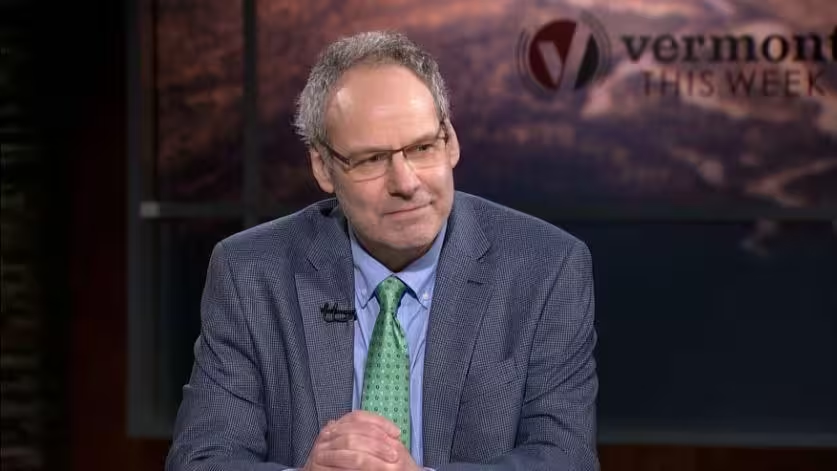
Vt. Lawmakers Agree on Safe Injection Site Legislation, Gov Plans to Veto | Vt.'s Biggest Energy Bill of the Session Heads to the Governor | UVM, Middlebury Student Protesters Take Down Pro-Palestinian Encampments | Panel: Mitch Wertlieb - Moderator, Vermont Public; Abagael Giles - Vermont Public; Kevin McCallum - Seven Days; Katharine Huntley - WCAX.
Problems playing video? | Closed Captioning Feedback
Problems playing video? | Closed Captioning Feedback
Vermont This Week is a local public television program presented by Vermont Public
Sponsored in part by Lintilhac Foundation and Milne Travel.
Support provided by:


Vermont This Week
May 10, 2024
5/10/2024 | 26m 45sVideo has Closed Captions
Vt. Lawmakers Agree on Safe Injection Site Legislation, Gov Plans to Veto | Vt.'s Biggest Energy Bill of the Session Heads to the Governor | UVM, Middlebury Student Protesters Take Down Pro-Palestinian Encampments | Panel: Mitch Wertlieb - Moderator, Vermont Public; Abagael Giles - Vermont Public; Kevin McCallum - Seven Days; Katharine Huntley - WCAX.
Problems playing video? | Closed Captioning Feedback
How to Watch Vermont This Week
Vermont This Week is available to stream on pbs.org and the free PBS App, available on iPhone, Apple TV, Android TV, Android smartphones, Amazon Fire TV, Amazon Fire Tablet, Roku, Samsung Smart TV, and Vizio.
Support the crew
Help Mitch keep the conversations going as a member of Vermont Public. Join us today and support independent journalism.Providing Support for PBS.org
Learn Moreabout PBS online sponsorshipState lawmakers agree on safe injection site legislation, but Governor Scott indicates he plans a veto.
It may save lives, but how many are we going to lose because we didn't get them into treatment or get them to keep them from using in the first place with prevention.
Plus, Vermont's biggest energy bill of the session heads to the governor's desk.
And an update on pro-Palestinian encampments on Vermont campuses.
That and more coming up on Vermont this week.
From the Vermont Public Studio in Winooski, this is Vermont this week, made possible in part by the Lintilhac Foundation and Milne Travel.
Thanks for joining us.
I'm Mitch Wertlieb.
It's Friday, May 10th.
And with us today on the panel, we have political reporter Kevin McCollum from Seven Days, Burlington reporter Katharine Huntley from WCAX.
And joining us remotely from Montpelier, a climate environment reporter Abagael Giles from Vermont Public.
Thank you all so much for being with us today.
With state lawmakers looking to adjourn the session today, and we should note that as you're watching this, there may still be quite a few loose ends to tie up.
Let's start with some of the legislation that has made its way to the desk of the governor this week.
Now, we heard from Governor Scott at the top of the program laying out some of his objections to a bill that would create a pilot harm reduction center.
It's also known as a safe injection site in Burlington.
Kevin, you actually went to see a safe injection site in New York City.
You wrote about this in seven days, a feature article.
What did you learn from that visit?
And is this the kind of thing that you could see happening in Burlington?
Right.
Well, we knew that this legislation was on track and it was one of the highest priorities of the legislature this session.
And so we decided to try to do an in-depth exploration of what OPEC is, as they're called, really are like on the ground.
And the only sanctioned overdose prevention sites in the nation right now are in New York City.
There's two of them.
So we went down there and we checked them out and we tried to understand exactly how they operate in an effort to give Vermonters a good sense of what it would look like in Burlington or in Brattleboro or somewhere else in the state for one of these if they actually came to pass.
What I found was they are places where people truly care about drug users and making sure that they have a safe, supportive environment in which to use.
At the same time, it's a very sad place.
It's a very difficult place to spend time because the people there are in such distress and are in such low places in their lives because they've they've turned to drugs in such significant ways.
And so there is a real fear of of dying from an overdose these days far more than ever before, with the fentanyl.
And as I was seeing that is now in in the drug supply.
And so for years, leaders in Vermont have been saying, look, we need to do more to help people in this crisis.
And so we really ought to make sure that there are places where people in Vermont who are addicted to drugs can inject these drugs safely.
And so for after years of pushing for it, finally, the legislature has said, you know what, we got to try it.
We got to let it happen.
And it looks like Burlington is going to be the site for one of these centers.
Now, the governor again, has indicated he would probably veto that legislation.
One of the things I noted in your article was that you talked to a gentleman who realizes the dangers of the drugs that he's taking.
He knows about sales and he knows there's fentanyl, but he also knows that he's going to use there was a part in the story where you talk about a daycare center with kids right across the street from the site that you were at.
The person who leaves that daycare center actually said they're good neighbors.
We haven't had a problem.
But the reality is there could be the kind of thing where you're seeing kids seeing things like people using needles, using drugs.
That's right.
I mean, one of the biggest obstacles to these to this legislation passing and to these sites being allowed in Vermont is the concern about what it would do to a neighborhood.
Right.
Do we really want a place where where illicit drug users congregate, they come to use drugs in this location?
And is that something that we really want for our little corner of the city and and clearly the area in New York that I went to visit one of these sites is a rough place.
It's a difficult place to be.
There's there's people in severe poverty.
And but what the supporters of this center and the leaders of the organization there say, look, this was already a rough place.
This was already a place where drugs were being used by many people.
And so what they did is they went to an area where there was already a needle exchange program and said, let's expand that.
And they say that their presence there actually helps to remove the drug use from the streets, improve the litter that you get from from lots of drug use and you're absolutely right.
The neighbors in in the area are actually pleased that it's there.
And again, the idea of this is there is reversal medication on hand for overdoses.
The idea is to save lives.
Catherine Huntley, I know that you have been following this story in Burlington.
You've talked to a lot of people who are unhoused in the city and what it wears.
What is their feeling about this sort of thing happening in Burlington?
Is it welcomed in their perspective?
It's more than welcome.
I mean, there is absolutely broad support.
The new mayor, Emma Mulvaney Stanek, she is in support of it, as is really the entire city council.
I mean, I haven't heard very much opposition, frankly.
There are the concerns about where it would be, you know, and would it bring more people who use to the city.
But frankly, Burlington has a huge problem right now.
I mean, it's it's not hard to find a needle.
I just spoke to a property owner yesterday who said on his property he found a box that had like hundreds of needles.
And it so it's you can really see it and you can really feel it when you're downtown.
I mean, most of the people who I'm friendly with who are unhoused, they carry around Narcan, they carry around several doses of Narcan and often, very often have to save their friends, have to save people they don't know on the street because the drugs are so deadly.
Do you find there's a tension there, though, between, let's say, the business community, people who are worried about how it looks on the streets of Burlington, as opposed to the political leaders like the new mayor who are in favor of this.
Honestly, the businesses see it so much that they have Narcan on hand.
A lot of places that I've spoken to.
So, you know, obviously people are more concerned if it would be next door to them.
But I think that it's pretty obvious that there's a huge problem and they want some sort of relief from it.
And Kevin, political question here.
Let's say the governor does go ahead and veto this legislation.
Do you think there may be the votes to override that?
Yeah, I definitely do.
It seems as though both the Senate and the House have have won over some of the more conservative members in their caucuses to make sure that they've got the two thirds votes necessary to override the governor and the advocates for this bill say they're pretty confident going into this.
Okay.
Speaking of vetoes, what the governor has to decide whether or not there are going to be overrides.
There's a lot going on in Montpelier with climate legislation.
Abigail Giles is there now because you've got a lot to cover today as the session tries to wrap up.
Abigail, tell us about some of the big bills that are heading to the governor's desk dealing with climate legislation.
Yeah, there are kind of, you know, three really big ones that come to mind right off the top of the bat.
One is an update to the state's renewable energy standard, which is the policy that governs how much renewable electricity utilities have to supply to their customers.
Another is the Climate Superfund Act.
That's a bill that aims to really go after the biggest oil companies in the world to try to sort of recapture some of the cost of what climate change has cost Vermont over the years.
And then there's also a bill called the Flood Safety Act, and that is really the sort of biggest bill, the section aimed at trying to reduce flooding in the future, knowing that as the climate changes, Vermont is continuing to see more and more extreme rain events.
So those are the big ones on the table right now.
What's got the most support?
Abigail I think there was tripartisan support for was it the resilienc Yeah, I think it's really interesting.
This was a bill where we really saw the Republican caucus in the building kind of split in terms of support.
I think the governor has expressed concern about the cost, but essentially this policy would create new regulations around new development in river corridors in the state.
So these are the areas around a river where essentially it tends to change its course and sort of send a high velocity of floodwater through a new channel.
It's where buildings get swept away.
If you think about some of the images we saw out of Tropical Storm Irene, these are the places where we saw massive destruction.
And essentially, these these spaces are largely unregulated in the state right now.
So that's kind of the big piece of that.
It also really sort of strengthens and codifies new protections for wetlands in Vermont.
Wetlands slow flood waters.
So that's another component of the bill.
And then additionally, it ramps up regulations of private dams in the state and creates new funding to shore up dams.
And the the sort of climate adapted picture that we can anticipate.
We are going to come back to some more about this with the climate legislation.
I do want to briefly ask, though, Abigail, one of those bills could be historic.
Write the Climate Superfund Act as you were describing it.
If it were to pass, would this be a first for the state of Vermont in the nation?
Yeah, absolutely.
Mitch.
So this this legislation is modeled after the Federal Superfund program.
There's been a longstanding precedent and law in the United States really for several decades now of essentially empowering the government to go after big polluters to clean up the pollution they caused in the process of doing business.
And so what this bill essentially does is it takes that model and applies it to climate change.
There's robust reporting showing that these are the biggest companies in the world knew about the impacts and the risks associated with their products dating back to the seventies.
And additionally, we've seen that in recent years these companies have continued to bring in record profits, even as, for example, Vermont saw an event that our state climatologist has said was clearly exacerbated by climate change this summer, which brought north of $1 billion.
And that was just one storm.
So certainly, I think a lot of lawmakers are looking around at their communities and seeing that people are still reeling.
There are certainly a lot of small businesses and homeowners who are not whole.
People are still displaced.
And I think this is an effort to try to sort of suggest that right now it's really everyday people who are paying for the impacts of climate change.
It's taxpayers.
It's going to cost us a lot to adapt.
And this endeavors to say, you know, maybe these big companies should help out.
Thank you for that update with that, Abigail.
And do stand by.
We're going to be coming back to you for some more talk about these really important bills.
There's been a lot going on with student protests that we wanted to pivot to that for a moment.
Catherine, I know this is something that you've been following as well.
First, let's hear from one of the student protesters at the University of Vermont.
His name is James.
He didn't want to give his last name.
And here he is talking about the encampments coming down at the University of Vermont.
We really achieved all we could in the immediate term with this specific tactical escalation and taking down the encampment made the most sense for continuing to build our power.
Now, this comes on the heels of Middlebury.
Students also take me down encampments over the protests.
A pro-Palestinian protest there.
Did the students get what they want here?
It's partially there.
One of their main things that they wanted was for the speaker who was supposed to speak at graduation, a US ambassador, Linda Thomas-Greenfield.
She had previously vetoed three cease fire resolutions, so they did not.
U.N.
Ambassador.
Yeah, yeah.
So, you know, they definitely got that.
And they also wanted the full disclosure of how the school is investing there endowment.
The school said that this is public because they always told the trustees, but the students felt like they only got a partial a partial look at that.
So they're pushing for more of that.
But really being able to get the speaker to not speak was one of their main one of their main goals, which they did succeed in.
Now we're not sure if she decided that she didn't want to come or if the school did cancel her.
We're still trying to figure that out.
But, you know, the encampment was up for ten days and they feel like from their posts and from what they've said, that they really succeeded and at least some of what they wanted.
And is there going to be disciplinary action taken against any of these students for what they did?
Yeah, the school right now is exploring that.
We're not sure exactly how many kids will actually be disciplined, but it seems like they will be.
Well, one person who did have the students backs, in a sense, is our senior senator, Bernie Sanders.
He took to the Senate floor not too long ago, made a very impassioned speech and called for a resolution protecting First Amendment rights.
Here's what the senator had to say.
President, the fact of the matter is that some 67% of Americans, according to recent polls, support the United States calling for a cease fire.
And 60% oppose sending more weapons to Israel.
So, no, Mr. President, it's not just protesters on college campuses who are upset about U.S. policy with regard to Israel and Gaza.
Increasingly, the American people want an end to U.S. complicity in the humanitarian disaster that is unfolding there.
So there is Senator Sanders talking about the need for peaceful protest and to protect that.
Kevin, the senator also made an announcement about his political future.
He's going to be running again.
Absolutely.
Right now, everyone has been wondering whether the 82 year old senator is going to throw his hat in the ring for another six years.
Obviously, the age of politicians is something that's on a lot of people's minds these days, with President Biden running again.
People are people are concerned about the age of their leaders.
And so everyone wondered whether Bernie was going to run.
He put that speculation to rest the other day and said, look, I've got a lot of work to do.
We've got a historic election here in 2024.
Donald Trump may very well be running again in the fall.
That is a huge, huge existential problem for this country.
And I've got a lot of according to him, he's got a lot of work to do left to do.
He still wants to explore and push for for climate legislation.
He still wants to help resolve the income inequalities in this country.
And so he's he's all in.
He's made that clear.
I don't think he's going to have any difficulty getting reelected.
Reelected.
He's got $10 million in the bank and no real major challenger on the horizon.
Well, I'm glad you mentioned the age factor, because that does seem like maybe the only thing that would be working against him in this sense.
I mean, political opposition, we do know at least one Republican will be seeking the Senate seat.
Right.
Right.
Gerald Malloy, I think he ran for Senate and Peter against Peter Welch and didn't do so well.
So I don't imagine he's going to do very well against Bernie Sanders.
And and on the age issue, like if you we just saw Bernie and you standing there in Washington, DC swinging away.
Right.
He is sharp as a tack and apparently in very good shape.
And he said, look, if I was healthwise having any difficulties, I wouldn't be running again.
So I'm fine.
And he did have a bit of a health problem.
There was a heart attack not too long ago, but he obviously came through with that.
And as you pointed out, he sounds is at least his voice and his way of speaking just as strong as ever when he comes back to Vermont.
You know, a lot of politicians come back from D.C. and they they they hold events and such.
When Bernie comes back from Vermont, he does things like he goes on a hike with a bunch of high school kids or something out in Stowe or in the mountains.
So, like, I don't I don't think we need to be too worried about his health.
So when you talk about someone like Bernie Sanders, who we feel has a pretty comfortable path to reelection, Governor Phil Scott is still, according to polling, the most popular governor in the country.
He had tremendous support.
He has won.
Every time he's run, he's won comfortably.
He's running again.
It looks like not officially yet, but we are hearing some buzz about another possible candidate who could give him a run for his money.
What are you hearing?
Absolutely.
So Howard Dean teased us all a few weeks ago by acknowledging that he was interested in exploring whether running for governor again would be something he would do.
He's been largely mum ever since.
But when you hang around the statehouse long enough, you start to listen to people talk and the word gets out among Democratic supporters that that there are things like signature drives happening all across the state to get his name on the ballot.
And you start to hear that people are very excited about the prospect of him taking on Governor Scott.
As you said, Governor Scott has trounced his opponents in the last four times, essentially.
And so that's kind of embarrassing for the Democratic Party, right?
I mean, the Democrats dominate in the legislature.
They dominate in D.C., the dominant in statewide offices, except for the governor's seat.
And so that's just really that really rankles a lot of people in the party.
And so they've been looking for someone with a little more a little more gravitas and some some some experience and some political chops and fund raising capability.
And former Governor Dean ticks all those boxes.
Well, thank you for that update.
And it would be fascinating to see if that challenge actually happens.
It might create a little more political drama, certainly in the state that's happening.
Abby Giles, I want to go back to you in Montpelier, because you know, these bills, I know there's a lot of loose ends that have to be tied together before a German happens.
Maybe it'll happen today.
Maybe it'll happen a little bit later.
I understand that there is a bit of a logjam over some actual legislation.
What can you tell us about that?
You know, I actually think that Kevin has done some great reporting on this topic, so I might pass that one over to him if he can speak on that one.
Absolutely.
Kevin, at 250.
Sure, I'll take a stab at it.
I mean, as it stood a few a few days ago, right, there was this there was this compromise where the developed areas of the state of Vermont would be exempt, essentially in the end for the next couple of years from actually 50 as a way to sort of grease the skids and remove the red tape that a250, you know, is for housing development, too, in an effort to sort of speed the development of new housing connected to that, though, was this idea that if we're going to loosen Act two fifties review of these projects in the downtown areas and developed areas of the state, we're going to have to tighten it up out in the woods.
We're going to have to protect wetlands more.
We're going to have to do more things to protect forest habitat, wildlife habitat.
And Governor Scott has been largely supportive of the idea of making it easier to build housing.
But he's very hesitant to sort of allow new regulations that would make it harder to build in other places for two reasons.
One is he just sees it as potentially inequitable, like with the why should the urban areas get a pass from act to 50?
But the rural areas are now going to have to do even more at 250 reviews for for various areas.
So there was a very delicate balance struck between these two groups.
The governor didn't want those two things mashed together, but they got mashed together into one big A250 Bill.
And I was just there at the State House this morning trying to get a bead on sort of how that bill, this bill is going, how it's progressing.
And it's still not clear.
There's there's definite last minute flurry of amendments to try to craft something that the governor might sign off on and that the environmental groups might sign off on.
And it remains to be seen.
It's going to go right down to the wire.
Yeah, it's a real conundrum trying to get that.
Everyone agrees that, you know, there's a need for housing, there's a need for more development.
But how to do that is always, always in the devil in the details there.
Abigail, what of the climate bills that you're seeing here?
Which do you think have the chance to be the most successful, maybe survive a gubernatorial veto?
You know, it's really interesting, Mitch.
I think in terms of the sort of big three that we talked about, both actually saw it really sort of tripartisan support, at least the Climate Superfund Act and the the flood safety bill.
I think the renewable energy standard policy, this is, again, that bill that would take Vermont utilities to 100% renewable power by 2035.
It also quadruples the amount of new renewable generation that they have to invest in, whether in Vermont or in the region.
This one, I think, is is quite a bit more controversial in terms of concern about how it might raise costs.
I will say the sort of best estimates that we have from the joint fiscal office predict that this would be a pretty a relatively small increase, depending on how you look at what that means over time.
But I think they estimated it was between four and $16 on the average Vermont households Bill, by 2035.
Certainly there are Republicans who are saying the cost of living is high and there are plenty of households, especially for folks who are lower income, that can't even afford that.
And I think that's probably what we're going to see from the governor as well.
So these are all three expected to earn vetoes, but I do think that there is based on the votes.
So far in the talk in the building, there's a lot of promise that they might be overridden.
I think those are those are fights that we will see hashed out in June during that veto session.
They've already announced they want to hold and are quickly dealing with things like pass.
We know that those so-called forever chemicals, which are in just about everything.
There's some legislation around that, too.
Yeah, absolutely.
There's a bill that is headed for the governor's desk that is interesting.
It's environmental bill that earned unanimous support in both chambers in the state House, which is very interesting.
We don't see that happen to too often.
And this would really be a sort of first in the country, kind of piece of legislation, effectively banning pass these forever chemicals that are very toxic in clothing and cosmetics and menstrual products.
Interestingly, the bill also restricts formaldehyde and mercury in make up and then sell products.
Who knew?
There, there, there.
Lawmakers wanted to take a really tough stance on lead.
That's another component that's really common in things like lipstick.
But that's something they're going to try to, I think, revisit in a future session.
So we'll have to see what happens there.
Okay.
Thank you so much for that update.
Also, Governor Scott had to fill a seat in Chittenden, 17 district.
Catherine.
What did he do there?
Who's been named?
Well, Abby Duke, a Democrat, has been named.
Now, of course, this was Emma Mulvaney Stanek, who's now the mayor of Burlington.
This was her seat.
Anyone that followed Emma Mulvaney Stanek, know that.
She's knows that she's a progressive.
She was the chair of the Progressive Party.
But the governor filled that role with a Democrat.
Now, when she was in the House, Emma was a progressive Democrat.
So the, you know, Governor Scott thought there's no problem there.
However, the progressives have have said that this has really broken a historic precedent.
And it's you know, they're definitely not happy.
They wanted a progressive to fill that scene as well.
Yeah.
Because they felt that that best, best helped the people in Burlington who had voted originally for someone who was a progressive to be in that seat.
Well, he didn't appoint a Republican.
I mean, that probably would have been bigger news there.
But, you know, as we know in Burlington politics, there's there's left and there's it's a little bit different left and right when when you talk about Burlington, for sure.
We also have some news that that came up about Vermont getting its own state mushroom.
I don't know if you have heard about this one.
We have a Brit.
There it is right there.
So I'm not going to try and pronounce the name of this new state mushroom, but it's the bear's head tooth.
And there you can see.
So if anybody ever asks, you know, does Vermont have an official state mushroom?
Yes, we actually do.
And there it is right there.
From what I hear, he's he's a real fun guy.
Oh.
Oh.
And I had to do this on my very first show.
I just I just had to go there and do that.
But that's okay.
Well, any thoughts on the new state Musuem or any other state edibles that we could be having in the future?
I don't know if I would eat that mushroom if someone put that in front of me, so I would take some courage.
I've never seen I've never seen that in the wild.
Have you?
That is the first time I've seen it, to be honest with you.
If I had seen that, it would not I would not say that looks like a mushroom.
I didn't know what that actually was, but I think it's nice that we actually have one now.
So you can add that to the trivia list.
Anything else as we wrap up here, folks, that you're going to be watching for, as the as things wrap up with the legislative session, Kevin?
Well, I am very interested to see if they're going to be able to get out of here today.
I mean, they when I was there this morning, the place was a beehive of activity.
There was all kinds of things going on.
There were still committees of conference happening on last minute deals.
They're still trying to hammer out a deal on the yield bill, as they call it, which is the bill that it sorts out, how much property taxes are going to be for education.
There are as a last minute flurry of bills back and forth and amendments to try to figure out exactly how much people are going to have to pay in increased property taxes to fund the education system.
And there's incredible pressure on them to get that right.
And so they're going to go down to the wire on that one as well.
Yeah.
And Abigail, things are wrapping up there.
We're not sure, though, right?
They're still trying to get some of this legislation passed.
Yeah, I think that a lot of the the big action for the climate bills will be during this veto session.
And, you know, even though we've got those cost estimates on the renewable energy standard bill, I think there are a lot of people who point out there is great uncertainty there that has to do with infrastructure and planning, some unknowns for sure.
So I think that affordability is going to be attention.
Okay.
We'll have a full wrap up for you next week on Vermont.
This week, Katharine Huntley, Kevin McCallum, Abagael Giles, thank you so much for being here today.
I'm Mitch Wertlieb and I hope you'll join us next week on Vermont.
This Week.

- News and Public Affairs

Top journalists deliver compelling original analysis of the hour's headlines.

- News and Public Affairs

FRONTLINE is investigative journalism that questions, explains and changes our world.












Support for PBS provided by:
Vermont This Week is a local public television program presented by Vermont Public
Sponsored in part by Lintilhac Foundation and Milne Travel.