
May 10, 2024 - Dr. Sherry O'Donnell (R)| OFF THE RECORD
Season 53 Episode 44 | 27m 45sVideo has Closed Captions
Topic: Republican Candidate for U.S. Senate joins the show. Guest: Dr. Sherry O'Donnell (R).
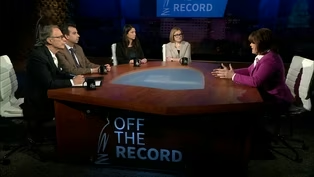
This week the panel discusses the Budgets. The guest is upcoming U.S. Senate Republican Candidate Dr. Sherry O'Donnell. Zachory Gorchow, Beth LeBlanc and Zoe Clark join senior capitol correspondent Tim Skubick to discuss the week in Michigan Politics.
Problems playing video? | Closed Captioning Feedback
Problems playing video? | Closed Captioning Feedback
Off the Record is a local public television program presented by WKAR
Support for Off the Record is provided by Bellwether Public Relations.
May 10, 2024 - Dr. Sherry O'Donnell (R)| OFF THE RECORD
Season 53 Episode 44 | 27m 45sVideo has Closed Captions
This week the panel discusses the Budgets. The guest is upcoming U.S. Senate Republican Candidate Dr. Sherry O'Donnell. Zachory Gorchow, Beth LeBlanc and Zoe Clark join senior capitol correspondent Tim Skubick to discuss the week in Michigan Politics.
Problems playing video? | Closed Captioning Feedback
How to Watch Off the Record
Off the Record is available to stream on pbs.org and the free PBS App, available on iPhone, Apple TV, Android TV, Android smartphones, Amazon Fire TV, Amazon Fire Tablet, Roku, Samsung Smart TV, LG TV, and Vizio.
Providing Support for PBS.org
Learn Moreabout PBS online sponsorshipThanks for tuning in.
A humanitarian doctor and minister, Dr. Sherry O'Donnell is also a Republican running for the U.S. Senate nomination.
She'll explain why.
Around the OTR table, Zachary Gorchow, Beth LeBlanc and Zoe Clarke.
Our lead story, The budget is moving.
What does this mean for you?
Sit in with us as we get the inside out.
Off the Record.
Production of Off the Record is made possible, in part, by Martin Waymire a full service strategic communications agency, partnering with clients through public relations, digital marketing and public policy engagement.
Learn more at MartinWaymire.com.
And now this edition of Off the Record with Tim Skubick.
Thank you very much.
Welcome to Studio C for another edition of Off the Record.
Well, the budget is moving.
Did you feel the Earth move yesterday was all over the House and Senate.
Let's take a look at what they are doing to the governor.
There's an old saying in town.
The governor proposes the new budget that lawmakers dispose of it, and Democrats are doing a lot of disposing and not doing everything the governor wants.
She, for example, wanted a hefty tax break for those who purchase an electric vehicle.
Union made the house said no thanks.
She also attempted to accelerate by two years her universal preschool program.
The House Democrats said no to that, too, and her $1,000 plus $5 hike at the state's landfill dumping fee.
House Democrats reduced the $5 to $0.36.
The governor also wanted free college tuition for all community college students.
Democrats decided instead to give out more scholarship money based on residency and the governor's attempt to take money from a teacher retirement account was modified.
And, well, the House did not go far enough, according to this K through 12 lobbyist.
Schools were happy to potentially see lawmakers do the heavy lifting of paying for teacher retirement, which is a benefit for students.
It would directly and permanently reduce the amount of money that schools have been forced to pay.
Every school during the state.
But on average have $500 per pupil permanently added to their spending power.
Local Representative Witwer, who chairs the House Budget Committee, says more money needs to go into local government.
So there is a boost in revenue sharing and local projects.
Progressive Democrats in the House wanted to spend it on this.
Which is investing in public transit, mental health services, schools, roads, bridges.
Meanwhile, House Republican leader Matt Hall and his colleagues offered 200 amendments to provide more, quote, accountability and transparency in the governor's budget.
All 200 rejected by the Democrats.
The Michigan Senate, controlled by Democrats, is also moving on its budget as the two houses exchange this bill.
There will be negotiations and the governor's not on the list yet.
She could bargain to get back part of what she is losing, at least at this hour.
All right.
So when you got home and thought about it, what impressed you or didn't impress you about the budget action this week?
Well, I mean, definitely the the money or the the departures that they made from the Whitmer agenda stood out.
There were several of those where they departed from in a lot of times.
Their excuse was either we think we can do it better this way by tweaking here and there, or we have to have priorities.
And this isn't a priority.
And I think that's part of the story here, is that they have a lot less money this year around than they have in the past.
There's a lot less disposable income.
There's there's a long wish list, but there's less money to go around.
There was one huge distinction in this budget.
The governors are not running for reelection and the House members are.
Yeah, I mean, like, can we also I mean, it was a great set up piece, but I think we can also do a another set.
That's another, you know.
Another set up piece, which is we should also for folks at home would just sort of like understand the process.
Yes.
These these are big votes.
They happen.
But what's going to happen next is we've got the consensus revenue estimating conference, which is going to help us even understand a little bit more about how much money there is going to be work with.
And then both the House and Senate still have to come together and come up with their own concurrence basically on these budget numbers.
So, you know, what you have basically right now is these sort of volleying, Right.
That the governor put out her executive budget, which is this is how much we want the House and Senate each do that.
And now they've got to come together.
But exactly to Beth's point, I mean, there is just less money, $9 billion.
You know, when when this was first sort of passed and there was a lot of money to your point, and now they've got to figure out how to takes, you know, a few zeroes off some of these budgets.
And that's what's going to be the next weeks here in Lansing.
And the governor won't get shut out in the end.
She's going to get some of what she wants.
But I think what was interesting is the number of kind of flagship proposals.
You know, they made a big deal about this idea that people can attend two years of community college without having to pay tuition that the state would pick up whatever costs aren't covered by other aid, and that the legislature here right now at this rate, is not jumping on board with excitement at that and in fact is pulling back, I think is very interesting or maybe a little surprising, you know, to what Zoe was just saying about the struggle to build a budget without all this extra money going around.
You know what?
Greece to the budget through to passage in recent years was this largesse for projects, nonprofit groups that, you know, may or may not, Beths done some great reporting on this, have, you know, legitimate needs for spending.
Also known as pork.
Yeah.
That they that they don't have that laying around but you see in some of these budgets where they've zeroed out some of the governor's proposals and some nonprofits now are getting funding because they've gone to the legislature and said, hey, we have a great program that we do and should get funding.
So it's going to be a really interesting push pull coming down the stretch here.
Just quickly to Zach, to that point, I mean, we were talking a little bit about before the program started about exactly this, that the governor and kind of trying to put out these things that she wants to see happen.
And, you know, over the summer, there was, you know, her big speech that was so interesting to folks in Lansing, because usually the governor puts out sort of an agenda speech in the state of the state.
She did that again in the summer.
What she'd like to see ahead and very few of those things realized.
And we're sort of seeing that 2.0 again, of the governor saying, here's what I'd like to see this time.
You know, in terms of money and Democrats in her own party going not so fast.
I thought one of the interesting things in the House is that both leaders, the Republican leader and they held their caucuses.
You know, theoretically, if the progressive Democrats who have not been that happy with Mr. Tate and a number of you could have held him up.
Okay.
But I think they got some sweeteners in this budget which shut them up and put 56 votes up on the board.
And no, Republicans are my close to the truth here or not.
Yeah, I mean, I don't know that this vote was indicative of what's to come.
I mean.
It was.
Yeah, I think there are bigger votes on the table up ahead, right?
This was like Zoe was saying.
This was this is sort of a volley type counterproposals between the governor in the chambers.
But I guess when the rubber hits the road is when that final vote is taken on the budget and there is a lot less to grease the wheels.
I mean, we haven't seen a budget in recent years where there hasn't been a lot of money that they can use to kind of, you know, horse trade ahead of a budget and to make everybody happy.
So this time around, it's there's going to have to be some real sacrifices made, I think.
What about the byplay between the two bodies, the Senate and the House?
What's going on there?
I mean, the House Senate rivalry, I like to say, is undefeated through the years, whether it's Republicans and Republicans, Republicans and Democrats in one chamber or Democrats there.
You know, when you look when the Senate looks north and the House looks south on the other side of the Capitol, there is a disdain and at times it's not as bad as others, but it's building right now.
And I think there's an increasing amount of angst in the Senate about the bottleneck that is forming in the House non budget legislation that the House has almost been completely inactive.
Going back to last November.
There's been really nothing of consequence that has moved out of the House since it lost its majority for about five months and then they get their majority back.
And this week, really this is inside baseball, but it's important.
I think the House did not hold any committee meetings so they could focus on the budget.
This is unprecedented.
I've never heard of, you know, the appropriations members do not sit on the policy committees for a reason so that you can walk and chew gum at the same time.
And apparently this week they decided they couldn't.
And the Senate has been passing a number of significant bills, things like changes to auto insurance, prescription drug affordability, board economic incentives.
And we could keep going on and on, but we won't.
And the House, it's just all sitting there in the house and the tension is building, I think.
Well, why is it sitting?
Because I mean, this this is fundamentally what we've been talking about for eight, nine, ten months now, that within the House there is a progressive wing who wants their agenda items to basically come first.
And like we saw over the fall, hesitated and said in some respects, like the land value tax, we're we're not even going to you know, we're not going to even vote for it if you put it up because we want to see our priorities first.
Well, it's this idea that we are in an election year and you stay away from the controversy so you don't hack anybody off at home is as simple as that or it's just a philosophical difference.
Help me out here.
I think all of the above.
Yeah.
Okay.
Let's say that the sense is that Speaker Tate is playing a cautious game here, that he does not want to rock the boat and have his members, almost all of whom are running for reelection this year and whose reelection is, you know, is what House majority depends on for them to cast any bad votes or votes that are going to rock the boat close to the election, that the number one priority is keeping the majority.
That is a bit of a different twist from previous speakers.
You'll remember we've had previous speakers say there's no one vote you can cast here that'll get you defeated.
If as long as you're doing the constituent work at home and taking care of business with with your voters.
It's an interesting gamble.
And I think within the caucus there's there's sort of a mindset of a, yeah, let's be really cautious and and make sure we don't take any votes that could endanger our majority.
And then there's another sign that says, listen, if we're going to lose this thing, let's go out with a bang.
Let's get the policy that we should that we want through and and just let the chips.
Fall where we haven't had majority in 40 years.
Hold our beer.
Let's let's go.
Yes, But of course, the retort to that is, if we do lose, we still have lame duck and we could clean up all of that stuff in lame duck.
That's the retort to that.
All right.
Tucked away in this budget was a $5 million report.
And I'm supposed to ask you this, but I. I'd like doing I guess I know you're going to have the.
Attack.
Yes, I guess we've been talking about this for a while.
Get away from the gas tax and maybe go to the miles driven.
So the more miles you drive, the more you pay.
It's a U.S. tax.
I'm basically a study.
So this is just a but let's be clear, this is money for a study.
This is not doing that.
This is the.
Republicans have already become unglued.
This is big brother going to be watching where I'm going and counting my miles.
Exactly.
Yeah.
It's a dead on arrival even before they study it.
I mean, there will be a study and it'll probably go on a shelf with a lot of other studies.
But the issue here is that the Michigan's roads are funded by two things.
One is vehicle registration fees and the other is gasoline taxes.
And you pay, you know, whatever it is now, 27, $0.28 per gallon.
But as vehicles become more fuel efficient, you people are buying less gas.
That means less taxes and less revenue for the roads.
And so this is an idea to deal with that.
And electric vehicles, right?
I mean, that's that's you know, this other fundamental issue you can't make up just via a car registration fees.
And I think right now it's sort of an urgent issue because the governor's bond that she put forward in 2019 that's running out this year, they're taking out the last tranche of that money.
And then most experts are saying that the state will have about a $3.9 billion shortfall for road moving forward per year.
So the pressure is definitely on to find some kind of revenue to pay for roads.
And so they're they're looking at everything, including miles driven.
Well, the good news is in other states it has worked, but they're not Michigan.
Let's call in our guest.
Doctor welcome to Off the Record.
Let's talk about the elephant in the room.
The popular wisdom in our town is simply this.
Without the Donald Trump endorsement, nobody can get the US Senate nomination in the Republican Party.
So I disagree with that vehemently.
Theres a surprise.
So first off, thank you for having me.
I appreciate being here.
So when I'm going I've been in 74 counties as of last night now, I've been several counties multiple times.
First off, the grass roots are absolutely loving me.
My message is resonating.
I'm not a recycled politician.
I'm a physician that has served humanity worldwide, 35 different countries, and I've also served locally.
And people are resonating with that.
They're ready for a change.
And they also realize that I'm the best candidate to beat.
Elissa Slotkin in the general.
With the popular wisdom still is, as soon as Mike Rogers got the Trump endorsement, his numbers went up astronomically.
Yours are like a 2%, ma'am.
I think that depends upon who you're pulling.
So the the numbers are the numbers may be there.
And yes, the Trump endorsement certainly did gain, Mike, some some stamina and some stature.
But when I was at the Trump rally that was in Saginaw, I can tell you that every time that Trump did a call out to Mike and Mike got up and spoke for a few minutes and the audience started chanting Sherry, Sherry three different times.
And there was thousands of people there.
Different of the counties are looking at doing a candidate endorsement, and I'm at the top of their list.
So one of the questions I had for you is if you were running among just the grassroots, like if you were running at a state Republican convention, that would be one thing.
But of course, this is a statewide primary.
The whole state, huge universe of voters.
It would be it's unthinkable to think someone could win without going on television means raising a lot of money.
How do you deal with that as someone who's totally new versus someone like Mike Rogers, who is going to be well funded and has a Trump endorsement?
We're going to be doing that.
But some of the people are telling me Trump doesn't vote in Michigan while I support Trump in his policy, he's had zero of seven candidates that he has endorsed actually win zero seven.
And what the voters are telling me is that Trump doesn't vote in Michigan.
The voters vote in Michigan.
And I will be doing some of that media coverage and I will gain that momentum.
So one of the things, too, that really made a big difference is turning on the petitions.
There were people that wanted to kind of held back and see who was going to sign in there and turn in the signatures.
I turned mine in March of 25th of 27,542.
So let's talk a little policy about votes that you would take if you were representing Michigan in the US Senate.
You were in Ukraine.
And I'm curious about Ukraine funding for the war.
This is something that that many Republicans in DC are against sending more money.
I'm curious where you stand on sending money to.
Ukraine, also against sending money to Ukraine.
When I went, I went in as a medical physician to serve the civilians that were injured in this crossfire of a war.
And I sent eight additional medical teams.
We did not take the taxpayer dollars and go to Ukraine.
But then I've done 35 different countries on mission trips and at our expense, not the taxpayer dollars.
So, no, I don't support.
Why what?
Why don't you support I mean, so you're saying that you went on the civilian dollar, why shouldn't federal money be used in this war?
Why not?
Because it's a war that's not going to be won.
When I was in Ukraine.
You mean its not going to be won against Russia, that Russia will take over Ukraine.
So it's not this war is not did not start February 24th, two years ago.
And when I was there in Ukraine with bombs going around me, I can tell you that even those people that we worked with, there was a patch that one point slammed the table and said, this war is about our freedom.
It did not start on February 24th.
It started years ago.
We're going to get into the same thing that we did.
We're going to be supporting a war that there's no transparency of the money.
There's no accountability of the money.
And we continue to send money while our borders are open.
Our first responsibility is right here in the United States at our border to close our borders first.
Isn't there a danger, though, to just let Vladimir Putin just basically annex the Ukraine?
I mean, there's the old, you know, appeasement doctrine, like let him let him have it.
It's fine.
Then what's next?
Isn't there a greater responsibility to our own border so that we're not taken over?
And I'm sorry, I think that we need to spend our taxpayer dollars here first and shore up our borders.
So you're an isolationist?
No, I'm not an isolationist.
I dont... You just said that you're more worried about this country than any other countries.
I'm not more.
Well, yes, I guess I am more worried about our country.
When you look at the diabolical state that we're in at the at the border.
I've been at the border five different places.
And Tom Homan has endorsed me as a candidate of choice.
But what we've got to realize is that we are imploding and a country, as Reagan said, many years ago, a country without a border is no country at all.
We are dealing in a dangerous situation right now.
So America first.
Yes, sir.
America first.
Speaking of the border and immigration, another vote that possibly could be taken would be about immigration.
There was a bipartisan Senate bill.
Republicans, Democrats got behind.
It would have actually been probably the most conservative change to immigration policy in years and years coming out of DC.
And by all accounts, it sounds like Donald Trump sort of killed it.
He didn't want it to be voted on in the US House because he didn't want Democrats to be able to say, you know, we made progress on the border.
Is that a vote you would have taken because it would have actually closed the border again, or at least become a more conservative way of border policy and years and years.
Would you have voted on that?
It was only a step towards but not the solution.
The solution is we need to build a wall and close the border.
But if you don't have 60 Republican votes in the Senate, that's just not going to happen.
And by all accounts, there's not going to be 60 Republicans or 60 Democrats in the US Senate come this election as a compromise.
You know, is it letting the great be in the way of the good?
A compromise still with wrong is still not a good compromise.
So when I say that the border needs to be.
Have any of you been down to the border?
Nope.
Okay, so I can tell from on the ground boots experience that border needs to be closed.
I'm convinced that if we actually saw what was going on on the border, there'd be mutiny in our country.
So do I think that border needs to be closed?
Yes, it should been closed.
Yesteryear.
When I was working with the sheriff from Kinney County and those docs ahead taken me around the border and the Border Patrol run that I did.
We are only catching a very, very slim part of it.
And the media would like to silence that.
The border needs to be closed.
I'm 100% for closing that border and it could been done yesteryear.
But you're not going to get a compromise on that.
That's just not going to happen in the US Senate with how American politics are.
We'll continue to push for that because that's what needs to be done when Trump is in office.
I think that would have been done.
There are far more coming over.
Why do you think that message is important?
I mean, we see again and again candidates in Michigan bringing up this this idea of immigration policy and everything like that.
In Michigan.
It seems a little less pressing because we are a border state.
Why do you think that message is so important when you're speaking to voters in Michigan?
So I would challenge that side a little bit.
I do believe that right now every state is a border state.
We are we're being infiltrated from the north.
Also, I was in St Clair and they pointed out to me exactly where illegal immigrants are coming through Michigan.
So to say that we're not a border state, yes, we are.
And there's also with a governor Whitmer's recent suggestion that she pay $500 to every family that would house a little illegal immigrant within their own housing.
I would dare say that I think we are a border state.
Where in St Clair?
We were in Algonac.
Okay.
On the issue of abortion, are you for the exceptions of rape, incest and the life of the mother?
So I'm for the time that no woman feels pressured or coerced into having an abortion.
The statistics show that 65% of women that have had an abortion would not have done so had they had the support.
I sit with those women.
I hear their stories.
I'm also looking forward to the time that a man is not exempt from that because it does take two biological sexes to have a child.
I'm also looking forward to the time that a men's consideration because it is their child.
A man's consideration is also taken into account.
Are you for the exceptions of rape, incest and the life?
That's less than 0.1% of abortions.
But the other thing we need to consider is also offering insurance.
Let me just interrupt.
It's a very clear question, and I haven't heard an answer yet.
Will you answer the question?
Are you for those three exceptions?
So those things are less than 0.1% of abortions.
That's really not the abortion issue.
But I think also we need to offer insurance to women that have made the tough decision to have that pregnancy and bring forth that child.
So, if I was going to.
We need to.
If I do a story tonight that you refused to take a position on that, would it be accurate?
No, it wouldn't.
It wouldn't be accurate.
Personally, I am for life.
Would you vote for a national abortion ban?
That is a state issue.
As far as the.
It could certainly become a federal issue and a vote in the U.S. Senate.
So that would be reversing Roe versus Wade.
I think we made some significant improvement when we overturn Roe versus Wade.
So you would not vote for a national abortion ban?
I would not.
That is a state issue.
It could be it could.
Come up in the US Senate.
So a ban on abortion in the in the United States.
Would you vote for that?
We need to take that into consideration where it is a state regulated issue.
If we went back to a national ban, we're never going to have a national band.
We're never going to have a national ban.
So do I think that we need to continue to work towards pro-life?
Absolutely.
I am pro-life.
Unfortunately, unfortunately, in the voting for the U.S. Senate, there is not take that under consideration that that light is not up there.
I'm sorry.
Well, you have to vote yes or no.
You can't vote.
Take it under consideration.
Ms.. Clarke's question is on the table.
How would you do it?
So I would vote for a national there that is not that is not going to.
Complete the sentence.
Why didn't you complete the sentence?
So I am unabashedly pro-life.
Well, I understand that.
But you almost said I would vote for it and then you stopped.
So you're asking if I would vote for a national ban on abortion?
I believe that was her question.
I mean, I would have to say yes, I would have to vote for a national ban on abortion.
Thank you.
I appreciate that.
So right to life of Michigan.
I mean, you know what?
Their endorsement criteria is The only exception that they support for a candidate to be considered for their endorsement is to save the life of the mother.
You're going to get that questionnaire from right to life.
How are you going to answer it?
That also is a very small percentage and it's been a smokescreen on the left side for a long time.
I can tell you in disaster relief that you always save the most a viable life.
We don't we don't kill a woman or let a woman's health go to save the unborn infant.
The most viable life at that point in time is the woman.
And just as in disaster relief, when you're considering two life and you have to consider that that is two lives we're considering.
We don't disregard the one just for the other.
We never do that to be at the unborn infant or the mother.
So to say that we would disregard the life of the mother.
That's not true.
I'm in medicine.
That's not what we do.
I want to go back to the immigration thing for a moment.
Are you saying they're illegal immigrants pouring over the St Clair River from Ontario into Michigan?
That's what the that's what the residents of Algonac and that's what Eileen Tasha shared with me.
I mean, that's the first I'm not saying that it's 100% untrue, but wouldn't that would be kind of obvious, wouldn't it, if you saw people in a bunch of canoes or powerboats making their way across the river.
Some said that they actually went swim across?
I'm just telling you with what the residents have shared with me when I was in Algonac That we're going to do an overtime segment.
Did you vote for Donald Trump?
Yes, sir, I did.
Okay.
And did you have anybody that you wanted to vote for before him.
Before he ran?
There were a whole bunch of Republicans running.
Did you have a favorite that wasn't him?
No.
Okay.
Hang out.
We'll do some overtime.
That's fine.
Very good.
Go to wkar.org for more of our conversation with the good doctor right here on Off the Record.
But first, these close credits.
Production of Off the Record is made possible in part by Martin Waymire, a full service strategic communications agency, partnering with clients through public relations, digital marketing and public policy engagement.
Learn more at MartinWaymire.com.
For more off the record, visit wkar.org.
Michigan public television stations have contributed to the production costs of Off the Record.
May 10, 2024 - Dr. Sherry O'Donnell (R)| OTR OVERTIME
Video has Closed Captions
Clip: S53 Ep44 | 16m 44s | Topic: Republican Candidate for U.S. Senate. Guest: Dr. Sherry O'Donnell (R). (16m 44s)
Providing Support for PBS.org
Learn Moreabout PBS online sponsorship
- News and Public Affairs

Top journalists deliver compelling original analysis of the hour's headlines.

- News and Public Affairs

Today's top journalists discuss Washington's current political events and public affairs.












Support for PBS provided by:
Off the Record is a local public television program presented by WKAR
Support for Off the Record is provided by Bellwether Public Relations.