
May 11, 2026 - Full Show
5/11/2026 | 26m 47sVideo has Closed Captions
Watch the May 11, 2026, full episode of "Chicago Tonight."
Renewed debate around a state law dealing with pretrial release. And making the case that Chicago’s violence prevention efforts could serve as a model to end all global violence.
Problems playing video? | Closed Captioning Feedback
Problems playing video? | Closed Captioning Feedback
Chicago Tonight is a local public television program presented by WTTW
WTTW video streaming support provided by members and sponsors.
May 11, 2026 - Full Show
5/11/2026 | 26m 47sVideo has Closed Captions
Renewed debate around a state law dealing with pretrial release. And making the case that Chicago’s violence prevention efforts could serve as a model to end all global violence.
Problems playing video? | Closed Captioning Feedback
Where to Watch Chicago Tonight
Chicago Tonight is available to stream on pbs.org and the PBS app.

WTTW News Explains
In this Emmy Award-winning series, WTTW News tackles your questions — big and small — about life in the Chicago area. Our video animations guide you through local government, city history, public utilities and everything in between.Providing Support for PBS.org
Learn Moreabout PBS online sponsorship>> Hello and thanks for joining us for this W T Tw News.
Special.
I'm Brandis Friedman and tonight we're looking at issues of policing and public safety.
>> And judge should have made the decision to keep that person in jail.
>> The killing of a Chicago police officer is renewing debate around a state law that means sweeping changes to Illinois's pretrial detention system.
And a new book diagnosis violence as an epidemic and suggest ways to cure it completely.
>> We'll get to that in just a moment.
But first off tonight, local officials are highlighting research, they say, shows an overdose prevention site sometimes known as a safe injection site.
We go a long way to reducing opioid overdose deaths in Chicago.
>> Social services, health care services, emotional support services.
>> sadly, I'm not there.
Lacking in our systems being able to provide those care and services can reduce staff.
Even one site here in the Chicago area, we could reduce overdose half.
>> Some elected officials and advocates are supporting legislation in Springfield that would launch a pilot program on the city's west side to establish an overdose prevention site where people who use drugs would do so under supervision of trained staff.
The group points to research from Brown University that shows such sites reduce overdose deaths by quickly providing emergency care, reducing the spread of infectious diseases and linking users to other services.
The pilot would be funded with an 18 million dollar allocation from the Illinois opioid remediation advisory board.
Some Joliet residents are asking state lawmakers to pass a measure that would slow the uploaded more data centers in their community.
>> The people across the state are now looking at the 795 acre.
One point, a giggle like Julie Technology Center as the leading example of what happens when big tech arrives in town with bags full of money faster than public oversight, regulatory safeguards and community consent to take their full course.
>> The Illinois Clean Jobs Coalition accuses Joliet City leaders of entering a confidentiality agreement with the data center developer and beginning discussions months before notifying residents.
They say the center was approved publicly in just 3 weeks, despite overwhelming community opposition residents are calling on lawmakers to pass the Power Act in Springfield, which would require data centers to pay for their own energy infrastructure and bring additional clean energy online among other requirements.
Up next, calls for changes to a state law dealing with pretrial release.
That's right after this.
>> W T Tw News coverage of policing and police reform supported by the Joyce Foundation.
>> A sweeping criminal justice reform law in Illinois, known as the Safety Act is under renewed scrutiny following the killing of Chicago Police Officer John Bartholomew.
Critics are pointing to the laws changes to the pre-trial detention system as having led to the controversial decision by a Cook County judge to allow Bartholomew's alleged killer out on electronic monitoring.
Despite prior violent offenses, Illinois Republicans are pushing for changes to that law, they say would make it easier for judges to detain defendants awaiting trial.
Joining us, our state Senator Terry Bryant, a Republican whose district in southern Illinois, includes Mount Vernon and Wayne City and State Sen LG, Suns junior, a Democrat whose district includes Chicago's Chatham Neighborhood, Calumet City in South Holland.
He was the lead sponsor of the Safety Senators, thanks to both for joining us.
Thanks for having Thanks for Senator.
Brian, I want to start with you.
In what way do you think Officer Bar Shoney's definite highlight the problems with the safety Act?
>> Well, first of the sense that Republicans have filed a bill Senate bill, 4195, which would basically just say there's someone is out on pretrial release and they commit another felony that they would have to be locked up.
So we know that the safety 12 subject matter hearings, but never actually got a vote in the committee where you flush out a lot of problems in those bills.
And so I think there are changes that need to be made just like with any bill that is 800 to 1000 pages long.
>> And in what ways do you think the results of of a a fund tally the the alleged the accused shooter of Officer Bartholomew under what parts of the Safety Act.
Could he should?
He have been back in in jail.
>> Well, there multiple ways.
First of as I said, there are portions of the safety act that needs to be tweaked, if you will, not necessarily, you know pushback when you say change a tweaking, that law is what we do with loss.
And we find that there are gaps.
There is a gap when someone is on tree pretrial release, they're on a bracelet and they're still released where the commit a heinous felony.
Let's also keep in mind this particular offender was also on parole, should have his parole violated and also had absconded I would love to have left.
So he was only a parole violator, but he was on the run and the apprehension unit for Department of Corrections was never notified.
So there are a lot.
There are a lot of gaps in how that individuals are getting by with not being detained properly and keeping public safe.
Senator Simms.
Well, everything that Senator Bryant talked about the law.
The law contemplates.
>> In a situation where this individual to commit work in minutes, another crime they would be would be held.
The lock the law comes.
Blake said already and then already calls certainly warning.
That this is we we should make the sweeping changes when we have one or another.
Let me be very clear what office about Mark You should never have happened.
It is a tragedy of the most pain for he and his family and my thoughts and prayers are with he and his family.
All of the Chicago Police force who police department and all of law enforcement around the state of Illinois and around the country.
But the reality that the judge is the one who made the decision.
He was the closest to the facts before him.
He was the one who had the opportunity to see what was going on.
He he was the one M Chally certainly been before him before jumped.
The judge is the one which is what the system calls for to make the decision that we we've had.
we've had a situation where we've had mandatory minimums formulate decisions being made and decisions being made for judges as opposed to allowing judges to make decisions about the cases before them and the cape in this case before the given the set of facts before Senate, certainly as we all know them to be just a fender should have been held.
So what that deal again with discretion was with the judge to make that determination.
And I want to we're definitely come back to authority of the judges.
Senator.
Brian, do you believe the safety the impact that it has and police to believe that it makes it harder for police to do their jobs.
>> I think it makes much harder for them to do to do their job.
And I would say consider some said that we don't need to make sweeping changes to the safety act.
I don't think it's a sweeping change to make an adjustment where an individual who's on pretrial release, this change would just say that they have to be detained if they commit another felony.
I don't think that's a sweeping change.
I think that's a tweak that is not only needed but is is absolutely imperative that we make that change.
They say we're going to come back to the judge's discretion.
But I think one of the most important things that needs to be changed under the safety Act is we we probably need to take away some of the judge's discretion and make it a little bit more clear to the judges when they should keep that person detained and not.
But I also want to go back I know this.
This interview is about this particular this particular change.
But let's keep in mind again, we have an offender who was out.
It was on parole.
In addition to pre-trial told he was on parole, he had no business being out in the public all and should have been should have his pool violated should have been locked up.
So there's good reasons why this offender should not have been on the streets.
Senator Bryan, you and House Republicans, you filed legislation, as you mentioned, and going to come back to in a minute Senator sent I promise you mentioned Senate Bill 4195.
>> Which would make you said tweaks.
Tell us about some of those week.
Senator Bryan.
Well, this in this particular case with Senate Bill, 4195.
Again, it would just the legislation.
>> Simply just says that an individual who's on pretrial release and commits another felony, whether on that release have would have to be detained.
So it does take judicial discretion away and just basically says this person is committing another felony.
They don't get to go out to use it.
It's too much to say that the person gets the 5th chance.
The tense chance, the 25th chance.
And there are multiple other offenders, not just this one but multiple other offenders who gone back out and committed heinous crimes because they were allowed out on with print pretrial detention instead of being locked up so they commit another felony.
They should be locked Well, so both cases are adjudicated.
>> So after the shooting, Governor JB Pritzker said you know, to the point of the judges again said that the safety it wasn't a safety act that played a role.
But it was a bad decision by the judge.
John, like?
>> And in this case, I mean, it's a tragedy.
What happened, awful and it as you've seen in most of the cases where Republicans have complained about the safety.
actually been bad decision an elected judge in Illinois or up or no hearing at all.
Because the prosecutor didn't bring it to the judge.
And that has been a reason why somebody gets let out a judge can make this decision.
A judge should have made the decision to keep that person in jail.
>> Senator Simms, what about that and what about what we've heard from your colleague, Senator Bryant, about whether or not the Safety Act gives judges too much of 40 or are some erring towards release of someone of an individual in cases like this one and others were someone who was on electronic monitoring, then then did commit another violent crime.
>> Shore and then again, that's that's where you here.
What what is being called a tweak is really a sweeping change.
If you are taking discretion away from the judge to make the determination that is a significant change.
That absolutely not a tweak.
It is not a tweak to say that we're going to stop the judge from being able to make the determination again.
The judge is the person was sitting I have set in detention courts in in Cook County and others where you see the judges who are presented with a set of facts, they have the opportunity to hear the individual's record.
They have opportunity here about here.
The risk assessment, which is what we have, what what we tried to do to make sure that we understand what threat the person presents too, to the to the community, to themselves or to others and the judge is the one who's making that decision.
They have the ability to make that determination based on the information presented to them.
But on top of that, we are.
We're in a situation now where this judge may to determine I was not there.
I disagree with it.
I disagree with the decision, but but we all have right now we all have been it's been benefit of hindsight in hindsight is certainly it's a it's certainly a benefit when you when you can look at the decision and and and make the determination after the decision been made.
But the judge, the person, again, an individual, elected judge as separately elected individual judge was part of a coequal branch of government made a determination is it was a decision I disagree with, but it is the school's decision that we have as a legislature.
And when signed passing this long beings and pass this bill and having be signed into law have made a determination then as a coequal branch of government, that is their decision to make.
>> Senator Brian, could judges or should they be doing something differently to assess the defendant before making a decision on whether or not to detain them?
>> think they have to.
Obviously they have to take all of the information, not just small amounts of this certainly this offender had a long history of fences over and over again, including felonies.
I hope that I because I hear both colleague and I heard the governor place a lot of blame on the judge and I'm not taking anything away from the judge, but there is also fault here to be had, as I said, the older Department of Corrections.
I hope that while they're trying to point blame at a particular they also point blame at the director of the Department of Corrections for not making sure that this person wasn't even out on the streets, but under the safety act.
Yes, I think that the judges there are times when we need to look at it and say maybe there's too much discretion given to the judges and we should take some of that back.
These are this is a very simple easy to wrap your mind around request that says that if outcome pretrial drug attention and then commit another crime, they have to be locked up a separate the Safety Act already already allows for that.
If there isn't, if there's a crime that's committed, the judge can always revoked the pretrial release.
>> And detained.
It allows for doesn't that doesn't a lot cases.
Saturday ended.
>> I'm gonna jump in here.
I appreciate you both.
That's where we're going to have to leave Senator LG, send Senator tearing Bryant, thanks to both.
Best of luck.
>> Thank you.
Thanks for having us.
>> Up next, a Chicago program now on a global mission.
Whether it's a school shooting or a political assassination acts of violence, create tragedies and fear in communities.
But our next guest argues that they should also be viewed the same way we view outbreaks of disease.
He argues in his new book, the end of violence, eliminating the world's most dangerous epidemic.
That violence should be treated as just that an epidemic.
But one that can be cured.
Joining us is Doctor Gary Slick and author of the End.
The violence as well as physician, epidemiologist and founder of Cure Violence, Global first known in Chicago as cease-fire, Dr Slick.
And welcome back.
Thanks for joining us.
It's great to be with you.
Thanks.
So you've long referred to violence as a disease and not.
>> Metaphorically.
How is violence like tuberculosis?
Measles?
Yeah, they follow the same rules of how they spread.
I mean, some go lungs respiratory and intestinal system sent this one goes to the brain.
>> So we figured out a way how.
Vines goes from one person to another, how it goes within a community and how it goes from one country to another as well.
And this is one of the things that really struck me in the research that I was doing.
Additional.
We had already shown the town's behaves like an epidemic.
That was clear just by looking at way that the waves in may apps charts graphs, the clustering.
We then went about in the first years of cease fire, which started, of course, here in Chicago.
It responded the first time we tried it, it got a 67% wrap.
That is to say the method itself.
But since cease-fire became, as you mentioned, cure violence, global.
This is work now in 60 cities in 20 countries.
>> And into that point, you know, how did the violence prevention model that you developed here in Chicago?
How does it serve as a blueprint for other cities and countries that you work?
It already has.
And I meant by so many names.
I mean, here in Chicago, it's being run by communities, partnering for Peace for credit, instant for nonviolence and others.
But it's going now by dozens of names in thousands of organizations and at least 90 cities.
There's a dozen cities or more that have gone to 50 or 60 year lows, some to record lows.
The country as a whole you may know is at the lowest rate since for 125 years.
And it's just not a coincidence that most of cities and communities are now using parts are all of this approach.
So you also you have research on, you know, how policies have impacted of violence, you know, whether or not being tough on crime and incarceration works.
>> But, you know, speaking about policing, how does the way we police communities in Chicago help or hurt the cycle of violence?
I'm not sure the way it's working in Chicago right now.
I it it's just simply this is a public health approach.
epidemic control for the most part, this is led by communities.
The guidance and training of people who have worked on the epidemics and placing is the backup to the backup.
It's just not the front line.
Because it has too many side effects.
I mean, it is sometimes needed to have a little additional presence, but it's a distraction from the main approach.
And the main approach really is finding the people who as far as violence goes.
Are most likely to do a shooting call might be thinking about in reaching them with people they trust, who are now trained and cooling people down and then changing their perspective.
And then the community has a response part of this.
And so on.
But this is very similar to what we did.
I want when I ran to B control program, we had a reach people who were likely to be spreading it and changing the likelihood of that spread medicines were used.
But fortunately, not needed for violence.
Same thing for kolr.
We are reaching people.
This is in Somalia.
Same thing, people with the same people in the case of arrested right in the case of violence.
The treatment is not in a buyout It is violence intervention by like you said trust and community members who have experienced this perhaps and can talk.
>> Can talk young people often young people down away from change and we know how to do that.
Now we know how to help people get out of the fix.
They're in and that prevents the spread.
And that blocks the next cases.
And that's how I just want to have this in case everybody dozen others.
Just 25 communities that I know of that have gone a year to 3 years with 0 shootings or killings.
In this largely on the East Coast.
3 in this city and also in Latin America and the most violent city in the world in 24 can send pages so and and Honduras, which had a rate of 10 times 10 times.
Chicago's now twice drop 90% in the first 2 years.
This was kick your violence is Latin American team, which super team is the is the the other teams that the organization is, I don't run the organization now.
So it a country like Honduras, for example, I imagine it probably took a great deal of of investment from the community as well as the government to create a 90% reduction like that.
It's always the community just like it is here.
It's always the community.
It's always the people there who were trusted.
We're just guided into how to.
Do the steps pandemic controls a very specific stepwise method of mapping finding out where it's happening, finding out who was trusted, finding out who has it?
the problem, et cetera, and then preventing the spread.
It's always about preventing the spread in the book.
You also talk for Terri and violence disorder.
What is that?
Yes, so that the it's important to realize that violence of all of these forms and you bring this mentioned, several of them, political violence, finance against children against women in the family.
Suicide.
All of these are different forms of the same disorder.
And we know that because they cause each other.
more included.
Authoritarian binds to shorter is what I've been calling now for a few years.
what we're seeing in this country and in other countries.
And what it means is that we need to stop seeing this as pound tax and stop saying it as government but seeing it as violence have no way taken over and we can see this by the violence that's happening by government and cities.
The city has experienced a lot of that.
By the year for him to the immigration raid a little ample mean it's not as if there could be immigration enforcement, but this is brutality, cruelty and violence.
And we also see this through some of the what's called political violence of any form from any side because violence spreads.
It doesn't know one versus another.
It just has this out.
It just takes that opportunity.
I just want to add to this.
They had the book goes through.
There's a whole chapter chapter 8 on finance of the state.
And authoritarian bouncers described as well as the playbook for interrupting it.
To that point, we've got about 30 seconds left.
You provide action items for readers of the book to do their part.
What are those?
Well, there's a lot it for one thing.
There's things you can do yourself, you know, and to prevent your own exposure and that of your children.
And it's also things that you can do for your community to make sure that it has either care bias or some other cvi program.
That is a sufficient intensity.
And so on.
And thus the city here in the Garden state been very good on this.
The book also talks about all the syndromes.
Okay and what and what works for all of them not going to get all the way on show.
They got to read the book.
They want to find Dr Cary's like and thank you so much for joining us.
Yeah, I think the book again, the book is called the End of Violence, eliminating the world's most dangerous epidemic.
>> And for more on violence intervention, you can visit W T Tw dot com slash firsthand.
And we're back to wrap things up right after this.
>> Chicago tonight is made possible in part why the Alexandra and John Nichols family.
The Pope Brothers Foundation.
And the support of these donors.
>> One note before we go a little self.
Congratulations.
W t Tw was honored to win 17.
Peter Alyssa Gore awards from the Chicago Headline Club for Excellence in local journalism this past Friday night.
In addition to winds by Wtta W's local production teams for Jeffrey Bears touring Chicago's lakefront and a number of Chicago's stories.
Documentaries W T Tw News picked up 10 awards including best community reporting.
Best reporting on race and diversity as well.
As for reporting on science and technology, Health education features headline writing and 2 for our W T Tw News explains series.
Congrats to All my Wdw colleagues in and out of the NEWSROOM on these honors its a pleasure to work with all of you.
And that's our show for this Monday night.
Join us again tomorrow night at 5, 30 10 and the dark horse candidate who eventually became the head of the Roman Catholic Church.
A look at Chicago zone, Pope Leo and his leadership after one year on the job.
Now for all of us here at Chicago tonight, I'm Brandis Friedman, thank you for watching.
Stay healthy and safe and have a good night.
>> Closed captioning is made possible by Robert a cliff and Clifford law offices, Chicago, personal injury and wrongful death that serves the needs of
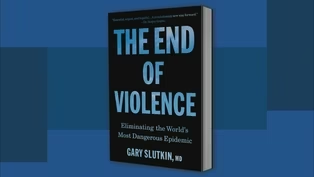
New Book Diagnoses Violence as an Epidemic
Video has Closed Captions
Physician and author Gary Slutkin looks at violence as a measurable and curable infectious disease. (8m 17s)
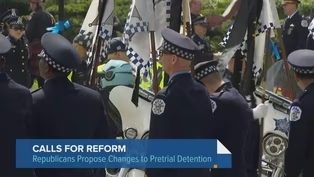
Renewed Debate Over SAFE-T Act After Chicago Police Officer Killed
Video has Closed Captions
Illinois Republicans are pushing for changes to the law. (11m 23s)
Providing Support for PBS.org
Learn Moreabout PBS online sponsorship New Episode
- News and Public Affairs

Top journalists deliver compelling original analysis of the hour's headlines.
 New Episode
- News and Public Affairs

Today's top journalists discuss Washington's current political events and public affairs.
 New Episode
 New Episode
 New Episode

 New Episode
 New Episode
 New Episode
Support for PBS provided by:
Chicago Tonight is a local public television program presented by WTTW
WTTW video streaming support provided by members and sponsors.