Vermont This Week
May 15, 2026
5/15/2026 | 26m 46sVideo has Closed Captions
Vt.’s lawmakers push big ideas, but struggle to fund them | Update on education reform efforts
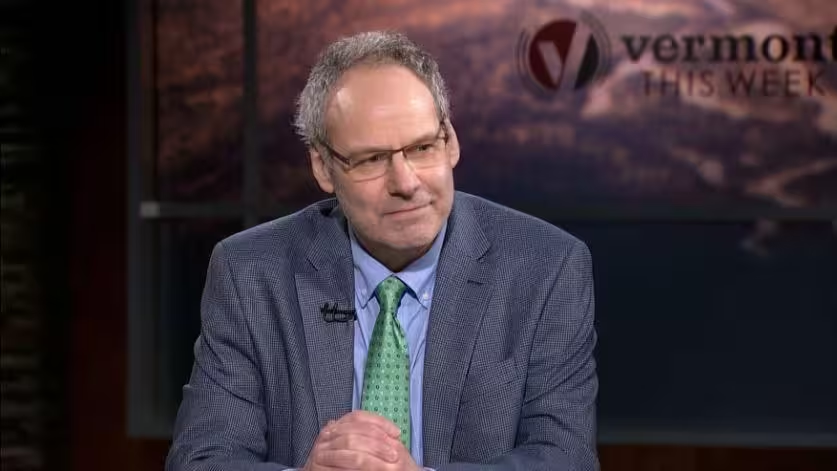
Vermont’s lawmakers push big ideas, but struggle to fund them | Update on education reform efforts | Hidden parking meter fees in Vermont | Moderator - Mitch Wertlieb; Hannah Bassett - Seven Days; Peter Hirschfeld - Vermont Public; Erin Petenko - VTDigger.
Problems playing video? | Closed Captioning Feedback
Problems playing video? | Closed Captioning Feedback
Vermont This Week is a local public television program presented by Vermont Public
Sponsored in part by Lintilhac Foundation and Milne Travel.
Support provided by:


Vermont This Week
May 15, 2026
5/15/2026 | 26m 46sVideo has Closed Captions
Vermont’s lawmakers push big ideas, but struggle to fund them | Update on education reform efforts | Hidden parking meter fees in Vermont | Moderator - Mitch Wertlieb; Hannah Bassett - Seven Days; Peter Hirschfeld - Vermont Public; Erin Petenko - VTDigger.
Problems playing video? | Closed Captioning Feedback
Where to Watch Vermont This Week
Vermont This Week is available to stream on pbs.org and the PBS app.
Support the crew
Help Mitch keep the conversations going as a member of Vermont Public. Join us today and support independent journalism.Providing Support for PBS.org
Learn Moreabout PBS online sponsorshipThis week, a look at how lawmakers in the state often push big ideas but struggle to fund them.
Plus, an update on education reform efforts in the state House and why you may be paying more to park without realizing it.
All that and more ahead on Vermont This Week.
From the Vermont Public Studio in Winooski.
This is Vermont This Week, made possible in part by the Lintilhac Foundation and Milne Travel.
Here's moderator Mitch Wertlieb.
Thank you for joining us.
I'm Mitch Wertlieb.
It's Friday, May 15th, and with us on the panel today, we have Hannah Bassett from Seven Days, Erin Patenko from VTDigger.
And joining us remotely, Peter Hirschfeld from Vermont Public.
And thank you all so much for being here today.
We're going to start off today talking about a story that affects like everything.
And, Hannah Bassett, you wrote about this with Alison Novak in seven days, and it's taking a look at the big ideas that Vermont lawmakers push, often leading to laws that get on the books.
But then there's the struggle to fund these things unfunded mandates.
This deals with everything from school literacy programs, PCB cleanups in schools, agency of natural resources.
What was the general gist of what you and Alison found in this reporting?
Lawmakers obviously are responsible for crafting the laws, the programs, funding, state agencies, making the frameworks for, what makes our state run.
But they're also responsible for funding those initiatives.
But the reality is that there's a limited pot of money to do so, and there often isn't enough money to go around to do that.
So what ends up happening in these circumstances is there are end up being what are called unfunded or underfunded mandates, and that means that there is not enough, money, not enough staff, not enough resources for the people who are given these responsibilities by lawmakers to carry out these duties, to, to accomplish what they're being told to do.
And it puts people in a really tough position.
It really does.
You know, we talked a little bit about this on the show last week, as we talked about the Vermont's ethics Commission, which is really struggling right now to do the job that it was tasked to do.
A lot of that has to come down to with like what you were just saying, staffing, for example.
The Ethics Commission has had two part time staff since it, was created in 2017, I believe it was, by the state legislature.
Since then, the commission's, staffing has remained the same, but the duties that it has had has increased this legislative session, the duties that the lawmakers have been considering putting on the Ethics Commission have only been increasing as well.
So, lawmakers recognize that the Ethics Commission is an important entity.
I think that's why there are so many responsibilities being placed on this entity.
But it's really hard for these two part time employees to carry out those duties when they only have so many hours in a week to do that.
So, these are these are issues that these, part time employees and the commissioners, their five commissioners who are on the state Ethics Commission have raised with lawmakers.
But there is still fundamentally this gap between the resources that are allocated, which is in the lawmakers control and what is actually passed at the end of the day.
I mean, it's so interesting because, again, when you look at like the Ethics Commission, for example, they already were saying they were struggling to do their work.
Then they were tasked with something new, which was to deal with financial disclosure forms for candidates who are running for office.
We got an election coming up.
You were writing about this saying that, somebody had to testify while they were on vacation, about this.
And it was kind of an emergency thing where they had to say, look, you're already asking us to do too much, and now these financial disclosure forms.
You're asking us to do that, too.
And the lawmakers reaction to that was not very sympathetic, was it?
To to the Ethics Commission?
The executive director is actually on unpaid leave at the moment.
Christina Seifried is on what's essentially her first leave in four years.
She decided to take this unpaid leave because she essentially reached her breaking point.
Because of this mismatch of responsibilities and time, trying to carry out so many of these duties, in this part time job that functionally was a full time job, but with part time pay.
So she is, in Indonesia as it turns out.
But as these responsibilities were being placed on the commission and, before the House government Affairs Committee, she decided to testify to them remotely.
So, joined them by zoom, to speak to why this might be an issue for them, given this mismatch of resources and bandwidth.
And, might be a better match, perhaps in this circumstance for the Secretary of State to take that on, which is its own discussion that they had.
But at the end of the day, it's this issue of resources and bandwidth.
But lawmakers were not very sympathetic in that moment to that.
I think they had some concerns about the Ethics Commission being resistant to taking on what is, financial disclosure form, fundamentally an ethics form, which on its face, one could see being well housed with an ethics commission.
But, to the Ethics Commission's point, it's hard when they are already suspending some of their core duties.
For example, they're no longer providing municipal services, advisory services to municipalities because they do not have the capabilities, the the staffing to do so.
So asking them to do another service just is not realistic for them.
So that was the point that the Ethics Commission, one of the points they were trying to get across that just was not being well received in that moment.
There was another big example you pointed out in the article, and, this is something folks will remember from, I think a few years back when, it was decided that there should be some PCB testing for schools in Vermont, and there was a school in North Country that that found after this testing happened.
This was, you know, mandated to do, that there was PCBs in the school and something had to be done about it.
But the money wasn't there to do anything about it.
And the school, you know, to their credit, they ended up coming up with a solution to put tents outside.
And the kids started the year in tents.
But that's not ideal.
And again, I think what I want to emphasize here is that these ideas lawmakers are coming up with in, in and of themselves, the intent is good, but it's that think through process, right?
Where do we have the money to follow through with the ideals we want these laws to represent?
Right, exactly.
And the lawmakers recognize that unfunded and underfunded mandates are not good policy, but they also recognize that they happen.
And it's a really challenging part of just how our citizen legislature is set up.
There's 180 lawmakers.
There are two chambers, and there's a limited pot of money available to fund all of these programs and all of these requests that are made of them.
This year, for example, the House Appropriations Committee, the chair told us that she got about $250 million worth of requests for programs, sent to her committee.
The committee was able to fulfill about $18 million in terms of one time and base funding.
So there's there a gap.
Exactly.
So these lawmakers are in a really tough position in terms of fulfilling these, these requests.
Everybody wants to do right by their, constituents create programs that they're being asked to do.
But it's also lawmakers responsibility to create programs that are sustainably funded so that the burden doesn't fall on principals, superintendents to, to carry the burden of a program that's not really funded.
Yeah.
Do things that they would like to do but can't necessarily do.
Pete Herzfeld, let me ask you this because you cover the state House.
You're in Montpelier right now.
A lot of these things we're talking about, we know Governor Phil Scott, for example, does not like new taxes, does not like new fees.
But one of the things that I know he also doesn't like is a wealth tax.
Now, this is an idea that's been floated around if we if there was going to be money to mandate, to, to fund some of these mandates, wouldn't in theory, a wealth tax be one mechanism to help pay for at least some of that?
I think that's one of the big arguments that Democratic lawmakers are making in Montpelier that, look, we have needs that exist in the state of Vermont, and we don't have sufficient revenues to meet those needs.
So let's increase taxes on higher earners in order to generate that revenue.
I also think, more broadly, lawmakers say they they're attuned to the fact that that the executive branch doesn't have enough money to do all the things that the legislature has asked it to do.
They also say, you know, we're not necessarily getting the sorts of insights into where there are fiscal problems from the governor in the form of his budget address.
He puts forward to spending plan every year.
That spending plan often doesn't identify the funding gaps that we later hear about within state government.
So I know having talking to a number of legislators that they would appreciate more insight from the executive, as it relates to where they might be able to, target resources to address the sorts of unfunded mandates that Hannah reported on.
That sounds like a communication problem to me, though, where, you know, just the information isn't getting passed around enough and then lawmakers don't know what they should do, what they can fund and can't fund.
Welcome to Montpelier.
Communication breakdowns are often the order of the day in this environment.
And, different constituencies, inability to communicate effectively with each other often results in, in these sorts of situations.
I want to just mention one more thing before I move on to, to, education reform, Pete.
And that's that.
You know, we talked about Hannah's story, talked about the PCB testing for example.
There are a lot of schools in Vermont that still need to be tested, right?
I mean, we have a graphic.
There's a 171 untested schools now, and I know a lot of schools are going to have the same problem I would imagine the North Country is going to have can they do the testing?
Do they have the money to fund that?
Well, the the, legislation that the lawmakers have before them this session is still in flux.
So it's it before US Senate lawmakers right now, the House had passed a version of a bill that would have, essentially terminated or put on a very long term pause, the PCB testing program, as we've known it, until there was sufficient funding from the state to carry out, all of the activities, associated with this.
The Senate essentially has bumped out the deadline for the testing program, initially to 2031 now, I believe most recently to 2036.
And I think part of the reason for moving the deadline is because of exactly what we just saw in that graphic.
More than half of these schools built before 1980, which is when PCBs were involved in school construction, remain untested.
And that's something that lawmakers are really uncomfortable with stepping away from.
So it's a tough position now that lawmakers have begun this process to, feel like they're leaving these schools without resources or this equity issue is one that's come up in committee discussions.
I appreciate the update on that.
Because I know the House was ready to drop the whole thing together.
But the Senate said, all right, let's push that back.
Exactly that Kendall Road.
Have some time to see what will happen with these bills.
Pete Herzfeld, where are we on education reform efforts right now at the state House.
Where's the bill?
What's happening?
Veering toward impasse at a at a accelerating rate.
The House passed a bill last month that, you know, it's a sweeping proposal.
It implicates almost every aspect of Vermont's public education system.
But the one sticking point that lawmakers and the governor have landed on is this question of governance reform.
The governor wants to force school districts to merge.
He says that's the only way you're going to achieve economies of scale, the only way you're going to get, larger districts that can pool instructional and infrastructure resources, create more efficiencies.
Lawmakers, Democratic lawmakers, though, say we we've heard from Vermonters as we've contemplated that proposal and they don't like they've told us loud and clear, they don't want it.
So the House passed a bill that relies on, voluntary mergers instead, the Senate has now basically embraced that proposal almost wholesale.
And so we find ourselves here nearing adjournment with, Democratic leaders in the House and Senate and Republican Governor Phil Scott, at odds over this one key issue.
There don't appear to be any obvious compromises in the offing right now.
And so, we're looking at an indefinite showdown.
The governor has said he's willing to keep lawmakers in session indefinitely until they bend to his demands.
And he said this week that if that means keeping them in Montpelier through the summer, then so be it.
That, seems like a pretty sticky wicket.
And it's not made any easier by the fact that the House education chair is not seeking reelection.
Is that right?
Yeah.
That's right.
Cornwall Representative Peter Coughlin is the Democratic chair of the House Education Committee.
I don't know to what extent his departure, affects this conversation.
We should also note that Senate President Pro Tem Philbert Ruth is not seeking reelection next year, so he won't be be here, in 2027 to pick up whatever pieces are left of this education reform bill.
But certainly Collins departure is is a notable one.
He's he's known in Montpelier for an even hand for his humility.
And he said that the the economics of service just don't work out anymore.
He saw his health care bill skyrocket as a result of those expiring, Affordable Care Act subsidies that that thousands of Vermonters lost starting, starting January 1st.
And he says the reality is he's going to have to find a job that provides health care in order to make ends meet.
And the legislature, is not that job.
A lot of Vermonters, I think, can relate to that very big problem.
Erin Patenko, whether or not education reform happens, budgets are an issue.
School budgets.
Certainly.
You've been covering what's been happening in Barre.
Their school district budget was shot down for a second time.
What happened there?
Yes.
The, the first vote happened on the, you know, typical Vermont annual town meeting day in March.
The board put forward, I think it was, it was above 3% budget increase that got voted down.
This time for barre is delayed annual city meetings.
They decided to do a revo ad.
I think it was around 2.7%.
So more than a little lower.
Yep.
That also got shot down.
But I got to say, the board chair that I talked to said he wasn't necessarily all that surprised because Barre has a long history of voting down these budget proposals.
In 2025, he said he was blindsided by their victory when it got approved the first time around in 2024.
They actually had, I think was four votes before it passed, and they had actually started the school year without a budget in place, which was a pretty nerve wracking time because if they had failed that fourth vote, they would have probably had to borrow from the state.
But you can only borrow 87% of your last year's budget.
That can be a pretty severe cut.
Yeah.
To deal with.
So Barre is not the only place in the state I think I was 5 or 6 different districts have had their second budget vote fail.
But Barre is probably the one with the biggest pattern of this kind of problem.
And it really seems like barre town and Barre City have very different perspectives on this, because Barre Town is the one who always votes no.
Yeah.
Whereas Barre City typically votes yes and has voted yes both times.
This year.
And you know, your article pointed out there can be varying reasons for that.
Maybe some folks who don't have kids in the school system anymore feel like, you know, why should they be paying and that kind of thing?
A lot of reasons for it, but certainly not easy.
Is there a danger now that they could go ahead with it without a budget?
Again, when's the next vote?
Basically.
So they haven't put a vote on the on the calendar yet.
They most likely will put a vote on the calendar for this summer.
But the, the board meets again, I think, on June 1st.
And they're going to make their final decision then on how to move forward.
Yeah.
I mean, I've heard a lot about affordability from, barre residents.
You know, Barre has a lot of lower income folks.
So, you know, even if it's a percentage of your property tax or your percentage of your income, paying higher taxes can be more of a challenge when you're already struggling to, you know, afford day to day life.
That that seems to be a big part of it.
Yeah, yeah.
No question.
Now, Barre has reelected Mayor Thomson.
You were speaking for the eighth term.
Yeah.
So he, you know, and he's trying to do the best job that he can, but that job is going to be a little bit tougher now that the city has lost its, city manager, Nicolas Castro, who's taking the job in South Burlington, right?
Yes, yes.
I, I've heard a lot of, city officials praise.
Nicolas is performance the city manager?
They they seem to think that he's a very, like, steady, person to lead the ship through the crisis that they had in the 2023 flood and then kind of again in the 2024 flood.
He's been in charge of a lot of projects related to flood mitigation, housing, infrastructure in the city.
And he says that he loves ferry, but the offer that he got to be deputy city manager at South Burlington was a career move that he could not turn down right.
So now the, the one of the biggest positions in Barry is open and I guess, all of you guys listening, if you're interested, reach out to bear Tom.
But before you do that, take note.
I think you had in the article you I think you quoted earlier, Castro was saying that he did the job for four years and it felt like eight.
Yeah, true, true.
It's not an easy job.
Now, this is true.
I mean, every every city that I've covered, that city manager job, I do not envy them.
You know, you have to be responsible to everybody in the city.
And there's such a vast array of different topics that you need to become an expert in, like I said, like flooding, housing, infrastructure, leading public employees, you know, finding funding for the initiatives that you would like to do, too.
So I, I do wonder, you know, how, how that role is going to keep, evolving as some of our city employees across the state start to get older and consider retirement?
Yeah.
You know who's going to step up and fill those shoes?
It's a really good point.
But yeah, Nicholas Castro moving on now to South Burlington.
And I'm sure they're grateful for the job that he did, as you said, guiding them through a lot of that tough flooding in Barry.
Aaron, you also had this really remarkable article.
It's it's funny, as I was coming here today, I parked the car, as I often do.
I use a little parking app.
And you have been studying this parking app that a lot of people in Vermont use it.
It turns out there's some hidden fees involved.
What's the story there?
Yeah, I. I started looking into this because I, like you, were, you know, was using the app and I was like, why, what is this little service fee added to this charge?
And especially if you park for like 15 minutes, you know, and the city just charging you $0.25.
But the app is adding $0.35.
It's kind of interesting to.
See $0.05 going.
Yes, yes.
Well, the the municipal fee goes to the municipality, but the service fee goes to Park Mobile.
And Park Mobile has earned hundreds of thousands of dollars off this fee because, you know, people park all the time every day in Vermont cities.
You know, they definitely say that they think that it's worth the, the cost to have, you know, the convenience of an app.
You can pay by phone.
You don't need to have quarters on you all the time.
And they, you know, they say that they need this to keep the app maintained and accessible and usable for people.
But I did hear from some readers after I published the story who said, you know, where's the option to pay with quarters?
I really don't want to have to use my phone to pay for parking.
So that's, that's kind of the trade off that a lot of municipalities are starting to kind of way, you know, as they decide, you know, how to move forward with that.
I feel like we all make that tradeoff, like all the time now.
It's like it's like, oh, just use the app, whatever it may be, you know?
And I do think it's like, what if you do want to just pump quarters into the into the meter, but you can't even find quarter meters sometimes anymore.
It's it's disappearing.
Really.
Yeah.
Yeah.
I mean, I've started to kind of keep an eye out and I would say it's probably around 75% of the time there's, a quarter or, you know, an analog option of some kind of available.
But the other 25%.
Yeah, you need to have a smartphone specifically because, you know, a dumb phone.
I don't know, but maybe you can call and I. We're going to look into this for the next.
Day.
There's going to be more of this dumb smoke either way.
Yeah, it would be a challenge.
So yeah.
So there's, there is a kind of an encroachment of this technology.
Really interesting, though, that these fees are not all going to the cities where you're parking.
They're all going to Winooski or Burlington.
It's just this chair.
This is true.
Although the cities say like it's great for us because we don't have to deal with the maintenance cost of running our own app or in some cases, you know, maintaining the kiosk where you had to pay, like those things sometimes break down and the city would have to pay to fix it.
And they don't have to do that with the app.
So they work out.
They say it works out for them.
I appreciate your reporting on that.
Pete Herzfeld, I wanted to ask about a proposed constitutional amendment to Vermont's constitution that is going to be headed to voters.
What is this dealing with?
This is a proposal to add an equal protection clause to Vermont's constitution.
Vermont is in the minority of states that has not amended its constitution to add an equal protection clause, and the language that one final approval in the House earlier this week guarantees equal treatment under the law.
For nine explicitly named protected classes, this includes sex, race, gender identity, sexual orientation, etc.. It passed both chambers of the legislature in two consecutive biennium, which is, what's required to to get an amendment, before voters to see if they want to ratify it or not.
And there was some increased Republican opposition during this last vote.
But Vermonters ultimately will get to decide whether they think that, the state's founding document ought to include this language.
And, Hannah.
So this will not be an unfunded mandate at all.
Right.
This is not one of those things that falls into that category just to be.
No, no, very different.
This will just be, constitutional amendment on the ballot this coming election.
If it passes.
And Peter Hirschfeld, important to point out, too, though, that this would not be able.
So this is not something that would supersede federal law.
Correct.
Would not supersede federal law.
But right now, the Vermont Supreme Court, sort of the arbiter of anti-discrimination cases.
And in the absence of an equal protection clause, they've had to look at the common benefits clause.
They'd have to they've had to look to the US Constitution to make, their legal rulings and precedents.
And there are some constitutional scholars who say, the addition of this equal protection clause might lead to some evolution in case law in this state that could meaningfully change the legal lens through which discrimination cases are considered.
All right.
Thank you for that update, Pete.
I'm going to end on, something that's happening in the state House, which is really exciting.
There's a new portrait that is honoring Vermont's first black woman legislator.
That would be Lavinia Dorsey bright.
And let's hear what her, daughter and the portrait artist had to say about this.
I think it's important for all Vermonters to have a mirror to see who they are when they walk into a place.
Just being that only in the room is, is an important piece.
And while, you know, while she was quiet, when she would take time to talk, the things that she said were important for her to be here, to start the process of having, portraits that represent the people of Vermont, people of our nation.
I think it's very important.
It's a beautiful portrait.
Peter's up and hung up at the statehouse yet.
Have you seen that yet?
Is that been officially displayed, or.
It's on the wall.
And I don't know if it's because I'm somebody that walks through that hall every day or not, but, it's it sort of changes eventually.
A little bit.
I have to say, I noticed it it changes the feel of that hall.
And, it's been a long running effort to get broader representation in the portraits that adorn the statehouse.
And I know that, a lot of people feel like this is a big moment in that process.
Something to go see for sure in Montpelier.
That's where we're going to have to leave it for today.
I want to thank our panel so much this week.
Hannah Bassett from Seven Days.
Thank you.
Erin Patenko from Vtdigger joining us remotely, Peter Hirschfeld from Vermont Public.
Thank you all so much for being here today.
I'm Mitch Wertlieb and I hope you'll join us next week.
Tune in Friday for Vermont this week.
Have a great week.
 New Episode
- News and Public Affairs

Top journalists deliver compelling original analysis of the hour's headlines.
 New Episode
- News and Public Affairs

Today's top journalists discuss Washington's current political events and public affairs.
 New Season


 New Episode
 New Episode
 New Episode

 New Episode
 New Episode
Support for PBS provided by:
Vermont This Week is a local public television program presented by Vermont Public
Sponsored in part by Lintilhac Foundation and Milne Travel.