Northwest Profiles
May 2022
Season 35 Episode 3505 | 26m 1sVideo has Closed Captions
Chef Chad White, WWII Black paratrooper battalion, capturing the cosmos.
Meet Chad White, a culinary artist that has brought a load of talent and delectable dishes to the Inland Northwest. Take flight with World War Two’s only all-Black parachute battalion, fighting fires in the northwest. Take in the images of Spokane photographer Terry Honyoust , who spends his evenings capturing stars, planets, nebulas, and galaxies far far away!
Problems playing video? | Closed Captioning Feedback
Problems playing video? | Closed Captioning Feedback
Northwest Profiles is a local public television program presented by KSPS PBS
Funding for Northwest Profiles is provided by Idaho Central Credit Union, with additional funding from the Friends of KSPS.
Support provided by:

Northwest Profiles
May 2022
Season 35 Episode 3505 | 26m 1sVideo has Closed Captions
Meet Chad White, a culinary artist that has brought a load of talent and delectable dishes to the Inland Northwest. Take flight with World War Two’s only all-Black parachute battalion, fighting fires in the northwest. Take in the images of Spokane photographer Terry Honyoust , who spends his evenings capturing stars, planets, nebulas, and galaxies far far away!
Problems playing video? | Closed Captioning Feedback
How to Watch Northwest Profiles
Northwest Profiles is available to stream on pbs.org and the free PBS App, available on iPhone, Apple TV, Android TV, Android smartphones, Amazon Fire TV, Amazon Fire Tablet, Roku, Samsung Smart TV, and Vizio.
Providing Support for PBS.org
Learn Moreabout PBS online sponsorship♪ Hello and welcome to the season finale of Northwest Profiles, I'm your host Lynn Veltrie and in celebration of another successful season of profiles thanks to wonderful viewers like you, we finish with an episode brimming with illuminating stories that are sure to mark the end of our 35th season with a resounding exclamation point.
On the way, we sample the flavor of Baja with an award-winning Spokane chef, discover some little known, world war two history from a vet on a mission and finally, we finish up looking skyward for a star lit photo shoot.
So, with food, history and stars on the agenda what more can I say?
Other than, what are we waiting for?
Let's light the fire, shall we?
For our first story, we meet a chef who takes his talents to the limit and then some, by not only excelling in what loves to do, but also by bringing his gastronomical talents to the people of Spokane.
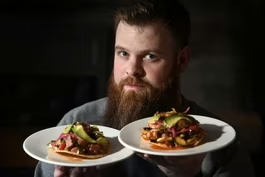
Greeting guests at his restaurant, Zona Blanca in the Holly Mason building in Spokane, is a perk for chef, Chad White.
Chad White: How's you're guys' day going so far?
Group: Good, how about you?
>>Very Good, first time here?
>>We've been in >>You've been in?
excellent.
Wonderful.
>>While running an operation that includes a bevy of restaurants, included in his hospitality group,you could say... this is something for which he lives.
Chad White: Zona Blanca is my baby.
This is everything to me.
Not that any of my other restaurants or my kids, as you can call them, are unimportant to me because they really are there.
They are they're everything to me.
And it's the families that I've built within them, the team that I spend more time with than I do with my actual family.
We've won chef of the year five years in a row.
We won best new restaurant.
We've been so blessed by this community that supported us, during COVID when it was hurting.
People came out and helped us.
Zona Blanca wouldn't be here if it wasn't for the community of Spokane and wouldn't be here for the family that I've built, that's helped grow it.
So it's everything to me.
I wake up in the morning and I'm so excited to get here to take my knife out of my bag, to work on a new dish, to train my team to explore new flavors.
>>Born and raised in Spokane and the Spokane Valley, Chad was an unlikely candidate to make the food and hospitality business his life's vocation.
Chad White: I'll be honest, I was the pickiest eater.
My mom would tell you anything.
Green on the plate Chad's not touching it, not a chance now I'll eat anything I had to give everything a try when I was a kid.
As an adult, I grow up and all the things that your mom used to tell you that were not cool or all of a sudden cool because, well, I'm my mom's age, when she was trying to teach me those lessons as a kid.
>>A proud graduate of Central Valley High, on 9-11 2001 Chad joined the service, and while in the Navy, began his culinary career while stationed in San Diego California.
After leaving the service in 2005 Chad was hot into his chosen profession.
Chad White: At 26 years old, I opened up a restaurant called Sea Rocket Bistro is the first restaurant that I owned.
We were a sustainable seafood restaurant.
I was the chef and owner.
It landed me on bizarre foods, with Andrew Zimmern being recognized for using everything that chefs weren't using in cooking.
There were no chefs at the time doing that with seafood.
From there, I opened a couple of restaurants with Brian Malarkey, Gabardine and then Común Kitchen and Tavern.
At that same time, I opened two other restaurants, one across the border called La Justina in Tijuana, Mexico.
I love Mexican food.
I've traveled all over Mexico, and I've had some great mentors and and teachers that have invited me into their homes and taught me about their culture and their food and the history of their food.
Something that I hold near and dear to my heart these days, which spawned, you know, Zona Blanca ceviche bar in Spokane.
>>From there, Chad has been one busy Jefe In 2016 He caught a huge break.
Top Chef, the wildly popular culinary competition on the Bravo Television Network offered him a slot on their season 13 series.
Chad White: Going on Top Chef was wild it's not what you think it is.
The behind the scenes is not as pretty as what you get to see on the TV.
But it opened my eyes about reality about this industry about how hard it is.
The competition was crazy, I mean, expectations were unrealistic and for obvious reasons, The chefs that I was up against were people that I already knew not like I knew them like, hey, what's going on, buddy?
I knew them because I followed them.
There were people that I was inspired by and I didn't know they were going to be on the show.
And I'm standing there first day with Tom and Padma off in the corner getting ready to say something.
At that time, I felt proud of myself that I was there number one, proud of my what I have built in that time.
I did well, you know, I finished in the top ten that show makes you, and that competition specifically makes you think so fast on your feet and what you learn there is no matter how good you are, there's somebody better.
>>Now on the heels of his thrust into the national limelight Chad decided to move back to Spokane from San Diego and apply his craft in his hometown in 2015 to the delight of the local restaurant scene.
Chad White: When I opened Zona Blanca in its first location on Madison, we were in the back of a cool Dive Bar called Steel Barrel Taproom, they have a little local brewery in there, and for people to walk through the Taphouse and then find this little, small ceviche bar with what I found to be a lot of culture was actually quite shocking, for the majority of people in Spokane.
Ceviche is a dish that is well known all over the country and especially in Latin America.
But in Spokane, it's only seen in restaurants peppered around small Mexican eateries.
This was my opportunity to show people the flavor of Baja.
I'm going to be making a Ceviche Mixto.
This is our most popular Civeche on our menu.
And I think the reason why people like it so much is there's just so much flavor going on.
As you can see, there's quite a bit of ingredients with shrimp and yellowfin tuna from Hawaii and octopus from Spain, Serrano, Chile, cilantro, cucumber, pickled red onions, and then we call this salsa de cocojates which is a Spanish peanut salsa with garlic and chili paste and chili infused oil And so just really zesty, full flavors, lots of texture is a lot of fun.
And the first time I had a ceviche like this was at a ceviche cart in in Ensenada by a lady by the name of Sabina.
And she's got this little tiny market.
She is about 70 years old.
And she's been working this ceviche cart for a really, really long time.
This is this is an inspired dish by her restaurant called La Guerrerense.
And so this is shrimp from the sea of Cortez Yellow fin Tuna, this comes from Hawaii.
And then we have Spanish octopus.
This is actually cooked.
The shrimp is soaked in lime juice.
Add a little bit of Serrano chilies, because we like it spicy here.
And then we've got our, Awache Roja.
So this is very zesty juahio chilies, lime juice, a little bit of orange, all blended together.
With some achiote, a little bit of sea salt, and then we just mix this up.
This is served with Tostadas.
Ours are corn tortillas.
And this is just so bright and fresh.
And then we do a little bit of pickled red onion.
This adds a little zing to it.
And then lastly, we top it with this peanut salsa.
And this adds a really unique flavor.
This salsa is absolutely inspired by the ceviche cart I talked about.
Hers is a lot spicier than ours.
But as this nuttiness, tons of flavor things that you wouldn't expect.
And it is absolutely delicious.
Ceviche Mixto.
As a younger man, I wanted to run, way before I learned how to walk.
I'm not even where I want to be yet, and I've been in this industry since 2001 gosh, 20 years now.
And I'm still learning every single day.
I wanted to learn so much coming out of the military.
I didn't have the skill set that a lot of the chefs that I was working side by side did.
But I had the discipline, I had the tenacity, I had a ton of grit, and I was willing to do the crap jobs.
Didn't matter what it was.
I wanted to be a chef and anybody that told me I couldn't be a chef, or I shouldn't be a chef, I proved them wrong.
I think when it's a passion you should listen to your heart.
And that's what you want to do.
Go after it.
These are our Octopus tacos.
With salsa roja, cilantro, mayonesa zorindiado.
Delicious Chad is currently in the running for a prestigious James Beard award for 2022.
In the culinary world that's a big deal and a real badge of honor, so Chad, we wish you good luck!!
Up next, we exit the kitchen and delve into our nation's past with Dr. Bob Bartlett a Spokane veteran who's on mission.
After reading an article in the Spokesman-Review about an all-black parachute battalion in World War two, Bob wanted to find out more.
Now, years later his research has compelled him to tell the battalion's story on film.
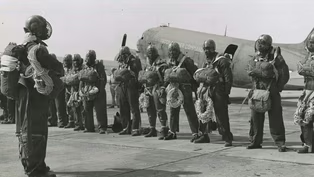
(Military drumming) NARR: The "Triple Nickle", an elite group of all-Black officers and soldiers got its start in 1943 at Fort Benning, Georgia.
Bartlett: Now these were the days of segregation, Jim Crow law.
And so, the military was as racist as society.
And so you had, virtually an all-Black army and an all-White army.
NARR: Before they became a parachute infantry battalion, these Black soldiers were a service company attached to the airborne school at Fort Benning.
Bartlett: They were guarding the gate, patching potholes, cooking, being a service company.
They were not soldiering.
They were living a separate life from the White troops.
They were not allowed in the theater, they had to sit in the back of the bus, they ate in separate dining halls, they had separate clubs on base.
They were led by a man by the name of Walter Morris.
Walter Morris took it upon himself to take the troops over to the training grounds where the White troops trained.
And he watched them every day do their calisthenics and jump off of towers, and so forth.
He led his troops over there and said 'although we're not paratroopers and we may never be paratroopers, we're gonna train like paratroopers.'
There were bets by the White troops that Black troops didn't have the internal fortitude to jump out of planes, they didn't have the guts to do the work.
So, they were betting that these Black troops would fail.
They didn't.
They graduated.
NARR: This new unit became the 555th Parachute Infantry Battalion, nicknamed "The Triple Nickle".
Bartlett: The 555th were Black from the lowest ranking to the top.
The war was coming to an end in Europe, but orders appeared.
The orders were marked "Classified".
So they thought "Hooray, we're going to get a chance to kick Hitler's tail", because that's what they wanted to do.
They wanted to fight against the world's most prominent racist, at the time, even though being treated as second-class citizens in their own country.
NARR: Their classified orders sent them to Pendleton, Oregon.
With the war in Europe winding down, the 555th expected to be sent to the Pacific.
But when they reached Oregon, they found that the fight was coming to them.
Japan had sent a fleet of hydrogen balloons into the jet stream, meant to deliver firebombs to the United States.
Bartlett: And they launched nearly 9,000 of these 33-foot diameter hydrogen filled balloons with these bombs underneath.
Many ditched in the ocean.
Some ended up in Mexico, Alaska.
Some actually turned around in the jet stream and flew back to Japan.
But they launched all of these balloons, the military kept it quiet.
There was a problem though because a couple of them worked really well.
And another balloon landed in the Tri-Cities at Hanford, in the fuse wires at Hanford.
Fortunately, it didn't explode, or we wouldn't have Richland, Kennewick or Hanford.
NARR: The military fought the firebombs with a campaign called "Operation Firefly".
The soldiers of the 555th were trained to parachute into steep wooded terrain, diffuse the bombs and put out fires using picks and shovels.
Their compelling story is almost completely unknown.
Dr. Bob Bartlett, a retired educator and a veteran, is working to change that.
Bartlett: I'm prior military, I was Army, Vietnam.
My brother in the Airforce.
And he was in Thailand, in and out of Vietnam the same time I was in Vietnam.
I come from a military family.
My great-great- great grandfather fought Company K 127th United States Colored Infantry in the Civil War.
My father was a combat medic, his brother was a combat medic.
My other uncle, Jim Scott was a tanker in World War Two.
And another uncle that was infantry in World War Two.
And so I come out of a long line of military, prior military folks.
So, I was surrounded as a kid with Black veterans, World War Two veterans who never told war stories, as you would imagine they would.
But they talked about the blatant racism that existed in the military.
Talked about riding in the back of the bus behind German prisoners of war who were sitting in the front of the bus.
Ogden: Bob is really the keeper of the story.
NARR: Bob met filmmaker Chase Ogden in 2016 at the Spokane International Film Festival, also known as SPIFF.
The two men began talking about the story of the "Triple Nickle".
Ogden: I really saw Bob's passion for it.
And I knew that I could help him bring that to more people.
He's done a lot of the research, a lot of the locating of stories, helping me write, choosing which pieces of the stories to include in the actual film.
But for the actual, like putting together of the film, that fell more on my shoulders because that's kind of my expertise, not necessarily what Bob is experienced with.
Bartlett: He weaved his magic and submitted this short in various film festivals like The Big Sky Film Festival over in Montana, and a few others.
And lo and behold, we were chosen in two of them; SPIFF and The Pan-African Film Festival in Los Angeles.
And so we're at the short film part of the story right now, and hopeful that someday, someone will see this story and think it's as amazing as I think it is and be willing to help us push it further, push it into a full feature film.
Because that would be absolutely amazing.
We have so many stories that you can't obviously tell in a short film.
This is such a northwest story.
And it's a Black story and it's an American story.
And it's a hard story because there's so much about it, about race.
You know, these men were treated horribly wherever they went.
Which is why we titled our documentary "Jumping Into Fire".
Because they not only jumped into fires, literally, they jumped into the fires of blatant racism.
They fought two battles at the same time.
So everywhere I've gone, I have never been in a hostile crowd who'd say "that's a bunch of baloney, or that's not near as exciting as I thought it'd be".
It's been to the contrary.
People say "my word, how come I don't know that story?
We need to know that story.
We need to know more of that story.
We want to know American history.
We need to know more American history!"
People are hungry to know these hidden stories.
It's just that we need to get to a stage now where we can tell it in full.
Ogden: Honestly, I've learned so much in working with Bob that I have a much greater appreciation for what people in America go through that don't look like me, that aren't White men.
And so that's been incredibly valuable.
Bartlett: This is not a project to me.
I'm connected to this story in my DNA.
My grandchildren, your grandchildren, children from now on need to know this story.
That if we don't get it told fairly soon it may never be told.
♪ The battalion's nickname "Triple Nickel" comes from its number, the Five Fifty-Fifth.
Its symbol is three buffalo nickels, referring to black soldiers in the US Army in the late 1800's.
Who were called "Buffalo Soldiers" For our final story we leave history behind to focus our attention on the night sky where stars, nebulae, and galaxies provide brilliant subject matter for Spokane photographer Terry Honyoust to capture after the sun goes down.
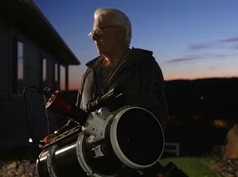
Well, my name is Terry Honyoust, and I'm retired I spent a lifetime as a telecommunications engineer.
Back in 1973 I bought my son, who was five at the time, one of those little tiny Tasco telescopes.
And we were in a backyard looking at stars and happened to look at a star and it turned out to be Saturn.
And I thought, oh my goodness, we need a bigger telescope.
I read every book I could about every galaxy, about every nebula, about every star supernovas and Red Giants.
And I just thought well, this is amazing.
When it comes to asteroid photography, it's a challenge.
You have to study.
You read a little bit, watch a few YouTubes but boy, I'd like to see everybody doing it.
has changed with digital and the Hubble, that everybody now can take a picture like the Milky Way in 30 seconds.
That's a Celestron 11 and it's the focal length of 2,850 millimeter focal length.
It's great for shooting pictures of Saturn, Jupiter, the moon.
People often ask me, well, how far can you see?
I don't know how far I can see.
If you can see it, you can photograph it.
My name is Paul Yost.
I'm a member of the Spokane Astronomical Society.
What is an Astro Photographer?
They are just someone that enjoys taking photographs of the night sky.
You could do that with just a regular camera.
You'll need to take long exposures in order to capture the stars.
One of the first times I met Terry was on the South Hill, so the stars were just barely starting to come out.
With his telescope, He has a Go-To on it.
So when he has it properly aligned, he can just say, Go-To this object.
He told it to Go-To the Sombrero Galaxy, and there's no way that you'd be able to see this galaxy.
By filtering the light out eventually there was resolution.
You could see the the Sombrero Galaxy.
I was completely astonished by this.
It was just fantastic.
I spent a lot of time with the Andromeda Galaxy.
Also a very easy image is the Orion Nebula.
You aim your telescope at it, you click for 10 seconds.
You get an image on your screen that's just amazing.
Between those two items, I like to try to get the sharpest, the most detail, the best photogenic looking image I can get.
I want a very good photograph.
That's the photographer side of me.
One thing you realize that we are very, very small.
You know!
I get a sense of peace; there is just so much more than us or so much more than me.
And then to be able to just photograph a portion of it and actually see something and take it home just like the Hubble can.
Well, it's just an amazing and it's inspiring and it's a challenge all in its own.
You think about how huge the sun is compared to our Earth and how far away it is and how far away the outer planets are and so just our solar system is enormous.
And yet compared to the galaxy, it's just it was lost in space.
To think about how fast light travels and how long it takes light to travel from the sun behind me takes eight and a half minutes to get here.
The next closest star, four and a half years, you get to the center of the galaxy, almost 30,000 light years away.
And then you get to the next closest galaxy to the Andromeda Galaxy, two and a half million light years away.
Without astronomy, I believe what we lose is our sense of place in the universe.
I think the sheer size there may be an end somewhere, but my belief is there's probably, probably not.
I don't know and I just kind of like to think that way, you know?
So now I need a bigger telescope!
And now as we gaze into the night filled with stars, time has come to turn out the lights on season 35 of Northwest Profiles with the promise of a new season of storytelling returning next fall.
So, for now this is Lynn Veltrie saying so long and keep in mind, the joy of living here in the Inland Northwest and western Canada is the fact there's always something to discover.
So, while the weather is hot venture out, and when you do, take time to enjoy the view
Video has Closed Captions
Clip: S35 Ep3505 | 8m 18s | Dr. Bob Bartlett shares the story of an all-Black parachute battalion in World War II. (8m 18s)
Video has Closed Captions
Clip: S35 Ep3505 | 5m 32s | Stars, nebulas, and galaxies are the subjects of Spokane photographer Terry Honyoust (5m 32s)
Video has Closed Captions
Clip: S35 Ep3505 | 9m 26s | Meet Chad White, a culinary artist that has brought a load of talent and delectable dishes (9m 26s)
Video has Closed Captions
Preview: S35 Ep3505 | 30s | Spokane chef Chad White; WWII Black paratroop infantry battalion; Astronomical imagery. (30s)
Providing Support for PBS.org
Learn Moreabout PBS online sponsorship













Support for PBS provided by:
Northwest Profiles is a local public television program presented by KSPS PBS
Funding for Northwest Profiles is provided by Idaho Central Credit Union, with additional funding from the Friends of KSPS.