Compass
May 2022 Edition
Season 6 Episode 4 | 26m 46sVideo has Closed Captions
Low-income weatherization program, healthcare recruitment and an avian influenza update.
The May 2022 edition of Pioneer PBS’s public affairs program Compass features a low-income weatherization program, creative healthcare employee recruitment in Hutchinson and excerpts from a press conference in Willmar on the avian influenza outbreak.
Problems playing video? | Closed Captioning Feedback
Problems playing video? | Closed Captioning Feedback
Compass is a local public television program presented by Pioneer PBS
Compass
May 2022 Edition
Season 6 Episode 4 | 26m 46sVideo has Closed Captions
The May 2022 edition of Pioneer PBS’s public affairs program Compass features a low-income weatherization program, creative healthcare employee recruitment in Hutchinson and excerpts from a press conference in Willmar on the avian influenza outbreak.
Problems playing video? | Closed Captioning Feedback
How to Watch Compass
Compass is available to stream on pbs.org and the free PBS App, available on iPhone, Apple TV, Android TV, Android smartphones, Amazon Fire TV, Amazon Fire Tablet, Roku, Samsung Smart TV, and Vizio.
Minnesota’s Alt-Meat Revolution
“Minnesota’s Alt-Meat Revolution" is a year-long video and print journalism collaboration project, looking into the roots and impact of the plant-protein phenomenon that’s exploding across the globe.Providing Support for PBS.org
Learn Moreabout PBS online sponsorship(lighthearted music) - [Narrator] Funding for compass is provided in part by, The McKnight Foundation, The Otto Bremer Trust and Members of Pioneer PBS.
Thank you.
Hi, I'm Amanda Anderson, welcome to the May Edition of Compass, the regional public affairs show on Pioneer PBS.
This month on Compass, we've learned about a low-income weatherization program through the Minnesota Community Action Partnership, talked with people thinking about creative healthcare employee recruitment in Hutchinson, and attended a press conference in Willmar on the avian influenza outbreak.
All this coming up on this May Edition of Compass.
(lighthearted music) The Minnesota Community Action Partnership has a weatherization program that qualifying households can apply for through a participating local community action agency.
Compass followed Bob Hoium from Prairie Five Community Action Council, to learn about how the program helps income qualifying homeowners, save and go greener by reducing energy consumption.
Weatherization is the process of making homes as energy efficient as possible, in return reducing consumption costs.
The Minnesota Community Action Partnership has a weatherization program that qualifying households can apply for, through a participating local community action agency.
The entire state is covered, but not all community action agencies offer the program.
This program is funded through the US Department of Energy and US Department of Health and Human Services.
- The weatherization program is a program designed to help low-income clients throughout the state through community action agencies, where we assess homes and do what the program will allow us to do to make the home more energy efficient and safe for the client and their family.
(upbeat music) - [Amanda] Bob Hoium is an Energy Auditor and Quality Control Inspector for Prairie Five Community Action Council's Weatherization Program.
Hoium does an initial inspection of the house to determine what needs to be fixed, updated or replaced.
He met us at Virginia Ryers, one bedroom home in Montevideo.
Ryer has lived here for 30 years, Murphy her dog, not quite as many - Roll the cameras - Roll it.
- [Amanda] She was ready to talk about the improvements to her 1940s home.
But first.
- Some years back, I did a pre-audit on this home, which is just a quick walkthrough to see if the home qualifies for the program, program isn't designed to fix every problem, so an example would be if the roof is in poor condition and leaking, we would have to wait until the client could get that repaired, so we're not coming in and doing more damage with our material.
- He was up and checked my attic and he said there was some vermiculute up there- - [Bob] And what I found in the attic is a material called vermiculite insulation, which can be assumed to contain asbestos.
- [Amanda] Vermiculite is a naturally occurring mineral once used as insulation.
A mine in Montana that produced the majority of vermiculite was found to be contaminated with asbestos.
That's why Hoium assumes any discovered vermiculite to contain asbestos.
It's discovery is an immediate halt in the weatherization project, because if the entire home can't be weatherized, it could do more harm than good.
- If we can't treat an area of the home, we may put the homeowner or the family in danger if we try to do the rest of the project, but we leave that area.
So by tightening up the house, if the home is taking on radon on our moisture, we're gonna create more problems.
So it's best just to leave it the way it is undisturbed and do a deferral on it.
- [Amanda] According to a Minnesota Commerce Department press release, the presence of vermiculite insulation in addicts is the main cause of weatherization deferrals throughout the state.
Because of this, in 2018, the department started a Healthy Air Program to help-low income homeowners remove vermiculate.
Hoium said that the current Healthy Air grant has a different funding source than the original, but the same purpose.
A homeowner can only receive a Healthy Air grant if the home can be fully weatherized after vermiculite removal.
Once the Healthy Air grants are awarded, a chain of contractors get set in motion.
First, enter Cody Dyshaw and his vermiculute removal crew.
- We have to go in there and first thing remove as much of the cellulose as we can.
- [Amanda] Cellulose is now the standard blown in insulation.
- We've got special vacuums that will end up taking the cellulose off the top, and then when we get down into the vermiculite, that special vacuum is filtered, so it can be sucked up and put into a 55 gallon drum that's lined with a six millimeter poly bag.
And essentially that vacuum just keeps filling up those bags and then we'll seal it off and take it out, and the special filters help to make sure that there's no asbestos fibers that get released into the air as it's being sucked through the vacuum.
- [Amanda] After the air is cleared, the weatherization improvements can start.
The work prescribed is informed by a blower door test.
- It's a way to measure the tightness in a house.
- [Amanda] The blower door test is done during Hoium's audit, again before the contractor start to compare notes, and a third time when the work is complete.
- Then we have a main attic measure which in this situation it was easy to model, 'cause I knew after we removed the vermiculite that it was gonna be empty.
- [Amanda] So Ryer's house needed the maximum amount of insulation.
Hoium also identified things like ceiling attic bypasses.
- Including the chimney, the soil stack open interior and exterior.
- The pull down attic ladder was leaky so they made a smaller attic lid, installed piping, sealed wall plates, lights, return duct work, installed carbon monoxide alarms and LED light bulbs.
There's a lot.
Then contractors Greg Seelen and his Son John Seelen step in.
- I'm the founder of Seelen Advanced Weatherization.
I work for five different agencies doing income-eligible weatherization.
It's what we do exclusively.
- [Amanda] They follow the work orders, and yes, some of that is attic-related, but as you heard the extensiveness of Hoium's energy audit, there's much more to it.
- The one part about what's with the income eligible weatherization is we use true building science in our approach.
We all know that heat rises.
So as heat rises up through the holes that are attached into the attic, we call them bypasses.
So now it creates an airflow through the hole.
When that goes up gets into the attic, that's what melts the snow and creates the icicles that you see from the outside.
So now then will add ventilation get rid of that heat, but our approach is to make a good air seal at the attic before we then add insulation.
- So what you're looking at here is the top side of your ceiling in your house.
When we're in the attic, this one has obviously been fully vacuumed and cleaned out for us, normally you'll see any type of an insulation that you're gonna have to dig up to find these things.
But what you see here is the tops of each wall in the house, this is a light that's been foamed and cross walls, these are all walls that you look for if you're digging through insulation and what we take is a one-part spray foam and we seal all the gaps.
Anytime we see where a wire goes in and then we seal up at a light all the way and we go through and we follow all the walls until you complete the entire house.
And that's gonna air seal all the heat loss are where your air is escaping into your attic.
- [Amanda] As they tighten up the house, AKA seal up air leakage, they also pay attention to ventilation.
- 'Cause once we air seal all these cracks, now we're tightening up the home which can create indoor air issues or moisture this helps eliminate that.
- [Amanda] The only drawback to eliminating moisture for Ryer, it seems, is no more bathroom mirror notes written from the steam.
- There was no moisture on my mirror.
- Really?
- Anything, yeah.
- So you can't write notes to yourself anymore.
- Nope, can't write my grocery list down there.
(upbeat music) - We typically get between at the very minimum 20 up to 60% air leakage reduction.
(upbeat music) I know we have a substantial energy savings in these homes, and that's very important and it's means we're gonna use less fossil fuels and therefore help our environment.
- And for low income people that can't afford, you know, stuff, it saves you money, you know, your heating bill and stuff like that, and I think it's very important.
(upbeat music) - Nursing and residential care facilities in Minnesota lost almost 6,000 workers in 2021.
With Minnesota projected to add nearly 60,000 new healthcare jobs over the next decade, Harmony River and Presbyterian Homes & Services are thinking about creative ways to recruit staff.
- Let's talk a little bit about senior care in Minnesota.
- Yeah.
- So amazingly enough 60,000 people turn 65 every year in Minnesota.
- [Amanda] Rob Lahammer knows senior care.
He's the vice president of engagement and advocacy at Presbyterian Homes & Services, a network of over 50 senior living communities throughout Minnesota, Wisconsin and Iowa.
He's been working for PHS for 34 years, almost 40 years in senior care generally.
- When I started it was eight, nine, 10% of the population was seniors.
We're now sitting around 16, it's going to be 25%.
So with 60,000 people, it's about 1 million people in Minnesota, 65 and older.
So as far as the industry goes, there are more seniors right now, 65 older, I'm almost that so I hate to call them seniors, but 65 and older that are in K-12 education.
- [Amanda] He said that throughout his career, the services provided by these facilities has expanded, and the bigger industry now is assisted living in memory care.
A report by Cameron Macht and Anthony Schaffhauser for Minnesota's Department of Employment and Economic Development, says that Minnesota is projected to add nearly 60,000 new healthcare jobs over the next decade.
And at the same time, the report found that while nursing and residential care jobs were up to almost 106,000 in December of 2020, after an initial dip in March 2020 because of COVID-19, Iin the entire year of 2021, this area lost almost 6,000 workers, down to just over 99,500.
This loss they say is because of facility closures, people quitting or retiring.
- What we certainly have seen changes in the last two years of COVID.
We used to see one person retire a year.
This last year, we quadrupled that.
- [Amanda] Located in Hutchinson, population about 14,500, Harmony River joined the PHS network in 2012 and is one of the more rural locations.
Wolling said that they've maintained 75% of their staff over the last two years, which of course means 25% has been turning over.
- So just give you an idea in the industry.
There's 23,000 open positions in senior care in Minnesota alone, 23,000.
This staggering number, and it's about 20% of positions are open.
Now before the pandemic, it was somewhere in the 12% range.
So what's really changed to get to your question, it's we have to attract people to wanna work here.
- [Amanda] Sometimes people feel called to senior care and caregiving work, what Lahammer calls... - God's work it's wonderful work.
- [Announcer] But sometimes attracting potential employees has to be more intentional, like the Hutchinson High School's TigerPath Program.
- The TigerPath Program is where they prepare students for the workforce.
So we have partnered with the Hutch High School to have students come in here and work and get their clinicals done if they're in the nurse, they actually started their own nursing assistant program at the Hutch High School.
- [Amanda] A collaboration between the chamber of commerce, leaders from the economic development authority and local businesses, Hutchinson High School started the TigerPath Program about seven years ago to expose students to what Andrea Moore, the TigerPath coordinator, calls "logical career pathways."
- They're industry recognized credentials and certifications, and then the student leaves not only with a high school diploma, but with a certification that's valuable in the workforce.
So, you know, just taking that all into account and then realistically saying, "what can we do here at Hutchinson High School?
What's realistic for us?
Can we do a welding certification or can we do CNA?
Or what can we do?"
I know a lot of people come and, you know, a lot of people say like, "oh I wish I had this when I was in high school" or, and I mean most of it is just things that schools have been doing, but it's just so much more intentional and- - [Amanda] Each student in their approximately 1000-person student body, chooses one of the four TigerPath options, stream, sci high, business and human services.
And in the 2020/2021 school year, a CNA certification was added, complete with onsite labs.
- Yep, there's whatever they named him, William.
But I mean, it's very particular what you have to have in your lab.
We really had a vision that we wanted to offer the CNA course, Certified Nursing Assistant course and certification here within the walls of the high school, because we really thought, and it has turned out to be true, that more students would be able to participate in that programming and get that certification, if they could do it during their school day as one of their electives.
- So that's a college credit course that they're taking.
They take all the classes there, then they come here for their clinical experience.
And then we've actually been able to hire on some of those students that top the class at the Hutch High School.
- And while harmony river has been partnering with Hutchinson High School, Presbyterian Homes & Services has been working on recruitment efforts a little bit further away over 7,000 miles away actually.
- So we have about 120 nurses right now in our system, which is about one out of four, one out of five of our hourly RNs are from the Philippines.
- [Amanda] PHS has been partnering with IPR the International Personnel Resource of the Philippines, also referred to as INR, International Nurses Registry for about 20 years.
- We were first introduced to the INR program probably about five or six years ago, maybe yeah.
And it's a program where we work with our corporate office to say we would like one, two, three INR staff members considered for our area.
- [Amanda] Harmony river makes monthly payments for each nurse they receive through the program.
A total of $25,000 per employee over the course of their three and a half year contract.
- If you look at that $25,000 compare it to what you're spending on advertising, recruiting and retaining a staff member, we're actually are money ahead.
- Bem Nonescan came to the us with her family in 2019 through the program.
- [Bem] And I'm a registered nurse in Harmony River Living Center.
I am a night shift nurse in Agate Trail.
- [Amanda] Harmony river is divided into different living blocks or neighborhoods, and Agate Trail is the one she works in.
Nonescan's very cheerful demeanor masks how complicated the IPR process really is.
- You have to pass the the National Licensure Examination.
- [Amanda] There's an English exam, Visa requirements, including limits on how many Visas are issued each year.
Plus finding an employer and interviewing.
The process took Nonescan nine years to complete, but she had a dream and followed it.
- Yeah, because I've heard that America is everyone's dream, right?
Yeah, I wanted to go to America because I said I wanna feel the snow.
And we got here during winter times.
- [Amanda] Her husband is working as an IT contractor and they have two kids, 8 and 10 years old, and they've all felt the snow.
The program helped Nonescan find housing, and now she's working through her three and a half year contract.
- We have experienced ups and downs, we know that because life in America's not easy, but all I can say is we're thriving and striving here in America and we are happy about it.
- So INR program we have about 120 people currently that work at INR program, we have about 80 family members that also work for us, that's about 200 people.
- And I think something that is unique that we've needed to do to accommodate some of the staffing challenges, is think creatively on how can we get staff in our door?
What can we do to meet them where they're at?
- [Amanda] So sometimes where potential employees are at, is down the street at the high school, and other times they're on the other side of the world.
All these pieces work together to help organizations like PHS and Harmony River, adapt not only to changing and aging workforce demographics, but also to a reality where more people are going to need living assistance in order to age well.
On April 19, Minnesota Governor Tim Walz, US Senators Amy Klobuchar and Tina Smith, Minnesota State Veterinarian Dr. Beth Thompson, and Minnesota Department of Agriculture Commissioner Thom Peterson gave a press conference in Willmar on the highly pathogenic avian influenza spreading throughout Minnesota.
- The operation, as I said, is multi-layered, it is working but I think folks need to recognize the toll that's taking both on the folks responding and especially the producers is pretty high.
There is both the economic impact to our producers, and thanks to the federal government's response, I heard in there that we're trying to get folks at least back to zero, so that they can repopulate and get going, but the mental health aspects are very trying on this.
These are folks that it's their livelihood, it's what they do.
And to have to depopulate these flocks is a pretty trying experience.
But with that being said, we're hopeful for a little bit of warm weather coming over the weekend.
At least see experts tell us that that will be helpful and slowing to spread, but I think the public needs to know is there is no risk in public health in this.
There's no risk of this entering into the food supply, but also some of the challenges, interestingly enough, the issue with broadband to be able to work remotely, slowing us down a little bit because of our lack of having broadband border to border and having this county covered the way we should, that was duly noted.
Again, you'll hear the federal government's major investments with the infrastructure act in the state, we're looking at historic investments to get that done.
And then the challenges of workforce, it's just hard, it's hard everywhere.
- This virus is carried by wild waterfowl.
We're waiting for those wild waterfowl to make their way through the Midwest right now, land of 10,000 lakes, we've had some inclemate weather, they're stopping by and they're leaving behind some of this virus.
So that is part of getting through all of this is the environment needs to warm up and we need to heat up and we need to dry out.
So getting that process in place to get the wild waterfowl outta here, we can't do anything about that, but they will finish their migratory patterns that they go through, and we're gonna get a dryer warmer environment.
The industry since 2015 here in Minnesota, and our backyard flock owners have really stepped up their biosecurity, meaning that our farmers and our backyard flock owners, aren't tracking the virus from farm to farm to farm.
What we're seeing is individual introductions from the wild waterfowl.
So the cases hopefully will stay down, there'll be less cases because we don't have that farm to farm spread.
I do know that the Minnesota Department of Natural Resources has guidance on bird feeders, and generally speaking it's a bit of common sense that needs to come into play.
Certainly if you've got a lot of waterfowl in your yard and have bird feeders, maybe it's not a good idea to put them out.
So yeah, it's a combination of listen to the experts again, Raptor Center, Department of Natural Resources, and then look at your own situation.
The songbirds, research really isn't in on the songbirds, we haven't seen the good research that they are being affected.
So stay tuned for that.
- In 2015, though we did see cases steady all the way through May, and then it kind of warmed down through June, middle of June.
So, just thinking where we are in this, you know, we may not even be halfway through, but again it's been acting different but looking at that, you know, we could be with us for a little while yet.
The good thing is that our state has invested over the years in having those two mental health counselors, as well as a 24 hour hotline, that farmers can call our Minnesota stressline.
You know, they can also, we added this last year, they can text, they can email, some people just don't feel comfortable, you know, calling and so we've tried to add different ways that they can do that.
The other thing we've learned too, with a lot of the producers and also the workers, this is also the workers on the farm incredibly stressful is that our case managers people like that, we really trained them to ask them twice, you know, ask them three times because the first time, you know, we'll tell people, have you used the line or have you tried it, you know, and they'll say, "I'll think about it."
You know, but once they finally do the, you know, the people will tell me what a relief that is.
So we are fortunate that Minnesota has those kind of resources that other states don't.
- The one thing we heard, and this just makes really good sense.
But you would tell you go through these, you don't know, having a case manager, that's the contact point for that one producer.
So that family has one phone number and someone who will pick up the call at any time and help manage from depopulation to financial health to mental health services or whatever.
And the team has said, you know, "that's good, but as we go to more, more and more places, we need more people to do that."
But I'm just really proud of the folks who are doing that, knowing that a producer doesn't have to go through the bureaucracy, doesn't get a busy signal or no one's there, or I don't know who you should talk to.
It's one person and they get answers.
And we're hearing from them that that's making a big difference.
- As you know, back in 2016, we lost 9 million birds, and now we're at 2 million.
We don't know how the weather's gonna treat us here and what's happening next, but what we do know is that we're in a much better case in many ways.
One, we've learned a lot more about how this is transmitted and what's happening, and we are having a bit of a crazy situation right now.
They called it popcorn with where it's hitting in Minnesota, but we know in a better way, how to ward it off.
Secondly, the indemnification was just a mess last time for farmers and for our producers.
And we have learned a lot since then.
The third thing is a lot harder.
I was recalling to some of our USDA and Minnesota Department of Ag Staff, who in there working every day with our producers, how the last time I was out here in Willmar, a farmer, a turkey farmer who is acting totally fine when the media was there, the minute they left he just burst out crying.
And he said, "this is the hardest thing I've ever had to do in all my years, farming and just killing the birds and the way we had to do it at the time we had to do it."
And that really stuck with me.
And they said, and they're still hearing things like that now, but that things have gotten better in terms of how we're handling it and the standards that are put in place, but also of course for preparing people for what's happening.
And that doesn't mean the workers still don't need help.
This is their livelihood.
They don't want to kill their birds at that moment in time.
And they don't want to kill them in the ways they had to do back in 2016.
- Couple other things that I heard that give me hope, as we think about making it through this emergency, we've got great communications here, and that is helping a lot to make sure that the scarce resources that we have aren't wasted.
We have better tools than we had in 2015.
I remember very vividly what it was like when this struck in, we were, you know, here in 2015, we have better tools all across the board for addressing the needs that we have.
We have better planning and practice, thanks a lot to the work that Amy did in the 2018 Farm Bill to support planting.
And that means that the EOC folks have been trying out different scenarios even before this happened, so that they were ready to be responsive as quickly as they could.
And last of all, really significant improvements that the producers have made in biosecurity, which is one of the reasons why we are not seeing transmission from barn to barn.
We're seeing it more from wild birds, and we hope at the end of the day, that that will minimize that the impact of this.
- Thank you for watching the May Edition of Compass.
Remember this program is digital first meaning we post our stories online before broadcasting them.
So pop over to our website in social pages, to be the first to know what we've been working on.
And a heads up the June Edition of Compass will air on June 9 on Pioneer PBS.
See you then.
[Announcer] Funding for Compass is provided in part by, The McKnight Foundation, The Otto Bremer Trust and Members of Pioneer PBS.
Thank you.
(lighthearted music)
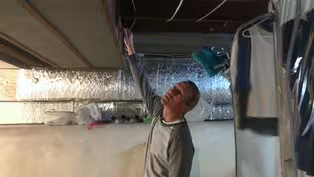
Low-income weatherization program
Clip: S6 Ep4 | 7m 39s | Learn about the Minnesota Community Action Partnership's weatherization program. (7m 39s)
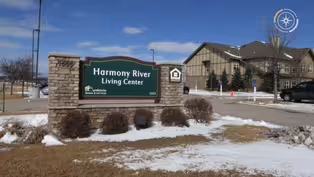
Aging with dignity: health care employee recruitment
Clip: S6 Ep4 | 8m 29s | Harmony River, a senior living facility, is thinking creatively about staff recruitment. (8m 29s)
Providing Support for PBS.org
Learn Moreabout PBS online sponsorship
- News and Public Affairs

Top journalists deliver compelling original analysis of the hour's headlines.

- News and Public Affairs

FRONTLINE is investigative journalism that questions, explains and changes our world.












Support for PBS provided by:
Compass is a local public television program presented by Pioneer PBS