
May 22, 2023
Season 1 Episode 251 | 27m 30sVideo has Closed Captions
Gov. Beshear launches his re-election campaign.
Gov. Beshear launches his re-election campaign, two former Kentucky Secretaries of State break down why Kentucky's elections are the way they are, a new "baby box" is in Kentucky, and a Kentuckian helping educate others about the hardships of re-entering society after incarceration.
Problems playing video? | Closed Captioning Feedback
Problems playing video? | Closed Captioning Feedback
Kentucky Edition is a local public television program presented by KET
May 22, 2023
Season 1 Episode 251 | 27m 30sVideo has Closed Captions
Gov. Beshear launches his re-election campaign, two former Kentucky Secretaries of State break down why Kentucky's elections are the way they are, a new "baby box" is in Kentucky, and a Kentuckian helping educate others about the hardships of re-entering society after incarceration.
Problems playing video? | Closed Captioning Feedback
How to Watch Kentucky Edition
Kentucky Edition is available to stream on pbs.org and the free PBS App, available on iPhone, Apple TV, Android TV, Android smartphones, Amazon Fire TV, Amazon Fire Tablet, Roku, Samsung Smart TV, and Vizio.
Providing Support for PBS.org
Learn Moreabout PBS online sponsorshipI have a question for you.
What is it?
Are you fired up and ready to go?
A fiery campaign kickoff for Governor Andy Beshear.
Inquiring minds want to know why Kentucky has closed primaries in all the governors races.
We asked some experts and they give us some answers.
I went through one of the reentry simulations thinking I knew everything, but I really didn't get a taste of life after incarceration at Debate Kitchen.
You heard it.
The most accessible museum in the world.
And a look at a new multimillion dollar attraction that's coming to Kentucky.
Production of Kentucky Edition is made possible in part by the KET Endowment for Kentucky Productions, the Leonard Press, Endowment for Public Affairs, and the KET Millennium Fund.
Good evening and welcome to Kentucky Edition on this Monday, May 22nd.
I'm Renee Shaw.
Thank you for starting off your workweek with us.
Just six days after the May 16th primary and the fall election campaign is already underway.
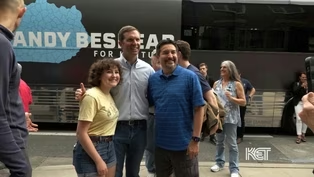
Governor Andy Beshear kicked off his reelection campaign with a bus tour across Kentucky.
Our Laura Rogers caught up with the governor at his first stop Monday night or Friday night in Bowling Green, where he spoke to a packed house at a downtown coffee shop.
Oh, yeah.
Oh, yeah.
Four more years.
Governor Andy Beshear drawing a standing room only crowd to his campaign kickoff stop in Bowling Green.
Our crowd was huge because we are ready to reelect Andy Beshear for a second term.
All right.
Beshear calling his supporters excited and optimistic, optimistic about a future where we're creating more jobs than ever before, where we're expanding health care and where we lead with love and compassion and never fear and division.
The governor highlighting economic development in the area with new projects breaking ground at the Kentucky Trans Park.
We are seeing more jobs, new jobs, jobs of the future more than this area has seen in 20 years.
In the last three.
I work at a trade school here in Warren County at the Warren County ATC, and my students are going to benefit from the economic development projects that he's got going on here.
And those kids are going to wind up with good paying jobs, earning a living wage.
What this is doing is creating a better life in this area where the kids that grow up here, no matter how big they dream, can stay near home, achieve, raise a family and do it in any field they can consider.
This year's other talking points include community safety, citing pay raises for Kentucky State police, expanding health care services, and his support for public education.
Many believe it was teachers who helped carry Bashir to victory in 2019.
Think about our educators.
You've got to look at their work conditions in their pay.
We can't be 44th in teacher pay and state number two in economic development in recent years.
Kentucky has seen registered Republican voters surpass Democrats.
This year was asked how he hopes to appeal to voters across party lines.
He says it means addressing the issues that matter to Kentuckians.
We've got to make sure that every day we're focused on things like health care, new job creation, public safety and public education.
And that's how we move people forward.
I can tell you, as governor, I don't focus on Democrat or Republican.
I don't focus on moving our state right or left.
I focus on moving it forward for all of our families.
And his message, the governor pointing out the crises he's weathered while in office and through a pandemic.
We've been through tornadoes.
We've been through floods.
We've been through a polar plunge.
-45 degree wind chill in Kentucky.
We're going through inflation while temporary, still tough on our families.
And we're even living through a war in Europe, something I thought I'd only read about in textbooks.
He has been with Bowling Green and Our Darkest Hour with the tornadoes and through the pandemic, he has shown true leadership this year, also receiving support from members of the United Auto Workers Local 2164.
I look around at our state where our unions are growing and are as busy as ever.
He never mentioned his opponent, Attorney General Daniel Cameron, by name, but he did respond to the anticipated attack ads that will be released leading up to November.
I think the people are going to be able to see how we run and who talks about the future versus who talks about the other candidate.
And they'll know who lives out their faith and values.
For Kentucky Edition, I'm Laura Rogers.
Thank you, Laura.
Between Friday and Sunday, Beshear made stops all across the state from Paducah to Pikeville.
The Republican Party of Kentucky put out a statement in response to Bashir's bus tour.
Spokesperson Sean Sather said, quote, No number of bus stops is going to make up for Andy's failed leadership.
We need to make sure we can elect Daniel Cameron and the entire Republican ticket this November and rid ourselves of Joe Biden's man in Kentucky.
End quote.
Well, look back at last Tuesday's Kentucky primary and head to the general election in Kentucky tonight.
Tonight, our panel includes two members of the Kentucky General Assembly and two political strategists, both Democrats and Republicans.
And, of course, we want your questions and comments.
We want you to join us tonight at eight Eastern, seven Central for primary recap, 2023 right here on KCET.
You know, there are often frequently asked questions, fake news about why Kentucky's elections are the way they are.
On Friday, we asked two former Kentucky secretaries of state why the Commonwealth has a closed primary system and option for straight party ticket voting and why statewide constitutional officers like governor are held in off years.
Let's talk about some commonly asked questions that we get after a primary, particularly like the one that we've had here in Kentucky.
I'll start with you, Trey.
Many people say, first of all, why are our primaries closed?
Why can't independence vote?
Well, it's a state law, so it could be changed.
And it is different in some other states.
Some states you don't even have.
Party primaries are completely open.
Other states, independents can come in.
But it basically goes back to the fact that the candidate, the parties like the fact that it's their own people.
They don't want interlopers.
It also drives people to pick a party.
By forcing you to to be in a political party.
And that's one of the reasons why Kentucky has roughly now 90% in either Republican or Democratic and 10%, whereas like Massachusetts is close to 40 or 50%.
Independents because they have an open primary.
But we're growing we're double digits now, and we weren't just a little while ago.
So which is sort of an indictment of the parties, because these people are willing to say, I'm not going to vote in my party primary, which usually determines the at a lot of local counties, it's who's going to be the winner in the fall is determined in the primary.
And some of our most of our congressional districts.
Whoever wins the primary is going to be the winner in the fall.
And so, yeah, that's that's telling people say, you know, I don't care.
I don't want to be part of either of those institutions.
And the discussions about this haven't really gone very far.
They haven't.
That's because people who are most interested write the rules, whether it's for Medicaid or road building or elections.
And the parties have an interest in keeping elections working the way they were.
So changing.
There's not an independent party that shows up for a convention to say, hey, let's march on the Capitol and get in the process.
Yeah, we Republicans might have wanted it to be open when we were in the minority.
That's right.
Yeah.
Now we're in the majority.
Why?
Why would you want that?
Same thing with a straight ticket option that benefits the party in power next day?
Yeah.
Go back in history several years ago.
25, Probably several.
Oh, the slow summer news day.
A reporter calls me and says, What about open primaries?
I said, I think a great, great idea.
Let's make people have an easy way to participate.
They also called another Bob, the legendary Bob Gable, and he said, great, put them in.
Then several days later, we conferred.
The feedback he got or not got was not particularly canned.
Yeah, it was summarily rejected by our friends in politics.
So it just doesn't it doesn't come around very easily as a point of discussion, although it may now it could.
But to have 10%, I think about one in every ten people you run into is an independent and that number is growing faster than the Republican growth has been to catch up with the Democrats.
And as traces in other states, it can be 2030 is not uncommon.
Another big state.
Yeah.
So straight party ticket voting.
That's another question we get.
Why do we have that option?
Again, it does benefit the party in power in the find at the local level because there are parts of the state that are very democratic and there are parts of the state that are very Republican.
It also it does speed the time to vote, makes it easier to do that.
When I was secretary, actually always recruited at the time a Republican House member to try to get rid of the straight take a vote.
I call it lazy voting.
You know, when I go, I'm Republican.
Republican.
But I you know, I'm going through race by race.
But it does you know, people kind of like it.
It makes it makes it shorter.
So in some respects, it makes it easier for election administrators because you just color in the one spot and you're done.
Yeah, but it makes a lazy electorate, though, right?
I mean, it takes out some of those with trail, like pulling the levers in the old days.
Yeah.
Going right to race, whether there's a constitutional amendment or a local stuff or a judicial race or whatever it is.
Yeah.
So with 14.45% voter turnout in the primary this time, why not move the governor primary, the governor's race to a presidential election year to boost up that voter participation?
So in northern Kentucky, we've actually had a lot of conversation about this because we're generally the area that votes the lowest in primaries and lowest except in the presidential year and the general.
And so we thought, wow, we could really boost our influence in the state because we take our big population and then have a higher voter turnout.
But I think there's again, there's the politics, just like with everything else.
So one is the statewide candidates, because they're run as their own, you get to focus completely on them.
It's easier for fundraising for them.
They also don't compete as much with the folks who are running in other year.
So legislators, if you move the statewide to one of those years, all of the state House members would always have to compete with the statewide and the Senate.
Every two years would have to do it.
So that's I think the biggest thing is the politics.
It would increase turnout.
You know, the argument for it is it allows more attention to be paid on those statewide candidates.
And I think it also gives a little bit more national coverage because we're the year before the presidential.
It would save money.
You know, there's a there's a cost savings.
And that's why we move from having an election every year.
Right.
In the early nineties, we eliminated the counties election and the odd year and moved it.
There was a five year term and so we elected folks in 93 to a five year term, so we moved that to 98.
So there is a precedent for consolidating.
But I do think a lot of it's that that, you know, the politics behind it prevent that from happening.
And it's the status quo.
You know, like as Bob said, the rules work for the people who win.
Right.
That's what I want to change.
Do you want to change nationalization of the races to write more so than what it is now?
If you stack a U.S. Senate race on top of the state races and congressional races on top, and you've got other races than the office like we ran for and served in, Secretary of state is squished even further down less attention.
And you're fundraising capacity shrinks.
Fundraising is challenged, but you need to raise more to try to compete with all that other information.
Mm hmm.
Now, because I actually I do support it.
I would rather be I think it'd be better to have two big election years and let us focus.
Let's it'd be easier on election administrators.
And I do appreciate the higher turnout.
And if we're worried about competition, well, maybe we shouldn't elect as many people to those offices.
Maybe we should eliminate some of those offices to make them appointed like State Treasurer, potentially State treasurer or some of county offices.
County offices?
Yeah.
What are you.
Are you for it or get it?
I can see the point and maybe we ought to move that direction.
But I remember hearing Happy Chandler speak one time.
He said It's like Arkansas.
They change their name.
It reads Arkansas or Kansas.
Right.
But they don't because they like it.
So we like what we've got.
And a lot of people who set those those frameworks in place probably would say, let's just keep it the way we've got the money factor.
Is there several million dollars to have an election?
But we do get distinction in the nation.
People watch from all directions.
I mean, when are we going to get calls from The Washington Post and other kinds and Politico and other.
Yeah, it was in The Washington Post today referencing my my Senate was was an article about Cameron and the role of McConnell.
And like, okay, I'm going to be in the story.
What's my descriptor?
Former McConnell acolyte Trey Grayson lost by a ton when I was in Politico for the first time.
It was like a 17 word end of the article barely mentioned, but it's a mention probably in the presidential year.
Not so much.
Not so much.
Right.
In other news, there is a new baby box in Kentucky.
The newest safe Haven baby box was unveiled at the Corbin Fire Department in southern Kentucky this afternoon.
The department shared these pictures on social media today.
A baby box allows for the legal, safe and anonymous surrender of an infant provided under the Safe Haven law.
It features silent alarms alerting first responders in the event a child is dropped off.
Earlier this year, a baby box in Bowling Green became the first in Kentucky to see an infant anonymously surrendered.
There are now 17 baby boxes across Kentucky.
After many months of negotiations, it looks like there is a deal to develop a parking lot across from Rupp Arena in downtown Lexington.
The Herald later reports the Lexington Central Corporation selected the Lincoln Webb Group to build a multi-use development.
Initial plans call for apartments, shops, a hotel, a grocery store and five parking garages, which would nearly double the number of current parking spots.
Construction could begin next year, and it could take up to three years to complete the project.
Federal money will help Kentucky students with access to school based mental health services.
Details and our look at mental health news.
The money is from the U.S. Department of Education.
It adds up to almost $17 million.
The West Kentucky Educational Cooperative will get $2.9 million over five years and will partner with Murray State University to train 30 mental health providers who will go to work in 14 school districts in western Kentucky.
The Green River Regional Educational Cooperative will receive almost $14 million.
It will work with Western Kentucky University to train and hire 45 mental health counselors who will work in 184 schools.
Kentucky is among the worst states in the U.S. when it comes to the number of child maltreatment cases.
Sometimes, even for doctors, it can be hard to know if a bruise is just an accident or something way worse.
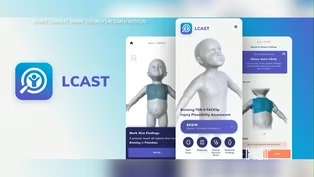
Now, a tech company in Louisville has created an app that's helping doctors spot signs of child abuse.
Elle Kast is a mobile app that we've developed in partnership with Dr. Mary Clyde Pierce, who is a premier expert in the field of child abuse.
And it's a tool for clinicians to use to screen children for child abuse.
So if a clinician is suspicious that a child, they see an injury on a child and they think maybe this kid's being abused, they can open up the app, plug in some information, and the tool will tell them, yes, that injury is likely because of abuse or actually it's probably an accident.
As a clinician, what you need to do is look over the child and see kind of do an exam and see what bruises they have and say, Oh, there's a bruise on the ear.
Say there's a bruise on the cheek in this area, in this area and say on the chest.
The app will then answer a few more questions and then it will show you the results.
And the results will tell you, you know, likely abuse, likely accident, indeterminate.
And it's based on research that's been peer reviewed and published by Dr. Pierce.
She actually created the ten four rule, which is one of the early child abuse rules, where basically if you're a kid and you have a bruise on your torso, ear or neck and you're under four months of age, it's about a 95% chance those bruises are from abuse.
You know, if you think about a kid with a bruise under four years of age, you know, toddlers have bruises all the time, right?
They're running around.
They're running into things.
They're running in the chairs, falling off things.
And so bruises often you don't you don't think, oh, that's a sign of abuse.
But what's really great about this app is that all the data is based around bruises and everybody has biases, right?
Even if you're perfectly decent person, you just have these built in biases.
So if you're a clinician and you're unsure if a kid's been abused, this tool empowers you to have that information.
And so not only will it just tell you the results say this is likely accident, likely abuse, they'll actually show you the statistics.
As new data is published, we can add it to the app.
As a user, you just get the latest version and then you have it.
We've collected a lot of feedback along the way from clinicians and it's been very positive clinicians want something where they can.
They want another tool that will help support, you know, support them in their job because this is a serious issue.
They want to help kids.
They can download the app, it's free.
They can just enter and it takes maybe 2 minutes to get through and they can have now more data to support whatever decisions they make.
Good information there.
The CEO of Slingshot says the app took ten years to develop, most of which was spent gathering research for the app.
The research was based on more than 2000 patients.
After years of offering second chance employment.
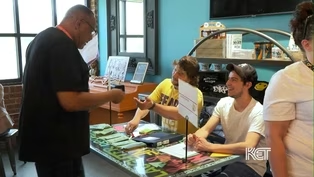
Rob Perez of Deviate Kitchen says he thought he knew it all when it came to the challenges faced by those reentering society after addiction or incarceration.
But a reentry simulation by the Kentucky Department of Corrections opened his eyes.
Now he's helping educate others about the hardships faced by those in reentry.
By hosting his own simulations, we've been employing people that have a past for over six years.
And I went through one of the reentry simulations thinking I knew everything.
But I really didn't understand all that people had to go through when just trying to get back into the community after jail or addiction.
This is the first simulation and we're setting up a series of them so that we can get people that currently may not have the understand, adding that we were lucky enough to have.
I work at Natalie's Sisters, which is a nonprofit that kind of helps women who pertain to this situation.
So I thought that I had kind of a better understanding of it, and I was sorely mistaken.
It was a lot harder than I thought.
The first week I walked around like five times in a circle because I couldn't find, you know, where I needed to go for work.
And I was like, in real life, you know, that's absolutely something that they go through.
We needed to have a bus pass for every place that we went, which is also something that I deal with on a daily basis at work.
But I didn't think it had as big of an impact as it does in real life.
When I was reviewing an application and weeding out people to interview because they had gaps in their employment and I didn't know how many barriers as an employer I had put up.
We all say that people, when they get out of jail or out of recovery, they need to pull themselves up by their own bootstraps.
The reality of it is, is that the private sector decides that they're going to put barriers on jobs, on housing and opportunities every day.
And it becomes so hard to just make ends meet that people go back to addiction, go back to jail, because it's just not possible.
People think that getting an ID is super easy, getting, you know, your Social Security card is super easy, but you can't do any of that if you don't have an address.
If you're coming straight out of jail, you don't have an address, you've got to start paying rent.
But to pay rent, you have to have a job.
To have a job, you have to have a house.
And it's just it's a cyclical type of thing.
I'm hoping that people that have jobs to offer have housing to offer, opportunities that they reevaluate.
Just say no.
When asked if they can give opportunities to people with a past.
It's easy to look at somebody and say, you know, they were incarcerated.
You know, they did this to themselves.
But I think having that empathy and looking at it from their point of view is a big step in being able to acknowledge that these kind of issues do happen and the best way to fix them.
Rob Perez says Diva Kitchen plans to house more reentry simulations in the future.
Once confirmed, those dates will be announced on social media.
Construction on a new museum is underway in Louisville.
The American Printing House for the Blind is the only federally funded source for educational texts for blind or low vision people in the U.S.. Today, the group broke ground on a new project called the DART Experience.
One of its goals is to serve as a global model by being the most accessible museum in the world.
The DOD experience will also work to change perspectives about blindness, something leaders say will create a more open minded society that seamlessly includes people with disabilities and the workforce, schools and communities.
You heard it the most accessible museum in the world.
No matter your ability, you will be able to experience it.
It will demonstrate the past and the current great work of the American Printing House of the Blind in existence for 165 years.
This is a wonderful concept for an attraction.
CB To hear that we are going to have the most accessible museum in the world right here in Louisville is amazing.
It will give people another unique, uniquely Louisville attraction to visit when they're here in Louisville.
It's going to be as distinct and unique as it's in its own way as the Slugger Museum.
As the Kentucky Derby Museum is the Muhammad Ali Center, or one of our many bourbon attractions, The $22 million Museum will be nearly five times larger than the group's existing space.
The Dodd experience will open in 2025.
Sadly, there will not be a Triple Crown winner this year.
Derby winner Mage finished third in the Preakness Stakes over the weekend.
National Treasure came in first.
The horse is trained by Bob Baffert, who won the Preakness for a record eighth time.
Another of Baffert's horses was euthanized on the track hours earlier.
Horse racing was already facing questions after several horses died at Churchill Downs in the lead up to the Kentucky Derby.
The Kentucky Connection to a baseball first and a look back at some of Queen Elizabeth's visits to Kentucky.
Our Toby Gibbs has more in tonight's Look at this week in Kentucky history.
Kentucky's first ever church service was May 28, 1775, when an Episcopalian minister led an Anglican service at Fort Boonesborough.
165 people died in the Beverly Hills Supper Club Fire in Newport on May 28th, 1977.
It's the worst disaster in northern Kentucky history and led to stronger fire laws throughout the U.S.. Queen Elizabeth, like Kentucky.
And she liked to visit in late May.
The queen arrived in the Blue grass on May 22nd, 1986.
May 26, 1989, and May 23rd, 1991.
Happy birthday to a pair of popular Kentucky singers.
Rosemary Clooney was born in Maysville May 23rd, 1928.
Tom T Hall was born in Olive Hill, May 25th, 1936.
The Kentucky colonels won the American Basketball Association Championship on May 22nd, 1975.
It's the only major professional sports title ever won by a Kentucky based team.
Major League Baseball's first ever night game was in Cincinnati on May 24th, 1935.
At the White House, President Franklin D Roosevelt turned a switch, turning on the lights at Crosley Field in Cincinnati.
And the Reds starting pitcher was Paul Derringer, a native of Springfield, Kentucky.
And those are the highlights.
This week in Kentucky history.
I'm Toby Gibbs.
Thank you, as always.
Toby Gibbs.
A Kentucky native is fulfilling a childhood dream.
And let's go back to John Shoffner is aboard the International Space Station.
He piloted Axiom Space is a X2 mission which launched yesterday.
We spoke to the Middlesboro native about this mission earlier this month, and you can see that interview now online on demand at Ted Dawgs Kentucky Edition coming up tomorrow on Kentucky addition, Hollywood comes to Kentucky.
I'm really happy to say that we've come here to Kentucky as a family filmmaking venture and that we are invested for long term.
The Bluegrass State has become attractive to the entertainment industry for a number of reasons.
We'll explore the economic impact.
Plus meet filmmakers behind a current project at Heart County tourist attraction.
That's tomorrow on Kentucky Edition, which I'll see you for 630 Eastern, 530 Central right here on KET.
I'm Renee Shaw.
Take good care and have a good night.
Video has Closed Captions
Clip: S1 Ep251 | 4m 2s | KY Gov. Andy Beshear kicked off his reelection campaign with a bus tour across Kentucky. (4m 2s)
Video has Closed Captions
Clip: S1 Ep251 | 3m 16s | An App that analyzes bruising on young children to help identify potential child abuse. (3m 16s)
Video has Closed Captions
Clip: S1 Ep251 | 7m 47s | Trey Grayson and Bob Babbage explain commonly asked questions about Kentucky's elections. (7m 47s)
Video has Closed Captions
Clip: S1 Ep251 | 3m 12s | An event allowing people to experience what life is like after addiction or incarceration. (3m 12s)
Providing Support for PBS.org
Learn Moreabout PBS online sponsorship
- News and Public Affairs

Top journalists deliver compelling original analysis of the hour's headlines.

- News and Public Affairs

FRONTLINE is investigative journalism that questions, explains and changes our world.












Support for PBS provided by:
Kentucky Edition is a local public television program presented by KET