Living St. Louis
May 25, 2026
Season 2026 Episode 10 | 27m 30sVideo has Closed Captions
Tony Foulds, Peter Raven, Trishaw Bikes at Friendship Village, STL H.E.L.P.
Englishman Tony Foulds visited St. Louis in April to honor the WWII pilot who saved his life; the life of botanist Dr. Peter Raven; three-wheeled, pedal-powered vehicles connect residents of a retirement community, and St. Louis HELP keeps medical supplies out of landfills and into homes in need.
Problems playing video? | Closed Captioning Feedback
Problems playing video? | Closed Captioning Feedback
Living St. Louis is a local public television program presented by Nine PBS
Support for Living St. Louis is provided by the Betsy & Thomas Patterson Foundation.
Living St. Louis
May 25, 2026
Season 2026 Episode 10 | 27m 30sVideo has Closed Captions
Englishman Tony Foulds visited St. Louis in April to honor the WWII pilot who saved his life; the life of botanist Dr. Peter Raven; three-wheeled, pedal-powered vehicles connect residents of a retirement community, and St. Louis HELP keeps medical supplies out of landfills and into homes in need.
Problems playing video? | Closed Captioning Feedback
Where to Watch Living St. Louis
Living St. Louis is available to stream on pbs.org and the PBS app.
Providing Support for PBS.org
Learn Moreabout PBS online sponsorshipWelcome to Living St.
Louis.
I'm Brooke Butler.
Memorial Day is a time to reflect on those who have shaped our lives, sometimes in ways we're still discovering.
Here at the Soldiers Memorial, that idea is especially present, but not every legacy is carved in stone.
Some are carried through memories and movement.
Our stories today are about how individual stories, acts of service, and moments of decision continue to reflect on generations to come.
On this Living St.
Louis, we meet a man who has spent a lifetime honoring a St.
Louis pilot whose sacrifice saved his life during World War II and whose journey finally brings him here.
We'll also look back at a conversation with the late Dr.
Peter Raven, whose work helped change how we understand and protect the natural world, and how at the Botanical Garden, his legacy will continue to grow.
We'll visit a local retirement community, finding new ways to stay active, connected, and engaged in the outdoors.
Plus, a look at a local organization working to keep medical equipment out of the landfill and into the homes of those in need.
It's all next on Living St.
Louis.
♪♪ - The word hero is used a lot.
It can describe someone that we look up to or admire for their contributions or talents.
In this next story, it's used in the classic sense of the word, for someone who has performed brave, selfless acts, putting the lives of others ahead of his own, and a man who has spent his life making sure that sacrifice is not forgotten.
It's been more than 80 years since the end of World War II, and the Soldiers Memorial in downtown St.
Louis has exhibits that remember many St.
Louisans who served in that war.
One of them is 1st Lt.
John Kriegshauser.
We're a military history museum, but everything we share is from a St.
Louis perspective.
On a recent Sunday afternoon, they presented Kriegshauser's whole story, one that, at least locally, was unknown.
I knew nothing about today's story before Rebecca... Kriegshauser's act of bravery may not have been a widely known story in his hometown, but in Sheffield, England, Kriegshauser and his nine crew members are celebrated as heroes.
That's because of this man, Tony Foulds, a 94 year old Englishman who never met Kriegshauser or his crew, but owes his life to them.
This to me so brave what they did.
They gave they gave the life for me and our lives.
When Tony was just eight years old on February 22nd, 1944, he and his friends were at Encliff Park in Sheffield, England, when a large, battle-damaged American bomber named Mi Amigo was returning from a mission and needed to make an emergency landing.
We heard this sound.
It was the biggest plane we've ever seen during the war, the B-17 Flame Fortress.
They'd been trying to find somewhere to land.
Because that was the only park in Sheffield that was flat, they were trying to land on there.
Because we were on, and this is where the bravery comes.
Oh, excuse my bad.
♪♪ - Knowing he could not safely land the plane without killing the children on the ground, 24-year-old Lieutenant Kriegshauser downed the plane into nearby trees.
The B-17 exploded immediately, killing all 10 crew members on board.
Because it was that brave, they gave their lives for us.
We wouldn't have lasted if the plane had tried to land.
Kriegshauser was posthumously awarded the Distinguished Flying Cross, the Air Medal, and the Purple Heart.
Knowing the crew of the Mi Amigo deliberately sacrificed themselves to avoid hitting him and other children is something Tony carries with him daily.
In 1969, a memorial was erected to honor the crew at the site of the crash.
And Tony spends his days tending to it.
First of all, I clean up, make sure everything's nice and clean.
All the paths, everything.
I go there regularly.
I lay flowers, I wreath.
And when I say I wreath, I mean a wreath.
And then I start talking to people who are interested.
Tony is in St.
Louis because of one of those people that were interested.
On a trip to England, St.
Louisan Rebecca Dunn found herself at the Mi Amigo Memorial.
I met Tony and we had a little cry and I thanked him for standing next to the Americans.
And when we were leaving, I had my youngest with me and I told him he had to read every name out loud of each man before we could leave.
And when we got to the pilot, it's going to make me cry.
The pilot was from St.
Louis.
And I was so shocked.
And I told Tony, I live in St.
Louis.
And I said, have you been?
And he said, I've never even been to America.
So I said, well, you're going.
I'm going to bring you.
Rebecca set up a GoFundMe, and she raised the money to bring Tony to America.
But bringing Tony to the States wasn't about him visiting a country he's never been to.
It was about visiting St.
Louis specifically, the place Lt.
John Kriegshauser was born and raised, the place where he is buried.
This time on American soil, escorted by the lieutenant's nephew, Tony got a chance to lay a wreath at the grave of the man who gave his life so a young boy in England could grow into an old man.
It is so special to me.
And I pray every morning for him, every night for him.
It will be a real cry, not just feeling about it.
But I know that his spirit is still in Sheffield.
It's been about a month since globally influential botanist Dr.
Peter Raven passed away.
As the longtime leader of the Missouri Botanical Garden, he helped transform the field of plant science and shaped modern conservation efforts.
In 2021, after publishing his biography, Jim Kirchherr sat down with Rave Here's that story from our archives.
Well, let me start at the beginning.
I was born on a warm night in Shanghai.
Well, we had time together, but not time for the whole story.
But in fact, that is where the story starts.
His family for years had business in China, and at the outbreak of war with Japan in 1937, they had to move to San Francisco.
Peter was a year old.
It's all in his autobiography, Driven by Nature, a personal journey from Shanghai to botany and global sustainability.
But the story of Peter Raven is still unfolding at the age of 85.
It seems to me that although you've been retired officially for a while, you're still working on stuff.
Do you have projects yet that you've got to finish up?
Well, I've had a long, happy life, and I've taken up a lot of projects and areas and things in it.
And actually, I'm still working on some projects in California that I might have started when I was 12 years old.
>> As a boy, he was something of a prodigy when it came to botany.
And with the help of teachers and mentors, he was doing fieldwork.
Here he is, just 14 years old.
>> I really enjoyed it.
But my first thought was probably to teach high school and keep doing it as a hobby.
I wasn't ready to plunge into it professionally at all.
>> But by college and graduate school, he had taken the plunge.
>> Well, there are a couple of stages.
I was first really focused on the plants of California.
I began then working on the evening primrose family based on an exciting discovery of one in the Presidio in San Francisco.
That in turn led me to New Zealand to look at other members of the same family.
And going to New Zealand really opened a worldwide view for me.
And then when I came back, and particularly when I moved to St.
Louis 50 years ago this year, 71, I began to think about plants on a worldwide scale.
Peter Raven's impact on the garden is well known, guiding its development with a new master plan.
The Japanese garden was added.
He built its budget, its staff, and its profile, and not just as a local attraction.
One of the most important parts of the Missouri Botanical Garden is something few visitors see, but is well known by botanists and researchers.
The herbarium is a huge library of dried plants from around the world.
In the Missouri Botanical Garden, we had about 2 million when I got here, and we have about 7 million now.
And they keep coming in.
It's one of the best in the entire world.
So it's not only very important as an index to cataloging and sorting out the wonderful diversity that supports the productive capacity of the Earth's ecosystems, but it's increasingly and unfortunately a repository for pieces of extinct organisms that we assume people will want to know about for centuries into the future.
So saving them is very important.
But even if he had never come to St.
Louis, Peter Raven would still have made his mark.
In the world of botany, there's his work on the evening primrose.
Students know his name from his textbook, which is still in use.
And when he was at Stanford, he and Paul Ehrlich did groundbreaking work describing the process of coevolution, where two different species, say a plant and an insect, will evolve in tandem in response to each other.
But it was at the Missouri Botanical Garden that the scientist became a public and even a world figure, an advocate for the environment, for the earth, a man described as a global evangelist for sustainability.
- We've all got a lot to do, and I think this is the message that I've gotten from reading the book and some of the other things you've done.
I don't mean you and I individually running out of time, but I get the sense that the earth might be running out of time.
- Well, the earth is tending to run out of time.
When I was born, we had fewer than one out of three people for every one we have now.
And there are very few scientists in the world who've thought about it, who thinks the world can accumulate the number of people that are in it now.
The problem is we're using up the productive abilities of the earth in food and air and pollution, all those things, faster than they can be reinforced or renewed.
With that, we've got to make some pretty drastic steps to be able to get along into a sound future.
The thing people have to remember about science is it's not a bunch of theories.
Somebody once said, "Do you believe in global warming?"
to a scientist.
He said, "No, I reserve belief for really important things like religion.
Global warming isn't a belief.
It's an assessment of hypotheses that have been made about an area of science."
That's why it's so extraordinarily important to educate our children, grandchildren and all about science and what it really is and how it works.
You mention in your book so many people that helped you, mentored you, inspired you, collaborated with you.
I imagine there must be hundreds if not thousands of people who would say the same thing about you.
I find my greatest joy in life, in fact, the only real purpose of living is to love and help other people.
And that anything that you learn or, or gain or achieve in your life, comes through other people.
That's how regardless of your religious beliefs, you really form a kind of immortality by helping other people to carry on the important messages and developments that you yourself might be able to make.
And it's given me my joy and my purpose all my life.
And yes, there are very many people and it's very gratifying to me to know that.
I'm joined here with Dr.
Lucia Lohmann, President and Director of the Missouri Botanical Garden, to talk about the late Dr.
Peter Raven.
And you knew Peter Raven very personally, he was a mentor to you over the years.
Talk a little bit about your relationship with him.
So I first met Peter in 1996.
I came to St.
Louis for graduate school, and Dr.
Raven was part of my Ph.D.
thesis committee.
Every time I would meet him, it would be a one hour meeting, and I'd have work for the next six months.
And I feel like at the same time, Peter was a true connector.
So he was a brilliant scientist.
And for me, even in Brazil, as a 17-year-old starting my degree in biology, I used his textbook.
We all read about his research papers.
He was the first person to produce a synthesis on origin of flowering plants.
So essentially saying, how did flowering plants get to have the distribution they have nowadays, which was really ahead of its time?
His spirit of collaboration and generosity.
And at the same time, one thing he would always emphasize was the need to communicate the science.
And he would always say, OK, don't just do your science.
Make sure you communicate it to the world.
Dr.
Raven would always say that.
And I completely agree with him that a lot of the innovation and creativity really comes to life when you have people from different fields.
So when even when we were in the field with artists and photographers, they would ask questions about our work that we never thought about before.
And that would lead to novel insights and different ideas on how to do things.
So really bringing people together from different generations, different expertise, I think that's crucial to innovation and is something he always emphasized.
Absolutely.
And I imagine that's probably why his career was so successful in the world of academia and with the garden itself being president at 35 and, you know, a long standing, impactful career here in St.
Louis.
No pressure, but it's pretty big shoes to fill.
Yeah, it really is.
I think nobody can fill those shoes because, you know, Peter's so remarkable.
Peter really pushed me to work at a global scale.
How can we grow the garden that is so rooted in St.
Louis, having all of these local actions, but the global impact?
But also, what is our role in the world and how can we contribute to something bigger than the garden itself?
Absolutely, and again, another big philosophy of his was how humanity interacts with the natural world around us.
One thing we are really working on now is telling those stories in new ways, right?
In such a busy world, people come and you immediately have a sense of calm.
And at the same time, we have all this science behind the scenes.
So nearly 100 scientists and PhD botanists who are doing all this science that really structure everything that people see around the garden.
Yeah.
And the things that you see around the garden, whether you know it or not, were probably at some point influenced by Dr.
Peter Raven.
And how do you hope to continue that legacy?
Anybody who comes here will always feel Peter's spirit and legacy.
- What Dr.
Raven was always very concerned about was how could people see them more connected to nature and not as a separate entity?
And I think that's a very important role that we carry too.
And if we think about the clothes we wear, the food we eat, the medicines we take, the oxygen we breathe, so we really cannot live without plants.
And that is crucial to protecting it.
We just, we only protect what we understand.
We only care about what we understand.
And we can play, well, we already play, and can play an even growing role in that respect.
- In thinking of our loved ones' legacies, sometimes we have to find new ways to carry those memories forward.
We visited one local retirement community where something as simple as getting outdoors brings a new sense of connection.
As we age, things change.
Our mobility shifts and memories fade.
For some, that could mean less time outside.
But something at Friendship Village is changing that narrative.
I feel how smooth it is though.
Making the outside more accessible to older adults.
It is.
Oh, there's a bump.
It's wonderful.
I'm out of my apartment and I'm a little bit disabled and I got into this and it's a smooth ride and it's just freedom.
Freedom.
That's what Joan, a resident at Friendship Village Sunset Hills, kept telling me as she rode around the campus on one of their new tri-shaws.
A three-wheeled, partly motor-powered trike, and the village calls it their "time machines," taking restricted residents back in time with new scenery, smells, and sensations.
I really love the mountains.
And up there we play bocce ball.
There are games up there.
It really has made it more joyful, just getting out and getting in this cart and just going, going, going.
And it's absolutely wonderful for me to be out and see the trees and the brook here and everything around here that you really don't get to see when you're like me and stuck inside so much.
Friendship Village purchased the two tri-shaws after visiting a conference last year.
They hold a maximum of two people in the front seat and it's even wheelchair accessible, making it easy for almost any resident at the village to enjoy the ride.
And for them and their family, it's hard to want to get off.
You're not going to get me out of here.
Let's go to Steak and Shake or something.
It gives them an opportunity to see their parent or their grandparent in a different light rather than visiting inside their room in the nursing home and looking at each other for a few hours and trying to think of something to do and to talk about or just to watch television.
It gets them outside and the adult children or their grandchildren are able to watch the reactions of their loved one as they pass by a certain item or something that they might see on the path of the trishaw to give them something to spark more conversation about what do you think about those flowers or did you see the bird up there something else to do and something else to see and talk to them about.
It may not be standard memory care but it's an activity that improves the overall resident experience.
Loved ones engaging in meaningful ways in nature, side by side, feeling the breeze.
You know, it makes me feel young again, about 60 years old.
See, this is what you're gonna say.
It makes me feel young again.
That's perfect.
That's good.
Doctors are really good at telling us what to do during treatment.
Take this, use that, come back in six weeks.
But after the doctor visit, most of us don't think about medication after we stop taking it.
Once a prescription changes or a piece of medical equipment isn't needed anymore, it quietly leaves our lives.
But of course, it doesn't actually disappear.
And when systems don't account for the full life cycle of care, communities often step in to fill the gaps.
And that's where STL Help comes in.
- Well, since 2008, St.
Louis Health Equipment Lending Program, also known as St.
Louis Health, has been collecting, inspecting, cleaning, repairing, and giving away home medical equipment to anyone who needs it.
We do not have any age, income, or diagnosis requirements.
We do not ask for their insurance card.
This is just neighbor helping neighbor.
And we do that through people recycling and donating equipment.
So they'll get wheelchairs, and they get walkers, and they get rollators, and they even get hospital beds.
Well, medical equipment, as you know, is very expensive.
So when a family member gets ill, a lot of times it's unexpected.
So rather than going to an assisted living or moving into a nursing home facility, STL Help is providing them with the equipment, thanks to donations from our neighbors, to keep them moving and mobile.
I just moved into a senior living building and I'm used to a shower, but they have a bathtub and I'm afraid of falling.
Yeah.
So I was able to get a chair, a shower chair, and that would make me feel more secure.
It's a blessing, especially when you really can't afford to get things like this and you never think about it.
I thank God for having this facility open where, you know, they give you opportunity then whoever the loved one wants to get right.
And then you do the right thing by when you get through with the equipment, you bring them back.
But what I'm going to do that they don't know, I'm going to donate $50 today.
When people need help and places like this can help them, you want to keep this place open.
We have free specialized pediatric home medical equipment.
It's difficult for families as they try to navigate insurance and get the kids what they need in order to be part of family, to be able to sit and have dinner with them, to be able to go to school.
We had a mom come in with her baby who was four years old and he has in-stage renal failure.
And he'd never walked, but so we got him something that would enable him to be able to go to school like his older brothers do.
You know, the mental health aspect of this all is huge as well, right?
That's the important thing, helping them to be part of community, be part of life.
And at the same time, helping to save the environment.
Absolutely, yeah.
We diverted just under 200 tons in 2025, and that's up from 79 tons in 2019.
So we're growing.
Everything gets washed that we deem is redeemable, like that we can reuse and recycle, is cleaned in our shower that we have here, and it gets disinfected.
- Are there many items that are donated that are not deemed reusable?
- Oh yeah, something, because as we say, we wouldn't wanna give anything that you wouldn't give to your mother away.
It needs to be in good condition.
There is just a lot of needs and again through the generosity of the people in our community we're able to address some of them.
To watch this full episode, check out What Do I Do With This on the PBS app, on the Nine PBS YouTube channel, or at Nine PBS.org/WhatDoIDoWithThis.
And that's Living St.
Louis.
How do you celebrate Memorial Day?
Does your family have a special way to preserve memories?
Let us know at Nine PBS.org/LSL.
I'm Brooke Butler.
Thanks for joining us.
♪♪ Living St.
Louis is funded in part by the Betsy and Thomas Patterson Foundation and the members of Nine PBS.
Nine PBS.
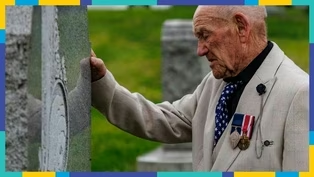
Englishman Visits St. Louis to Honor WWII Pilot Who Sacrificed His Life for Him
Video has Closed Captions
Clip: S2026 Ep10 | 5m 26s | Tony was a young boy in Sheffield, England when he witnessed a damaged American bomber crash. (5m 26s)
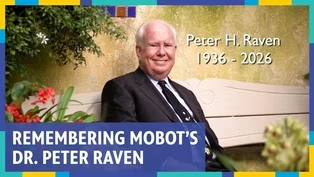
MOBOT President Lucia Lohmann Discusses the Legacy of Dr. Peter Raven
Video has Closed Captions
Clip: S2026 Ep10 | 4m 16s | Dr. Lucia Lohmann talks about the influence of her mentor, the late Dr. Peter Raven. (4m 16s)
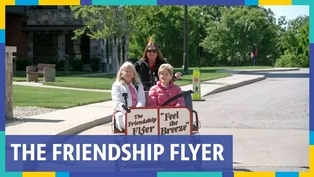
Trishaw Bikes at Friendship Village Bring Residents Outdoors
Video has Closed Captions
Clip: S2026 Ep10 | 3m 9s | Three-wheeled bikes encourage residents to connect with the outdoors and each other. (3m 9s)
Providing Support for PBS.org
Learn Moreabout PBS online sponsorship











Support for PBS provided by:
Living St. Louis is a local public television program presented by Nine PBS
Support for Living St. Louis is provided by the Betsy & Thomas Patterson Foundation.