
May 26, 2026 - Full Show
5/26/2026 | 26m 50sVideo has Closed Captions
Watch the full May 26, 2026, episode of "Chicago Tonight."
A federal program could send millions of dollars to Illinois students, but critics say it will defund public schools. And what to know about weight loss drugs as the demand for them grows.
Problems playing video? | Closed Captioning Feedback
Problems playing video? | Closed Captioning Feedback
Chicago Tonight is a local public television program presented by WTTW
WTTW video streaming support provided by members and sponsors.
May 26, 2026 - Full Show
5/26/2026 | 26m 50sVideo has Closed Captions
A federal program could send millions of dollars to Illinois students, but critics say it will defund public schools. And what to know about weight loss drugs as the demand for them grows.
Problems playing video? | Closed Captioning Feedback
Where to Watch Chicago Tonight
Chicago Tonight is available to stream on pbs.org and the PBS app.

WTTW News Explains
In this Emmy Award-winning series, WTTW News tackles your questions — big and small — about life in the Chicago area. Our video animations guide you through local government, city history, public utilities and everything in between.Providing Support for PBS.org
Learn Moreabout PBS online sponsorshipHello and thanks for joining us on Chicago tonight.
I'm Nick Blumberg.
>> Brandis Friedman is on assignment.
Here's what we're looking at.
Well, Illinois opt into a federal tax credit scholarship program.
We hear the pros and cons.
And what to know about prescription weight loss drugs as demand for them grows.
First off tonight, Cook County Forest Preserve.
Police are asking for the public's help in identifying a assault suspect.
>> The attack, the 29 year-old woman happened in a heavily wooded area of La Bob Wood's on the northwest side around 12:30PM, on Saturday.
According to a release, police distributed a sketch of the suspect today.
He's described as a white man about 6 feet in height with a long brown and blonde beard reaching to his chest forest preserve police along with Cook County Sheriff's Police and the Chicago Police Department have been canvassing the area since the assault.
Anyone with information is asked to call 847-635-1188.
A peek behind the curtain at the grand jury proceedings in the failed Broadview 6 case.
Attorneys for the former defendants had demanded the typically secret grand jury transcripts in the controversial case after Chicago's U.S.
attorney dismissed all remaining charges last week.
Earlier today, a federal prosecutor said the government would not object to the transcripts released which is expected sometime next month after reviewing the unredacted records of the grand jury proceedings, a federal judge said she was, quote, incredibly shocked and said prosecutors have broken the trust placed in them.
For more back story on this case, check out our Web sites.
39 Million Dollar annual tax break.
That's the top line of a study from the Cook County Treasurer's Office into the proposed mega projects bill.
It's aimed at easing a new Chicago Bear Stadium in Arlington Heights.
The analysis from Treasurer Maria Pappas is office is the first goal putting a price tag on the legislation passed the Illinois House last month, but has yet to clear the state Senate, according to the report, the yearly savings would amount to more than 1.5 billion dollars over the course of the 40 year agreement.
The bill proposes state lawmakers are set to adjourn by Sunday with Governor JB Pritzker telling reporters last week that he was optimistic the legislation would pass before that deadline.
got more details on our website.
Up next, the debate over the new Federal Tax Credit Scholarship program and whether Illinois should participate.
It's right after this.
Chicago tonight is made possible in part.
>> By the Alexandra and John Nichols family.
The Pope Brothers Foundation.
And the support of these donors.
>> Federal Tax Credit scholarship program passed last summer as part of the so-called one big beautiful bill could bring new education funding to Illinois students.
So far, 27 states.
Most of the Republican leaning have opted in if Illinois chooses to participate.
Scholarship granting organizations could provide families with money for tutoring test prep and private school tuition.
But critics argue the tax credit initiative is a school voucher program in the skies that could divert money from already under-funded public schools.
Joining us to discuss the issue are Kasey Creswell, executive director of Illinois Families for Public Schools, a nonprofit organization aimed at improving Illinois's public school system.
Bobbie Sylvester, vice president of the Urban Center, Chicago, based organization focused on developing centrist leaders and a, quote, commonsense policy agenda.
Thank you both for joining us.
We appreciate it.
So by the semester can give us a server rundown of this program.
What it would mean for Illinois students if the state were to opt in.
Sure.
Well, what it would mean is that potentially billions, if not 10's of billions of dollars could come to benefit education of children in Illinois, both at public and private institutions.
So our public schools and our private schools could all benefit.
>> And the way that this works is individuals, federal taxpayers can make a donation to the scholarship granting organization and that scholarship granting organization then use those funds to provide educational opportunities for kids, whether that's tutoring bus services, or private school tuition or, you know, there's just a long list of things that can be used for.
can see your organization along with 44 others wrote a letter to Governor JB Pritzker, urging him not to opt-in to the program.
What are your concerns?
>> As we've seen with voucher programs around the country about send public tax dollars to private schools who do not have to serve all kids.
And there's a lot of discrimination issues at private schools, especially for example, students with disabilities.
If you place child in private school, you're giving up their rights to free appropriate public education that you have in a public school.
And so really those discrimination issues and the lack of oversight and transparency and accountability for public dollars spent as vouchers.
It is the big issues without your programs >> You know, Bobbie, what do you make of the the argument that this program would be diverting funds away from public schools toward private schools?
Yeah, it's simply not true.
The reality is that the federal government continues to provide funding for education.
The state government continues to provide funding for education and then the vast majority of funds come from property tax payers at the local level.
And its important to note that the state of Illinois has never spent more money on public schools and certainly there is a focal formula.
The evidence base funding formula that calls for more.
We think that's great.
That should be continued and encouraged.
But there's certainly the opportunity here to bring billions of dollars to public school students.
And since most Illinois students are public school students, they would benefit the most if Governor Pritzker into this program.
You know, Kasey Bobby mentioned earlier, you know, families who received the scholarship funds, they could use them for a range of expenses, you know, could be tutoring, could be test prep.
Do you think most families might use the money for those services rather than for private school tuition >> so what we do over the program so far is that states are not going to have the option to regulate the so-called scholarship organizations.
That's the voucher distribution funds.
And so those can be set up by essentially anyone who can set up a 5, one C 3 and the dollars will go to whoever that organization wants to support.
So there are already very large multi state U.S.
yos existing around the country.
And those are really set up to benefit from this program and they have the infrastructure and the advertising and marketing, for Betsy DeVos is nonprofit has set up a seed fund to make sure that studios that go to private schools will have the way to reach taxpayers, who will then senator tax dollars to those organizations.
So it's really to the extent that it can benefit private public schools that will be in communities that can set up the sort studios.
And if the state is not regulating them, I think we'll see something very similar to what we see in.
For example, Chicago, with friends of organizations, the Federal Reserve Bank to the big study of those organizations back in 2023.
And they really benefit the post wealthy schools wealthy communities.
And to the extent that we're going to see public schools benefit from any of these dollars, I think that's really going to be concentrated.
And while the communities to get what do you make of that argument, body, that it's just going help folks who are already fairly well off?
>> Yeah, I don't think that's going to be true at because there's mobilization happening and certain areas, right to make sure that public school students benefit as well as that low income students benefit.
>> And so I had to take the first part, you know, Dr Stafford, someone that I for Matt, he's superintendent public school superintendent from Southern Illinois.
He's already working to organize an sto for his school district so that he can take advantage of these funds and make sure that he's capturing as many dollars as possible for his students here in Illinois.
Now for the private schools.
If it was, it's generally can be used for tuition for the percentage that goes to private schools and it's going to go to students who cannot otherwise afford to attend a private school.
And that's what is certainly we expect to happen.
You know, Kasey, and in that letter to Governor Pritzker, we organization argued that this program pretty closely resembles the invest in kids program.
The Illinois operated between 2017 2023.
>> How did that program shape your view of this new initiative?
>> I think the key problems with that program that we really saw were one discrimination.
We saw discrimination against students with disabilities, LGBTQ+ students, undocumented immigrant students pregnant parenting students, students that had abortions.
Policies discriminating.
It's those students or in some staff and families were on the books in many, many schools that were getting public dollars.
So that was a huge problem.
Another promise that the oversight was really lacking.
And we had fairly well designed program priced out or programs go.
But we still could.
did not have exact dollar amounts that we're going to each school, the breakdown and information about the demographics of students was weak.
They were supposed to be annual testing during that program and we only got testing one time and one annual report in 6 years and even that limited oversight is not going to be present in this federal program.
It's going to be even weaker.
And so that really is just, you anyone worried about where their federal tax dollars are going to go?
Should be concerned about that.
>> just a couple things there.
So one item point to note that this is taxpayer driven decision meeting.
You as the individual get to decide which has geo that you donate to.
And so you get to choose, right?
So it's not that it's just going to somewhere right?
You're going to know because you have to take action to direct it to very often your local area, right to benefit students who could use those those funds.
But what do you make of that argument that, you know, critics saying this could go toward schools that are discriminating against certain classes of students.
Lgbtq kids, students with disabilities.
Yeah, I think that's a red herring.
think that's inaccurate.
I've seen plenty of private schools that I have very different policies on this and there's certainly federal and state anti-discrimination laws on the books and those have not gone away and they continue to be available to for anyone who thinks that they have been discriminated against as much as Cassie says that there's claims of discrimination.
I have yet to see actual person who has said that.
>> So to be clear, the same federal and state laws that control our regulate anti-discrimination in public schools don't really apply to private schools, especially religious schools.
So that means that the schools actually are free to discriminate in that way.
You can go on the website of the schools and see in their parent handbooks.
And and, you know, when you look at some of the data that the state Board of Education had on say, for example, special education when if you look through all the hundreds of schools that giving private school vouchers only about 15% of them reported serving any special education students.
The state Board of that.
So, you know, public schools in Illinois, 100% of our schools are serving kids with individual lies, education programs.
And that's in part because there are very strong laws.
So if you discriminate against since this abilities for their parents have recourse to pursue and make sure that they have their rights protected.
But what, you know, some supporters of this program, you know, they some of the argument is that, you know, families.
>> In a desert educational options beyond public schools that may be underperforming that may have, you know, be struggling.
What what do you make of that argument?
I mean, woman, we actually look at the data from longstanding about your programs around the country.
They do not result in better academic outcomes, especially for low-income students, for students of color, for with disabilities.
So if you're actually concerned about academic outcomes, what we need to do is strengthen our public school systems that serve 9 out of 10 kids in our state and around the country.
So that's really the important part there.
Another part about this federal program that actually different than the Illinois program.
Illinois had an income level of just a couple times the federal park proper, the poverty rate, this program has a limit of 300% of the area.
Median income.
So for the Chicago area, that means families, you know, of 4 making more than $300,000 will qualify for Boucher.
And we've seen these universal voucher programs around the country where any child from any family can get a voucher.
We've seen that next door in Iowa and that really ends up benefiting wealthy families who are already sending their kids to private school.
And that ends up being like two-thirds or more of the kids getting vouchers are in those families, you know, body during the March primaries, Illinois voters approved a non-binding referendum supporting the states participation in this program.
>> Do you expect that?
You know, Governor Pritzker will will opt Illinois into it?
certainly hope so.
And we think that this.
As people continue to understand this law, that there will be more and more very recently, the state of New York has indicated that they are going to opt in.
So that is another big Democratic state that is said that they want to participate in this program.
And so we're certainly hopeful and that is our expectation that he will act just a few seconds left.
But have you heard anything from from the governor's office on this issue?
He says he's waiting for the regulations to come out.
>> From what we've already heard from the Department of Treasury Treasury and the IRS.
I don't think we can expect the Trump administration to be creating a program that is going to help public schools because that is just not what their goal All right.
Well, we could spend probably the whole this issue, but that's all the time we have for right now.
>> Bobbie Sylvester, Kasey Creswell, thank you both for joining us.
We appreciate it.
Thank you for having us.
Up next, what to know about weight loss drugs as demand for them grows.
>> Demand >> for weight loss medications is growing in the United States.
Recent polling shows roughly one in 8 adults are taking a glp one weight loss drug GOP ones like Ozempic and we'll go V have been prescribed for patients to manage diabetes, obesity and other conditions as an effective treatment.
However, the soaring rise in popularity of the drugs has some healthcare workers concerned over their accessibility to vulnerable populations.
Joining us to discuss all this, Theresa Gentile, a board certified registered dietician and spokesperson for the Academy of Nutrition and Dietetics, which is headquartered here in Chicago and Dr.
Laura Farrington medical oncologist for City of Hope Cancer Center.
Chicago with a specialization in cancer treatment.
Thank you both for joining us.
We appreciate it.
I'd like to start with you.
If I could, please, Dr Farrington, you know, for for folks who have heard about these drugs, but don't necessarily know the exact mechanism.
How do they work?
>> So glp one drugs are synthetic versions of a natural gas for Mon your body already produces the GOP ones work multiple different works in your pancreas that works in your liver and works in your stomach by slowing das trick emptying which allows you to feel fuller longer and less hungry and also works in your brain to suppress hunger and reduce food cravings.
>> And Theresa know you often recommend weight loss medication when working with patients.
How have you seen these these GOP ones improve folks, conditions?
>> Well, many of these glp one drugs past research behind them.
It turns out improving cardiovascular.
wasn't pretty cardiovascular risk and improving insulin sensitivity and the weight loss along can change people's lives.
It is is absolutely life changing for some people.
>> And I understand, you know, typically you're part of a larger team when it comes to treating patients.
Why it's that holistic approach.
Important when you're prescribing weight loss medication for folks.
>> There are so many facets that go into weight loss that's not just good medical.
So that's the clinical supervision.
And medical supervision is extremely important Supervision is very important as well because there's a real risk micronutrient deficiencies.
There's a risk disordered eating behaviors that might and there's a risk of other mental health issues that might come around tension with know that people are starting to Newsweek and very quickly.
Yeah.
>> You know, Dr Farrington and emerging areas of research when it comes to these weight loss medications, you know, their impact on inflammation metabolism, cancer, biology.
What are what are some of the key things we've learned so far?
>> Well, when it comes to glp ones and cancer the day we've seen so far is very exciting that these retrospective analysys are showing potentially improve survival, for example, in early-stage cancer and also at a retrospective analysis show that potentially this may actually decreasing the sum of 14 of the most common cancers that we see.
However, the data that we have so far, mostly through retrospective analysys.
So it's really important to take what we know so far that these drugs may be helpful in cancer.
They may help people lose weight, keep their blood sugars under control.
Treat sleep apnea, however, does not ready for prime time.
I would not recommend a patient that has cancer to, for example, only treat with the glp one.
Absolutely not.
But in certain cases, for example, in women with obesity after they've had cancer or women with diabetes after cancer, potentially, these drugs may be life's life-changing and life-saving for many patients.
But those are the patients.
I would encourage to go on clinical trials for this.
>> Yeah, I was going to ask I mean, what are questions that still need to be answered with this research for the information to become, you know, more more solidified.
>> Yes, every drug and medication out there needs to have a rigorous clinical trials, not just this drug, help me lose weight.
And now I don't have cancer.
We need thousands of women to enroll in these trials so that we can figure out who are the best patients candidates for these drugs.
Who benefits the most and who should we be keeping these away from for the highest risk patients?
You know, these these drugs can certainly cause issues like Payne, Korea, Titus Eye disorders, you know, significant weight loss making patients under weight.
So it is not for every person out there but trying to figure out exactly who the right patient is that these drugs may help save their lives.
Well, that's what we're working on right now.
You know, As we mentioned, the polling shows these medications are becoming.
>> Increasingly popular.
Why do you think more people are becoming interested in pursuing glp ones?
>> Well, for one, their weight loss potential is phenomenal.
Compared to the previous generation of weight loss drugs.
I mean, the dual agonist has shown up to 20% weight loss and clinical studies.
Another reason is that because people are seeing that it's working for their friends and family word is getting out.
And I think even more importantly, it's a bringing the recognition that obesity is a condition and need to treat it as such and not just inside the medical community, but outside the medical community that the city isn't just I FaceTimed a lack will power that it is a medical condition and needs to be addressed because there are issues of Mormons genetics that come into play >> And you know, how do you think the popularity of these medications, you know, talking about some of the unintended consequences?
How might these GOP once, you know, affect folks, mental health for people who are struggling with with stigma around around weight around >> yeah, it can be very difficult for people I found some of my patients.
It's for them.
They felt they were giving when they took the medication that they have struggled for so long.
And it's such an important part of their identity, actually, that it's hard to say that going to do this.
You know, that will be asked if they're doing it the natural way.
you know, being on it helped free them from some of the other issues that come along with the food.
And for the first time, sometimes for the first time in their entire life control over from you what they're eating and that can be very free for people.
They can start to worry.
Think about other things in the last of the unjust.
>> You know, Dr Farrington.
There was a Washington Post story in recent days detailing could be relatively easy for folks to get a GOP.
One prescription through apps through online doctors.
They reported, you know, folks with eating disorders have gotten access to them as well.
Are you concerned about how you know, easy for some folks?
It can be to purchase glp ones.
>> You think it's a little bit scary how easy it is to get some of these medications and how they are coming from people that aren't in a patient physician relationship.
I think it's very important to realize that these are not quick fix, weight loss, drugs.
These are long-term medications to help with overall survival and to help with your cardiovascular fitness.
And so it is not something that you should be getting online from someone you meet that day.
The other part that scares me is that a lot of people are getting compound in glp ones.
Meaning there are pharmacies that are making these drugs and compounding them with other things that don't even necessarily have to be regulated.
And so a lot of there's a lot of people out there that are getting a lot of garbage that they're getting either in shots or pills that may not even resemble these drugs or they resemble them away.
But we do not know that those are safer beneficial.
I do encourage patients to trying to get these drugs with a primary care physician they've had a relationship with a nose, their medical history and also through real pharmacies through through places like Lily or pharmacies that, you know, we know what is in these shots because a lot of these compounding pharmacies or med spas, you don't really know what's in there and you can be injecting your body with things that are bad for it.
Yeah.
>> We've got just about up 20 seconds left, doctor.
But for folks who thinking about taking these medications, what's the most important thing?
You want them to understand?
>> Talk to your primary care doctor about this.
This is not a quick thinks this is a long term.
You know, goal for you.
And so it is it's not something that you should just be getting through an online compounding pharmacy.
>> All right.
That's all the time we have for this segment.
Dr.
Laura Farrington Theresa Gentile, thank you for your expertise.
We appreciate it.
And that's our show for this Tuesday night.
Sign up for our free email newsletter.
Urban nature to stay up to date on environmental news.
Information on local wildlife and much more.
That's a W t tw Dot com Slash newsletter.
Join us tomorrow night at 5, 30 10.
Look at where budget negotiations stand in Springfield as state lawmakers face an end of month deadline.
Now for all of us here Chicago tonight.
I'm Nick Lumber.
Thank you for watching.
Stay healthy and safe and have a good night.
>> Closed caption News made possible by Clifford and Clifford Law offices, a Chicago personal injury and wrongful death that supports
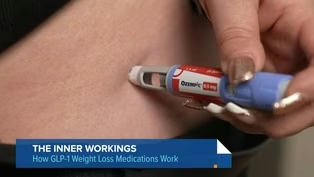
As Demand for GLP-1 Weight Loss Drugs Grows, Some Worry About Vulnerable Groups
Video has Closed Captions
As the use of GLP-1 drugs grow, some worry about widespread access. (9m 7s)
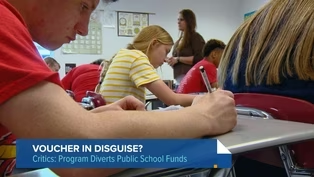
The Debate Over a Federal Tax Credit for Private School Tuition
Video has Closed Captions
Should Illinois participate in a federal tax-credit program for school expenses? (11m 59s)
Providing Support for PBS.org
Learn Moreabout PBS online sponsorship New Episode
- News and Public Affairs

Top journalists deliver compelling original analysis of the hour's headlines.
 New Episode
- News and Public Affairs

Today's top journalists discuss Washington's current political events and public affairs.


 New Episode
 New Episode
 New Episode


 New Episode
 New Episode
 New Episode
Support for PBS provided by:
Chicago Tonight is a local public television program presented by WTTW
WTTW video streaming support provided by members and sponsors.