Northwest Profiles
May 27, 2021
Season 34 Episode 4 | 29mVideo has Closed Captions
Professional axe throwing , Stage Left Theater, Print artist Reinaldo Gil Zambrano
Reinaldo Gil Zambrano creates intense images combining his Latin American heritage with the energy of the PNW. Meet World Champion axe thrower Miguel Taburini, who brings the lumberjack's pastime to downtown Spokane. The show carries on during Covid at Stage Left Theater, with improvisational, cutting-edge programing for virtual audiences. See how farming helps vets transition back home.
Problems playing video? | Closed Captioning Feedback
Problems playing video? | Closed Captioning Feedback
Northwest Profiles is a local public television program presented by KSPS PBS
Funding for Northwest Profiles is provided by Idaho Central Credit Union, with additional funding from the Friends of KSPS.
Support provided by:

Northwest Profiles
May 27, 2021
Season 34 Episode 4 | 29mVideo has Closed Captions
Reinaldo Gil Zambrano creates intense images combining his Latin American heritage with the energy of the PNW. Meet World Champion axe thrower Miguel Taburini, who brings the lumberjack's pastime to downtown Spokane. The show carries on during Covid at Stage Left Theater, with improvisational, cutting-edge programing for virtual audiences. See how farming helps vets transition back home.
Problems playing video? | Closed Captioning Feedback
How to Watch Northwest Profiles
Northwest Profiles is available to stream on pbs.org and the free PBS App, available on iPhone, Apple TV, Android TV, Android smartphones, Amazon Fire TV, Amazon Fire Tablet, Roku, Samsung Smart TV, and Vizio.
Providing Support for PBS.org
Learn Moreabout PBS online sponsorship♪ Hello and welcome to this edition of Northwest Profiles I'm your host Lynn Veltrie and with spring now in full bloom we invite you to relax and enjoy another fabulous assortment of stories about some of the creative and colorful personalities we live with here in the Pacific Northwest.
So, let's get ready to meet them, shall we?
For our first story, we had a chance to check out a unique business in downtown Spokane where people are given a chance to unwind a bit by literally giving them sharp objects to throw!
Sounds like good fun to me!!!
The abrupt sound of metal to wood...occurring over and over.
Activity inside Spokane's Jumping Jackalope Axe Throwing company is vibrant.
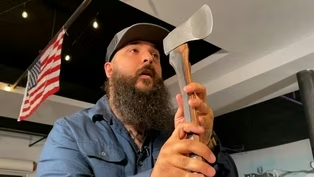
Centering around throwing sharp objects at a lumber faced wall with a large target painted on it, the owner and chief axe thrower here, a Venezuelan born axe throwing champion, counts himself fortunate to have discovered a vocation that he most certainly loves.
>>Arriving from Venezuela in 2013, Miguel set his roots in Oklahoma and a few years ago he catapulted into his current profession.
>>After his stint in Oklahoma, he moved to the Pacific Northwest and started his own axe throwing company in Spokane.
>>Now... there's playing for fun, and there's playing for a major competition.
By hosting the Jumping Jackalope Jamboree a World Axe Throwing League sanctioned event and drawing some of the best axe throwers in America, Miguel gave the Spokane area public a chance to watch some top tier throwing.
>>By breaking into the WATL league after its inception in 2017 and subsequently winning numerous titles in the last two years, Tamburini has been rated number one in the world twice coupled with being an 8-time regional champion and has used his technique to make his mark in this up-and-coming sport.
It's good to know that the art of axe throwing isn't confined to just lumber camps or county fairs.
It looks like a great way to work off some stress.
Moving on as we see our world opening up again after the pandemic, one of the most exciting changes will be in Spokane's live theater venues.
One of these vital places is Stage Left Theater, a little yet powerful company whose mission is to challenge us while giving us a laugh, a cry and an opportunity to expand our social awareness.
(upbeat jazz music) ♪ I wake up with a smile on my face ♪ - [Jeremy] My name is Jeremy Whittington, and my title is Managing÷¦Artistic Director here at Stage Left Theater.
♪ I can't stop this feeling ♪ ♪ It's one of a kind ♪ (laughing) - It is the Inland Northwest's premier progressive non-profit theater.
- [Stage Actor] I'm able to move one way.
- [Jeremy] We pride ourselves on doing the edgier shows that a lot of theaters don't touch in the area.
- It will shout in exquisite excitement!
It will vibrate you.
- [Jeremy] We do political plays, we do plays about feminism, LGBTQ rights, we do racially charged plays - I began beating him.
I'm!
Spite!
- I started this position January of 2020.
So, right before COVID hit.
(jazz music) - Oh, for a muse of fire that would ascend the brightest heaven of invention.
- Our mission here is to lift marginalized voices in our community and tell stories that bring to light issues that might not otherwise be touched upon in storytelling, in the local theater region.
- [Skit Narrator] I need to stand and face the face that I do wear with fear and disdain.
(jazz music) - When I first came on to this position and met with the board of directors, I told them that we need to always institute our mission into everything that we do, and we can't bastardize our principals in any way, we can't veer off and do something fluffy that doesn't fit into our mission statement.
And that's what's gonna really solidify us; I think it has solidified us as the go-to theater for political statement, for women's rights, for raising those female and black community in this town.
And while it's difficult, it's definitely worth it.
Back in 2011, the owner of the building and our current board president Robert Nelson decided to have a group of his senior friends get together and do a reader's theater.
And they were housed in various basements of churches, and schools, and things like that.
They were doing a play reading in the basement of a church, and as the story goes, one of the deacons had walked by and heard some bad words come out of this script.
And they were asked to leave the church.
So, Robert being the irreverent person that he is, decided that he was gonna build his own theater.
So, he bought this building here in downtown Spokane and got at it-it was an old retail space- and turned it into a 70 seat theater that you see today.
And it became Stage Left out of the necessity to, kind of, tell those stories that are a little left leaning, and a little progressive, and a little in your face with their political statements.
And that's kind of how this little theater formed.
- [Stage Actor] My dear brother, dear to me, biggest that I am, vicious scheming.
- [Jeremy] We're really trying to be an active presence in our community.
- All the world to me as well thou knowest.
- Not only does it follow our mission statement, but it lets other like-minded organizations know that they're not alone.
♪ So much love, ♪ ♪ You've given me so much love ♪ - [Jeremy] Our programming definitely involves doing some mainstream shows that people might be aware of.
When we do choose those mainstream shows, we try to pick shows that aren't necessarily telling somebody what they should think, but telling them that, that they should think.
- This.
Nope, he deserves this.
Nobody... - You'll walk out of the theater with conversations with the people that you sat next to.
We're not trying to make anybody left-leaning.
That's not the mission of this theater.
And we've certainly done plays that explore what can be negative about the left too.
It's really about having conversations with people.
- He will trust his wife.
He will not be jealous.
- [Jeremy] Since we shut down, we've kind of had to pivot and dodge, and come up with new ways to tell stories.
And starting last August of 2020, we began streaming various festivals, if you will, that normally would have happened on our stage.
- Up next, it's a tale of triumph, of fire, and excitement.
- [Jeremy] We have Kid's Corner, which is local scripts from first graders that actors would perform on our stage.
- Hi.
- [Jeremy] And since we couldn't have the actors in here, obviously, we sent those scripts out and had the actors perform TikTok videos.
- [TikTok Voiceover] Dun dun dun dun dun dun dun dun - [Jeremy] That was our first foray into the streaming world - And then an epic battle ensued.
- [Stage Actor] And the face of Jesus speaks to her.
The face of Jesus says, draw the blades!
And the woman is frozen with fear.
And again, Jesus says, draw the blades!
And the woman speaks!
The woman says, it's part of a set.
(audience laughter) - For the last show that we did before closing for COVID, was "Lonely Planet" by Steven Dietz.
And when we did that production, we knew we had something special on our hands and we wanted to take that to state competition and regional competition, and hopefully nationals.
And because COVID hits, the whole system of festival going got reworked, and it ended up being virtual.
And so, I submitted a 30 minute clip of that show, and we made it to the top 38 in the nation.
And then all the judges voted again, and we made it to the top 12 in the nation.
And just last week, they sent a film crew of Broadway filmmakers out here, with their six HD cameras, and they filmed our one hour presentation for a national competition to the AACT festival.
We did the very best we could.
The performances were fantastic.
I designed the set for that; it's one of those sets that I got to walk away from, knowing that I put everything that I had into it, and there's nothing I would have done differently.
♪ Look around ♪ ♪ And see what's there ♪ ♪ Smell the flowers ♪ ♪ Fill the air ♪ - [Jeremy] When I took this position at Stage Left Theater, I felt like I landed at home.
The support that I have from the community has been overwhelming.
The level of support, both financially and emotionally, that I personally have received and the theater has received has just been a little overwhelming, really.
♪ Don't be sad ♪ - [Jeremy] People love what we do here.
There's this sense that Stage Left has been able to, kind of, be on the precipice of trying new things during this pandemic.
We've done them, and we failed, and we've succeeded.
But every time, the community has really rallied around us and given us their full support.
I think that everyone wants theater in this community to succeed.
Whether it's here, or Civic Theater, or Lake City Playhouse, or Ignite, or Aspire, or Blue Door Theater, all of these little components that make up the overall theater community of the Spokane region are really coming together in a way that I don't think I've seen any way since, since I've lived in Spokane.
And all our ships are rising.
And I think that we're gonna come out of the pandemic with new ideas, new partnerships, and new insights that are going to really help the arts just bump up to the next level, in this area.
(gentle music) The competition with the A.A.C.T is like the Tony Awards of community theater.
It began with 38 theatre companies from across the country, and now it's down to only 12 with the winners to be announced this June.
It's a special recognition to all the hard-working crew, performers and volunteers that make stage left an important part of Spokane's artistic community so break a leg, and on with the show!
Now, let's remain in the world of the arts and move from the stage to the canvas and the creative work of an artist who describes himself as a sponge, meaning that he soaks up inspiration from everywhere.
He creates intense images.
And he wants to use them to bring communities together.
♪ Reinaldo: I do wordless narratives, visual narratives that challenge the written language.
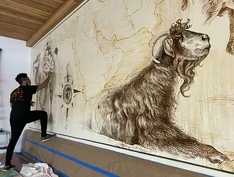
>> Reinaldo Gil Zambrano, or RGZ for short is a print maker and mural artist living in Spokane.
Reinaldo: I just feel that printmaking is just this beautiful thing that empowers people.
Because you get to draw on a piece of wood or metal.
Then you carve it, so you become a sculptor.
And then you basically ink it and print it.
And it becomes better because it's more graphic and bulky, with this beautiful texture that is really hard to create with any other technique.
So when you get that excited about this process, you just want to share it with other people.
And when you do that, you see that they get really excited about it too.
So it's a contagious thing.
>> Reinaldo was born in Caracas, Venezuela where he discovered his deep love of art.
My parents were always very supportive of me in pursuit of my passion for arts.
They even allowed me to paint and draw on the wall next to my bed.
And I'm very, like I don't like that wall at all, but they said, "Well, come by and paint it again."
You know?
I say this a lot, but I was getting ready to become a really bad architect because that was kind of the thing that was related to art in Venezuela.
>> Reinaldo attended United World College in Costa Rica, where he veered away from architecture and fully into art.
At the college, he connected with students from around the world.
I was fascinated with the idea of being in this environment where 72 different people from 60-something different countries, just live together.
And it was amazing.
It showed me, like the diversity in people, but also all the similarities that we have.
So I just grew up fascinated with the idea of getting to see more of the world.
>> Right about then, a recruiter from The College of Idaho near Boise offered Reinaldo a scholarship.
They saw my portfolio and they say like, "If you want to go to school with us, you have a full ride."
>> Reinaldo finished his education in the northwest, and now lives in Spokane.
He freely shares his passion for creating images that challenge the written language.
With my experience that I found in Costa Rica, living in Costa Rica with all these people that speak so many languages, is that there is so many similarities that we have as humans.
Part of that collective consciousness, that we should celebrate.
So when you do artwork, that have this visual narrative that doesn't have any writing in it, it allows also people to bring their own experiences and complete the story.
So that's why we've developed the Spokane Print Fest that has been happening for the last two years.
Where we bring different institutions, colleges, artists, to somehow share their passion for printmaking with the rest of the community and show them what they're capable of doing.
And it's amazing to see the students being the instructors for their community.
>> Some of Reinaldo's art pieces can be very large, calling for extreme measures.
And we ended up renting a steam roller and inviting all these different people from Pullman and from Moscow and we printed together and it was great.
♪ >> Like his college days in Costa Rica, Reinaldo was part of an important multicultural experience in Spokane.
He was asked to create the letter M on the Black Lives Matter mural.
And I jumped in and said, "Yeah, of course.
I will definitely work on this."
And it was the concept that they brought was beautiful.
To somehow bring 16 different artists from different ethnicities, pretty much coming together and working and collaborating to this massive piece that is actually one of the biggest murals in Spokane.
>> Reinaldo doesn't want to stop with that mural.
And I say that I am a full-time day dreamer.
So walking around in the city, especially in downtown, I get to see this beautiful architecture that we have.
But then, so many possibilities, because they're just pretty much walls that are high and elevated.
But also, they're pretty much, I call them, canvases.
>> Reinaldo worked with another artist to create sample pictures to demonstrate what could be possible.
They are basically surfaces waiting for us to bring visual narratives into that area and activate them and make the city even more vibrant.
So I know that people talk about Portland, this city that is pretty much creating all this beautiful art, Seattle.
But we have the talent here.
We just haven't really started activating these spaces.
♪ ♪ One thing that I really enjoy about this process is to bring other people together.
So creating events, developing spaces like this one and creating workshops, and things that somehow bring other people into the making process that I do is something that is really strong in my practice.
♪ Reinaldo's imagery combines his Latin American heritage with the energy and people that surround him here in the northwest.
And although some of his artwork can seem dark, he says that it comes from a good place.
For our last story we'd like pay tribute to the approaching Memorial Day holiday with a story about local veterans.
We all know the road home for our returning veterans isn't always a smooth one and for many returning to the world they left behind seems like yet another battle.
But in Spokane an idea that offers hope and a new career path blossomed in our own backyard, and for some of our local veterans it's become their way back home.
(calm acoustic guitar music) ♪ You're climbing a mountain and I don't know why ♪ ♪ But I think it's time to come back down again ♪ ♪ And tend to my garden ♪ ♪ See that it grow strong ♪ ♪ In my own garden ♪ ♪ Singing my own song ♪ - I think it was 2013, I attending a film screening at the Spokane Community College, they had a veterans program there and it was the depiction of this newest generation of veterans coming back and that transition, and how difficult that can be for them sometimes.
Whether it's PTSD or just the transition itself, it's difficult for them to find their way again and at the same time, our American agriculture, we have dilemma going on in this country right now where the average age is 60 years old and we don't have the backfill of people coming into this as a profession or an occupation to be able to feed ourselves.
So after the film I literally walked out that day and thought, "We have to do something.
"I have to find a way for the Spokane Conservation District, "just to get involved."
♪ Looking for answers way up in the sky ♪ Through conversations and connections I met a couple other gals here in Spokane and we put together what we thought was a model, that we could start something.
♪ See that it grows strong ♪ ♪ In my own garden ♪ First place was find farmers, find farmers that would be interested in mentoring.
So I went to a farm bureau meeting, I threw this crazy idea out there, "Hey I've this idea," and I had a family that the very next day after that presentation, they stepped up and they said, "We have this little farm house and three acres of land "and some equipment and we believe in this program "and we think there's something there "and we're giving it to you."
And they did.
♪ In my own garden ♪ ♪ In my own town ♪ - I did six tours in the Middle East.
I knew when I got back to Ritzville that I wanted to do some agriculture but I just couldn't find my way.
You always have a mission when you're in the military.
You have a daily regimen, what you do every day, every week, every month.
There's always certain things that you need to be doing at certain times of the year or you're getting ready to deploy.
When you get out, you necessarily don't have that anymore.
I don't want to say lost, but you're not sure which direction you're supposed to go into.
So I had a hard time adjusting, finding something that filled all those voids.
♪ So it's one more day in the garden ♪ Someone put it really well at one of our briefings that you spend however long you're in, so for me, it was 21 years in the Air Force.
They teach you how to be an Airman, how to do your job, how to be in the military, but they don't spend one day teaching you how to be a civilian.
♪ Overcomes the light.
♪ - You know your family is your family but they don't really get it.
Vets on the Farm to me is, is kind of my family.
You know, in the military that's kind of what you get when you go to a new base.
You get this ready-made family.
But you're not prepared for when you get back and for me, Vets on the Farm was just kind of finding my way back home again.
- It used to be that there was down time, there was processing time, decompression.
Now it's 18 hours, you're in Afghanistan, 18 hours later you're home, here you go, go back to your real life.
That's hard to do.
♪ To get it right ♪ This type of activity has taken them from a destroyer mentality to a creator and a nurturer again and when they can do that, there's healing in that.
So to have something like this now, for this newest generation of veterans, to be able to help them transition into that next mission has been so well-received.
And I put it like this, "We're either going to do programs like this and put some thought, some money, some time into it or we're going to pay for it later" because the suicide rate, the domestic violence, the drug and alcohol abuse, that's what happening if we don't have effective programs to be able to offer.
(upbeat acoustic guitar) - [Grant] We go through a 12-week course cultivating success through the WSU extension office.
They help you find your path, a business plan.
- I call it the big sifter.
So we throw this idea in the top, we spend 12 weeks sifting it out, shaking it down, refining it, and in the end they come out with something that might be a business model or a business plan.
It might be bankable for them, that's the goal.
For some of them, they'll be able to move on with that.
For others, it may be that you know what, that's not going to work.
That's just not economically feasible.
That's a good thing, that they can spend that 12 weeks figuring that out rather than actually try it and then have problems later on.
(upbeat acoustic guitar) - [Grant] The one thing that I really get out is helping other people find their way to grow and to transition, to find that direction that they need to be going.
(calm acoustic guitar music) Being out here and we love our customers.
- [Brianna] It's been really fun interacting with all the people that come out to the farm stand and they're all just kind of stoked on our products because we put a lot of love and effort into what we do out here and it really is paying off.
- [Grant] We do want to make money of course, but we want to be more the part of the community and that's what we get from a lot of our customers.
- [Vicki] We're growing people, we're growing community, we're growing that ability for them to transition back into a civilian life again.
♪ We all need a place that we come from ♪ ♪ To our own garden is back where we will come ♪ - [Grant] If this helps one person find their self-worth then it means everything to me.
♪ Yeah in my own garden ♪ And with that it's time to bring to a close this edition of Northwest Profiles and our 34th season.
As always if you would like to learn more about the stories you've just seen, simply go online to ksps.org Until we meet again this is Lynn Veltrie saying so long and remember, here in the Inland Northwest and western Canada adventure is all around waiting to be explored, so get out there and when you do, take time to enjoy the view.
Video has Closed Captions
Clip: S34 Ep4 | 5m 22s | Meet a Spokane businessman who happens to be a world champion...at tossing an axe! (5m 22s)

Video has Closed Captions
Clip: S34 Ep4 | 7m 48s | Stage Left Theater didn't let Covid-19 stop them delivering thought-provoking performances (7m 48s)
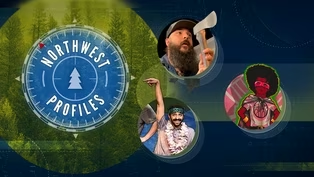
Preview: S34 Ep4 | 30s | Professional Axe throwing , Stage Left Theater, Print artist Reinaldo Gil Zambrano (30s)
Video has Closed Captions
Clip: S34 Ep4 | 6m 30s | Reinaldo Gil Zambrano, a Venezuelan print maker and mural artist with big plans. (6m 30s)
Providing Support for PBS.org
Learn Moreabout PBS online sponsorship












Support for PBS provided by:
Northwest Profiles is a local public television program presented by KSPS PBS
Funding for Northwest Profiles is provided by Idaho Central Credit Union, with additional funding from the Friends of KSPS.