
May 29, 2024 - PBS NewsHour full episode
5/29/2024 | 57m 46sVideo has Closed Captions
May 29, 2024 - PBS NewsHour full episode
May 29, 2024 - PBS NewsHour full episode
Problems playing video? | Closed Captioning Feedback
Problems playing video? | Closed Captioning Feedback
Major corporate funding for the PBS News Hour is provided by BDO, BNSF, Consumer Cellular, American Cruise Lines, and Raymond James. Funding for the PBS NewsHour Weekend is provided by...
May 29, 2024 - PBS NewsHour full episode
5/29/2024 | 57m 46sVideo has Closed Captions
May 29, 2024 - PBS NewsHour full episode
Problems playing video? | Closed Captioning Feedback
How to Watch PBS News Hour
PBS News Hour is available to stream on pbs.org and the free PBS App, available on iPhone, Apple TV, Android TV, Android smartphones, Amazon Fire TV, Amazon Fire Tablet, Roku, Samsung Smart TV, LG TV, and Vizio.
Providing Support for PBS.org
Learn Moreabout PBS online sponsorshipAMNA NAWAZ: Good evening.
I'm Amna Nawaz.
GEOFF BENNETT: And I'm Geoff Bennett.
On the "NewsHour" tonight: Jury deliberation gets under way in Manhattan in the criminal hush money trial of former President Donald Trump.
AMNA NAWAZ: A razor-thin primary win for a Texas incumbent highlights the growing rift within the Republican Party.
GEOFF BENNETT: And Judy Woodruff looks at how Alaska changed its primary elections to break partisan gridlock.
PASTOR ANDY BARTEL, St. John United Methodist Church: It allows people like me and other nonpartisan voters the opportunity to weigh in without having to necessarily commit ourselves to a particular party.
(BREAK) GEOFF BENNETT: Welcome to the "NewsHour."
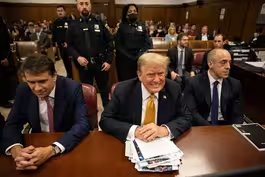
Former President Donald Trump's future now rests in the hands of a jury in New York City.
Jurors in the criminal hush money case against Mr. Trump began deliberating this morning.
AMNA NAWAZ: Seven men and five women received instructions from Judge Juan Merchan and were then sent off to decide this historic case.
William Brangham has been covering the trial from the start, and he joins us now.
So, William, let's start with those instructions that the judge gave to the members of the jury.
They're very important in this case, the subject of a lot of debate between the defense and the prosecution.
Tell us more about what exactly the judge instructed those jurors to do this morning.
WILLIAM BRANGHAM: You're right, Amna.
They are always -- they're important in every case, but particularly in this one because it is such a complicated case.
And the judge laid out several key issues.
First off, he stressed to the jury that a defendant can be held liable for the criminal acts of other people if the defendant basically instructed or asked or helped them to do so and did so intentionally.
Secondly, the judge then went through the 34 different charges, which all accuse Donald Trump of falsifying business records.
And those are 34 different checks and invoices and ledger entries, all in relation to the payment made to silence adult film star Stormy Daniels.
Third, he explained that, for those 34 charges to become felonies, not just misdemeanors, they must have been done to commit or to conceal another crime.
And, in this case, it is alleged that he was committing a violation of New York state election law, which basically prohibits someone's -- promoting someone's election through unlawful means.
And he explained that that could have been a violation of federal election law, falsifying other records or tax law.
Again, quite complicated instructions.
In fact, the jury today asked for a rereading of some of those.
Those apply to each and every count, and the jury on each of those has to be unanimous.
AMNA NAWAZ: So, William, this now sits with the jury.
It's an if -- it's a big if -- but if the jury does decide that former President Trump is guilty in this case, what kind of punishment might he be facing?
WILLIAM BRANGHAM: If he's found guilty on one count or 34 counts or somewhere in between, it is then up to the judge to decide his sentence.
And in New York state, judges have a lot of leeway in deciding the sentencing.
Each of these charges carries a maximum of four years and $5,000 penalty, four years in prison.
But it is not at all clear that the former president would be incarcerated.
He could be sentenced to probation.
He could be sentenced to house arrest.
Each of those latter two would give him more freedom.
I mean, all along, Judge Merchan has acknowledged the historic nature of who this defendant is.
I mean, this is a man who's running for president.
He ought to be out campaigning.
This is a man who very well could become the next president.
And so Merchan said it is a last resort for him to imprison Donald Trump.
But he said, if it comes to that and he feels it's necessary, he could do so.
Whether that happens or not, I mean, legal analyst Norm Eisen looked at all of the cases of felony prosecutions of falsifying business records, like this case, and found that about 10 percent of those cases ended up where the defendant went to jail for a period of time.
Now, those cases often involved other charges as well that Trump is not facing.
And, of course, none of those defendants were Donald Trump.
You also simply can't overlook Trump's history and his demeanor towards the rule of law.
I mean, this is a man who has been fined and gagged and warned and held in contempt by a lot of different judges in different cases.
He's never admitted guilt or remorse.
He has attacked this judge directly.
All of those things can be counted in sentencing.
So it's very uncertain.
I think anyone that tells you they know what's going to happen here, don't listen to them.
AMNA NAWAZ: So, this is, as you mentioned, a defendant who's also running for president.
And we obviously have to wait for the jury to reach a decision, but do we have any sense of how a verdict could impact, potentially, that presidential race?
WILLIAM BRANGHAM: Yes.
Along - - very good timing here.
Along with our colleagues at Marist and NPR, we put out a poll that asked this question, what might happen if Trump were found guilty or not guilty and how that would affect their vote.
And I want to put up some of those results here.
If Trump is found not guilty among all registered voters, 14 percent said it was more likely they would vote for him; 9 percent said it was less likely he would get their vote.
Three-quarters of all registered voters said it wouldn't make a difference.
But among Republican voters, an innocent verdict bumps up that more likely to vote for him number to 26 percent.
The percentage saying they're less likely to vote for him drops to just 3 percent, and those saying it makes no difference, that goes down slightly to 68 percent.
Now, what if Trump is found guilty?
Among all voters, those saying they're more likely to vote for him stays unchanged, about 15 percent.
But double the number, 17 percent, say a guilty verdict means they're less likely to vote for him.
And 67 percent of all registered voters again say it wouldn't make any difference.
But, again, let's look specifically at Republican voters.
If he is found guilty, the number of Republicans saying they're more likely to vote for him goes up 10 percent to a quarter of all Republican voters.
The number saying they're less likely to vote for him rises to 10 percent.
That's a 7 percent shift; 64 percent of all Republicans say a guilty verdict would make no difference.
So, overall, this poll indicates that a guilty verdict could impact Donald Trump, but only at the margins affecting his electoral chances.
AMNA NAWAZ: All right, that is William Brangham joining us from New York tonight.
William, thank you.
WILLIAM BRANGHAM: Thanks, Amna.
GEOFF BENNETT: In the day's other headlines: Israel's national security adviser says he expects another seven months of fighting in Gaza.
The remarks come amid growing international pressure on Israel over its offensive against Hamas.
It also raises questions about who will control Gaza after the war.
At a press conference today in Moldova, Secretary of State Antony Blinken urged Israel to come up with a strategy.
ANTONY BLINKEN, U.S. Secretary of State: In the absence of a plan for the day after, there won't be a day after.
And this is where we need to go.
Or, if not, we will have chaos, lawlessness, and a vacuum that eventually will be filled again by Hamas or maybe something, if it's possible to imagine, even worse, jihadis.
GEOFF BENNETT: On the ground, Israel's military said today it has seized a key corridor along Gaza's border with Egypt.
Israel says the area is a focal point for tunnels that Hamas uses to smuggle weapons and other goods.
Meantime, Israel expanded its offensive in the Southern Gaza City of Rafah.
The IDF released video today of its troops operating in and around buildings within the city.
Thousands of Gazans continue to evacuate the areas nearby.
South Africans voted today in what could be the country's most significant election in decades.
The African National Congress party led South Africa out of apartheid and has dominated the political scene for the last three decades.
But several polls have put the ANC support among voters below 50 percent, meaning it could lose its majority in Parliament.
The economy is a driving factor for many voters, with an estimated half of South Africa's 62 million residents living in poverty.
MUHAMAD MAKGOTHO, Cape Town, South Africa, Resident: So, I think, if we want to change the economic state and all the things that we complain about and we post about on social media and all of that, I think all of us need to come out and actually do something about it.
GEOFF BENNETT: Roughly 45 percent of South Africans are registered to vote, and final results are expected by this Sunday.
A volcano in Southwestern Iceland has erupted for a fifth time since December.
The eruption shot red hot bursts of lava more than 150 feet in the air along a fissure over a mile long.
This particular stretch of volcanoes had been dormant for nearly 800 years before eruptions started again in 2021.
Criminal charges against the world's top golfer have been dismissed.
Scottie Scheffler was facing a felony charge and three misdemeanors related to a traffic incident at the PGA Championship in Kentucky earlier this month.
Scheffler did not appear in court for today's brief hearing, and it was not his lawyer, but, rather, the county prosecutor who requested the case be dismissed.
MIKE O'CONNELL, Prosecutor, Jefferson County, Kentucky, Attorney's Office: My office cannot move forward in the prosecution of the charges filed against Mr. Scheffler.
Mr. Scheffler's characterization that this was -- quote -- "a big misunderstanding" -- close quote - - is corroborated by the evidence.
GEOFF BENNETT: Scheffler's attorney says the golfer is happy it's over.
The police officer involved in the incident has since been disciplined for not activating his body camera during the arrest.
Nissan has issued an urgent do-not-drive warning to owners of older vehicles, citing an increased risk of explosions from their Takata brand airbag inflators.
The malfunction sends dangerous metal fragments flying toward the driver.
The recall affects 84,000 older vehicles that includes the early 2000s Pathfinder, an Infiniti QX4 SUV, as well as the early-to-mid 2000s Sentra compact cars.
Today's recall comes after one person was killed and as many as 58 injured by exploding inflators since 2015.
On Wall Street today, stocks struggled amid ongoing worries over the timing of potential interest rate cuts by the Federal Reserve.
The Dow Jones industrial average lost more than 400 points to close at 38441.
The Nasdaq gave back nearly 100 points after closing at an all-time high on Tuesday.
The S&P 500 dropped 39 points.
And giant pandas are returning to Washington.
The Smithsonian's National Zoo announced today that China has agreed to send a pair of pandas to the U.S.
They will fill the void left by the three pandas who were returned to China last November.
The number of pandas in American zoos has dwindled as loan agreements lapsed during diplomatic tensions between the U.S. and China.
The National Zoo's director laid out the details of the agreement earlier today.
BRANDIE SMITH, Director, National Zoo and Conservation Biology Institute: We are welcoming giant pandas back to our nation's capital by the end of this year.
(APPLAUSE) BRANDIE SMITH: Yes.
Yes, absolutely.
The Smithsonian and the China Wildlife Conservation Association have reached a 10-year cooperative breeding and research agreement.
GEOFF BENNETT: The only pandas currently in the U.S. live at the Zoo Atlanta and are scheduled to go back to China at the end of the year, so some sad days ahead for Atlanta, but some very good news for panda fans in D.C.
Still to come on the "NewsHour": Supreme Court Justice Samuel Alito rejects calls to recuse himself from January 6-related cases despite a flag controversy; a new report exposes decades of sexual abuse of Native American children by clergy at Catholic boarding schools; and Major League Baseball has a new all-time career leader in batting and slugging after the Hall of Fame recognizes achievements by players in the Negro Leagues.
U.S. Supreme Court Justice Samuel Alito told lawmakers today he won't recuse himself from cases involving the 2020 presidential election or the January 6 Capitol riot.
That's despite concerns about two flags associated with far right causes that have flown over his properties.
Responding to demands from Democrats that he disqualify himself, Alito said in two letters that his wife, Martha-Ann Alito, was responsible for flying the flags.
"My wife is an independently-minded private citizen," the justice wrote.
"She makes her own decisions and I honor her right to do so."
Kathleen Clark is with us.
She's a law professor at Washington University in St. Louis, and she specializes in government ethics.
Thanks for being with us, especially as you're traveling.
KATHLEEN CLARK, Washington University of Saint Louis: Thank you.
GEOFF BENNETT: So, The New York Times reported that there was this upside-down American flag displayed at Alito's Virginia home in the days before President Biden's inauguration.
And in the letter that he issued today, the justice said he had nothing whatsoever to do with the flag.
He was not aware of it.
When he became aware of it, he asked his wife to take it down, but she refused for several days.
And he says: "My wife and I own our Virginia home jointly.
She therefore has the legal right to use the property as she sees fit."
Is that an adequate explanation from an ethics perspective?
KATHLEEN CLARK: No, it is not.
Justice Alito is accurate in saying that his wife has a legal right to display a flag in front of a house that she co-owns with him.
No one's questioning her legal rights.
The issue is whether he needs to recuse once it has become clear that his -- this flag associated with the January 6 insurrection was displayed in front of a house he co-owns.
So this isn't about his wife's First Amendment rights.
This is about recusal obligations that Congress has imposed on justices and judges.
GEOFF BENNETT: Well, in his letter, he also addressed the more recent reporting by The Times that there was this Appeal to Heaven flag that flew at his beach home in New Jersey.
This is a flag that was also carried by January 6 rioters.
And, in his letter, he says: "I was not familiar with the Appeal to Heaven flag when my wife flew it.
She may have mentioned that it dates back to the American Revolution, and I assumed she was flying it to express a religious and patriotic message.
I was not aware of any connection between this historic flag and the Stop the Steal movement, and neither was my wife.
She did not fly it to associate herself with that or any other group.
"As I said in reference to the other flag event, my wife is an independently minded private citizen.
She makes her own decisions and I honor her right to do so.
Our vacation home was purchased with money she inherited from her parents and is titled in her name.
It is a place away from Washington where she should be able to relax."
Again, your assessment of this explanation.
KATHLEEN CLARK: This is a closer call if indeed this is a home that Justice Alito doesn't have any legal right to, if that is the case.
But, again, the issue isn't just subjectively what was in Justice Alito's mind.
Congress mandates that justices recuse, disqualify themselves if their impartiality might reasonably be questioned.
It's not enough to say that as Justice Alito was ignorant.
The question is whether it's reasonable for people to question his impartiality in these cases related to the January 6 insurrection.
GEOFF BENNETT: What about Justice Clarence Thomas?
Because he has also faced calls to recuse himself, given the fact that his wife, Ginni Thomas, was involved in efforts to reverse President Biden's election win.
She also attended the rally that Donald Trump held the day of the January 6 insurrection.
Justice Thomas hasn't recused himself, nor has he explained to the American public why he chose not to recuse.
Is he duty bound to do so?
KATHLEEN CLARK: There is no legal requirement that he explained.
But, as a matter of good ethics and good policy, he absolutely should explain himself.
I mean, that is the one positive thing I can say about Justice Alito's letters to Congress today, is that he does purport to explain his refusal to recuse.
And justices should explain themselves when they refuse to disqualify themselves.
GEOFF BENNETT: The Supreme Court, as you well know, adopted a formal code of ethics last year, last November, first time in history it's ever done that.
Is there anything in that code of ethics that speaks to these situations involving Justices Alito and Thomas?
KATHLEEN CLARK: Yes, there is.
That code of conduct that the Supreme Court adopted purports to change the rule, the law that Congress imposes on justices of the Supreme Court.
So, the statute says justices have to recuse when their impartiality might reasonably be questioned.
And that code of conduct suggests they only need to recuse if an unbiased person would question their impartiality, suggesting that the -- if it's a biased person who questions their impartiality, then they don't need to recuse.
This is not the standard that Congress imposed on justices.
And it seems to be a -- I think the justices apparently thought it gave them some wiggle room, and now Alito is trying to use that wiggle room to justify his refusal to recuse.
GEOFF BENNETT: And at least as it stands right now, the justices themselves are the final arbiters here.
KATHLEEN CLARK: Yes, and that's a very important point.
The justices themselves individually decide whether or not to recuse.
There's a basic concept in law and in ethics that someone should not be the judge of their own case.
And we see the importance of that standard in this situation.
Alito -- Justice Alito claims that no reasonable, unbiased person would question his impartiality and seems to be suggesting that those of us who have argued that he needs to recuse are somehow biased.
He's accusing untold number of experts of bias, when he's unable to recognize his own bias.
GEOFF BENNETT: Katherine Clark is a professor of law at Washington University in St. Louis.
Thanks so much for joining us.
KATHLEEN CLARK: Thank you.
AMNA NAWAZ: A congressional primary election in Texas is getting national attention for what it could mean for the future of the Republican Party and for other incumbents facing far right challengers.
Laura Barron-Lopez has more.
LAURA BARRON-LOPEZ: That's right, Amna.
Like past recent election cycles, more extreme far right candidates are running up and down the ballot this year.
In Texas, incumbent Republican Congressman Tony Gonzales, who has worked across the aisle on a number of issues, faced such a challenge.
Last night, Gonzales narrowly staved off the far right YouTube personality Brandon Herrera, receiving 50.7 percent of the vote to Herrera's 49.3 percent.
To discuss what these growing divides mean for the future of the Republican Party, I'm joined by former Republican Congressman Joe Walsh.
Congressman, thanks so much for being here.
FMR.
REP. JOE WALSH (R-IL): Good to be with you.
LAURA BARRON-LOPEZ: Brandon Herrera forced Congressman Gonzales into this run-off and was attacking Congressman Gonzales specifically for voting for bipartisan bills on gun safety, on gay marriage, and Congressman Gonzales barely won by 407 votes.
FMR.
REP. JOE WALSH: Barely.
LAURA BARRON-LOPEZ: What's your big takeaway from this?
FMR.
REP. JOE WALSH: It's a -- it was a unique race because, without the issue of immigration, which is the biggest issue down there, Gonzales would have lost.
I mean, he barely won against a far right gun-loving kook who would have beaten him if that was the only issue.
But I think immigration and I think Abbott's endorsement of Gonzales really helped push him over.
LAURA BARRON-LOPEZ: The Texas governor, Abbott.
FMR.
REP. JOE WALSH: Yes.
LAURA BARRON-LOPEZ: Gonzales called himself a Trump supporter, said that he supports the former president, but he is someone who appears willing to work with Democrats and work across the aisle.
Yes, he won, but do you think that there is a future in the Republican Party for more centrist, moderate, bipartisan Republicans?
FMR.
REP. JOE WALSH: No, no.
Well, A, you have to be a Trump supporter.
And even Gonzales, who is thought of as more of a centrist Republican, he's all in with Trump, and he got down on his knees and said the greatest things about Trump during this campaign to help him win.
So you have to be that, or there's no room in the party.
But, no, the base of the party still wants the most extreme MAGA voices.
LAURA BARRON-LOPEZ: And so, if you don't support Trump, you could lose in a primary.
And, I mean, you're someone who rode in on the Tea Party wave.
FMR.
REP. JOE WALSH: Yes.
LAURA BARRON-LOPEZ: Do you feel as though you or other Tea Party candidates pushed the party down this pathway at all?
FMR.
REP. JOE WALSH: Oh, absolutely.
We helped lead to Trump.
I have said this often.
The base of my former party is radicalized.
We helped to radicalize them.
And that's a scary thing.
But, in those days, it was where you stood on the issues.
That made you either a RINO or a far right Republican.
Now it's all about, where do you stand on Trump?
And if you oppose Trump, like Joe Walsh or Liz Cheney or Adam Kinzinger, you have no future in the party.
LAURA BARRON-LOPEZ: So, you're saying, in your day, it was more about policy.
FMR.
REP. JOE WALSH: It was all about policy.
You were a crazy Tea Party conservative or an establishment Republican, but that was where you stood on issues like guns and immigration.
LAURA BARRON-LOPEZ: I want to ask you also about some other Republican candidates, one in Minnesota, Royce White.
He hasn't won the GOP primary for the U.S. Senate there, but he has been endorsed by the state Republican Party.
He's appeared next to conspiracy theorist Alex Jones, and he also appeared with Trump's former chief strategist Steve Bannon.
And on -- when he was talking to him, he criticized women.
ROYCE WHITE (R), Minnesota Senatorial Candidate: Let's just be frank.
Women have become too mouthy.
As the Black man in the room, I will say that.
LAURA BARRON-LOPEZ: He's not the only GOP candidate who has made derogatory comments about women.
There's also the North Carolina GOP gubernatorial candidate, Mark Robinson, who has cast doubt or mocked accusations from women during the MeToo movement, has said that he embraces titles like male chauvinist pig, according to The 19th News report.
Is misogyny becoming a pattern amongst GOP candidates?
FMR.
REP. JOE WALSH: Yes, just like bigotry and anti-transgender, LGBTQ feelings.
Look, it's cruelty.
Trump is cruel.
And cruelty right now sells in the party.
This stuff works.
The cruel, mean things that these Republican candidates will say about women or people of color, or, again, transgender Americans, right now, in the party, that works and that sells.
And that's pretty darn sad.
LAURA BARRON-LOPEZ: It -- also, when we're talking about the former President Donald Trump, there's Republican Congressman Bob Good of Virginia.
He's the chair of the hard right Freedom Caucus.
He's facing a challenge from the right in John McGuire, a state senator who attended the Stop the Steal January 6 rally.
And Bob Good himself voted to overturn the election results in 2020, but still Donald Trump endorsed his challenger.
Does this ultimately just come down to loyalty?
FMR.
REP. JOE WALSH: Well, with Trump, this is, again, a total ego play.
Good supported DeSantis in the presidential primary initially.
That really pissed off Trump.
So, Trump -- but Good is -- as you said, he's a crazy, far right, Marjorie Taylor Greene Republican who Ted Cruz, Mike Lee, a number of conservatives have endorsed.
So I don't think the Trump endorsement in this one matters that much.
LAURA BARRON-LOPEZ: But does the ultimate litmus test come down to loyalty and election denialism now?
FMR.
REP. JOE WALSH: Completely.
You -- the harder you embrace Donald Trump, the better your future in the party.
The harder you deny that Joe Biden won the 2020 election, the better you are in the party right now.
And that's not changing any time soon.
LAURA BARRON-LOPEZ: Former Congressman Joe Walsh, thank you so much for your time.
FMR.
REP. JOE WALSH: Thanks.
AMNA NAWAZ: For 150 years, the U.S. government sent Native American children to remote so-called boarding schools as part of a systematic effort to seize tribal lands and eradicate Native American culture.
Dozens of these boarding schools were run by the Catholic Church or its affiliates.
A new Washington Post investigation has revealed widespread sexual abuse of generations of these children at many of those institutions.
Lisa Desjardins has the story.
And a warning: The story contains sensitive subject material.
LISA DESJARDINS: Geoff, this report documents the sexual abuse of more than 1,000 children by over 100 priests, sisters and brothers.
But experts believe that number is likely a significant undercount.
Earlier today, we spoke with Deborah Parker, chief executive of the National Native American Boarding School Healing Coalition.
DEBORAH PARKER, National Native American Boarding School Healing Coalition: For us, this is a national crime scene, and our relatives, our Native American relatives, deserve to know the truth.
LISA DESJARDINS: For more, we're joined by Washington Post reporter Dana Hedgpeth, who was part of the team that reported this story and is a member of the Haliwa-Saponi Tribe of North Carolina.
Thank you so much for joining us.
Can you help our viewers understand the scope of the abuse that you uncovered?
DANA HEDGPETH, The Washington Post: This is a very important topic, and there's been a lot of work already done on this.
We hope to move the ball forward and shed new light on it.
And what we found in our investigation gave new details about the level of sexual abuse that was done by Catholic priests, sisters and brothers from the 1800s to the 1900s at schools.
Most of the abuse occurred in the 1950s and '60s and involved 1,000 children.
And experts like Deb Parker and others believe that that is really only the tip of the iceberg, that the abuse was more widespread, deeper than probably we found.
But documents are inconsistent and incomplete.
So that is what we found in our investigation.
LISA DESJARDINS: We're talking about Native boys and girls ranging from age from some of the very smallest into teenage years, some generations, multiple generations at the same school by multiple abusers.
Deborah Parker also spoke to us about why some of those survivors stayed silent so long.
DEBORAH PARKER: Many of these boarding schools' survivors were told that, if they tell anyone, that they'd be hurt, or that God wouldn't love them, or that they would actually go to hell.
There's a great fear in telling the story.
LISA DESJARDINS: This speaks to one of the evils of this kind of abuse.
But reporters have talked about - - in the national spotlight, we have had a conversation about Catholic abuse of children for decades now.
Why do you think it's taken so long to pay attention to what happened in Native land?
DANA HEDGPETH: Folks like myself, Native Americans, know these stories, they have been passed down.
And families, people know these stories.
It is not a new history, unfortunately.
It's a painful history that's been recognized.
Probably one of the best reasons that this history is coming more to light now in more recent times is twofold.
One, in the early 2000s, The Boston Globe did great work of exposing the abuse that was happening there.
So that showed people that, the Catholic Church, people could be held accountable.
And that was a very much a turning point for Native Americans.
These were very young children.
They didn't know at the time or understand that they were being abused.
And the way abuse happens, unfortunately, it takes so long to process.
It's painful.
People repress those things.
And only as they became adults did they really understand and feel more comfortable with coming forward.
LISA DESJARDINS: There are so many gut-wrenching stories here that are important to tell.
But could one stand out of a person or family that you think viewers should be aware of?
DANA HEDGPETH: I would say Clarita Vargas, who went to a school, a Catholic-run school, in Omak, Washington.
And Clarita came forward, and she was one of several dozen victims in a large lawsuit that eventually got settled.
But what really stands out with Clarita's stories that the lawyers noticed right away is the movie nights, as the lawyers always called it.
Clarita went there when she was a young girl.
And, sadly, she was lured, like many children.
A priest named Father Morse would invite them to his office on Sunday nights for movie night.
And if you can imagine being a young child and being lured to see a movie, they didn't have any special things, but being lured with candy canes at Christmastime or chocolate bars or chocolate chip cookies, where the children were then abused.
And, sadly, what's so powerful about that story is it wasn't just happening to Clarita.
It was happening to the other young girls at that same school.
And then, as the lawyers investigated and went to other reservations, talked to other people, they realized that this similar thing, luring children with candy, literally preying on children, these vulnerable kids away from their homes, taken from their families, stripped of their culture.
And it was a pattern of abuse that was happening, just not at this school, but at dozens of other schools.
LISA DESJARDINS: We also spoke to someone else in your story, Jim LaBelle.
He's Inupiaq of Alaska.
And he was separated from his family, not even given a name, called by a number when he was a child, he told us, sexually abused and beaten.
Here's how he described the isolation, especially from that abuse.
JIM LABELLE, Boarding School Survivor: There is no place that a child could be safe from predators, pedophiles, from so much abuse, strappings, rippings, beatings, putting in dark closets, wearing a dunce cap in the front of the classroom, running the gauntlets.
There is no place to get away from any of what we were experiencing.
LISA DESJARDINS: This is so shameful.
No White House has ever formally apologized for the United States' integral role in what happened in boarding schools in this country.
Now, the U.S. Conference of Catholic Bishops, responding to your story, did acknowledge the history and deep sorrow from this era.
They said they hope for a dialogue.
Didn't talk about the sexual abuse in their response, though.
My question to you is, what do Native communities and survivors want to happen?
What do they want to hear?
DANA HEDGPETH: It's not about the money from lawsuits.
It's not about issuing press releases by Catholic dioceses or churches.
For so many Native people, survivors who went through these schools and their descendants, it's about the acknowledgement that they were wronged.
It's about someone of official capacity, the president, the pope, standing before them and saying, I'm sorry.
This government wrong you.
It was a systematic effort to try to eradicate and assimilate Native children, strip them of their culture and what they knew, force them into a -- quote, unquote -- "education."
And they want that acknowledgment.
They want that face-to-face acknowledgment, not on a piece of paper.
They want that face-to-face acknowledgment that they were wronged by the U.S. government.
LISA DESJARDINS: Your address is also sort of an acknowledgement.
It is from a survivor of the boarding schools as well.
I want to ask you, in thinking about this story, why do you think it is so hard for the United States, versus Canada, which has spent much more looking into these issues and compensating survivors?
Why is it hard for the United States to reckon with these very dark moments in our past?
DANA HEDGPETH: It's a very good question, and I like the way you asked that.
I would say Canada struggled as well.
We talked to Murray Sinclair, who headed the Truth and Reconciliation Commission there in Canada, in quite a bit of detail.
And he told us that it was difficult there.
This is not an easy process any time you shine a light on a tragic history.
This is the darkest chapter of America's very dark history of how Native Americans were treated.
So there is nothing easy about this.
They spent seven years in Canada and $6 billion to come to a 4,000-page conclusion of how their indigenous communities were treated, and they concluded that it was a cultural genocide.
Why is the U.S. so far behind?
Again, it's not an easy process.
I think things are moving forward.
It is coming into the light, so to speak, in large part because of Deb Haaland, who is the first Native American Cabinet secretary.
It's a very personal story for her, her own family.
Her own grandmother was taken, rounded up on, put on a train, taken 100 miles from her home.
No one understands this story more personally than Deb Haaland.
And she's bringing it to light.
LISA DESJARDINS: Dana Hedgpeth, thank you so much.
This is phenomenal reporting and so important.
DANA HEDGPETH: Thank you so much for having me and for listening to the story.
GEOFF BENNETT: A major factor in the increasing partisanship we have seen in recent years is how the parties select their candidates.
Alaska has lately been trying something different, which is already showing results, while facing some resistance.
Judy Woodruff traveled there as part of her ongoing series about divisions in the country, America at a Crossroads.
JUDY WOODRUFF: Alaska is a state like no other.
Part of the union for just 65 years, it's the largest state by far, and its natural beauty is matched only by its unique history and independent spirit.
DAVID NICOLAI, Traditional Storyteller: In one move, you come back out and let go with your thumb.
JUDY WOODRUFF: David Nicolai is an Alaska native Yupik storyteller with deep connections to the state's history and traditions.
DAVID NICOLAI: And my favorite part about this one is, the sun sets.
The Yupik word for this is airraq, and it's storytelling with a loop of string.
Whoa, you did it.
I learned these string figures from my father and from his mother.
You can try learning this one.
My daughters, Annabel (ph) and Rose (ph), are 9 and 6.
And it's a joy to share these string figures with them and pass on the tradition.
JUDY WOODRUFF: His daughters recently saw another Yupik Alaska native sharing her culture far across the country in the U.S. Capitol, Alaska's only congressional representative, Mary Peltola.
REP. MARY PELTOLA (D-AK): (SPEAKING IN FOREIGN LANGUAGE) That means thank you very much.
And with that, I yield back.
(APPLAUSE) DAVID NICOLAI: After she was elected and sworn in, during her opening remarks, she, spoke Yupik on the House floor.
And that was the very first time that language was spoken in that chamber.
My daughters and I watched that.
And both of my daughters were like, "She's just like us."
Oh, my goodness, that was just very special.
JUDY WOODRUFF: And yet Representative Peltola's path to the Capitol Building wasn't just historic, as the first Alaska Native in Congress.
It was also in part the result of Alaska's unique primary system, which went into effect in 2022.
Primaries are preliminary elections where voters choose their party's candidate for the general election.
In most states, voters can vote only in one party's primary, either the Republican or the Democratic Party.
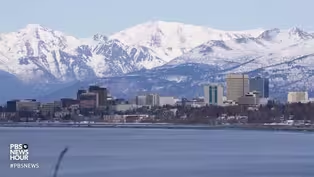
But in Alaska and a handful of other states, all the candidates, Republicans, Democrats, even independents, appear on a single ballot that all citizens vote on.
And, in Alaska, the top four vote-getters move on to the general election.
NICK TROIANO, Executive Director, Unite America: The system is responsive to the nuanced preferences of voters.
JUDY WOODRUFF: Nick Troiano ran for a congressional seat from Pennsylvania 10 years ago as an independent.
After losing that race, he founded the nonpartisan nonprofit Unite America, a group dedicated to reforming the electoral system.
He says Alaska's primary has helped moderate that state's political extremes and bring more voters into the electoral process.
NICK TROIANO: I look at the winners of the statewide races in Alaska and see that a conservative Republican governor was reelected, a moderate Republican senator was also reelected, and a moderate Democrat won in an open seat for the U.S. House.
JUDY WOODRUFF: His new book, "The Primary Solution," outlines the issues he sees with the way most states hold their primaries, where voters can choose candidates only from a single party.
NICK TROIANO: Right now, we have a system that overrepresents those at the fringes of both political parties, at the expense of the majority.
What was stunning to me is that, in the last midterm elections, 83 percent of U.S. House races were not decided in November.
They were decided in the primary elections months before November.
JUDY WOODRUFF: And in those primaries, where the vast majority of races are decided, the most partisan voters are more likely to cast ballots.
NICK TROIANO: It was only 8 percent of voters nationally that cast ballots in those primaries that determined the outcome.
So you had 8 percent of voters electing 83 percent of our leaders.
It's no wonder why Congress doesn't represent us.
JUDY WOODRUFF: In a narrowly divided Congress, individual representatives from these noncompetitive districts can have an outsized impact.
An example, Republican Matt Gaetz won his 2022 primary in Florida's District 1 by winning just 73,000 votes out of nearly 550,000 registered voters.
He easily won the general election in his deep red district, and soon led the move to depose the then-Speaker of the House Kevin McCarthy in October of 2023.
MAN: The office of the speaker of the House is hereby declared vacant.
JUDY WOODRUFF: Leading to weeks of gridlock while the party struggled to choose a new leader.
REP. MARY PELTOLA: The open primary made a huge difference.
That was a real game changer for me.
JUDY WOODRUFF: As a relative unknown, Democrat Mary Peltola beat former Republican Alaska Governor and 2012 vice presidential nominee Sarah Palin under the new primary system in 2022.
She says the old system in Alaska was contributing to deepening polarization.
REP. MARY PELTOLA: You get a campaign where both of the individuals are on both ends of the spectrum.
Do I want someone far, far left or far, far right?
And all of their campaign promises have been about staying true to ideology, not compromising.
And I have found that many partisan issues don't necessarily relate to a person's everyday life.
PASTOR ANDY BARTEL, St. John United Methodist Church: In our congregation, we have got a lot of diversity, politically speaking.
JUDY WOODRUFF: Pastor Andy Bartel's United Methodist Church in Anchorage is home to Democrats, Republicans, and independents, many of whom volunteer at the monthly food bank.
He says having a single primary for all candidates and for all voters benefits independents like him, who are no longer limited to voting in either a Democratic or Republican primary.
PASTOR ANDY BARTEL: Alaska, I think, is portrayed as this deeply red state.
And yet there are a lot more people who are registered as nonpartisan than there are in either of the two parties.
It allows people like me and other nonpartisan voters the opportunity to weigh in without having to necessarily commit ourselves to a particular party.
JUDY WOODRUFF: Once voters from across the political spectrum have weighed in, in the primary, the top four vote-getters move on to the general election.
Voters can choose a single candidate or rank their preferred candidates one to four.
But not everyone is happy with these reforms.
Jerry Michel owns a construction company in Anchorage and feels the reforms have pushed some Republicans to the side.
JERRY MICHEL, Owner, Alaska Steel and Drywall Systems: It kind of split up people's votes.
Well, we're generally a more Republican-leaning state, and it didn't feel real good there, because, with the open primary, all of a sudden, now we have multiple people going into the general election.
JUDY WOODRUFF: Christy Bridges (ph) is the owner of The White Spot, Anchorage's longest-running restaurant.
She's not a fan of the new system either.
CHRISTY BRIDGES, Owner, The White Spot: I would very much like to see the ranked-choice voting system repealed.
I just want to be able to put your vote in and get that winner from the two candidates or however many candidates.
JUDY WOODRUFF: And the effort to repeal is under way.
The Alaska GOP has come out against the open primary and ranked-choice voting, along with prominent Republicans like Sarah Palin.
A proposed ballot measure that would undo the reforms appears to have enough signatures to move forward, though it is being challenged in the courts.
HANS VON SPAKOVSKY, Former Federal Election Commissioner: I think the deep divisions that we have, that's not a result of the primary system.
That's a result of the deep division among the American people and the public.
JUDY WOODRUFF: Hans Von Spakovsky is the manager of the Election Law Reform Initiative at The Heritage Foundation, a conservative think tank.
HANS VON SPAKOVSKY: Independents, if they really want to have a say in who a political party nominee is going to be, they should join that political party.
And if they're not willing to do that, why should they have a right to choose who's going to represent that political party?
JUDY WOODRUFF: No matter how many Americans in a particular state say they identify as independent, you're saying it's more important to keep the parties strong?
HANS VON SPAKOVSKY: The parties are a collection of their members.
So the members of the Democratic Party have primacy.
The members of the Republican Party have primacy.
JUDY WOODRUFF: This fight is playing out well beyond Alaska.
In six other states this year, Republican lawmakers and party officials are attempting to ban or overturn primary reforms, while also fighting against efforts to expand them in eight more, including Nevada, where some top Democrats have also are also opposing reform.
STATE SEN. CATHY GIESSEL (R-AK): had served in the Republican Party over the decades.
So it was very difficult to have my political party actually vilifying me.
JUDY WOODRUFF: Cathy Giessel is a Republican state senator in Alaska who supports primary reform.
She faced stiff opposition from the right under the old partisan primary system.
STATE SEN. CATHY GIESSEL: The Republican political party did not like the fact that I was working with a Democrat and an independent.
So when I went to run in 2020, that's when the political party actually recruited, the Republicans recruited someone who was far more -- air quotes -- "conservative."
And I lost in the primary, significantly lost.
JUDY WOODRUFF: But Senator Giessel ran again in 2022 under the new primary system, and she won.
How has this new primary system affected governing?
STATE SEN. CATHY GIESSEL: We have a bipartisan coalition.
It's made up of nine Democrats and eight Republicans.
So that's 17 out of 20 members came together and said, let's work together.
The difference in running in this open primary is that you actually do have to talk to everyone.
I walked up to doors and knocked on doors I had walked past previously because they weren't Republicans.
JUDY WOODRUFF: Behind one of those doors was independent voter and Yupik storyteller David Nicolai.
DAVID NICOLAI: Her tone the way she her tone and the way she conducted herself in that 2022 election was completely different.
JUDY WOODRUFF: So she knocked on your door?
DAVID NICOLAI: Absolutely.
It feels like she has intentionally been much more moderate with many of her votes and policies, and has turned around to appeal to a much more moderate group of voters.
JUDY WOODRUFF: And yet it's unclear if that appeal to moderation can prevail during a period of increasingly partisan politics.
For the "PBS NewsHour," I'm Judy Woodruff in Anchorage, Alaska.
AMNA NAWAZ: Perhaps more than any other major sport, baseball prides itself on its statistics.
It's how the sport recognizes its all-time greats.
Those stats are now changing in a big way.
Major League Baseball announced today it will officially incorporate statistics from the Negro Leagues into its record books.
That means some of the greatest players from those leagues will now move into the top 10 ranks in the record books.
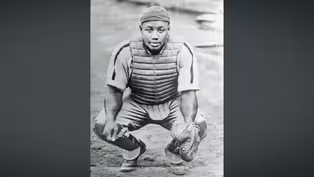
The legendary hitter Josh Gibson, for example, will move to the top of several record lists.
We're joined now by Gibson's great-grandson, Sean Gibson, as part of our ongoing coverage of Race Matters.
Sean, welcome to the "NewsHour."
Thanks for joining us.
SEAN GIBSON, Josh Gibson Foundation: Thanks for having me.
AMNA NAWAZ: So, your great-grandfather Josh Gibson will now be recognized as having the highest season batting average, the highest career batting average in all of Major League Baseball.
What's this moment like for you and for your family?
SEAN GIBSON: You know what?
This is a great moment for our family.
It's not just for our family.
It's for all the Negro League family members as well, because this is not just about Josh Gibson.
I mean, as you mentioned, Josh Gibson will be, at several categories, ranked number one, some at two and some at three.
But, for us, it's more exciting too to also see some of the other great Negro League baseball players be recognized as well.
As you saw in the press release, over 2,300 African American baseball players will now be included in the MLB record books.
And so we're very excited to see Josh Gibson ranked at some of the top of all time in some of these statistics.
And it's been a long time coming.
This announcement was made back in 2020, almost four years ago.
And here we are, four years later, and the statistics finally have came out, and we're very excited to see Josh ranked at some of those top categories.
AMNA NAWAZ: This does now put him officially in MLB stats ahead of Ty Cobb for his batting average, ahead of Babe Ruth's slugging percentage.
These are the greats.
These are names that, even if you're not a baseball fan, when it comes to American baseball.
So why hasn't the name Josh Gibson been part of that conversation before?
SEAN GIBSON: Well, I think because of the league that he played in, which was the Negro Leagues.
Some people try to discredit some of the records from the Negro Leagues.
But, as I always say, is that Josh Gibson and Satchel Paige and other great African American players, they would have loved to play in the Major Leagues.
Kenesaw Mountain Landis, the commissioner of Major League Baseball of the time, denied over 3,400 African American men the opportunity to play in the Majors.
And so, when you look at Josh Gibson, Satchel Paige, Cool Papa Bell, Oscar Charleston, and Buck Leonard, and the rest of the Negro League baseball players, yes, they did not play in the Majors, but they suited up just like their counterparts.
They put their pants on.
They put the jerseys on, and they put their cleats on.
They went out there and played the game of baseball.
But today marks a day in history.
AMNA NAWAZ: Sean, I do want to put to you, because some people have criticized this decision by the MLB.
They say it basically allows them to rewrite history.
The sports journalist Howard Bryant said this: "In addition to their exclusion from playing against their white peers, the totality of conditions stands as embarrassing testimony to what the Major Leagues forced black players to endure, and that cannot be erased with a procedural merger a century later."
Sean, he's basically saying this allows them to kind of cleanse a racist past.
Do you agree with that?
SEAN GIBSON: I love Howard.
I know Howard very well.
And that's his opinion.
I respect his opinion.
But with the way I look at it and the way other fellow family members look at it is, is, that we understand that racism -- racism is going on today, still, no matter what.
And the one thing I don't want people to think is that this is something that Major League Baseball to basically, like, just kind of, like, appease the African American community and say, hey, let's do this to make a feel -- make it right or wrong.
As I was saying before, these guys earned -- that .466 batting average that Josh had in 1943, he earned that.
He earned that.
Satchel Paige, his strikeouts, he earned that.
On base percentage, he -- Josh Gibson earned that.
And so whether if it's a -- it's something that Major League Baseball didn't acknowledge 100 years ago because they didn't play in the Majors, no, I feel like these guys deserve to be recognized.
Major League Baseball is making this decision because it's the right thing to do.
And not only that, though.
It is definitely a piece of our history.
Even though these guys did not play in Major Leagues, it's still a part of baseball history.
AMNA NAWAZ: Sean, what else do you want us to know about your great-grandfather, both on the field or off the field?
What kind of stories did you hear about him through your family that we should know about?
SEAN GIBSON: Well, the one thing I want people to know is that just -- just, when you look at these statistics, and when you go to Google the top baseball player of all time or the top home run leader, the top batting leader, and you will start seeing different faces that you never saw before.
Take the time and educate yourself on these players.
Take the time and do some research on these players.
These men played the game because they loved the game of baseball.
They enjoyed the game of baseball.
AMNA NAWAZ: That is Sean Gibson, great-grandson of the late, great Josh Gibson, joining us today.
Sean, thank you for your time.
SEAN GIBSON: Thank you for having me, and have a great day.
AMNA NAWAZ: And join us again here tomorrow night for a look at how rising costs and a supply shortage are limiting first-time buyers' ability to purchase a home.
And that is the "NewsHour" for tonight.
I'm Amna Nawaz.
GEOFF BENNETT: And I'm Geoff Bennett.
For all of us here at the "PBS NewsHour," thanks for spending part of your evening with us.
Alito won't recuse himself from election and Jan. 6 cases
Video has Closed Captions
Alito says he won’t recuse himself from election and Jan. 6 cases after flag controversies (7m 32s)
How open primaries, ranked-choice voting can break gridlock
Video has Closed Captions
How open primaries and ranked-choice voting can help break partisan gridlock (11m 54s)
How the judge instructed jurors in Trump's trial
Video has Closed Captions
How a verdict in Trump's hush money case could sway voters (6m 23s)
MLB recognizes Negro Leagues by adding stats to record books
Video has Closed Captions
MLB recognizes Negro Leagues legends by adding their stats to official records (5m 24s)
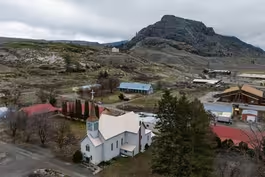
Report exposes boarding school abuse of Native Americans
Video has Closed Captions
Sexual abuse of Native American children at boarding schools exposed in new report (8m 41s)
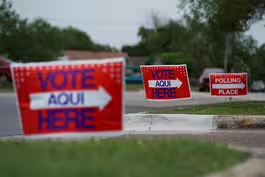
Texas primary race highlights the growing rift within GOP
Video has Closed Captions
Far-right challenge to GOP incumbent in Texas highlights growing rift within party (6m 16s)
Providing Support for PBS.org
Learn Moreabout PBS online sponsorship
- News and Public Affairs

Today's top journalists discuss Washington's current political events and public affairs.

- News and Public Affairs

FRONTLINE is investigative journalism that questions, explains and changes our world.












Support for PBS provided by:
Major corporate funding for the PBS News Hour is provided by BDO, BNSF, Consumer Cellular, American Cruise Lines, and Raymond James. Funding for the PBS NewsHour Weekend is provided by...