Vermont This Week
May 3, 2024
5/3/2024 | 26m 43sVideo has Closed Captions
Vt. Senate Declines to Confirm Education Secretary Zoie Saunders
Students in Vermont Join Pro-Palestine Encampments Across the Nation | Vt. Senate Declines to Confirm Education Secretary Zoie Saunders | Howard Dean Mulls Run for Governor, Again | Panel: Cat Viglienzoni - Moderator, WCAX; Mark Davis - Vermont Public; Alison Novak - Seven Days; Calvin Cutler - WCAX.
Problems playing video? | Closed Captioning Feedback
Problems playing video? | Closed Captioning Feedback
Vermont This Week is a local public television program presented by Vermont Public
Sponsored in part by Lintilhac Foundation and Milne Travel.
Support provided by:


Vermont This Week
May 3, 2024
5/3/2024 | 26m 43sVideo has Closed Captions
Students in Vermont Join Pro-Palestine Encampments Across the Nation | Vt. Senate Declines to Confirm Education Secretary Zoie Saunders | Howard Dean Mulls Run for Governor, Again | Panel: Cat Viglienzoni - Moderator, WCAX; Mark Davis - Vermont Public; Alison Novak - Seven Days; Calvin Cutler - WCAX.
Problems playing video? | Closed Captioning Feedback
How to Watch Vermont This Week
Vermont This Week is available to stream on pbs.org and the free PBS App, available on iPhone, Apple TV, Android TV, Android smartphones, Amazon Fire TV, Amazon Fire Tablet, Roku, Samsung Smart TV, and Vizio.
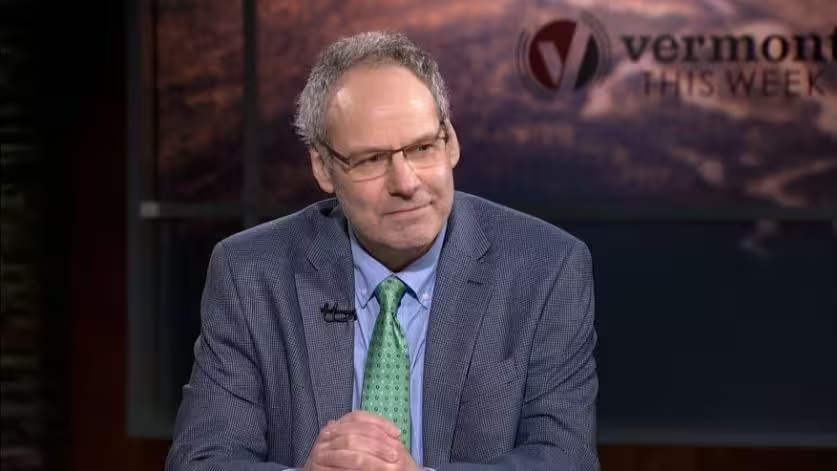
Support the crew
Help Mitch keep the conversations going as a member of Vermont Public. Join us today and support independent journalism.Providing Support for PBS.org
Learn Moreabout PBS online sponsorshipComing up on Vermont this Week, heated words and a rare no vote from lawmakers on Vermont's education secretary nominee.
I have never experienced such an intense and well-organized lobbying effort as I've seen with this nomination.
Why is Vermont's longest serving governor eyeing the state's top job again?
And Vermont students camping out on campus to protest the war in Gaza.
From the Vermont Public Studio in Winooski, this is Vermont this Week, made possible in part by the Lintilhac Foundation and Milne Travel.
And thanks for joining us on Vermont this week Im Cat Viglienzoni Joining us on the panel today Vermont Public ‘s Mark Davis, Alison Novak from Seven Days and WCAXs Calvin Cutler.
Thank you all for being here.
We start with high tensions on local college campuses from Chittenden County to Addison County and into the Upper Valley.
Students camped out to show their support for people in Palestine.
No matter what we're facing here.
We need all eyes on Gaza.
And no matter how big this movement gets, it's just a drop in the bucket for what we need to do to to free Palestine.
I think a lot of Jewish students feel really afraid here walking by.
That's really intimidating.
And those were students from Middlebury and the University of Vermont, two schools here with encampments.
Mark.
Do you think the schools are taking these encampments seriously?
I think it's impossible for them not to be and to take a step back.
And there has been a wave of this across the country.
This week.
There's another wave of student activism, I think, largely in response to a bunch of arrests of Columbia University students there.
And so we've seen this again.
They've been at UVM and Middlebury all week.
Students have relatively similar demands on on both campuses.
At UVM, they want they want to disclosure of endowment investments.
They wanted divestment from weapons manufacturers and Israeli companies.
They wanted amnesty for their own protests.
And so at least we know in UVM that part of their demands seem to have been met when it comes to disclosure of finances.
However, you know, I think the most striking scenes we've seen so far have come, as you mentioned, across the Connecticut River at Dartmouth.
Those students try to set up an encampment.
Again, the ones that UVM and Middlebury have been on for days now.
Dartmouth shut that campaign down within hours.
There was a mass police presence, as you're seeing here, effectively, you know, SWAT style police.
90 arrests at Dartmouth students, faculty, staff, community members.
I think we noted two journalists from Dartmouth appeared to be arrested for not protesting, which is being their and doing their jobs.
And so that those were, I think, the that's where tensions are highest right now.
There was a lot of pushback.
Could you have waited longer to do that?
Was the heavy police presence necessary?
So, yeah, this doesn't seem like it's necessarily going anywhere.
Now, speaking of the arrests you were talking about at Dartmouth, the 90 protesters who were arrested.
Do you foresee Middlebury or UVM going that route anytime soon?
Boy, I don't know and I don't know how much.
Then seeing what happened at Dartmouth might might influence that.
Right.
I think the Dartmouth administration is coming in for a lot of criticism from its own faculty and staff about how that went.
The response from the Dartmouth administration as effectively been, you were warned, they told students in the days before, if you try to create an encampment, it's not going to be tolerated.
And several warnings day of the message and the Dartmouth administration has effectively been actions have consequences.
And so I'm very curious to see, you know, UVM and Middlebury looking at what happened at Hanover, how their strategy might be different.
And Calvin, you were on the UVM campus when at first this encampment first popped up over the weekend.
What sorts of things were you hearing from protesters who were there?
Yeah, I mean, these protesters were very passionate.
You know, there has been access to the press has been somewhat challenging, I'd say, you know, getting people to talk on camera, on the record.
Certainly there's been a lot of the protesters and students have been, you know, worried about retribution or blowback from the university or from the broader community as well.
If it's posted on social media or otherwise.
But, you know, really, you know, there were students that I was speaking with.
And, you know, I asked them, like, are you concerned, you know, if there is a heavy police response like we've seen in other other states, and they said like, yes, we will continue, like we are willing to get arrested because that's just how strongly they feel about this.
I think one of my big questions, though, is, you know, to what effect will all of these protests actually make a difference in the Biden administration's foreign policy?
You know, he addressed these these protests earlier this week and he was asked by a reporter that asked, you know, are you thinking about a policy change in light of all these protests?
And he said no one word.
So I guess that's kind of where we stand, right?
You know, can these college campuses make these changes?
Will that affect federal policy?
I don't know.
But but certainly it's really we haven't seen protests like these on college campuses in decades.
It's interesting.
It's in some ways seems to have parallels in a little bit to the Vietnam War protests, the end that in some ways I think we saw maybe it was Senator Sanders who was talking to one of the national media outlets last night saying, you know, is this effectively is this Biden's Vietnam?
Yeah.
I mean, it's a good it's a fair question.
Right.
And I think, you know, what's different this time around, especially speaking with the students at UVM who are protesting, but also just across the street, Hillel, the UVM Student Jewish Organization, you know, they are really deeply concerned about some of the rhetoric that they're hearing in the direction of this conversation.
And so I guess that's sort of a different twist this time around compared to Vietnam, where there's, you know, this is a wedge issue between students and it's dividing the student community in the university community as well.
Mark, we know commencements coming up just a couple of weeks out for UVM.
You think that's going to play any role in how the university responds?
I think that's the next marker to watch.
You know, at UVM, actually, one of their demands, the scheduled commencement speaker is a former U.S. ambassador to the U.N..
They would like her not to show up.
She cast a no vote on Security Council resolution in February.
But sort of aside from that specific demand, obviously, that's a high profile time for the campus community.
It's also theoretically the time when students leave campus and go home for the summer.
So yeah, that seems like the next big event on the calendar.
We'll have to keep watching that.
High tensions also under the golden dome this week.
Tuesday, a Senate showdown over the governor's pick for education secretary led to a heated debate.
Her vision was narrow and uninformed and didn't come out of the reality of public education here in Vermont.
This has been a very poisonous, poisonous atmosphere.
I have never witnessed in my 14 years in this building such character attacks towards what I consider a very, very good person.
Alison, the Senate ultimately voted no on Zoe Saunders 99.
Given that these kinds of votes are usually procedural.
Were you surprised by that outcome?
We had been reporting kind of leading up to the vote, and I think it became pretty clear on Monday that it would probably be a no vote.
But what I think was surprising was that just a couple of minutes after that, no vote happened, the governor essentially said we're not going to listen to the senators and appointed her as an interim secretary of education.
And so the speed at which that happened, I think, was a little bit jarring for people.
And, you know, some might argue that he ignored the will of the legislature and the many constituents that senators said contacted them to say that they didn't feel that the experience really aligned with Vermont's public education system.
And we know the governor addressed why he made that decision.
Let's take a listen.
I still believe she's the right person at the right time for this position.
So I thought we'd just fill that interim position with the secretary of education that we started with.
So, Alison, just describe how he was able to do that.
How was he able to appoint her as the interim secretary, even the lawmakers said, you know, we don't want her as education secretary.
So the way the governor described it is it's within his right as governor to appoint an interim position for a vacancy, to fill a vacancy.
And so that's what he did.
You know, at that press conference, he also said that he considered the opposition and the kind of the vote against her as a partizan political hit job, which was definitely very strong rhetoric.
And I've spoken to, you know, representatives from the NEA, from the Vermont superintendents Association.
He, the governor, cited outside groups as influencing the election when asked what those outside groups were.
He mentioned the NEA and mentioned superintendents.
And those organizations say, we are not outside groups.
We are the people that represent the people, the rank and file in the field that are doing this work every day.
And so I think there was a fence taken at the fact that this was described as this kind of outside orchestrated opposition when, you know, many have said that it was a very grassroots opposition toward her appointment and didn't really have anything to do with the fact that she was from Florida, which is something that the governor has said repeatedly.
But it was more her lack of experience as a teacher, principal superintendent and her lack of experience working in a school and in a traditional public school system.
Although I will say her Florida connections did come up in a campaign email that David Zuckerman sent out.
Tell us what happened there.
Yeah, essentially, David Zuckerman sent out the weekend before the vote.
He sent out a it wasn't necessarily a fundraising email, but it was an action email, I think is what he's described it as.
And it basically said that Zoe Saunders had received an award from Ron DeSantis, governor of Florida, for her work in charter schools, which turned out to be not accurate.
You know, she did receive an award, but it was from the Department of Education.
It wasn't from the governor personally.
And of course, then he went on in the email to raise concerns about, you know, book banning and issues surrounding LGBTQ education and things like that that we've seen kind of pop up in Florida.
And, you know, it was really interesting.
I don't think that email changed anybody's minds.
I think everybody's vote was already set heading into it.
But it really it was just one more thing that kind of raised the temperature of this of the debate on the floor.
You know, we've heard poisonous, toxic.
Like those are words I really haven't heard at the state house in the past few years until this year.
And I think it just goes to show just how contentious this is.
You know, the property tax issue is is really raising temperatures as well.
But anyway, back to Zuckerman and then after the vote, I think it's worth noting, too, he then apologized to Zoe Saunders and he apologized to his colleagues on the Senate floor from the rostrum, you know, for raising the temperature.
So he did take responsibility for that.
After the vote, yes.
What does this all say, Mark?
This back and forth, this kind of power struggle between the governor and the legislature.
What's your read on that?
Yeah, I think this can start to feel a little bit like inside baseball to a lot of Vermonters, right?
A confirmation vote in temperatures inside the statehouse.
This is really about the ongoing crisis in public education in Vermont that we've seen unfolding here in recent months.
And this is probably a chapter in that story.
When we saw a third of school budgets go down a few months ago, when we're seeing the declining enrollment, increasing deficits everywhere, and frankly, an inability so far of the governor and the Democrats to come up with a solution to this problem, even though the problem really seems to be intensifying.
That's probably the more significant story here.
And this slides into it somewhere.
Mm hmm.
Usually these are pretty noncontroversial appointments, you know, that happen.
The process is generally not something that barely even makes the news.
You know, what does this say about potentially the larger tensions over our education system like you just brought up?
Does it mean, you know, that we really don't have a good solution going forward?
Or does it mean that you know, there are some hard choices and no one really wants to acknowledge them right now?
And this is a battle that kind of takes away from that.
I think it's both of those things.
I think we'll talk school budgets a little bit later in the show today.
But that's right.
I mean, it feels like this is something you can get your arms around and maybe do something about and the session is still going on.
So give it some more time.
But it does not appear at this moment that there is some really sort of sweeping solution to this problem that's come up.
And I will say, too, I think part of the the tension and the debate around Secretary Sanders as well has been this long simmering debate about public education and the value that it contributes to society versus our school voucher system for, you know, private and independent schools.
That's also sort of, I think, has been a through line or one of those those through lines, if you will, to the story, too.
Mm hmm.
I mean, we were just talking about education, school budgets.
You know, let's let's go on that one, Alisyn.
Another week, another set of budget votes.
What were some of the big takeaways here?
So as of now, there's been more than a dozen budgets that have been voted down for a second time.
So as probably people remember on town meeting day, about 30 budgets were voted down.
Some of those those school boards have gone back to the drawing board and revised budgets, and many of those have been voted down.
And so I think there's a real fear within, you know, school systems within school districts that like what happens if we keep on voting and people keep saying no?
And, you know, I think there is some real kind of questions about why the budgets have been voted down a second time.
And you know, for some, there's a third vote on the horizon now.
And I think it's a little unclear as to whether, you know, the the votes are not going.
The school districts way because solely of property taxes or because maybe people, you know, as they've said, you just want to send a message to Montpelier or in some cases they might not like what the school district has decided to cut.
Maybe they say we don't want all these paraprofessional positions cut or we don't like that you've eliminated this program that we love.
And so that would be another grounds for them rejecting a budget.
And so I think, you know, many school districts are in a very difficult position where they're really trying to figure out like, what can we cut to please voters or, you know, is there enough that we could cut that would please our voters?
Right.
And we know more communities are voting this coming week.
South Burlington is one of them.
Their third attempt at passing the budget.
And I know they told the community, you know, if this one does not pass, we get one more shot after this and then, you know, we run out of time, basically.
Mm hmm.
And there had been some a proposal within the legislature to after the third vote, you know, instead of going to the 87% funding, which is what happens now, to try to change that, to make things a little easier for school districts.
But I don't know if that's really gone anywhere.
But, yeah, I think, you know, when I think about, you know, how the these budgets are going to affect students, I think that's an interesting thing, too, because if districts are having to cut more and more, what is the impact going to be on student learning?
And I think that's something that sometimes gets forgotten.
And in all this talk about property taxes, definitely something that could make for a very interesting governor's race this year.
Howard Dean considers a run for governor again.
In a statement to reporters this week, the Democrat did not commit to throwing his hat in the ring, but did say, quote, I believe Vermont is in real danger of losing much of what we have fought for and much of what we have accomplished in the atmosphere of anger and disrespect, which permeates Montpelier.
Calvin, You first reported that he was considering a run.
Based on what you're hearing.
How serious is the former governor about going after his old office?
I think it's pretty serious.
I mean, at this point, you know, we haven't really seen another challenger come forward.
Burlington former Burlington Mayor Miro Weinberger was considering one running for higher office.
We haven't heard from him.
And so we think about who else could.
You know, the Democratic Party call upon you know, we know your Charleston is in Charleston as well, of course, has announced as well.
And, you know, Governor Howard Dean, it would be a really interesting race to see.
I mean, Governor Phil Scott, if he were to announce that he was running, you know, he's got hundreds of thousands of dollars in the bank for campaign finance.
Governor Dean as well, could potentially pull down donor dollars from the national stage.
Just their style of politics, I think, would be really interesting to see the side by side.
But I think there's also a question, too, of what which Howard Dean would we see?
Right.
Would we see the the fiscal fiscally moderate, you know, Governor, that we saw back in the nineties and 2000s, or would we see the Howard Dean on the campaign trail, the more liberal you know, Howard Dean.
So it would be an interesting one.
Mm hmm.
Yeah.
You know, we're sitting here for a show to review what happened in the past week, and I think it's fair to interpret that statement and some of the public things that were said as as well as some of the subsurface things, it seems like it's trending more in that direction.
We don't know yet.
Maybe he doesn't even know yet.
But I think what we've seen recently, it seems like maybe it's going that way.
And, you know, I think there are times when people who do what we do for a living or who follow this show get get really excited and maybe make too much of something.
This were it to happen, were we to get Howard Dean versus Phil Scott?
Seems like one of those things that would justify the hype.
I think certainly we'd be talking about the most formidable challenge to Phil Scott since he's been there.
But I think he might even have to go back decades to sea, to, you know, formidable heavyweights, frankly, going at it for an office of this significance.
We don't see this in Vermont very often.
So, again, we don't know yet.
But there is a reason we're all paying attention to this so closely.
This would be an absolutely fascinating race, I think, for the reasons Calvin just laid out.
Which Howard Dean are we going to get?
I think it's also fair to remember it's been 20 years since the Dean scream.
It's been 20 years since he's been on the stage.
I think there'd be some more threshold questions.
Does Howard Dean still have his fastball?
You know, no reason to think he doesn't necessarily, but we haven't seen it and he certainly hasn't been inactive in politics.
Know that I mean, by campaigning and debating is a different animal.
So we haven't really seen that from him and from Phil Scott.
He has not faced very strong Democratic opposition.
And so we haven't had to see that level from him either.
Again, no reason to think it's not there, but we haven't seen it in a while.
So again, we still don't know.
But there's a reason we're talking about this a lot.
And it was interesting that that email from the Dean camp, I would I would say it almost should be the Dean campaign.
Right.
Because it sounded like he was laying out a campaign platform, although to be clear, did not come from a campaign official email.
But it certainly sounded like one.
It did indeed.
And I think some of the issues that the former governor laid out, I mean, it was interesting.
He raised concerns about, you know, spending and tax burden, you know, like issues about affordability for Vermonters.
But then in the same breath, you know, a paragraph later he talked about I think he said that this was one of the best legislatures that we've we've had in recent memory.
So I guess I'm curious to kind of drill down what did he mean by that?
And I think the other big significant thing is his talk when he mentioned health care.
That is an issue that really has not been touched in Montpelier on a political scale, if you will, since single payer fell apart during the Shumlin administration.
And so some people have, you know, pointed the finger at Governor Phil Scott saying he has not taken leadership on health care reform, the all payer model, etc..
So I think that would be a really interesting issue.
Should these two candidates, you know, go head to head?
That would be a really interesting one to see on the campaign trail.
And we should know more in the coming weeks.
Usually the governor waits until after the session is over to announce any plans.
So we expect to hear from that sometime in the future here.
Switching gears over to a story that you've covered, Allison, at a diverse city becoming less so Winooski residents getting squeezed out as housing becomes more expensive.
You went to a new school for this story, obviously.
What kinds of stories are you hearing from the people who live there or who used to live there?
So I did this story, which is on the cover of Seven Days this week with my colleague Derek Brower, who often writes about housing, or whereas I'm an education reporter.
And so we were really looking at the impact of the kind of pro-development policies that Winooski has put in place and how, you know, while they have spurred growth and a lot of new units being built, primarily those have been studios and one bedroom apartments.
And so the type of family housing that a lot of people in Winooski need is no longer available.
Meanwhile, rents are going up.
The number of Airbnbs in Winooski has tripled in the last couple of years and you know, for a long time new Americans have been settled in.
Winooski is as you know through refugee resettlement because it was an affordable community and so particularly that group of residents is being impacted and that has a real impact on the school system because in Winooski, as many people know, it's the only majority minority school district in the state.
A third of students are learning English as a second language and the school district has really set itself up as a place that supports families.
They have seven multilingual liaisons that, you know, interpret for families.
They have a little shop in the atrium that you can come and get food and clothing and things like that.
And they also have a pretty amazing campus.
They had passed a bond a couple of years ago and built like kind of a state of the art new school, which at that time they predicted that enrollment was going to be increasing for the next ten years.
And now they're predicting a decrease in enrollment.
And so the school district is really invested in trying to get families to stay in Winooski.
So to that end, they've hired a housing case manager that is on call a couple of times a week, that meets with families, that gets to kind of walk them through the housing process.
It's very complicated process, obviously, in terms of like finding affordable housing, especially for people who don't speak English well.
And so we were able to observe one of those meetings.
I also got the chance to talk to students 2 to 17 and 17 and 18 year old high school students who are both from Burundi.
And, you know, it was really interesting to hear their perspective of coming to Vermont in 2018 and 2019.
And, you know, how many times they've had to move, how insecure their housing has been.
And as the school district told us, it's you know, they didn't initially want to get involved in housing, but if students don't have stable housing, they really are not able to come to school and learn.
And so, by necessity, schools are having to invest in services like housing support, mental health support.
We hear a lot about.
And so I think that's also part of the picture that school districts are doing a lot besides academics, not necessarily because they want to, but because if they don't, students aren't going to be able to learn.
And so I think when we talk about school spending, too, that is something that is really important to note, that it's not that schools are just kind of wastefully spending on things.
They're spending on things that are critical for students to be able to learn.
So where do they if they can't stay in Winooski, where do they go?
So we have heard that some families are moving out of state.
Actually, a couple black couple.
That is kind of the centerpiece of the story.
They lived in Winooski for ten years.
Both of them grew up in Chittenden County and they are moving to Charlotte, North Carolina.
They don't know anyone there, but they were able to find, you know, cheaper rent a nice apartment with a pool in the complex.
And so they really are sad to be leaving Winooski, but they don't see any other choice.
We've heard that.
Well, we know that refugees aren't really being settled in Winooski anymore.
And you know, UCI has told us that, you know, it's kind of a shame because Winooski is really set up as this diverse community, community and offers a lot to, you know, refugees, but there's just no place to house them anymore.
So how do the services then get to the people who still need them if they're not living in Winooski, where I imagine many of those services were located?
Well, I think that's a part of the problem.
And what the school district is really worried about, the fact that when you ski schools are really set up to address these issues and not every school district is you know, they try their best.
But when you ski superintendent well, Nurse Chavarria and multilingual coordinator Mohamed Diab often go to other schools to kind of advise them on how to, you know, support multilingual students and are worried that, yeah, if these students are moving to Essex or Colchester or South Burlington, you know, there's not going to be the same level of support for them.
Mm hmm.
We did want to get to a couple of lighter stories here before we wrap up.
We want to remind people green update is Saturday.
Vermont is attempting to break a Guinness World Record.
They need at least 5000 pledges to pick up trash in 24 hours.
People can sign up on their website or on the green up day app.
And finally, the wait is over for Vermont.
This week, there is a new permanent host, Mitch Wortley, who is going to take the helm next week.
Thank you so much to everyone who's filled in over this past year hosting this program with such skill and dedication.
It's been amazing to see.
It's also been great to be a part of and I can't tell you how deeply honored and grateful I am to be the new host of Vermont this week.
I want you to know that I live in Vermont and I care about this state deeply.
So all the issues that we talk about in this program matter to me, and I know they matter to you.
There's a great legacy with this program over the last four decades.
I want to honor that, continue it and explore some new venues as well and have some fun along the way.
I can't wait to get started next week.
Speaking with the very best journalist in Vermont.
And I hope you'll join us.
And I think I can speak for the panel here when I say we offer our congratulations to Mitch on his new appointment there.
And I want to thank the panel of reporters we have here this week, Vermont Publics Mark Davis, Allison Novak from Seven Days and WCAXs Calvin Cutler.
And thank you all for watching.
Take care, everyone.

- News and Public Affairs

Top journalists deliver compelling original analysis of the hour's headlines.

- News and Public Affairs

FRONTLINE is investigative journalism that questions, explains and changes our world.












Support for PBS provided by:
Vermont This Week is a local public television program presented by Vermont Public
Sponsored in part by Lintilhac Foundation and Milne Travel.