Vermont This Week
May 31, 2024
5/31/2024 | 26m 45sVideo has Closed Captions
A Week Inside Vt.'s Busiest Courthouse | Gov Signs Public Safety Bill, Dozens of Others
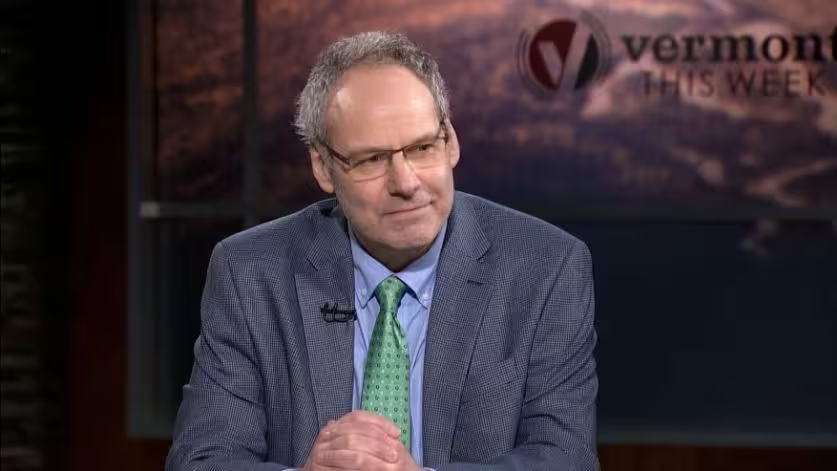
Trials & Tribulations: A Week Inside Vt.'s Busiest Courthouse | Gov Signs Public Safety Bill, Dozens of Others | UVMMC Seeks State Regulator’s Approval for $130M Surgical Facility | Panel: Mitch Wertlieb - Moderator, Vermont Public; Colin Flanders - Seven Days; Calvin Cutler - WCAX; Derek Brouwer - Seven Days.
Problems playing video? | Closed Captioning Feedback
Problems playing video? | Closed Captioning Feedback
Vermont This Week is a local public television program presented by Vermont Public
Sponsored in part by Lintilhac Foundation and Milne Travel.
Support provided by:


Vermont This Week
May 31, 2024
5/31/2024 | 26m 45sVideo has Closed Captions
Trials & Tribulations: A Week Inside Vt.'s Busiest Courthouse | Gov Signs Public Safety Bill, Dozens of Others | UVMMC Seeks State Regulator’s Approval for $130M Surgical Facility | Panel: Mitch Wertlieb - Moderator, Vermont Public; Colin Flanders - Seven Days; Calvin Cutler - WCAX; Derek Brouwer - Seven Days.
Problems playing video? | Closed Captioning Feedback
How to Watch Vermont This Week
Vermont This Week is available to stream on pbs.org and the free PBS App, available on iPhone, Apple TV, Android TV, Android smartphones, Amazon Fire TV, Amazon Fire Tablet, Roku, Samsung Smart TV, and Vizio.
Support the crew
Help Mitch keep the conversations going as a member of Vermont Public. Join us today and support independent journalism.Providing Support for PBS.org
Learn Moreabout PBS online sponsorshipTrials and tribulations.
Vermont public and seven days teamed up to spend a week inside Vermont's busiest courthouse.
We let you know what they learned.
Plus, the filing deadline for candidates passes and we'll tell you who's on the ballot.
And Vermont's largest health care system seeks state regulators approval for a $130 million surgical facility.
That and more ahead on Vermont this Week.
From the Vermont Public Studio in Winooski, this is Vermont this Week made possible in part by the Lintilhac Foundation and Milne Travel.
Here's moderator Mitch Wortlieb Thanks for joining us.
I'm Mitch Wetlieb.
It's Friday, May 31st.
And with us on the panel today, we have Colin Flanders from Seven Days statehouse reporter from WCAX Calvin Cutler and Derek Brouwer from Seven Days.
Thank you all so much for being with us.
And Derek, I want to start with the story that you reported with Liam Elder Corners of Vermont Public about trials and tribulations.
That is the title of your feature in seven days.
And this is about a backlog of cases in the court system, lots of cases that folks haven't gotten to.
What's driving that?
Why is there such a backlog?
Yeah, I mean, this all starts with the pandemic.
I mean, there was something of a backlog before then, but really this exploded when the courts were shut down during COVID 19.
Trials were halted for more than a year as long as two years in some counties in the state.
And that meant that most cases weren't resolving during this time.
And so they piled up.
And the number of pending cases in the state right now is double what it was before the pandemic.
So that results in just a crush of work for everybody who's involved in the judiciary.
And there's a practical effect, too, of course, for the folks who are waiting for trial.
I mean, what did you find out about people who have been sort of in limbo?
Yeah.
I mean, I think that is that's one effect of this backlog that is easy to overlook, I think is the way in which the swiftness of justice is important.
I mean, the speedy trial, everybody knows that notion.
But I think when cases are languishing for months, years beyond when they should be resolved, that that leaves victims without resolution and it leaves defendants without a sense of where their life is going to go next as well, whether that's rehabilitation or incarceration or some kind of community service or even restorative justice.
And so everything is sort of grinds to a halt and and it's not a good outcome for anybody.
Well, what's being done about it?
Well, they are slowly and surely chipping away at it.
There is progress being made statewide, but at this rate, it's going to take years.
I mean, we're already four years from the pandemic and we're still talking about a COVID backlog, but it could be five, even ten more years before we get back back to normal.
One of the things that I found really moving in the story is that, you know, you follow real people who are affected by this.
And homelessness is a big problem.
Drug use comes into this.
These are things that we've covered on the show before.
What about some of the people that you met along the way?
I mean, what did you find out about them?
Yeah, I mean, that's what really stood out to me during the week I spent at the courthouse is how the life circumstances of so many people who are coming through for crimes of the day, humdrum crimes, things like retail theft, too, that are that really have captured a lot of public interest, but often are not covered by the media, the case by case level.
But people coming through, you know, for these with these charges are their lives often are really chaotic or they have these other conditions going on, whether it's mental health or the lack of an address.
That makes it hard actually to even carry their case through to conclusions.
So showing up for a hearing is difficult.
Determining whether somebody is competent to stand trial is a serious issue.
And I you know, one that involves somebody's constitutional rights and those can take months or even in some cases, you know, a year or more to resolve.
So these are cases that are seemingly straightforward and low level, but for for these sorts of reasons can drag on and become much more complicated to resolve.
And what are the folks who work in the system?
You know, whether it's the attorneys, the judges, are they seeing what they need, that maybe from the state that could that could help at all?
Yeah.
I mean, there's certainly frustration among people who are working in the system.
And there are a lot of opinions throughout the judiciary, in the criminal justice system about about how to approach these matters.
But the biggest item has been has been the budget and funding.
And so the budget that Scott signed earlier this month does include funding for some more three new judges across the state, as well as 21 judicial assistants and officers.
And there's some money for prosecutors as well.
So that is a starting point, is that there just aren't enough people to do the amount of work.
I mean, it's double the amount of work there used to be.
You know, we're going to get into some of the public safety issues in just a moment.
There were lots of bills that the governor signed did not sign.
As long as we're talking courts, of course, we have to acknowledge that there was a pretty big court case that came down, a big decision regarding the former president of the United States, who is now the first president ever in history to become a convicted felon.
And, of course, we're talking about former President Donald Trump.
The news came down last night that he has been convicted on 34 counts of fraudulent business dealings to cover up some pretty salacious of allegations about sleeping with a adult film actress, etc.. We got some reaction from our congressional delegation.
Senator Peter Welch had this to say No one is above the law, including the president of the United States.
So it's a real affirmation for that founding principle of our country that is so essential for our well-being.
That is the view, of course, from our junior senator, Peter Welch.
Colin Flanders I wonder though, you know, here in Vermont, this news comes down.
It's of course, it's big national, international news.
What practical effect, if any, does it have really here in Vermont about the way people view Donald Trump?
I would say it has very, very little to no impact at all here in Vermont.
I mean, to the extent that he had any chance of making a dent in Joe Biden's haul this November here in Vermont, I don't think it will have a big impact.
I am more interested to see what it means on the national level.
I think we're all trying to figure that out.
I mean, we saw within hours of the decision some of Trump's allies coming out to defend him.
I think it has surprisingly done a lot to solidify some of the disparate parts of the GOP that are now rallying behind their presumptive nominee.
And also just the idea that a flood of donations have come in because of this.
So I think it as far as how this positions him come November nationally, I think it's a big open question.
I think we would be surprised probably by how little this will mean for the overall electorate, and there'll be plenty of talk about that coming up, of course, in November.
So let's bypass that for now.
We have other things we need to talk about here that are that are really big.
Kelvin Cutler, Governor Scott has signed some bills into law.
He lets them become law without his signature.
Others he veto.
Let's start with the public safety bill that the governor signed.
What are some of the major points in that one?
Yeah, I mean, so to to Derrick's point earlier, you know, public safety was a really big issue that state lawmakers were looking to address this year.
They were hearing from their constituents in a big way.
Governor Phil Scott had said that the work on public safety and funding for the judiciary and more accountability measures was one of the more bright spots for bipartisan cooperation this session.
But there is a package, several bills that, you know, earned the governor's signature.
One, you know, increasing penalties for drug trafficking, you know, more penalties for car theft, retail theft, you know, trafficking, fentanyl and psilocybin, ghost guns as well.
You know, those those guns that you can print offline in a 3D printer and, you know, that don't have serial numbers.
So new regulations for those.
And also to Derrick's point earlier, too, about, you know, addressing the court backlog funding for the judiciary.
New positions, also a pretty trial monitoring program, people that are released on conditions, making sure that they're adhering to those conditions in the community.
And also, new tools for judges to to to determine the conditions of release for individuals, what their prior history of, you know, have they in the past been able to adhere to those conditions and whatnot?
So just a firehose of, you know, of legislation that aims to address public safety.
How much will it move the needle on, you know, guns, drugs, you know, issues that we've seen?
I think it still remains to be seen.
But state lawmakers were really trying to take a holistic 30,000 foot view of just every single piece of our criminal justice system here.
And the governor did veto the safe injection site bill for Burlington.
What can you tell us about that?
That was kind of unexpected, vetoed.
It was.
And I think this is one that the governor for four months, even for years now, has been signaling that he is, you know, opposed practically just, you know, doesn't see it as working in a rural state like Vermont, but also having moral objections as well.
Just, you know, government sanctioned, you know, consumption of of illicit narcotics.
You know, it's something that doesn't necessarily sit well with with a lot of people at the state house.
It's a really passionate issue on all sides.
So the governor did veto this bill, saying that the money from this could have been used for other proven harm reduction measures, treatment, prevention, that type of thing.
It appears as though state lawmakers do have the votes to override this in both the House and the Senate.
You don't know until you know, but it looks like this potentially could be moving forward.
But it's important to note, though, that with the overdose prevention sites, it's just one piece of this mosaic of of, you know, harm reduction.
You know, everybody has said all along that this isn't a a panacea.
This isn't going to solve our drug crisis.
But it's definitely you know, some people see it as an important piece of the puzzle.
And Collin, I know that you've been following some of the numbers that that were released about a slight downturn in some of the opioid overdose deaths.
But that doesn't tell the full story, does it?
Yeah, I was I was really interested to see the reason the governor gave for vetoing this, in part was that he was seeing some positive trends.
He put it in our data.
And anyone following the news a few weeks ago, you probably saw there were some headlines about a 5% reduction in the annual deaths.
As someone who covered this pretty closely, I was kind of skeptical of that.
This idea that that is a is something we really should be celebrating when just two or three years ago, the numbers were a third of what they are now.
And when I talk to providers in the field, they have similar feelings that if if we are bending a curve in any way, they don't seem to be seeing it as in which we are constantly talking about is killing people in ways that are I don't know how to say this.
I mean, sometimes more horrific than a fatal overdose.
These people are dying very, very slowly, painful deaths from these infections that can land them in the hospital.
They can lose limbs.
So this idea that we have somehow turned turned the corner, I think is is is just not true.
And I will note to Calvin's point to the evolving nature of these conversations here in Burlington.
Actually, there was the police chief, John Muir ad was opposed for a while and still remains skeptical, but sent a letter with the mayor this week urging the governor to sign this bill because he said at this point we're willing to try anything.
So I think a lot of lawmakers went through the same thing.
It does seem that's what's driving this move towards at least trying this.
We've got to try something because up to this point, nothing else has worked.
And Derek, I have to imagine that this is something that cropped up as you looked into the courthouse issues.
A lot of the people that maybe were following it had some substance abuse issues.
Did you find that was the case?
Yeah, that might even be an understatement.
I mean, drugs just loom over so much of what goes on in the criminal justice system right now.
I think in our prisons, it's 60% of inmates are on medically assisted treatment.
So that gives you a sense of the scale here.
But yeah, I mean, I followed one man who was pleading guilty to cases that had been lasting, you know, over two years.
And he had accumulated more than a dozen charges over that time.
But he was hobbling to court with both of his feet bandaged.
He had, as I was saying, infections that had been lingering for over a year.
He'd been hospitalized and in fact, had missed court because he was in the hospital at one point.
So, yeah, I think that is it is huge.
I mean, I saw people who showed up to court high and impaired and judges questioned whether they could even hold a hearing because whether they were in the right state of mind to go forward.
So it it it makes it at one level, it makes even just carrying out justice really hard.
But I think being there and seeing this over and over again gives a sense for what is driving so much of this uptick and low level criminal behavior.
And did you get the sense from the people you spoke with that they would love to see a safe injection site, a place where they can do these drugs and know that there's reversal medication on hand, that kind of thing?
Yeah, I think, you know, I think opinions vary on it.
I didn't have too many in-depth conversations about that, but I did talk to this gentleman I just mentioned to you, Alexander Miller.
He he talked to me about his desire for treatment.
And he's certainly had struggles over the years getting treatment to stick.
And it's been a long journey for him.
And he's still not there yet.
But he goes to you know, he went to his court hearing after stopping by the methadone clinic that morning.
So there is there is a desire to to get clean, but then also an understanding.
I mean, as he explained it to me, it's a really long process.
And and he needs a place to use as his feet were you know, were demonstrating to me there, you know, he needs a place to be safe while he's doing it.
Speaking of a long process, Kelvin, you were saying before we went to air that, you know, if this does happen, if it goes through, they override the governor's veto.
It's going to take a while for this to get set up.
Yeah, you're right.
I mean, there's still a lot of steps that we have to go through in order to, you know, find a facility who's going to operate it, you know, how is it going to be staffed?
There's still a lot of logistical questions that that we still have.
Also, you know, if there is a a a new president, if there is a Trump presidency, what would, you know, an approach to these sites look like under a Republican Department of Justice?
I think that's an open question as well.
And also, you know, to Colin's point about, you know, the the just horrific nature of some of these drugs, what will our drug supply look like in two, three years?
And will this be the best intervention or the best strategy to try to save lives or get people into treatment, etc.?
So we're still it's we're talking about it now, but it's still going to be some time before these are fully implemented.
And I think that's a great point, Calvin, because I think that's like this conversation has dragged on for years now to the point where some of the opposition against it has even changed because now the drug supply we're seeing is different.
People are using more the idea of what are you going to live there?
But I think that there are a lot of people out there who are kind of relieved that we're going to be able to close this.
But if the veto does, if the veto vote does go through, will be able to move on, have another conversation about what else can we be doing?
I think this has taken up so much airtime, and I understand where rural lawmakers are coming from, too.
The idea that this is just in Burlington, but this is a statewide problem and we need to be thinking about geographical solutions as well.
We're going to get to some other bills that that did get through in just a moment.
But in other health care related news, Colin, the University of Vermont Medical Center, state's largest hospital, would love to get more surgeries done.
So they are asking for approval of a $130 million state of the art surgical facility.
I think this would replace the Fanny Allen campus in Colchester, which just doesn't have the capacity to do all this.
What has to happen for this to go through and what kind of effect would it have?
Yeah, so so we're at the process right now where the UVM Medical Center has proposed this and is asking state regulators for permission to begin breaking ground.
It's been put off for a couple of years because of some budget issues, but they say they have the money now and it's desperately needed.
We're expecting a decision sometime later this summer, but if it does go through, the hope is that this will expand the medical center's capacity for surgeries by thousands.
And that's a big deal.
We've been talking about backlogs at the court system.
We'll ask anybody, can they say, yeah, ask anyone who's tried to get a surgery, even an appointment at UVM Medical Center.
I mean, there's people who are waiting months and months to get painful ailments like joint replacements completed.
And so the hospital is saying that this is just unsustainable and it's only going to worsen as we move forward.
As Vermont's population ages and as Chittenden County's population perhaps continues to grow.
And so the hope is that within the next couple of years, this could open it would expand capacity and would also allow them to shift some procedures away from the main campus, which I think is a big point, because a lot of rural hospitals say they struggle to get patients to UVM in time for lifesaving procedures.
Some of that's because there's people who are tied up who don't really need to be there.
And so the hope is that they'll be able to switch that.
Speaking of those rural hospitals, though, are they at all concerned about losing revenue to the big hospital if everyone's getting their surgeries done there?
That's totally right.
And that's part of like the sausage making here that I think some people at home are probably it raises their eyebrows, this idea that some hospitals are fighting over business, but this is a business, health care.
And there are hospitals who are worried that UVM is going to take an even bigger share of the market, and that makes it harder for rural hospitals to get by.
The interesting thing is it's a it's an argument that UVM itself has made in the past when opposing a different surgery center here in Colchester.
So I think, again, anyone who's tried to get a procedure done, the idea that we might have too much capacity is kind of farcical.
I mean, there's there's no doubt that we need to do something here.
UVM thinks it has the answer and we'll see if state regulators agree.
Yeah, we'll have to check that out.
Getting back to some of these bills that the governor has either let become law or has signed into law, were there any that really surprised you, Calvin, that the governor said yes to?
Yeah, I think there were two that really were a surprise to me, the flood safety, the flood regulation of river corridors and dams and emergency communications.
The governor had concerns about the states ability and the state's capacity to do this work within the Agency of Natural Resources.
He let that one become law without his signature.
Another one, the Climate Superfund Act, which would allow Vermont to sue fossil fuel companies for, you know, damages caused by climate change fueled extreme weather.
That one, the governor also let become law without his signature.
He had concerns of the legal cost to taxpayers, you know, us being the first state to take on big oil.
But yeah, that was a somewhat of a surprise to see both of those go into law without his signature.
And first in the nation.
Right.
I mean, this is a first for Vermont.
Yeah, exactly.
I mean, a lot of states are going to be looking at, you know, how we navigate over the next few years, what arguments we make.
It's going to be a really fascinating one to watch in the next few years.
And I have to ask, what is your bedroom look like at this time?
I imagine you just have all over that.
How do you keep all these things straight?
And that's it, really.
I just I love news.
I am just a sponge for information and these are all really important and really fascinating policies, whether we're talking about drug policy, health care, you know, climate mitigation strategies.
I mean, this is a it's there's a lot that state lawmakers did a lot this year with some of these vetoes coming out like 8 p.m..
It's a good thing you do love it because I know you've been working late.
Yeah, indeed.
I'm imagining like the pin cushions, you know, in the detective things where this connects to this and I've got the picture of this here, but you're on top of it all, which is why we're so glad that you're here.
I do want to make note of the passing of a longtime Vermont legislator, Dick Mazur, who passed away due to complications from cancer.
I mean, he served for more than four decades, a pretty big loss, I would say this is a huge loss to the state, just, you know, number one for institutional knowledge, but also just the relationship that he had with other state lawmakers and with his constituents.
You know, everybody I've talked to this this week, I've talked with, you know, over a dozen state current and former state lawmakers about the impact that he's had on Vermont.
You know, his time in the transportation committee, in the institutions committee, just the outsized impact that he's really had on the state of Vermont, but also just how politics works and who, you know, rises to two offices.
You know, he's counseled back about Governor Phil Scott, you know, Governor Howard Dean.
I mean, many state lawmakers he's had a very close relationship with.
And it all gets back to his store, you know, in Colchester and, you know, working there all the time and hearing directly from his constituents.
So, yeah, everybody I'm hearing from in Montpelier saying it's an end of an era and, you know, is really celebrating the impact that he's had.
You know, some of the people I talked to when I mentioned this, the first thing they mentioned was, oh, the store, you know, it wasn't even, you know, first the lawmakers.
That's the kind of effect that he had.
Here's what a couple of his former colleagues had to say about his passing.
He always did what was right for the state first, never mind what the party pressures were when you were on a committee with Senator Miles.
It wasn't Republican, it wasn't Democrat, it wasn't progressive.
It was for what was right for the state.
He really reinforced the culture that we want to maintain in Vermont, where it's about service and it's about modesty and it's about doing real things for real people.
So as we move on now to our present political landscape, there are the filing deadline has passed for candidates who want to seek office.
Now, I wouldn't say it's the most exciting slate of candidates, but but what do you look at when you when you see the candidate list here?
Yeah, I think there's no real big surprises.
And I think we were kind of spoiled a couple of years ago with all of these really fascinating races.
For me, I think it frees up some air time for down the ballot races of these candidates who might otherwise struggle to get their names out there.
And I think I'll be watching locally how some of these races shape out and what are the issues that are dominating the conversation, especially Calvin, as you were talking about what the legislature is doing with all of these public safety bills.
I think we just think back a few years ago in the conversation was police reform.
And so what is it that's going to galvanize people this year?
I'm really fascinated to see want to get to a story that you've been reporting on a little bit, Derek, and this has to do with Goddard College.
You know, it was sad news when that college closed in Plainfield.
And there's a lot of controversy now about what's going to happen next.
What can you update us on with that situation?
Yeah, I mean, these things never end well.
Everybody tends to be unhappy when a college closed because they mean so much to their communities.
And unfortunately, we've seen this so many times now in Vermont.
But the trustees have gone to college, which announced it would close in April, have found a buyer for the campus hundred and 17 acre campus.
But they're not saying who that buyer is at this point.
So we really have a lot of questions and we don't know yet what is going to become of that campus.
But what we do know is that a lot of people in the community who had already expressed interest in buying the property here and we're using it in more community oriented ways, are very upset by this.
They're accusing the trustees of of breaking the law in the process that they've gone about.
It's unclear to me at this point whether they have any merit to that to that claim.
But I think there is a lot of frustration and still a lot of questions to be answered about what's next up there.
Want to get to a story about something that was discovered in Vermont for the first time in like 100 years.
And, you know, if you're into flora and fauna, you'll want to know about the false mermaid weed that was found in Vermont.
We have a lovely picture of it here.
I love these stories because, you know, it's kind of like it's a comeback story.
Nobody had seen this in a while.
And as I understand it, this was discovered when a different sample was sent to a scientist who said, What is that only thing in the background?
There?
And it turns out that this false mermaid weed has been found in Vermont for the first time since 1916.
So that's something that we need to acknowledge.
I mean, we talked about the state mushroom a couple of weeks ago.
So, you know, we've got to give some some some props to the false mermaid weed as well.
As we look at that, there are other things happening as well that I want to get to.
Briefly, Kelvin, something that I have always found fascinating, the 32 hour workweek, is it ever going to happen?
You know, at least not not this year, right?
There was it was one bill that, you know, was sponsored by Bradford State Representative Monique Priestley, which essentially would explore would set, you know, our workweek at 32 hours and or a four day workweek.
It's something that's been explored in other countries.
Some companies are moving this way.
Senator Bernie Sanders has introduced a bill on the federal level that would do just that.
And really, this this bill was more you know, it was tipped to spark discussion at the state house of what should the American workweek look like?
You know, as we're going through a huge digital transition with with automation, artificial intelligence, you know, stress burnout, I mean, there's just a lot of different factors of how the American workplace is is changing and what it means to be a worker.
And so it really did spark some some really deep reflections among state lawmakers, among the public.
Yeah, it's really it's an interesting conversation.
If we did go to the four day workweek, I would vote to have Monday off so we could still do this show on Friday.
I would hate not to have you all with us.
Here it is.
We're moving into the month of June.
That is, of course, pride month.
There are a number of activities are going on throughout.
We're just going to give you some here that are happening just this weekend.
Pilgrim's Pride Fest is happening also pride of Woodstock, which looks like Thursday, May 30th, right through June 2nd, and Essex Pride on Saturday, June 1st.
So there'll be a lot to do.
And we'll keep you updated on this as we move out through the month of June on events that are happening for Pride Month.
I want to thank you all so much for being here today.
Collin Flanders Seven Days.
Calvin Cutler, WCAX and Derek Brouwer of Seven Days.
Check out a story, trials and tribulations in the latest issue.
I'm Mitch Wortley.
Thank you so much for tuning in.
I hope you'll join us next week as well right here on Vermont this Week.
You have a great week.

- News and Public Affairs

Top journalists deliver compelling original analysis of the hour's headlines.

- News and Public Affairs

FRONTLINE is investigative journalism that questions, explains and changes our world.












Support for PBS provided by:
Vermont This Week is a local public television program presented by Vermont Public
Sponsored in part by Lintilhac Foundation and Milne Travel.