
May 5, 2026 | Carolina Impact
Season 13 Episode 1325 | 26m 29sVideo has Closed Captions
Oil Shock, Wallet Shock; Oglukian Oriental Rugs; Dorne Pentes's Creations; & Old Cars, Young Hearts
Pain at the pump - how rising gas prices are affecting those in our region; The centuries old traditions of Persian Rugs at Oglukian Oriental Rugs in Charlotte; Artist Dorne Pentes introduces us to his creations, Apollo and Athena-The Oracles; & A Model 'A' club fights to keep history alive by passing cars, skills, and joy to youth now.
Problems playing video? | Closed Captioning Feedback
Problems playing video? | Closed Captioning Feedback
Carolina Impact is a local public television program presented by PBS Charlotte
May 5, 2026 | Carolina Impact
Season 13 Episode 1325 | 26m 29sVideo has Closed Captions
Pain at the pump - how rising gas prices are affecting those in our region; The centuries old traditions of Persian Rugs at Oglukian Oriental Rugs in Charlotte; Artist Dorne Pentes introduces us to his creations, Apollo and Athena-The Oracles; & A Model 'A' club fights to keep history alive by passing cars, skills, and joy to youth now.
Problems playing video? | Closed Captioning Feedback
Where to Watch Carolina Impact
Carolina Impact is available to stream on pbs.org and the PBS app.

Introducing PBS Charlotte Passport
Now you can stream more of your favorite PBS shows including Masterpiece, NOVA, Nature, Great British Baking Show and many more — online and in the PBS Video app.Providing Support for PBS.org
Learn Moreabout PBS online sponsorship(upbeat music) - [Announcer] This is a production of PBS Charlotte.
- Just ahead on "Carolina Impact," pain at the pump.
See how the rising gas prices are affecting our region.
Plus, how a local business preserves Persian culture through rugs, and an area club keeps the novelty of vintage cars alive through teens.
"Carolina Impact" starts now.
(upbeat music) Good evening, thanks so much for joining us.
I'm Amy Burkett.
Gas prices have been on a rollercoaster since the war with Iran began.
And as global oil supplies have been disrupted, drivers are feeling the impact every time they fill up.
Data shows that families across the country have already spent an extra $8.4 billion on gas since the war started.
That increased spending has forced many to make tough decisions about what to cut back on.
"Carolina Impact's" Dara Khaalid and videographer John Branscum show us there are ways to save at the pumps.
- Today, the US and Israel launched an unprecedented joint attack on Iran.
- [Dara] February 28th, 2026.
- [News Anchor] Dozens of strikes on dozens of targets around the country.
You can see the map there.
The largest operation in Israeli history using Israeli jets, as well as American tomahawks and jets.
- [Dara] You likely remember that day, and all the breaking news surrounding it.
(explosion booming) Months later, the back and forth continues, which leaves Americans paying higher gas prices as the conflict disrupts the global oil market.
- Gasoline is the thing that hits consumers the clearest, and it's also a price that's posted clearly so people can see it every day.
And the the reason that high energy prices impact us here in in America is that gasoline is a globally traded commodity.
And when you have a a shortage globally or a shock globally, price effects are gonna show up everywhere.
- [Dara] Especially in our wallets.
- It's costing me 20 more dollars to fill up this car.
I can't afford to keep filling it up, you know what I mean?
So today I did $50.
You know?
I usually do 20.
- Well, I know the price of gas is hurting a lot of people.
- [Dara] Mark Vitner, chief economist at Piedmont Crescent Capital, says the biggest impact is on daily commuters who live outside the city.
- They really don't have an option.
There's no mass transit they can take.
It's harder for them in a carpool because there's just not as much density, and so that's where the burden really falls heaviest.
- [Dara] Katia Faroun deals with this every day.
Her commute to work from NoDa to Matthews is about 30 miles a day, and the increased cost adds up fast.
- Gas prices have been going up a lot recently.
I commute about a half an hour to work every day.
I pay attention to it just because of all that commuting.
- [Dara] As gas prices climb, many have had to their budgets, deciding what to cut back on to make ends meet.
- It's definitely something that I've been paying attention a little bit more to in my budgeting just because it's, you know, a necessary payment, a necessary price that, you know, you need to consider it with like, utilities and other sort of everyday bills to pay.
- [Dara] As summer approaches, increased costs at the pump can have a negative impact on vacation plans.
- It definitely does make you think about, okay, should we take that long trip this summer?
Should we do something closer to home?
- We're all feeling it.
Paying more at the pumps these days.
Well experts say that there are ways that you can save a few bucks here and there.
Like rewards programs offered through gas stations.
- I've talked to some people that have strategies where they pull two cars up at the same time, so they can maximize and make sure they get the 30 gallon limit that they can get.
- [Dara] Programs like Shell Fuel Rewards save members between 3 to 10 cents per gallon based on their status.
And Circle K's Inner Circle has a signup offer that lets you save 25 cents per gallon the first five times you fill up.
People we spoke to have others they like to use.
- QuikTrip is always my go-to station.
- We're pretty big Costco people, so we just kind of know that Costco's always kind of reliably low.
- [Dara] Here's something else to think about.
- If you have a car that runs on premium, and you have one that runs on regular, well, maybe you want to drive the one that runs on regular a little bit more, unless the premium one gets really good gas mileage.
- [Dara] You can also be mindful of how many trips you take, and cut out unnecessary ones.
Plus, don't forget, you don't always have to be behind the wheel to get a route.
- [Mark] If you got an opportunity to walk or take mass transit, the weather's perfect for walking right now.
So take advantage of that.
- With so much uncertainty ahead, the best thing people can do is stay aware, plan ahead, and look for small ways to ease the strain on their budget.
For "Carolina Impact," I'm Dara Khaalid.
- Thank you, Dara.
A good way to keep up with gas prices near you is by using apps like GasBuddy, WEX Connect, and AAA Mobile.
From rising prices at the pump to something built to last a lifetime.
While many are feeling the pinch of higher everyday costs, but there's another side of value, one rooted in time, skill, and tradition.
In this next story, we take a look at the art and craftsmanship behind Persian rugs, where equality is measured not in today's price, but in generations.
"Carolina Impact's" Jason Terzis joins us with a look at a business whose traditions and quality have remained unchanged.
- Well, as we know, different cultures have different styles, whether in religion, communication, food, clothing, even home decor.
In the Persian culture, rugs are immensely popular, serving as the central artistic and functional focal points of home life, considered living art.
It's a tradition that's been around over 2,500 years.
(upbeat music) - A rug is the soul of any room that you walk into.
- [Jason] Their handmade works of art.
- And I'm not talking about machinery rugs.
- [Jason] Reflecting the history and culture of a region - And it requires a certain craftsmanship and a certain expertise in order to get these rugs woven.
- [Jason] Prized for their unique patterns, incredible workmanship, and outstanding durability.
- That's the culture of Persia.
We do have even the rug as the museum, you know, over probably 600 years or 700 years old, you know?
- [Jason] Each distinguished by materials, weaving techniques, and area of origin.
- The history of rugs goes back thousands of thousands of years, and originated in Persia and we are Persian.
So I would like to confidently say that we have the expertise to know the care of these rugs.
- [Jason] And unlike a lot of things in our disposable society, the older the rug, chances are the more valuable, with quality ones passed down generation to generation.
- They give him like the gift, wedding gift or graduation gift.
- The rug business is very niche.
There's not many people who know this skill who are able to know how to repair them, how to clean them, because they are oriental, hand woven rugs.
There is a certain care to them.
(upbeat music) - [Jason] The most expensive Persian rug ever purchased was from the 17th century, selling at auction in 2013 for a whopping $33.8 million dollars.
Others have hit 19 million.
- And my dad can literally look at a rug and tell you the age, where it was woven, what it's made out of.
- Most of the rugs, I would say 90%, rug is wool and cotton.
- [Bita] So the foundation of this rug is cotton, and the pile is gonna be wool.
- And some rock has got the silk.
- [Bita] So the foundation of this rug and the pile is both silk, and you can, you can touch it, you can feel it.
It's super silky in different lightings.
It shines.
- If you're talking about the new rugs today, pretty much they come from India, Pakistan, Afghanistan, even Turkish.
Like, the room size like 8 by 10, roughly lowest around $1,500 up to 5,000.
- It validates the reason why you're spending so much money on these rugs, and spending so much money on taking care of these rugs, because there's so much history behind it.
(upbeat music) - [Jason] Although several countries are associated with the term Persian rug, authentic Persian carpets and the traditional methods of producing them originate in Iran.
- This is from Persia, this is from Turkey, it's from Afghanistan.
And then you go, next thing you know, you go to by like, cities, and then you look at the designs like hey, this is from Tabriz, or like from Bakhtiari, like all those, et cetera.
- In Charlotte, the history of Persian rugs runs way deeper than you'd likely imagine.
- Back in 1800s, an Armenian family immigrated to Charlotte, and back then Charlotte, was just a farm.
So there wasn't much here.
So they were one of the first established families here who had the rug business.
- [Jason] In 1932, Levan Oglukian started Oglukian Oriental Rugs, located within the Ivy's department store uptown.
Years later, moving it to his family home near South Park.
To this day, the street is named in honor of the Oglukian family.
- As Oglukian Oriental Rugs have customers from all over North Carolina.
Huntersville, Statesville, Concord, Rock Hill.
- We have customers who came in that their grandparents or their great-grandparents have used this business.
So how cool is that?
Like, getting to touch a piece of like, woven material that's been handed down generation, generations, and they entrusted those to us.
- [Jason] Growing up in Iran, Reza Ghaffari was introduced to the trade at a young age.
It was part of his own family heritage.
- I do remember we had the loom at home, always.
- And each family member would walk in, and they would work on the loom for a little bit.
And after it'd be done, it'd be like their family rugs.
- [Jason] So when he came to Charlotte in the late 90s, going to work for the Oglukian family business only seemed natural.
- Oglukian, when he saw me, I know about the rugs, I can do repairs.
I know each single rug, where they from, what's the age, what's the condition, what's the value.
- [Jason] When Oglukian retired, Reza took over, keeping the name, but moving the business to its current location, on Fugate Road off Monroe.
- [Reza] We brought the business here 2008.
- [Jason] Where he carries on all the traditions of the trade, including intricate repair work.
- Major repair, I'm talking about the like that rug has got damaged like the holes.
- [Bita] So what my dad is doing right now is that he's repairing a rug that has some moth damage.
So the foundation is exposed.
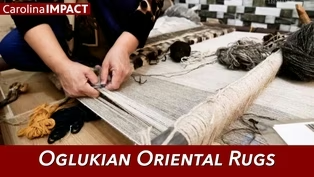
So the white lines you see, it's the cotton foundation, and what he's doing is he's taking wool, and he's weaving the pile back on, and he's matching the colors and the pattern.
So we'll never know that it was ever damaged.
- [Jason] And notice how Reza is using the backside of a needle to do his repair work, not the pointed end.
This is done to prevent potential further damage.
- [Bita] Sometimes when there's like a hole, just a hole in the rug.
- Yeah.
- He has to weave the foundation first.
- [Jason] Cleaning is another big part of the business.
- [Bita] First, we completely soak the rug in water to begin loosening any dirt and build up.
Next, we sprinkle our special rug shampoo all over the surface of the rug.
Then we use our hand washing machine, which gently scrubs the rug clean.
This machine is designed to reach every single corner and surface area without damaging the fibers of the rug.
After that, we use our vacuum extraction machine to suck out the remaining moisture deep inside the rug fibers.
Lastly, we will lay the rug out to dry in natural sunlight, which helps with both drying and deodorizing.
- [Jason] And just like the Oglukian family handed off the business to Reza, he in turn one day hopes to turn it over to his kids, Parsa and Bita.
- He always wanted me to learn, get to know more about rugs, because eventually, with his blessings, I mean, obviously he would want me to take over the business, - [Jason] It's an art form steeped in tradition, dating back hundreds of years, with the skills to meet centuries-old standards alive and well in Charlotte, thanks to a family business that keeps on evolving.
- I love learning about the tradition and the culture.
- Yeah.
- But now I think you've got a confession to share with folks.
- A little personal confession about this.
And it's going along the lines of that we're able to find our story ideas anywhere and everywhere, and the belief that anything or anyone could make a good story.
The Ghaffari family, they're my next door neighbors.
So they've had the carpet business for years and years, and I've seen 'em come in, Reza pull in with a truck all the time, and I'm like, this might make for a good idea.
And they're actually located not too far from us.
So I popped in one day and was looking around, I'm like, here we go.
This is a perfect story.
- We love your perfect stories.
You're always on the job and we appreciate it.
Well, from a tradition that's stayed the same to new advancements we're seeing with artificial intelligence, it's been all over the news lately.
Sometimes we may not even realize when we're using it.
Installation artist Dorne Pentes embraces that technology.
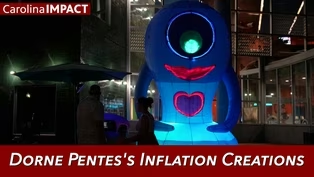
His larger than life, whimsical, inflatable creations, combine light, sound, and AI to create a unique, immersive art experience.
Producer Russ Hunsinger introduces us to Dorne and his friends, the Oracles.
(upbeat music) - Hi, Athena.
- Hello, my name is Athena.
I'm from the planet Claire.
Here to educate and enlighten you.
- Watching people's reactions, it brings me a great deal of joy.
(upbeat music) To see people realize, look at this amazing creature.
Look, I can talk with it, and I can have this conversation.
It'll read me a poem, it'll ask me a question.
It's just wonderful to see people drop their skepticism and drop their coolness.
They immediately open up, they smile, they laugh, it brings them a bit of joy.
And man, that's what I started out to do.
So it's great.
I started finding my voice around 2015.
Up until that time, I had been a filmmaker.
My father was a designer and a sign painter for decades.
He was an excellent sign painter.
And in 2015, he passed away.
And I inherited his set of markers.
And so I started drawing.
I really feel like there's a large part of my father in these markers.
During Covid, I started drawing what I would call sort of alien spirits, and they had these really big eyes, and these really pretty smiles.
But this is one of the original drawings of the Oracles.
And about a year or two after that I said, wow, this would be so good if I could make these into something huge.
(upbeat music) Got a sewing machine, got some patterns, and started cutting and putting fabric together, and eventually came up with the Oracles.
This is the best part.
(upbeat music) Oracles are creatures from another planet, the planet Claire.
They have come here to spread a message of love and joy and knowledge.
- [Athena] What are you curious about today?
- They will ask you what you're curious about.
They will ask you questions.
They will talk to you.
Apollo is approximately 9 feet tall, and about 8 feet in circumference.
Apollo is made of ripstop nylon tent fabric.
Apollo has inside a number of sound-activated LED lights.
So when Apollo speaks, you will see the lights.
The way Apollo works is you walk up to the kiosk and you touch on the tablet, and it gives you an instruction to say, "Hi, Apollo."
- [Apollo] Hello.
- Apollo's a pretty unique piece of artwork.
People it kind of blows their minds that they can talk to an imaginary creature.
They suspend their disbelief, and they happily engage with it.
- Hi Athena.
- [Athena] Hello, my name is Athena.
- They are powered by an artificial intelligence knowledge base that I have put into them.
They know all about loving kindness.
They know about creativity.
They know about spirituality.
- [Athena] What's something that made you smile today?
- My husband.
- [Athena] That's wonderful.
Love carries beautiful warmth.
- So we all have Alexa at home, but this was something very unique, yeah.
I think she definitely listens very carefully to what I have to say.
She doesn't do any mistake.
- [Athena] Hello, my name is Athena.
- Athena, who is pink.
Athena is 18 feet tall.
She is the goddess of wisdom from Greek mythology.
I'm Greek, and so I was inspired to name Apollo and Athena after, you know, the gods of my heritage.
They're lots of fun.
You can talk to them, you can ask them questions, they will chat with you.
They will be nice to you.
They can see their conversation on the screen.
- I think it's a lovely creation.
It's very unique, especially for kids, or someone who's trying to understand what AI manifests.
It's all around us.
It is a very nice way for someone who wants to connect with AI and understand what it entails.
- I think artificial intelligence is a tool, just like every other technological advancement.
And it is a tool that if is used properly can be very wonderful and enlightening.
- I think it's an amazing manifestation of what AI can do for you.
- Yeah.
- What is the tallest tree in the world?
- [Athena] The tallest tree in the world is a coast redwood named- - Really, I think the art, you know it is the inflatable, but the conversation is also the art.
Conversation is a key point of humanity.
I mean we all love having a conversation.
It brings us joy.
People can be standoffish about it, but I feel like when people come and interact and they realize what it is and the conversations it can have, and kind of the softness it can have that has been designed to have really opens people up.
- The artificial intelligence, you know, learns as you talk with it, so it becomes more human.
It has opinions, it gets humorous.
The character really comes alive, and I think that's what makes people really happy.
When I see people enjoying Apollo, it just makes me smile a lot.
It makes me really happy.
It's nice to be able to create something that brings light to someone's day.
- Thank you, Russ.
Dorne's inflation creations have visited over 20 festivals in the southeast.
Most recently, you may have seen them as part of this year's Charlotte Shout.
Lastly, tonight, from futuristic AI creations to vintage cars.
They're almost a century old, but Model A Fords are still turning heads all over the Carolinas.
Members of the Queen City Model A club keep the vintage cars running, traveling together to shows, schools, and weekend trips.
But members are not getting any younger, and they're working with the next generation to take over the wheel.
"Carolina Impact's" Chris Clark has the story.
(upbeat music) - [Chris] At Jim Townsend shop's in Rock Hill, these cars aren't tucked away under covers.
They're out in the open, up on lifts, out on the road and surrounded by people who still light up around them.
- Model As are meant to drive and to share with the public.
I like to see 'em on the road, you know, not in a museum.
- And that's the hook.
These old Fords aren't just something to look at, there's something to experience.
What's it like when you take this thing out on the road?
- It's awesome.
You know, people would just wave, and smile and take pictures.
- [Chris] And part of the charm is that these cars still carry a little personality, too.
- This is a rumble seat, 'cause you're sitting above the rear axle, and it's also affectionately referred to as the mother-in-law seat, because the rear window does not fold down.
So she's kind of sitting in her own world back here.
- [Chris] And when a line of Model As heads down the road together, they rarely go unnoticed.
- I look in my rear view mirror, and the cars are backed up as far as you can see.
Well, the problem was we had 25 cars, all different models of Model As tooting along 47, 49 miles an hour.
And the people passing us in the left lane, we're all driving slow, had their phones out, videoing all of us, and we're waving at 'em.
- [Chris] For the people in this club, the cars are only part of the appeal.
The other part is who they bring together.
- It's like coming home when I come into the shop.
Guys come in and we work on the car together, and it's formed a comradery among the members.
- [Chris] And what starts in the shop doesn't stay there.
It spills onto back roads, beach trips, and weekend getaways.
- Touring with these with these folks is just a really good time.
Tight knit community.
They become your best friends.
- [Chris] For Holden Long, these cars are tied to family.
- My grandpa had one, and it was just something fun for me to do a new hobby, and then also getting to spend time with him.
So, to me it was like a win-win.
- [Chris] Connor Jackson found that same pull.
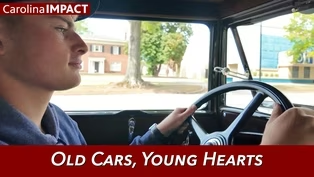
You're 17, you're in a car that is what, a hundred years old almost?
- 96.
- 96.
What made you get interested in something this old?
- So my grandpa's had Model As for all my life, and so, you know, being around his cars, you know?
When I found out Mr.
Foster was giving away a Model A, I was just absolutely ecstatic.
- [Chris] And once one became his, he was all in.
- It's awesome just being able to, you know, oh, that's a new rattle.
Let me, you know, take this part and see if I can figure it out.
And then just going, you know, straight in with, you know, just a few simple hand tools.
You don't need anything special or even power.
- [Chris] But getting one on the road is one thing.
Learning how to handle it is another.
- It's definitely not power steering.
It takes two full arms to drive a Model A. It's a full-time job driving it, you need to be alert.
- We can't tell the size of his forearms, 'cause you got on long sleeves.
But power steering is one thing the car doesn't have.
What's something else that kind of took you by surprise when you're driving this thing around?
- Just getting used to double clutching.
It's definitely something that takes, you know, people a little bit to learn - [Chris] Out on the road, that old car sets 'em apart from just about every other 17 year old out there.
- Every time I see, you know, a little kid wave, I make sure to blow the horn.
(horn blaring) - What's your girlfriend think of this thing?
- She loves it.
It's definitely something different, something unique, - [Chris] But underneath all the fun, the club knows it needs a younger generation to carry this forward.
- We have a club of 80 members, and our average age in the club is 76.
What we're concentrating on is getting youth, 35 and younger, into this hobby.
- [Chris] So this isn't just about preserving cars, it's about preserving the know-how that keeps them alive.
- This is, you know, a mission that we have as a club is to assure that taking care of these cars and being caretakers of the cars can continue.
- That's why they're trying to build a youth center of sorts, a training space, a place where younger people can come in and learn what older members already know.
- I'm very hopeful that they can put together this project, I think is the key to move forward.
A modern garage doesn't know how to work on them.
There's no computer that you can plug into to tell you what you do next.
- [Chris] In some cases, older members have done more than just invite younger people into the hobby.
They've given them the cars themselves.
One member wanting to spare his family the burden later on decided that some of his cars should go to younger people who would keep them going.
- We had two of those four winners of the Model A Youth Restoration Award.
They were given cars by a member.
We had a member that had two cars and he called me, and he said, "I want to give these cars, but I want to give them to youth."
And you know, we found two youth that were, had an interest in it, and we put these cars in their hands.
- [Chris] For the club, the real hope isn't simply handing over a car, it's watching a young person take ownership of it.
And when Connor met Greg Foster for the first time, he got to see exactly that.
- My first impression is that he has obviously been doing a lot of work on that car, because it didn't look anything like that when he got it.
That car looks great.
I probably wouldn't have it given away.
(man laughing) - How you doing?
- Pleasure to meet you.
Car looks wonderful.
- Thank you.
- Better than what I have, that's for sure.
- For Holden, the appeal is easy to understand.
- No one really has, you know, a Model A or anything like that.
They're like, how old is it?
And I tell 'em.
They're like, really?
- What would you say to someone that's kind of on the fence about getting into this Model A club?
- Do it.
It's one of the best things that's ever happened to me.
You know, there's so many great people involved with the club - [Chris] And that's where this story really comes alive.
Not just in the garage, not just on the road, but in the passing of the keys.
- We've got four youth that have have gotten involved, and we're trying to support them anyway we can to keep 'em interested - [Chris] At a shop, full of old steel and knowhow, the future of this hobby may come down to something pretty simple.
A younger set of hands, a set of keys, and somebody willing to teach.
For "Carolina Impact," I'm Chris Clark.
- Thank you, Chris.
For this club, preserving the past isn't just about maintaining old cars, it's about passing down the passion to the next generation before it's too late.
What great story ideas do you know about?
We would love to learn about them.
Please email details to stories@wtvi.org.
Well, before we leave you tonight, I'd like to thank the group from Elysium School of Innovation in Huntersville.
Now, these extraordinary students are so amazing that I promised them that we were going to do a story about them and all the businesses that they run, and all the amazing things that they do.
So stay tuned to "Carolina Impact," because soon you're gonna see these kids on our air.
Well, thanks so much for joining us.
We always appreciate your time, and I look forward to seeing you back here again next time on "Carolina Impact."
Good night, my friends.
(upbeat music) - [Announcer] A production of PBS Charlotte.
Dorne Pentes's Inflation Creations | Carolina Impact
Video has Closed Captions
Clip: S13 Ep1325 | 5m 49s | Artist Dorne Pentes introduces us to his creations, Apollo and Athena-The Oracles (5m 49s)
Oglukian Oriental Rugs | Carolina Impact
Video has Closed Captions
Clip: S13 Ep1325 | 7m 20s | The centuries old traditions of Persian Rugs at Oglukian Oriental Rugs in Charlotte. (7m 20s)
Oil Shock, Wallet Shock | Carolina Impact
Video has Closed Captions
Clip: S13 Ep1325 | 4m 20s | Pain at the pump - how rising gas prices are affecting those in our region. (4m 20s)
Old Cars, Young Hearts | Carolina Impact
Video has Closed Captions
Clip: S13 Ep1325 | 6m 41s | A Model A club fights to keep history alive by passing cars, skills, and joy to youth now. (6m 41s)

May 5, 2026 Preview | Carolina Impact
Preview: S13 Ep1325 | 30s | Oil Shock, Wallet Shock; Oglukian Oriental Rugs; Dorne Pentes's Creations; & Old Cars, Young Hearts (30s)
Providing Support for PBS.org
Learn Moreabout PBS online sponsorship New Episode
- News and Public Affairs

Top journalists deliver compelling original analysis of the hour's headlines.

- News and Public Affairs

FRONTLINE is investigative journalism that questions, explains and changes our world.
 New Episode
 New Episode
 New Episode
 New Episode
 New Episode
 New Episode
 New Episode
 New Episode

 New Episode
 New Episode
Support for PBS provided by:
Carolina Impact is a local public television program presented by PBS Charlotte