
May 5, 2026 - Full Show
5/5/2026 | 26m 47sVideo has Closed Captions
Watch the May 5, 2026, full episode of "Chicago Tonight."
An effort to regulate social media for children. A growing movement not to pay federal taxes. And a women’s sports bar is coming to Wrigleyville.
Problems playing video? | Closed Captioning Feedback
Problems playing video? | Closed Captioning Feedback
Chicago Tonight is a local public television program presented by WTTW
WTTW video streaming support provided by members and sponsors.
May 5, 2026 - Full Show
5/5/2026 | 26m 47sVideo has Closed Captions
An effort to regulate social media for children. A growing movement not to pay federal taxes. And a women’s sports bar is coming to Wrigleyville.
Problems playing video? | Closed Captioning Feedback
How to Watch Chicago Tonight
Chicago Tonight is available to stream on pbs.org and the free PBS App, available on iPhone, Apple TV, Android TV, Android smartphones, Amazon Fire TV, Amazon Fire Tablet, Roku, Samsung Smart TV, LG TV, and Vizio.

WTTW News Explains
In this Emmy Award-winning series, WTTW News tackles your questions — big and small — about life in the Chicago area. Our video animations guide you through local government, city history, public utilities and everything in between.Providing Support for PBS.org
Learn Moreabout PBS online sponsorship>> Hello and thanks for joining us in Chicago tonight.
I'm joined on this brand is Freeman is on assignment.
Here's what we're looking at.
>> Perverse incentive that social media companies seem to have to keep kids scrolling.
>> How annoying lawmakers are working to change how youth access social media.
Refusing to pay federal income taxes is growing in popularity as a form of protest.
But what are the risks?
>> Where many of those young people and a first for Wrigleyville, a bar dedicated to women's sports.
We talked with the owner about her game plan.
>> Shootings Chicago so far this year are up over last year's historic lows through the first 4 months of 2026, there has been 130 homicides up 8% compared to this time last year.
There's also been 421 shootings.
A 6% increase over 2025. but data from the Chicago Police Department also shows a 33% decline in armed robberies in a 50% drop in carjackings year to date and violent crime on the CTA is also down 15%.
For more on the latest city-wide crime stats, you can visit our website.
Hundreds and thousands of people brought to the U.S.
as children are now at the center of an immigration fight.
Today advocates held a news conference alongside Senator Durbin warning the Deferred Action for Childhood Arrivals program.
Better known as DACA could be in jeopardy.
It comes as hundreds of recipients report delays and DACA renewals.
Other people have face deportation after recent decision by the Board of Immigration Appeals say DACA status alone is not enough to stop someone from being deported created under the Obama administration.
Daca has protected more than 800,000 people and provided work with or station.
Jarvis Durbin says recipients undergo rigorous background checks and many are building careers and families in the U.S.
pushing back on claims that portray the so-called Dreamers as a public safety threat.
>> We've opened 101 cases in our office 101 cases of DACA recipients.
We're struggling now to be renewed.
>> The Department of Homeland Security recently disclosed last year the ICE deported dozens of DACA beneficiaries and detained over 300.
And then last week, the Department of Justice's Board of Immigration Appeals issued a decision that could lay the groundwork for ice to be able to deport more DACA recipients.
>> The future of DACA remains in the hands of the court as legal challenges continue to move forward and tickets for the highly anticipated opening of the Obama presidential center are going on sale tomorrow morning.
But be ready.
They're expected to go fast.
It comes after nearly 5 years of construction on the project in Jackson Park.
The center will officially open to the public on June 19th Juneteenth with planned events scheduled throughout the holiday weekend.
General admission tickets for Illinois residents are $26 for those 12 and up and $15 for children under 12.
The museum will also be free for Illinois residents every Tuesday.
The center has exhibits across 4 floors and includes a full-size replica of President Obama's Oval Office.
Tickets are required to visit the museum, but the surrounding area, including gardens art installations in a free and a playground is free and open to the public tickets go on sale tomorrow at 09:00AM.
Up next, calls to regulate how children use social media.
That's right.
After this.
>> Chicago tonight is made possible in part by the Alexandra and John Nichols family.
The Pope Brothers Foundation.
And the support of these donors.
>> For the decades we've been using social media, there's been a debate over how you should be able to access it.
On one hand addictive feeds, keep kids scrolling endlessly and can harm their mental health.
On the other hand, social media can give young people spaces for expression that aren't available in school or at home.
Whether you see it as a force for good batter somewhere in between calls to regulate social platforms have spread across the nation.
That includes here in Illinois.
Joining us here to talk about all that is Jessica Schneider, professor of medical social sciences at Northwestern University, a young director of communications and public policy at the UC at the ACLU of Illinois and State Representative Jennifer gone guard.
Sure what's whose district includes parts of Glenview Wilmette in Skokie.
Thank you all for joining us.
This is an important topic cause.
I feel like we live in the era of social media now.
Can you believe Now just a guy want to start with the what are some ways a social media can impact youth mental health positively and negatively.
You would say.
And I really appreciate the framing of the question as both positively and negatively because it is a really complex relationship screen time alone.
Time spent on social media doesn't correlate very cleanly with youth mental health outcomes.
What does correlate with youth mental health outcomes or how young people actually use the platform.
Certainly the architecture behind the platform.
Infinite Scroll.
These harmful algorithmic feeds that can really undermine youth mental health, particularly for young people who are already at risk at the same time, social media platforms are often the first and sometimes only place that young people actually seek out mental health support and connection.
I'm a child.
I love the clinical psychologist.
I study interventions that can be deployed through social media platforms to meet you swear they're actually for seeking help.
potential the population health potential of these platforms, if leverage properly is really tremendous for promoting youth mental health.
But as they're currently designed, that really isn't being accomplished because these companies are allowed to create platforms that are, you know.
incentivizing kids to stay on them at all costs.
really saying there's pros and cons here.
There's absolutely pros and cons and I think they can be leveraged for good if supported in doing that.
But currently they're not.
And representative gone Gershwin's ou word.
Are you so would you argue that social media platforms need to be regulated?
effective, introduce and pass legislation out of the House of does exactly that.
>> we believe that by targeting the most harmful features, I'm the social media platforms that we're striking the right balance between protecting kids, mental health while also allowing some of the good things the professor just outlined.
>> Representative, why would you say that think regulating social media has by partisan interest?
>> I think there's been a watershed of understanding by parents about the downsides of social media addiction and the impact that this has on our kids, mental health.
And so this is really not a partisan issue.
This is a bipartisan concern, I think shared by just about every parent frankly by kids themselves.
I'm a mom of 3 boys.
And I hear from my kids concerns about not being able to put that phone down feeling like they're glued to their screens.
honestly, what this bill is attempting to do is to target those design features that we find most harmful to kids.
>> then what are your thoughts?
You argue that preserving youth access to social media is important.
Why is that?
You know, I think part of part of the reason that we're concerned is because that access is really an important First Amendment right to get access to information.
We think so much about.
>> The First Amendment being about what I can say, right?
But it's also about the information I can get.
One of the things you hear in this discussion is concerned about these platforms.
But but I think whether or not it's the right solution to have government decide what information is available and to whom is the place where we just sort of depart in looking at a solution because, in fact, is the professor points out.
There are people who are finding and young people who are finding solutions to the challenges that they face through these online platforms.
And so how do we how do we balance those things and make sure that we are limiting expression or access to information while at the same time addressing the worst and most harmful and features that I think everybody widely agrees.
It was really interesting because we all have kids or your grandfather, yourself.
Jessica, I want to talk a little bit about what really is doing.
They recently bended youth under 16.
>> From using social media are outright bans of youth on social media, effective.
>> So this is I think a very common impulse right to just say, OK, no more adolescents on social media because of these harms that are being identified.
And unfortunately, I don't think these are helpful solutions, even though they're being very widely implemented.
And I actually really appreciate that.
This bill in Illinois is not doing a blanket ban but instead targeting the design features that actually undermine youth mental health and in Australia, not only is the band ineffective because you are really tech savvy.
They will find ways around this ban in this area would say absolutely because they're motivated to do so.
But bill, simply find themselves in to less regulated portions of of the Internet maybe even be less safe that way.
But we're really letting platforms off the hook.
If we focus on Vance, essentially we're saying so don't go after the the social like that.
The company's precisely create guardrails at that.
Have good implementation power that have good stickiness and and force these companies to create platforms that can be leveraged for good by banning young people from these platforms altogether.
It essentially gives them a free pass not to change.
What's wrong with the platforms.
However, those regulations have to have teeth.
And I think the implementation of regulations on these platforms is going to be the real challenge to figure out how to actually make them stick.
And representative, you talked a little bit about it, but you are the chief sponsor on that bill called the Children's Social Media Safety Act in Illinois.
>> Can you break it down for me?
A little bit more what its regulating and what it's doing.
>> Yeah, thank you.
So this bill primarily does 3 things and it does not regulate content.
It targets knee most harmful features that we see causing problems on mine.
So it stops addictive.
Algorithmic feeds.
I'm it.
I disallow zahn and prevent social media companies from essentially recognizing you're only information to curing content that keeps you glued to your screen.
It also stops location, sharing as well as those scam financial transactions with strangers online as well as and in the middle of the night notifications.
So we think that by targeting they harmful design, features starches algorithmic feeds that are designed that are designed to be addictive.
They are addictive.
I design I'm we can I address they most harmful features social media platforms without restricting content.
>> And what are your thoughts that?
Because we know once you you can click on something right on social media and then the algorithm starts just spewing that contact in.
This is where I think we're we're still looking for a balance.
involves, you know, a solution that maybe isn't a governmental solution one of the things like the Trevor Project and other people who work with LGBTQ youth.
Tell us.
>> Is that sometimes that algorithmic feed once a young person start searching, they may find information in a non supportive home.
That may be very important for them in terms of reaching out a safe and healthy outcome for their life.
And so I think it's, you know, again, I think this discussion just says we need to continue to find a balance.
But I think to the point that that the professor made earlier, you know, we shouldn't forget that the people the, know, essentially the billionaires who control these algorithms were all placed up front at the inauguration last year.
They are getting off the hook off the hook.
Scot free without being responsible for doing any of this.
And frankly, you know, I think, you know, broader education on the harms of this broader education.
I think on some of the the more corrosive factors that parents and others could look out for and putting up as consumers pressure on those folks to make changes, I think is a way go yet.
And Jessica, we'll have a couple seconds.
But again, we mentioned you also have a young child.
>> I you know, what do you hope social media looks like for youth 10, 50 years, 10, 15 years from now.
I really hope that the potential of these algorithms to connect people with resources that are well time for their needs and the potential of these platforms that reach unprecedented numbers of young people to actually deliver supports in real time based on what they're searching for that are evidence-based that are effective.
That is the social media universe that I hope exists.
Not just one that takes advantage of young people's attention, but that actually leverage is tremendous platform for the public health opportunity that it is think you're going to leave it at that.
But thank you for all of your input.
Up next, a growing protest against the federal government withholding federal tax payments.
>> Some Chicagoans are choosing a new way to protest the Trump administration instead of taking to the streets.
Some people are letting their wallets to the talking by refusing to pay federal taxes.
The action is called tax resistance and has grown in popularity following the country's handling of the war in Gaza and the conflict in Iran.
But of course, it's not without its risks.
Here to break it all down for us Jacoby fund manager with the New England War Tax resistance.
And gentlemen talking associated director of the tax program for Fester of Instruction in law of Northwestern's law school.
Thank you both for joining us.
I did.
I was not knowledgeable about this type of I have to tell you so can break it down for us and tell us a bit about what is tax resistance and how do people practicing?
>> Yes, war tax resistance are.
We're a group of people that we don't disagree with taxing, OK?
We actually want to pay our taxes, but we want them to go back into the communities that we live in.
We want to see these this money benefit our neighbors and we're against war.
So 53%, the war tax, the war Resisters puts out a pie chart every year of the federal budget.
And 53% of it goes to military spending.
So more tax researchers say this isn't right.
We don't want this all this money going toward.
There's many different ways to do it.
Some people live below the taxable income.
They live simply in order to not pay taxes at to creating a plan.
Yeah, yup, absolutely.
Some people they what they'll do is they'll file their taxes and they'll pay a portion of it.
Sometimes they'll pay.
You know, 47% Bogo with the the pie chart for that year and go with that amount.
Other people will file and they won't pay anything at all.
they often include a letter to the IRS.
If you don't pay the full amount to the IRS in any way in any any deduction from from what you owe.
It's handled by a not a machine.
And so it's a way to get noticed.
And to just speak your mind.
Yeah, I want to bring Jenna being I want to bring you and if you don't pay your taxes, we know you can get a lot of big trouble.
>> including going writers and what's at stake here legally.
Yes, so I think you know, we just heard that there's a number of different forms of tax resistance.
>> And things like reducing your incomes of you pay the federal government less taxes is perfectly legal.
There's no requirement that you earn a certain amount of money, but but there are rules about once you do earn a certain level of income, you have to pay income taxes.
And if you don't do that, there are both civil penalties and the potential for criminal criminal proceedings.
If you're found to be guilty of local tax evasion.
so things like paying a portion of your taxes might reduce the penalties.
But you're still not kind off the hook.
So there's a number of different things I've heard about.
We you things like penalties for failure to file your tax return, but you can file a tax return and still not pay your taxes and then avoiding the failure to file penalties but still potentially subject to the failure to pay penalties.
And of course, the IRS will also come after you potentially for interest on unpaid taxes and Tony Abbott.
But of course, you can understand why people would want to be part of this saw movement.
He would say.
>> Well, yes, I mean, it's there's a long history of of certain tax resistance as a form of civil disobedience protest in in the United States.
You know, this was actually it goes way back really to even before the founding of the United States right to the colonial era.
There were talk those tax resistance to the British government.
There abolitionists who use tax resistance to protest slavery.
Famously, I think, you know, the author Henry David Thoreau refused to pay taxes for some years and a protest against slavery and also the Mexican-American War back in the 1800.
So this is something that is not unusual.
And and taxes are such a key part of citizenship, if you will, right.
The wall of the government taxes are important to raising revenue.
And so it is a powerful form of protest.
But again, and there are serious wreck something because not paying taxes is a legal.
And then I want to bring you and we just mentioned about the history of this.
Now you work for the New England War tax resistance was started.
>> The organization started in 1968. following the Vietnam War.
Tell us a bit about the organization's history and why you think it's still relevant to this day.
>> Yeah.
I work for a board of directors that is concerned.
Consists of people that have been more Texas sisters from between.
25 and 40 These people are active in their communities trying to make change and support local or organizations, the organizations that they would like their taxes to be supporting and we're at a moment where they're broken hard.
They're broken hearted that like in the 25 to 40 years of resistance that they've been doing.
They haven't seen improvement and U.S.
policy abroad.
And so in this moment, they're great fall for like the growth of the war tax or text your sister movement.
They're grateful for more people coming into this.
But there also like really sad to be at this point where we we need growth and you know, why do you think this particular form of civil disobedience is important?
>> Yeah, I mean, there I mean, >> there are so many ways to resist.
Resist, you know, this administration or the policies that immigration raids, the warning the war in Palestine.
But this is something that is like deeply personal.
It is a a commitment between you and and the the IRS, the federal government and so this is something that like we don't exactly know how big this movement is because it is personal are seeing an increase users are just yes, we're seeing reaching out.
We're seeing more people are asking for help protecting financial assets in case that they are levied by the U.S.
government for the war tax resistance.
We're seeing people jump in and say, hey, I want to learn more and I want to understand the risks because I'm at a point where I am ready take risks to make change.
And Jenna, to be we only have a couple seconds.
What are your final thoughts?
Yeah, just you know, at one point is that not everyone can be a can resist paying taxes.
People who are paid a salary from an employer.
There's foxes are emitted by their employer.
And so tax resistance isn't an option for everyone.
>> even for people who do choose to go that route, right, there are serious potential consequences.
And and so, you know, it is important to think about maybe other ways of expressing dissatisfaction with the government and the way that the government is spending taxes, rain.
And of course, our most important voice, I citizens is is the ability to vote.
So we're going to have to leave it at that very volatile.
But thank you.
Thank you for both of your inputs.
>> Absolutely.
Thanks for having Up next, a new bar dedicated fans of women's sports.
>> WNBA season tips off this Friday and soon they'll be a new place in Chicago to watch those games and other women's sports.
We spoke with the owner of a new bar opening in Wrigleyville and got a sneak peek at her game plan.
>> Hi, my name is close to Florida's welcome to Level Sporting Club.
It's under construction now.
But soon the site Wrigleyville will be all about women's sports all the time.
The norm is now walking into a sports bar and it's a man's game.
And you have to ask for the women's game.
But at this bar, women's sport is taking Centre court.
I was going through a lot of different names, but Fermi level stood out the most because I'm here to level the playing field for women.
Sports steps away from Wrigley Field.
Notice is tapping into a fanbase, she says, is already here.
Bradley Beal is the entertainment District of Chicago.
And I wanted to take my seat where we belong.
I didn't want to be in the outskirts.
People don't realize this, but that majority of the fans that go to Wrigley are women.
Florida is is an athlete herself.
She played division one basketball at Northwestern University.
I'll say it.
blue in the face of my whole life and my whole career is indebted to the sport of basketball.
And you know what we're experiencing right now.
Not just hear what which I'm trying to contribute to, but >> we're experiencing a cultural shift and that cultural shift is towards women's sports.
>> So tell me a little bit about the vision of this first level.
the first level up here is going to be where all the upbeat sports bar music Food, TV's, you know, it's it's a whole should being up and down stairs, a completely different game plan.
So this is going to be my lower-level key club.
I'm gonna have a piano player down here.
Singalong piano by where the panel players playing among them.
Beyonce.
It'll be a high energy by boat.
On a piano, it'll be.
Your lounge, your candle, that darker type of IED.
So if you're trying do like a date night and come down here, if you want all the fun and excitement, you go upstairs She's stepping into one of the fastest growing audience is in sports, backed by a strong roster of women.
Investors.
My team that I that was intentional.
Jennifer King, who coached the Chicago Bears was running back coach and the Washington commanders Ashley Bracy was the head coach of USC women's basketball, Evan MIT basketball player at the University of Chicago soccer player.
My Culinary partners, a two-time big arm on chef who played soccer for the University of Texas.
What I'm doing now is for the community's the LGBT community, the women sports community.
That's a culture that I'm trying to build up.
Now, she says basketball has opened doors for her and now she wants to give that same opportunity to the next generation.
>> Hopefully in doing this, you know, young girls that are gonna pay women's sports can sustain a business or hey, I can make a career out of women's sports to be able to get back to easing.
>> Very excited.
Very exciting for that neighborhood.
Now, level Sporting Club is set to open at the end of the month to learn more.
Visit our website.
And that's our show this Tuesday night.
Join us tomorrow night at 5.30, in 10.
Now there's a new cooking show Indian as apple pie.
It's showcasing delicious recipes in rich culture.
Now from all of us here, Chicago tonight.
I'm John Madden members.
Thank you for watching.
Stay healthy and safe.
Good night.
>> caption is made possible why Robert, a cliff and Clifford question Ka go personal injury and wrongful death.
That serves the needs
For Some, Refusing to Pay Federal Taxes Is a Form of Protest
Video has Closed Captions
Some Chicagoans are choosing a new way to protest the Trump administration. (7m 21s)
Some Lawmakers Seek to Regulate Social Media for Kids
Video has Closed Captions
There's a debate over how or whether youth should be able to access social media. (9m 32s)
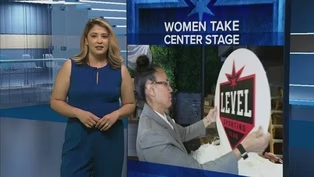
Women's Sports Bar Coming to Wrigleyville
Video has Closed Captions
At Level Sporting Club, women's sports are the main event. (3m 4s)
Providing Support for PBS.org
Learn Moreabout PBS online sponsorship
- News and Public Affairs

Top journalists deliver compelling original analysis of the hour's headlines.

- News and Public Affairs

Today's top journalists discuss Washington's current political events and public affairs.










 New Season
Support for PBS provided by:
Chicago Tonight is a local public television program presented by WTTW
WTTW video streaming support provided by members and sponsors.